


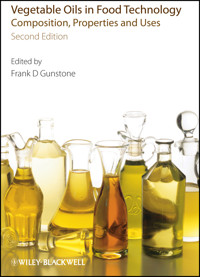
Vegetable Oils in Food Technology E-Book
170,99 €
Mehr erfahren.
- Herausgeber: John Wiley & Sons
- Kategorie: Fachliteratur
- Sprache: Englisch
Our dietary intake comprises three macronutrients (protein, carbohydrate and lipid) and a large but unknown number of micronutrients (vitamins, minerals, antioxidants, etc). Good health rests, in part, on an adequate and balanced supply of these components. This book is concerned with the major sources of lipids and the micronutrients that they contain.
Now in an extensively updated second edition, the volume provides a source of concentrated and accessible information on the composition, properties and food applications of the vegetable oils commonly used in the food industry. Chapters are devoted to each type of oil, and an introductory chapter by the Editor provides an overview of the current production and trade picture globally. The book includes coverage of the modifications of these oils that are commercially available by means of partial hydrogenation, fractionation and seed breeding. The major food applications are linked, wherever possible, to the composition and properties of the oils.
This new edition widens the range of oils covered, addresses issues related to trans fats reduction, and new composition data is included throughout. The book is an essential resource for food scientists and technologists who use vegetable oils in food processing; chemists and technologists working in oils and fats processing; and analytical chemists and quality assurance personnel.
Praise for the first edition:
"This excellent book consists of 337 pages in 11 chapters, written by 13 experts from six countries...the important vegetable oils are dealt with in great detail. With obesity on all out lips...this book also rightly defends itself and its content - namely, that all vegetable oils, when used correctly and of course in moderation, are indeed necessary to all of us."
–Food & Beverage Reporter
"Overall, the book covers all of the major oils which the potential reader is likely to approach it for... covers a wide range of topics from production, through composition to nutritional aspects... The volume is well indexed, particularly for the individual subject oils, and it is easy to find specific topics within its chapters."
–Food Science and Technology
"This latest book edited by Professor Gunstone belongs to the kind of books where the reader rapidly knows it will bring him a wealth of updated information concentrated in one book. The goal to 'serve as a rich source of data' on the thirteen major oils and their important minor components has been attained. There is a need for books of such quality."
–European Journal of Lipid Science and Technology
Sie lesen das E-Book in den Legimi-Apps auf:
Seitenzahl: 782
Veröffentlichungsjahr: 2011
Ähnliche




















Contents
Preface to the First Edition
Preface to the Second Edition
Contributors
List of Abbreviations
1 Production and Trade of Vegetable OilsFrank D. Gunstone
1.1 Extraction, refining and processing
1.2 Vegetable oils: Production, consumption and trade
1.2.1 Nine vegetable oils
1.2.2 Palm oil
1.2.3 Soybean oil
1.2.4 Rapeseed/canola oil
1.2.5 Sunflowerseed oil
1.2.6 Groundnut (peanut) oil
1.2.7 Cottonseed oil
1.2.8 Coconut oil
1.2.9 Palmkernel oil
1.2.10 Olive oil
1.2.11 Corn oil
1.2.12 Sesame oil
1.2.13 Linseed oil
1.3 Some topical issues
1.3.1 Imports into China and India
1.3.2 Trade in oilseeds and in vegetable oils
1.3.3 Food and non-food use of vegetable oils
1.3.4 Prices
1.3.5 The food–fuel debate
1.3.6 Predictions for future supply and demand
1.3.7 Sustainability
1.3.8 Genetic modification
References
2 Palm OilSiew Wai Lin
2.1 Introduction
2.2 Composition and properties of palm oil and fractions
2.2.1 Palm oil
2.2.2 Palm olein
2.2.3 Palm stearin
2.3 Physical characteristics of palm oil products
2.3.1 Palm oil
2.3.2 Palm olein
2.3.3 Palm stearin
2.4 Minor components of palm oil products
2.4.1 Carotenes
2.4.2 Tocopherols and tocotrienols (tocols)
2.4.3 Sterols, squalene and other hydrocarbons
2.5 Food applications of palm oil products
2.5.1 Cooking/frying oil
2.5.2 Margarines
2.5.3 Shortenings
2.5.4 Vanaspati
2.5.5 Cocoa butter equivalents (CBE)
2.5.6 Other uses
2.6 Nutritional aspects of palm oil
2.7 Sustainable palm oil
2.8 Conclusions
References
3 Soybean OilTong Wang
3.1 Introduction
3.2 Composition of soybean and soybean oil
3.2.1 Seed composition
3.2.2 Oil composition
3.2.3 Fatty acid composition
3.2.4 Minor components
3.3 Recovery and refining of soybean oil
3.3.1 Oil extraction
3.3.2 Oil refining
3.3.3 Modified non-alkaline refining
3.3.4 Co-products from oil refining
3.3.5 Fatty acid esters of glycidol and 3-monochloro-1,2-propanediol as processing contaminants
3.4 Oil composition modification by processing and biotechnology
3.4.1 Hydrogenation
3.4.2 Interesterification
3.4.3 Crystallization and fractionation
3.4.4 Traditional plant breeding and genetic modification
3.4.5 Oxidative and sensory properties of low-linolenic acid soybean oil to replace trans frying oil
3.5 Physical properties of soybean oil
3.5.1 Polymorphism
3.5.2 Density
3.5.3 Viscosity
3.5.4 Refractive index
3.5.5 Specific heat
3.5.6 Melting point
3.5.7 Heat of combustion
3.5.8 Smoke, flash, and fire points
3.5.9 Solubility
3.5.10 Plasticity and spreadability
3.5.11 Electrical resistivity
3.6 Oxidation evaluation of soybean oil
3.7 Nutritional properties of soybean oil
3.8 Food uses of soybean oil
3.8.1 Cooking and salad oils
3.8.2 Margarine and shortening
3.8.3 Mayonnaise and salad dressing
References
4 Canola/Rapeseed OilRoman Przybylski
4.1 Introduction
4.2 Composition
4.2.1 Nature of edible oils and fats
4.2.2 Fatty acid composition of canola oil
4.2.3 Minor fatty acids
4.2.4 Triacylglycerols
4.2.5 Polar lipids
4.2.6 Tocopherols
4.2.7 Sterols
4.2.8 Pigments
4.2.9 Trace elements
4.2.10 Commercial crude oil, refined, and deodorized oil
4.2.11 Oxidative stability
4.3 Physical and chemical properties
4.3.1 Relative density
4.3.2 Viscosity
4.3.3 Smoke and flash point
4.3.4 Cold test
4.3.5 Crismer value
4.3.6 Saponification number
4.3.7 Iodine value
4.3.8 Melting characteristics, polymorphism, and crystal properties
4.4 Major food uses
4.4.1 Standard canola/rapeseed oil
4.4.2 High-erucic acid rapeseed (HEAR) oil
4.5 Conclusion and outlook
References
5 Sunflower OilMaria A. Grompone
5.1 Introduction
5.2 Sunflower oil from different types of seed
5.2.1 Regular sunflower seeds
5.2.2 Commercial sunflower oil types
5.2.3 Composition of commercially available sunflower oil types
5.2.4 Other sunflower seed types to be commercialised
5.3 Physical and chemical properties
5.3.1 Relative density
5.3.2 Viscosity
5.3.3 Refractive index
5.3.4 Smoke point, flash point and fire point
5.3.5 Other physical properties
5.4 Melting properties and thermal behaviour
5.4.1 Melting properties of regular sunflower oil
5.4.2 Thermal behaviour of different sunflower oil types
5.5 Extraction and processing of sunflower oil
5.5.1 Preparation of sunflower seeds for extraction
5.5.2 Sunflower oil extraction
5.5.3 Processing of crude sunflower oil
5.6 Modified properties of sunflower oil
5.6.1 Hydrogenation of regular sunflower oil
5.6.2 Interesterification of sunflower oil
5.7 Oxidative stability of commercial sunflower oils
5.7.1 Inherent stability of different commercial sunflower oil types
5.7.2 Shelf-life of sunflower oil
5.7.3 Accelerated ageing of sunflower oil
5.7.4 Stabilisation of sunflower oil by added antioxidants
5.8 Food uses of different sunflower oil types
5.8.1 Use of regular sunflower oil as salad oil and cooking oil
5.8.2 Margarine and shortening
5.9 Frying use of commercial sunflower oil types
5.9.1 Frying use of regular sunflower oil
5.9.2 Frying use of high-oleic sunflower oil
5.9.3 Frying use of mid-oleic sunflower oil
5.9.4 Frying use of sunflower oils with a high content of saturated fatty acids
Acknowledgement
References
6 The Lauric (Coconut and Palm Kernel) OilsIbrahim Nuzul Amri
6.1 Introduction
6.2 Coconut oil
6.2.1 Coconut palm
6.2.2 Coconut oil
6.2.3 Composition
6.2.4 Properties
6.2.5 Trade specifications
6.3 Palm kernel oil
6.3.1 Palm kernel oil
6.3.2 Composition
6.3.3 Properties
6.3.4 Trade specifications
6.4 Processing
6.4.1 Fractionation
6.4.2 Hydrogenation
6.4.3 Interesterification
6.5 Food uses
6.5.1 Frying
6.5.2 Margarine
6.5.3 Medium-chain triacylglycerols
6.5.4 Speciality fats: Cocoa butter substitutes
6.5.5 Filling creams
6.5.6 Non-dairy creamer
6.5.7 Non-dairy whipping cream
6.5.8 Non-dairy cheese
6.5.9 Filled milk
6.5.10 Ice cream
6.5.11 Toffees and caramels
6.6 Health aspects
References
7 Cottonseed OilMichael K. Dowd
7.1 Introduction
7.2 History
7.3 Seed composition
7.4 Oil composition
7.4.1 Triacylglycerol fatty acids
7.4.2 Other oil components
7.4.3 Gossypol
7.5 Chemical and physical properties of cottonseed oil
7.6 Processing
7.6.1 Seed preparation
7.6.2 Oil extraction
7.6.3 Oil finishing
7.6.4 Additional processing
7.7 Cottonseed oil uses
7.8 Co-product uses
References
8 Groundnut (Peanut) OilLisa L. Dean, Jack P. Davis, and Timothy H. Sanders
8.1 Peanut production, history, and oil extraction
8.2 Oil uses
8.2.1 Frying and food
8.2.2 Feed
8.3 Composition of groundnut oil
8.3.1 Oil in seed
8.3.2 Fatty acids
8.3.3 High-oleic peanut oil
8.3.4 Triacylglycerol structure
8.3.5 Phospholipids
8.3.6 Sterols
8.3.7 Antioxidants
8.4 Chemical and physical characteristics of groundnut oil
8.4.1 General
8.4.2 Color
8.4.3 Density and viscosity
8.4.4 Melting point/crystallization
8.4.5 Free fatty acid (FFA)
8.4.6 Iodine value (IV)
8.4.7 Peroxide value
8.4.8 Acetyl value
8.4.9 Heat of fusion
8.4.10 Unsaponifiable material
8.5 Health issues
8.5.1 Cardiovascular disease and diabetes
8.5.2 Weight control
8.5.3 Allergy
Note
References
9 Olive OilDimitrios Boskou
9.1 Introduction
9.2 Extraction of olive oil from olives
9.2.1 Pressure
9.2.2 Centrifugation (three-phase system)
9.2.3 Two-phase decanters
9.2.4 Percolation (selective filtration)
9.2.5 Processing aids
9.2.6 Extraction of pomace oil (olive residue oil)
9.3 Olive oil composition
9.3.1 Fatty acids and triacylglycerols
9.3.2 Mono- and di-acylglycerols
9.3.3 Other constituents
9.4 Effect of processing olives on the composition of virgin olive oils
9.4.1 Aroma compounds
9.4.2 Polyphenols
9.4.3 Other minor constituents
9.5 Refining and modification
9.5.1 Olive oil and olive pomace oil refining
9.5.2 Refining and minor constituents
9.6 Hardening and interesterification
9.7 Quality, genuineness and regulations
9.7.1 Olive oil
9.7.2 Analysis and authentication
9.8 Consumption and culinary applications
9.8.1 Olive oil in frying
References
10 Corn OilRobert A. Moreau
10.1 Composition of corn oil
10.1.1 Introduction: The corn oil industry
10.1.2 Common corn oil refining steps and effects on oil composition
10.1.3 The composition of crude corn oils – comparison of corn germ oil, corn kernel oil, and corn fiber oil
10.1.4 Fatty acid composition of corn triacylglycerols
10.1.5 Triacylglycerol molecular species
10.1.6 Unsaponifiables and phytosterols
10.1.7 Tocopherols and tocotrienols
10.1.8 Carotenoids
10.1.9 Trans fatty acids
10.2 Properties of corn oil
10.2.1 Chemical and physical properties
10.2.2 Stability
10.2.3 Nutritional properties
10.3 Major food uses of corn oil
10.3.1 Cooking/salad oil
10.3.2 Margarines and spreads
10.4 Conclusions
References
11 Minor and Speciality OilsS. Prakash Kochhar
11.1 Introduction
11.2 Sesame seed oil
11.2.1 World seed production
11.2.2 Lipid composition
11.2.3 Seed processing and oil refining
11.2.4 Sesame antioxidants and oil stability
11.2.5 Health-promoting effects
11.3 Rice bran oil
11.3.1 Production of bran and oil extraction
11.3.2 Oil refining and high-value by-products
11.3.3 Lipid composition and food uses
11.3.4 Potential health benefits and future trends
11.4 Flaxseed (linseed and linola) oil
11.4.1 Flax production and oil composition
11.4.2 Edible uses of flaxseed and its oil
11.4.3 Linola oil
11.5 Safflower oil
11.6 Argan kernel oil
11.7 Avocado oil
11.8 Camelina seed oil
11.9 Grape seed oil
11.10 Pumpkin seed oil
11.11 Sea buckthorn oil
11.12 Cocoa butter and cbe
11.12.1 Cocoa butter
11.12.2 Illipe butter (Borneo tallow)
11.12.3 Kokum butter
11.12.4 Sal fat
11.12.5 Shea butter
11.12.6 Mango kernel fat
11.13 Oils containing g-linolenic acid (gla) and stearidonic acid (sda)
11.13.1 Evening primrose oil
11.13.2 Borage oil
11.13.3 Blackcurrant seed oil
11.13.4 Stearidonic acid oils
11.13.5 Nutritional and health benefits of GLA and SDA oils
11.14 Tree nut oils
11.14.1 Brazil nut kernel oil
11.14.2 Hazel nut oil
11.14.3 Macadamia nut oil
11.14.4 Walnut oil
11.14.5 Health benefits of nuts and nut lipids
References
Useful Websites
Index
This edition first published 2011 © 2011 by Blackwell Publishing Ltd.
Blackwell Publishing was acquired by John Wiley & Sons in February 2007. Blackwell’s publishing program has been merged with Wiley’s global Scientific, Technical and Medical business to form Wiley-Blackwell.
Registered OfficeJohn Wiley & Sons Ltd, The Atrium, Southern Gate, Chichester, West Sussex, PO19 8SQ, UK
Editorial Offices9600 Garsington Road, Oxford, OX4 2DQ, UKThe Atrium, Southern Gate, Chichester, West Sussex, PO19 8SQ, UK2121 State Avenue, Ames, Iowa 50014-8300, USA
For details of our global editorial offices, for customer services and for information about how to apply for permission to reuse the copyright material in this book please see our website at www.wiley.com/wiley-blackwell.
The right of the authors to be identified as the authors of this work has been asserted in accordance with the UK Copyright, Designs and Patents Act 1988.
All rights reserved. No part of this publication may be reproduced, stored in a retrieval system, or transmitted, in any form or by any means, electronic, mechanical, photocopying, recording or otherwise, except as permitted by the UK Copyright, Designs and Patents Act 1988, without the prior permission of the publisher.
Designations used by companies to distinguish their products are often claimed as trademarks. All brand names and product names used in this book are trade names, service marks, trademarks or registered trademarks of their respective owners. The publisher is not associated with any product or vendor mentioned in this book. This publication is designed to provide accurate and authoritative information in regard to the subject matter covered. It is sold on the understanding that the publisher is not engaged in rendering professional services. If professional advice or other expert assistance is required, the services of a competent professional should be sought.
Library of Congress Cataloging-in-Publication Data
Vegetable oils in food technology : composition, properties and uses / edited by Frank D. Gunstone. – 2nd ed.
p. cm.
Includes bibliographical references and index.
ISBN 978-1-4443-3268-1 (hardcover : alk. paper) 1. Vegetable oils. 2. Food industry and trade.
I. Gunstone, Frank D.
TP680.V44 2011
664′.3–dc22
2010041148
A catalogue record for this book is available from the British Library.
This book is published in the following electronic formats: ePDF 9781444339901; Wiley Online Library 9781444339925; ePub 9781444339918
Preface to the First Edition
Our dietary intake comprises three macronutrients (protein, carbohydrate and lipid) and a large but unknown number of micronutrients (vitamins, minerals, antioxidants etc.). Good health rests, in part, on an adequate and balanced supply of these components. This book is concerned with the major sources of lipids and the micronutrients that they contain.
Supplies and consumption of oils and fats are generally described in terms of seventeen commodity oils, four of which are of animal origin and the remainder of which are derived from plants. This selection of oils does not include cocoa butter, with an annual production of around 1.7 million tonnes, which is used almost entirely for the purpose of making chocolate. Nor does it include oils consumed in the form of nuts. The production and trade data that are available and are detailed in the first chapter relate to crops either grown and harvested for the oils that they contain (e.g. rape and sunflower oils) or crops that contain oils as significant by-products (e.g. cottonseed and corn oils).
Annual production and consumption of oils and fats is about 119 million tonnes and rising steadily at a rate of 2–6 million tonnes per year. This is required to meet the demand, which also grows at around this rate, partly as a consequence of increasing population but more because of increasing income, especially in developing countries. Around 14% of current oil and fat production is used as starting material for the oleochemical industry and around 6% is used as animal feed (and indirectly therefore as human food). The remaining 80% is used for human food – as spreads, frying oil, salad oils, cooking fat etc. These facts provide the framework for this book.
After the first chapter on production and trade, there follow ten chapters covering thirteen oils. The four dominant oils are discussed first: soybean, palm, rape/canola and sunflower. These are followed by chapters on two lauric oils (coconut and palmkernel), cottonseed oil, groundnut (peanut) oil, olive oil, corn oil and three minor but interesting oils (sesame, rice bran and flaxseed). The authors – from Europe, Asia and North America – were invited to cover the following topics: the native oils in their original form and in modified forms resulting from partial hydrogenation, fractionation or interesterification, and related oils produced by conventional seed breeding and/or genetic modification. For each of these, information is provided on component triacylglycerols, fatty acids, minor components (phospholipids, sterols, tocols, carotenoids etc.) and their major food uses.
The book will serve as a rich source of data on these oils and the important minor components that they contain. It should therefore be of special value to food producers requiring up-to-date information on their raw materials, which will probably already have been processed, at least in part.
The editor thanks the authors for their efforts to convert his concept into a reality and for their patience and willing cooperation, and he acknowledges the generous help and advice that he has received from the publisher, Dr Graeme MacKintosh and his colleagues.
Frank D. Gunstone
Preface to the Second Edition
It is nine years since the first edition of this book was published. The success of this led to the idea that we should produce a second, updated and extended edition. Each revised chapter has new information that has been published since 2002 and the final chapter has been extended to cover the more important minor seed oils. As in the first edition, there is an emphasis on data for both the major and minor components present in each oil.
Significant changes in the last nine years have been the development of seeds producing oils with a different fatty acid composition based on current nutritional views. For example, there are more high-oleic varieties of several oils. Current views on the nutritional properties of trans acids and the requirement in some countries to report these on food labels have had an influence on avoiding partial hydrogenation and finding alternative ways of producing oils and fats with the required nutritional and physical properties.
In the years between 2001/02 and 2008/09, production of the nine major vegetable oils rose 42% from 93 to 132 million tonnes. In this period there was an increased use for non-food purposes and consequent pressure on the supplies required to meet the food needs of a population growing in number and in disposable income.
While many of the chapters have been revised by the original authors, new authors were found for three of the chapters. I am indebted to all the authors for their efforts and for their patience with the editor. I also acknowledge the assistance provided by David McDade and his colleagues at Wiley-Blackwell.
Frank D. Gunstone
Contributors
Dr Dimitrios Boskou
Laboratory of Food Chemistry and Technology
School of Chemistry
Aristotle University of Thessaloniki
University Campus, Thessaloniki 54124
Greece
Dr Jack P. Davis
United States Department of Agriculture
Agricultural Research Service
Market Quality and Handling Research Unit
Box 7624, North Carolina State University
Raleigh, NC 27695-7624
USA
Dr Lisa L. Dean
United States Department of Agriculture
Agricultural Research Service
Market Quality and Handling Research Unit
Box 7624, North Carolina State University
Raleigh, NC 27695-7624
USA
Dr Michael K. Dowd
USDA ARS SRRC
1100 Robert E Lee Blvd
New Orleans, LA 70124-4305
USA
Professor Maria A. Grompone
Av General Flores 2124
Montevideo 11800
Uruguay
Professor Frank D. Gunstone
3 Dempster Court
St Andrews
Fife KY16 9EU
Scotland
Dr Ibrahim Nuzul Amri
Malaysian Palm Oil Board
6 Persiaran Institusi
43000 Kajang, Selangor
Malaysia
Dr S. Prakash Kochhar
SPK Consultancy Services
14 Holmemoor Drive
Sonning
Reading RG4 6TE
UK
Dr Siew Wai Lin
Malaysian Palm Oil Board
6 Persiaran Institusi,
43000 Kajang, Selangor
Malaysia
Dr Robert A. Moreau
Eastern Regional Research Center,
United States Department of Agriculture,
Agricultural Research Service,
600 East Mermaid Lane,
Wyndmoor, Pennsylvania
USA
Professor Roman Przybylski
University of Lethbridge
Department of Chemistry and Biochemistry
Lethbridge, Alberta
Canada T1K 3M4
Dr Timothy H. Sanders
United States Department of Agriculture
Agricultural Research Service
Market Quality and Handling Research Unit
Box 7624, North Carolina State University
Raleigh, NC 27695-7624
USA
Professor Tong Wang
Department of Food Science and Human Nutrition
2312 Food Sciences Building
Iowa State University
Ames, Iowa 50011-1061
USA
List of Abbreviations
ABTS2,2′-azino-bis(3-ethylbenzthiazoline-6-sulphonic acid)ALAalpha-linolenic acid (18:3n-3, all cis)AMFanhydrous milk fatAOCSAmerican Oil Chemists’ SocietyAOMactive oxygen methodAPascorbyl palmitateBbehenic acidBCOblackcurrant oilBFbutterfatBfRFederal Institute for Risk AssessmentBHAbutylated hydroxyanisoleBHTbutylated hydroxytolueneBNOBrazil nut oilBOborage oilCAEcaffeic acid equivalentCANcanola oilcpCentipoiseCBcocoa butterCBEcocoa butter equivalentCBIcocoa butter improverCBRcoca butter replacementCHDcardiovascular heart disease or coronary heart diseaseCLAconjugated linoleic acidCLnAconjugated linolenic acid (18:3)COcoconut oilCPKOcrude palm kernel oilCPOcrude palm oilCVDcardiovascular diseaseDAFdays after floweringDAGdiacylglycerol(s)DGDGdigalactosyl diglycerideDHAdocosahexenoic acidDMPSdimethylpolysiloxaneDNAdeoxyribonucleic acidDOBIdeterioration of bleachability indexDPPH1,1-diphenyl-2-picrylhydrazylDSCdifferential scanning calorimeteryEDTAethylenediaminetetraacetic acidEPAeicosapentaenoic acid; or Environmental Protection AgencyEPOevening primrose oilEUEuropean UnionEU-2727 countries of the European UnionFAfatty acidFACfatty acid compositionFAOFood and Agriculture OrganisationFASForeign Agricultural ServiceFDAFood and Drug Administration (US)FFAfree fatty acidsFFBfresh fruit bunchFHSBOfully hydrogenated soybean oilGCgas chromatographyGEglycidol fatty acid estersGGgalactosyl glycerolGHGgreenhouse gas(es)GLAgamma-linolenic acid (18:3n-6, all cis)GLCgas liquid chromatographyGLCOgamma linolenic canola oilGMgenetically modified or genetic modificationHDLhigh-density lipoprotein(s)HEARhigh-erucic rapeseed oilHLaCOhigh-lauric canola oilHNOhazelnut oilHOhigh-oleic oilHOCOhigh-oleic canola oilHOLLCOhigh-oleic low-linolenic canola oilHOLLSOYhigh-oleic low-linolenic soybean oilHOSOhigh-oleic sunflower oilHOSUNhigh oleic sunflower oilHP HLhigh-palmitic/high-linoleic sunflower oilHP HOhigh-palmitic/high-oleic sunflower oilHPKShydrogenated palm kernel stearinHPLChigh-performance liquid chromatographyHPOhydrogenated palm oilHPOohydrogenated palm oleinHS HLhigh-stearic/high-linoleic sunflower oilHS HOhigh-stearic/high-oleic sunflower oilHS HPhigh-stearic/high-palmitic sunflower oilHSCOhigh-stearic canola oilHYDCOhydrogenated canola oilHYDSOYhydrogenated soybean oilICCAInterstate Cottonseed Crushers AssociationIEPOinteresterified palm oilIOOCInternational Olive Oil CouncilISOInternational Standard OrganisationIViodine valueLlinoleic acidLCAlife-cycle analysisLCPUFAlong-chain polyunsaturated fatty acidsLDLlow-density lipoproteinLEARlow-erucic rapeseed oilLFRALeatherhead Food Research Association (UK)LLCOlow-linolenic canola oilLnlinolenic acidLPClysophosphatidylcholinesLPElysophosphatidylethanolaminesM&Imoisture and impuritiesMAGmonoacylglycerol(s)MCF-7human breast cancer cell lineMCFAmedium-chain fatty acidMCPD3-monochloro-1,2-propanediolMEOMAMalayan Edible Oil Manufacturers’ AssociationMGDGmonogalactosyl diglycerolMNOmacadamia nut oilMOmid-oleic oilMOSUNmedium-oleic sunflower oilMPOBMalaysian Palm Oil BoardMPPdipalmitoyl myristoyl glycerolMTmetric ton (tonne, 1000 Kg)mtmillion tonnesMUFAmonounsaturated fatty acidsNCPANational Cottonseed Products AssociationNCVTNational Cotton Variety TrialsNESHAPNational Emission Standards for Hazardous Air PollutantsNSANational Sunflower Association (US)NMRnuclear magnetic resonanceNDnon detectablenrnot recordedOoleic acidO/Lratio of oleic acid to linoleic acidOOOoleic-oleic-oleic triacylglycerol (triolein)OSIoxidative stability indexPpalmiticPAphosphatidic acidsPBSYprime bleachable summer yellow (grade of cottonseed oil)PCphosphatidylcholinesPCRpolymerase chain reactionPDGpalm diacylglycerolsPDIprotein dispersibility indexPDOProtected Designations of OriginPEphosphatidylethanolaminesPETpolyethylene terephthalatePFADpalm fatty acid distillatePGphosphatidylglycerols; or propyl gallatePHSBOpartially hydrogenated soybean oilPIphosphatidylinositolsPKOpalm kernel oilPKOopalm kernel oleinPKSpalm kernel stearinPLphospholipidsPMFpalm mid-fractionPOpalm oilPOMEpalm oil mill effluentPOOdioleo palmitoyl glycerol (includes OPO isomer)POopalm oleinPOPdipalmitoyl oleoyl glycerol (includes PPO isomer)POspalm stearinppmparts per million (mg/kg)PPPtripalmitoyl glycerol (triplamitin)PPStdipalmitoyl stearoyl glycerolPSphosphatidylserinesPVperoxide valueRBDrefined, bleached and deodorisedRIrefractive indexRNAiRNA interference (genetic technique used to interrupt the normal translation of mRNA molecules)RSOrapeseed oilSstearic; or saturated (type of fatty acid)SBDDsoybean deodorizer distillateSBOsoybean oilSCPASociety of Cotton Products AnalystsSDAstearidonic acid (18:4n-3, all-cis)SEPsequential extraction processSFIsolid fat indexSfMFsoft milkfat fractionSFOsunflower oilSGesterified phytosterol glycoside; or specific gravitySMPslip melting pointsn-stereospecific or regiospecific numberingsn-1, sn-2 and sn-3positions of the glycerol backboneSOOstearic-oleic-oleic triacylglycerolSOSstearic-oleic-stearic triacylglycerolSPCsoy protein concentratesSPIsoy protein isolateSSStrisaturated acyglycerols or trisaturatesStstearic acidStOOstearic-oleic-oleic triacylglycerolStOStstearic-oleic-stearic triacylglycerolSUSdisaturated monounsaturated acylglycerolsSUUdiunsaturated monosaturated acylglycerolsSVsaponification valueTAGtriacylglycerol(s)TBARSthiobarbituric acid-reactive substancesTBHQtertiary-butylhydroquinoneTIUtrypsin inhibitor unitTRFtocotrienol rich fractiontrtraceUunsaturated (type of fatty acid)USunsaponifiable matterUSDAUnited States Department of AgricultureUSDA-NASSUnited State Department of Agriculture – National Agricultural Statistics ServiceVCOvirgin coconut oilWHOWorld Health OrganisationWNOwalnut oilwtweight1 Production and Trade of Vegetable Oils
Frank D. Gunstone
1.1 EXTRACTION, REFINING AND PROCESSING
Most vegetable oils are obtained from beans or seeds, which generally furnish two valuable commodities: a fatty oil and a protein-rich meal. Seed extraction is achieved by pressing and/or by extraction with hexane. Oils such as palm and olive, on the other hand, are pressed out of the soft fruit (endosperm). Seeds give oils in differing proportions. Using USDA figures for 2008/09, world average oil yields are: soybean (18%), rapeseed (39%), sunflower (41%), groundnut (32%), cottonseed (14%), coconut (62%) and palmkernel (44%). In addition, yields from palm fruit (45–50%), olive (25–30%) and corn (about 5%) are as indicated. The relatively low yield of oil from soybeans is compensated for by the value of the high-quality protein meal (79%) accompanying the oil.
Some oils, such as virgin olive oil, are used without further treatment other than filtering, but most are refined in some measure before use. The refining processes remove undesirable materials (phospholipids, monoacylglycerols, diacylglycerols, free acids, colour and pigments, oxidised materials, flavour components, trace metals, sulphur compounds and pollutants), but may also remove valuable minor components, including antioxidants and vitamins such as carotenes and tocopherols. The refining processes must therefore be designed to maximise the removal of undesirable components and minimise the removal of the valuable minor components. Some of the latter are recovered from side streams of the refining process to give commercial products such as phospholipids, free acids, tocopherols, carotenes, sterols and squalene. Because of changes that occur during refining, it is important to know whether compositional data refer to crude or refined oil. Details of the levels of these in the various seed oils are given in appropriate chapters in this volume. Extraction processes have been described by Fils (2000), De Greyt and Kellens (2000) and, more recently, Dijkstra and Segers (2007). Hamm (2001) has discussed the major differences in extraction and refining procedures in Europe and North America as a consequence of the size of the industrial plant and of the differing oilseeds to be handled.
Lesen Sie weiter in der vollständigen Ausgabe!
Lesen Sie weiter in der vollständigen Ausgabe!
Lesen Sie weiter in der vollständigen Ausgabe!
Lesen Sie weiter in der vollständigen Ausgabe!
Lesen Sie weiter in der vollständigen Ausgabe!
Lesen Sie weiter in der vollständigen Ausgabe!
Lesen Sie weiter in der vollständigen Ausgabe!
Lesen Sie weiter in der vollständigen Ausgabe!
Lesen Sie weiter in der vollständigen Ausgabe!
Lesen Sie weiter in der vollständigen Ausgabe!
Lesen Sie weiter in der vollständigen Ausgabe!
Lesen Sie weiter in der vollständigen Ausgabe!
Lesen Sie weiter in der vollständigen Ausgabe!




