


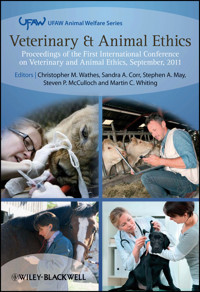
Veterinary and Animal Ethics E-Book
84,99 €
Mehr erfahren.
- Herausgeber: John Wiley & Sons
- Kategorie: Fachliteratur
- Serie: UFAW Animal Welfare
- Sprache: Englisch
The first International Conference on Veterinary and Animal Ethics (ICVAE) held in September 2011 saw leading experts from across the world come together to discuss the most important issues of animal welfare in contemporary veterinary practice and research. This is the extended proceedings of that conference, enabling all those interested in this increasingly significant subject to benefit from the insights of those discussions.
The conference was divided into four sessions: Principles of veterinary and animal ethics; Justifying ends - the morality of animal use; Ethical analyses of animal use; and Cultural, political, legal and economic considerations. Each session contained four or five papers, and these are presented here in full, as well as the transcribed question and answer sessions at the end of each paper, and a short post-presentation reflection from each author. Also included is the debate on the motion ‘Is it better to have lived and lost than never to have lived at all?’ which records three prepared responses to the question as well as registrants’ comments from the floor.
KEY FEATURES
• Contributions from the leading thinkers in veterinary and animal ethics today
• Includes stimulating, challenging, thought-provoking and sometimes controversial discussions
• Addresses key questions on the role of the veterinarian and the morality of animal use, as well as our impact on wildlife
• Provides guidance on the practical application of ethical principles and the problems encountered
Published as part of the UFAW Animal Welfare book series. See www.wiley.com/go/ufaw for more details.
Sie lesen das E-Book in den Legimi-Apps auf:
Seitenzahl: 685
Veröffentlichungsjahr: 2012
Ähnliche




















Contents
Contributors
Foreword
Preface
I Principles of Veterinary and Animal Ethics
1 The History of Veterinary Ethics in Britain, ca.1870–2000
1.1 Introduction
1.2 Professional Conduct and the Relief of Animal Suffering, 1870–1919
1.3 The Ethical Nature of Veterinary Work, 1919–1948
1.4 The Eclipse of Animal Ethics, 1948–1975
1.5 The Reshaping of Veterinary Ethical Thought, 1975–2000
1.6 Conclusion
2 The Idea of Animal Welfare – Developments and Tensions
2.1 Background – The Modern Idea of Animal Welfare and the Brambell Report
2.2 Conclusions
3 Lessons from Medical Ethics
3.1 What Can Veterinary Ethics Learn from Medical Ethics (and Vice Versa)?
3.2 The Relevance of Medical/Veterinary Ethics and Its Place in the Undergraduate Curriculum
3.3 Role of Medical Ethics in Driving Legal Change
3.4 Professional Ethics – Behaviour and Regulation
3.5 Ethical Approaches to Dilemmas Confronting the Modern Veterinarian – Can We Learn from Clinical Ethics Frameworks?
4 Veterinary Ethics, Professionalism and Society
4.1 Introduction
4.2 The Nature of the Modern Profession
4.3 Veterinary Professional Ethics – More than Etiquette!
4.4 The Effect of the Societal Context on the Profession and Its Members
4.5 Professionalism and Physician Agency
4.6 Lessons for Veterinary Education
4.7 Continued Relevance to Society of the Professional Model
4.8 Conclusion
II Justifying Ends – The Morality of Animal Use
5 Justice of Animal Use in the Veterinary Profession
5.1 Societal Relationships with Animals
5.2 The Different Uses of Animals and Their Moral Status
5.3 The Separation of Animals from Humans
5.4 Justice as Understood by the Medical Profession
5.5 Veterinarians and Animal Justice
5.6 Conclusion
6 Telos
6.1
6.2
7 Agriculture, Animal Welfare and Climate Change
7.1 Introduction
7.2 The Link between Agriculture and Climate Change
7.3 Sustainable Intensification
7.4 Livestock Intensification and Animal Welfare Problems
7.5 The Ethics of Genetic Modification
7.6 Radical Naturalism: An Alternative to Sustainable Intensification
7.7 Discussion
7.8 Conceptions of Human Nature
7.9 Summary
8 Ethics and Ethical Analysis in Veterinary Science: The Development and Application of the Ethical Matrix Method
8.1 Introduction
8.2 Professional Ethics and Animals
8.3 Ethical Tools: The Role of the Ethical Matrix
8.4 Original Development and Application of the Ethical Matrix
8.5 Further Development of the Ethical Matrix
8.6 Development of the Ethical Matrix and Its Use in Veterinary Practice
9 The Ethics of Animal Enhancement
9.1 Introduction
9.2 What Is Enhancement?
9.3 Normalcy
9.4 Terms of Reference for the Future Debate on Animal Enhancement
9.5 Animal Welfare Implications
III Ethical Analyses of Animal Use
10 Wildlife Medicine, Conservation and Welfare
10.1 Introduction
10.2 Anthropogenic Threats to Wild Animal Conservation
10.3 To Which Wild Animals Do Welfare Concerns Apply?
10.4 Anthropogenic Threats to Wild Animal Welfare
10.5 Responsibility for Wildlife Welfare
10.6 Interventions for Wildlife Welfare
10.7 Welfare/Conservation Conflicts
10.8 Dealing with Welfare/Conservation Conflicts
10.9 Concluding Comments
11 Veterinary Ethics and the Use of Animals in Research: Are They Compatible?
11.1 Historical Perspectives
11.2 Scale of Usage
11.3 Public Perceptions
11.4 Ethical Standpoints
11.5 Measuring Harms and Benefits
11.6 The Rise of the 3Rs
11.7 Ethics and the Drug Discovery Process
11.8 Openness
11.9 Conclusion: The Role of the Veterinary Profession
12 Production Animals: Ethical and Welfare Issues Raised by Production-focused Management of Newborn Livestock
12.1 Introduction
12.2 Production-Orientated Neonatal Management Issues
12.3 Ethical and Animal Welfare Issues
13 Companion Animals
13.1 Introduction
13.2 Domestication of Cats and Dogs
13.3 The Role of Cats and Dogs in the Family: The Human-Companion Animal Bond (CAB)
13.4 Ethical Issues Arising from a Shared Lifestyle
13.5 Ethical Issues Arising from Pets as ‘Furry Children’: The Importance of the Individual
13.6 Euthanasia
13.7 Conclusion
14 Ethical Analysis of the Use of Animals for Sport
14.1 Introduction
14.2 Welfare Issues of Animals in Sport
14.3 The Ethics of Using Animals for Sport
14.4 Conclusion
IV Cultural, Political, Legal and Economic Considerations
15 Global Cultural Considerations of Animal Ethics
15.1 Introduction
15.2 Variation within a Culture
15.3 Variation between European Countries
15.4 Variation between Continents
15.5 Variation between Specific Cultures
15.6 Working Together
16 Animal Ethics and the Government’s Policy: ‘To Guard and Protect’
16.1 Historical Perspective on English Law and Its Regard for Animals
16.2 Development of Government Policy on bTB: A Wicked Problem
16.3 Animal Ethics, Animal Welfare and Government Policy-making Today
16.4 Conclusions
17 Veterinary Ethics and Law
17.1 Introduction
17.2 Disciplinary Proceedings against Veterinarians
17.3 Handling Complaints
17.4 Defects in the Complaints Procedure
17.5 Disciplinary Appeals
17.6 The Case for Reform
18 Ethical Citizenship
18.1 Introduction
18.2 Citizens Want More Ethical Treatment of Animals
18.3 Problems for Citizens and Consumers
18.4 Responsibility of the Citizen/Consumer
18.5 Conclusion
19 Principles, Preference and Profit: Animal Ethics in a Market Economy
19.1 Introduction
19.2 The Basic Model of Economic Activity
19.3 Animals in Economic Activity
19.4 Ethics and Market Behaviour
19.5 Moral versus Economic Value
Debate: ‘Is It Better to Have Lived and Lost than Never to Have Lived at All?’
Index
The Universities Federation for Animal Welfare
UFAW, founded in 1926, is an internationally recognised, independent, scientific and educational animal welfare charity that promotes high standards of welfare for farm, companion, laboratory and captive wild animals, and for those animals with which we interact in the wild. It works to improve animals’ lives by:
Funding and publishing developments in the science and technology that underpin advances in animal welfare;
Promoting education in animal care and welfare;
Providing information, organising meetings and publishing books, videos, articles, technical reports and the journal
Animal Welfare
;
Providing expert advice to government departments and other bodies and helping to draft and amend laws and guidelines;
Enlisting the energies of animal keepers, scientists, veterinarians, lawyers and others who care about animals.
‘Improvements in the care of animals are not now likely to come of their own accord, merely by wishing them: there must be research … and it is in sponsoring research of this kind, and making its results widely known, that UFAW performs one of its most valuable services.’
Sir Peter Medawar CBE FRS, 8th May 1957
Nobel Laureate (1960), Chairman of the UFAW Scientific Advisory Committee (1951–1962)
UFAW relies on the generosity of the public through legacies and donations to carry out its work, improving the welfare of animal now and in the future. For further information about UFAW and how you can help promote and support its work, please contact us at the address below:
Universities Federation for Animal Welfare
The Old School, Brewhouse Hill, Wheathampstead, Herts AL4 8AN, UK
Tel: 01582 831818 Fax: 01582 831414 Website: www.ufaw.org.uk
Email: [email protected]
UFAW’s aim regarding the UFAW/Wiley-Blackwell Animal Welfare book series is to promote interest and debate in the subject and to disseminate information relevant to improving the welfare of kept animals and of those harmed in the wild through human agency. The books in this series are the works of their authors, and the views they express do not necessarily reflect the views of UFAW.
This edition first published 2013 © 2013 by Universities Federation for Animal WelfareSeries editors: James K. Kirkwood and Robert C. Hubrecht
Wiley-Blackwell is an imprint of John Wiley & Sons, formed by the merger of Wiley’s global Scientific, Technical and Medical business with Blackwell Publishing.
Registered OfficeJohn Wiley & Sons, Ltd, The Atrium, Southern Gate, Chichester, West Sussex, PO19 8SQ, UK
Editorial Offices9600 Garsington Road, Oxford, OX4 2DQ, UKThe Atrium, Southern Gate, Chichester, West Sussex, PO19 8SQ, UK2121 State Avenue, Ames, Iowa 50014–8300, USA
For details of our global editorial offices, for customer services and for information about how to apply for permission to reuse the copyright material in this book please see our website at www.wiley.com/wiley-blackwell.
The right of the author to be identified as the author of this work has been asserted in accordance with the UK Copyright, Designs and Patents Act 1988.
All rights reserved. No part of this publication may be reproduced, stored in a retrieval system, or transmitted, in any form or by any means, electronic, mechanical, photocopying, recording or otherwise, except as permitted by the UK Copyright, Designs and Patents Act 1988, without the prior permission of the publisher.
Designations used by companies to distinguish their products are often claimed as trademarks. All brand names and product names used in this book are trade names, service marks, trademarks or registered trademarks of their respective owners. The publisher is not associated with any product or vendor mentioned in this book. This publication is designed to provide accurate and authoritative information in regard to the subject matter covered. It is sold on the understanding that the publisher is not engaged in rendering professional services. If professional advice or other expert assistance is required, the services of a competent professional should be sought.
Library of Congress Cataloging-in-Publication Data
International Conference on Veterinary and Animal Ethics (1st : 2011 : London, England)Veterinary and animal ethics : proceedings of the First International Conference on Veterinary and Animal Ethics, September 2011 / edited by C M Wathes ... [et al.]. p. cm. Includes bibliographical references and index.
ISBN 978-1-118-31480-7 (hardcover : alk. paper) 1. Veterinarians–Professional ethics–Congresses. 2. Animal welfare–Congresses. I. Wathes, Christopher M. II. Title. SF756.39.I58 2011 179′.3–dc23
2012010187
A catalogue record for this book is available from the British Library.
Wiley also publishes its books in a variety of electronic formats. Some content that appears in print may not be available in electronic books.
Cover image: top left: © Sharon Redrobe; top right and bottom left and right: © Shutterstock.comCover design by Sandra Heath
Contributors
Michael C. ApplebyWorld Society for the Protection of AnimalsLondonPatrick BatesonUniversity of CambridgeCambridgeMadeleine CampbellHobgoblins Equine Reproduction CentreDuddleswellSandra A. CorrUniversity of NottinghamNottinghamBjörnForkmanUniversity of CopenhagenCopenhagenMarie FoxUniversity of BirminghamBirminghamNigel GibbensDepartment for Environment, Food and Rural AffairsLondonColin GilbertThe Babraham InstituteCambridgeSophia HeppleDepartment for Environment, Food and Rural AffairsLondonPeter JinmanRoyal College of Veterinary SurgeonsLondonCarolyn JohnstonKing’s College and Kingston UniversityLondonKarsten Klint JensenUniversity of CopenhagenCopenhagenJames K. KirkwoodUniversities Federation for Animal WelfareLondonJudy MacArthur ClarkHome OfficeLondonStephen A. MayRoyal Veterinary CollegeLondonSteven P. McCullochRoyal Veterinary CollegeLondonJohn McInerneyUniversity of ExeterExeterDavid J. MellorMassey UniversityPalmerston NorthKate MillarUniversity of NottinghamNottinghamBernard E. RollinColorado State UniversityColoradoPeter SandøeUniversity of CopenhagenCopenhagenJohn WebsterUniversity of BristolEmeritusMartin C. WhitingRoyal Veterinary CollegeLondonSarah WolfensohnSeventeen Eighty NineSwindonAbigail WoodsImperial College LondonJames YeatesRSPCAHorsham
Foreword
Ethics is synonymous with Moral Philosophy, which implies much more than just trying to do the right thing; it forces such questions as what is right, right for whom and why? This conference on veterinary and animal ethics asks us to consider our duties to the animals, primarily in our care, not excluding animals in the wild where their welfare is directly or indirectly affected by man or his activities. It explores how these duties may be reconciled with our other duties of care not only to human society but to the entire living environment. It recognises that if these ethical principles are to be put into practice, rather than act merely as aids to a sense of moral superiority, they have to accommodate both the realities of politics and economics and the biology of human motivation.
Veterinary ethics is a clearly defined subset of this general duty of care. Veterinarians have to reconcile their responsibilities to their animal patients, their human clients, their own welfare and that of their families. However, the ethical principles that apply to veterinary practice do not differ in essence from those that apply to anyone who uses animals, whether directly as a farmer or pet owner, or indirectly as food, clothing or for new drugs.
A useful way to address our complex ethical responsibilities to all parties is through application of the ethical matrix, described here by Kate Millar. This (in my interpretation) sets out two fundamental principles of ethics (input factors). The first is the consequentialist principle of beneficence/non-maleficence, which equates to the utilitarian promotion of general well-being. The second is the principle of autonomy, which equates to the duty to ‘do as you would be done by’. In veterinary and animal ethics, these principles are applied to four concerned parties: society at large, direct animal users (farmers, veterinarians, scientists), domestic animals (used by us) and finally all the fauna and flora that make up the living environment. Balanced application of these two moral principles to recognise and address the needs of all concerned parties should achieve the desired outcome, which is the best approximation to justice for all. If this requires a descent into moral relativism, then so be it.
Direct and indirect users of animals, for example farmers and consumers, respectively, are moral agents with the duty to balance rights and responsibilities; rights to safe food and drugs against our responsibilities to the animals involved in their production. The animals (and the environment) are the moral patients. They have no responsibilities to us. One can conclude from this that they have no rights either although this is a very one-sided conclusion since they cannot argue their case. What is certain is that we all share the responsibility to ensure that those to whom we entrust the duty of care have both the competence and the compassion to do it well. It is very easy to care about animals; caring for them takes skill and it takes patience.
The invited papers, debate and discussion contained within this book may be seen as variations on three main themes:
History and evolution of human attitudes to animals, the environment and professionalism in human and veterinary medicine.
Ethical analysis of current practice with regard to the use of animals on farm, in the home, for science and for sport.
Practical application of ethical principles through the law, political action and the economics of the free market.
Classic moral philosophy (e.g. Plato) may define the good according to absolute and unchanging paradigms. However, our interpretation of these paradigms is in a state of constant flux. Papers by Woods, Johnson, May and Appleby explore changing attitudes within and between cultures to the human and animal patients that come within our care. When I was young it was deemed perfectly acceptable to drown kittens at birth; now we agonise over whether it is an insult to its telos to spay a cat. The shifting sands of practical morality should engender a sense of caution. We cannot assume that we who attended a meeting in London, UK, in 2011 are necessarily more moral now than those who came before or those in other cultures who live far away. Neither can we assume that our current concepts of middle-class morality will survive the impact of unforeseen future knowledge and future pressures on society. The principle of ‘judge not, that ye be not judged’ has an excellent provenance.
Papers by Mellor, Gilbert, Campbell and Corr examine ethical issues arising from the way we currently treat the animals which bring us direct benefits in the form of food, medicine, entertainment and love. James Kirkwood considers our responsibilities to wildlife. These papers, explicitly or by implication, acknowledge at the outset the principles of beneficence and autonomy then proceed to explore the extent to which animal owners fulfil their duties to promote the general well-being and individual freedoms of animals in their care in the light of current knowledge of their physiological and behavioural needs. The moral strength of these papers lies in their recognition of the need to seek a better understanding of what they, the animals, would like from us, as distinct from what we would like from them.
The third and most pragmatic series of papers address problems of acting according to ethical principles within the real world. The law defines the limits of acceptable and unacceptable conduct. Laws defined in broad terms such as ‘unacceptable suffering’ are essential and flexible enough to accommodate changing concepts of what is meant by care and suffering. Governments interpret the law through regulations that seek to describe in detail just what one should and should not do in specific circumstances. When drafting regulations, the aim should be to strike a balance between carrot and stick, while avoiding pettifogging intrusions on personal liberties and lengthy expositions of the blindingly obvious. The paper by Hepple and Gibbens on the ethical basis of UK Government (Defra) policy is refreshingly true to these aims. However, the main limitation of laws and regulations is that they can do little more than seek to ensure that we comply with current standards of acceptability. If we are to encourage the spread of higher standards of animal care than those permitted within the law, we need to harness the power of the people. In the final paper, John McInerney presents a cool economist’s evaluation of the things that determine the value we give to animals. He points out that every time we make a value judgement, we make an ethical decision and, in these matters, we are probably getting better. There have in recent years been some spectacular improvements in standards of animal care, and this has come about largely through the power of the people rather than through legislation. The markets (specifically the supermarkets) have responded to increased public demand for higher welfare (e.g. free range eggs) with an impressive range of measures and quality control procedures that are bringing about real improvements. Many of us for many years have been calling for justice for the animals. Progress has been slow and our ideals are probably unachievable, but now, more than ever before, I believe that we are limping in the right direction.
John WebsterUniversity of Bristol
Preface
This book contains the extended proceedings of the First International Conference on Veterinary and Animal Ethics (ICVAE). The conference was held at the Royal College of Physicians, London, from 12 to 13 September 2011. It was organised by the Editors and sponsored by:
The Wellcome Trust
The Royal Veterinary College
The Animal Care Trust
Universities Federation for Animal Welfare, UFAW
The guest at the reception was Jim Paice, MP, Minister for Food and Farming, Defra, London.
In the original preamble, we said:
We have seen dramatic changes over the last few decades in the way we live alongside and interact with animals. Extraordinary advances have been made in our understanding of animal behaviour, physiology and disease. Fifteen years ago, the first mammal was successfully cloned from an adult cell and Dolly the sheep was born. Advances in animal breeding have created dairy cows that can produce 50 litres of milk per day at a metabolic cost of five times maintenance (in comparison a Tour de France cyclist has a demand of 2.7 times maintenance). The selective breeding of chickens has created a modern broiler that has undergone a 300% increase in growth rate. Advances in veterinary surgery enable us to prolong animal life using heart by-pass procedures and renal transplants and to give routinely artificial joints to arthritic dogs. Yet there is an increasing sense that these developments have not been scrutinised ethically and that such review is overdue. This conference aims to present and encourage stimulating, challenging, thought-provoking and sometimes controversial discussion. We encourage you to participate in the debate wholeheartedly. The organisers recognise that we need to ask the right questions. We hope that the conference will agree on the questions, even if the answers are not to hand, yet. As starters, we suggest:
The conference was separated into four sessions, each containing four or five papers. Questions and answers after each paper were recorded and transcribed and these are presented here too. In addition, each author has availed themselves of the opportunity to write a commentary after they had reviewed their paper and answers.
The debate included a debate with the motion ‘Is it better to have lived and lost than never to have lived at all?’ This was also recorded and transcribed. The conference programme described it thus: ‘Banner’s principles of animal ethics mix the approaches of duties-based ethics and consequence-based ethics. This pragmatic solution is often used when humans have to make difficult moral choices about the treatment of animals in our care. Often we have to weigh up issues relating to an animal’s quality and quantity of life. This balance lies at the heart of the moral – as well as the welfare – debate. During this discussion, delegates will consider a proposal, which can be interpreted variously, e.g. in terms of moral principles, specific issues such as population control, or illustrative examples.’ James Kirkwood, Bernard Rollin and James Yeates spoke to the motion before it was opened to registrants from the floor.
The Editors, 2012
I
Principles of Veterinary and Animal Ethics
PATRICK BATESON
University of Cambridge
The first session of this excellent symposium consisted of an eclectic group of lectures. The first was given by a historian, Abigail Woods; the next by a philosopher, Peter Sandøe; the third by a lawyer, Carolyn Johnston; and the final one by a veterinarian, Stephen May. The organiser, Christopher Wathes, had allowed 10 min for discussion after each lecture. I had worried that this might prove too much, especially as each speaker was going to be kept strictly to time. I thought that I might have to keep the session going with chairman-like remarks and contrived questions. I need not have been concerned. The audience were splendid and generated first-rate discussion. So much so, indeed, that hands were still being raised when the allotted time for discussion came to an end. This attentiveness by the audience to a broad range of issues augured well for the rest of the meeting.
In his book Man and the Natural World, Keith Thomas described how the moral concerns of those who had preached and pamphleteered against cruelty to animals had remained remarkably constant in England from the fifteenth to the nineteenth century. Humans are fully entitled to domesticate animals and to kill them for food and clothing, but they are not to tyrannise or cause unnecessary suffering to animals. Domestic animals should be allowed food and rest and their deaths should be as painless as possible. Wild animals could be killed if they were needed for food or thought to be harmful. Even though game could be shot and vermin hunted, it was wrong to kill for mere pleasure.
Moral philosophers have made major contributions to the ethical problems raised by the treatment of animals. Even so, all their adopted positions require careful thought. Utilitarians often have problems trading off animal suffering against the benefits humans derive from animals because the costs and benefits of any action are not measured in the same terms. Those who confer rights on animals do not reveal what responsibilities animals have in return in the same way that humans have when they make an implicit contract in return for their rights. To my mind, even Bernard Rollin, who spoke in the second session, had too inflexible a notion of what animals should be allowed to experience. After all, adaptability is as much part of the animal’s telos as anything else it is adapted to do.
Those concerned with human medicine considered the ethical and legal issues raised by medical care long before the veterinarians thought formally about the ethics of their care of animals. Informed consent does not arise with animals but, even in humans, the issue has proved much more difficult to deal with than was at first thought. It is widely believed that the veterinarians should always have the welfare of animals at the forefront of their minds. The sheer expense of running an expensive practice does mean, however, that conflicts of interest arise. I felt therefore that this meeting, which started so well, was especially welcome in addressing the ethical problems faced by the veterinary profession.
1
The History of Veterinary Ethics in Britain, ca.1870–2000
ABIGAIL WOODS
Imperial College
Abstract: This paper examines the history of veterinary ethics in Britain over the period 1870–2000. It lays aside present-day normative conceptions of veterinary ethics in order to understand how veterinarians in the past perceived this issue and the social, economic and political factors that influenced their thinking. This analysis reveals the changing nature and scope of veterinary ethics. Prior to 1948, when anyone could legally practice veterinary surgery, veterinarians argued that treating animals ethically meant placing them under veterinary care: The interests of the veterinarian, owner, animal and society were best served by ensuring full veterinary discretion in treatment. The state acknowledged this claim with the passage of the 1948 Veterinary Surgeons Act, which restricted the practice of veterinary surgery to qualified veterinarians. Veterinary ethical priorities then shifted to professional conduct. However, later in the century, as the social and economic climate grew more hostile to professional power and privileges, and animal welfare moved up the political agenda, veterinarians began to recognise potential conflicts in interest between animals, owners, society and the profession, and to navigate them using new forms of ethical thinking. No longer concerned with extending their power to treat animals, they focussed on the appropriate exercise of that power within the clinical encounter. Previously regarded as a matter of individual clinical freedom, how veterinarians treated animals became an ethical problem that attracted both professional and public concern.
Keywords: Britain, conduct, concern, ethics, ewe, owner, veterinarian, veterinary ethics, veterinary history, veterinary surgeon, Veterinary Surgeons Act, welfare
1.1 Introduction
Veterinarians have always encountered ethical dilemmas in the course of their work. The nature of these dilemmas and how veterinarians perceived and responded to them has changed over time. Focusing on Britain, from the late nineteenth century to the very recent past, this paper provides a preliminary analysis of these changes. Its short length precludes a detailed examination of particular ethical issues. Rather, the aim is to identify broad trends in how veterinarians conceptualised and approached veterinary ethics in their practice and politics.
There is little existing literature on this topic. Histories of medical ethics do not examine the veterinary field (Rothman 1991; Cooter 2002) and veterinarians rarely feature in histories of animal ethics, which focus on key thinkers, scientists, politicians and campaigners (Kean 1998; Guerrini 2003; Boddice 2009). Tannenbaum’s (2005) textbook on veterinary ethics does not attempt a historical account, while Legood’s (2000) is restricted to the history of animal welfare. Only Rollin (2006) engages seriously with the history of veterinary ethics. His purpose is to show that veterinarians have an under-developed sense of ethics. Drawing on lived experience in the USA, he argues that veterinary ethical concerns were traditionally confined to matters of professional conduct. Only in the later 1970s and 1980s did veterinarians respond – albeit belatedly and reluctantly – to society’s emerging concern for animal ethics.
Lesen Sie weiter in der vollständigen Ausgabe!
Lesen Sie weiter in der vollständigen Ausgabe!
Lesen Sie weiter in der vollständigen Ausgabe!
Lesen Sie weiter in der vollständigen Ausgabe!
Lesen Sie weiter in der vollständigen Ausgabe!
Lesen Sie weiter in der vollständigen Ausgabe!
Lesen Sie weiter in der vollständigen Ausgabe!
Lesen Sie weiter in der vollständigen Ausgabe!
Lesen Sie weiter in der vollständigen Ausgabe!
Lesen Sie weiter in der vollständigen Ausgabe!
Lesen Sie weiter in der vollständigen Ausgabe!
Lesen Sie weiter in der vollständigen Ausgabe!
Lesen Sie weiter in der vollständigen Ausgabe!
Lesen Sie weiter in der vollständigen Ausgabe!
Lesen Sie weiter in der vollständigen Ausgabe!
Lesen Sie weiter in der vollständigen Ausgabe!
Lesen Sie weiter in der vollständigen Ausgabe!
Lesen Sie weiter in der vollständigen Ausgabe!
Lesen Sie weiter in der vollständigen Ausgabe!
Lesen Sie weiter in der vollständigen Ausgabe!
Lesen Sie weiter in der vollständigen Ausgabe!
Lesen Sie weiter in der vollständigen Ausgabe!
Lesen Sie weiter in der vollständigen Ausgabe!




