


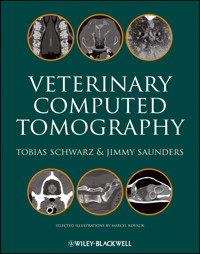
Veterinary Computed Tomography E-Book
154,99 €
Mehr erfahren.
- Herausgeber: John Wiley & Sons
- Kategorie: Fachliteratur
- Sprache: Englisch
This practical and highly illustrated guide is an essential resource for veterinarians seeking to improve their understanding and use of computed tomography (CT) in practice. It provides a thorough grounding in CT technology, describing the underlying physical principles as well as the different types of scanners. The book also includes principles of CT examination such as guidance on positioning and how to achieve a good image quality.
Written by specialists from twelve countries, this book offers a broad range of expertise in veterinary computed tomography, and is the first book to describe the technology, methodology, interpretation principles and CT features of different diseases for most species treated in veterinary practice.
Key features
• An essential guide for veterinarians using CT in practice
• Includes basic principles of CT as well as guidelines on how to carry out an effective examination
• Describes CT features of different diseases for most species treated in practice
• Written by a range of international leaders in the field
• Illustrated with high quality photographs and diagrams throughout
Sie lesen das E-Book in den Legimi-Apps auf:
Seitenzahl: 798
Veröffentlichungsjahr: 2011
Ähnliche




















Table of Contents
Cover
Title page
Copyright page
Contributors
Preface
Acknowledgements
CHAPTER ONE: CT Physics and Instrumentation – Mechanical Design
Basic CT Unit Anatomy
X-Ray Tube
Collimators and Filtration
Detector Systems
Gantry Anatomy
Scanning Modes
Table Design
Proprietary CT Terminology
CHAPTER TWO: CT Acquisition Principles
Image Parameter Selection
Patient Set-Up
Patient Restraint
CHAPTER THREE: Principles of CT Image Interpretation
Basic CT Descriptive Terminology
Image Labels
Tomographic Reconstruction: CT Numbers or Hounsfield Units
Digital Image Display: Windowing Techniques
CHAPTER FOUR: Artifacts in CT
Introduction
Geometrical Errors
Algorithm Distortions
Attenuation Measurement-Induced Artifacts
Energy Spectrum Effects
Conclusions
CHAPTER FIVE: CT Contrast Media and Applications
Intravenous Contrast Medium Administration
Equine Intra-Arterial Contrast Administration
Contrast Administration Method: Manual Versus Power Injector
Other Contrast Media Applications
CHAPTER SIX: Special Software Applications
Densitometry
Automated Bolus Tracking
CT Perfusion Imaging
Multiplanar Reconstruction
Curvilinear Reconstruction
Paddle Wheel Reconstruction
3D Reconstruction
CHAPTER SEVEN: Digital Environment
Picture Archive and Communication Systems
DICOM
RIS/HIS
Transfer Speed
Non-Proprietary Workstations
CHAPTER EIGHT: CT Planning for Radiotherapy
Introduction
Principles of External Beam Radiotherapy
Principles of Radiotherapy Treatment Planning
Reducing Set-Up Errors
Summary
CHAPTER NINE: Interventional CT
Introduction
CT for Biopsy Procedures
CT Monitoring of Stents and Other Devices
CT Assisted Embolization Techniques
CT-Monitored Cryoablation of Tumors
Interventional CT in Equines
CHAPTER TEN: Purchase Considerations
Business Plan: Income versus Expenses, i.e. Profit or Loss
Service Contract: All, Some or Nothing at All
Caseload Considerations: Fixed and Variable Costs of Doing Business
CHAPTER ELEVEN: Nasal Cavities and Frontal Sinuses
Imaging Protocol
CT: Anatomy and Normal Variants
Disease Features
CHAPTER TWELVE: Oral Cavity, Mandible, Maxilla and Dental Apparatus
Imaging Protocol
CT: Anatomy and Normal Variants
Non-Dental Diseases
Dental Diseases
CHAPTER THIRTEEN: Temporomandibular Joint and Masticatory Apparatus
Imaging Protocol
CT: Anatomy and Normal Variants
Disease Features
CHAPTER FOURTEEN: Orbita, Salivary Glands and Lacrimal System
Imaging Protocol
The Orbita
The Salivary Glands
Lacrimal System
CHAPTER FIFTEEN: External, Middle and Inner Ear
Imaging Protocol
CT: Anatomy and Normal Variants
CT Disease Features
CHAPTER SIXTEEN: Calvarium and Zygomatic Arch
Imaging Protocol
CT: Anatomy and Normal Variants
CT Disease Features
CHAPTER SEVENTEEN: Lymph Nodes of Head and Neck
Imaging Protocol
CT: Anatomy and Normal Variants
Disease Features
CHAPTER EIGHTEEN: Pharynx, Larynx and Thyroid Gland
Imaging Protocol
CT: Anatomy and Normal Variants
Disease Features
CHAPTER NINETEEN: Brain
Imaging Protocol
CT: Anatomy
Disease Features
CHAPTER TWENTY: Pituitary Gland
Introduction
Imaging Protocol
CT: Anatomy
Disease Features
CHAPTER TWENTY-ONE: Cranial Nerves and Associated Skull Foramina
Imaging Protocol
CT: Anatomy and Normal Variants
CT Disease Features
CHAPTER TWENTY-TWO: Vertebral Column and Spinal Cord
Imaging Protocol
CT: Anatomy and Normal Variants
Disease Features
CHAPTER TWENTY-THREE: Heart and Vessels
Imaging Protocol
CT: Anatomy
Disease Features
CHAPTER TWENTY-FOUR: Trachea
Imaging Protocol
CT: Anatomy and Normal Variants
Disease Features
CHAPTER TWENTY-FIVE: Mediastinum
Imaging Protocol
CT: Anatomy and Normal Variants
Disease Features
CHAPTER TWENTY-SIX: Lungs and Bronchi
Imaging Protocol
CT: Anatomy and Normal Variants
CT Disease Features
CHAPTER TWENTY-SEVEN: Pleura
Imaging Protocol
CT: Anatomy
Disease Features
CHAPTER TWENTY-EIGHT: Thoracic Boundaries
Imaging Protocol
CT: Anatomy and Normal Variants
Disease Features
CHAPTER TWENTY-NINE: Liver, Gallbladder and Spleen
General Imaging Protocol
Contrast Imaging Protocols
Transsplenic CT Portography
CT: Anatomy and Normal Variants
Disease Features
CHAPTER THIRTY: Pancreas
Imaging Protocol
CT: Anatomy and Normal Variants
Disease Features
CHAPTER THIRTY-ONE: Gastrointestinal Tract
Imaging Protocol
CT: Anatomy and Normal Variants
Disease Features
CHAPTER THIRTY-TWO: Urinary System
Imaging Technique
CT: Anatomy and Normal Variants
Urological Abnormalities
CHAPTER THIRTY-THREE: Genital Tract
Imaging Protocol
CT: Anatomy and Normal Variants
Disease Features
CHAPTER THIRTY-FOUR: Adrenal Glands
Imaging Protocol
CT: Anatomy and Normal Variants
CT Disease Features
CHAPTER THIRTY-FIVE: Systemic and Portal Abdominal Vasculature
Imaging Technique
Vascular Anatomy and Normal Variations
Assessment of Normal Vascular Structures
Vascular Diseases
CHAPTER THIRTY-SIX: Abdominal Lymph Nodes and Lymphatic Collecting System
Imaging Protocol
CT: Anatomy and Normal Variants
Disease Features
CHAPTER THIRTY-SEVEN: Long Bones
CT: Anatomy and Normal Variants
Disease Features
CHAPTER THIRTY-EIGHT: Joints
Imaging Protocols
CT: Anatomy and Normal Variants
General Joint Disease Features
Specific Joint Disease Features
The Shoulder Joint
The Elbow Joint
The Carpal Joint
Specific Disease Features of the Digits
The Coxofemoral Joint
The Stifle Joint
The Tarsal Joint
CHAPTER THIRTY-NINE: Particularities of Equine CT
Scanning Technique (Including Facilities and Equipment)
Imaging Protocols
CHAPTER FORTY: Equine Sinonasal and Dental
Dental and Periodontal CT: Anatomy and Normal Variants
Dental and Periodontal Disorders
Sinonasal: CT Anatomy and Normal Variants
Sinonasal Disorders
CHAPTER FORTY-ONE: Equine Calvarium, Brain and Pituitary Gland
Artifacts Associated with Imaging of the Equine Head
CT: Anatomy and Normal Variants
Disease Features
CHAPTER FORTY-TWO: Equine Neck and Spine
CT: Anatomy and Normal Variants
Disease Processes
CHAPTER FORTY-THREE: Equine Fractures
Introduction
Fissures, Stress Fractures and Subtle Subchondral Bone Fractures
Salter–Harris Fractures
Comminuted Fractures
Complex Joints (Carpus, Tarsus)
CHAPTER FORTY-FOUR: Equine Foot
CT: Anatomy and Normal Variants
Disease Features
CHAPTER FORTY-FIVE: Equine Fetlock
CT: Anatomy and Normal Variants
Disease Features
CHAPTER FORTY-SIX: Equine Upper Limbs (Carpus, Tarsus, Stifle)
CT: Anatomy and Normal Variants
Disease Features
CHAPTER FORTY-SEVEN: Ruminant and Porcine
Ruminant CT
Porcine CT
CHAPTER FORTY-EIGHT: Rabbits and Rodents
Imaging Protocol
CT: Anatomy and Normal Variants
CT Disease Features
CHAPTER FORTY-NINE: Avian
Imaging Protocol
Imaging Technique
CT Anatomy and Normal Variants
Disease Features: General Remarks
Disease Features: Skeleton and Head
Disease Features: Coelomic Organs
Acknowledgement
CHAPTER FIFTY: Chelonians
Imaging Protocol
Imaging Techniques
CT: Anatomy and Normal Variants
Disease Features: Skeleton and Head
Disease Features: Coelomic Organs
Index
This edition first published 2011 by John Wiley & Sons Ltd
© 2011 John Wiley & Sons Ltd
Wiley-Blackwell is an imprint of John Wiley & Sons, formed by the merger of Wiley’s global Scientific, Technical and Medical business with Blackwell Publishing.
Registered office: John Wiley & Sons Ltd, The Atrium, Southern Gate, Chichester, West Sussex,
PO19 8SQ, UK
Editorial offices: 9600 Garsington Road, Oxford, OX4 2DQ, UK
The Atrium, Southern Gate, Chichester, West Sussex, PO19 8SQ, UK
2121 State Avenue, Ames, Iowa 50014-8300, USA
For details of our global editorial offices, for customer services and for information about how to apply for permission to reuse the copyright material in this book please see our website at www.wiley.com/wiley-blackwell.
The right of the author to be identified as the author of this work has been asserted in accordance with the UK Copyright, Designs and Patents Act 1988.
All rights reserved. No part of this publication may be reproduced, stored in a retrieval system, or transmitted, in any form or by any means, electronic, mechanical, photocopying, recording or otherwise, except as permitted by the UK Copyright, Designs and Patents Act 1988, without the prior permission of the publisher.
Designations used by companies to distinguish their products are often claimed as trademarks. All brand names and product names used in this book are trade names, service marks, trademarks or registered trademarks of their respective owners. The publisher is not associated with any product or vendor mentioned in this book. This publication is designed to provide accurate and authoritative information in regard to the subject matter covered. It is sold on the understanding that the publisher is not engaged in rendering professional services. If professional advice or other expert assistance is required, the services of a competent professional should be sought.
Library of Congress Cataloging-in-Publication Data
Veterinary computed tomography / edited by Tobias Schwarz, Jimmy Saunders.
p. ; cm.
Includes bibliographical references and index.
ISBN 978-0-8138-1747-7 (hardcover : alk. paper) 1. Veterinary tomography. 2. Radiography, Medical—Digital techniques. I. Schwarz, Tobias. II. Saunders, Jimmy, 1965-
[DNLM: 1. Tomography, X-Ray Computed—veterinary—Practice Guideline. SF 757.8]
SF757.8.V48 2011
636.089'60757–dc22
2010051093
A catalogue record for this book is available from the British Library.
This book is published in the following electronic formats: ePDF 9780470960127; ePub 9780470960134; Mobi 9780470960141
Contributors
William H. Chess Adams, BS DVM DACVR DACVR-RO
School of Veterinary Medicine
University of Wisconsin-Madison
Madison
Wisconsin
USA
Hendrik-Jan Bergman, DVM DipECAR certISELP
Lingehoeve Diergeneeskunde Equine Referral Hospital
Lienden
The Netherlands
Susanne Boroffka, MA Dr. med. vet. PhD DipECVDI
University Clinic for Companion Animals
Utrecht University
The Netherlands
Ana V. Cáceres, BS DVM DACVR
University of Pennsylvania
School of Veterinary Medicine
Philadelphia
Pennsylvania
USA
Laurent Couturier, Dr Med Vet DipECVDI, AZURVET
Referral Center in Diagnostic Imaging and Neurology
Cagnes sur Mer
France
Marc-André d’Anjou, DMV DACVR
Université de Montréal
Saint-Hyacinthe
Québec
Canada
Sophie Dennison, BVM&S DACVR MRCVS
San Francisco
California
USA
Randi Drees, Dr. med. vet. DipECVDI DACVR
School of Veterinary Medicine
University of Wisconsin-Madison
Madison
Wisconsin
USA
Lisa J. Forrest, VMD DACVR DACVR-RO
School of Veterinary Medicine
University of Wisconsin-Madison
Madison
Wisconsin
USA
Ingrid Gielen, MSc Dr Med Vet PhD
Faculty of Veterinary Medicine
Ghent University
Merelbeke
Belgium
Michaela Gumpenberger, Dr. med. vet.
Clinic of Diagnostic Imaging
University of Veterinary Medicine
Vienna
Austria
Silke Hecht, Dr. med. vet. DipECVDI DACVR
University of Tennessee
College of Veterinary Medicine
Knoxville
Tennessee
USA
Victoria Johnson, BVSc DVR DipECVDI MRCVS
Vet CT Specialists Ltd
Cambridge
UK
Ingmar Kiefer, Dr. med. vet.
Department of Small Animal Medicine
Veterinary Faculty
University of Leipzig
Germany
Jennifer Kinns, BSc VetMB DipECVDI DACVR MRCVS
VDIC-Idexx
Stirling
UK
Robert Kirberger, BVSc MMedVet(Rad) DipECVDI
Faculty of Veterinary Science
University of Pretoria
Onderstepoort
South Africa
Marcel Kovalik, Dr. Med. Vet. PhD MRCVS
Royal (Dick) School of Veterinary Studies
The University of Edinburgh
Roslin
UK
Eberhard Ludewig, Dr. med. vet. DipECVDI
Department of Small Animal Medicine
Veterinary Faculty
University of Leipzig
Germany
Wilfried Mai, MS Dr. Med. Vet. PhD DipECVDI DACVR
University of Pennsylvania
School of Veterinary Medicine
Philadelphia
Pennsylvania
USA
Robert Malinowski, MA DVM
College of Veterinary Medicine
Michigan State University
East Lansing
Michigan
USA
Fintan McEvoy, MVB PhD DVR DipECVDI
Faculty of Life Sciences
University of Copenhagen
Copenhagen
Denmark
Federica Morandi, MS Dr. Med. Vet. DipECVDI, DACVR
College of Veterinary Medicine
The University of Tennessee
Knoxville
Tennessee
USA
Alastair Nelson, MA VetMB CertVR CertESM MRCVS†
Rainbow Equine Clinic
Old Malton
North Yorkshire
UK
Robert O’Brien, MS DVM DACVR
Department of Veterinary Clinical Medicine
University of Illinois
Urbana
Illinois
USA
Stefanie Ohlerth, Dr. med. vet. habil. DipECVDI
Division of Diagnostic Imaging
Vetsuisse Faculty
University of Zürich
Zürich
Switzerland
Michail Patsikas, MD DVM PhD DipECVDI
School of Veterinary Medicine
Aristotle University of Thessaloniki
Thessaloniki
Makedonia
Greece
Audrey Petite, Dr. med. vet. DVDI DipECVDI MRCVS
Pixelvet
Kent
UK
Rachel Pollard, DVM PhD DACVR
University of California Davis
School of Veterinary Medicine
Davis
California
USA
Sarah Puchalski, BSc DVM DACVR
School of Veterinary Medicine
University of California Davis
Davis
California
USA
Victor Rendano Jr., MSc VMD DACVR DACVR-RO
Veterinary Multi-Imaging Pllc
Lansing
New York
USA
Federica Rossi, Dr. med. vet. SRV DipECVDI
Clinica Veterinaria dell’Orologio
Sasso Marconi
Bologna
Italy
Valerie Samii, DVM DACVR
College of Veterinary Medicine
The Ohio State University
Columbus
Ohio
USA
Jimmy Saunders, Dr. med. vet. PhD CertVR DipECVDI
Faculty of Veterinary Medicine
Ghent University
Merelbeke
Belgium
Ryan M. Schultz, DVM DACVR
Seattle Veterinary Specialists
Kirkland
Washington
USA
Tobias Schwarz, MA Dr. med. vet. DVR DipECVDI DACVR MRCVS
Royal (Dick) School of Veterinary Studies
The University of Edinburgh
Roslin
UK
Gabriela Seiler, Dr. med. vet. DipECVDI DACVR
College of Veterinary Medicine
North Carolina State University
Raleigh
North Carolina
USA
Olivier Taeymans, DVM PhD DipECVDI
Cummings School of Veterinary Medicine
Tufts University
North Grafton
Massachusetts
USA
Russ Tucker, DVM DACVR
Veterinary Clinical Sciences
College of Veterinary Medicine
Washington State University
Pullman
Washington
USA
Henri van Bree, DVM PhD DipECVS DipECVDI
Faculty of Veterinary Medicine
Ghent University
Merelbeke
Belgium
Katrien Vanderperren, DVM PhD
Faculty of Veterinary Medicine
Ghent University
Merelbeke
Belgium
Massimo Vignoli, Dr. med. vet. PhD SRV DipECVDI
Clinica Veterinaria dell’Orologio
Sasso Marconi
Bologna
Italy
Zoe Windley, BVetMed Hons MRCVS
Royal Veterinary College
North Mymms
UK
Erik R. Wisner, DVM DACVR
School of Veterinary Medicine
University of California Davis
Davis
California
USA
Allison Zwingenberger, DVM MAS DipECVDI DACVR
School of Veterinary Medicine
University of California Davis
Davis
California
USA
Preface
Since its development in the 1970s computed tomography (CT) has undergone continuous technological improvement and refinement, contributing greatly to the advancements in clinical medicine. As radiography in the 1890s, CT was initially developed by physicists and engineers but was very quickly adapted to the needs of clinical medicine. The first scanners offered an amazing new way to indirectly visualize the brain and other organs, something that had previously been impossible. Veterinary CT was introduced in the late 1980s, initially by scanning animal patients in human medical institutions. The installation of a CT scanner at the Centre Radiothérapie-Scanner on the campus of the École Nationale Vétérinaire d’Alfort in Paris in 1989 perhaps marks the beginning of dedicated veterinary CT. At first it was primarily used for imaging of the head in dogs and cats with neurological or nasal diseases. The development of slip ring technology, which allowed helical scanning, and the design of better and smaller detectors, opened up new avenues for veterinary use, including thoracic imaging and high-definition scanning of lungs and bone. With the advancement of multi-detector-row technology a new chapter begins for veterinary CT. Long body parts can be scanned within a couple of seconds in amazing detail and with minimal image artifacts. For large domestic animals, small mammals, birds, reptiles, and even wildlife and zoo animals, CT enables us to obtain a quick and accurate diagnosis of many disorders. Computed tomography is now widely used in veterinary practice, it is comparable with or superior to other imaging modalities for many disorders, and has immense potential as a rapid and efficient diagnostic tool for a wide range of indications.
Several atlases (Assheuer and Sager, 1997; Davies et al., 1987; Mihaljeviet al., 2009) and articles have been published depicting the computed tomographic anatomy of the dog and selected other species. The reader is referred to these for detailed anatomic information. A large body of scientific publications describing the computed tomographic features of diseases in animals has also been published to date. This book closes a gap as the first comprehensive textbook of CT, including technological concepts, imaging protocols and computed tomographic disease features for most species treated in veterinary practice. We have been fortunate enough to attract more than forty veterinary specialists from 13 different countries to provide state-of-the-art expertise on the wide spectrum of veterinary computed tomography.
We wish you pleasant reading and hope that we can provide some answers for you and stimulate your curiosity for veterinary CT.
Tobias Schwarz & Jimmy Saunders
Edinburgh & Ghent, January 2011
References
Assheuer J and Sager M (1997) MRI and CT atlas of the dog. Berlin: Blackwell Science.
Davies AS, Garden KL, Young MJ and Reid CSW (1987) An atlas of X-ray tomographic anatomy of the sheep. DSIR Bulletin No 243. Wellington, New Zealand: Department of Scientific and Industrial Research.
Mihaljevi M, Kramer M and Gomeri H (2009) CT und MRT atlas. Transversalanatomie des Hundes. Stuttgart: Parey.
Acknowledgements
This book represents the collaborative effort of more than 40 authors to whom we are extremely grateful. The high quality of their contributions and their timely manuscript submissions deserve a special thank you. We are also indebted to Marcel Kovalik for providing the wonderful illustrations, often at very short notice. We would like to thank Edouard Cauvin for help in translation of Chapter 21 and all other individuals who kindly contributed images to this textbook as acknowledged in the figure legends.
This textbook would not have been possible without the hard work and endless patience of the publishing team at Wiley-Blackwell, in particular Justinia Wood and Nancy Turner whose effort and dedication are greatly appreciated.
Our colleagues have assisted us a great deal in the clinics while we were working on this textbook and we would like to express our gratitude in this regard to Maya Esmans, Carolina Urraca, Tiziana Liuti, Mairi Frame, Elizabeth Munro, Pascaline Pey, Elke Van der Vekens, Anais Combes, Els Raes, Yseult Baeumlin, Hendrik Haers, Stijn Hauspie and others, such as Simon Kidd and David Williamson, who helped us with difficult technical issues.
We are particularly appreciative of the support we received from our families throughout this project and would like to thank our wives Aaike and Deborah for their patience and understanding. Also Aurélie, Deborah, Virginie, Alice, Ingrid and Misha receive our thanks for understanding why we could spend so little time with them. We are all happy that this project has now come to a conclusion.
This book is a tribute to our friend, colleague and co-author Alastair Nelson, a true pioneer in equine computed tomography, whose untimely death meant a great loss to all of us.
A final mention goes to all animals who patiently sat, stood or laid down for their CT examinations and whose images provide the core of this book.
Tobias Schwarz & Jimmy Saunders
Edinburgh & Ghent, January 2011
CHAPTER ONE
CT Physics and Instrumentation – Mechanical Design
Jimmy Saunders and Stefanie Ohlerth
Basic CT Unit Anatomy
A computed tomography (CT) unit consists of a gantry, a patient table, hardware equipment, an operator console and optionally additional workstations.
The gantry is a doughnut-shaped ring containing the X-ray tube, the detector array and associated equipment. The central hole in the gantry accommodates the patient on a sliding table. The X-ray tube rotates around a slice of patient anatomy. This slice represents the X-Y plane, with the X-axis being horizontal and the Y-axis vertical. The isocenter of the gantry is the central point of this plane. The third dimension is represented by the Z-axis, which is along the orientation of the patient table. The patient bed is a sliding tray on a fixed table with an adjustable height and a defined capacity of forward motion. The operator console is located in another room or behind radioprotective screening, and allows operation of the CT units. Additional workstations can be used to review processed image data, but usually not raw data processing.
X-Ray Tube
Basic Anatomy of the X-Ray Tube
An X-ray tube is a vacuum tube that produces X-rays. It is composed of a cathode (filament) and an anode (target). The cathode cup is negatively charged and incorporates a wound tungsten filament that emits electrons when heated. The anode consists of a disk of tungsten or a tungsten alloy with an annular target, called the focal track, close to the edge. The anode disk is supported on a long stem that is supported by ball bearings within the tube. The anode can be rotated by electromagnetic induction from a series of stator windings outside the evacuated tube.
The X-ray tube is enclosed in a housing unit filled with insulating oil. This oil provides electric shielding from the tube voltage, X-ray protection and transmits heat generated in the housing unit to the unit’s surface. The exterior of the housing unit is cooled with a fan, and insulating oil is cooled by passing it through a heat exchanger.
Low-power applications use stationary anode tubes, while for most mid-range and high-performance applications there is a need to utilize rotating anode tubes.
Basic Physiology of the X-Ray Tube
A current of a few amperes (4–8 A) heats the tungsten filament that releases electrons (thermoionic emission) in the vacuum. A high-voltage power source (‘tube voltage’) ranging from 30 to 150 kilovolts (kV) is connected across cathode and anode to accelerate the electrons producing an electron flow (‘tube current’). These electrons collide with the anode material and about 1% of their kinetic energy is converted into X-rays, usually perpendicular to the path of the electron beam. The remainder of energy is converted into heat, causing the X-ray tube to warm up during operation. The temperature of the focal track can increase quickly to 1000–1500°C. Heat diffuses by conduction throughout the anode body and by thermal radiation (infrared radiation) to the tube housing (80%). Heat is removed from the tube housing by convection to the surrounding atmosphere.
Many X-ray systems, including CT, have built-in safety features that will not allow the equipment to be operated in ‘overheated’ conditions. The temperature cannot be measured directly in the focal track. It has to be evaluated based on indirect values that characterize the ability of the anode to store the heat generated during the X-ray emission, such as the anode heat capacity, the anode dissipation/cooling rate or the tube dissipation.
Specificities for CT
Since the invention of CT, its demands regarding the X-ray source never ceased to increase and are largely superior to those of radiography. These specific requirements can be summarized with higher scan power, shorter rotation times (maximum rotation speed), shorter cool-down times and smaller focal spots without compromise on resolution and image quality. In older CTs, the generator capacities and anode disk’s heat storage capacities were insufficient and long time interruptions were needed.
Scan power: typical values for the maximum power are 20/40–100 kW with the high voltage range ranging from 80 to 150 kV.
Focal spots: X-ray tubes use typical focal spot sizes of 0.5–1.2 mm. Specific innovations for CT are the ‘flying focus’ allowing for control of the focus position on the anode during the scan or the electromagnetic control of the electron beam, which allows switching of the focal spot position both in the fan and in the Z-direction, providing overlapping sampling.
Rotation speed: the traditional glass tube technology is not adequate in terms of required precision and stability to sustain the very high rotation speed, up to 10 500 rotation/min, of high-performance tubes. Despite its higher thermic dissipation and lower cost, glass has been replaced by the metal ceramic technology, which is more precise and better able to sustain the constraints related to the rotation speed.
Cool-down time: different approaches can be used on their own or in combination to shorten the cool-down times and improve the heat storage capacities of CT.
The ‘brute force approach’ was the main way used for three decades. This approach consists of an increase in the thermal capacity of the anode by increasing its diameter and mass. This system has obvious limitations, as it still uses radiative cooling.The ‘material approach’ is based on a slow evolution in the materials used for the anode.Direct:
Use of circular grooves in the anode support to increase the contact and improve cooling.Use of special liquid metal vacuum bearings that allow faster anode rotation.Focal track made of a mixture of rhenium and tungsten. Rhenium has a higher linear expansibility than tungsten and slows the rate at which anode crazing occurs.Anode ‘compound’/increased thermal capacities: use of molybdenum or graphite with tungsten in the anode disk. Molybdenum has twice the specific heat capacity and half the density of tungsten. Graphite has an even higher specific heat capacity and a quarter of the density of molybdenum. It increases thermal capacity.Replacement of the ball bearings by a liquid metal (gallium) that allows the evacuation of heat by conduction.Indirect:
Multiple detectors allow reduction of the heat produced via reduced scan duration by a factor approximately equivalent to the number of rows. Manufacturers developed systems with up to 1000 rows.The ‘paradigm shift’ corresponds to innovations in X-ray tubes.In 2000, Siemens developed the Straton tube, also called the rotating envelope tube, for its high-tech scanner. This tube uses direct convective cooling, exclusively of the anode, with a cooling oil stream at the anode’s back surface. As a result, the cooling rate is vastly increased to 4.8 MHU/min, eliminating the need for large heat storage capacities of the anode disk and reducing waiting times due to anode cooling in the clinical workflow.
This lighter tube also presents a solution for the acceleration/pressure centrifuge high G (above 20 G).
Another innovation on the X-ray tube in relation to CT is the dual-source CT (two tubes, two detector fans); the main advantage of this architecture is its improved temporal resolution. In today’s CT scanners, the gantry rotation time is reduced to about 0.35 s and it is mechanically challenging to reduce that time even further, which justifies the renewed interest in multisource architectures.
Collimators and Filtration
CT systems feature various collimators, filters and shielding designs, which provide filtration of the X-ray spectra, definition of the measured slices, guarding detectors against scattered radiation and general radiation protection. These vary from scan to scan but always offer the same functions.
Collimation
Collimation in CT serves to ensure good image quality and to reduce unnecessary radiation doses for the patient.
Collimators are present between the X-ray source and the patient (tube or pre-patient collimators) and between the patient and the detectors (detector or post-patient collimators).
The tube collimator is used to shape the X-ray fan beam before it penetrates the patient (restrict the X-ray flux applied to a narrow region defines the shape of the X-ray beam). It consists of a set of collimator blades made of highly absorbing materials such as tungsten or molybdenum. The opening of these blades is adjusted according to the selected slice width and the size and position of the focal spot. It defines slice thickness for single-slice CT. Tube collimators define the dose profile according to the required slice thickness. Post-patient collimators improve the slice sensitivity profile by giving a more rectangular shape. Table 1.1 shows the features of CT collimators.
Table 1.1 CT collimator features.
*Can only be implemented in scanners with a rotating detector.
Filtration
The X-ray photons emitted by the X-ray tube exhibit a wide spectrum. The soft, low-energy X-rays, which contribute strongly to the patient dose and scatter radiation but less to the detected signal, should be removed. To achieve this goal, most CT manufacturers use X-ray filters.
The inherent filtration of the X-ray-tube, typically 3 mm aluminium equivalent thickness, is the first filter. In addition, flat or shaped filters can be used. Flat filters, made of copper or aluminium, are placed between the X-ray source and the patient. They modify the X-ray spectrum uniformly across the entire field of view. Because the cross-section of a patient is mostly oval-shaped, some manufacturers use shaped (or bow-tie) filters. These filters have an increased thickness from center to periphery, allowing them to attenuate radiation hardly at all in the center but strongly in the periphery. They are made from a material with a low atomic number and high density, such as Teflon.
In some machines comb-shaped collimators close to the detector array are used to decrease the effective detector element width and thus increase the achievable geometrical resolution.
Detector Systems
The detector is the system for quantitative recoring of the incident ionizing radiation. It acts in two steps.
1. The reception of the incident X-ray photon via X-ray-sensitive detector elements with a specific geometrical configuration.
2. The transformation of the X-ray photon into a corresponding electrical signal, that is then amplified and converted from an analog to a digital form (via analog-to-digital converters). This step is relatively easily specified and submitted to few fluctuations.
There are two detector types.
Ionization chambers, mostly filled with the noble gas xenon under high pressure. Gas detectors have become obsolete due to their limited detection efficiency and the difficulty in manufacturing them for multi-row design.Scintillation detectors, in the form of crystals such as cesium iodide or cadmium tungstate, and ceramic materials such as gadolinium oxysulfide. These detectors are now predominantly used mainly because of their short decay time, which is an essential factor in subsecond scanning times since. Ultra-fast ceramic (gadolinium oxysulfide based) have superior characteristics in this area, making them the best choice for spatial resolution and image quality.The alternative detector concept is the flat-panel technology. Potential advantages are the possibility to scan with wider cone angles without the need to develop detectors with 1024 rows or more and the high spatial resolution, particularly in medium to large field of view scans. Flat-panel detectors were developed for digital radiography and their use for CT is currently being explored by manufacturers.
Gantry Anatomy
Third Generation
With third-generation CT, simultaneous rotation of the X-ray tube and detector array became possible (rotate/rotate geometry, rotating gantry). Moreover, the number of detectors and the angle of the fan beam were increased considerably so that the X-ray beam could scan the entire patient. The translational motion of first- and second-generation CT scanners could therefore be eliminated, which reduced the scan times substantially.
In the beginning, third-generation scanners suffered from the problem of ring artifacts. Each detector in third-generation scanners is responsible for the data corresponding to a ring in the image. Detectors close to the center of the detector array are responsible for a ring with a smaller diameter than those detectors towards the periphery of the detector array. Because there is always a certain amount of electronic drift associated with each detector, this causes gain changes between detectors, finally leading to ring artifacts. Today, modern technology has overcome this problem so that third-generation CT scanners are free of ring artifacts.
Multislice CT systems always use a third-generation technology and they provide scan times as short as 0.5 s.
Fourth Generation
Because of the problem of ring artifacts with third-generation scanners, fourth-generation CT scanners were designed. The detectors are placed separately in a stationary 360° ring around the patient and only the X-ray tube rotates (rotate/stationary geometry). Whereas in third-generation scanners, data are acquired by the detector array simultaneously, a single detector collects the data in fourth-generation CT over the period of time that is needed for the X-ray tube to rotate through the arc angle of the fan beam. Each detector also represents its own reference detector. In this way, ring artifacts were avoided in fourth-generation scanners.
This technology requires many detectors because the detector array covers a 360° angle. It is not used nowadays to design multislice CT units because of the high costs for such an immense number of detectors.
Slip-Ring Technology
In third- and fourth-generation scanners, the X-ray tube rotates around the object. This also applies to the detectors in third-generation scanners. In combination, this is also referred to as a ‘rotating gantry’, although not all parts of the gantry rotate. These components require a number of electrical connections for high-voltage power, data transmission and control. In most early CT systems, the connections between the components on the rotating side of the gantry bearing and the power sources, computers, etc., on the stationary side of the bearing were made using cables. They were of finite length and allowed a rotation of perhaps 700°. As a result, these systems had to stop and reverse rotation directions between images.
The alternative to this cable system is the slip-ring technology. It allows the continuous circular rotation of the X-ray tube and other components of a CT system. In a slip ring, electrical brushes allow connections between continuously rotating and stationary components. The slip-ring design made it possible to achieve greater rotational velocities allowing shorter scan times. It finally enabled the design of the modern helical CT scanner.
Multislice CT
Helical CT represents a CT system using slip-ring technology in which continuous X-ray tube rotation is used along with simultaneous and continuous table translation through the gantry. The X-ray tube describes a helical path around the object. The term ‘helical CT’ is equivalent to spiral CT, which is actually an inaccurate term (a spiral decreases in diameter). Helical CT scanners are named single section (single slice, single detector row), dual section (dual slice, dual detector row) or multisection (multislice, multidetector, multi-row) according to the maximum number of slice images generated per gantry rotation.
Helical CT technology makes it possible to image a given volume much more quickly (e.g. 30 s for the entire abdomen). More importantly, though, it allows a volume to be imaged during a more consistent phase of contrast enhancement. It is of significant benefit for CT angiography and multiphase abdominal imaging. The extent of sequential coverage, or the total time of scanning, is generally limited by X-ray tube heating.
The relationship between the incremental table movement and the selected slice width during one rotation of the gantry is described as ‘pitch’. In single-slice CT the pitch describes the ratio of the table movement per 360° gantry rotation to the collimator width (collimator pitch). In multislice CT, the detector pitch describes the ratio of the table movement per 360° gantry rotation to the detector width. The collimator pitch, then, defines the ratio of the detector pitch to the number of detector rows in multislice technology. The pitch influences patient dose, scan time and image quality. Increasing the pitch decreases scan time and reduces motion artifacts. However, the effective section thickness as well as image noise increases, too. For clinical studies, a pitch of 1–1.5 is commonly used.
Since the helical data set does not correspond to sequential plane data, it needs to be reconstructed via interpolation into planar image data sets before the actual CT reconstruction.
With single-slice CT, detectors are rather wide in the Z-axis, e.g. 1 × 20 mm. Almost the entire detector element is actively detecting radiation, and slice thickness is determined by the collimator width. Per default, the collimator width is always smaller than the detector width. Therefore, for single-slice CT, slice thickness can be decreased via smaller collimator width; however, utilization of the X-ray beam is lower, therefore signal-to-noise-ratio decreases as well. This may be partially compensated by increasing the mAs. As an advantage, partial volume averaging decreases and spatial resolution is improved with thinner slice thickness.
With multislice CT, detectors are much smaller (e.g. <1 × 1 mm). The detector size determines the smallest possible slice thickness and the collimators determine the number of detectors used. If only the central two detectors are used, the slice width can be reduced below the detector width. To allow for variation in slice width and to decrease scan time, the signals from multiple rows of detector elements can be combined, so-called binning. Binning can be performed during the requisition or from raw data after scanning.
There are two detector array designs in multislice systems: those with detector elements of equal width (equal-width design) in each detector row and those with detector elements of unequal width in the different detector rows (unequal-width design).
With multislice CT, a much higher anatomic coverage can be achieved with the same pitch and slice thickness than in single-slice CT. For the same anatomic coverage and scan time, with single-slice CT one has to either increase the pitch or the slice thickness. But image quality is then degraded considerably.
There are many advantages with multislice CT. Scanning is faster, providing better temporal and contrast resolution and fewer motion artifacts. Consequently, multiphase studies (e.g. arterial, venous, portal phase studies) became possible. Thinner slice thicknesses are possible, which improves spatial resolution and reduces partial volume averaging. Due to more patient length scanning per rotation, higher X-ray tube current settings may be used, which in turn reduces image noise.
Table 1.2 shows typical performance characteristics for a CT scanner in 2010.
Table 1.2 Performance characteristics for a CT scanner in 2010.
Power60–100 kWRotating time per 360°0.33–0.4 sSlice width0.5–0.6 mmSimultaneously scanned slices64Data per helical scan200–4000 MBImage matrix512 × 512z-coverage per rotation20–40 mmScan times ‘whole body’10–30 sScan range>1000 mmIsotropic spatial resolution0.4–0.6 mmContrast resolution3 HUEffective dose1–20 mSvMoving Gantry
Most CT units include a moving table and a fixed gantry housing. However, for certain purposes, moving or sliding gantries have been developed. Instead of the table moving into the gantry, as in conventional CT, in this case the table is fixed and scanning is accomplished by moving the gantry over the patient. In human oncology, for example, it may be an advantage during the course of irradiation if a CT scan can be performed for treatment planning adjustments immediately prior to irradiation. For this, patients are positioned on a common and fixed treatment table, which is integrated in a combined CT and linear accelarator irradiation system. The irradiation system and the CT gantry are positioned on opposite ends of the table so that, by rotating the treatment table, linac radiotherapy or CT scanning can be performed. Moving gantry systems are also designed for usage during surgery or angiography.
Scanning Modes
A routine scan requires a scout radiograph for anatomical orientation and scan region (slice) selection and scan performed in sequential or helical mode.
Scout Radiograph (Survey Radiograph, Localizer Radiograph, Scanogram, Topogram, Scout View)
A survey radiograph, similar to a conventional radiograph, is very useful for selection of single slices or complete scan regions. This radiograph is taken with a low dose and low spatial resolution by transporting the patient slowly through the field of measurement with the X-ray tube in a fixed position with radiation emitted continuously or in pulsed mode. Lateral scanograms are particularly useful to select the gantry tilt according to anatomy.
Sequential Scanning (Axial Scanning, Single-Slice Scanning)
For a long time, CT examinations consisted of scanning single slices sequentially. A single slice is scanned, then the patient is transported for a scan increment, mostly equal to the chosen slice thickness. Then, a second scan is taken and the procedure is repeated. This examination mode is relatively time-consuming and has been largely replaced by the faster helical CT. One fundamental disadvantage is that overlapping images for 3D image reconstruction are generally not available.
Modern scanners offer automated and therefore fast modes for scanning single slices sequentially. Cardiac scanning may be a future indication.
Dynamic Scanning (Serial Scanning)
Dynamic CT is used to record temporal changes in the density characteristics of an object. Typically, dynamic scanning is used to assess contrast medium dynamics. A representative selected slice is scanned repeatedly or multiphase examination of a complete organ is performed before, during and/or after administration of contrast medium. The observed changes may represent physiological processes, such as heart motion or breathing, or pathological processes such as portosystemic shunts. Dual-phase CT angiography is a minimally invasive technique, which provides an excellent 3D representation of portal and hepatic vascular anatomy.
Material-Selective Scanning (Dual-Energy CT)
Dual-energy methods serve to obtain information about the material composition in the tissues examined. To achieve this, a selected slice is scanned with two different spectra, i.e. with different high-voltage values and possibly with different filtration. This can be done in two successive scans or by switching the high voltage rapidly from projection to projection.
Table Design
Many CT tables are made of a carbon fiber material because it will not cause artifacts when scanned. The movement of the table is referred to as incrementation (incrementation indexing). All table designs have weight limits that if exceeded may compromise increment accuracy. The maximum table load on actual CT machines is between 200 kg and 330 kg. Various table attachments and positional aids are available for specific body parts. For large animal CT these are usually custom made (for details, see Chapter 39).
Proprietary CT Terminology (Table 1.3)
Table 1.3 Proprietary CT terminology.
Further Reading
Bushberg JT, Seibert JA, Leidholdt EM and Boone JM (2002) Computed tomography. In: Bushberg JT, Seibert JA, Leidholdt EM and Boone JM (eds) The essential physics of medical imaging (2e), pp 327–72. Philadelphia, PA: Lippincott Williams & Wilkins.
CHAPTER TWO
CT Acquisition Principles
Tobias Schwarz and Robert O’Brien
Image Parameter Selection
Introduction
When running a CT scan the operator of a CT unit is faced with a large number of selectable settings, which can be intimidating. The following guidelines are designed to help in the selection process and can be used to set up individual CT protocols.
Body Part Selection
In all modern CT units, the operator needs to preselect a body part folder, which contains different protocol options. The body part selection includes hardware choices such as selection of specifically shaped bow-tie filters for beam hardening compensation. These are not adapted to veterinary patients and therefore it is worth testing other body parts protocol groups as well. There are often restrictions on protocol uses and topogram selections and it is not always possible to reuse topograms when changing protocol groups.
Lesen Sie weiter in der vollständigen Ausgabe!
Lesen Sie weiter in der vollständigen Ausgabe!
Lesen Sie weiter in der vollständigen Ausgabe!
Lesen Sie weiter in der vollständigen Ausgabe!
Lesen Sie weiter in der vollständigen Ausgabe!
Lesen Sie weiter in der vollständigen Ausgabe!
Lesen Sie weiter in der vollständigen Ausgabe!
Lesen Sie weiter in der vollständigen Ausgabe!
Lesen Sie weiter in der vollständigen Ausgabe!
Lesen Sie weiter in der vollständigen Ausgabe!
Lesen Sie weiter in der vollständigen Ausgabe!
Lesen Sie weiter in der vollständigen Ausgabe!
Lesen Sie weiter in der vollständigen Ausgabe!
Lesen Sie weiter in der vollständigen Ausgabe!
Lesen Sie weiter in der vollständigen Ausgabe!
Lesen Sie weiter in der vollständigen Ausgabe!
Lesen Sie weiter in der vollständigen Ausgabe!
Lesen Sie weiter in der vollständigen Ausgabe!
Lesen Sie weiter in der vollständigen Ausgabe!
Lesen Sie weiter in der vollständigen Ausgabe!
Lesen Sie weiter in der vollständigen Ausgabe!
Lesen Sie weiter in der vollständigen Ausgabe!
Lesen Sie weiter in der vollständigen Ausgabe!
Lesen Sie weiter in der vollständigen Ausgabe!
Lesen Sie weiter in der vollständigen Ausgabe!
Lesen Sie weiter in der vollständigen Ausgabe!
Lesen Sie weiter in der vollständigen Ausgabe!
Lesen Sie weiter in der vollständigen Ausgabe!
Lesen Sie weiter in der vollständigen Ausgabe!
Lesen Sie weiter in der vollständigen Ausgabe!
Lesen Sie weiter in der vollständigen Ausgabe!
Lesen Sie weiter in der vollständigen Ausgabe!
Lesen Sie weiter in der vollständigen Ausgabe!
Lesen Sie weiter in der vollständigen Ausgabe!
Lesen Sie weiter in der vollständigen Ausgabe!
Lesen Sie weiter in der vollständigen Ausgabe!
Lesen Sie weiter in der vollständigen Ausgabe!
Lesen Sie weiter in der vollständigen Ausgabe!
Lesen Sie weiter in der vollständigen Ausgabe!
Lesen Sie weiter in der vollständigen Ausgabe!
Lesen Sie weiter in der vollständigen Ausgabe!
Lesen Sie weiter in der vollständigen Ausgabe!
Lesen Sie weiter in der vollständigen Ausgabe!
Lesen Sie weiter in der vollständigen Ausgabe!
Lesen Sie weiter in der vollständigen Ausgabe!
Lesen Sie weiter in der vollständigen Ausgabe!
Lesen Sie weiter in der vollständigen Ausgabe!
Lesen Sie weiter in der vollständigen Ausgabe!
Lesen Sie weiter in der vollständigen Ausgabe!




