


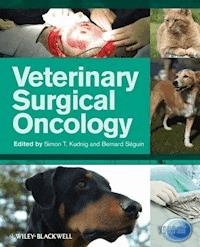
Veterinary Surgical Oncology E-Book
160,99 €
Mehr erfahren.
- Herausgeber: John Wiley & Sons
- Kategorie: Fachliteratur
- Sprache: Englisch
Veterinary Surgical Oncology provides in-depth coverage of surgical techniques for treating cancer in small animal patients. Organized by body system, each chapter presents detailed, well-illustrated descriptions of surgical procedures, with additional information on diagnostic testing, aftercare, outcomes, and prognosis. Edited and authored by members of the Veterinary Society of Surgical Oncologists, Veterinary Surgical Oncology's comprehensive coverage of surgical treatments for cancer provides an invaluable decision-making tool and is equally useful for veterinary surgeons and veterinary oncologists. The book begins with introductory chapters on the principles of surgical oncology, multimodal therapy, and interventional radiology, then presents chapters on surgical techniques in all anatomical structures, including procedures not well covered in existing literature. The first book to focus on the surgical aspects of cancer treatment, Veterinary Surgical Oncology is an essential reference for anyone with an interest in surgical oncology.
Sie lesen das E-Book in den Legimi-Apps auf:
Seitenzahl: 1829
Veröffentlichungsjahr: 2012
Ähnliche




















Table of Contents
Cover
Title page
Copyright page
Dedication
List of Contributors
Preface
1 Principles of surgical oncology
Preoperative Considerations
Surgical Planning
Postoperative Considerations
2 Multimodal therapy
3 Interventional oncology
Imaging
Instrumentation and Implants
Approaches
Nonvascular Interventional Oncology Techniques
Vascular Interventional Oncology Techniques
4 Skin and subcutaneous tumors
Skin Tumors General Principles
General Approach to the Diagnosis and Staging of Skin Tumors
Mast Cell Tumors
Mesenchymal Tumors and Melanoma
5 Head and neck tumors
Lymph Node Staging
Nasal Planum Tumors
Tumors of the Pinna
Tumors of the External Ear Canal
Tumors of the Middle Ear
Salivary Gland Tumors
Tumors of the Lip
6 Oral tumors
Introduction
Diagnosis and Clinical Staging
General Surgical Considerations
Surgical Approach to Tumors of the Mandible
Surgical Approach to Tumors of the Maxilla
Mandibular and Maxillary Tumors in Dogs
Surgical Approach to Tumors of the Hard Palate
Surgical Approach to Tumors of the Tongue
Multimodal Management of Oral Tumors
Prognosis
7 Alimentary tract
Esophagus
Stomach
Liver and Gallbladder
Pancreas
Small Intestine
Colorectal Tumors
Perianal Tumors
8 Respiratory tract and thorax
Rhinotomy
Laryngeal Tumors
Thoracotomy
Tracheal Tumors
Lung
Metastasectomy for Sarcomas
Thoracic Wall Resection
9 Cardiovascular system
Heart and Heart-Base Tumors
Pericardial Tumors
Carotid Body Tumors
Vascular Oncologic Surgery—Tumor Emboli Excision
10 Reproductive system
Female Reproductive System
Male Reproductive System
11 Urinary tract
Biopsy Procedures for Urinary Tumors
Imaging Techniques
Kidney
Ureters
Bladder
Urethra
12 Eyelids, eye, and orbit
Introduction
Clinical Workup and Biopsy Principles
Imaging Techniques
Eyelid Neoplasia
Conjunctival, Nictitans, and Scleral Neoplasia
Eye Neoplasia
Orbital Neoplasia
13 Endocrine system
Pituitary Tumors
Adrenal Tumors
Thyroid Tumors: Feline Hyperthyroidism
Thyroid Glands: Canine Thyroid Tumors
Parathyroid Tumors
Endocrine Pancreatic Tumors
14 Hemolymphatic system
Spleen
Thymus
Lymph Nodes
Lymphatics
15 Nervous system
Brain and Calvarial Tumors
Spinal Tumors
Peripheral Nerve Sheath Tumors
16 Musculoskeletal system
Skeletal Tumors
Joint Tumors
Muscle Tumors
Adjuvant and Other Therapies
Index
This edition first published 2012 © 2012 by John Wiley & Sons, Ltd.
Wiley-Blackwell is an imprint of John Wiley & Sons, formed by the merger of Wiley’s global Scientific, Technical and Medical business with Blackwell Publishing.
Registered office: John Wiley & Sons Ltd, The Atrium, Southern Gate, Chichester, West Sussex, PO19 8SQ, UK
Editorial offices: 2121 State Avenue, Ames, Iowa 50014-8300, USA
The Atrium, Southern Gate, Chichester, West Sussex, PO19 8SQ, UK
9600 Garsington Road, Oxford, OX4 2DQ, UK
For details of our global editorial offices, for customer services and for information about how to apply for permission to reuse the copyright material in this book please see our Website at www.wiley.com/wiley-blackwell.
Authorization to photocopy items for internal or personal use, or the internal or personal use of specific clients, is granted by Blackwell Publishing, provided that the base fee is paid directly to the Copyright Clearance Center, 222 Rosewood Drive, Danvers, MA 01923. For those organizations that have been granted a photocopy license by CCC, a separate system of payments has been arranged. The fee codes for users of the Transactional Reporting Service are ISBN-13: 978-0-8138-0542-9/2012.
Designations used by companies to distinguish their products are often claimed as trademarks. All brand names and product names used in this book are trade names, service marks, trademarks or registered trademarks of their respective owners. The publisher is not associated with any product or vendor mentioned in this book. This publication is designed to provide accurate and authoritative information in regard to the subject matter covered. It is sold on the understanding that the publisher is not engaged in rendering professional services. If professional advice or other expert assistance is required, the services of a competent professional should be sought.
Library of Congress Cataloging-in-Publication Data
Veterinary surgical oncology / [edited by] Simon T. Kudnig, Bernard Séguin ; illustrations by Dave Carlson.
p. ; cm.
Includes bibliographical references and index.
ISBN-13: 978-0-8138-0542-9 (hardcover : alk. paper)
ISBN-10: 0-8138-0542-2 (hardcover : alk. paper)
ISBN-13: 978-0-4709-6321-0 (epdf)
ISBN-13: 978-0-4709-6322-7 (epub)
ISBN-13: 978-0-4709-6323-4 (mobi)
I. Kudnig, Simon T. II. Séguin, Bernard, 1968–
[DNLM: 1. Neoplasms–surgery. 2. Neoplasms–veterinary. 3. Surgery, Veterinary–methods. SF 910.T8]
LC classification not assigned
636.089'7–dc23
2011032156
A catalogue record for this book is available from the British Library.
Wiley also publishes its books in a variety of electronic formats. Some content that appears in print may not be available in electronic books.
Disclaimer
The publisher and the author make no representations or warranties with respect to the accuracy or completeness of the contents of this work and specifically disclaim all warranties, including without limitation warranties of fitness for a particular purpose. No warranty may be created or extended by sales or promotional materials. The advice and strategies contained herein may not be suitable for every situation. This work is sold with the understanding that the publisher is not engaged in rendering legal, accounting, or other professional services. If professional assistance is required, the services of a competent professional person should be sought. Neither the publisher nor the author shall be liable for damages arising herefrom. The fact that an organization or Website is referred to in this work as a citation and/or a potential source of further information does not mean that the author or the publisher endorses the information the organization or Website may provide or recommendations it may make. Further, readers should be aware that Internet Websites listed in this work may have changed or disappeared between when this work was written and when it is read.
To my wife Narelle, my parents Philip and Judy, my brother Martin, and my sister Mandy for their unending support and understanding, and to my daughter Samantha for the joy and perspective on life you have brought.
S.K.
To my wife Lisa, my parents Gisèle and René, and my brother Jean-François for their encouragement, support, and love and to my children Alexandre and Gabrielle, for being my inspiration and teaching me so much more.
B.S.
To Dr. Stephen J. Withrow for teaching us, among many other things: “Success is the ability to move forward in the face of failure.”
S.K. and B.S.
List of Contributors
Sara A. Ayres, DVM, DVSc, Diplomate ACVS
Surgeon, Simcoe Veterinary Surgical Referral
Ontario, Canada
Head and Neck Tumors
Nicholas J. Bacon, MA, VetMB, CertVR, CertSAS, Diplomate ECVS, Diplomate ACVS
Clinical Assistant Professor, Surgical Oncology
University of Florida College of Veterinary Medicine
Gainesville, Florida, USA
Urinary Tract
Tania A. Banks, BVSc, FACVSc
Lecturer, Small Animal Surgery
The School of Veterinary Science, The University of Queensland
Gatton Campus, QLD, Australia
Multimodal Therapy
Alimentary Tract: Pancreas
Sarah Boston, DVM, DVSc, Diplomate ACVS
Assistant Professor, Small Animal Surgery (Surgical Oncology)
Department of Clinical Studies
Ontario Veterinary College, University of Guelph, Guelph, ON, Canada
Respiratory Tract and Thorax: Chest Wall Tumors, Laryngeal Tumors, Tracheal Tumors
Tara A. Britt, VMD, Diplomate ACVS
Veterinary Surgical Services
Veterinary Referral Center of Colorado
Englewood, CO, USA
Reproductive System: The Male
Lisa Brownlee, DVM, MS, Diplomate ACVIM (Internal Medicine)
Assistant Professor, Department of Clinical Sciences
College of Veterinary Medicine, Oregon State University
Corvallis, OR, USA
Endocrine System
Paolo Buracco, DVM, Diplomate ECVS
Professor of Veterinary Surgery
School of Veterinary Medicine
Grugliasco, Turin, Italy
Alimentary Tract: Colorectal Tumors and Perianal Tumors
Earl F. Calfee, III, DVM, MS, Diplomate ACVS
Nashville Veterinary Specialists
Nashville, TN, USA
Alimentary Tract: Stomach, Liver and Gall Bladder, Pancreas, Small Intestine
Elaine R. Caplan, DVM, Diplomate ACVS, Diplomate ABVP
Texas Veterinary Oncology, Capital Area Veterinary Specialists, Inc.
Austin, TX, USA
Nervous System
Ryan P. Cavanaugh, DVM, Diplomate ACVS
Staff Surgeon, VCA Alameda East Veterinary Hospital
Denver, CO, USA
Alimentary Tract: Stomach, Liver and Gall Bladder, Pancreas, Small Intestine
William T.N. Culp, VMD, Diplomate ACVS
Assistant Professor, Small Animal Surgery (Surgical Oncology/Interventional Radiology), Department of Surgical and Radiological Sciences
School of Veterinary Medicine, University of California, Davis
Davis, CA, USA
Principles of Surgical Oncology
Interventional Oncology
Alimentary Tract: Esophagus
Michael Davidson, DVM, Diplomate ACVO
Professor, Ophthalmology; Associate Dean and Director of Veterinary Medical Services
College of Veterinary Medicine, North Carolina State University
Raleigh, NC, USA
Eyelids, Eye, and Orbit
William S. Dernell, DVM, MS, Diplomate ACVS
Professor and Chair, Department of Veterinary Clinical Sciences
College of Veterinary Medicine, Washington State University
Pullman, WA, USA
Musculoskeletal System
Nicole Ehrhart, VMD, MS, Diplomate ACVS
Professor, Surgical Oncology, Department of Clinical Sciences
College of Veterinary Medicine and Biomedical Sciences, Colorado State University
Fort Collins, CO, USA
Principles of Surgical Oncology
James P. Farese, DVM, Diplomate ACVS
Associate Professor, Surgical Oncology, Department of Small Animal Clinical Sciences
College of Veterinary Medicine, University of Florida
Gainesville, FL, USA
Urinary Tract
Musculoskeletal System
Jolle Kirpensteijn, DVM, PhD, Diplomate ACVS, Diplomate ECVS
Professor, Surgery, Department of Clinical Sciences of Companion Animals
Faculty of Veterinary Medicine, Utrecht University
Utrecht, The Netherlands
Skin and Subcutaneous Tumors: Skin Tumors General Principles, Soft Tissue Sarcomas
Simon T. Kudnig BVSc, MVS, MS, FACVSc, Diplomate ACVS
Staff Surgeon, Melbourne Veterinary Specialist Centre
Melbourne, Victoria, Australia
Cardiovascular System
B. Duncan X. Lascelles, BSc, BVSc, PhD, CertVA, DSAS(ST), Diplomate ECVS, Diplomate ACVS
Professor of Surgery and Pain Management, Surgery Section and Comparative Pain Research Laboratory
North Carolina State University College of Veterinary Medicine
Raleigh, NC, USA
Oral Tumors
Eyelids, Eye, and Orbit
Julius M. Liptak, BVSc, MVetClinStud, FACVSc, Diplomate ACVS, Diplomate ECVS
Specialist Small Animal Surgeon, Alta Vista Animal Hospital
Ottawa, Ontario, Canada
Head and Neck Tumors
Oral Tumors
Musculoskeletal System
Marina Martano, DMV, PhD
Assistant Professor of Veterinary Surgery
School of Veterinary Medicine, University of Turin
Grugliasco (TO), Italy
Respiratory Tract and Thorax: Thoracotomy, Rhinotomy
Eric Monnet, DVM, PhD, Diplomate ACVS, Diplomate ECVS
Professor, Small Animal Surgery, Department of Clinical Sciences
Colorado State University College of Veterinary Medicine and Biomedical Sciences
Fort Collins, CO, USA
Cardiovascular System
Emanuela Morello, DMV, PhD
Assistant Professor of Veterinary Surgery
School of Veterinary Medicine, University of Turin
Grugliasco (TO), Italy
Respiratory Tract and Thorax: Lung.
Stewart Ryan, BVSc, MS, Diplomate ACVS
Assistant Professor, Musculoskeletal and Surgical Oncology, Department of Clinical Sciences
College of Veterinary Medicine and Biomedical Sciences
Colorado State University
Fort Collins, CO, USA
Skin and Subcutaneous Tumors: Skin Tumors General Principles, Mast Cell Tumors
Bernard Séguin, DVM, MS, Diplomate ACVS
Associate Professor, Department of Clinical Sciences
College of Veterinary Medicine, Oregon State University
Corvallis, OR, USA
Endocrine System
Maurine J. Thomson, BVSc, FACVSc
Specialist, Surgical Oncologist
Veterinary Specialist Services, Springwood Centre
Underwood, Qld, Australia
Reproductive System: The Female
Sebastiaan van Nimwegen, DVM, PhD
Department of Clinical Sciences of Companion Animals
Faculty of Veterinary Medicine, Utrecht University
Utrecht, The Netherlands.
Skin and Subcutaneous Tumors: Skin Tumors General Principles, Soft Tissue Sarcomas
Peter J. Walsh, DVM, MVetSc, Diplomate ACVS
Veterinary Specialty Group
West Sacramento, CA, USA
Endocrine System
Christine C. Warzee, DVM, Diplomate ACVS
Assistant Professor, Surgical Oncology
Center for Comparative Oncology, College of Veterinary Medicine
Michigan State University
East Lansing, MI, USA
Hemolymphatic System
Stephen J. Withrow, DVM, Diplomate ACVS, Dipomate ACVIM (Oncology)
University Distinguished Professor, Surgical Oncology, Department of Clinical Sciences
College of Veterinary Medicine and Biomedical Sciences, Colorado State University
Fort Collins, CO, USA
Respiratory Tract and Thorax: Metastasectomy for Sarcomas
Deanna R. Worley, DVM, Diplomate ACVS
Assistant Professor, Surgical Oncology, Department of Clinical Sciences
College of Veterinary Medicine and Biomedical Sciences, Colorado State University
Fort Collins, CO, USA
Musculoskeletal System
Erik G.H. Wouters, DVM
Department of Clinical Sciences of Companion Animals
Faculty of Veterinary Medicine, Utrecht University
Utrecht, The Netherlands
Skin and Subcutaneous Tumors: Skin Tumors General Principles, Soft Tissue Sarcomas
Preface
This book is the result of the collaboration between many contributors who belong to the Veterinary Society of Surgical Oncology (VSSO). At its inception, the impetus to write this book was to help fulfill the goals of the VSSO, which include “to disseminate knowledge to help provide the highest possible standard of surgical treatment for cancer and to encourage and promote education in surgical oncology for professional veterinary students, graduate students and house officers, and graduated veterinarians and veterinary surgeons” (www.vsso.org/aims.html).
The field of surgical oncology has greatly expanded in recent years. The creation of the VSSO reflects this growth. The idea of the VSSO was the brainchild of Dr. Steve Withrow. Dr. Withrow is, for many of us, the pioneer of surgical oncology in veterinary medicine, and he instituted the first fellowship in veterinary surgical oncology in 1988. Many of the original members of the VSSO are graduates of the fellowship. Under the leadership of Dr. Julius Liptak, the VSSO was officially created in 2006. In the first year of the VSSO, there were less than 30 members, whereas at the time of publication there are more than 235. Members are from North America, Europe and the United Kingdom, Australia and New Zealand, and Asia.
The American College of Veterinary Surgeons (ACVS) has announced that it will recognize further training and expertise in certain fields of surgery, one of which is oncologic surgery. This is affirmation of the expanding body of knowledge in surgery in general as well as that focusing on a certain field is necessary to remain the most proficient. The recognition of advanced training in a field will best promote continued development of novel ideas that will increase our understanding of the diseases and their treatment. We hope this textbook will serve as a repository of knowledge for anyone with an interest in surgical oncology to use and to build upon in the future.
The emphasis of this book is on the surgical aspect of treating small animals afflicted by cancer. This book is not meant to be a full review of small animal oncology as there are several excellent existing textbooks doing so. For instance, this book was not meant to be a comprehensive review of how to diagnose the diseases. Rather, we wanted to concentrate on the surgical procedures, such as those that are not well covered in the literature. Our goal is to assist decision making and to cover controversies in the field. The reader is expected to have a basic knowledge of general surgical principles and surgical techniques.
We are indebted to all the contributors for their remarkable contributions. The excellence of the chapters is to their credit and not ours, but any errors are our responsibility. We want to thank Erin Gardner, Erica Judisch, Nancy Turner, Erin Magnani and Susan Engelken from Wiley-Blackwell for their assistance and patience during this whole process, which was for the most part new to both of us. We also want to thank Jane Loftus for copy-editing the chapters; and Dave Johnson and Lorie Kennerly from the Information Technology Services at the College of Veterinary Medicine, Oregon State University, for their assistance when needed. We also thank Jill Bartlett from Oregon State University and Jean-François Séguin for their technical assistance with some of the figures. We need to thank our colleagues, house officers, students, and staff for their support and the motivation they supplied. And most importantly, we thank our families who by extension and default have lived through the creation of this book. Without their support and understanding, this would not have been possible.
We hope you find this book helpful in your practice and education and welcome any comments you may have.
Simon T. Kudnig and Bernard Séguin
1
Principles of surgical oncology
Nicole Ehrhart, William T.N. Culp
Cancer treatment is a rapidly changing and evolving area involving the use of multiple diagnostic and therapeutic modalities to achieve the most optimal outcome. Surgical intervention remains a pivotal aspect of the treatment of cancer. Surgery cures more cancer than any other single modality. Nonetheless, the optimal treatment pathway for any given animal patient with cancer most often involves several adjuvant treatment modalities. Adjuvant treatments significantly affect the success of surgery, and likewise, surgery affects the outcome of adjuvant treatments. It is widely recognized in human cancer centers that patient outcome is greatly improved when surgery is performed by a surgeon with specialized training in oncologic procedures. These surgeons have expertise in selecting surgical treatment options in combination with other forms of cancer treatment, as well as knowledge of the benefits and risks associated with a multidisciplinary approach beyond that which can be mastered within a 3-year surgery residency training program. This level of expertise requires an understanding of the fundamental biology of cancer, clinical pharmacology, tumor immunology and endocrinology, as well as a thorough understanding of potential complications of multimodality therapy. Veterinary training programs in surgical oncology have been in existence for the last 14 years. With the development of new treatments such as small molecule inhibitors, gene therapy, and new forms of radiation, the role of the surgical oncologist is constantly evolving and changing (O’Reilly et al. 1997; Drixler et al. 2000).
Therapeutic goals (e.g., curative intent, cytoreduction, or palliation) for each case should be established with the pet owners before surgery is initiated. The efficacy of surgical therapy in any patient with cancer is heavily dependent upon the surgeon’s global understanding of the patient’s general health status, lifestyle, and activity level; type and stage of cancer; adjuvant therapies available; alternatives to surgery; and expected prognosis. To maximize effectiveness, the optimal treatment pathway for each case should be strategically assessed before initiating treatment. This planning should always include a frank and thorough discussion with the owner regarding preoperative diagnostic tests, stage of cancer, palliative options, surgical options, adjuvant treatments likely to be needed, costs, postoperative care, and expected function, cosmesis and prognosis including risks of complications. The goal of this discussion is to provide owners with enough information to help them make an informed choice regarding the best treatment plan for their companion. Highly individualized initial planning will allow for the best overall outcome for each patient.
Preoperative Considerations
Signalment
The patient’s age, gender, breed, and weight are important factors in the determination of appropriate recommendations. Advanced age is not necessarily a negative prognostic factor. Comorbidities common to geriatric veterinary patients such as renal insufficiency, hepatic disease, or osteoarthritis may limit or change specific treatment recommendations; however, the age of the patient alone should not.
Certain neoplastic diseases are common in a particular gender or breed. The surgical oncologist should always bear in mind the role that gender and breed play in the diagnosis of neoplasia. As an example, the differential list for a flat-coated retriever with a femoral bony lesion noted on radiographs that has been referred for a suspected diagnosis of osteosarcoma should be expanded to include histiocytic sarcoma; other diagnostics such as an abdominal ultrasound would be recommended to look for other foci of histiocytic disease.
Other portions of the signalment are also important to note, including the patient’s weight and body condition. Patients that are morbidly obese or those in poor body condition may not be able to function effectively or may be more severely debilitated by a major surgery. For example, a patient with cancer cachexia can have such profound alterations of their carbohydrate, protein, and fat metabolism that recovery may be compromised (Ogilvie 1998).
Staging and Concomitant Disease
Staging diagnostics such as a complete blood count, chemistry profile, urinalysis, thoracic radiographs, and abdominal ultrasound are essential components for the preoperative assessment of veterinary oncology patients. While there is debate about the timing of some of these diagnostics (i.e., before or after biopsy), for many patients thorough preoperative staging diagnostics can unmask an underlying condition that may alter the plan or better assist the surgeon to provide a more accurate prognosis. Alternative surgical dose may also be recommended based on the results of staging.
Neoadjuvant Therapy
Lesen Sie weiter in der vollständigen Ausgabe!
Lesen Sie weiter in der vollständigen Ausgabe!
Lesen Sie weiter in der vollständigen Ausgabe!
Lesen Sie weiter in der vollständigen Ausgabe!
Lesen Sie weiter in der vollständigen Ausgabe!
Lesen Sie weiter in der vollständigen Ausgabe!
Lesen Sie weiter in der vollständigen Ausgabe!
Lesen Sie weiter in der vollständigen Ausgabe!
Lesen Sie weiter in der vollständigen Ausgabe!
Lesen Sie weiter in der vollständigen Ausgabe!
Lesen Sie weiter in der vollständigen Ausgabe!
Lesen Sie weiter in der vollständigen Ausgabe!
Lesen Sie weiter in der vollständigen Ausgabe!
Lesen Sie weiter in der vollständigen Ausgabe!
Lesen Sie weiter in der vollständigen Ausgabe!
Lesen Sie weiter in der vollständigen Ausgabe!




