


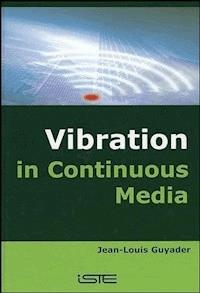
Vibration in Continuous Media E-Book
243,99 €
Mehr erfahren.
- Herausgeber: John Wiley & Sons
- Kategorie: Wissenschaft und neue Technologien
- Sprache: Englisch
Three aspects are developed in this book: modeling, a description of the phenomena and computation methods. A particular effort has been made to provide a clear understanding of the limits associated with each modeling approach. Examples of applications are used throughout the book to provide a better understanding of the material presented.
Sie lesen das E-Book in den Legimi-Apps auf:
Seitenzahl: 379
Veröffentlichungsjahr: 2013
Ähnliche




















Table of Contents
Preface
Chapter 1: Vibrations of Continuous Elastic Solid Media
1.1. Objective of the chapter
1.2. Equations of motion and boundary conditions of continuous media
1.3. Study of the vibrations: small movements around a position of static, stable equilibrium
1.4. Conclusion
Chapter 2: Variational Formulation for Vibrations of Elastic Continuous Media
2.1. Objective of the chapter
2.2. Concept of the functional, bases of the variational method
2.3. Reissner’s functional
2.4. Hamilton’s functional
2.5. Approximate solutions
2.6. Euler equations associated to the extremum of a functional
2.7. Conclusion
Chapter 3: Equation of Motion for Beams
3.1. Objective of the chapter
3.2. Hypotheses of condensation of straight beams
3.3. Equations of longitudinal vibrations of straight beams
3.4. Equations of vibrations of torsion of straight beams
3.5. Equations of bending vibrations of straight beams
3.6. Complex vibratory movements: sandwich beam with a flexible inside
3.7. Conclusion
Chapter 4: Equation of Vibration for Plates
4.1. Objective of the chapter
4.2. Thin plate hypotheses
4.3. Equations of motion and boundary conditions of in plane vibrations
4.4. Equations of motion and boundary conditions of transverse vibrations
4.5. Coupled movements
4.6. Equations with polar co-ordinates
4.7. Conclusion
Chapter 5: Vibratory Phenomena Described by the Wave Equation
5.1. Introduction
5.2. Wave equation: presentation of the problem and uniqueness of the solution
5.3. Resolution of the wave equation by the method of propagation (d’Alembert’s methodology)
5.4. Resolution of the wave equation by separation of variables
5.5. Applications
5.6. Conclusion
Chapter 6: Free Bending Vibration of Beams
6.1. Introduction
6.2. The problem
6.3. Solution of the equation of the homogenous beam with a constant cross-section
6.4. Propagation in infinite beams
6.5. Introduction of boundary conditions: vibration modes
6.6. Stress-displacement connection
6.7. Influence of secondary effects
6.8. Conclusion
Chapter 7: Bending Vibration of Plates
7.1. Introduction
7.2. Posing the problem: writing down boundary conditions
7.3. Solution of the equation of motion by separation of variables
7.4. Vibration modes of plates supported at two opposite edges
7.5. Vibration modes of rectangular plates: approximation by the edge effect method
7.6. Calculation of the free vibratory response following the application of initial conditions
7.7. Circular plates
7.8. Conclusion
Chapter 8: Introduction to Damping: Example of the Wave Equation
8.1. Introduction
8.2. Wave equation with viscous damping
8.3. Damping by dissipative boundary conditions
8.4. Viscoelastic beam
8.5. Properties of orthogonality of damped systems
8.6. Conclusion
Chapter 9: Calculation of Forced Vibrations by Modal Expansion
9.1. Objective of the chapter
9.2. Stages of the calculation of response by modal decomposition
9.3. Examples of calculation of generalized mass and stiffness
9.4. Solution of the modal equation
9.5. Example response calculation
9.6. Convergence of modal series
9.7. Conclusion
Chapter 10: Calculation of Forced Vibrations by Forced Wave Decomposition
10.1. Introduction
10.2. Introduction to the method on the example of a beam in torsion
10.3. Resolution of the problems of bending
10.4. Damped media (case of the longitudinal vibrations of beams)
10.5. Generalization: distributed excitations and non-harmonic excitations
10.6. Forced vibrations of rectangular plates
10.7. Conclusion
Chapter 11: The Rayleigh-Ritz Method based on Reissner’s Functional
11.1. Introduction
11.2. Variational formulation of the vibrations of bending of beams
11.3. Generation of functional spaces
11.4. Approximation of the vibratory response
11.5. Formulation of the method
11.6. Application to the vibrations of a clamped-free beam
11.7. Conclusion
Chapter 12: The Rayleigh-Ritz Method based on Hamilton’s Functional
12.1. Introduction
12.2. Reference example: bending vibrations of beams
12.3. Functional base of the finite elements type: application to longitudinal vibrations of beams
12.4. Functional base of the modal type: application to plates equipped with heterogenities
12.5. Elastic boundary conditions
12.6. Convergence of the Rayleigh-Ritz method
12.7. Conclusion
Bibliography and Further Reading
Index
First published in France in 2002 by Hermès Science/Lavoisier entitled “Vibrations des milieux Continus”
Published in Great Britain and the United States in 2006 by ISTE Ltd
Apart from any fair dealing for the purposes of research or private study, or criticism or review, as permitted under the Copyright, Designs and Patents Act 1988, this publication may only be reproduced, stored or transmitted, in any form or by any means, with the prior permission in writing of the publishers, or in the case of reprographic reproduction in accordance with the terms and licenses issued by the CLA. Enquiries concerning reproduction outside these terms should be sent to the publishers at the undermentioned address:
ISTE LtdISTE USA6 Fitzroy Square4308 Patrice RoadLondon WIT 5DXNewport Beach, CA 92663UKUSAwww.iste.co.uk
© ISTE Ltd, 2006
© LAVOISIER, 2002
The rights of Jean-Louis Guyader to be identified as the author of this work have been asserted by him in accordance with the Copyright, Designs and Patents Act 1988.
Library of Congress Cataloging-in-Publication Data
Guyader, Jean-Louis.
[Vibrations des milieux Continus. English]
Vibration in continuous media/Jean-Louis Guyader.
Includes bibliographical references and index.
ISBN-13: 978-1-905209-27-9
ISBN-10: 1-905209-27-4
1. Vibration. 2. Continuum mechanics. I. Title.
QA935.G8813 2006
2006015557
British Library Cataloguing-in-Publication Data
A CIP record for this book is available from the British Library
ISBN 10: 1-905209-27-4
ISBN 13: 978-1-905209-27-9
Preface
This book, which deals with vibration in continuous media, originated from the material of lectures given to engineering students of the National Institute of Applied Sciences in Lyon and to students preparing for their Master’s degree in acoustics.
The book is addressed to students of mechanical and acoustic formations (engineering students or academics), PhD students and engineers wanting to specialize in the area of dynamic vibrations and, more specifically, towards medium and high frequency problems that are of interest in structural acoustics. Thus, the modal expansion technique used for solving medium frequency problems and the wave decomposition approach that provide solutions at high frequency are presented.
The aim of this work is to facilitate the comprehension of the physical phenomena and prediction methods; moreover, it offers a synthesis of the reference results on the vibrations of beams and plates. We are going to develop three aspects: the derivation of simplified models like beams and plates, the description of the phenomena and the calculation methods for solving vibration problems. An important aim of the book is to help the reader understand the limits hidden behind every simplified model. In order to do that, we propose simple examples comparing different simplified models of the same physical problem (for example, in the study of the transverse vibrations of beams).
The first few chapters are devoted to the general presentation of continuous media vibration and energy method for building simplified models. The vibrations of continuous three-dimensional media are presented in Chapter 1 and the equations which describe their behavior are established thanks to the conservation laws which govern the mechanical media. Chapter 2 presents the problem in terms of variational formulation. This approach is fundamental in order to obtain, in a systematic way, the equations of the simplified models (also called condensed media), such as beams, plates or shells. These simplified continuous media are often sufficient models to describe the vibrational behavior of the objects encountered in practice. However, their importance is also linked to the richness of the information which is accessible thanks to the analytical solutions of the equations which characterize them. Nevertheless, since these models are obtained through a priori restriction of possible three-dimensional movements and stresses, it is necessary to master the underlying hypothesis well, in order to use them advisedly. The aim of Chapters 3 and 4 is to provide these hypotheses in the case of beams and plates. The derivation of equations is done thanks to the variational formulations based on Reissner and Hamilton's functionals. The latter is the one which is traditionally used, but we have largely employed the former, as the limits of the simplified models obtained in this way are established more easily. This approach is given comprehensive coverage in this book, unlike others books on vibrations, which dedicate very little space to the establishment of simplified models of elastic solids.
Chapters 5, 6 and 7 deal with the different aspects of the behavior of beams and plates in free vibrations. The vibrations modes and the modal decomposition of the response to initial conditions are described, together with the wave approach and the definition of image source linked to the reflections on the limits. We must also insist on the influence of the “secondary effects”, such as shearing, in the problems of bending plates. From a general point of view, the discussion of the phenomena is done on two levels: that of the mechanic in terms of modes and that of the acoustician in terms of wave’s propagation. The notions of phase speed and group velocity will also be exposed.
We will provide the main analytical results of the vibrations modes of the beams and rectangular or circular plates. For the rectangular plates, even quite simple boundary conditions often do not allow analytical calculations. In this case, we will describe the edge effect method which gives a good approximation for high order modes.
Chapter 8 is dedicated to the introduction of damping. We are going to show that the localized source of damping results in the notion of complex modes and in a difficulty of resolution which is much greater than the one encountered in the case of distributed damping, where the traditional notion of vibrations modes still remains.
The calculation of the forced vibratory response is at the center of two chapters. We will start by discussing the modal decomposition of the response (Chapter 9), where we are going to introduce the classical notions of generalized mass, stiffness and force. Then we will continue with the decomposition in forced waves (Chapter 10) which offers an alternative to the previous method and is very effective for the resolution of beam problems.
For the modal decomposition, the response calculations are conducted in the frequency domain and time domain. The same instances are treated in a manner which aims to highlight the specificities of these two calculation techniques. Finally we will study the convergence of modal series and the way to accelerate it.
In the case of forced wave decomposition, we will show how to treat the case of distributed and non-harmonic excitations, starting from the solution for a localized, harmonic excitation. This will lead us to the notion of integral equation and its key idea: using the solution of a simple case to treat a complicated one.
Chapters 11 and 12 deal with the problem of approximating the solutions of vibration problems, using the Rayleigh-Ritz method. This method employs directly the variational equations of the problems. The classical approach, based on Hamilton's functional, is used and the convergence of the solutions studied is illustrated through some examples. The Rayleigh-Ritz quotient – which stems directly from this approach – is also introduced.
A second approach is proposed, based on the Reissner’s functional. This is a method which has not been at the center of accounts in books on vibrations; however, it presents certain advantages, which will be discussed in some examples.
Chapter 1
Vibrations of Continuous Elastic Solid Media
1.1. Objective of the chapter
This work is addressed to students with a certain grasp of continuous media mechanics, in particular, of the theory of elasticity. Nevertheless, it seems useful to recall in this chapter the essential points of these domains and to emphasize in particular the most interesting aspects in relation to the discussion that follows.
After a brief description of the movements of the continuous media, the laws of conservation of mass, momentum and energy are given in integral and differential form. We are thus led to the basic relations describing the movements of continuous media.
The case of small movements of continuous elastic solid media around a point of static stable equilibrium is then considered; we will obtain, by linearization, the equations of vibrations of elastic solids which will be of interest to us in the continuation of this work.
At the end of the chapter, a brief exposition of the equations of linear vibrations of viscoelastic solids is outlined. The equations in the temporal domain are given as well as those in the frequency domain, which are obtained by Fourier transformation. We then note a formal analogy of elastic solids equations with those of the viscoelastic solids, known as principle of correspondence.
Generally, the presentation of these reminders will be brief; the reader will find more detailed presentations in the references provided at the end of the book.
1.2. Equations of motion and boundary conditions of continuous media
1.2.1. Description of the movement of continuous media
To observe the movement of the continuous medium, we introduce a Galilean reference mark, defined by an origin O and an orthonormal base . In this reference frame, a point M, at a fixed moment T, has the co-ordinates (x1 , x2 , x3).
The Euler description of movement is carried out on the basis of the four variables (x1 , x2 , x3 , t); the Euler unknowns are the three components of the speed of the particle which is at the point M at the moment t.
[1.1]
Derivation with respect to time of quantities expressed with Euler variables is particular; it must take into account the variation with time of the co-ordinates xi of the point M.
Figure 1.1.Location of the continuous medium
For example, for each acceleration component γi of the particle located at the point M, we obtain by using the chain rule of derivation:
and noting that:
we obtain the expression of the acceleration as the total derivative of the velocity:
or in index notation:
[1.2]
In the continuation of this work we shall make constant use of the index notation, which provides the results in a compact form. We shall briefly point out the equivalences in the traditional notation:
– partial derivation is noted by a comma:
– an index repeated in a monomial indicates a summation:
The Lagrangian description is an alternative to the Euler description of the movement of continuous media. It consists of introducing Lagrange variables (a , a , a , t), where (a , a , a) are the co-ordinates of the point where the particle is located at the moment of reference t. The Lagrange unknowns are the coordinates x of the point M where the particle is located at the moment t:
Lesen Sie weiter in der vollständigen Ausgabe!
Lesen Sie weiter in der vollständigen Ausgabe!
Lesen Sie weiter in der vollständigen Ausgabe!
Lesen Sie weiter in der vollständigen Ausgabe!
Lesen Sie weiter in der vollständigen Ausgabe!
Lesen Sie weiter in der vollständigen Ausgabe!
Lesen Sie weiter in der vollständigen Ausgabe!
Lesen Sie weiter in der vollständigen Ausgabe!
Lesen Sie weiter in der vollständigen Ausgabe!
Lesen Sie weiter in der vollständigen Ausgabe!
Lesen Sie weiter in der vollständigen Ausgabe!
Lesen Sie weiter in der vollständigen Ausgabe!
Lesen Sie weiter in der vollständigen Ausgabe!




