


2,99 €
Mehr erfahren.
- Herausgeber: Noel Gray
- Kategorie: Fantasy und Science-Fiction
- Sprache: Englisch
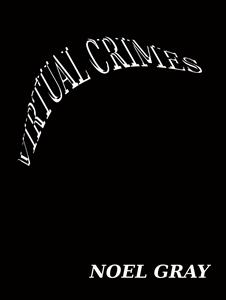
After capsule computers, tapeworms, had been swallowed by all Internet users, it became possible to determine in advance what Virtualists might in the future commit a crime against Virtuality. All those charged were prosecuted in The Court of Possibility; if found Probable, they were immediately stripped of all their user rights, never again, ever, to enjoy the wonders of Virtuality, or even the normal gluttonous fare of the Internet. Their one hope to avoid this bleak, disconnected future was to engage the famous defence counsellor, Roger Sattana, a.k.a. The Devil. The Devil's Trials were the most visited sites on the Web, claiming the attention of all Virtualists and most non-creative onliners, alike. Even Virtual God logged-on, occasionally. Virtual Crimes is the author’s third publication in the recent genre, Fy-Sy (Fictive-Science). As the name implies, the science in this genre is implausible, non-credible, and absurd.
Das E-Book können Sie in Legimi-Apps oder einer beliebigen App lesen, die das folgende Format unterstützen:
Veröffentlichungsjahr: 2017
Ähnliche














© Noel Gray 2017
ONDINA PRESS
www.noelgraybooks.com
Book cover by Ondina Press
Contents:
The Icon Fader
The Feedback Deleter
The Net Wrecker
The Omega Trap
Pre-Virtual Impossible Trials
There is one site that is known to all who surf the Internet. It is located at the deepest level of virtuality in the Illusions Sea. It is the Court of Possibility where every exit is an entrance and every entrance is a Mobius strip. The only way to leave this site, once entered, is to follow a trial to its conclusion, or secretly employ a hack-exit app.
The court’s jurisdiction extends across all electronic times, spaces and fields. Its sole function is to hear cases covered by the criminal code: VUD (Virtually United Domains). This code, which is based on pre-emptive law, states that a possible virtual crime is any action that if it happens could endanger the well being of the Internet, including that of its users. Because the Internet is the one true democracy ever devised by any civilization, albeit by accident, the trials held in this court command the attention of almost every onliner, virtual, pre-deleted, or otherwise.
In this electronic world of countless dimensions but no depth, made possible by the invention of a reality that has no materiality other than an electronic screen, one particular act is universally abhorred: PossibleCrimes against Virtuality. This particular offence involves unsolicited deletion, or deleticide as it is commonly known. Deleticide is the destruction of individual virtualities in an effort to defrag large parts of the Internet along political, ideological, or religious lines. The few users ever charged with acts of possible deleticide were all found Probable - their tautological punishment: perpetual cursor-freeze with all access rights forever denied. This irreversible punishment was officially known as: Communication Erasure, or the slang version, Dead Netted.
However, there was one notable exception to this record.
The Icon Fader
The case that was a notable exception to the rule was later dubbed “Nth Degree Deletion” by the online media, and involved one of the strangest figures in the history of the Internet. His name was Gordon Owen Dunbar and he had more dimensions to his virtuality than time had directions. If ever a virtualist was everywhere and nowhere at once, it was Dunbar.
Genesis, the VUD’s eyes-everywhere computer, had drawn up Dunbar’s charge sheet. It did not mince its words: Dunbar was to be tried for the most serious of offences, crimes against virtuality. The gravity of the case made Genesis appoint the famous attorney, Mason Carver, a.k.a. the Chisel, to act as prosecuting counsel, and the equally renowned and always active defence attorney, Roger Sattana, a.k.a. the Devil. The presiding judge was Earl St. James, a.k.a. the Saint.
On the day of the trial the clerk of the court rose from his site in a dimension adjacent to the Judge’s bench. In a loud voice he informed everyone present that the Court of Possibility was now in session and that his Honour, Earl St. James, the Chief Justice of the Illusions Sea, was presiding. Without further ado the judge directed Mason Carver to proceed with his opening address to a jury of twelve virtualists randomly chosen from across the Internet.
Nodding at the judge, the Chisel cleared his throat with exaggerated care. He decided to use one of his favourite opening addresses. “You, the jury, will come to see that the defendant, a Virtual Criminal if ever I saw one, is not just guilty as charged. You will also see that this...this...this...this excuse for an imagination is a disgrace to Virtuality. He does not deserve to be a member of any network, real, imaginary, or otherwise. In fact, when you hear the full extent of his possible crime, you will, I am sure, not only find him to be a Web horror of the worst possible kind, but you will also be unable in your hearts to think of him as even virtual, let alone a fellow surfer.”
“That is enough!” shouted the Saint, outraged at the Chisel’s inflammatory remarks. “Really, Mr. Carver, you are overstepping even the very lenient bounds of this court. Please refrain from insulting the defendant. I will not tolerate such an indiscretion again. Possible criminal or not, the defendant is entitled to the full respect of the law, and I intend he shall have it. I must add, Mr. Carver, that I am deeply surprised at your behaviour. Deeply surprised, and not a little disappointed.”
The Chisel didn’t blink an eye at this reprimand. The blood was flowing. The old days were back. His head shaking slowly from side-to-side he drifted over to the jury and let out a deep sigh. It was a famous sigh with a long history of success, no less so on this occasion. Several jurors, those closest to the defendant’s site, visibly reformatted their sites to another dimension.
The Devil, showing no signs of concern, slowly rose to his feet, his large and ancient frame protesting at the task. “If the prosecuting counsellor believes my client is not even a true virtualist, and therefore not bound by the jurisdiction of this court, may I ask him for his support in declaring a mistrial?”
The courtroom erupted with laughter. More sites were reformatted in the jury box, this time back to their original dimension. The Chisel offered to take the matter into consideration. The Devil smiled at the lie and sat himself back in his chair. He indicated to the Saint that he would wave his opening speech. The Chisel was accordingly instructed to begin the prosecution’s case.
“If it pleases the court,” said the Chisel, “I will start by getting Genesis to report the salient issues relating to the charge sheet.” He then punched a few keys on his Me2Pad and within seconds a huge monitor appeared, resting on a holographic cube, made of virtually pure gold. The monitor’s screen lit up with an image of a pentagon, its outer edges a brilliant, shimming blue. A faint violet colour filled the pentagon. Flashes of crimson stars darted backwards and forwards across this violet field. This was the face of Genesis, and whenever it spoke the crimson stars would blink gold and the outer line of its face, the pentagon’s sides, would begin to rapidly pulsate, expanding and contracting as they did so. It basically resembled an agitated Persian Rose petal that could speak.
The Chisel glanced at the court reporters to make sure they were online. “Genesis, please inform the court of the facts regarding this...this disgusting illusion disguised as a defendant?”
“I told you that was enough, Mr Carver,” said the Saint in a heated tone. “If you so much as hint at any more insults I shall hold you in contempt.”
“Forgive me, your honour. I can’t help getting emotional when prosecuting vermin.”
“Mr. Carver, this is absolutely the last warning. Get on with what’s relevant.”
“Yes, your honour. Please excuse my lapse. I will try to put my feelings to one side.”
“Mr Carver!”
“Sorry, your honour. Now where was I. Ah, yes, Genesis, please inform the court of the relevant facts about this case.”
Genesis’ voice was unlike the usual nasal, castrato, metallic, slightly haughty, boring monotone sound of most personality technology. Instead, it had a Welsh accent full of melancholy that radiated a quiet authority. “Just before his arrest the defendant’s My-Icon, a crying eye inside a golden circle, entered a highly disordered state, or in simple terms, it began to rapidly blink at an unpredictable rate. Because all My-Icons are part of the Great Cyber Pool, any changes in their capacity to maintain a steady luminosity is seen as a threat to Virtuality as a whole. Such unpredictable blinking almost always results in a virtual crime being imagined and therefore is immediately investigated. The following report is that investigation up to the moment the defendant was brought before this court.”
“The defendant’s name is Gordon Owen Dunbar. His age is undetermined. His birth date is unknown. His virtuality is unknown. His...”
“What?” shouted the Chisel, as he pressed the hold button on his Me2Pad. “Are you telling this court that this...this individual is not even a real virtualist?”
Genesis did not answer.
“Well?” screeched the Chisel.
“I think you might get an answer, Mr. Carver, if you reactivate Genesis,” sarcastically said the Saint. Prior to the trial the Saint had sought the advice of several colleagues who were familiar with the famous Mason Carver. They all agreed there was not an attorney who knew more about pre-emptive law than the Chisel. They also agreed he was detestable. Sit on him, or he’ll sit on you; that being the sum of the advice the Saint had received. What they did not tell him was how difficult it was to sit on a chisel.
“Thank-you, your honour. The disgust oozing out of the defendant made me forget for the moment what I was doing.”
“Mr. Carver, I warned you earlier. You are now in contempt of this court to the tune of one thousand access credits. Any more of your nonsense and I’ll bankrupt you. Am I making myself clear?”
“Yes, your honour. And thank you for being so lenient with the fine. I shall endeavour to keep my bile, sorry your honour, may I proceed?”
“Yes, Mr Carver, for all our sakes and your online balance, let us get on with this trial.”
One thousand access credits - mere dinosaur dust, the Chisel laughed under his breath - the chance to twig the tail of the Devil was worth more than money. He then pressed the appropriate key and Genesis came back online. He repeated his question.
“Your question, Mr. Carver, is unanswerable because the defendant’s virtuality is unknown. Therefore, he could be any particular virtuality, or not any particular virtuality, as you like.”
“Well, he can’t be all of them, or not all of them,” yelled the Chisel.
“True; but he can be not all of them except one. The question is which one is he? Or which all but one is he not?”
“Well, he’s not virtually Chinese you idiot, just look at him.”
Genesis smiled across one of its circuits. It liked its boss because he generally stuck to the facts. Not like the Devil who was all tricks, crashes, and guesses. Putting its reverie to one side, it continued. “If one eliminates all the dimensional, temporal, and other fantasy systems assumed to be peculiar to certain virtualities, a dubious idea if ever I heard one, it still leaves ten billion, or perhaps ten billion and one virtualities that the defendant may or may not be. I therefore think, Mr. Carver, your question remains unanswerable.”
“Please spare the court your wit, Genesis, and get on with the report,” coldly said the Chisel, while making a note to raise this question of virtuality again. He couldn’t believe his luck; the defendant was not even a real virtualist - God what a break.
“To continue,” obeyed Genesis. “The defendant has no Internet Site he calls home. He appears in no forum. In fact, he has no online records whatsoever. He has no password, no network, no graphic programs, and no other virtualist personally knows him.”
“Well, if this...this ghost, excuse me, if this defendant owns nothing, comes from nowhere, has been nowhere, and no one knows him, in short, a nothing going nowhere, then how in all that is holy did you find out his name?” demanded the Chisel, somewhat taken aback by this nonsense.
“The Site Sweepers who arrested him asked him his name,” answered Genesis.
“How did they find him in the first place if he lives nowhere, has no records, and all the rest of the things you said he doesn’t have?” yelled the Chisel.
“The officers in question were called to investigate a disturbance in the community site, Almost There Park. There had been a report that a very large, aristocratic looking virtualist was eating the park’s wild life, pigeons to be exact.”
“He was doing what?” screamed the Chisel. He couldn’t believe his luck. The illusion sitting next to the Devil was already a lunatic to start with. A pigeon eater! My God, how lucky can one virtual patriot get in a lifetime?
Genesis ignored the Chisel’s request to duplicate his earlier remarks. “When the officers arrived they did indeed find a very large, aristocratic looking individual eating pigeons. When questioned about his behaviour he said there was a surplus of pigeons in the park and this surplus was seriously depleting the chances of the long-term survival of the greatest number of birds who lived in the park. He also said he was hungry.”
“With this confession in hand the officers arrested him, and noticing that his My-Icon was blinking they requested me to run a background check. When that turned up blank, the only time it has ever happened I might add, I ordered the officers to ask him his name. They did and he told them they could, if they like, call him Gordon Owen Dunbar.”
The Devil’s sneaked in a question. “So, what you’re telling the court, Genesis, is you know absolutely nothing about my client except his My-Icon blinks, he likes fowl but is also ecologically concerned, and his name is Gordon Owen Dunbar?”
“That is correct.”
“Do you have any explanation as to why my client is the only virtualist you do not have any knowledge of, at least until he was arrested?” asked the Devil.
“I have no answer to that, Mr. Sattana. I double-checked all cyber records. Nothing. I then ran an icon scan on the whole Internet. The scan shows everyone who is legally entitled to be in cyberspace. Nothing. I also ran a quantum particle scan. This scan shows the molecular disturbance made by anyone entering virtuality, even if they hitch-hiked in on the back of a random modem. Nothing. I also ran a time scan. This kind of scan shows how long a virtualist has been in virtuality - again, nothing. I finally ran a trash probe of every virtualist in existence. This probe determines if anybody in the past personally knew Dunbar but then decided to trash that memory. Nothing.”
“Nothing?” asked the Devil, leaving aside the fact that Genesis had disclosed for the first time it could stick its nose, at its own volition, into every virtualist’s online life.
“Yes, that is right, nothing. Apparently, the only conclusion supporting the evidence, or its lack, is the defendant appeared in virtuality at the moment he began eating the park’s birds.”
“Thank-you,” said the Devil.
“Well, he’s certainly here now,” agreed the Chisel, determined to get to the meat and avoid the bones. “Continue, Genesis.”
“After the defendant was taken into custody I ran a complete scan on his virtual make-up. The following are the results of this scan: The defendant’s My-Icon is so unstable that it will ultimately affect his other icons, even though his particular icon clusters are unlike any on record. However, while every possible virtual criminal has icon fading, in Dunbar’s case the fading would eventually be total, that is, every one of his icons would fade. This has never happened before, although the possibility that it could one day happen was known to exist. ”
“Hold it there, Genesis,” interrupted the Devil. “Do you have an estimate as to when the defendant’s My-Icon is likely to start affecting all his other icons?”
“No.”
“Rubbish,” yelled the Chisel at Genesis. “After it turned its attention from genes to icons, the Never-Ending Genome Project that first discovered the significance of the My-Icon is quite specific on this point. If total icon fade ever happened then it would take between one and seven crashes and eight start-ups, but never more than eight. Is that correct?”
“Yes,” agreed Genesis.
“Then why did you answer ‘no’ to the previous question?”
“Because in this particular case, due to the fact the defendant’s icon clusters lie outside any known parameters, the best I can estimate is it may take between seven crashes and eight start-ups. It could be more. However, let me point out that the Never-Ending Genome Project did not have me to consult when it made its original predictions and calculations. Therefore, it was always a possibility some icon clusters would be abnormal. This just happens to be one of those times, albeit the first.”
“So, basically,” queried the Devil, “the rest of my client’s icons could take forever to be affected?”
“No. Clearly, the maximum time is the length of the defendant’s virtual life. After he’s permanently off-line his icons will never be affected because they will no longer exist.”
“The maximum time then, which as you seem to be indicating is going to be more than eight start-ups, will be determined by how long my client’s virtual life will last?” queried the Devil.
“Yes.”
“How long do you think that will be?”
“That is impossible to calculate.”
“Too true,” said the Devil, smiling at his client who nodded his agreement.
“If my learned colleague has finished fishing,” said the Chisel, “then please continue, Genesis. I’m sure we have explored this matter sufficiently. After all, there’s no question the defendant’s My-Icon will affect all his other icons in time, is there?”
“No. It will definitely affect them, in time.”
“Good. Well, this is all that interests the jury. So, shall we continue?” The Chisel loved telling the jury what interested them. It always worked. He could see on their faces they were glad to be told the question of time was nothing but nonsense thrown up by the defence to confuse things and gain more time.
Picking up where it had let off, Genesis said, “I ran a further check to determine what possible effect this would have on the rest of virtuality. My conclusion is that the force of all of Dunbar’s icons fading simultaneously would be so great that an unstoppable icon ripple would circumnavigate the Internet, erasing countless other icons belonging to other virtualists.”
At this point one of the jurors tapped a key on her Me2Pad, causing the word “fade” to be highlighted on the central monitor screen. This action automatically instructed Genesis to elaborate on said term.
“There are only two types of fading, or definitions of fading, that fit this defendant’s icon profile. One is the common understanding of this term: a slow disappearing from view, in the graphic and grid senses. The other is a more obscure sense and relates to permanently extinguishing a virtualist’s content but leaving intact their on-screen existence. Their icons are still visible but their folders are empty, so to speak.”
“What in the name of heaven does that drivel mean?” yelled the Chisel. “Fading is fading. Either virtualists are eventually deleted or they’re not.”
“That is a pedestrian understanding of the term fade, Mr. Carver.”
“Don’t lecture me you bag of chips. Is the defendant capable of possibly deleting virtualists or not.”
“The term delete, Mr. Carver, is in the same category as the term fade. It is not necessarily confined to graphic erasure. It is possible the defendant will delete many virtualists when all his icons begin to fade. But this deletion could just as easily be in a spiritual, or content sense as a graphic one.”
“Okay, the defendant’s a possible mass deleter. Let’s get on with it. Who is he capable of deleting?”
“The analysis I conducted on the defendant,” continued Genesis as ordered, “further indicated, as I mentioned earlier, he would not only eventually delete his own icons, but those of countless others. I calculated the possibilities and it seems highly possible the defendant will delete between five, and five point five billion virtualists.”
The courtroom erupted at this remark. Nearly six billion surfers! Everyone stared at the horror sitting next to the Devil. No wonder he asked the Devil to defend him. Who else would have the gall?
“Once these deletions start how long will it take them to be completed?” asked the Devil, without lifting his head from a flash drive sheath of illuminated manuscripts he was studying.
“One day.”
“One day!” shouted the Chisel. “One God-forsaken day!”
“Mr. Carver!”
“Sorry, your honour. But I think you must agree it staggers the imagination to think that this despicable non-virtualist...”
“Two thousand credits, Mr. Carver.”
“...could contemplate deleting this many innocent virtualists in one day. Tell me Genesis, what effect will this slaughter by this obvious online foreigner have on the total well-being of the Internet?”
“I do not know, yet. I will have the calculations completed directly. It is the biggest calculation I have ever undertaken. It therefore requires me to download several million data banks to make some space. The answer should be forthcoming, shortly, or a little longer. ”
The Chisel made a mental note to get Genesis overhauled at some later date. Obviously, one of its circuits must be down, melted, or just plain dead. “I’m sure the jury can wait to hear the gory details. It’s enough they know at this point such an act could happen. So, Genesis, what part of virtuality will be predominantly affected?”
“The virtualists whose icons will be zapped all belong to the Western Server. The Mid-Eastern, Eastern, and Polar Servers will remain unaffected.”
“Is there anything else these poor souls have in common, apart from being on the same server?” queried the Chisel.
“There is one other common factor,” answered Genesis.
“Genesis, for the love of God, I don’t want to extract all the information like rotten computer teeth, one chip at a time. What in the name of heaven is the other common denominator possessed by these virtualists?”
“They no longer exist.”
“WHAT?” yelled the Saint, beating the Chisel by a fraction of time beyond calculation, even by Genesis. The gaggle of reporters at the back of the court almost melted their info-makers as they coded in what they had just heard. The holographic operators standing nearby nearly wound their laser lenses off their shafts. The rest of the audience were shaking their heads like hundreds of turtles choreographed to imitate pendulums. For his part, the Chisel resembled a snail whose home had just been repossessed.
“They no longer exist,” repeated Genesis as requested. “The first one disappeared in approximately 2347 BC (Before Computers), and the last one vanished yesterday.”
“Let me see if I’ve got all of this straight,” said the Saint in his first commanding tone for the day. The court was deadly quiet. “We have a defendant charged with the possible deletion of nearly six billion virtualises who have already been deleted. Tell me, Mr. Carver, do you spot the slight inconsistency here, or am I the only one who has the genius to see it?”
The Chisel rose to the challenge and glared at Genesis. It was time to treat this tub of electronic-fat like a hostile witness. Genesis was making him look like a fool. Worse, it was making pre-emptive law look insipid. Some things were not to be tolerated. “Genesis, the jury and I have had enough of this nonsense. Throughout your report you have wavered between fact and fantasy. You have consistently been unable to tell us anything certain about the defendant other than his name. And we certainly don’t need some over-priced filing cabinet to get this little gem for us. Indeed, your answers have brought disgrace upon the law and I will not tolerate that. As his honour, equally disgusted with your shameful behaviour, has hinted: how can virtualises who are already deleted get themselves re-deleted?”
“As you may recall,” sneered Genesis, “I did mention deletion was not restricted to graphic erasure or site closure. The deletions that will be carried out by Gordon Owen Dunbar’s total icon fade will relate to the legacies left behind by the already deleted on liners. My calculations show this legacy is of the intellectual variety.”
“You’re telling us the defendant is going to delete program-etched thought shadows?” scoffed the Chisel.
“Exactly,” answered Genesis, relieved beyond description the Chisel had finally got the point.
“Then why, you...you load of electronic excrement...”
“Mr. Carver, I must ask you to refrain from filth.”
“...did you put on the charge sheet the word, ‘deleticide?’”
“There was simply no other word available that so adequately described the defendant’s possible crime. At least, not on the scale I have outlined. I did toy with eradication, dissolving, crashing...”
“The court’s not interested in your dictionary casserole, Genesis,” yelled the Chisel, beside himself with anger. His case was slipping away. Please God, not again.
“...but finally the term deleticide simply had to suffice,” carried on the unflappable fact addict, still in its lovely voice. “True, the word’s association has generally been with icon and site erasure, but a case can be made...”
“Shut up you...you...bucket of info-dung, no one here is interested in your musings. What we are interested in is this, do you have anything else of any significance to add to these proceedings before we tell you the Off word?”
“For instance?” enquired Genesis, still showing commendable restraint in the face of sustained abuse.
“Well, for openers, there’s the little matter that seems to have slipped...God, I was almost going to say your mind...what an insult that would have been to virtualists everywhere. However, now, who exactly are all these already deleted onliners who cover the entire history and prehistory of the Western Server? And what would deleting their legacies, as you quaintly put it, achieve?”
“First, these people of whom I speak come from every walk of life and have influenced the Western Server in crucial ways. Of course, they’re not the only people who influenced things, but the thought shadows left behind by their programs have frozen countless cursors, and so on. Their effect has been so great that many contemporary virtualists have frankly faded away to nothing. This indeed is the nub of the defendant’s virtual criminal intent. The readings I get from his My-Icon show unmistakably that he is only interested in those program-etched thought shadows that continue to cause cursor freeze leading to eventual content fade.”
“Give us an instance of this freezing?” barked the Chisel.
“There was the first pre-virtualist, a Greek philosopher called Plato,” answered Genesis. “He couldn’t stand people paying more attention to the world of icons than they did to ideas, or system programs, as they later became known. What was worse, he created this first virtual world, Ideal Forms he called it, but didn’t create the technology to get to it. As every onliner knows, a virtual world to become a virtuality needs to have more than one virtualist inhabiting it otherwise it’s just an empty site inside someone’s head. Plato was big on promises but short on delivery. Over the next two thousand years or so, countless would-be virtualists, or neo-Platonists as they liked to be called, took up his promises but also failed to deliver the technology. Plato’s Ideal Forms remained out of reach.”
“However, that wasn’t the worse part. Over that same period countless ordinary people, or pre-onliners to be exact, invested their savings in physical things like surveying, farming, art works, music, and so on. When Plato came to town, these folks felt justifiably cheated. Their shares plummeted while all the Ideal Form merchants made a fortune with their promises of a world free from change. In next to no time countless upon countless spirits became depressed and many went permanently off-line, or died, to use pre-Internet language. This trend has continued in one way or another right up to the present day. Indeed, today’s Internet is full of sites that sucker-in countless innocent onliners by promising virtualities they can’t deliver.”
“Basically,” concluded Genesis, “the defendant intends to delete all this influences and thereby, presumably, clear the Internet of non-possible promises.”
“This is the greatest load of rubbish I’ve ever heard,” shouted the Chisel. “Who does the defendant think he is? Who elected him to determine what or who should be on the Internet? Just who does he think he is, strutting in here and telling this glorious virtuality that one of the pillars of its whole wonderful existence is a pile of crud, of worthless promises?”




