


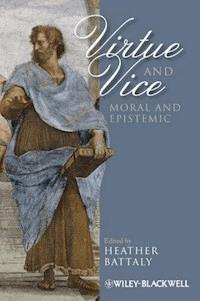
Virtue and Vice, Moral and Epistemic E-Book
21,99 €
Mehr erfahren.
- Herausgeber: John Wiley & Sons
- Kategorie: Geisteswissenschaft
- Serie: Metaphilosophy
- Sprache: Englisch
Virtue and Vice, Moral and Epistemic presents a series of essays by leading ethicists and epistemologists who offer the latest thinking on the moral and intellectual virtues and vices, the structure of virtue theory, and the connections between virtue and emotion. * Cuts across two fields of philosophical inquiry by featuring a dual focus on ethics and epistemology * Features cutting-edge work on the moral and intellectual virtues and vices, the structure of virtue theory, and the connections between virtue and emotion * Presents a radical new moral theory that makes exemplars the foundation of ethics; and new theories of epistemic vices such as epistemic malevolence and epistemic self-indulgence * Represents one of the few collections to address both the moral virtues and the epistemic virtues * Explores a new approach in epistemology - virtue epistemology - which emphasizes the importance of intellectual character traits
Sie lesen das E-Book in den Legimi-Apps auf:
Seitenzahl: 545
Veröffentlichungsjahr: 2011
Ähnliche




















Contents
Notes on contributors
1 INTRODUCTION: VIRTUE AND VICE
The Basics
The Structure of Virtue Ethics and Virtue Epistemology
Virtue and Context
Virtue and Emotion
Virtues and Vices
Acknowledgments
References
Part 1: The Structure of Virtue Ethics and Virtue Epistemology
2 VIRTUE ETHICS AND VIRTUE EPISTEMOLOGY
Substantive and Explanatory Virtue Ethics
Synchronic and Diachronic Accounts
Who Is a Virtue Ethicist?
Aristotelian Virtue Ethics
An Aristotelian Virtue Epistemology
Virtue Epistemology: Challenges and Prospects
Acknowledgments
References
3 EXEMPLARIST VIRTUE THEORY
1. Introduction
2. My Theory of Moral Theory
3. The Structure of Some Moral Theories
4. Exemplarism
5. A Comprehensive Exemplarist Virtue Theory
References
4 RIGHT ACT, VIRTUOUS MOTIVE
1. The Higher-Level Account: Consequentialist Virtues
2. The Higher-Level Account: Deontological Virtues
References
Part 2: Virtue and Context
5 AGENCY ASCRIPTIONS IN ETHICS AND EPISTEMOLOGY: OR, NAVIGATING INTERSECTIONS, NARROW AND BROAD
1. Introduction: Major Problems with Trait Ascriptions
2. The Logic of Intellectual Trait Ascription and the Generality Problem
3. The Logic of Moral Trait Ascription and the Global Trait Problem
4. The Common Structure of the Two Problems
Acknowledgments
References
6 VIRTUES, SOCIAL ROLES, AND CONTEXTUALISM
Virtues and Our Social Roles: Moral and Epistemic
Epistemic Contextualism
Attributor Contextualism
Problems for Attributor Contextualism
Methodological Contextualism
Problems for Methodological Contextualism
Virtue Contextualism: Methodological Contextualism Supplemented with Social Roles
An Objection Considered
Conclusion
Acknowledgments
References
Part 3: Virtue and Emotion
7 VIRTUE, EMOTION, AND ATTENTION
1
2
3
4
Acknowledgments
References
8 FEELING WITHOUT THINKING:
1. Intellectualism: Is Knowledge the Path to Virtue?
2. Contemporary Philosophy of Emotion: How Should We Define Emotion?
3. Emotional Contagion and Mirroring Processes
4. Why Do Definitions Matter?
References
Part 4: Virtues and Vices
9 A CHALLENGE TO INTELLECTUAL VIRTUE FROM MORAL VIRTUE: THE CASE OF UNIVERSAL LOVE
1. Introduction
2. The Possibility of Universal Love
3. Lovingness and Heidegger’s Notion of a Grundstimmung
4. Grace
5. Universal Love as Arational
6. Universal Love as Reasonless
Acknowledgments
References
10 OPEN-MINDEDNESS
Why Talk About Open-Mindedness?
Desiderata for an Account of Open-Mindedness
Accounts of Open-Mindedness
The Puzzles
The Open-Minded Agent
A Final Reckoning
Conclusion
References
11 EPISTEMIC MALEVOLENCE
1. Malevolence Proper
2. An Epistemic Counterpart of Malevolence
3. Epistemic Malevolence and Intellectual Vice
Acknowledgments
References
12 EPISTEMIC SELF-INDULGENCE
1: Aristotle on Moral Temperance, Self-Indulgence, and Insensibility
2. Epistemic Temperance, Self-Indulgence, and Insensibility
Acknowledgments
References
Index
METAPHILOSOPHY SERIES IN PHILOSOPHY
Series Editors Armen T. Marsoobian, Brian J. Huschle, and Eric Cavallero
The Philosophy of Interpretation, edited by Joseph Margolis and Tom Rockmore (2000)
Global Justice, edited by Thomas W. Pogge (2001)
Cyberphilosophy: The Intersection of Computing and Philosophy, edited by
James H. Moor and Terrell Ward Bynum (2002)
Moral and Epistemic Virtues, edited by Michael Brady and Duncan Pritchard (2003)
The Range of Pragmatism and the Limits of Philosophy, edited by Richard Shusterman (2004)
The Philosophical Challenge of September 11, edited by Tom Rockmore, Joseph Margolis, and Armen T. Marsoobian (2005)
Global Institutions and Responsibilities: Achieving Global Justice, edited by Christian Barry and Thomas W. Pogge (2005)
Genocide’s Aftermath: Responsibility and Repair, edited by Claudia Card and Armen T. Marsoobian (2007)
Stem Cell Research: The Ethical Issues, edited by Lori Gruen, Laura Grabel, and Peter Singer (2007)
Cognitive Disability and Its Challenge to Moral Philosophy, edited by Eva Feder Kittay and Licia Carlson (2010)
Virtue and Vice, Moral and Epistemic, edited by Heather Battaly (2010) Global Democracy and Exclusion, edited by Ronald Tinnevelt and Helder De Schutter (2010)
This edition first published 2010
Chapters © 2010 The Authors
Book compilation © 2010 by Blackwell Publishing Ltd and Metaphilosophy LLC
Edition history: originally published as Volume 41, Nos. 1–2 (January 2010) of Metaphilosophy
Blackwell Publishing was acquired by John Wiley & Sons in February 2007. Blackwell’s publishing program has been merged with Wiley’s global Scientific, Technical, and Medical business to form Wiley-Blackwell.
Registered Office
John Wiley & Sons Ltd, The Atrium, Southern Gate, Chichester, West Sussex, PO19 8SQ, United Kingdom
Editorial Offices
350 Main Street, Malden, MA 02148–5020, USA
9600 Garsington Road, Oxford, OX4 2DQ, UK
The Atrium, Southern Gate, Chichester, West Sussex, PO19 8SQ, UK
For details of our global editorial offices, for customer services, and for information about how to apply for permission to reuse the copyright material in this book please see our website at www.wiley.com/wiley-blackwell.
The right of Heather Battaly to be identified as the author of the editorial material in this work has been asserted in accordance with the Copyright, Designs and Patents Act 1988.
All rights reserved. No part of this publication may be reproduced, stored in a retrieval system, or transmitted, in any form or by any means, electronic, mechanical, photocopying, recording or otherwise, except as permitted by the UK Copyright, Designs and Patents Act 1988, without the prior permission of the publisher.
Wiley also publishes its books in a variety of electronic formats. Some content that appears in print may not be available in electronic books.
Designations used by companies to distinguish their products are often claimed as trademarks. All brand names and product names used in this book are trade names, service marks, trademarks or registered trademarks of their respective owners. The publisher is not associated with any product or vendor mentioned in this book. This publication is designed to provide accurate and authoritative information in regard to the subject matter covered. It is sold on the understanding that the publisher is not engaged in rendering professional services. If professional advice or other expert assistance is required, the services of a competent professional should be sought.
Library of Congress Cataloging-in-Publication data is available for this book.
9781444335620 (paperback)
A catalogue record for this book is available from the British Library.
NOTES ON CONTRIBUTORS
Guy Axtell is Assistant Professor of Philosophy and Religious Studies at Radford University of Virginia and critical thinking coordinator for the university’s humanities and behavioral sciences core curriculum. He has written on various topics in metaphysics, epistemology, and value theory, and is administrator of JanusBlog: The Virtue Theory Discussion Forum, a network of close to two hundred researchers worldwide. He is currently working on book-length manuscripts on the epistemology of disagreement and the ethics of belief.
Jason Baehr is Associate Professor of Philosophy at Loyola Marymount University in Los Angeles. He works mainly in the areas of epistemology and virtue theory. Some of his recent publications include: “Evidentialism, Vice, and Virtue” (Philosophy and Phenomenological Research, 2009); “Is There a Value Problem?” in Epistemic Value, eds. Adrian Haddock, Alan Millar, and Duncan Pritchard (Oxford UP, 2009); and “Four Varieties of Character-Based Virtue Epistemology” (Southern Journal of Philosophy, 2008). He has recently completed a major monograph in virtue epistemology titled The Inquiring Mind: On Intellectual Virtues and Virtue Epistemology (forthcoming with Oxford UP).
Heather Battaly is Professor of Philosophy at California State University Fullerton. Her primary areas of research are epistemology, ethics, and virtue theory. Her publications include: “Metaethics Meets Virtue Epis- temology” (Philosophical Papers, 2008); “Virtue Epistemology” (Philosophy Compass, 2008); “Teaching Intellectual Virtues” (Teaching Philosophy, 2006); and “Is Empathy a Virtue?” in Empathy: Philosophical and Psychological Perspectives, edited by Amy Coplan and Peter Goldie (Oxford University Press, forthcoming). She is currently writing a book on the virtues.
Michael S. Brady is Senior Lecturer in Philosophy at the University of Glasgow. His main research interests are in metaethics, philosophy of emotion, and epistemology. He is the editor of New Waves in Metaethics (Palgrave Macmillan, forthcoming) and, with Duncan Pritchard, of Moral and Epistemic Virtues (Blackwell, 2003), and has published articles in journals such as Philosophical Studies, Philosophical Quarterly, and American Philosophical Quarterly.
Amy Coplan is Associate Professor of Philosophy at California State University, Fullerton. Her research interests include moral psychology, ancient Greek philosophy, philosophy of emotion, and aesthetics, especially philosophy of film. She has published articles in these areas and is currently coediting an interdisciplinary collection on empathy and editing a collection on the film Blade Runner.
Roger Crisp is Uehiro Fellow and Tutor in Philosophy at St Anne’s College, Oxford, and Professor of Moral Philosophy at the University of Oxford. He is the author of Mill on Utilitarianism (Routledge, 1997) and Reasons and the Good (Clarendon Press, 2006), and has translated Aristotle’s Nicomachean Ethics for Cambridge University Press. He is an associate editor of Ethics and a delegate to Oxford University Press.
Thomas Hurka is Chancellor Henry N. R. Jackman Distinguished Professor of Philosophical Studies at the University of Toronto. He is the author of Perfectionism (1993), Principles: Short Essays on Ethics (1993), and Virtue, Vice, and Value (2001), as well as many articles on topics in normative ethics and political philosophy. He recently finished a trade book The Good Things in Life and is preparing to write a scholarly book, British Moral Philosophers from Sidgwick to Ewing.
Wayne Riggs is Associate Professor of Philosophy at the University of Oklahoma. His primary area of interest is epistemology. Recent publications include “Two Problems of Easy Credit,” in Synthese (2009), “Luck, Knowledge and Control,” in Epistemic Value, edited by Adrian Haddock, Alan Millar, and Duncan Pritchard (2009), and “The Value Turn in Epistemology,” in New Waves in Epistemology, edited by Vincent Hendricks and Duncan Pritchard (2009).
Christine Swanton teaches in the Department of Philosophy at the University of Auckland, New Zealand. She is currently working on the virtue ethics of Hume and Nietzsche. Her book on virtue ethics, Virtue Ethics: A Pluralistic View, was published by Oxford University Press in 2003 (with a paperbound edition appearing in 2005).
Sarah Wright is Assistant Professor of Philosophy at the University of Georgia. In addition to virtue epistemology, she writes and teaches in general epistemology, cognitive science, and environmental ethics. She has published essays on virtue epistemology in the Southern Journal of Philosophy and Acta Analytica and an essay on decision theory (with David Schmidtz) in Midwest Studies in Philosophy.
Linda Zagzebski is George Lynn Cross Research Professor of Philosophy and Kingfisher College Chair of the Philosophy of Religion and Ethics at the University of Oklahoma. She is past President of the Society of Christian Philosophers and past President of the American Catholic Philosophical Association. In addition to many articles, she is the author of Virtues of the Mind (1996), Divine Motivation Theory (2004), Philosophy of Religion: An Historical Introduction (2007), and On Epistemology (2008).
1
INTRODUCTION: VIRTUE AND VICE
HEATHER BATTALY
The Basics
Elizabeth Anscombe’s infamous 1958 paper “Modern Moral Philosophy” argued that ethical theory should jettison meaningless evaluations of acts, like “right act” and “wrong act,” and instead evaluate the character traits of agents. Radically, Anscombe called for the elimination of deontological and consequentialist theories in ethics. Though few philosophers have embraced her eliminativism, Anscombe is widely credited with ushering in a revival of virtue ethics. Virtue ethics shifts the focus of ethical evaluation away from actions and onto agents. It tells us what it is to be an excellent person, and what qualities excellent people have. In short, virtue ethicists think that moral virtues matter. Many contemporary virtue ethicists employ the work of the ancients, especially Aristotle, in developing their views. Thus, in On Virtue Ethics, Rosalind Hursthouse (1999) argues for an account of the moral virtues that is neo-Aristotelian. In The Morality of Happiness, Julia Annas (1993) explores Aristotelian and Stoic views of the virtues.
Virtue epistemology developed in response to two different sets of concerns. In the 1980s Ernest Sosa introduced the notion of an intellectual virtue in an attempt to circumvent the debate between foundationalism and coherence theory, and to answer objections to reliabilism (see Sosa 1991). In 1996, Linda Zagzebski’s Virtues of the Mind argued for a virtue theory in epistemology that is analogous to contemporary virtue theories in ethics. Both versions of virtue epistemology shift the focus of epistemic evaluation away from beliefs and onto agents. Virtue epistemology tells us what it is to be an excellent thinker, and what qualities excellent thinkers have. In short, virtue epistemologists think that epistemic virtues matter. “Virtue-responsibilists” like Zagzebski argue for accounts of the epistemic virtues that are based on Aristotle’s account of the moral virtues, whereas “virtue-reliabilists” like Sosa argue that epistemic virtues are qualities that enable us to attain truths.1
What exactly is a virtue theory in ethics and epistemology? Virtue theories can be contrasted with act-based and belief-based theories. Act—based theories in ethics, like deontology and consequentialism, take right and wrong acts—types of act-evaluation—to be more fundamental than the moral virtues and vices—types of agent-evaluation. Accordingly, act-based theories define the moral virtues and vices in terms of right and wrong acts. Virtue theories in ethics do the reverse. They take the moral virtues and vices—types of agent-evaluation—to be more fundamental than any type of act-evaluation. Accordingly, virtue theories in ethics define right and wrong acts in terms of the moral virtues and vices, rather than the other way around. For instance, Hursthouse explains right action in terms of the virtues as follows: “An action is right iff it is what a virtuous agent would characteristically . . . do in the circumstances” (1999, 28). Analogously, belief-based epistemologies, like evidentialist accounts of justification and truth-tracking accounts of knowledge, take justified beliefs and knowledge—types of belief-evaluation—to be more fundamental than the epistemic virtues and vices—types of agent-evaluation. Accordingly, belief-based theories would define the epistemic virtues and vices (if they addressed them at all) in terms of justified beliefs or knowledge. Virtue theories in epistemology do the reverse. They take the epistemic virtues and vices—types of agent-evaluation—to be more fundamental than any type of belief-evaluation. Accordingly, virtue theories in epistemology define belief-evaluations—justification and knowledge—in terms of the epistemic virtues, rather than the other way around. To illustrate, Sosa argues that knowledge requires true belief that is produced by an intellectual virtue (see Sosa 1991, 2004, 2007), while Zagzebski contends that knowledge is belief that results from acts of intellectual virtue (1996, 271). The first group of chapters in this collection addresses virtue theories in ethics and epistemology. The collection opens with “Virtue Ethics and Virtue Epistemology,” in which Roger Crisp rejects the definition of virtue theory above, and offers an alternative.
Lesen Sie weiter in der vollständigen Ausgabe!
Lesen Sie weiter in der vollständigen Ausgabe!
Lesen Sie weiter in der vollständigen Ausgabe!
Lesen Sie weiter in der vollständigen Ausgabe!
Lesen Sie weiter in der vollständigen Ausgabe!
Lesen Sie weiter in der vollständigen Ausgabe!
Lesen Sie weiter in der vollständigen Ausgabe!
Lesen Sie weiter in der vollständigen Ausgabe!
Lesen Sie weiter in der vollständigen Ausgabe!
Lesen Sie weiter in der vollständigen Ausgabe!
Lesen Sie weiter in der vollständigen Ausgabe!
Lesen Sie weiter in der vollständigen Ausgabe!
Lesen Sie weiter in der vollständigen Ausgabe!
Lesen Sie weiter in der vollständigen Ausgabe!
Lesen Sie weiter in der vollständigen Ausgabe!
Lesen Sie weiter in der vollständigen Ausgabe!




