


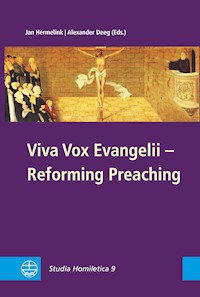
Viva Vox Evangelii - Reforming Preaching E-Book
Erhalten Sie Zugang zu diesem und mehr als 300000 Büchern ab EUR 5,99 monatlich.
- Herausgeber: Evangelische Verlagsanstalt
- Kategorie: Religion und Spiritualität
- Sprache: Deutsch
This volume contains the proceedings of an international homiletical conference, held in summer 2012 in Wittenberg (Germany). The theme "Viva Vox Evangelii – Reforming Preaching" focuses on the vivid and multivoiced performance of preaching; it is worked out by researchers from North and South America, South Africa, India as well as from North and Middle Europe. The contributions deal with the different social, political, cultural and religious contexts of preaching, and they reflect on the consequences for content and form of the respective sermon. Additionally, the volume gives examples of original sermons from various religious traditions. Many articles are responding to each other, so in effect the volume displays an inspiring view on the international research in homiletics today. Der Band dokumentiert eine internationale Tagung zur Predigtlehre, die im Sommer 2012 in Wittenberg stattfand. Das Tagungs-Motto 'Viva Vox Evangelii – Reforming Preaching', das den lebendigen, vielstimmigen Vollzug der Predigt fokussiert, wird von Forscherinnen und Forschern u. a. aus Nord- und Südamerika, Südafrika, Indien sowie aus Nord- und Mitteleuropa bearbeitet, und zwar nicht nur im Blick auf die Predigt selbst, sondern auch hinsichtlich ihrer ganz unterschiedlichen sozialen, politischen, kulturellen und religiösen Kontexte. Dazu kommt die Dokumentation exemplarischer Predigten aus verschiedenen kirchlichen Traditionen. Viele Texte beziehen sich dialogisch aufeinander, so dass insgesamt ein höchst anregendes Bild der internationalen homiletischen Forschung der Gegenwart entsteht.
Sie lesen das E-Book in den Legimi-Apps auf:
Seitenzahl: 871
Veröffentlichungsjahr: 2013
Das E-Book (TTS) können Sie hören im Abo „Legimi Premium” in Legimi-Apps auf:
Ähnliche




















VIVA VOX EVANGELII – REFORMING PREACHING
STUDIA HOMILETICA 9
EDITED BY JAN HERMELINK
AND ALEXANDER DEEG
Bibliographic information published by the German National Library
The Deutsche Nationalbibliothek lists this publication in the Deutsche Nationalbibliografie; detailed bibliographic data are available in the Internet at http://dnb.dnb.de.
© 2013 by Evangelische Verlagsanstalt GmbH · Leipzig
This work, including all of its parts, is protected by copyright.
Any use beyond the strict limits of copyright law without the permission of the of the publishing house is strictly prohibited and punishable by law.
Cover: Kai-Michael Gustmann, Leipzig
Typesetting: Steffi Glauche, Leipzig
E-book production: Zeilenwert GmbH 2016
ISBN 978-3-374-03305-8
www.eva-leipzig.de
PREFACE
Wittenberg: the small German town on the banks of the Elbe River is closely connected with Martin Luther and Philipp Melanchthon, with the rediscovery of justification by God’s grace alone, with new insights on Christian faith and Christian life – and in addition, Wittenberg is connected with a reformation of preaching. Celebrating 500 years of reformation in 2017, Wittenberg proved to be a most suitable place for the 2012 meeting of Societas Homiletica.
Viva Vox Evangelii: the Living Word of the Gospel is what Luther expected to be heard in sermons, hymns, and services. Of course, it is God’s word and it is the Holy Spirit’s transforming of the preachers’ words into a living word that creates new faith. But this does not mean that preachers do not have to care for their preaching. Just the opposite: In a church coming from Wittenberg, the reformation of preaching is a necessary task and ongoing challenge. Again and again preachers must find words that bring biblical texts and the complex realities of today’s world into conversation with one another.
Viva Vox Evangelii – Reforming preaching: in August 2012, more than 140 homileticians from all over the world met in Wittenberg to examine this theme from different perspectives. This book presents the results of that conference. In three keynote addresses the dimensions of language, ritual, and biblical exegesis were presented and discussed; in addition, five sermons from Germany, Sweden, India, South Korea, and the United States offer examples of homiletical practice; and nearly 20 research papers from Europe, the USA, South Africa, and India reflect on current challenges. Finally a North and a South American voice give their commentaries on the conference.
The Wittenberg conference was organized by the former President of Societas Homiletica, Prof.Dr.Jan Hermelink (Göttingen), by the International Secretary, Prof.Dr.Alexander Deeg (Leipzig), both in cooperation with the Wittenberg Center for Preaching and Homiletics of the Protestant Church of Germany, directed by Kathrin Oxen. We are very grateful for the support given to this meeting by the Wittenberg Center and its staff.
As editors, we express our gratefulness to all the contributors to the conference and to this volume. We especially want to thank Maximilian Baden, Marina Heuer, Alina Penninger, and Susanne Platzhoff for their work in the editorial process. This book was made possible through the financial aid of the Evangelical Lutheran Churches of Bavaria, of Hannover and in North Germany, the United Lutheran Church of Germany, and of the Evangelical Churches in Baden and in Central Germany. We thank these churches warmly for their help. We also thank our publisher »Evangelische Verlagsanstalt«. (Leipzig), and in particular Dr.Annette Weidhas for her cooperation.
Martin Luther once said: »We both, pastor and listener, are only pupils; there is only this difference, that God is speaking to you through me. That is the glorious power of the divine Word, through which God Himself deals with us and speaks to us, and in which we hear God Himself.«. (Sermons on the Gospel of St. John, LW 23, 98) May this book contribute to the international dialogue on preaching and hearing the living word of the Gospel.
Göttingen/Leipzig, March 2013Jan Hermelink and Alexander Deeg
TABLE OF CONTENTS
Cover
Title
Imprint
Preface
Jan Hermelink/Alexander Deeg
The Hand on the Book Address on Opening Evening
Kathrin Oxen (Wittenberg, Germany)
»Viva Vox Evangelii« – Preaching the Gospel in a multitude of Voices Presidential Address
Jan Hermelink (Göttingen, Germany)
KEYNOTE LECTURES AND RESPONSES
»In Principio erat sermo« Sermon as Act
Marilynne Robinson (Iowa City, USA)
Preaching God’s Wisdom Response to Marilynne Robinson
Alexander Deeg (Leipzig, Germany)
Symbols are not symbolic: Dynamic Voices in surprisingly living Rituals
Martin Modéus (Linköping, Sweden)
Response: Who is preaching – the preacher or symbols and rituals? A Response to Bishop Modeus
Raymond Khumalo (Kwa-Zulu Natal, South Africa)
»He, who wants to hear God talking, shall read the Holy Writ« Biblical Notes on hearing the Scripture and reading the Gospel
Jan-Dirk Döhling (Bochum, Germany)
»He, who wants to hear God talking, shall read the Holy Writ« Response to the paper by Jan-Dirk Döhling
J. Jayakiran Sebastian (Philadelphia, USA)
SERMONS
Predigt über Jeremia 4,1–10 (Opening Service) Key-Notes of the Sermon on Jer 1:4–10
Nikolaus Schneider (Düsseldorf, Germany)
Inner and outer – the skin (Sermon at Evening Service) Sermon at Societas Homiletica
Carina Sundberg (Norrkoping, Sweden)
If the lion roars, who will not fear? If the dog barks, who will not hear? Sermon on Matthew 15:21–28 (Evening Service)
Benaiah J. Premiah (Madras, India)
›The Gospel‹ and ›The Sword‹ Sermon on Hebrews 4:12–13 (Evening Service)
Choi Young Sil (Seoul, South Corea)
Sermon on Num 23,11–20 (Closing Service)
Dawn Ottoni-Wilhelm (Richmond, USA)
WORKING PAPERS
The Preacher as ›diakonos‹ according to John 12:26
Gert Breed (Potchefstroom, South Africa)
The Living Voice of the Gospel? Re-Hearing a Prophetic Voice from Apartheid South Africa
Johan Cilliers (Stellenbosch, South Africa)
The Living Voice of the Gospel needs a Preacher
Marianne Gaarden (Aarhus, Denmark)
Metaphors and Preaching: Attending to the Literal
David M. Greenhaw (St. Louis, USA)
Reforming Preaching: Developing Collaboration between the Pulpit and the Pew
J. Dwayne Howell (Campbellsville, USA)
Overcoming the Harmless Sermon: Strengths & Weaknesses of Protestant Preaching
Bert de Leede/Ciska Stark (Amsterdam, Netherlands)
New Song Desired: Aesthetical homiletic and its reception in Hungary
Zoltán Literáty (Hungary)
The Re-formed Preacher Biblical Wisdom Literature as a Model for the Character of the Preacher
Alyce M. McKenzie (Dallas, USA)
A Theology of Preaching in Post-Christendom: Seeking a New Paradigm
Eunjoo Mary Kim (Denver, USA)
Viva Vox Evangelii. The Reforming of Preaching: A Liturgical Approach
Ben de Klerk (Potchefstroom, South Africa)
»Obedience to God« Preaching through the lenses of Social Identity Theory
Ian A. Nell (Stellenbosch, South Africa)
Exegesis and Homiletics: A Double Look at the Pericope of Mark 9:14–29 (17th Sunday after Trinity)
Jantine Nierop/Helmut Schwier (Heidelberg, Germany)
The Preaching with the Refrain
Ivan Petrović (Zagreb, Croatia)
Preaching to Dalits: A New Look for Relevance
John Prabhakar (Hyderabad, India)
Describing together New methods and teaching concepts in continuing homiletic education for pastors in the Evangelical Lutheran Church of Norway
Tore Skjæveland (Ulset, Norway)
Easter on Twitter – a digital pilgrimage on the mobile
Christian G. Sørensen (Aalborg, Denmark)
Aiming at Change The Transformative Dimension of Preaching
Manuel Stetter (Tübingen, Germany)
Reformation Roots of Prophetic Preaching: A Comparative Study between U. S. and South African Homiletical Approaches
Nora T. Tisdale (Yale, USA)/ Fritz de Wet (Potchefstroom, South Africa)
Reforming Preaching in Light of the Environmental Crisis
Tom Troeger (Yale, USA)
The Friend and the Stranger A Homiletic Model
Kerstin Wimmer (Lund, Sweden)
FINAL COMMENTARIES
The Viva Vox Evangelii in Latin America: Some reflections on Homiletic in the context and some impressions from the participation in the Societas Homiletica conference
Júlio Cézar Adam (São Leopoldo, Brasil)
Closing Comments Viva Vox Evangelii, 2012
Lucy Hogan (Washington DC, USA)
More books
Footnotes
THE HANDON THE BOOK
Address by Rev. Kathrin Oxen
Director of the Wittenberg Institute of Preaching and Homiletics at the Opening Reception
The hand on the book, the open book. There is the hand lying on it – or is it in the book? He has left his hand there, though just now he is not looking at the book, but at the people. Is his finger searching for a line and staying in touch with the words? Is this a gesture of »making sure«? The spoken words sail out through space. They are so free, almost frighteningly free. But the written word is different, fixed on the page. It is something to hold on to, to be sure of. Must the hand be there, on the book?
A detail, a section from the predella of Lucas Cranach’s reformation altar. All of you will see this detail on our convention folders and hymn sheets – and of course in the original when you visit the Town Church here in Wittenberg. And there you will see the entire picture: Martin Luther preaching the gospel and with his other hand pointing to Christ on the cross. The hand in the book is a detail.
Here in Wittenberg we are, to be sure, in a very historic place, but we should not forget that Societas Homiletica comes together in the year 2012. Therefore, let me quote from a source that is increasingly popular also among sermon writers today: Wikipedia, German version, article »Detail«:
»Often the sense and purpose of a text, a picture or another object of contemplation or discussion is better revealed by looking closely at specific details.«
The hand on the book is such a detail. And I believe it is the detail which can help us understand the sense and purpose of this conference. The hand on the book is the reason for packing suitcases and locking doors; it allows us to catch the right train or hail a taxi. It waits with us at the check-in counter and helps us endure long hours in airplanes over the ocean. The hand on the book.
Societas Homiletica has come together in a place from which vitality and strength went forth to wake up what was almost dead, in church and society. And it began with a man who opened a book and placed his hand on it to feel the life that was inside. Not just to confirm everything he already knew, not just to be sure that everything he said was right.
The hand on the book is able to feel life – strange, pulsating, intractable life. A pulse that is contagious, a discovery that makes the heart beat faster and opens our mouths to speak.
We have all come to Wittenberg to do something that he did five hundred years before us: to place our hands on the book. To feel its pulse. To see if it is alive. Viva vox evangelii, the living voice of the gospel, the word that is alive and strong.
Now after nearly five hundred years new impulses for preaching the gospel are to go forth from Wittenberg. I am the director of the »Wittenberg Institute of Preaching and Homiletics« which was founded here in 2009 by the German Evangelical Church. The hand on the book, the work with the Bible – that is one detail of our mission, but also the hand on the sermon manuscript and the hand that signals encouragement to the preacher and pats him on the back.
We are a kind of emergency room for the sermon of today, asking: Is there still life in it? Can we feel a pulse in the words we preach? Can they reach out to touch people or even bring them back to life? And we all look forward to the coming days and the wonderful chance to feel each other’s homiletic pulses!
The hand on the book is a detail. It is the sense and purpose of this conference. To feel whether a heart is beating – and if the vox evangelii is still alive and well. That is why we are here. A sincere welcome to you all!
»VIVA VOX EVANGELII«: PREACHING THE GOSPEL IN A MULTITUDE OF VOICES
Presidential Address1
Jan Hermelink
Dear participants of this 10th international conference of Societas Homiletica, dear colleagues, dear sisters and brothers in Christ:
In 1523, a new voice was heard in Wittenberg – the voice of Martin Luther. Certainly, in 1523 Luther had already been teaching here for more than 10 years. Six years prior to that, he published the 95 theses against Indulgences. For many years, he preached in the Town Church at least twice a week and published dozens of sermons, tracts, theses.
But again: In 1523, the voice of Luther was heard as a new voice, surprising himself – and also strongly impressing the public.
After having taught, preached and written for a long time, and being nearly 40 years old – in the summer of 1523, Luther wrote his first song: »By help of God I fain would tell«.2
This is a ballad responding to the burning of two young Augustinian friars in Brussels who where in fact the first martyrs of the evangelical faith. Luther’s song, a lament and also a protest song, was published as a leaflet; it spread rapidly from market to market, from mouth to ear – reporting and proclaiming, accusing the sophists and preaching the new faith.
Luther’s voice, which so far had been heard in sermons and disputations that were read by many people, became a new voice in public: a voice that sings.
Watching the enormous effect of his first chant, in the same year Luther felt the urge to write a second song: »Dear Christians, one and all,rejoice«.3 In this song he put into practice what he had written shortly before in his preface to the September edition of the German New Testament: »Gospel, Euangelion – this is a Greek word, it means in German: good message, good tale, good news, good clamor that is sung, spoken and excited.«4
Luther’s song is pure Gospel. Indeed, it is the good news in music and verses. The living voice of the Gospel is sung and said here – and, at the same time, it is Luther’s own and unique voice, which is to be heard here. It is his theology, his teaching and preaching – sung and spoken.
So at the beginning of our conference on »The living Voice of the Gospel«, before reflecting and doing research on that voice – let us join in with Luther’s voice, by lending to it our own voices. Let us sing, let us raise our voices and rejoice, as Luther invites us to do.
Dear Christians, one and all, rejoice,
with exultation springing,
And, with united heart and voice
And holy rapture singing,
Proclaim the wonders God hath done,
How His right arm the victory won;
Right dearly it hath cost Him.
2. Fast bound in Satan's chains I lay,
Death brooded darkly o'er me,
Sin was my torment night and day,
In sin my mother bore me;
Yea, deep and deeper still I fell,
Life had become a living hell,
So firmly sin possessed me.
3. My own good works availed me naught,
No merit they attaining;
Free will against God's judgment fought,
Dead to all good remaining.
My fears increased till sheer despair
Left naught but death to be my share;
The pangs of hell I suffered.
4. But God beheld my wretched state
Before the world's foundation,
And, mindful of His mercies great,
He planned my soul's salvation.
A father's heart He turned to me,
Sought my redemption fervently:
He gave His dearest Treasure.
5. He spoke to His beloved Son:
'Tis time to have compassion.
Then go, bright jewel of My crown,
And bring to man salvation;
From sin and sorrow set him free,
Slay bitter death for him that he
May live with Thee forever.
6. This Son obeyed His Father’s will,
Was born of virgin mother,
And God’s good pleasure to fulfill,
He came to be my Brother.
No garb of pomp or power He wore,
A servant’s form, like mine, He bore,
To lead the devil captive.
7. To me He spake: Hold fast to Me,
I am thy Rock and Castle;
Thy Ransom I Myself will be,
For thee I strive and wrestle;
For I am with thee, I am thine,
And evermore thou shalt be Mine;
The Foe shall not divide us.
8. The Foe shall shed My precious blood,
Me of My life bereaving.
All this I suffer for thy good;
Be steadfast and believing.
Life shall from death the victory win,
My innocence shall bear thy sin;
So art thou blest forever.
9. Now to My Father I depart,
The Holy Spirit sending
And, heavenly wisdom to impart,
My help to thee extending.
He shall in trouble comfort thee,
Teach thee to know and follow Me,
And in all truth shall guide thee.
10. What I have done and taught, teach thou,
My ways forsake thou never;
So shall My kingdom flourish now
And God be praised forever.
Take heed lest men with base alloy
The heavenly treasure should destroy;
This counsel I bequeath thee.
Clearly, it is Luther’s own voice with which we join here in singing. It is his style of speech, his manner of preaching and teaching: quite elementary and highly dramatic, using plenty of biblical metaphors, appealing to the affects and emotions of the audience.
Also, this song gives voice to Luther’s theology: the uselessness of »good works«, the false concept of »free will«. (see verse 4), and, correspondingly, the warning against »base alloy«. (see the last verse) – to put it simply: against the bad mixture of Gospel and Law that would destroy the pure grace from heaven. – And in the middle of the song, Christ’s work of salvation is beautifully summarized: »I am with thee, I am thine – and evermore you shalt be mine« – a joyous exchange in the language of love and engagement.
The song gives voice to Luther’s insight: The Gospel is something spatial: While the sinner is falling »deep and deeper«. (verse 2), Christ is coming near to him. Also, the Gospel is something corporal: It is flesh and blood, admixed with our flesh, more intensely than in sexual acts – and so, as the song tells and enacts, the Gospel itself is a performance, a dramatic event, or more specifically it is an event of conflict and combat against devil, sin and death.
The Gospel as performance, as a dramatic event: Luther’s song places that experience not least of all in the liturgy: in the church festivals of Christmas (verse 6), Good Friday and Easter (verse 8), Ascension and Pentecost.
The Gospel as event, as dramatic combat and glorious victory – this good news must be sung with a melody that is itself highly dramatic. In Luther’s song the Gospel is realized as a song of death and life, as a musical reverberation of mercy and salvation.
The Gospel in itself is an act of speaking and listening – we all have learned that from Luther and Calvin, and in this song we are reminded of this, using the concept of voice and sound. The Gospel must be proclaimed (see verse 1), »with united heart and voice«, because it is a voice in itself: it is God speaking here, with mercy and compassion, to his beloved Son; and – even more – the Gospel is giving sound to the voice of the Son: it is the »ipsissima vox«, the living voice of Christ which is sung and spoken here for no less than four full verses.
The Gospel must be sung and spoken; it must be preached, heard and answered because it is a dialogue in itself, an interchange of divine voices – this fundamental insight of Luther is enacted here.
»Viva Vox Evangelii«, »the living voice of the Gospel« – is fundamental to Luther’s theology. Therefore it is a theology of preaching, of speaking and singing chants. It was this theology that provoked the Reformation – being a movement of voices, of preaching and singing.
So, in the horizon of Luther’s song that we have just sung, or even better: in the sound space of that song, I’d like to develop more explicitly how Luther’s theology of the Gospel also provoked a new art of preaching. I want to give some indications of what that may mean in the actual context of Germany and its churches – and also in the course of our conference.
With Luther’s song in our ears, we may hear seven motives or phrases, seven variations on preaching the Gospel’s voice.
A) Essentially, the Gospel is a voice. It is an interchange of divine voices, as modeled in Luther’s song. So also preaching is nothing other than giving a voice to the Gospel with my own voice.
But before we start to preach, and before we start to reflect on preaching, we should – as the Gospel is a voice event – start with hearing. For Luther it is fundamental – as we all know – that faith comes from hearing (Rom 10:16). Faith begins with listening to the living voice of the Gospel – so faith does not begin with working, and also it doesn’t begin with preaching, nor with teaching theology, nor with reading homiletical textbooks.
I think this is also important to recognize at the beginning of this conference. A lot of people have made great efforts to prepare lectures and sermons, to write papers and responses, and all of you have made great efforts, and offered time and money, to attend this gathering.
But now it is time for hearing. It is time for listening – listening to the scholarly insights delivered in the next few days. We will discuss these lessons intensely, in the reflection groups and in other contexts, but we should not forget: Hearing comes first.
The Gospel is a voice. Faith comes from hearing this voice. These concepts are fundamental for Luther’s preaching, because faith is a matter of the heart. Faith is a matter of the will. It is a matter of the intellect, too, but basically it is a matter of the heart.
Therefore, the Gospel must be spoken and sung, it must be narrated, brought into images and metaphors before it is brought to specific practice and thoughtful theory. Consequently, singing may be even more important than preaching, as singing goes directly to our hearts, bodies and souls.
Thus faith starts with hearing; with the heart’s listening to the Gospel’s living voice. Therefore I am happy that this conference will give us many opportunities to listen to sermons preached from different cultural backgrounds – from Germany and South Korea, from India and Sweden, from the United States. And we will listen to sermons in various cities, receiving an impression of the living voice of the Gospel in Germany.
B) Luther’s Gospel song gives sound to a dramatic interchange of voices: the divine Voices of God the Father and God the Son – and a human voice giving sound to that dialogue. The Gospel is a voice, sung and spoken by human voices. So also preaching is done by a human voice, and it reflects the preacher’s human condition.
It is quite obvious that Luther’s song gives voice to his own personal experiences. The song gives sound to an »I« which was bound »in Satan’s chains«; the sin is »my torment«, and it is I who fell »deep and deeper«. (verse 2). It is easy to relate these words to Luther’s own torment and despair, as he labored here in the Wittenberg cloister, reading the Mass and studying Scholastic theology. At the core of Luther’s theology, and at the core of his preaching, there is the situation of a person tormented by sin – and justified by Divine Grace: »My innocence shall bear thy sin; so art you blest forever«. (verse 8).
Luther’s preaching is deeply personal, it is giving voice to a peculiar biography, to a specific experience with God – and it is easy to imagine the specific voice which belongs to that experience.
To reform preaching (i. e., in Luther’s song and theology), to speak with my own voice, is to speak with my own body and soul – tormented and lifted up, falling to hell and comforted by the divine voice.
Preaching the Gospel is to be performed with my own personal voice. So it is not just by chance that many papers submitted to this conference are dealing with the person of the preacher. The preacher’s wisdom is discussed, as is her mandate to be a prophet, a diacon and a fool. These papers invite us to reflect upon the specific qualities of the preacher, his personal figure, her specific voice.
Of course, we have to bear in mind Luther’s warning against concentrating too much on the preacher’s personality – because it is not the preacher’s life, but his teachings, her ›doctrina‹ that are decisive for my own faith.
But if preaching is a matter of voice – what could be more personal than a woman’s or a man’s voice? Even if I try to exclude my personal context and experiences from my words – the voice I’m preaching with, its tension, colour, rhythm and modulation – all of this will inevitably reveal my emotional situation, including the state of my particular body and soul.
The own voice of the preacher, his or her personal experience as a precondition for the sermon’s impact – this issue is significant also for the church’s situation in Germany.
As in most modern societies, the images of church and religion in Germany are shaped by mass media. Whether or not they like it, the local pastor and preacher in Leipzig or Wittenberg are compared to images of pastors and preachers viewed on television.
We know that the church is represented by individual persons and Christian faith is embodied by specific voices – may it be Margot Käßmann, Nikolaus Schneider, or (not least) the German Pope Benedict. Faith is embodied by Episcopal persons as well as other voices of the church’s leadership in Germany.
Quite clearly this situation is a highly ambivalent one. If the bishop is preaching, the church may be full, the public may be impressed. But the next Sunday, whether in Wittenberg, Berlin, or in a small village, Ms.Mueller or Mr.Schmidt will preach and their voices will only be heard by a handful of people.
In any case, when we reflect on the reform of preaching we must also address the preacher’s own voice, his or her personal experience, as well as the duties and the specific promises made to me, to the preacher: »What I have done and taught, teach thou, […] so shall my kingdom flourish now, and God be praised forever.«. (verse 10)
C) The specific experience which is spoken of in Luther’s song clearly has a specific structure. The song tells of Satan, of »brooding death« and »living hell«. And we also sang of the devil led captive (verse 6), of being comforted in trouble (verse 9) and being »blessed forever«. (verse 8).
In fact, the voice of this song is shaped by a strictly theological pattern: the pattern of despair and salvation, of contest and certainty, and behind that: the pattern of Law and Gospel.
For Luther, as we know, this pattern yet again is a pattern of voices. Not only is the Gospel a voice, but also the Law, the law of God, is given voice. Law is giving the order to do »good works«. Divine commands are heard here: ›Do that – don’t do this!‹ But: »My own good works availed me naught«. (verse 3).
Instead, the Gospel that is sung in Luther’s song is essentially a voice giving promises (see verses 7–9): »Thy ransom I myself will be« – and the Spirit, who »shall in trouble comfort thee.«
Preaching then, in Luther’s perspective, is giving voice to these promises and, prior to that, to those troubles. Preaching is giving sound to the desperate fight against »God’s judgment«. Then we hear and sing of Christ’s wrestling with the devil and death.
Preaching also must give voice to the manifold struggles and disputes of human life. »Preaching as shaping experience in a world of conflict« – this was the theme of the Societas Homiletica’s 6th International Conference, held in Singapore in 2004,5 and this theme has shaped and determined the Societas’ meetings since then: »Preaching […] in a world of conflict« – whether in Pretoria 2006, where we heard of the socio-political conflicts in Post-Apartheid South Africa, or in Copenhagen 2008 or in Yale 2010, where we heard of the troubles and divisions in the midst of those affluent societies.6
In the midst of these and other conflicts, preaching dares to ask for Law and Gospel. In the midst of our troubles, in society as in individual life, preaching gives voice to the struggle and despair suffered throughout the world.
And then preaching dares to say: Our despairs must be heard as the consequence of sin, as the Devil’s work, also. This is a risky venture: to name the divine Law in those conflicts, to give voice to the fatal despair which is caused by human will exerted against God’s will. – It may also be a risk to preach the Gospel, this clear voice of comfort: »Be steadfast and believing: Life shall from death the victory win. My innocence will bear thy sin.«. (verse 8)
By preaching Law and Gospel, we enter into the battles and troubles surrounding us, we join the voices of despair as well as the voices of hope.
With this in view, it is significant that many papers presented at this conference deal with the troubles and conflicts of contemporary societies – giving voice to the environmental crisis or to social injustice in India, in East Asia and in South Africa.
Preaching the living voice of the Gospel must be substantiated through clear words. Preaching has to name plainly and lament clearly, as Luther did with his first song. Preaching is giving voice to the troubles – and promises of today.
Again, let me say a few words about trouble and despair in the German situation, and also about promise and hope.
I think the basic experience to which preaching can refer in the context of Wittenberg, is an experience of liberation. Although this is sometimes disputed, for most people it is obvious: the so called ›Wende‹, the turnaround of 1989/90 when the Wall between East and West Germany collapsed, this political turnaround meant a liberation in social life as well as many individual lives.
The ›Wende‹ was prepared and supported by many church activities: Many groups urging political reform first met in parish houses, many pastors were members of those groups, advocating for social change and civil rights. And in the months of turnaround, many sermons focused on the revolutionary changes in politics, economics and social life.7
There were many promises given in the context of the 1989 ›Wende‹: promises of landscapes flourishing, economically and socially, promises of flourishing churches, too, with many people joining again after having been forced to leave the church under the socialist party’s regime.
As you may see for yourselves in the city of Wittenberg, many promises have been fulfilled, at least in terms of economics and public well-being. Most houses are restored, streets are repaired, and even electronic data lines are in good condition. On the other hand, in the next few days you may notice that there is a lack of economic activity in East Germany: many companies have closed down, the rate of unemployment here is nearly double the amount of that in West Germany. There are also many social issues here, as the East German states face serious problems with right wing extremist movements.
Even more than these troubles there is a sense of disappointment in the church. The hope for full churches and the promises of flourishing parishes have not been fulfilled. On the contrary, the churches in East Germany are struggling with a steady drop in attendance and membership and consequently they are struggling with huge financial problems – although the economic crisis menacing Europe has not reached our churches to date. Nevertheless, the Christian churches in Leipzig, Wittenberg, and Berlin have had to reduce their personnel, close down churches and reduce the number of parishes as well.
These concerns about money and pastoral work are absorbing a lot of the church’s energy – you may often hear about that during our time in Wittenberg. Also the church’s preaching sometimes is preoccupied with these troubles, and so it is at risk dimming the light of Grace. Sometimes there is more lamenting than rejoicing in our preaching; the voice of fear is sometimes louder than the voice of the Gospel.
It is therefore all the more important that this conference reminds us: The Gospel’s voice is a voice of comfort in trouble, a voice of certainty in all despair. So preaching has to name our fears as well as God’s promises to overcome them; it is giving sound to a disturbance which will be calmed.
D) The Gospel is a voice in itself. Therefore, it is both intensely personal and necessarily related to our shared struggles and problems. The Gospel surely leads the preacher and congregation together into shared ministry.
But, according to the model we usually adopt in thinking on preaching, one person is speaking – and ›the audience is listening‹. This obviously is not the image Luther has in mind when he is teaching, preaching and singing the Gospel. Therefore, in a fourth variation on the theme of the »living voice«, let me turn again to Luther’s Gospel song of 1523.
From its very beginning, this song clarifies that the appropriate way to preach (or better, the way to »proclaim«) the Gospel is not using an individual voice alone: »Dear Christians, one and all, rejoice« – it is a group, it is a crowd that Luther is speaking of here. Even better, it is a choir of Christians encouraged to »proclaim the wonders God has done.«
The song also clarifies the reason for that many-voiced way of preaching: God’s own work isn’t done mono-voiced, it is the Father speaking – in fact singing – to his beloved Son, the son addressing me, and the Holy Spirit, sent to be the divine voice in everyone’s mind, heart and body.
The Gospel is a many-voiced event in itself, and so is its teaching and proclaiming. There may be one person composing the Gospel’s music and writing the lyrics– but there are many, »one and all«, who adopt the tune. We all have to join in singing the song’s verses that address divine and human beings.
The Gospel and its preaching include a multitude of voices. We know that this model also applies to Luther’s own practice. His style of preaching is dialogical: giving voice to the sinner, to the skeptic and the despaired; giving voice to Christ, commanding and promising; giving voice to the soul, believing and rejoicing.
This inner and outer dialogue arises out of Luther’s reading the Bible as well as his reading of commentaries and other voices of tradition – and his preaching arises out of theological disputes, teaching in the seminary and at the Round Table. Luther’s theology of the Gospel emerges out of his longterm conversations with colleagues and friends, students and opponents.
So Luther’s preaching represents not just one voice but an outpouring of a multitude of voices, and it is answered by a multitude of voices, also – the voices of the hearers, passing along Luther’s words (including his songs) to their families and neighbors, and the voices of the city’s councilors and the various sovereigns, intensely debating the social consequences of that preaching.
There is an enduring conversation, an ongoing discussion, and a polyphony of voices related to preaching, and it is precisely in the midst of this polyphony of human voices that the Gospel can really be heard.
It struck me as quite remarkable that some of the workshops of this conference deal with the issue of polyphony: for example, a workshop on the socalled ›Bibliologue‹. Also, many of the papers deal with dialogues and conversations related to preaching: for example, papers on the »collaboration between the pulpit and the pew«, a paper which empirically explores sermon listening as an »inner dialogue«, and a paper »describing sermons together« in a pastor’s group as part of continuing education.
All of these contributions respond to the Reformation’s insight that preaching the Gospel is not a monological event but a polyphony of voice and listening, of manifold hearing and many-voiced singing.
Not least of all, this renewal of preaching implies a specific image of the congregation. In hearing the Gospel’s voices, the hearers also are constituted as a polyphony. They are constituted and renewed as an association of equal voices that must pass along the Gospel to one another and to society at large.
Let me turn again to the present context of church and society in Germany. The Reformation’s impulses I outlined here have given quite a polyphonic structure to the Evangelical church, especially today. Not only may each pastor be understood as the local bishop and each theologian may act as the ›magisterium in persona‹, but also in public, protestants may be heard in diverse voices, with diverging positions, regarding, e.g., bioethics and the issue of circumcision, which is at this time fervently disputed in Germany.
In the last decade, the polyphony of Protestantism has been criticized by many church leaders: The church, they say, should exhibit a more »evangelical profile«. It should become more decisive, more assertive in a society which is becoming in itself more and more pluralistic, multicultural and multireligious – also bearing in mind that since the reunification, nearly every third German is not attached to any religion at all.
Because this religious diversity frightens many Christians, there is a tendency to favor a mono-voiced church: a church with strong leadership, a church with mono-voiced authority in the bishop’s office as well as the pulpit.
As I understand it, this idea contradicts the Reformation’s image of the church as a cooperative association of equal hearers, as a polyphony of voices. In my view, the image of a church singing with united heart and in many voices, the church of the Reformation, being »pluralistic on principle« – as the Systematic Theologian Eilert Herms has called it8 – this polyphonic church could provide society with a model with which to face its own pluralism and religious polyphony.
The church is pluralistic, it is polyphonic on principle because preaching the Gospel in itself is a matter of many voices. Preaching is an ongoing conversation, a living network of listening and responding.
I am pleased to say that this polyphonic principle is modeled by this international conference: what a multitude of voices, what a polyphony of Gospel voices may be heard among us! The Evangelical Church as polyphony: it is precisely this idea that will be realized during our time together in Wittenberg as we will hear many different voices, during lectures and worship, workshops and excursions, arguing, debating and listening for the Gospel‘s voice in everything we share with one another.
E) The Gospel is a voice event – so it must be spoken and sung with human voices and it must be preached and heard in a polyphonic way. This foundational argument of the Reformation generates two further critical assertions.
First, the Gospel is a voice and therefore not a ritual. It is neither the eucharist nor the ritual of confession. Hence the Gospel cannot be dominated by an institution, neither by the church ruling on the ritual nor by the priest who may decide whether to grant absolution. Being a living voice, the Gospel must not be contained or governed by the church’s organization, a political program, or even in a system of theology.
Second, because the Gospel is a living voice, Luther insists that it is an unwritten message, inscribed neither in a book nor a stone. While the message of Law must be written, the Gospel’s message is to be orally sung or spoken.
So the Gospel is not written, neither in theological books nor in church instructions, although both may be important to understand the divine dialogue. Also the Gospel cannot be found directly in the Bible, as if it were present without spoken proclamation. No, the biblical texts are bound to become oral voice, immediately addressing us again. Jan-Dirk Döhling’s keynote address further develops this theme in his presentation on ›Hearing the Scripture‹9.
The Gospel is not a written message, so it is also not to be found in religious treatises, essays or poems. Although Luther owed his public notoriety to his written sermons and his tracts and pamphlets in particular, he vigorously insisted that the Gospel must be heard orally; that all of our writings are bound only to provoke dispute and fresh conversation, to release a new polyphony of voices.
The Gospel, the »ipsissima vox« of Christ must be spoken and sung because it wants to go directly to the heart; it wants to reach the person immediately, without mediation. At its very essence, the Gospel is an actual event that directly addresses us with the voice and presence of Christ.
The oral nature of the Gospel provides an important reference point for our conference. In preparing for our meeting, there has been an enormous amount of writing: Lectures and other papers have been written, read and rewritten in advance. In addition, the organization and planning of this conference has included innumerable meetings, letters, and an endless stream of emails.
But now, I am happy to say that the time of writing and reading is over. Now that we are together in Wittenberg, it is time to deliver the lectures, preach and talk with one another – in small groups, as we walk along the streets or enjoy breaks between sessions. It is through these sounds that we may hear the voice of the Gospel here and now in Wittenberg.
F) Although the Gospel is not a ritual, it must be emphasized: The Gospel’s voice is not without a ritual. More precisely, the Gospel‘s voice cannot be heard without the sacrament, without encountering Christ in the performance of worship. This at least is Luther’s strong conviction: the Gospel cannot be heard without performing the sacrament of bread and wine.
Again, we may note this conviction in the Gospel song we sang earlier. Its dramaturgy is shaped by the Liturgical Year, from Christmas to Pentecost. In addition, this song is clearly intended for a liturgical context, requiring a congregation that sings, that voices and rejoices in the Gospel.
For the Christian church – including Reformed, Lutheran, Catholic and other traditions – encountering God is a joint performance. Hearing the Gospel is a corporate experience and a collaborative action culminating in the sacrament. Along similar lines, Martin Modéus will deliver a keynote lecture on »Dynamic Voices in surprisingly living Rituals«, and we are hardly surprised that there is some research present at this conference dealing with the relationship between liturgy and preaching.
The Gospel’s voice may not be heard without ritual: this is also an important emphasis of the Evangelical church, including the churches of East Germany. The Evangelical church traditionally sees itself as ›The church of the word‹, and that seems to mean: We are the church of sermons, discourse and public statements.
Meanwhile, with the help of practical theology, the church is learning that the Gospel’s voice is performed in the context of liturgy. Especially in a society saturated with diverse social media and mindful of events that feature considerable public staging, the church is reminded that the Gospel’s voice is to be staged also: in worship, in the congregations’ joint action, and not least of all in the church’s buildings.
It is one of to the most surprising experiences of the East German churches how important their buildings have proven to be. The old church buildings in many villages (many of which were run-down and seemed all but forgotten) are now seen as the town’s center, even its soul. They are reconstructed with a lot of voluntary work, often even by people who are not at all members of the church.
The Gospel’s voice needs a liturgy, and even more, it seems to need a place designed for liturgy. And at times, these places, the church‘s buildings, may sound more convincing than a lot of sermons.
G) Luther’s Gospel song gives sound to that voice as an oral event; a corporal and liturgical performance. So the song seems to emphasize: the Gospel is always addressed immediately to my heart, its voice is targeted directly to the person’s core, without any distance, without any doubt, and also without any reflection.
However, there are indeed traces of theological reflection in this song. Speaking of »good works«, and even more: speaking as if »free will« were a real person – this reveals a considerable amount of theological thought, and this is true also of that condensed verse at the song’s end: »Take heed lest men with base alloy/The heavenly treasure should destroy« – this is not the heart’s tongue, this is not the simple language of religion.
Obviously, Luther’s song is full of theology: it is full of complex thought and reflection. This is also true of Luther’s preaching: it is addressed to the heart, but at the same time, or better, in the same movement, the sermons are full of theological reflection.
In the Gospel song, we may see this in the way Luther portrays the narrator through use of the first person singular, »I«. This »I« articulates itself as bound and then as blessed and comforted. Obviously, these lines are the outcome of intense reflection. Articulating the heart’s trouble, its despair and relief, is only possible by using a highly complex apparatus of theological discourse.
The core of Luther’s theology, the discovery of the »it’s me« of faith, the invention of the believer’s self, who may sing and tell of his or her salvation – this is not the immediate result of the Gospel’s voice. Luther’s invention of the believer’s self is – as we know – the outcome of deep reflection as well as theological disputation. It arises from the enduring conversations in the Wittenberg faculty, the ›language of the self‹ emerges from the polyphony Luther experienced here in this place.
So my assertion that ›Preaching is giving voice to the Gospel’s voice‹ must in the end be modified. Preaching surely is not the immediate result of listening to the Gospel’s voice. This voice rather is mediated by reflection, implicit or explicit, and it is mediated by theology.
Singing the Gospel, and also preaching it, needs theological reflection; it needs some distance and a lot of critical reflection. It emerges out of this reflection, this sounding and resounding of theological thoughts.
You may hear that argument not least as the confession of a German theologian accustomed to reflection, emphasizing distance and also doubt. I’m saying this also as a member of the German church, glad that my church shows interest in theological reflection – for example by supporting institutions like the Wittenberg Center of Preaching and Homiletics, or by offering considerable financial support for conferences like this.
In my opinion, this conference may be viewed as an example of best practice in theology: listening to sermons, discussing and critically reflecting on various aspects of our theologies of preaching, and returning again to worship, to singing and hearing the Gospel again.
I will conclude this address by proposing three key questions that emerge from the thoughts on preaching the Gospel’s voice which I have described here. Each question applies to a specific context of all preaching. Those three questions may be useful for our working at this conference – and also for our homiletical work at home.
I) We have seen that the Gospel’s voice is inevitably preached amid the troubles of life – whether we encounter these troubles in the life of a whole society or amid particular life stories. I simply suggest that we first pay attention to the specific problems, tensions and conflicts which shape the different voices we will hear as well as the different ways in which we hear one another at this conference: let us consider the context of concern as we listen to one another.
II) For the Reformation, preaching the Gospel is anything but a one-voiced event. So let us be mindful of the multitude of voices that surround every sermon. There are many voices shaping the sermon’s preparation and many voices attending the sermon; in the liturgy and in the pew, there is a manifold resonance and dissonance that the preacher hopes for, fears and is sometimes surprised to discover: let us look in detail for this network of voices.
III) Finally, we should carefully attend to our reflections on the preaching we encounter here. There is always a context of theory shaping the preacher’s actions. Let us remember that we are working as theologians and look for the theoretical implications of our practice: for the hermeneutics, philosophy, and architecture of preaching. The Gospel is not least of all to be found in the context of reflection – and so let us listen together in a spirit of critical reflection for »the living voice of the Gospel« in this conference – and also in the book published in its aftermath.
KEYNOTE LECTURESAND RESPONSES
»IN PRINCIPIO ERAT SERMO«
Sermon as Act
Marilynne Robinson
For a century and more we in the West have been told that our experience of life is deficient, lacking something truly essential, to our happiness and also to our humanity. Oddly, it is the privilege of advanced education that generally induces us to accept this impoverished condition as inescapably our own. Again, oddly, the interpretation of our condition, which quite invariably includes loss of religious belief, puts its apparent antidotes, notably religious belief, beyond the pale on grounds of naivety, nostalgia and so on. Those who might not otherwise suffer from this affliction are coaxed into acknowledging that God, however essential he has been proved to be, to our happiness and our humanity, was nevertheless a creature of historical circumstance.
None of this has ever seemed true to me, or even logical. Nor have I been persuaded that human life was or could be less a marvel than it was when it was felt to address and celebrate the sacred, being itself sacred. So I have studied Scripture and theology, and I have gone to church. My tradition places great importance on the sermon, and I go in hopes of hearing something that acknowledges this deep old human intuition, this sense of the sacred. Often I don’t hear any such thing, but sometimes, more remarkably, I do. A good sermon is a pure, rare, strangely unworldly gift. How is the possibility of such a gift to be understood?
In his translation into Latin of the opening phrase of the Gospel of John, John Calvin followed Erasmus, and the earlier examples of Tertullian and Cyprian, in choosing the word Sermo rather than the word Verbum. It is clear from his Commentary that he found the more conventional translation lacking in substance and resonance, inadequate to the theological burden of John’s Logos. The English, »In the beginning was the Word«, is so familiar, so pleasingly straightforward, so sanctified by use, that it is hard now to think of it as insufficient, even though it is clearly a translation from the Latin, not from the Greek. Of course the whole world has changed, and Latin has receded so far in Western culture that associations that colored or burdened particular words in the 16th century are lost to us now. And over time the same words have acquired new resonances that elevate them.
Still, there is interest for me in the distinction Calvin insists on between Sermo, which he calls the sapientia Dei, and Verbum, which is for him the temporal or transient utterance that is the human voice of Divine Wisdom, a thing to be sharply distinguished from its essence and its eternal source. He says, »When the Scripture speaks of the Word of God, it certainly were very absurd to imagine it to be only a transient and momentary sound, emitted into the air, and coming forth from God himself; of which nature were the oracles, given to the fathers, and all the prophecies. [The Word of God] is rather to be understood of the eternal wisdom residing in God, whence the oracles and all the prophecies proceeded.« Christ for Calvin is the creative Wisdom expressed in the being of all things. In his translation and Commentary his concern is to insist on the ontological meaning of John 1. Christ, the Wisdom of God, is present in the order of being itself, as he »upholds all things by the word of his power«. (Hebr 1:3) and present as well in the testimony of the Ancient Prophets who »spake by the Spirit of Christ no less than the Apostles and all the succeeding ministers of the heavenly doctrine.« For him the very sinews of reality are made of the wisdom proceeding from this source, whether implanted in materiality with all its aspects and conditions, or spoken by those »ministers of the heavenly doctrine« who have been its teachers through the whole of Christian time. The knowledge of God and the knowledge of ourselves are an aspect of this wisdom that is sacramental in its reciprocity.
This is consistent with a metaphysics, an ontology, that runs through the whole of Calvin’s thought. It places humankind, and the most striking of human attributes, at the center of cosmic reality. The kind of thought that is often called modern forbids at least tacitly the acknowledgment of human exceptionalism, as if it were reasonable to exclude reality’s most exotic expressions from an account of the nature of reality. Science itself tells us not to overlook the effect of the observer on any observation, an effect including but not limited to bias. Yet a very primary datum, ourselves in our undeniable distinctiveness, is folded into statements about primates in general, or about the wiles and aspirations of genes, human and other. Thought, that gorgeous blossoming of consciousness so deeply interesting to earlier civilization, dropped away as an object of thought as a consequence of the strange idea that we are not appropriately described by the qualities that are unique to us. This idea has eluded scrutiny, having created an environment friendly to its own flourishing.
Ontology creates a vast and liberating space. To propose that the order of the universe at every scale is, so to speak, of one substance with words preached – assuming that these words bear some relation to truth – may seem arbitrary. Contained in it is the assumption that human beings bear a privileged relation to truth, one that allows them to find it, however gradual and partial the discovery might be, and also to speak it, however imperfectly it is discerned and expressed by them. Contained in it also is the assertion that the life proposed to us by faith, which is often said to run counter to the behests of our animal nature, actually finds its origins in a more absolute and essential reality, that is, in the Divine Wisdom that is the eternal source of all being.
It would seem, objectively speaking, that human beings do indeed enjoy a privileged relation to truth. Science bears this out, to offer what is surely the least controversial instance. Calvin makes the relationship between divine wisdom and human knowledge explicit: »Of [God’s] wonderful wisdom, both heaven and earth contain innumerable proofs; not only those more abstruse things, which are the subjects of astronomy, medicine, and the whole science of physics, but those things which force themselves on the most illiterate of mankind, so that they cannot open their eyes without being constrained to witness them. Adepts, indeed, in those liberal arts, or persons just initiated into them, are thereby enabled to proceed much further in investigating the secrets of Divine Wisdom. Yet ignorance of those sciences prevents no man from such a survey of the workmanship of God, as is more than sufficient to excite his admiration of the Divine Architect.« For Calvin, Divine Wisdom has the character of revelation. As it emanates from God it also reveals Him. And as we are able, within radical limits, to perceive and understand it as Wisdom, even to investigate it, we are participants in it. This ontology precludes all conflict among the varieties of knowledge. There is no devaluing of learnedness and inquiry on one hand and on the other no essential disability imputed to ignorance. The attributes of Wisdom are utter plenitude and perfect grace. It is justified in all its children.
My affinity for Calvin seems as remarkable to me as it has seemed to certain of my readers and critics. And when I propose his metaphysics as a model for thought, I do so in full awareness that there are other excellent models. Calvin produced an extraordinary body of theology and scholarship, which is so broadly neglected as to seem new, and at the same time so deep an influence on my religious heritage and my civilization as to seem as I read it like the awakening of submerged memory. So its satisfactions for me are no doubt particularly deep. Lately I have been turning my thinking toward the ontological Christ, the Christ-presence in Creation. Calvin says, »Were it not that [Christ’s] continued inspiration gives vigour to the world, every thing that lives would immediately decay, or be reduced to nothing«. (Comm. p.31). Emily Dickinson wrote, »All circumstances are the frame/In which His Face is set,/All Latitudes exist for His/Sufficient continent./The light His Action and the dark/The Leisure of His Will,/In Him Existence serve, or set/A force illegible.«
As is very often the case, I recognize that I have been more than anticipated in a thought that to me, for me, had seemed new. I was taught that the demythologizing of Christianity was a step forward, or at least such a deft strategic retreat that it came to the same thing. But since myth – never to be confused with fable – is ontology, since its terms attempt to describe the origins and nature of reality, Christianity was induced to excuse itself from explorations of this kind, to tend to its own truncated magisterium, or, to put the matter another way, to stumble forever at its own threshold, fretting over the issue of belief versus disbelief, having accepted garden variety credibility or plausibility as the appropriate standard to bring to bear on these reported intrusions of higher truth upon human experience. Calvin says, »All who are not regenerated [italics mine] by the Spirit of God possess some reason, and this is an undeniable proof that man was made not only to breathe, but to have understanding«. (Comm. p.33). Our strange, voracious brilliance is not less an anomaly on this planet than our propensity toward religious belief. Objectively speaking, there are no grounds for the tendency even in modern Christianity to make clean distinctions between these impulses, let alone to oppose them.




