


28,99 €
Mehr erfahren.
- Herausgeber: Packt Publishing
- Kategorie: Wissenschaft und neue Technologien
- Sprache: Englisch
If you’re familiar with the progressive Vue framework for creating responsive user interfaces, you’ll be impressed with its latest iteration, Vue 3, which introduces new concepts and approaches design patterns that are uncommon in other libraries or frameworks. By building on your foundational knowledge of Vue 3 and software engineering principles, this book will enable you to evaluate the trade-offs of different approaches to building robust applications.
This book covers Vue 3 from the basics, including components and directives, and progressively moves on to more advanced topics such as routing, state management, web workers, and offline storage. Starting with a simple page, you’ll gradually build a fully functional multithreaded, offline, and installable progressive web application.
By the time you finish reading this Vue book, not only will you have learned how to build applications, but you’ll also understand how to solve common problems efficiently by applying existing design patterns. With this knowledge, you’ll avoid reinventing the wheel for every project, saving time and creating software that’s adaptable to future changes.
Das E-Book können Sie in Legimi-Apps oder einer beliebigen App lesen, die das folgende Format unterstützen:
Seitenzahl: 429
Veröffentlichungsjahr: 2023
Ähnliche



















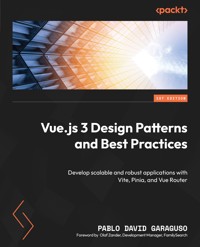
Vue.js 3 Design Patterns and Best Practices
Develop scalable and robust applications with Vite, Pinia,and Vue Router
Pablo David Garaguso
BIRMINGHAM—MUMBAI
Vue.js 3 Design Patterns and Best Practices
Copyright © 2023 Packt Publishing
All rights reserved. No part of this book may be reproduced, stored in a retrieval system, or transmitted in any form or by any means, without the prior written permission of the publisher, except in the case of brief quotations embedded in critical articles or reviews.
Every effort has been made in the preparation of this book to ensure the accuracy of the information presented. However, the information contained in this book is sold without warranty, either express or implied. Neither the author, nor Packt Publishing or its dealers and distributors, will be held liable for any damages caused or alleged to have been caused directly or indirectly by this book.
Packt Publishing has endeavored to provide trademark information about all of the companies and products mentioned in this book by the appropriate use of capitals. However, Packt Publishing cannot guarantee the accuracy of this information.
Group Product Manager: Pavan Ramchandani
Publishing Product Manager: Jane D’Souza
Senior Content Development Editor: Feza Shaikh
Technical Editor: Saurabh Kadave
Copy Editor: Safis Editing
Project Coordinator: Manthan Patel
Proofreader: Safis Editing
Indexer: Manju Arasan
Production Designer: Ponraj Dhandapani
Marketing Coordinators: Anamika Singh, Namita Velgekar, and Nivedita Pandey
First published: May 2023
Production reference: 1240423
Published by Packt Publishing Ltd.
Livery Place
35 Livery Street
Birmingham
B3 2PB, UK.
ISBN: 978-1-80323-807-4
www.packtpub.com
To Elizabeth, Adele, Gabriel, and Eleonora, my wonderful children, whose love and affection kept me going every day. I truly believe the world is a better place because of them.
– Pablo David Garaguso
Foreword
Does the following situation sound familiar to you?
You are invited by a friend to a dinner party. A delicious meal is served, and everyone enjoys the evening. Something about the meal – the combination of flavors – tastes extra special. You want to recreate the meal for yourself to impress your own family and friends. You almost don’t dare to ask, but when you do, your host tells you happily about their “secret” method. However, they are an experienced chef and what is simple for them sounds complex to you. Since you feel unsure where to start, your host assures you they will write down and explain all the steps so you can learn how to recreate the meal. By the end of the evening, you have the information you need to produce something special on your own.
By now, you might know where this is going. You chose this book because you are interested in web development. Looking at the field as a whole may feel overwhelming, and you need a clear explanation of the smaller components so you know where to start. Combining the right ingredients (here, libraries and frameworks) with the guidance of an experienced “chef” will enable you to set off on your own journey.
Luckily, you have found a guide written by a master in his field. In my time with Pablo Garaguso, I’ve found him to have the “magic sauce” that allows him to come to impressive solutions quickly. He applies his knowledge and creativity to inspire his team members. Moreover, he is a wonderful teacher and willing to share freely. He gives you the background information you need to understand how and why to do things a certain way. By following his advice, you will gain a deeper understanding of web development and not only be able to apply the principles in this book but also start to experiment with them and create your own solutions for future projects.
Pablo provides information on setting up a project, constructing UI components, creating single-page apps and progressive web apps, data flow, multithreading, common UI and UX patterns, testing, source control, and deploying your application. He even includes helpful hints on migrating from Vue 2 to Vue 3.
I hope you will enjoy working through the examples provided as much as I did.
I invite you to join in on this journey of discovery!
Olaf Zander Development Manager, FamilySearch
Contributors
About the author
Pablo David Garaguso was born in Argentina, and since he was a child, he had a special interest in computers. He programmed his first game at the age of 12 years old, and since then, his interest only kept growing. As an adult, he graduated in computer sciences from CAECE University, Mar del Plata, with a specialty in human-computer interfaces. Later in life, he went back to school to work on his MBA at CEMA University, Buenos Aires, with a specialization in corporate entrepreneurship and management. He worked in South America and Europe for almost 20 years in multiple positions. He discovered Vue early on, but it was not until version 2 that he adopted it for his projects. He currently works as a solutions architect and full-stack engineer in Finland, where he resides with his children. His software solutions are used all around the world in specific areas. In his limited spare time, being a natural storyteller, he is also an author of interactive fiction and novels.
About the reviewers
Fotis Adamakis is an experienced software engineer with a strong background in JavaScript, testing, and accessibility. He is proficient in writing clean, maintainable code for large-scale applications, following best practices and industry standards. Fotis has a particular passion for Vue and has developed a high level of expertise in using it.
Aside from his technical skills, Fotis is also a skilled author and speaker on frontend development topics. He has been invited to speak at various conferences, where he shares his knowledge and insights on the latest trends in the field.
He continually seeks new challenges and opportunities to grow and expand his skills.
Simon Nørlund Eldevig is an experienced frontend engineer who has worked in frontend development for over 7 years. His extensive experience has made him an expert in building scalable and responsive web applications.
Throughout his career, Simon has worked with a variety of clients, ranging from small to large enterprises, helping them to develop elegant and user-friendly interfaces. He takes great pride in staying up to date with the latest trends and technologies in frontend development, which has allowed him to create cutting-edge solutions.
Simon is a true frontend enthusiast, which is why he’s also an organizer of Vue.js meetups in his local community.
Tamrat Assefa is a full-stack developer from Addis Ababa, Ethiopia. He has a bachelor’s degree in software engineering from Addis Ababa University. After landing small projects for local clients while still in school, Tamrat quickly jumped into the web development scene. He has been developing web applications for more than 7 years now and has a very deep knowledge of Vue.js, his favorite JavaScript frontend library. When he is not building features and squashing bugs, you can find him working on cars or playing his favorite game, Dota 2.
Table of Contents
Preface
1
The Vue 3 Framework
The progressive framework
Using Vue in your web application
The bundler way, a better way...
Understanding single-file components
Different strokes – options, composition, and script setup API
Exploring built-in directives in Vue 3
v-bind: (shorthand ":")
v-show
v-if, v-else, and v-else-if
v-for and :key
v-model
v-on: (and the shorthand @)
Built-in components
Book code conventions
Variables and props
Constants
Classes and component names
Functions, methods, events, and filenames
Instances
Summary
Review questions
2
Software Design Principles and Patterns
What are the principles of software design?
A non-exclusive list of design principles
Separation of concerns
Composition over inheritance
Single responsibility principle
Encapsulation
KIC – keep it clean
DRY – don’t repeat yourself
KISS – keep it simple and short
Code for the next
What is a software design pattern?
A quick reference list of patterns
The singleton pattern
The dependency injection pattern
The factory pattern
The observer pattern
The command pattern
The proxy pattern
The decorator pattern
The façade pattern
The callback pattern
The promise pattern
Summary
Review questions
3
Setting Up a Working Project
Technical requirements
Project setup and tools
Folder structure and modifications
Integration with CSS frameworks
The w3.css framework
FontAwesome is just awesome
Vite configuration options
The To-Do app
Summary
Review questions
4
User Interface Composition with Components
Technical requirements
Page composition with components
Step 1 – identify layouts and user interface elements
Step 2 – identify relationships, the data flow, interactions, and events
Step 3 – identify user interactivity elements (inputs, dialogs, notifications, and more)
Step 4 – identify design patterns and trade-offs
Components in depth
Local and global components
Static, asynchronous, and dynamic imports
Props, events, and the v-model directive
Custom input controllers
Dependency injection with Provide and Inject
Special components
Slots, slots, and more slots...
Composables and mixins
Dynamic components with “component:is”
A real-world example – a modals plugin
Setting up our development project
The design
The implementation
Implementing our new To-Do application
A small critique of our new To-Do application
Summary
Review questions
5
Single-Page Applications
Technical requirements
What is a SPA?
The Vue 3 router
Installation
A new To-Do application
Routes’ definition and the Router object
Router template components
Nested routes, named views, and programmatic navigation
Exploring authentication patterns
Simple username and password authentication
OpenID and third-party authentication
Passwordless or one-time password (OTP) authentication
2FA - Two Factors Authentication
Web3 authentication
Summary
Review questions
6
Progressive Web Applications
Technical requirements
PWAs or installable SPAs
Upscaling a SPA into a PWA
The manifest file
Testing your manifest
Install prompt
Service workers
Vite-PWA plugin
Testing your PWA score with Google Lighthouse
Summary
Review questions
7
Data Flow Management
Technical requirements
Components’ basic communication
Implementing an event bus with the Singleton and Observer patterns
Implementing a basic reactive state
Implementing a powerful reactive store with Pinia
Browser data stores – session, local, and IndexedDB
Experimenting with reactivity and Proxies patterns
Summary
Review questions
8
Multithreading with Web Workers
Technical requirements
An introduction to web workers
Implementing a Web Worker
The business delegate pattern
The dispatcher pattern
Establishing a communication pipeline with the web worker
Accessing IndexedDB with DexieJS in the web worker
Consuming a RESTful API with the web worker
A simple NodeJS server for testing
Summary
Review questions
9
Testing and Source Control
Technical requirements
What are testing and TDD
What to test
Our base example application
Installation and use of Vitest
Special assertion case – fail on purpose
Special assertion case – asynchronous code
Installation of Vue Test Utils
In-source testing
Coverage
The Vitest UI
What is source control... and why?
Source control with Git
Installation on Windows systems
Installation on Linux systems
Installation on macOS systems
Using Git
Managing branches and merges
Merging conflicts
Working with remote repositories
Continuous Integration and Delivery
Summary
Review questions
10
Deploying Your Application
Technical requirements
What is involved in publishing a web application?
Domains, Domain Name Servers (DNS), and DNS records
Considerations for building our application for deployment
Web server options and configurations
Apache HTTP Server configuration
Nginx server configuration
Other servers
Transferring your files to the server
Protecting your web application with Let’s Encrypt
Summary
Review questions
11
Bonus Chapter - UX Patterns
Technical requirements
UI design versus UX design
The principles of UI design
Sufficient contrast or distinction between elements
Stimulating repetition and being consistent
Be mindful of alignment and direction
Use proximity and distance to show natural groups
Laws for UI design
Common patterns for data manipulation
HTML input elements
Checkboxes, radios, and toggle switches
Chips, pills, or tags
Common patterns for data visualization
Tooltips
Notification dots, bubbles, marks, or badges
Toast notifications
Carousel or image sliders
Progress bars and spinners
Pagination and infinite scroller
Common patterns for interaction and navigation
Placement of menus
Breadcrumbs
Modal dialogs
Menu icons
Accordion menus
Mega menus
Drop-down menus
Common patterns for content organization
Responsive applications
Home link
Hero section, call to action, and social media icons
Other patterns
Dark patterns
Trick questions
Sneak into the basket
Roach motels
Privacy Zuckering
Preventing price comparison
Misdirection
Hidden costs
Bait and switch
Confirm shaming
Disguised ads
Friendly spam
Summary
Review questions
Appendix: Migrating from Vue 2
A different way to bootstrap and start the application
Register global components, plugins, and so on
The data property is now always a function
There are more reactive options to choose from
Changes to v-model, props, and events
Removed old browser compatibility
Changes in directory and file organization
Changes in the router and state management
New components and other changes
Other breaking changes
Summary
Final words
Index
Other Books You May Enjoy
Preface
Vue 3 is the latest and most performant iteration of the “progressive framework” to create reactive and responsive user interfaces. The framework itself introduces new concepts and approaches to design patterns that could be uncommon in other libraries and frameworks. By learning the basics of the framework and understanding design principles and patterns from software engineering, this book helps you identify the trade-offs of each approach and build solid applications.
It starts with basic concepts and then moves forward through examples and coding scenarios to build incrementally more complex architectures. You will start with a simple page and end with a multithreading, offline, and installable Progressive Web Application (PWA). The content also explores how to use the new test tools available for Vue 3.
Beyond showing you “how things are done,” this book helps you to learn how to “think” and “approach” common problems that design patterns have already found a solution for. Avoiding re-inventing the wheel with every project will save you time and make your software better suited for future changes.
Who this book is for
This book targets Vue developers who care about framework design principles and utilize commonly found design patterns in web application development. Learn to use and configure the new bundler (Vite), Pinia (state management), Router 4, web workers, and other technologies to create performant and solid applications. Prior knowledge of JavaScirpt and basic knowledge of Vue would be beneficial.
What this book covers
Chapter 1, The Vue 3 Framework
What is the Vue 3 progressive framework? This chapter introduces the most important aspects of the framework and other key concepts.
Chapter 2, Software Design Principles and Patterns
Software principles and patterns make up the trademarks of good software architecture. This chapter introduces both, with examples for implementation in JavaScript and Vue 3.
Chapter 3, Setting Up a Working Project
With the necessary introductory concepts in place, this chapter sets up a working project that will be used as the base reference for future projects. It will guide you, step by step, on how to start a project using the right tools.
Chapter 4, User Interface Composition with Components
This chapter introduces the concept of user interfaces and leads you into the implementation of a web application, from the conceptual visual design to the development of components to match it.
Chapter 5, Single-Page Applications
This is a key chapter that introduces the Vue Router to create single-page web applications.
Chapter 6, Progressive Web Applications
This chapter builds on top of SPAs to create PWAs and introduces the use of tools to evaluate their readiness and performance.
Chapter 7, Data Flow Management
This chapter introduces you to key concepts to design and control the flow of data and information within an application and between components. It introduces Pinia as the official state management framework for Vue 3.
Chapter 8, Multithreading with Web Workers
This chapter focuses on improving the performance of a large-scale application using multithreading with web workers. It also introduces more patterns for an easy-to-implement and maintainable architecture.
Chapter 9, Testing and Source Control
In this chapter, we are introduced to the official testing tools provided by the Vue team, as well as the most widespread version control system: Git. The chapter shows how to create test cases for our standalone JavaScript as well as Vue 3 components.
Chapter 10, Deploying Your Application
This chapter presents the necessary concepts to understand how to publish a Vue 3 application on a live production server and how to secure it with a Let’s Encrypt certificate.
Chapter 11, Bonus Chapter - UX Patterns, This bonus chapter expands into the concepts of user interface and user experience patterns, to provide a common language between the developer and designer. It presents the common patterns provided by the HTML 5 standard and other common elements.
Appendix: Migrating from Vue 2 to Vue 3
This appendix provides a guide to changes and migration options for experienced Vue 2 developers.
Final Words
In this final chapter, the author briefly summarizes all the concepts learned in each chapter and encourages you to continue your personal development.
To get the most out of this book
This book assumes that you are familiar with and comfortable with web technologies such as JavaScript, HTML, and CSS. Developers interested in expanding their understanding of design patterns and architecture will get the most out of this book. Students and beginners in the world of web applications can also follow this book by paying careful attention to the code examples and using the provided projects from the GitHub repository.
Software/hardware covered in the book
Operating system requirements
Official Vue 3 ecosystem:
Vue 3 frameworkPiniaVue RouterViteVitestVue Testing ToolsWindows, macOS, or Linux
Node.js (any version + v16 LTS)
Windows, macOS, or Linux
Web servers: NGINX, Apache
Windows or Linux
Visual Studio Code
Windows, macOS, or Linux
Chrome browser
Windows, macOS, or Linux
There are no specific hardware requirements considering modern computers, but it is recommended to have at least the following:
An Intel or AMD CPU of at least 1 GHz4 GB of RAM (more is better)At least 10 GB of available storage (for programs and code)As a general rule, if your computer can run a modern web browser (Chrome/Chromium, Mozilla Firefox, or Microsoft Edge), then it should meet all the requirements to install and run all the developer tools mentioned in this book.
If you are using the digital version of this book, we advise you to type the code yourself or access the code from the book’s GitHub repository (a link is available in the next section). Doing so will help you avoid any potential errors related to the copying and pasting of code.
Download the example code files
You can download the example code files for this book from GitHub at https://github.com/PacktPublishing/Vue.js-3-Design-Patterns-and-Best-Practices. If there’s an update to the code, it will be updated in the GitHub repository.
We also have other code bundles from our rich catalog of books and videos available at https://github.com/PacktPublishing/. Check them out!
Code in Action
The Code in Action videos for this book can be viewed at https://packt.link/FtCMS
Download the color images
We also provide a PDF file that has color images of the screenshots and diagrams used in this book. You can download it here: https://packt.link/oronG.
Conventions used
There are a number of text conventions used throughout this book.
Code in text: Indicates code words in text, database table names, folder names, filenames, file extensions, pathnames, dummy URLs, user input, and Twitter handles. Here is an example: “The main.js file will import and launch the Vue 3 applications.”
A block of code is set as follows:
<script setup> // Here we write our JavaScript </scrip> <template> <h1>Hello World! This is pure HTML</h1> </template> <style scoped> h1{color:purple} </style>When we wish to draw your attention to a particular part of a code block, the relevant lines or items are set in bold:
<script> export default{ data(){return {_hello:"Hello World"}} } </script>Any command-line input or output is written as follows:
$ npm installBold: Indicates a new term, an important word, or words that you see onscreen. For instance, words in menus or dialog boxes appear in bold. Here is an example: “In this case, it is worth mentioning the Boy Scout Principle, which is similar but applies in groups.”
Tips or important notes
Appear like this.
Get in touch
Feedback from our readers is always welcome.
General feedback: If you have questions about any aspect of this book, email us at [email protected] and mention the book title in the subject of your message.
Errata: Although we have taken every care to ensure the accuracy of our content, mistakes do happen. If you have found a mistake in this book, we would be grateful if you would report this to us. Please visit www.packtpub.com/support/errata and fill in the form.
Piracy: If you come across any illegal copies of our works in any form on the internet, we would be grateful if you would provide us with the location address or website name. Please contact us at [email protected] with a link to the material.
If you are interested in becoming an author: If there is a topic that you have expertise in and you are interested in either writing or contributing to a book, please visit authors.packtpub.com.
Share Your Thoughts
Once you’ve read Vue.js 3 Design Patterns and Best Practices, we’d love to hear your thoughts! Please click here to go straight to the Amazon review page for this book and share your feedback.
Your review is important to us and the tech community and will help us make sure we’re delivering excellent quality content.
Download a free PDF copy of this book
Thanks for purchasing this book!
Do you like to read on the go but are unable to carry your print books everywhere?
Is your eBook purchase not compatible with the device of your choice?
Don’t worry, now with every Packt book you get a DRM-free PDF version of that book at no cost.
Read anywhere, any place, on any device. Search, copy, and paste code from your favorite technical books directly into your application.
The perks don’t stop there, you can get exclusive access to discounts, newsletters, and great free content in your inbox daily
Follow these simple steps to get the benefits:
Scan the QR code or visit the link belowhttps://packt.link/free-ebook/9781803238074
Submit your proof of purchaseThat’s it! We’ll send your free PDF and other benefits to your email directly




