


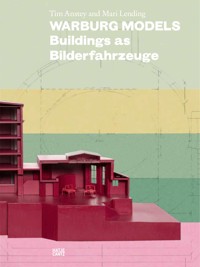
Warburg Models E-Book
27,99 €
Mehr erfahren.
- Herausgeber: Hatje Cantz Verlag
- Kategorie: Geisteswissenschaft
- Sprache: Englisch
Architectural patronage was crucial for the thinking of Aby Warburg and his circle. In Hamburg the purpose-designed Kulturwissenschaftliche Bibliothek Warburg, completed in 1926, organized Warburg's remarkable library. From 1927 Warburg developed ideas about orientation in the radical transformation of a disused water tower into the Hamburg Planetarium. After the Warburg Institute transferred to London in 1933 this pattern of seminal architectural commissioning continued, including projects designed by the avant-garde practice Tecton during the 1930s, and culminating in the construction of the library's present home at Woburn Square, Bloomsbury in 1958. Warburg Models: Buildings as Bilderfahrzeuge follows this history, using archive photographs, architectural drawings and a series of architectural models to show how the Warburg scholars projected a connection between their own physical occupancy of architectural space and their shared ideas about intellectual order, cultural survival, and memory. MARI LENDING and TIM ANSTEY are both professors of architectural history at the Oslo School of Architecture and Design. Their continuing archive-based seminar on the relationship between the Warburg Institute and architecture has developed into an exhibition and a book, not least because of the skilled participation of their model-building students.
Das E-Book können Sie in Legimi-Apps oder einer beliebigen App lesen, die das folgende Format unterstützen:
Seitenzahl: 129
Veröffentlichungsjahr: 2023
Ähnliche




















Colour chart for coding book spines, in use at the Warburg Library from 1922 to 1981.
WARBURG MODELS
Tim Anstey and Mari Lending
BUILDINGS AS BILDERFAHRZEUGE
Tim Anstey
BUILDING BIOGRAPHIES
Kulturwissenschaftliche Bibliothek Warburg, 1926–33
Hamburg Planetarium, 1930–33
SS Hermia, 1933
Thames House, 1934–37
Cottage at Bromley, 1934–35
Imperial Institute Buildings, 1937–58
Woburn Square, 1958–
TRIANGULATIONS
The Elliptical Reading Room as Denkraum
Claudia Wedepohl
The Hamburg Planetarium as a Problem Building
Uwe Fleckner
Seesawing
Dag Erik Elgin
The Play of Allusion at Woburn Square
Elizabeth Sears
Remodelling the Warburg Institute
Bill Sherman
Stack Room, “Art History” (main level), “Topography, Applied Arts” (mezzanine). Warburg Institute, Imperial Institute Buildings, ca. 1952.
WARBURG MODELS
Tim Anstey and Mari Lending
1 Aby Warburg in Arizona, April 1896.
2 Reading/lecture room, KBW. Photographic album, 1926.
At the start of the twentieth century the German art historian Aby Warburg saw a connection between the circulation of images, the emotive power of physical movement, and the development of material cultural production. Warburg was very much a child of the circulatory nineteenth century, of its obsession with movement and its saturation by media. As an errant member of a powerful banking family, he inherited a banker’s interest in questions of circulation and a capacity for identifying new contexts where investment might lead to unexpected profit. Where his four brothers concerned themselves with maintaining the position of the family business (Max Warburg became chairman and Fritz acted as a director of M. M. Warburg & Co. in Hamburg) and with developing family and international financial ties in the United States (Paul Warburg’s expertise lay behind the establishment of the American Federal Reserve, and Felix married into the Loeb banking family and became managing partner of the New York house of Kuhn, Loeb & Co.), the eldest brother Aby’s concerns were with cultural capital. The markets he exploited provided new kinds of evidence about the past, particularly about the relationship between Eurasian antiquity and the European Renaissance, reappraising the survival of ancient traits in the cultural production of later epochs. Warburg’s contribution to the history of art is undoubted. The frameworks for cultural interpretation evolved within the institute he founded in 1921 to develop Kulturwissenschaft (cultural science) retain their relevance today.
In trying to make sense of the past and in interpreting what was at stake in the production of visual art through history, Warburg and his collaborators became sensitive to the material lives of images; that is to say, to the biographies of material artifacts that carried representations (books, prints, paintings; sometimes tapestries or domestic furnishings) from one place to another. He called these phenomena Bilderfahrzeuge—“image-vehicles”—capturing in an elegant way the combination of imaginary association and material construction that his idea of cultural transference implied. This style of thought made it possible to plot “flows” of cultural information across time and space, explaining the transfer of visual imagery and shifting, interpretive associations. It also highlighted a connection between the motive and the emotive quality of travelling images. Warburg was interested in how antique representations of movement and force, textual and visual, would recur in later artistic expression, attributing a special potency to representations that, in whatever way, signalled action through frozen movement. Such examples of the vivid afterlives of ancient Pathosformeln were powerfully explored in his studies of antique imagery in fifteenth-century Florentine painting, exemplified through a series of iconic female figures: a nymph bearing a basket in Ghirlandaio’s Birth of St. John the Baptist or Botticelli’s figurations in the Primavera and the Birth of Venus. In all of them motion and emotion were joined.
3 Sandro Botticelli, Primavera, ca. 1480. Uffizi Gallery, Florence.
A principal tool for tracking the kind of gossamer connections on which this view of cultural history relied was a book collection whose organization could be moulded and redistributed to bring out hidden alignments. Warburg’s library was a device for such spatial tracking, and it had, from its first inception, a spatial dimension that was unusual. Perhaps inevitably, this spatial aspect became, as Warburg’s enquiries were formalized and the book collection expanded, an architectural one. An attention to the way spatial trajectories had generated influence across wide swathes of history—on how Bilderfahrzeuge travelled—produced a concordant concern with the way the library itself was spatialized, and on how movement was implied in its organization, fostered through sequences and juxtapositions.
Warburg’s itinerant library, its captivating idiosyncrasies and radical relational order, have proven enduring objects of fascination across disciplines. In all this work the special character of the institution’s architectural spaces has been tacitly admitted, but never consistently studied as a whole. Warburg Models: Buildings as Bilderfahrzeuge focuses on a highly pragmatic and physical dimension of the library’s history: the built spaces that have housed the holdings, their disparate manifestations in their motive and emotive aspects, and the necessary reinscription of this architecture at various addresses. By unearthing drawings (spanning from sketches to annotated technical drawings), letters, and accounts of these architectural projects in the archives of the Warburg Institute and the collections of the Royal Institute of British Architects, and by triangulating our observations with the archival work already carried out on a few of the buildings (particularly that of Tilmann von Stockhausen, Uwe Fleckner, and Elizabeth Sears on the Kulturwissenschaftliche Bibliothek Warburg, the Planetarium in Hamburg, and the Warburg Institute’s premises in London), we hope to provide yet another fragment to sustain the afterlife of a cornucopian tradition of ideas. In our case, a century’s worth of images and texts, that throw light on built and unbuilt projects, have also been transformed in the sense that we have translated this highly modern, even avant-garde, architectural trajectory into three dimensions. Introducing the scale model as a vehicle to understand the concerns of an architecture that might be called “Warburgian,” we attempt to construct a “little library”—a visualization of buildings and a retelling of their stories organized according to an overarching principle of architectural representation—revealing connections through juxtaposition and sequence in a way that recalls the efficacies of Warburg’s own instrumentalizing library.
“From floor to ceiling the walls were covered in books, the pantry became a stack room, heavy shelves were hanging dangerously over doors, the billiard room had been changed into an office, in the hall, on the landings, in the drawing-room of the family—everywhere books, books, books; and new books came in every day.”1
In 1943, Fritz Saxl, the acting director of the library from 1920 to 1924, and formal director from Warburg’s death in 1929 until his own in 1948, recalled his mentor and colleague’s book collection as it threatened to consume Warburg’s home at Heilwigstrasse 114 in the suburbs of Hamburg. Saxl first encountered the collection in 1910. “Bewildered” by the sight of the 15,000 volumes in their “baffling” arrangement, observing the collector who “never tired of shifting and re-shifting them,” and alert to the constant regrouping of a collection whose ever-changing order was based on Warburg’s credo “the law of the good neighbour,” he was struck by how the deluge of books and documents appeared to be “intensely alive.”2 In the early 1920s, embarking on the endeavour of “developing this manifestly personal creation into a public institution,” Saxl and Gertrud Bing—recruited to the staff in Hamburg from December 1921, and later the Institute’s assistant director and then director from 1955 until 1959—attempted “to ‘normalize’” the order of the, by then, 20,000 volumes without destroying “the original character of the collection as an instrument for research.”3 Together, Saxl and Bing laid the ground for a hypermodern organization in this rare book collection. Following a long (and much discussed) mental breakdown, Warburg returned to Hamburg from Ludwig Binswanger’s private clinic at Bellevue in Kreuzlingen, Switzerland, in August 1924. On May 1, 1926, the purpose-built Kulturwissenschaftliche Bibliothek Warburg (KBW) was formally inaugurated on the plot at Heilwigstrasse 116, adjacent to Warburg’s own home and interconnected with it (they shared a lift). “Built with economy of space like a ship, and equipped with modern library equipment,” the new building was articulated externally on the model of the town houses adjacent to it. Together, Heilwigstrasse 114 and 116 were arranged to hold 120,000 volumes.4
Architecture, interiors, and technological systems played a crucial role in the way Aby Warburg and his followers conducted their interrogation of culture and memory. Between 1923 and 1958 this led to six architectural projects. The KBW was completed to the designs of a young Hamburg architect, Gerhard Langmaack, with guiding advice from the city’s Baudirektor Fritz Schumacher, whom the Warburg family knew well. A connection to banking efficiency and an almost neurotic emphasis on internal systems of exchange were evident in this building. Architectural and bibliographic order were conditioned by industrial technologies of communication: more than twenty telephones, an epidiascope projector that could cast images from books or lantern slides across the reading room, a pneumatic tube system for moving book request slips, book lifts, and conveyor belts: all these squeezed into a building volume that remained domestic in scale. In 1927, as the members of the nascent Warburg Institute established themselves in this building, Warburg became involved in a scheme to create a permanent exhibit on the history of cosmology, together with a small library of relevant books, within the city’s plans to purchase a Zeiss star-projector and set up a planetarium for Hamburg. The planetarium was to occupy a much larger structure, that of a disused brick water tower, an expressionist building designed by the Munich-based architect Oskar Menzel and constructed during World War I. Warburg and Saxl proposed to install the exhibit in two dedicated rooms in this empty shell, a plan realized, at no small expense, by Warburg’s followers, who would present, by means of images and casts, an overview of historical understandings of the heavens and their relation to human destiny as manifest in cultures from ancient Babylon and Egypt to modern Europe. The exhibit opened in 1930, a year after Warburg passed away.
In 1933, when National Socialist politics threatened both its activities and its existence in Germany, Warburgs’ library transferred to London. Saxl and Edgar Wind, with help from the Warburg family and an extraordinary intervention from UK academia, arranged the removal. Bing orchestrated two successive shipments of property (the KBW building would be stripped), both on the HAPAG steamship Hermia: the books went first, over 500 crates shipped from Hamburg on Tuesday, December 12, 1933. The Hermia thus provided a brief home for the library, acting as a kind of temporary image-vehicle carrying its ideas and influences. This “transplantation” happened in the conviction “that the Institute’s continental roots could not fail to flourish in British soil,” in the words of Eric M. Warburg, Aby’s nephew, who coordinated the move for the family.5
In London, despite uncertainty and straitened circumstances, the pattern of architectural commissioning initiated in Hamburg continued. As the library and its scholars moved through a series of homes, they collaborated with the avant-garde architectural group Tecton, established in 1931 by the Russian émigré architect Berthold Lubetkin together with a group of Architectural Association graduates, tying the Institute’s design ambition to the boldest modernism in London: the Penguin Pool and the Gorilla House at London Zoo (1933–34), and the apartment complex Highpoint 1 (1935) were realized in the same years. Later, as they planned a permanent home, the Institute’s leaders negotiated with the office of the University of London’s architect, Charles Holden. Holden had become famous during the 1930s for his streamlined Underground stations, although by the time the Warburg Institute encountered him, the production of his office had moved to a very 1950s post-war abstract classicism, to the frustration of the then director Gertrud Bing.
4 Penguin Pool, London Zoo, Regents Park, London. Postcard, ca. 1934.
Between 1934 and 1937, as the political outlook worsened in Europe, the Institute occupied part of the ground floor of Sir Frank Baines’s monumental and newly constructed state-of-the-art offices at Thames House on Millbank, Westminster. Within this building, which became home to a variety of tenants including the British Secret Service MI5 during the same years, the Tectonite Godfrey Samuel tailored the library into an elegant, horizontal, tightly planned, modernist interior. His proposal reused much of the furniture and shelving from the library in Hamburg but changed the relationship between its spatial layout and its readers. While collaborating intimately in saving and running the Warburg Institute as director and assistant director, Saxl and Bing also commissioned from Samuel a house for a life together in the new capital. Between the summer of 1934 and January 1935, three schemes were worked out for a cottage at Bromley, leaving behind a set of seductive drawings and a detailed correspondence between the architect and the two Warburg scholars: a lost continental modernist house on a beautifully sloped plot in Elstree Hill, Bromley, about forty minutes’ drive south-east of the city. The project was never realized—in 1935 Bing and Saxl feared that the Warburg Library might relocate to the United States—but many of the ideas evident in the plans were realized in Samuel’s contemporary commissions, particularly that for the country house for another art historian, Ellis Waterhouse, at Overshot Hall in Oxfordshire (1935).
5 Thomas Edward Collcutt, Imperial Institute Buildings, South Kensington, London, inaugurated 1893.
After a frustrating hiatus, as building works were completed, the Institute reopened to the public in February 1939 in rooms in a wing of the Imperial Institute in South Kensington, a grandiose white elephant of a building designed by Thomas Edward Collcutt, born out of an 1880s dream of making permanent an exhibition to link Britain and its Empire with Queen Victoria’s Jubilee celebrations. The eerie and eclectic complex this created formed an unlikely framework for the activities of the Warburg Institute, but one which provided its London home for twenty years (apart from its evacuation during the Second World War). An American junior fellow vividly described the complex as “too gigantic in size, too fantastic in design, and too aimless in purpose for anything on the human scale,” recalling that the library “was cold and dark, colder and darker than the outdoors,” and that “high overhead hung a pale bulb in whose distant and faint illumination I read and took notes, often with gloved fingers.”6 Even at the Imperial Institute the Warburgians made architectural incisions, cutting a staircase through the Victorian structure to create a link between reading room and stackrooms, and creating a “bizarre atrium, set all around with office doors from which world-famous scholars would pop out and in again—like an apotheosized cuckoo-clock.”7 After 1943, various proposals were developed for a new building, for which first Fritz Saxl and finally Gertrud Bing acted as the commissioning clients. Charles Holden’s design, part of the masterplan developed for the University of London, resulted in the construction of the library’s present home at Woburn Square in Bloomsbury, inaugurated in 1958. As in Hamburg, “MNHMO∑YNH” was transcribed over the entrance—incised in stone in Hamburg, carved in wood in London—.emphasizing how the Warburg scholars imprinted their new homes with institutional memory.
The arrangement of these various undertakings occupied the directors of the Warburg Institute continuously over four decades. In all the different instantiations of the library, an identity emerged between the spatial organization of the building and the intellectual organization of a set of ideas around cultural memory, projecting a tie between architectural space and intellectual order. The KBW in Hamburg divided Warburg’s book collection over four floors in a reinforced concrete bunker at the centre of a masonry building, each level identified with a major theme, or “problem,” for the library’s research: Bild (first floor), Orientierung (second), Wort (third), and Handlung (fourth floor). In the moves the library made in London this order was both preserved and reinterpreted. At Thames House




