


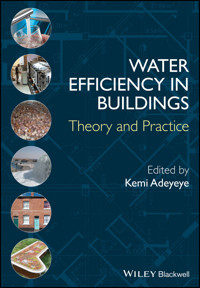
Water Efficiency in Buildings E-Book
93,99 €
Mehr erfahren.
- Herausgeber: John Wiley & Sons
- Kategorie: Wissenschaft und neue Technologien
- Sprache: Englisch
This reference source on water efficiency in buildings provides comprehensive and up-to-date information. Both multi-disciplinary and practical, it signposts current knowledge, innovation, expertise and evidence on an important subject which is high in the resource management debate.
Water Efficiency in Buildings: a review of theory and practice is structured into five sections: Policy; People; Building Design and Planning; Alternative Water Technologies; and Practical Examples & Case Studies. This final section of the book presents new and current practice as well as lessons learnt from case examples on the use of water saving technologies and user engagement.
Current evidence is vital for effective policy making. The dynamic nature of issues around water resource management creates a higher need for robust and reliable data and research information that can inform policy and regulations.
This compendium provides a roadmap for researchers and building professionals on water efficiency as well as for policy makers and regulators. The case studies and research presented fall within the water supply and demand spectrum, especially those that focus on process efficiency, resource management, building performance, customer experiences and user participation, sustainable practises, scientific and technological innovation. The benefit and impact of the research is at the localandnational level, as well as in the global context.
Sie lesen das E-Book in den Legimi-Apps auf:
Seitenzahl: 504
Veröffentlichungsjahr: 2013
Ähnliche




















Contents
About the Editor
About the Contributors
Foreword
Preface
Acknowledgements
Abbreviations
Section 1: Policy
1 Water Policy and Regulations: A UK Perspective
Introduction
Water policy and context
Policy for water users
Methodology
Interview findings
Discussion
Further recommendations
Conclusion
Acknowledgements
References
2 Water Policy in Water-Stressed Regions: The Case Study of Iran
Introduction
Iran: water resources and use
Water resource planning and implementation
Policy opportunities and constraints
Recommendations
Conclusion
Acknowledgements
Further reading
References
3 Water Policy for Buildings: A Portuguese Perspective
Introduction
Policy context and evolution
Water efficiency in buildings
Opportunities and constraints
Conclusions and recommendations
Further reading
References
Section 2: People
4 Understanding Consumer Response to Water Efficiency Strategies
Introduction
Explorations in socio-demographic and contextual factors
Broadening the understanding of consumer responses
Recognising the attitude–behaviour gap
Conclusion and recommendations
Further reading
References
5 Distributed Demand and the Sociology of Water Efficiency
Introduction
Developing an idea of ‘distributed demand’ and a practice perspective on water efficiency
Beyond behaviour and technology: a practice perspective on ‘efficiency’
Conclusion
Acknowledgements
Further reading
References
6 Co-creating Water Efficiency with Water Customers
Introduction
Information technology for co-creation
A co-creation toolkit for personalised value and knowledge for water efficiency
Discussion
Conclusion
Further reading
References
Section 3: Building Design and Planning
7 Assessment Methodologies for Water Efficiency in Buildings
Introduction
Building environmental assessment and rating methods
Discussion
Conclusion
Further reading
References
8 Intelligent Metering for Urban Water Planning and Management
Introduction
Role of intelligent water metering and big data
Intelligent metering applications and benefits
Conclusion and recommendations
Further reading
References
9 Integrated Sustainable Urban Drainage Systems
Introduction
Sustainable drainage systems
Types of SuDs
Case studies: integrated SuDs
Conclusion
Further reading
References
Section 4: Alternative Water Technologies
10 Greywater Recycling in Buildings
Introduction
Greywater quantity and quality
Greywater policy and guidelines
Greywater technology
Project examples
Benefits and constraints of greywater recycling
Conclusion and recommendations
Further reading
References
11 Rainwater Recycling in Buildings
Introduction
Rainwater harvesting systems
Rainwater quality
Treatment technologies
Storage system sizing
Environmental benefits
User perception and acceptability
Conclusions
Further reading
References
12 A Strategic Framework for Rainwater Harvesting
Introduction
Developing a socio-technical evidence base
Selected socio-technical evidence base results
The strategic framework for RWH in the UK – a synthesis
The framework
Conclusion
Acknowledgements
Further reading
References
Section 5: Practical Examples and Case Studies
13 Lifecycle Benefits of Domestic Water-Efficient Fittings and Products
Introduction
Methodology
Findings
Conclusion
Further reading
References
14 Water Efficiency in Office Buildings
Introduction
Methodology
Influences on water efficiency
Conclusions and recommendations
Acknowledgements
Further reading
References
15 Lessons from a New Water Treatment Plant in a Water-Stressed Region
Introduction
Case study: Mashhad water treatment plant
Practical problems associated with the new WTP
Conclusion
Acknowledgements
Further reading
Reference
16 Water-Efficient Products and the Water Label
Introduction
Water and energy are inextricably linked
The Water Label
The Water Calculator
Conclusion
Further reading
References
17 ‘Greening the Green’ – Community Water in the Age of Localism
Introduction
The case study community
The water workshop
Workshop findings
Action from the workshop
Discussion
Conclusion
Acknowledgements
Further reading
References
Advertisements
Index
This edition first published 2014© 2014 by John Wiley & Sons, Ltd
Registered OfficeJohn Wiley & Sons, Ltd, The Atrium, Southern Gate, Chichester, West Sussex, PO19 8SQ, United Kingdom.
Editorial Offices9600 Garsington Road, Oxford, OX4 2DQ, United Kingdom.The Atrium, Southern Gate, Chichester, West Sussex, PO19 8SQ, United Kingdom.
For details of our global editorial offices, for customer services and for information about how to apply for permission to reuse the copyright material in this book please see our website at www.wiley.com/wiley-blackwell.
The right of the author to be identified as the author of this work has been asserted in accordance with the UK Copyright, Designs and Patents Act 1988.
All rights reserved. No part of this publication may be reproduced, stored in a retrieval system, or transmitted, in any form or by any means, electronic, mechanical, photocopying, recording or otherwise, except as permitted by the UK Copyright, Designs and Patents Act 1988, without the prior permission of the publisher.
Designations used by companies to distinguish their products are often claimed as trademarks. All brand names and product names used in this book are trade names, service marks, trademarks or registered trademarks of their respective owners. The publisher is not associated with any product or vendor mentioned in this book.
Limit of Liability/Disclaimer of Warranty: While the publisher and author(s) have used their best efforts in preparing this book, they make no representations or warranties with respect to the accuracy or completeness of the contents of this book and specifically disclaim any implied warranties of merchantability or fitness for a particular purpose. It is sold on the understanding that the publisher is not engaged in rendering professional services and neither the publisher nor the author shall be liable for damages arising herefrom. If professional advice or other expert assistance is required, the services of a competent professional should be sought.
Library of Congress Cataloging-in-Publication Data
Water efficiency in buildings : theory and practice / edited by Kemi Adeyeye. pages cm Includes bibliographical references and index.
ISBN 978-1-118-45657-6 (cloth)1. Water efficiency. 2. Sustainable buildings. 3. Water-supply–Cost control. I. Adeyeye, Kemi, 1979– editor of compilation. TH6127.W38 2014 696ʹ.1–dc23
2013033902
A catalogue record for this book is available from the British Library.
Wiley also publishes its books in a variety of electronic formats. Some content that appears in print may not be available in electronic books.
Cover image: Davood Nattaghi and Erwin Nolde.Background Image – Floorplan: Vectorstock / Alchena;Image 1 – Tap and Glass: iStockPhoto / Courtney Keating;Image 5 – Terraced Houses: iStockPhoto / kelvinjayCover design by Garth Stewart
About the Editor
Kemi Adeyeye is a senior lecturer at the University of Brighton where she teaches and conducts research on various aspects of building design and technology, sustainability, resource efficiency and use. Her academic and professional background is in architecture, building development, adaptation and optimised delivery as well as post-occupancy processes. She holds a Master’s degree in Architecture (Design) (University of Nottingham, UK) and a PhD awarded by Loughborough University, UK. She is a chartered member of the Chartered Institute of Architectural Technologists (CIAT) and the Royal Institute of Surveyors (RICS). Her work experience includes various forms of architectural consultancy, planning, building development and management, especially during the post-occupancy stages. Her water-efficiency research focuses on finding integrated solutions – people, process, product – and how these systems-led solutions can be implemented in buildings for long-term results. Her research also focuses on finding collaborative solutions to water resource issues. Therefore, the majority of her work is carried out with industry partners.
She was a DEFRA/EPSRC research fellow. She is Co-Director of the Advanced Technologies in Built Environment, Architecture & Construction (@BEACON) research group at the University of Brighton. At the university, she also manages the collaborative Water Efficiency Lab and initiated and manages the DEFRA-funded Water Efficiency in Buildings Network. With industry and academic members, the network aim is to propose and promote knowledge-based yet practical water-efficiency solutions for policy, industry and building users.
About the Contributors
Ilan Adler is founder and chairman of the International Renewable Resources Institute (IRRI-Mexico), a non-governmental association specialising in the promotion of renewable energies and sustainable water practices throughout rural and urban areas in Mexico. He has lectured to a wide variety of audiences, teaching at universities as well as workshops in Puerto Rico, Ecuador, the USA and different areas of Mexico, also as a Solar Energy International (SEI) instructor. In 2004, he worked for the UNEP as a consultant in waste-water management for Latin America and the Caribbean. Through a number of start-up companies he has also been involved in consulting, design and implementation of appropriate technologies such as rainwater harvesting, biogas and solar systems. His publications include articles, stories and children’s books related to water conservation and environmentalism. He has a Master’s degree in Environmental Science from Wageningen University, the Netherlands and is currently pursuing his PhD in rainwater quality and purification technologies at University College London, where he also works as a teaching assistant.Ben Anderson is originally from a natural sciences background. He has a BSc in Biology and Computer Science (Southampton University, UK) and a PhD in Computer Studies (Loughborough University, UK). He has used techniques from computer science, cognitive psychology, anthropology, economics, sociology and social geography during his time as an academic and commercial research scientist engaged in conducting and managing basic and applied social research programmes. His main research interest is the relationship between social practices and infrastructural change with a particular focus on social communication, resource (energy, water) consumption, micro-social resilience and sustainable living with cross-cutting interests in temporal and spatial variation. He is currently a Visiting Research Fellow at the Lancaster Environment Centre and a Senior Research Fellow in the Sustainable Energy Research Group at the University of Southampton.Jean Balnave is the administrator for the Water Efficiency in Buildings Network, a multidisciplinary network of academics, industry practitioners and NGOs funded by DEFRA. She is the interface between the network, members and the general public. She is involved in promoting the network’s activities to various audiences and at relevant international events. Her study and research interests include earth and environmental sciences, water-efficient technologies and water user behaviours and practices. Recent projects included a water efficiency and community resilience study, and she is currently responsible for the network’s recently launched water messaging programme.Stewart Barr obtained his PhD from the University of Exeter in 2001 and is now Associate Professor in the Geography Department at the university. His research interests focus on how environmental social science can lead academic discussions on social transformation in an age of accelerated environmental change. He teaches both undergraduate and postgraduate courses in Geography and runs a final-year undergraduate specialist module on Geographies of Transport and Mobility. Cara Beal obtained her PhD from the University of Queensland in Soil Science. She is a research fellow at the Smart Water Research Centre, Griffith University, Queensland, Australia. A recognised expert in smart metering and residential water end-use studies, she also has over 20 years’ experience in integrated water resource management. She has managed a number of large research projects in the private, government and academic sectors and has authored more than 50 peer-reviewed publications across a range of topics including urban water planning, social analysis of water consumption, decentralised waste-water treatment systems, demand forecasting and the water–energy nexus.Lee Bint earned her PhD from Victoria University, Wellington, New Zealand. She graduated from her doctoral studies on water performance in commercial office buildings in 2012, supervised by Professor Robert Vale and Mr Nigel Isaacs. She has since been working at BRANZ Ltd, investigating energy and water use across New Zealand non-residential buildings. Her research interests centre on improving water and energy performance of commercial buildings.David Brindley is Business Support Manager at the Bathroom Manufacturers Association and has worked in the bathroom industry for over 40 years. His previous roles of Technical Manager and Engineering CAD Draughtsman at one of the UK’s major bathroom manufacturing companies have provided a wealth of experience in all aspects of the industry including product design, manufacturing and marketing. He brings this vast product knowledge to his current position of administering the Water Label Scheme and other areas of the BMA business. Andrew Brohier studied at the University of Western Sydney where he completed a Bachelor of Construction Management (Honours). His honours thesis focused on sustainable innovations which optimise water efficiency in dwellings. After completing his studies he is now working within the construction industry as an Accredited Building Surveyor, where he endeavours to promote awareness regarding innovations which can improve water efficiency in all forms of construction. Alison Browne is a Research Fellow at the Sustainable Consumption Institute, University of Manchester with interests in water, climate change adaptation, everyday practice and sustainable consumption, and the community and social impacts of large-scale resource development (agriculture, mining, rural and urban development). Prior to joining the SCI in September 2012 she was a Senior Research Associate at the Lancaster Environment Centre, Lancaster University (2010–2012). Here she managed two large interdisciplinary projects on climate change, water resource management and everyday practice (the EPSRC-funded ARCC-Water and the ESRC/DEFRA/Scottish Government SPRG Patterns of Water projects). She has also been involved in a range of consultancy projects for the UK water industry (Thames Water, UKWIR) focused on climate change, demand management and water efficiency. Prior to moving to the UK she obtained her PhD from Curtin University, was a Research Fellow at the Research Centre for Stronger Communities, Curtin University (2009–2010) and a Research Scientist at CSIRO Australia (2007–2009) working on urban water management, sustainable agriculture and resource development.David Butler is Director of the Centre for Water Systems, University of Exeter. He is Professor of Water Engineering at the University of Exeter and an Engineering & Physical Sciences Research Council (EPSRC) Established Career Fellow. He is a chartered civil engineer, a chartered environmentalist and a Fellow of the IWA, Institution of Civil Engineers and CIWEM. He specialises in sustainable urban water management, has published over 250 technical papers and is co-editor-in-chief of the Urban Water Journal. His research has been funded continuously by EPSRC since 1995.Luiza Cintra Campos is a Senior Lecturer in Environmental Engineering, University College London. She has a PhD in Environmental Engineering from Imperial College. She is a civil engineer specialising in environmental engineering and has over 8 years of practical experience working for a state water and waste-water company and over 10 years of experience working as a lecturer at various universities in Brazil. She joined University College London (UCL) in 2007 as a lecturer in the Department of Civil, Environmental and Geomatic Engineering where she is currently the Programme Director for Environmental Engineering UG. Her research interests lies in water and sanitation, varying from modelling purification mechanisms of slow sand filtration to sustainable and resilient sanitation services. Some of her research projects include the impact of rainwater harvesting on urban flood attenuation and water supply, the reduction of risks in sanitation infrastructure, health built environments, the treatment and disinfection of water/rainwater and the modelling the next generation of sanitation systems.Susanne M.Charlesworth is a Reader in Urban Physical Geography and Director of SuDs Applied Research Group; Geography, Environment and Disaster Management, Coventry University. She gained her PhD in ‘The retention of pollutant history in the sediments of two urban lakes, Coventry, UK’ from Coventry University in 1994 and has been Director of the SuDs Applied Research Group at Coventry University for the past 6 years. Whilst she has undertaken research and development in SuDs and has publications in that subject area, she has also published in urban geochemistry, risk assessments for children associated with urban contaminants and urban hydrology.Stephen J. Coupe is an environmental scientist with an interest in storm-water management, sustainability and environmental microbiology. He has a PhD in sustainable drainage water quality and worked as research manager for Hanson Formpave between 2006 and 2011. Working as a research fellow at Coventry University, he teaches on undergraduate and postgraduate programmes and is fully engaged in multidisciplinary research activities. Amal S. Faraj has a background in civil engineering, having worked for Repsol/Akakus Oil Operations, a Spanish–Libyan joint enterprise in Tripoli. In 2007, she achieved an MSc in Environmental Management from Coventry University. She was recently awarded a PhD from Coventry University, for research entitled ‘Assessing the performance of combined sustainable drainage and a renewable energy device in heating a domestic building’.Eric R.P. Farr is a researcher and critic with an MArch/MUD and a PhD in Architecture and Urban Studies. He specialises in theorising fuzzy logic for planning decision/policy making, as well as sustainable built environment and architectural theory. His experience is backed by his work as an international design consultant. He has been invited to give talks and lectures in universities and professional organisations worldwide. He advocates the significance and impact of what is understood to be rather discrete context-based features of sustainability through co-creation of knowledge and value between different levels of stakeholders from policy makers to end users. Nick Gant is Assistant Head of the School for Research, Economic and Social Engagement at the School of Art, Design and Media, University of Brighton and co-founder of Community21. He leads applied research in areas of design communication and sustainability enabled via material and digital media. His recent work explores enabling young people to envision the future of their sustainable communities by using and co-designing accessible envisioning technologies (apps). He also uses waste materials with embedded histories and narratives to mediate meanings and values that engage users in sustainable issues and behaviour change. As a designer and researcher he collaborates with NGOs, charities and industry and has led projects funded by Nominet Trust, Gulbenkain Foundation, the National Lottery and the Department of Energy and Climate Change. As co-founder of Community21 his work facilitates mass participation in networks of neighbourhood and community-led planning. Damien Giurco is Associate Professor and Research Director at the Institute for Sustainable Futures, University of Technology, Sydney. Established in 1996, the Institute’s mission is to ‘create change towards sustainable futures’. Working with government and industry, he leads urban water research focused on smart metering, water efficiency, industrial ecology, end-use modelling, integrated resource planning and policy. He holds Bachelor of Science and Bachelor of Engineering degrees from the University of Melbourne and a PhD from the University of Sydney.Nigel Isaacs M.Bldg.Sc. is a Senior Lecturer in the School of Architecture, Victoria University of Wellington and formerly a Principal Scientist at BRANZ Ltd. His work on the Household Energy End-Use Project led to new knowledge about the how, why, where and when of residential energy use and services. His work centres on understanding energy and water demand in buildings.James Jenkins is currently a Senior Lecturer in Environmental Management at the University of Hertfordshire, UK. His research is shaped by his interest in water resource problems connected with drinking water quality, water usage and consumer engagement. He has previously been a regional committee member of the Consumer Council for Water and its predecessor, WaterVoice. He obtained his PhD in 2007 from the Department of Geography at King’s College London.Will Medd is a Lecturer in Human Geography, Lancaster Environment Centre, Lancaster University, where he has been teaching and researching issues around everyday life, socio-technical infrastructures and sustainability. He earned his PhD in Sociology from Lancaster University. He is also a certified work/life coach and runs a private coaching practice specialising in coaching for academics. His co-authored book YourPhDCoach will be published by the Open University Press in September 2013.Fayyaz Ali Memon is Associate Professor at the Centre for Water Systems, University of Exeter. He was based at Imperial College London before joining the University of Exeter. He has research interests in water reuse technologies, water consumption trends, rainwater harvesting, greywater recycling, water-saving micro-components, lifecycle analysis, sustainable drainage systems, carbon footprinting and decision support systems for water management. He is a chartered engineer, fellow of the UK Higher Education Academy and member of the Chartered Institution of Water and Environmental Management and the Institution of Civil Engineers.Davood Nattaghi received his BSc in Mechanical Engineering followed by an MSc in Project Management for Construction. He has over 7 years’ experience in leading and delivering some of the most challenging, demanding and complex water infrastructure projects, including pipelines, water/waste-water treatment plants, pump stations and desalination plants. Ernest O. Nnadi is a sustainable drainage and water quality expert. He conducted the first study on the application of the SuDs system known as the Pervious Pavement system in storm-water recycling for irrigation purposes. He received a PhD in the field of Civil Engineering from Coventry University, UK and has since been working as an academic and applied researcher. He has industrial experience in his field, having worked on and collaborated with industrial partners on several innovative, applied research and development projects. He is the author of several journal articles and peer-reviewed conference papers. He is also a fellow of the Higher Education Academy and a member of several international and national professional associations in his field.Erwin Nolde is an electrical and environmental engineer with over 20 years’ expertise in the sustainable water management field. He specialises in the planning, design and implementation of decentralised water recycling systems in combination with heat recovery from greywater. He is founder and managing director of Nolde & Partner – Innovative Water Concepts and acts as a consultant for public authorities, industry, NGOs, housing associations and private house owners. He is co-founder and member of the board of the German Association for Rainwater Harvesting and Water Reuse (fbr) and a member of several DIN and DWA working groups.Yvonne Orgill is the Chief Executive of the UK’s Bathroom Manufacturers Association, which has grown significantly under her leadership and is now recognised and respected as ‘The Voice of the UK Bathroom Industry’. Today she leads a trade body representing over 80% of the UK bathroom brands – both manufacturers and media involved in the UK bathroom industry. Its membership employs more than 10,000 people across almost 70 sites and is responsible for a combined membership turnover fast approaching £1 billion. She represents the UK bathroom industry on a number of forums in the UK and Europe. She regularly meets with government and the European Commission. She is a high-profile spearhead of the European Water Label committee, which promotes the successful Water Label scheme. The scheme was introduced and developed by the BMA, and adopted across the 27 countries of Europe in 2012. She has been instrumental in promoting the Water Label, which has been embraced by major builders and plumbers’ merchants and retailers. Kriengsak Panuwatwanich completed his Bachelor in Engineering (Civil) from Sirindhorn International Institute of Technology, Thailand followed by a Master of Engineering Science from the University of New South Wales and a PhD from Griffith University, Australia. He also holds a Graduate Certificate in Higher Education, also from Griffith University. His research interests cover the areas of engineering, construction, environmental and project management. He has published in many top-tier journals, including the Journal of Environmental Management, Journal of Cleaner Production, Journal of Resources, Conservation and Recycling, Automation in Construction, as well as the International Journal of Project Management. He is currently a lecturer at Griffith School of Engineering, Griffith University, Queensland, Australia.Alexis Pericli has a BSc (Hons) in Geography and an MSc in Environmental Management from the University of Hertfordshire. He is a PhD research student in the Geography and Environmental Sciences subject group, Department of Human and Environmental Sciences, University of Hertfordshire, UK – supervised by Dr James Jenkins. His PhD focuses on understanding government responses to the environmental problems of water scarcity and quality.Carla Pimentel Rodrigues graduated from the University of Aveiro (Portugal) in Civil Engineering and has headed the technical secretariat of the NGO ANQIP since 2007. She is currently studying for her PhD in the area of water efficiency, again at the University of Aveiro.Poorang Piroozfar holds a BArch and an MArch, followed by a PhD, in Architecture from the School of Architecture, University of Sheffield. He is a Senior Lecturer in Architectural Technology and Director of @BEACON (Advanced Technologies in Built Environment, Architecture and Construction) Research Centre, School of Environment and Technology, University of Brighton. His research spans rule-based expert systems, ICT, building facades as well as process, production and information management in the AEC industry. His interest in customer-centric approaches to design, fabrication and implementation in the construction industry has converged with other new concepts, resulting in the introduction of new interdisciplinary and multidisciplinary research projects during recent years. Martin Pullinger works at the University of Edinburgh, School of GeoSciences, on the EPSRC-funded IDEAL home energy advice project, which explores the interaction between energy technologies and householder practices related to energy use. His research focuses on multidisciplinary understanding of the interactions between ecological sustainability and human wellbeing. He seeks to produce new insights into how different everyday practices and working patterns influence household carbon footprints, water and energy use, as well as wellbeing, and the implications for the design of policies and household-level feedback systems relating to sustainable lifestyles, practices and behaviours. He previously worked on the ARCC-Water Project at Lancaster Environment Centre, Lancaster University, contributing to the development of new theoretical and methodological approaches to the study of everyday water-use practices. Prior to that, during his PhD at the University of Edinburgh, he investigated the impacts of working patterns on wellbeing and on energy use from household consumption.Dexter Robinson is a recent graduate in Architectural Technology at the University of Brighton. His research interests include water efficiency in buildings, with primary focus on investigating the efficacy of technological and innovative solutions for resolving water-efficiency challenges in buildings and the built environment as a whole. He is now embarking on a PhD study exploring how to provide integrated water-efficiency solutions within domestic properties. His doctoral study is funded by the School of Environment and Technology, University of Brighton Doctoral Fund, supported by SmartSource Water, Reading.Armando Silva Afonso holds a PhD in Hydraulics and has been a Professor in the Department of Civil Engineering at the University of Aveiro (Portugal) since 2001. Previously he was a Professor at the University of Coimbra. He is also Chairman of the Board of the Portuguese Association for Quality and Water Efficiency in Building Services (ANQIP) and Regional President of the Portuguese Association of Water Resources (APRH). His current research interests include efficiency and sustainability related to water supply and drainage in buildings and he is an invited expert of the European Commission (DG Environment) for water efficiency in buildings.Rodney Stewart is an Associate Professor and Director of the Centre for Infrastructure Engineering & Management (CIEM) based at Griffith University, Queensland, Australia. He is a specialist in engineering and environmental management research, particularly related to smart water metering and end-use analysis. He currently leads water end-use studies covering potable-only water supply schemes, dual supply schemes and internally plumbed rain tank schemes. He was appointed as a National Water Commission Fellow in 2011 to verify the end-use potable water savings achievable from a range of contemporary water supply schemes. More recently, his work has explored the residential end-use water–energy nexus as well as the development of intelligent algorithms for autonomous water end-use analysis. He has published over 100 refereed publications. Siraj Tahir is an environmental engineer with a BSc from the University of Missouri, Columbia and an MSc in Environmental and Water Resources Engineering from City University London. He is an EngD Research Engineer in Urban Sustainability and Resilience, Department of Civil Environmental and Geomatics Engineering at University College London, sponsored by EPSRC and Arup – supervised by Luiza Campos. His EngD focuses on the role of rainwater harvesting for water resource and surface water management in London. His other research interests include integrated water management, water efficiency, alternate water supply systems and water-sensitive urban design.Vivian Tam is a Senior Lecturer at the School of Computing, Engineering and Mathematics, University of Western Sydney, Penrith, Australia. She completed her PhD at the City University of Hong Kong on recycled concrete in 2005. She has been developing her research interests in the areas of environmental management, sustainable construction and concrete recycling. She has continually published peer-reviewed articles in leading journals. She is also an invited member of the Editorial Advisory Board for Construction and Building Materials, Elsevier; The Open Construction and Building Technology Journal, plus The Open Waste Management Journal, Bentham; and was an invited Editorial Review Panel Member for the International Journal of Construction Project Management, Nova Science Publishers, Inc. She was also invited as a Keynote Speaker for the First International Research Symposium on Recycled Concrete and Its Applications, Shanghai, China in July 2008. She has been a regular reviewer for a number of leading international journals and conferences. Before joining UWS, she worked as a lecturer with the Griffith School of Engineering, Griffith University, Gold Coast, Australia.Robert Vale MA, DipArch, PhD is a Professorial Research Fellow in the School of Architecture at Victoria University, Wellington, New Zealand. He has written several books on environmental design, including The Autonomous House (1975), Green Architecture (1990) and Time to Eat the Dog? (2009). He is currently running a three-year FRST-funded research project to determine the form of ecologically sustainable communities in New Zealand.Sarah Ward is Business Engagement Manager, Centre for Business and Climate Solutions and Research Fellow, Centre for Water Systems at the University of Exeter, where she develops and manages relationships with businesses, as well as undertaking research into social and technical aspects of water reuse and alternate water systems. Her main area of interest is sustainable water management, in its many forms. She gained her PhD from the University of Exeter, where she investigated socio-technical aspects of rainwater harvesting systems. She has worked in the water sector for over 10 years, recently working on projects investigating modelling frameworks for integrated sustainable development, the socio-technical integration of water and energy within new housing developments and how practitioner and researcher engagement leads to impact generation. She has a growing publication record, which includes over a dozen journal articles, various conference papers and industry articles, three book chapters and a book, currently in progress, on alternate water supply systems. She is an Associate of the Higher Education Academy in the UK, a Chartered Member (M.CIWEM) of the Chartered Institution of Water and Environmental Management (CIWEM) and a Chartered Environmentalist (CEnv).Terry Woolliscroft BSc (Hons) Grad. I Ceram is a ceramic technology graduate. He has worked in the bathroom industry for 35 years and has experienced all aspects of the industry including product design and management, manufacturing, logistics, sales and marketing. With this breadth of knowledge behind him he now concentrates on passing on his experience through specialist writing, lecturing and presenting training courses for those wishing to enter the industry. He is a skilful producer of short specialist training and marketing videos. He is also expert in creating entertaining, informative and instructive PowerPoint presentations covering both the technical and marketing sides of the industry.
Foreword
Water is the cornerstone of civilisation. From the great cisterns of the Indus Valley civilisation to the London ringmain, the supply of water is an essential part of human existence. Likewise, the wise use of water is at the centre of the world’s religions and has cultural significance worldwide. But for the past couple of centuries, humans have started to take water management for granted. We have considered ourselves to be masters of the environment, able to turn the direction of rivers and to build cities in the desert. This arrogance has led to failures that have demonstrated that we must live within our natural means – the disaster of the Aral Sea, or the mining of aquifers in California or the impending folly of the Chinese South–North transfer are all examples of the hubris and arrogance of big civil engineering.
This massive engineering is a response to a gradual yet relentless global water crisis which is being played out in slow motion in front of us. Water is required for power generation, for transport, for manufacturing, for our homes and most importantly to feed us, with global water use to produce food currently at 200,000,000 litres per second. A growing population will require more water for all of these things, and a changing climate will mean accessing this water will become increasingly difficult. We will see more floods and droughts, and this will strain the centralised water networks of the developed world and worsen the dire water and sanitation situation in the developing world. This uncertainty does not require large-scale Victorian solutions, but small-scale flexible solutions that are appropriate to the local situation. Because, unlike many of the global challenges we face, this is one where the solutions are simple and accessible to us all. Water is effectively a global commodity traded vicariously through the movement of food, but at the same time all water is local. Simple actions like turning the tap off when we brush our teeth or buying a water-efficient washing machine will have a direct impact on the local aquatic environment, and engaging people through these actions will in turn engage them in the wider global water issues.
Therefore, the real answer to our future water needs lies not in grandiose schemes but in sustainable consumption in our homes and offices. We need to look at the clever use of technology and social science to maximise and optimise the use of existing supplies of water.
This is why water conservation in buildings is essential. Ultimately, we should be aiming for buildings that are self-sufficient in water, and use natural processes to treat the water they use in a closed loop for reuse, energy and food production. This may sound far-fetched but the technology is available now, all we need is a confluence of policy, human behaviour, finance and manufacture to provide the right conditions to enact these technologies.
There is a lot of work taking place around the efficient use of water within buildings, but often this is done in isolation, there is no point in developing amazing water-saving devices that no one wants to use, and there is no point in exhorting people to save water if they have no control over appliances that use a predetermined amount. The way we should develop water- efficient buildings is to consider all aspects of the built environment, which requires us to consider sociology as well as hydraulics, finance as well as aesthetics, and local management as well as national policy.
This book provides a comprehensive assessment of the state of the art of water efficiency in buildings, in both theory and practice. It covers all aspects that influence water use in the home, from innovative water-saving products to addressing the habitual manner in which we use water. This provides academics, practitioners, NGOs, policy makers and others with all the information and tools they require to develop water-efficient approaches for the built environment. It contains contributions based on the knowledge and experience of global experts in the field and draws conclusions on what is required in terms of policy, regulation, stakeholder engagement and the evidence base that will all enable the implementation of water-efficient technologies.
In short, the world is facing a slow, relentless water crisis and the way we interact with water in the built environment is central to dealing with the crisis; this book holds the key to how we do that.
Jacob TompkinsManaging Director, Waterwise
Preface
Water resources in many parts of the world are under stress due to increasing global population, climate change, geographically variable and unpredictable rainfall patterns, inaccessible, unusable or difficult to abstract water, high water use for industrial as well as agricultural processes and crucially high water use for direct human activity, e.g. cleaning and washing. According to UNESCO, 1.1 billion people around the globe already lack sufficient access to safe drinking water and it is predicted that water scarcity will increase further in the coming decades, by around 20%, due to climate change. Contrary to popular perception, water availability is not just a challenge for countries in dry, arid regions. It is increasingly a global challenge irrespective of geo-climatic locations. To provide some perspective, recent figures show that some 120 million people in the European region do not have access to safe drinking water. Areas with historic high water availability increasingly suffer water stress as well, in addition to contending with excessive rainfall, floods, contaminated surface water, etc.
Lesen Sie weiter in der vollständigen Ausgabe!
Lesen Sie weiter in der vollständigen Ausgabe!
Lesen Sie weiter in der vollständigen Ausgabe!
Lesen Sie weiter in der vollständigen Ausgabe!
Lesen Sie weiter in der vollständigen Ausgabe!
Lesen Sie weiter in der vollständigen Ausgabe!
Lesen Sie weiter in der vollständigen Ausgabe!
Lesen Sie weiter in der vollständigen Ausgabe!
Lesen Sie weiter in der vollständigen Ausgabe!
Lesen Sie weiter in der vollständigen Ausgabe!
Lesen Sie weiter in der vollständigen Ausgabe!
Lesen Sie weiter in der vollständigen Ausgabe!
Lesen Sie weiter in der vollständigen Ausgabe!
Lesen Sie weiter in der vollständigen Ausgabe!
Lesen Sie weiter in der vollständigen Ausgabe!
Lesen Sie weiter in der vollständigen Ausgabe!
Lesen Sie weiter in der vollständigen Ausgabe!
Lesen Sie weiter in der vollständigen Ausgabe!
Lesen Sie weiter in der vollständigen Ausgabe!
Lesen Sie weiter in der vollständigen Ausgabe!
Lesen Sie weiter in der vollständigen Ausgabe!
Lesen Sie weiter in der vollständigen Ausgabe!
Lesen Sie weiter in der vollständigen Ausgabe!
Lesen Sie weiter in der vollständigen Ausgabe!
Lesen Sie weiter in der vollständigen Ausgabe!
Lesen Sie weiter in der vollständigen Ausgabe!




