


Erhalten Sie Zugang zu diesem und mehr als 300000 Büchern ab EUR 5,99 monatlich.
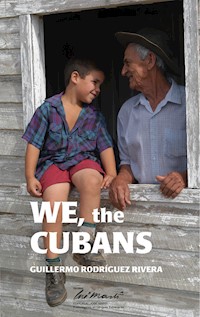
"We the Cubans" by Guillermo Rodríguez Rivera is a catchy and accurate portrait of the essence of Cuban identity. The significance of being an Island; the inescapable relationship between history, society, and politics; the mix of races, religions, and cultures are analyzed here—not from an academic or traditional perspective, but from a more personal approach.
Sie lesen das E-Book in den Legimi-Apps auf:
Seitenzahl: 210
Veröffentlichungsjahr: 2016
Das E-Book (TTS) können Sie hören im Abo „Legimi Premium” in Legimi-Apps auf:
Ähnliche















Original title in Spanish:
Por el camino de la mar o Nosotros, los cubanos
First edition: Alys Betancourt and Karen López Díaz
E-book edition: Claudia María Pérez Portas
Desing: Enrique Mayol Amador
E-book design and desktop publishing: Alejandro Fermín Romero
Photography: Julio Larramendi
First edition: 2007
© 2014, Guillermo Rodríguez Rivera
© 2014, Angie Todd
© 2014, Editorial JOSÉ MARTÍ
ISBN: 978-959-09-0630-5
A harsh memory to recall
that which the clouds cannot forget,
by way of the sea!
Nicolás Guillén
. . . Cuban identity is not only in the result but also in the complex process of its formation, disintegrative and integrative, in the substantial elements that entered into its action, in the environment in which it operates and in the vicissitudes of its course.
Fernando Ortiz
Introduction
Our poetry, from Heredia to date, has been alert to politics. The completeness of human beings was given to us in the figure of José Martí, the unifying incarnation of words and action, of history and poetry, of immanence and significance. Since his fall in Dos Ríos, older or younger, we all Cubans are or should be his sons and daughters.
When it seemed that poetic words were sealing themselves off to the point of a total separation from politics, José Lezama Lima wrote in Orígenes in January 1953, “Secularidad de José Martí” [Secularity of José Martí], which reads, “In his first secularity, the living fertility of his force as a historical impulse capable of leaping over the rough insufficiencies of the immediate to advise us of the cupolas of the new nascent actions is surprising.”
In the development of these acts that constitute the living history of our Revolution, Cuban poetry has constantly given testimony of the profoundest political events. One example of that is in many of the poems by Guillermo Rodríguez Rivera, but also in younger poets such as Reinaldo García Blanco, seemingly the ironic and playful inventor of the most unheard realities that one day will be understood as political testimonies.
The core – if not necessarily the theme of our poetry – is politics. Guillermo has openly demonstrated that, and now he is giving us a treatise on the history of Cuba that could only be written in the wake of the years of Revolution through which we have lived.
At this time it is not about putting poetry on one side and prose on the other, as if they were genres invented by the Academy for its delight. It is about accepting everything that we have experienced from all languages; it is about putting language at the service of reality – only that reality does not end with newspapers, which in their turn have their own poetry. At the end of the day, it is about writing as one lives and in that Guillermo Rodríguez Rivera is simply a maestro, more conversational than magisterial, master of his verse and his prose, both of which he uses as he likes. For a start, this time he has written what is a profound meditation on the events that constitute us as a nation and as a homeland, two things that, in my judgment, are not the same. The nation is a fact. The homeland is a mystery. But we are not going to make a theology of the homeland. Nothing is further from that than the acute and perceptive author of this book, which, it seems to me, should have been called “Nosotros, los cubanos” [We, the Cubans], and which should be read by those who want to know who we are and how we are, although of course, we will never all agree on such points. Because really being Cubans consists, among other things, in not agreeing.
However, all of us will agree on the lucidity, directness and courage of this extremely short essay of an intellective foundation, if such a genre exists. For example, Guillermo tells us that when the United States stops pestering us, we shall have to reexamine ourselves internally. Among many others, that observation is what we could call a poetic historiography; that is, without lyricism. In this case, the poet reserves his lyricism for his infinite love of trova, of which he and his brother Alipio are Quixotes and bayardos.
My thanks to Iroel Sánchez for inviting me to this launch and congratulations on promoting a mass reedition of Por el camino de la mar; Los cubanos; or Nosotros, los cubanos, a book that we will all enjoy and that we all need.
Cintio Vitier
Words read out at the launch of the first edition of this book, October 15, 2005.
Many years ago now I wrote a poem that I entitled “Cubano” [Cuban]. In the barely two pages that it covers, I tried to approach certain ways of being of people in my country.
In some way, these 100-plus pages are the consequence of those two pages; or rather, those and these are the fruit of an inquiry in order to discover how we are (in other words, who we are), which regresses from time to time into our history, I suppose to the point when it becomes very clear. Doubtless, it will then no longer concern enough to make us write on this subject.
Or perhaps not, because I do not believe in a national spirit laid down for once and for all, and maybe we have to return to the subject periodically.
Although I have frequently written them, I did not want to convert this meditation into an academic essay, with a copious bibliography and clusters of notes at the bottom of the page. I preferred to let my discourse flow freely, perhaps referring – except from all the necessary distances, which are many – to the founder of the genre, Michel de Montaigne. And it is strange, but that freedom was linked to that of the “post-modern essay,” also a return to the origins.
In addition to the authors quoted in the text, I have to mention a couple of books read a long time ago, and to which these pages are owed: Raíces psicológicas del cubano [Psychological Roots of Cubans] by José Ángel Bustamante, andEl carácter cubano [The Cuban Character] by Calixto Masó. And to evoke another to whose family this essay would wish to belong: El laberinto de la soledad [The Labyrinth of Solitude] by Octavio Paz. Finally, I dedicate a salute in the distance and a mischievous wink at my wise and joyful professor of History of America, The Guatemalan Don Manuel Galich.
As I advanced in the writing, these pages were politicizing me, because neither do I believe in the existence of a “national soul” on the margins of history. Politics are nothing more than confused history: that maremagnum of events, and ideas that have to proceed to occupy their place, clarifying themselves with the implacable march of time. Cubans’ lives have been so immersed in the political witches’ Sabbaths of their nation that it is impossible to talk of one without concerning oneself with the others. Thus, when history and politics loudly reclaimed their presence, I let them flower and tell what they had to tell.
All in all, this is not an essay that wishes to assume an essentially political point of view. Moreover, in order to inquire into how we are and who we are, it has become inevitable to also try to elucidate why we are that way.
We have lived so much plagued by the urgencies of the exhausting way of life that we have almost always had, that it is worth stopping for a moment to look at ourselves in the mirror. I would like it to be how Antonio Machado asked, “not to shave or dye your hair.” Hopefully, we will achieve it, you, the readers and I.
g. r. r.
Note for the Second Edition
I have to confess that I was surprised (I would be lying if I did not say pleasantly) by the welcome given to the first edition of this essay. Many readers have praised it, and my vanity has obliged me to include in this second edition the generous words with which Cintio Vitier introduced the first one.
It was he who suggested the change to the book’s title. He told me that the essay should be called “Nosotros, los cubanos” and it was not at all difficult for me to welcome one of those alternative titles dreamed up by Renaissance or Romantic figures like Othello or the Moor of Venice, or Don Alvaro or The Force of Destiny. It is, above all, a minimal demonstration of my admiration for the maestro Vitier.
Some good friends suggested that I should update the book politically. It did not seem appropriate to me to change anything in the first offering, but to add as an appendix the consideration of an issue particularly in use in our times: the so-called “globalization.” To a certain extent, it is a problem that besets the Cuban destiny.
It only remains for me to thank the readers of Nosotros, los cubanos. Hopefully, those of Nosotros, los cubanos, will be as many and as good as they were.
g. r. r.
By Way of the Sea
I believe that it is in Lo cubano en la poesía [The Cuban Essence in Poetry], by Cintio Vitier, where the image (legend? scientific supposition?) of Cuba emerging from the waters of the sea appeared for the first time. Then, as a gentle preamble, came the doomed vignettes of Vista del amanecer en el trópico [View of Dawn in the Tropics] by Guillermo Cabrera Infante. And I myself, in one of the poems in El libro rojo [The Red Book], wrote of the island:
Where she herself is trapped
By the waters of the sea,
Like a low cost Atlantis.
But if the island came to be shaped from the sea are we the ones that emerged, or barely the remains of what sunk? A new Aphrodite or Titan avant la lettre, our destiny has been unbreakably bound to that “sea way” from which, subsequently, has arrived everything that we are and, in some way, from which all of us Cubans have come.
The Spanish began to arrive in the initial voyages that Admiral Christopher Columbus made to the new world, which he discovered on seeking another way to Japan and China that would circumvent the Constantinople route, in the power of the Turks.
The crossroad between the two Americas, key to the Gulf, Cuba interposed itself in the path of travelers, who collided with her on October 27, 1492.
“This is the most beautiful land that human eyes have ever laid sight on,” they say that the Genovese affirmed. Was Don Christopher – in the end the founder of tourism – “selling” his discovery to the kings of Castile and Aragon and to the monks of Rabida, who sponsored his journey? I do not believe so, because Columbus did not think that he had arrived at unknown lands that needed to be promoted, but that he had reached Cathay, the name given to China.
In another of his voyages he tried to measure Cuba and establish whether it was an island or a continent. But he got bored with skirting that never-ending coast (after all, Cuba is one of the largest islands in the world) and suspended the measurements, taking for granted that it was on continental land. Of Asia, of course. Years later, Américo Vespucio established that the Americas was a continent unknown to the Europeans, and the sailor Sebastián de Ocampo took an integral measurement of Cuba, affirming our insular condition.
When the Spaniards came to us in subsequent voyages by Columbus or with Diego Velázquez, the first governor of the island, they came up against the oldest inhabitants of this land. Our indigenous peoples (they were called Taínos, Siboneyes and Guanahatabeyes in my elementary education books when I studied Cuban history in my childhood) had reached Cuba from the south, also by the sea route, jumping from island to island via the belt of the Antilles. They were of Arawak origin and presumably arrived fleeing from the warrior people that would give their name to our sea and who proclaimed – with the infallible stupidity always associated with the idea of national superiori-ty – that “only the Carib is a man.” But the Spanish conquistadors thought something similar of themselves, and they carried harquebuses.
The Caribs settled in the Lesser Antilles and even in Puerto Rico, but never reached the point of having a stable population nucleus in Cuba.
Our indigenous peoples were not Aztecs, Mayans, Quiches or Incas, the shapers of great civilizations or, more exactly, were in a much more primary phase of their evolution.
In the early 20th century, the learned anthropologist Fernando Ortiz noted the incorrectness of the term Siboney to designate our indigenous peoples. The names that contemporary history, backed up by archeological discoveries, gives to their cultures (Mayarí, Guayabo Blanco, et al.) are certainly others, but what I wish to point out here is that they were peoples who lived of gathering, hunting, fishing, agriculture and, in the most advanced groups, made elemental pottery. They were incapable of enduring the feudal institutions that their conquistadors imposed on them, making them leap, without transition, over centuries of history. Better said, precipitating them over centuries of history.
As distinct from the persecuted Protestants who went to North America, the Spanish conquistadors did not arrive with their families to found and carve out haciendas that would have made them prosperous, but to enrich themselves rapidly by plundering precious metals, very scarce in Cuba.
The Indians were assigned to them in a kind of feudal “control,” which ended up being practical slavery or even worse, as the colonists had available people that had cost them nothing and that they feared could be taken away from them at any moment; thus it was about exploiting them to the maximum in the shortest time possible.
It is calculated that when the Spanish arrived the number of indigenous Cubans was around 300,000. Less than 50 years after the conquest had begun, barely 4 000 were left, which gives some idea of the devastating genocide committed.
José Juan Arrom, that important academic and noble man has labored profusely in researching the indigenous contribution to our culture, but I am of the belief that, beyond a fistful of words, the constructive inheritance of the bohío (a hut that was the shelter for the Cuban rural poor until the 20th century), and the habit of smoking – perhaps the grand revenge of Cuban indigenous peoples against their bloodsuckers from the white West – not much has been preserved from those original inhabitants of Cuba.
In Baracoa or Bayamo one can still see humans who bear the imprint of our indigenous peoples. But the original peoples disappeared pretty rapidly, devastated by a way of life that they could not endure, or constantly more diluted via intermixing with the conquistadors, who robbed the indigenous men of their women and began to populate the island with mixed-race offspring.
In all honesty, more than three centuries later, our poets had to invent the Cuban Indians.
In the third decade of our 19th century, only two outstanding men believed in the viability of an independent Cuba: the philosopher, teacher and priest Félix Varela – now proclaimed a Servant of God as the first step toward his possible canonization – and José María Heredia (cousin of the Parnassian French poet of the same name, who was born afterwards), perhaps the first Romantic in the Spanish language. But towards the middle of that same century, the will to solicit reforms of a Spain incapable of granting them disappeared and the separatist alternative became dominant. Poets began to promote that with the very means of their art.
Around 1850 a poetic movement appeared that came to be called Siboneyism. It was founded by José Fornaris from Bayamo and Juan Cristóbal Nápoles Fajardo from Las Tunas. It was Fornaris–a personal friend of Carlos Manuel de Céspedes–who indirectly gave a name to the trend, with a book entitled Los cantos de Siboney [The Songs from the Siboney], but Nápoles Fajardo was the strongest voice in that line of Cuban poetry. He had an unusual nickname: El Cuculambé, for some an anagram of Cuba clamé (Cuba, I cried out for); for others a fusion of cook and calembé, the loincloth of our Indians.
He was the definitive incorporator of the décima – the 10-line Baroque stanza that Vicente Espinel fixed in 1591 – as the instrument of Cuba’s popular campesino poetry, although he was also a fully-trained poet who was not ignorant of the Latin classics or, as can be seen, the Spanish poetry of the Renaissance and Baroque periods.
El Cucalambé made Cubans see an image of those distant and lost ancestors who were the Cuban Indians: he made them return from the shadows to take possession of a world where Spain did not exist, in order to place them in the environment of a landscape that had nothing to do with that of the peninsula, even though he constructed that universe in the Castilian tongue and Andalusian tongue:
With a firefly in his hand
And a large cigar in his mouth
From a rock, an Indian
Looked at the Cuban sky.
The night, the mountain and the plain
Seen with its dark mantle,
The mountain and the mist
Tremble from the light assault of the wind,
And the yagruma trees murmur
While he sighs sadly.
He recreates the image of Hatuey, the mythical but historic Taino chief who was burned by the conquistadors at the stake as a rebel and who – as Friar Bartolomé de las Casas relates – rejected the extreme unction or baptism (in his case, they were the same thing) when he understood that it was to send him to the same heaven as the one of his cruel hangmen.
El Cucalumbé also reaffirmed the specific nature of the Cuban landscape, which nourished the myths of a nation that was arising and trying to find itself and to reencounter its past, even by inventing it. After all, as Antonio Machado said about truth, who does not know that the past is also invented? Do we not always say that we were what today we wish that we had been? Is not our history that which we suppose should have been our destiny? Imagining a past, like a future, is the first step to meriting it.
Those who, likewise, “by way of the sea,” had arrived to annihilate and replace that poor and suffering first indigenous population would constitute much more important Cuban roots.
Spain is an essential root for Cuba. And to say Spain presupposes taking on a diversity that, at the height of the16th century, when the colonization of the island began, had historically involved Celts, Iberians, Greeks, Phoenicians, Latins, Visigoths, Arabs. That cocktail, never completely integrated, has determined the appearance of various languages, various cultures, various nations that Castilian centralism – since the 15th century and up to the dictatorship of Francisco Franco – has been unable to break.
The peripheral cultures that would subsequently be-come dominant in the conformation of the Spanish em-igration to Cuba (those from the Canaries, Galicia, Asturias) had very little weight in that initial period. Castilians, Andalusians, Leoneses, Extremadurans had a higher pro-file. Moreover, for a certain period, only Castilians and Leoneses were authorized to settle in Cuba.
The Spain that conquered Cuba was marked by a par-adoxical duality. It was characterized by intolerance, because the humanism of Erasmus and the illustrious thinking of the Renaissance were fleeting movements in Spain, lacking a power base in a country without a genuine bourgeoisie and repressed by the consolidation of the Inquisition. It was the Spain that had forced Jews to convert to Christianity or expelled them from its territory, thus annihilating the embryo of trade and that, one century later, would also expel the Moors.
After the defeat of the Castilian commune in Villalar, the Spanish monarchy made pacts with the feudal lords, while the English equivalent began to do so more and more with its bourgeoisie. A clear retrogression began that would prolong medieval values and generate Spanish decadence, starting with the emblematic defeat of the Invincible Armada in the reign of Felipe II. Its members were the men that had consummated, in the same year as the discovery of America, the process of re-conquest with the taking of Granada by the Catholic kings.
Spain was the only Western European country to be invaded and dominated by the Arabs (at least partially) for more than seven centuries. Thus, the Catholic doctrine became virtually the equivalent of its identity, subjugated by the Muslim invaders. To be a Spaniard was to be Christian and that categorical identification denied nuances or mediations and, from that point, fortified the power of the clergy even more.
If this historical process became fertile soil for Spanish intolerance, it would also become so for tolerance because, doctrines apart, the Arab presence accustomed Spaniards to coexist with “others,” knowing that they too were human beings.
The image of Arabs in La chanson de Roland is incredibly different from that in the Mío Cid or in the great Spanish Romancero [Romance Literature] compiled in the 15th century. The unreality of the Arabs in the French epic as opposed to the humanity of those in the Spanish epic can only be explained by the fact that while those of Spain were part of the real life of that country, on the other side of the Pyrenees they were only imagined.
The Spain that arrived in The Americas was a Spain that had not abandoned yet the Middle Ages, which was prolonged there; the Spain of men capable of naming California one of the lands that they found, in memory of the wandering knights; capable of seeking El Dorado in the Andes, or the source of eternal youth in Florida.
Spain is a society in which the father is a central figure in the family. Only in Galicia, a land of absent fishermen and emigrants, would mothers – women – occupy a space similar to that of men.
There were very few poems to mothers in Spain while, in the 15th century, Jorge Manrique wrote the enduring Coplas [Stanzas] dedicated to the death of his father, whose venerability was infinitely greater in his poem than in reality. Spain is the only country in the Hispanic world where “I s hit on your father” constitutes an insult that in the others is only reserved for mothers.
Almost on a par with their arrival in Cuba and with the growing elimination of the island’s indigenous population, the Spanish conquistadors began to introduce black slaves, who would constitute the other essential root of the Cuban identity. Initially they came to fulfill domestic tasks, but little by little the heaviest works were conferred on them in the plantations and in the sugar mills, and their import increased enormously.
The Africans were as different among themselves as Andalusians would be from Basques. They were hunted on the African coasts and brought to Cuba as a pure labor force. They might have come from any region or have been uprooted from any culture and arrived with nothing more than their songs and with the gods that they sheltered in their brains and hearts. They were not even allowed to keep their own names.
In approximately the same period when the U.S. Black Muslims decided to adopt Arab names to replace the ones that the masters had given their ancestors and when the radical leader Malcolm Little had solved the problem by changing his last name to X, the mixed-race Cuban Nicolás Guillén wrote:
Do you know my other surname, that which comes to me
From that vast land, the bloody and
Captured surname, which passed over the sea
Among chains, that passed among chains over the sea?
Ah, you cannot recall it!
You have dissolved it in immemorial ink.
You have robbed it from a poor indefensible black man
[...]
I am also the grandchild,
Great-grandchild,
Great-great-grandchild of a slave.
There were no gods more appropriate to survive in the conditions of slavery than those of the perfectly structured Yorubá pantheon, brought to western Cuba by Nigerian Africans, in the same way as they were taken to northeast Brazil. That perfect religious synthesis survived in Cuba, initially masked in the images and attributes of the Cath-olic saints and, in the end, fusing with those in a process of acculturation that Fernando Ortiz more – appropriately – called transculturation. Many Cubans of today venerate the power of Changó in Saint Barbara, and in Obbatalá, the attributes of the Virgin of Mercy.




