


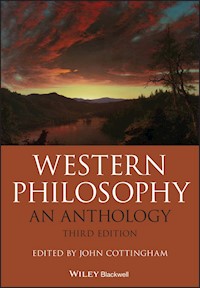
Western Philosophy E-Book
32,99 €
Mehr erfahren.
- Herausgeber: John Wiley & Sons
- Kategorie: Geisteswissenschaft
- Serie: Blackwell Philosophy Anthologies
- Sprache: Englisch
The new edition of this celebrated anthology surveys the Western philosophical tradition from its origins in ancient Greece to the work of today’s leading philosophers
Western Philosophy: An Anthology provides an authoritative guided tour through the great tradition of Western philosophical thought. The seminal writings of the great philosophers along with more recent readings of contemporary interest are explored in 144 substantial and carefully chosen extracts, each preceded by a lucid introduction, guiding readers through the history of a diverse range of key arguments, and explaining how important theories fit into the unfolding story of Western philosophical inquiry. Broad in scope, the anthology covers all the main branches of philosophy: theory of knowledge and metaphysics, logic and language, philosophy of mind, the self and freedom, religion and science, moral philosophy, political theory, aesthetics, and the meaning of life, all in self-contained parts which can be worked on by students and instructors independently.
The third edition of the Anthology contains newly incorporated classic texts from thinkers such as Aquinas, Machiavelli, Descartes, William James, and Wittgenstein. Each of the 144 individual extracts is now followed by sample questions focusing on the key philosophical problems raised by the excerpt, and accompanied by detailed further reading suggestions that include up-to-date links to online resources. Also new to this edition is an introductory essay written by John Cottingham, which offers advice to students on how to read and write about a philosophical text.
Part of the Blackwell Philosophy Anthologies series, Western Philosophy: An Anthology, Third Edition remains an indispensable collection of classic source materials and expert insights for both beginning and advanced university students in a wide range of philosophy courses.
Sie lesen das E-Book in den Legimi-Apps auf:
Seitenzahl: 2871
Veröffentlichungsjahr: 2021
Ähnliche




















BLACKWELL PHILOSOPHY ANTHOLOGIES
Each volume in this outstanding series provides an authoritative and comprehensive collection of the essential primary readings from philosophy’s main fields of study. Designed to complement the Blackwell Companions to Philosophy series, each volume represents an unparalleled resource in its own right, and will provide the ideal platform for course use.
Cottingham:
Western Philosophy: An Anthology
(third edition)
Cahoone:
From Modernism to Postmodernism: An Anthology
(expanded second edition)
LaFollette:
Ethics in Practice: An Anthology
(third edition)
Goodin and Pettit:
Contemporary Political Philosophy: An Anthology
(second edition)
Eze:
African Philosophy: An Anthology
McNeill and Feldman:
Continental Philosophy: An Anthology
Kim and Sosa:
Metaphysics: An Anthology
Lycan and Prinz:
Mind and Cognition: An Anthology
(third edition)
Kuhse and Singer:
Bioethics: An Anthology
(second edition)
Cummins and Cummins:
Minds, Brains, and Computers – The Foundations of Cognitive Science: An Anthology
Sosa, Kim, Fantl, and McGrath:
Epistemology: An Anthology
(second edition)
Kearney and Rasmussen:
Continental Aesthetics – Romanticism to Postmodernism: An Anthology
Martinich and Sosa:
Analytic Philosophy: An Anthology
Jacquette:
Philosophy of Logic: An Anthology
Jacquette:
Philosophy of Mathematics: An Anthology
Harris, Pratt, and Waters:
American Philosophies: An Anthology
Emmanuel and Goold:
Modern Philosophy – From Descartes to Nietzsche: An Anthology
Scharff and Dusek:
Philosophy of Technology – The Technological Condition: An Anthology
Light and Rolston:
Environmental Ethics: An Anthology
Taliaferro and Griffiths:
Philosophy of Religion: An Anthology
Lamarque and Olsen:
Aesthetics and the Philosophy of Art – The Analytic Tradition: An Anthology
John and Lopes:
Philosophy of Literature – Contemporary and Classic Readings: An Anthology
Cudd and Andreasen:
Feminist Theory: A Philosophical Anthology
Carroll and Choi:
Philosophy of Film and Motion Pictures: An Anthology
Lange:
Philosophy of Science: An Anthology
Shafer-Landau and Cuneo:
Foundations of Ethics: An Anthology
Curren:
Philosophy of Education: An Anthology
Shafer-Landau:
Ethical Theory: An Anthology
Cahn and Meskin:
Aesthetics: A Comprehensive Anthology
Western Philosophy An Anthology
Third edition
Edited byJohn Cottingham
Editorial material and organization © 1996, 2008, 2020 by Blackwell Publishing Ltd
BLACKWELL PUBLISHING
350 Main Street, Malden, MA 02148–5020, USA
9600 Garsington Road, Oxford OX4 2DQ, UK
550 Swanston Street, Carlton, Victoria 3053, Australia
The right of John Cottingham to be identified as the Author of the Editorial Material in this Work has been asserted in accordance with the UK Copyright, Designs, and Patents Act 1988.
All rights reserved. No part of this publication may be reproduced, stored in a retrieval system, or transmitted, in any form or by any means, electronic, mechanical, photocopying, recording or otherwise, except as permitted by the UK Copyright, Designs, and Patents Act 1988, without the prior permission of the publisher.
Designations used by companies to distinguish their products are often claimed as trademarks. All brand names and product names used in this book are trade names, service marks, trademarks, or registered trademarks of their respective owners. The publisher is not associated with any product or vendor mentioned in this book.
This publication is designed to provide accurate and authoritative information in regard to the subject matter covered. It is sold on the understanding that the publisher is not engaged in rendering professional services. If professional advice or other expert assistance is required, the services of a competent professional should be sought.
First edition published 1996 by Blackwell Publishers Ltd Second edition published 2008 by Blackwell Publishing Ltd Third edition 2021
12 2015
Library of Congress Cataloging-in-Publication Data
Names: Cottingham, John, 1943- editor.
Title: Western philosophy : an anthology / Edited by John G Cottingham.
Description: Third edition. | Malden, MA : Blackwell Publishing, [2021] | Series: Blackwell philosophy anthologies | Includes index. Identifiers: LCCN 2020040690 (print) | LCCN 2020040691 (ebook) | ISBN 9781119165729 (paperback) | ISBN 9781119165736 (pdf) | ISBN 9781119165743 (epub) | ISBN 9781119165750 (ebook other) Subjects: LCSH: Philosophy--Introductions. Classification: LCC BD21 .W43 2021 (print) | LCC BD21 (ebook) | DDC 190-dc23
LC record available at https://lccn.loc.gov/2020040690
LC ebook record available at https://lccn.loc.gov/2020040691
A catalogue record for this title is available from the British Library.
Cover image: Frederic Edwin Church, Twilightin the Wilderness, 1860, oil on canvas,© The Cleveland Museum of Art,Mr. and Mrs. William H. Marlatt FundCover design by Wiley
Set in 10.5/12.5pt Minion
by Integra Software Services, Pondicherry, India
Printed and bound in Singapore
by COS Printers Pte Ltd The publisher’s policy is to use permanent paper from mills that operate a sustainable forestry policy, and which has been manufactured from pulp processed using acid-free and elementary chlorine-free practices. Furthermore, the publisher ensures that the text paper and cover board used have met acceptable environmental accreditation standards.
For further information on
Blackwell Publishing, visit our website:
www.blackwellpublishing.com
John Cottingham’sWestern Philosophy: An AnthologyPraise for the first edition
‘It is difficult to imagine how this volume could be improved upon as the very best historically based anthology of the essential philosophical writings. Cottingham’s commentary and introductions are extremely clear and helpful. It will provide an ideal text for an excellent introductory course in philosophy’. Christopher Hookway, University of Sheffield
‘This volume is a superb resource for beginning students and their teachers. Not only is it an excellent anthology – a comprehensive, well-chosen, well-edited collection of classic texts, from Plato to Sartre, Aristotle to Rawls – it is also a perspicuous systematic presentation of the subject, owing to the editor’s skilful provision of introductory material and notes. Judiciously annotated lists of supplementary readings further enhance the value of this outstanding volume.’ Vere Chappell, University of Massachusetts
‘In this anthology the highly respected philosopher John Cottingham has assembled 100 classic selections from Plato to Parfit. Done with care and considerable expertise the result is arguably the best single-volume introduction to the writings of Western philosophy.’ John Haldane, University of St Andrews
‘A truly outstanding collection. An excellent course book which doubles as a solid reference volume. The clarity of the commentary makes these classic readings vivid and accessible to students.’ George Graham, University of Alabama
‘By providing the means to appreciate philosophy as the great historical odyssey of the human intellect, this ambitious anthology makes philosophy come alive for students and general readers alike.’ David Cooper, University of Durham
For JCC and family
Contents
Cover
Series page
Title page
Copyright
Edition
Dedication
Preface
Acknowledgements
Guidance for Readers and Format of the Volume
Introductory Essay: How to Read a Philosophical Text and How to Write about It
Part I Knowledge and Certainty
Chapter 1: Innate Knowledge Plato,
Meno
Chapter 2: Knowledge versus Opinion Plato,
Republic
Chapter 3: Demonstrative Knowledge and Its Starting points Aristotle,
Posterior Analytics
Chapter 4: New Foundations for Knowledge René Descartes,
Meditations
Chapter 5: The Senses as the Basis of Knowledge John Locke,
Essay Concerning Human Understanding
Chapter 6: Innate Knowledge Defended Gottfried Leibniz,
New Essays on Human Understanding
Chapter 7: Scepticism versus Human Nature David Hume,
Enquiry Concerning Human Understanding
Chapter 8: Experience and Understanding Immanuel Kant,
Critique of Pure Reason
Chapter 9: From Sense-certainty to Self-consciousness Georg Hegel,
Phenomenology of Spirit
Chapter 10: Beliefs Judged by Their Practical Effects William James,
What Pragmatism Means
Chapter 11: Against Scepticism G. E. Moore,
A Defence of Common Sense
Chapter 12: Does Empirical Knowledge Have a Foundation? Wilfrid Sellars,
The Myth of the Given
Part II being and reality
Chapter 1: The allegory of the cave plato,
Republic
Chapter 2: individual substance aristotle,
Categories
Chapter 3: supreme being and created things rené descartes,
Principles of Philosophy
Chapter 4: qualities and ideas john locke,
Essay Concerning Human Understanding
Chapter 5: substance, life and activity gottfried leibniz,
New System
Chapter 6: nothing outside the mind george berkeley,
Principles of Human Knowledge
Chapter 7: the limits of metaphysical speculation david hume,
Enquiry Concerning Human Understanding
Chapter 8: metaphysics, old and new immanuel kant,
Prolegomena
Chapter 9: reality as flux alfred whitehead,
Process and Reality
, and
Science and the Modern World
Chapter 10: being and involvement martin heidegger,
Being and Time
Chapter 11: the end of metaphysics? rudolf carnap,
The Elimination of Metaphysics
Chapter 12: the problem of ontology w. v. o. quine,
On What There Is
Part III Language and Meaning
Chapter 1: The Meanings of Words Plato,
Cratylus
Chapter 2: Language and Its Acquisition Augustine,
Confessions
Chapter 3: Thought, Language and Its Components William of Ockham,
Writings on Logic
Chapter 4: Language, Reason and Animal Utterance René Descartes,
Discourse on the Method
Chapter 5: Abstract General Ideas John Locke,
Essay Concerning Human Understanding
Chapter 6: Particular Ideas and General Meaning George Berkeley,
Principles of Human Knowledge
Chapter 7: Denotation versus Connotation John Stuart Mill,
A System of Logic
Chapter 8: Names and Their Meaning Gottlob Frege,
Sense and Reference
Chapter 9: Definite and Indefinite Descriptions Bertrand Russell,
Introduction to Mathematical Philosophy
Chapter 10: Meaning and Use Ludwig Wittgenstein,
The Blue and Brown Books
Chapter 11: Non-descriptive Uses of Language J. L. Austin,
Performative Utterances
Chapter 12: How the Reference of Terms is Fixed Saul Kripke,
Naming and Necessity
Part IV Mind and Body
Chapter 1: The Immortal Soul Plato,
Phaedo
Chapter 2: Soul and Body, Form and Matter Aristotle,
De Anima
Chapter 3: The Human Soul Thomas Aquinas,
Summa Theologiae
Chapter 4: The Non-material Mind or Soul and Its Relation to the Body René Descartes,
Discourse and Meditations
Chapter 5: The Identity of Mind and Body Benedict Spinoza,
Ethics
Chapter 6: Mind–Body Correlations Nicolas Malebranche,
Dialogues on Metaphysics
Chapter 7: Body and Mind as Manifestations of Will Arthur Schopenhauer,
The World as Will and Idea
Chapter 8: The Problem of Other Minds John Stuart Mill,
An Examination of Sir William Hamilton’s Philosophy
Chapter 9: The Hallmarks of Mental Phenomena Franz Brentano,
Psychology from an Empirical Standpoint
Chapter 10: The Myth of the ‘Ghost in the Machine’ Gilbert Ryle,
The Concept of Mind
Chapter 11: Mental States as Functional States Hilary Putnam,
Psychological Predicates
Chapter 12: The Subjective Dimension of Consciousness Thomas Nagel,
What is it Like to be a Bat?
Part V The Self and Freedom
(a) The Self
Chapter 1: the self and consciousness John locke,
Essay Concerning Human Understanding
Chapter 2: the self as primitive concept Joseph butler,
Of Personal Identity
Chapter 3: the self as bundle David hume,
A Treatise of Human Nature
Chapter 4: the partly hidden self Sigmund freud,
Introductory Lectures on Psychoanalysis
Chapter 5: liberation from the self Derek parfit,
Reasons and Persons
Chapter 6: selfhood and narrative understanding Charles taylor,
Sources of the Self
(b) Freedom
Chapter 7: human freedom and divine providence augustine,
The City of God
Chapter 8: freedom to do what we want Thomas hobbes,
Liberty
,
Necessity and Chance
Chapter 9: free will as the power of rational agency Thomas reid,
Essays on the Active Powers of Man
Chapter 10: absolute determinism Pierre-Simon de laplace,
Philosophical Essay on Probability
Chapter 11: condemned to be free Jean-Paul sartre,
Being and Nothingness
Chapter 12: Freedom, Responsibility and the Ability to Do Otherwise Harry G. Frankfurt,
Alternate Possibilities and Moral Responsibility
Part VI God and Religion
Chapter 1: God Cannot Be Thought Not to Exist Anselm of Canterbury,
Proslogion
Chapter 2: The Five Proofs of God Thomas Aquinas,
Summa Theologiae
Chapter 3: God as Source of My Idea of the Infinite René Descartes,
Meditations
Chapter 4: God’s Existence Derived from His Nature or Essence René Descartes,
Meditations
Chapter 5: The Wager Blaise Pascal,
Pensées
Chapter 6: The problem of Evil Gottfried Leibniz,
Theodicy
Chapter 7: The Argument from Design David Hume,
Dialogues Concerning Natural Religion
Chapter 8: Against Miracles David Hume,
Enquiry Concerning Human Understanding
Chapter 9: Faith and Subjectivity Søren Kierkegaard,
Concluding Unscientific Postscript
Chapter 10: Reason, Passion and the Religious Hypothesis William James,
The Will to Believe
Chapter 11: The Meaning of Religious Language John Wisdom,
Gods
Chapter 12: Many Paths to the Same Ultimate Reality? John Hick,
Problems of Religious Pluralism
Part VII Science and Method
Chapter 1: four types of explanation aristotle,
Physics
Chapter 2: experimental methods and true causes francis bacon,
Novum Organum
Chapter 3: Mathematical science and the control of nature René descartes,
Discourse on the Method
Chapter 4: The limits of scientific explanation George berkeley,
On Motion
Chapter 5: the problem of induction David hume,
Enquiry Concerning Human Understanding
Chapter 6: the relation between cause and effect David hume,
Enquiry Concerning Human Understanding
Chapter 7: causality and our experience of events Immanuel kant,
Critique of Pure Reason
Chapter 8: the uniformity of nature John Stuart mill,
System of Logic
Chapter 9: science and falsifiability Karl popper,
Conjectures and Refutations
Chapter 10: how explaining works Carl G. hempel,
Explanation in Science and History
Chapter 11: scientific realism versus instrumentalism Grover maxwell,
The Ontological Status of Theoretical Entities
Chapter 12: change and crisis in science Thomas kuhn,
The Structure of Scientific Revolutions
Part VIII Morality and the Good Life
Chapter 1: morality and happiness plato,
Republic
Chapter 2: ethical virtue aristotle,
Nicomachean Ethics
Chapter 3: morality and natural law aquinas,
Summa Theologiae
Chapter 4: virtue, reason and the passions Benedict spinoza,
Ethics
Chapter 5: human feeling as the source of ethics David hume,
Enquiry Concerning the Principles of Morals
Chapter 6: duty and reason as the Ultimate Principle Immanuel kant,
Groundwork of the Metaphysic of Morals
Chapter 7: happiness as the foundation of morality John Stuart mill,
Utilitarianism
Chapter 8: utility and common-sense morality Henry sidgwick,
Methods of Ethics
Chapter 9: against conventional morality Friedrich nietzsche,
Beyond Good and Evil
Chapter 10: duty and intuition w. d. ross,
The Right and the Good
Chapter 11: ethics as Rooted in history and culture Alasdair macintyre,
After Virtue
Chapter 12: could ethics be objective? Bernard williams,
Ethics and the Limits of Philosophy
Part IX Problems in Ethics
Chapter 1: Inequality, Freedom and Slavery Aristotle,
Politics
Chapter 2: War and Justice Thomas Aquinas,
Summa Theologiae
Chapter 3: Taking One’s Own Life David Hume,
On Suicide
Chapter 4: Gender, Liberty and Equality Mary Wollstonecraft,
A Vindication of the Rights of Women
Chapter 5: Partiality and Favouritism William Godwin,
Enquiry Concerning Political Justice
Chapter 6: The Status of Non-human Animals Immanuel Kant,
Lectures on Ethics
Chapter 7: The Purpose of Punishment Jeremy Bentham,
Principles of Morals and Legislation
Chapter 8: Our Relationship to the Environment Aldo Leopold,
The Land Ethic
Chapter 9: Abortion and Rights Judith Jarvis Thomson,
A Defense of Abortion
, and Patrick Lee & Robert P. George,
The Wrong of Abortion
Chapter 10: The Relief of Global Suffering Peter Singer,
Famine, Affluence and Morality
Chapter 11: Medical Ethics and the Termination of Life
James
Rachels,
Active and Passive Euthanasia
Chapter 12: Cloning, Sexual Reproduction and Genetic Engineering Leon R. Kass,
The Wisdom of Repugnance
Part X Authority and the State
Chapter 1: Our Obligation to Respect the laws of the state plato,
Crito
Chapter 2: The Just Ruler Thomas aquinas,
On Princely Government
Chapter 3: Power and Control Niccolò machiavelli,
The Prince
Chapter 4: Sovereignty and Security Thomas hobbes,
Leviathan
Chapter 5: Consent and Political Obligation John locke,
Second Treatise of Civil Government
Chapter 6: Against Contractarianism David hume,
Of the Original Contract
Chapter 7: Society and the Individual Jean-Jacques rousseau,
The Social Contract
Chapter 8: The Unified State – From Individual Desire to Rational Self-determination Georg hegel,
The Philosophy of Right
Chapter 9: Property, Labour and Alienation Karl marx and Friedrich engels,
The German Ideology
Chapter 10: The Limits of Majority Rule John Stuart mill,
On Liberty
Chapter 11: Rational Choice and Fairness John rawls,
A Theory of Justice
Chapter 12: The Minimal State Robert nozick,
Anarchy, State and Utopia
Part XI Beauty and Art
Chapter 1: art and imitation plato,
Republic
Chapter 2: The Nature and Function of dramatic art aristotle,
Poetics
Chapter 3: the idea of beauty Francis hutcheson,
Inquiry Concerning Beauty, Order, Harmony, Design
Chapter 4: aesthetic appreciation David hume,
Of the Standard of Taste
Chapter 5: the concept of the beautiful Immanuel kant,
Critique of Judgement
Chapter 6: the metaphysics of beauty Arthur schopenhauer,
On Aesthetics
Chapter 7: the two faces of art Friedrich nietzsche,
The Birth of Tragedy
Chapter 8: the value of art Leo tolstoy,
What Is Art?
Chapter 9: imagination and art Jean-Paul sartre,
The Psychology of Imagination
Chapter 10: what is aesthetics? Ludwig wittgenstein,
Lectures on Aesthetics
Chapter 11: the meaning of a literary work W. K. wimsatt jr. and M. C. beardsley,
The Intentional Fallacy
Chapter 12: the basis of judgements of taste Frank sibley,
Aesthetic Concepts
Part XII Human Life and Its Meaning
Chapter 1: How to Accept Reality and Avoid Fear Lucretius,
On the Nature of the Universe
Chapter 2: Life Guided by Stoic Philosophy Seneca,
Moral Letters
Chapter 3: Meaning through Service to Others Augustine,
Confessions
Chapter 4: Contentment with the Human Lot Michel de Montaigne,
On Experience
Chapter 5: The Human Condition, Wretched yet Redeemable Blaise Pascal,
Pensées
Chapter 6: Human Life as a Meaningless Struggle Arthur Schopenhauer,
On the Vanity of Existence
Chapter 7: The Death of God and the Ascendancy of the Will Friedrich Nietzsche,
Thus Spake Zarathustra
Chapter 8: Idealism in a Godless Universe Bertrand Russell,
A Free Man’s Worship
Chapter 9: Futility and Defiance Albert Camus,
The Myth of Sisyphus
Chapter 10: Involvement versus Detachment Thomas Nagel,
The Absurd
Chapter 11: Religious Belief as Necessary for Meaning William Lane Craig,
The Absurdity of Life without God
Chapter 12: Seeing Our Lives as Part of the Process Robert Nozick,
Philosophy’s Life
Background Reading and Reference
Notes on the Philosophers
Index
End User License Agreement
Guide
Cover
Series page
Title page
Copyright
Table of Contents
John Cottingham’s Western Philosophy: An Anthology Praise for the first edition
Dedication
Preface
Acknowledgements
Guidance for Readers and Format of the Volume
Introductory Essay: How to Read a Philosophical Text and How to Write about It
Begin Reading
Background Reading and Reference
Notes on the Philosophers
Index
End User License Agreement
Pages
i
ii
iii
iv
v
vi
vii
viii
ix
x
xi
xii
xiii
xiv
xv
xvi
xvii
xviii
xix
xx
xxi
xxii
xxiii
xxiv
xxv
xxvi
xxvii
xxviii
xxix
xxx
xxxi
xxxii
xxxiii
xxxiv
xxxv
xxxvi
xxxvii
1
2
3
4
5
6
7
8
9
10
11
12
13
14
15
16
17
18
19
20
21
22
23
24
25
26
27
28
29
30
31
32
33
34
35
36
37
38
39
40
41
42
43
44
45
46
47
48
49
50
51
52
53
54
55
56
57
58
59
60
61
62
63
64
65
66
67
68
69
70
71
72
73
74
75
76
77
78
79
80
81
82
83
84
85
86
87
88
89
90
91
92
93
94
95
96
97
98
99
100
101
102
103
104
105
106
107
108
109
110
111
112
113
114
115
116
117
118
119
120
121
122
123
124
125
126
127
128
129
130
131
132
133
134
135
136
137
138
139
140
141
142
143
144
145
146
147
148
149
150
151
152
153
154
155
156
157
158
159
160
161
162
163
164
165
166
167
168
169
170
171
172
173
174
175
176
177
178
179
180
181
182
183
184
185
186
187
188
189
190
191
192
193
194
195
196
197
198
199
200
201
202
203
204
205
206
207
208
209
210
211
212
213
214
215
216
217
218
219
220
221
222
223
224
225
226
227
228
229
230
231
232
233
234
235
236
237
238
239
240
241
242
243
244
245
246
247
248
249
250
251
252
253
254
255
256
257
258
259
260
261
262
263
264
265
266
267
268
269
270
271
272
273
274
275
276
277
278
279
280
281
282
283
284
285
286
287
288
289
290
291
292
293
294
295
296
297
298
299
300
301
302
303
304
305
306
307
308
309
310
311
312
313
314
315
316
317
318
319
320
321
322
323
324
325
326
327
328
329
330
331
332
333
334
335
336
337
338
339
340
341
342
343
344
345
346
347
348
349
350
351
352
353
354
355
356
357
358
359
360
361
362
363
364
365
366
367
368
369
370
371
372
373
374
375
376
377
378
379
380
381
382
383
384
385
386
387
388
389
390
391
392
393
394
395
396
397
398
399
400
401
402
403
404
405
406
407
408
409
410
411
412
413
414
415
416
417
418
419
420
421
422
423
424
425
426
427
428
429
430
431
432
433
434
435
436
437
438
439
440
441
442
443
444
445
446
447
448
449
450
451
452
453
454
455
456
457
458
459
460
461
462
463
464
465
466
467
468
469
470
471
472
473
474
475
476
477
478
479
480
481
482
483
484
485
486
487
488
489
490
491
492
493
494
495
496
497
498
499
500
501
502
503
504
505
506
507
508
509
510
511
512
513
514
515
516
517
518
519
520
521
522
523
524
525
526
527
528
529
530
531
532
533
534
535
536
537
538
539
540
541
542
543
544
545
546
547
548
549
550
551
552
553
554
555
556
557
558
559
560
561
562
563
564
565
566
567
568
569
570
571
572
573
574
575
576
577
578
579
580
581
582
583
584
585
586
587
588
589
590
591
592
593
594
595
596
597
598
599
600
601
602
603
604
605
606
607
608
609
610
611
612
613
614
615
616
617
618
619
620
621
622
623
624
625
626
627
628
629
630
631
632
633
634
635
636
637
638
639
640
641
642
643
644
645
646
647
648
649
650
651
652
653
654
655
656
657
658
659
660
661
662
663
664
665
666
667
668
669
670
671
672
673
674
675
676
677
678
679
680
681
682
683
684
685
686
687
688
689
690
691
692
693
694
695
696
697
698
699
700
701
702
703
704
705
706
707
708
709
710
711
712
713
714
715
716
717
718
719
720
721
722
723
724
725
726
727
728
729
730
731
732
733
734
735
736
737
738
739
740
741
742
743
744
745
746
747
748
749
750
751
752
753
754
755
756
757
758
759
760
761
762
763
764
765
766
767
768
769
770
771
772
773
774
775
776
777
778
779
780
781
782
783
784
785
786
787
788
789
790
791
792
793
794
795
796
797
798
799
800
801
802
803
804
805
806
807
808
809
810
811
812
813
814
815
816
817
818
819
820
821
822
823
824
825
826
827
828
829
830
831
832
833
834
835
836
837
838
839
840
841
842
843
844
845
846
847
848
849
850
851
852
853
854
855
856
857
858
859
860
861
862
863
864
865
866
867
868
869
870
871
872
873
874
875
876
877
878
879
880
881
882
883
884
885
886
887
888
889
890
891
892
893
894
895
896
897
898
899
900
901
902
903
904
905
906
Preface
An anthology can serve many different purposes. Anthologies of poetry usually leave readers to make their own way, sampling the flowers arranged for their delight. With philosophy things are rather different. Many of the arguments of the great philosophers rest on a daunting array of presuppositions and concealed premises, and careful guidance is needed if many readers are not to be overwhelmed. The texts included in this volume, and the linking passages of introduction and commentary, offer a guided tour through the main branches of the subject, introducing the ideas in sequence, and uncovering the main outlines of that complex interplay of arguments which forms the Western philosophical tradition. The central aim, as with all anthologies, is to put the reader in touch with the texts themselves. Those embarking on the subject can sometimes find it hard even to grasp just what philosophy is, and there is no better way of discovering than to read the writings of the great philosophers at first hand. This volume is designed to present some of the most important extracts from those writings in a way that will enable the individual to achieve a clear overview of how the subject developed, and how the most important theories fit into the overall picture. It is, I hope, a book which individuals will be able to keep by them, for pleasure and profit, as they set out on the quest for philosophical understanding.
The book also has the more specific aim of being serviceable to university students undertaking a formal course of study in philosophy. Philosophy is a wide-ranging subject, and there is no single template for an ideal introductory course (and even if there were, philosophy departments worth their salt would not wish to grind out exactly the same syllabus year after year). There are many ways into philosophy, and no good reason why one particular branch of the subject should always form the chosen route. One of the objects of this book is to provide, within the compass of a single volume, a set of key introductory materials for the widest possible range of courses, covering all the main branches of the subject (or at least all those suitable for teaching at a basic undergraduate level). Fundamental issues in epistemology are dealt with in Part I (‘Knowledge and Certainty’). Part II (‘Being and Reality’) is concerned with general metaphysics and ontology, and Part III (‘Language and Meaning’) deals with central philosophical concerns about how language is related to thought and to the world. The philosophy of mind is covered in Part IV (‘Mind and Body’), and the important issues of personal identity and the freedom of the will receive separate treatment in Part V (‘The Self and Freedom’). The philosophy of religion and the philosophy of science are dealt with in Part VI (‘God and Religion’) and Part VII (‘Science and Method’) respectively. The next two parts deal with moral philosophy: Part VIII (‘Morality and the Good Life’) tackles theoretical and systematic issues in normative ethics, while Part IX (‘Problems in Ethics’) covers a selection of key issues in applied moral philosophy. Part X (‘Authority and the State’) and Part XI (‘Beauty and Art’) deal respectively with political philosophy and aesthetics, and, to conclude the volume, Part XII (‘Human Life and its Meaning’) covers some of the various ways in which great thinkers, ancient and modern, have tackled the old puzzle of what significance, if any, attaches to human existence.
Although the first three parts of the volume are devoted to epistemology, meta-physics and philosophy of language, traditionally considered as having a ‘foundational’ role in philosophy, the issues raised here are among the most demanding in the book, and there is no compelling reason why any given introductory course should have to begin with them. Each part of the volume is intended to be self-contained, and students and teachers are invited to work on the various parts of the book in any order they see fit, or indeed to concentrate on any particular part or parts in isolation. That said, given the nature of philosophy there is inevitably a fair amount of overlap between the topics raised in various parts; where this happens footnotes are provided to draw attention to connections with relevant texts or commentary in other parts of the volume.
The passages of introduction and commentary which link the extracts have been kept as concise and clear as possible. They are, of course, no substitute for the interpretations and evaluations which lecturers and instructors will themselves wish to provide. This book is designed to be serviceable for both teachers and students, not to eliminate the need for hard work by either group. So what is provided here is a basic scaffolding on which courses can be constructed, and a supportive framework for those coming to the texts for the first time. There is always a danger of oversimplification when writing with the principal aim of helping the student reader. Philosophy is not an easy subject, and spoon-feeding is often counterproductive; in the end there is no alternative to readers wrestling with the arguments for themselves. But without a clear initial overview, the whole philosophical enterprise can seem dauntingly obscure. Qualifications, objections, reinterpretations – these can always be added later; but if there is no initial understanding, the enthusiasm for making these further efforts will simply ebb away before any progress has been made.
These points notwithstanding, there may still be some who may have certain reservations about the very idea of introducing students to philosophy by way of an anthology, as opposed to through the intensive study of complete texts. Those who (like the present writer) were taught by this latter method will know that it has a very great deal to recommend it. Nevertheless, the vast expansion in numbers in tertiary education during the late twentieth century has required many philosophy teachers to rethink their approach. This has been particularly true in the United Kingdom. A typical annual philosophy intake in most British universities used to comprise a relatively small number of students who, even in their first year, could be taught in specialized classes and tutorials. But nowadays introductory classes can run to hundreds, and for groups of this size no library, however well equipped, can furnish enough copies of books and articles to support the traditional tutorial system based on the weekly reading list. Many teachers in Britain have thus had to accept what their counterparts in North America and elsewhere have long taken as given: the need for a single compendious volume of readings which will supply the materials for an entire introductory course in philosophy. Such volumes do not, of course, preclude students from reading more widely (as every good teacher will want to encourage them to do); but they at least ensure that some of the basic textual materials are to hand.
Although the volume is a stout one, the constraints of space are nevertheless such that many hard choices have been necessary. To begin with, this is a collection based on ‘classic’ texts, and this means that only a relatively small percentage of the extracts are taken from the work of philosophers from the recent past. To have given a representative selection of today’s proliferating philosophical theories and debates would have required virtually an entire volume corresponding to each of the divisions of the present book. The classic materials featured here are nevertheless designed to provide a good base for understanding more recent developments, and the commentary accompanying each part of the volume often includes brief glances forward to later theories. Even within the terms of its chosen framework, however, the selection presented here cannot make any claim to completeness: the schema of twelve extracts in each of the twelve parts yields that pleasingly duodecimal aggregate traditionally termed a ‘gross’ (which gives the book a considerably wider scope than most recent anthologies); but I am well aware of the very many candidates for inclusion that have had to be omitted. If specialists, turning to their chosen authors, are shocked by the brevity of the extracts, or the severity of the abridgements, I can only plead that they bear in mind that nothing in the present project is designed to stop students going on to make a more detailed and thorough study of the authors represented here. On the contrary, it is my earnest hope that students who might have been overwhelmed by stern injunctions to read ‘all or nothing’ will be sufficiently excited by some of the extracts here to turn to the full texts, and to the suggestions for further reading which are provided at the end of each Part.
As well as the abridging noted in the previous paragraph, in preparing the extracts for inclusion in this volume I have not hesitated to modify spelling, punctuation and layout to make the material more readily accessible to the modern reader. It is of course vital that critical editions should preserve the original texts for scholarly use, but the aims of an anthology such as this are rather different; and since so many long-dead Greek, Latin, French and German writers are in any case presented here in modern English translations, it seemed over-exacting to insist on antiquated spelling and grammar just for those philosophers who wrote in English. I did indeed at one point consider ‘translating’ the extracts from such writers as Locke and Hume (that is, providing completely new modern English versions), but in the end (despite the urgings of some colleagues) resisted this radical measure, contenting myself instead with a few minor modifications of phrasing in places where the original was so antique that it might pose a major obstacle to the modern student reader. Some will feel I have not gone far enough; others will no doubt express outrage that a single comma has been altered. Bearing in mind, as always, the readership for whom this book is intended, I have tried to follow an Aristotelian mean between opposing culinary vices: my aim has been to avoid making the fare either blandly over-processed or harshly indigestible.
As for the principles of selection, since it would be impossibly ponderous to defend each decision, chapter and verse, I will simply observe that one overarching aim has been to try to make sure that the materials within each Part of the volume hang together as far as possible; rather than leaving readers to sink or swim, as is often done, I have tried to guide them through the extracts, linking the ideas together, so that by the end of each Part they should be able to move towards achieving a coherent, if necessarily schematic, overview of the relevant branch of the subject. Further details of the plan of the book may be found in the ‘Guidance for Readers and Format of the Volume’ (pp. xxviii–xxx, below).
I am very grateful to the publishers and individual authors and translators named in the footnotes at the start of each extract for permission to reproduce the materials indicated. Further details are given in the Acknowledgements (pp. xxi–xxvii, below). (In a number of cases, the translations from the original Greek, Latin, French and German texts are my own.) As noted above, for the purposes of the present volume it has been necessary to abridge some of the extracts, and in the interests of clarity or consistency I have sometimes modified the original spelling and punctuation, and made occasional minor changes in phrasing. Further details may be found in the footnotes accompanying each extract. Finally, I should like to acknowledge here the wealth of helpful advice I have received from friends and colleagues in the course of preparing this volume. I am especially grateful to John Ackrill, John Andrews, Doug Buchanan, Edmund Burke, Harley Cahen, Enrique Chávez-Arvizo, Max de Gaynesford, Hanjo Glock, John Haldane, Brad Hooker, Andrew Mason, Richard Norman, David Oderberg, Derek Parfit, Harry Parkinson, John Preston, Michael Proudfoot, Steve Smith, Sandy Stewart, Jim Stone, Mark Tebbit and Rosemary Wright. I am greatly indebted to Enrique Chávez-Arvizo for checking the ‘Notes on the Philosophers’, and for preparing the index.
Preface to the Second Edition
The original edition of 1996 contained ten Parts of ten extracts each. All the material that appeared in the first edition has been retained in full, but the volume has been substantially enlarged for this second edition.
In the first place, each of the existing Parts now contains two additional extracts, bringing the total number of extracts per Part to twelve instead of ten. The decision to use more modern material for these further extracts was relatively easy, not just because many philosophers and students find a special excitement in more recent developments, but also because philosophy is a living and constantly evolving subject, and it is important for those studying the Western philosophical tradition to be aware that it continues to develop. The roots and trunk of the old plant are immensely valuable in themselves, but also because they put forth fresh shoots. That said, the selection of the new, more recent, materials was far from easy, since unlike the great classics of the past, they have yet to prove their enduring worth; what is more, today’s philosophers are notoriously at odds about the relative importance of the proliferating current trends in the subject. I cannot hope to please everyone, but I have tried to select pieces that, firstly, will give some sense of where each of the respective branches of the subject is going, and, secondly, will stand some comparison with their august predecessors – either because since publication they have already achieved something of the status of instant classics, or else because they are at least worthy representatives of distinctive strands of philosophical inquiry that seem likely to endure.
As well as augmenting the existing Parts of the volume, I have also included two completely new Parts, each of twelve items, which (as noted above in the main Preface) brings the total number of extracts in the book as a whole to 144, in place of the original hundred. Dividing the spoils equally between ‘theoretical’ and ‘practical’ philosophy (to use a classification commonly employed in Philosophy departments in continental Europe), I have devoted these two new sections of the book to Philosophy of Language, and to the Meaning of Life respectively. The former is a subject that forms a vitally important part of the Western philosophical tradition, and one that many readers of the first edition expressed a strong interest in seeing included in any revised volume; the latter relates to one of philosophy’s oldest and most weighty preoccupations, eclipsed under the restrictive conception of philosophical inquiry that became fashionable around the middle of the twentieth century, but now happily reinstated.
I am most grateful to those many philosophical colleagues from around the world who were kind enough to let me know that they found the first edition of the book useful, and I am heavily indebted to a large number of friends and colleagues for invaluable suggestions about the composition of this new edition, and/or for comments on the new material. Particular thanks are due to Michaela Baker, Jonathan Dancy, Max de Gaynesford, Brian Feltham, Philip Goff, Brad Hooker, John Hyman, Ward Jones, Seán MacGiollarnath, David Oderberg, John Preston, Severin Schroeder, Philip Stratton-Lake, Daniel Whiting and Andrew Williams. Emma Borg was kind enough to cast an expert eye over the draft of Part III, and made many valuable suggestions for improvement, and Joseph Jedwab kindly did the same for Part VI, and Andrew Williams for Part X. I have a special debt to Javier Kalhat, whose judicious advice was an enormous help to me, and who also provided unstinting assistance in hunting down the relevant materials and making suggestions for abridgement. Bryan Weaver provided much appreciated help with the additions to Part IX. Finally, I should like to express my thanks to Nick Bellorini, the Commissioning Editor at Blackwell Publishers, for encouraging me to produce this second edition, and to all the members of the editorial and production team for their hard work and efficiency.
JC
Reading, England
April 2007
Preface to the Third Edition
Philosophy is not an easy subject, and the appearance of a third edition of this anthology has provided the opportunity to increase the amount of help and advice included for the benefit of students and other readers. In response to many requests, I have added, at the start of the volume, an introductory essay which offers advice on how to set about reading a philosophical text and how to write about it. There are no quick and easy formulas in philosophy, but I hope at least some of those using this anthology as a course text will find this essay helpful. In addition, the opportunity has been taken to revise and substantially augment the suggested further readings and sample questions accompanying the texts. Instead of a brief list of readings at the end of each part of the volume, each of the 144 individual extracts is now followed by several specimen questions designed to focus on some of the key philosophical problems raised by the excerpt, together with a list of readings related to the specific text in question. A particular point has been made of including references to online resources which give the student quick access to helpful critical and exegetical guidance.1
Probably no two philosophers will agree on the ideal selection of texts for an anthology of this kind, and a survey the publishers conducted of current users of the second edition produced a wide variety of suggestions for alternative texts that might be included. Though I was wary of making any wholesale changes, I have as a result introduced a small number of changes to the texts chosen for this third edition, in order to fill some gaps; but reluctance to make what was already a fairly bulky volume more unwieldy decided me to make substitutions rather than additions, and I have retained the basic framework adopted for the second edition (twelve parts each of twelve sections). The overall character of the anthology has been preserved, with preference nearly always given to texts that have stood the test of time, as opposed to more recent offerings that may be attracting current interest, but whose long-term place in the canon of Western philosophy cannot yet be said to be secure.
I am grateful to several members of the team at Wiley for encouraging me to undertake the revisions for this third edition, and to many friends and colleagues who have been kind enough to offer advice, including Paul Lodge, David McPherson, Mark Tebbit and Ramón Tello. Particular gratitude is owed to Dr Julia Weckend for her invaluable work in updating and augmenting the specimen questions and reading suggestions at the end of each extract.
JC
West Berkshire, England
January 2020
1
In referencing an online resource the full url is provided, clicking on which will enable those using the ebook version of this volume to link directly to the item in question. Those using the print version of this volume can access such resources by typing the url provided into a browser; but where the link is is a long one it may be quicker simply to access the homepage of the relevant site (for example the
Stanford Encyclopedia of Philosophy
) and then use the site’s own search facility to navigate to the particular article or item needed.
Acknowledgements
The editor and publishers wish to thank the following who have kindly given permission for the use of copyright material:
Part I Knowledge and Certainty
4 René Descartes, Meditation I and part of II, pp.12–17 from
Meditations on
First Philosophy
[
Meditationes de prima philosophia
, 1641], trans. John Cottingham (Cambridge: Cambridge University Press, 1986). © 1986 by Cambridge University Press. Reproduced with permission of Cambridge University Press.
6 Gottfried Leibniz, paras 44–53 from Peter Remnant and Jonathan Bennett (ed. and trans.),
New Essays on Human Understanding
[
Nouveaux essais sur l’entendement humain
, c.1704; first pub.1765] (Cambridge: Cambridge University Press, 1981). © 1981 by Cambridge University Press. Reproduced with permission of Cambridge University Press.
8 Immanuel Kant, extracts from ‘Introduction’, Sections 1 and 2 (B1–5); ‘Transcendental Logic’, Section 1 (B74–5); ‘Transcendental Analytic’, Book I, chapter 2; ‘Transition to the Transcendental Deduction of the Categories’ (B124–6) from
Critique of Pure Reason
[
Kritik der reinen Vernunft
, 1781; 2nd edn 1787], trans. (with minor modifications) N. Kemp Smith (2nd edn) (London: Macmillan, 1933). Reproduced with permission of Springer Nature.
11 G. E. Moore, ‘A Defence of Common Sense’, [1925], extracts from G. H. Muirhead (ed.),
Part I. Contemporary British Philosophy
, second series (London: Allen & Unwin, 1925).
12 Wilfrid Sellars, ‘Empiricism and the Philosophy of Mind’, in
The Foundations of Science and the Concepts of Psychoanalysis
, Minnesota Studies in the Philosophy of Science, Vol. 1 (University of Minnesota Press, 1956) pp. 293–300 (VIII. Does Empirical Knowledge Have a Foundation?). © 1956 by University of Minnesota Press. Reproduced with permission of University of Minnesota Press.
Part II Being and Reality
2 Aristotle, chapter 5 (2a11–4b19), pp. 5–12 from
Categories
[
Categories
, c.330 BC], trans. J. L. Ackrill (Oxford: Clarendon, 1963). © 1963 by Oxford University Press. Reproduced with permission of Oxford University Press.
3 René Descartes, Part I, articles 51, 52, 54, 63; Part II, articles 1, 2, 3, 4, 21, 22, 23, 36, 64 from
Principles of Philosophy
[
Principia Philosophiae
, 1644], pp. 210–11, 215, 223–5, 232, 240, 247 from
The Philosophical Writings of Descartes
, vol. I, trans. J. Cottingham, R. Stoothoff and D. Murdoch (Cambridge: Cambridge University Press, 1985). © 1985 by Cambridge University Press. Reproduced with permission of Cambridge University Press.
5 Gottfried Leibniz,
New System of Nature and the Communication of Substances
[
Système nouveau de la nature et de la communication des substances
, 1695], pp. 115–25 (with omissions) from
Philosophical Writings
, trans. G. H. R. Parkinson and M. Morris (London: J.M. Dent, 1973). Reproduced with permission of Everyman’s Library, an imprint of Alfred A. Knopf.
9a Alfred North Whitehead, Ch. 9 extracts (with minor modifications) from
Science and The Modern World
(New York: Macmillan, 1925). © 1925 by The Macmillan Company, renewed 1953 by Evelyn Whitehead. Reproduced with permission of The Free Press, a division of Simon & Schuster, Inc. All rights reserved.
9b Alfred North Whitehead, excerpts from Part II, Ch. 10, sections I–V from
Process and Reality: An Essay in Cosmology
(New York: Macmillan, 1929). © 1929 by The Macmillan Company. Reproduced with permission of The Free Press, a division of Simon & Schuster, Inc. All rights reserved.
10 Martin Heidegger, §§ 1, 2, 3, 4, 15, 26, 29, pp. 21, 25, 31, 32–5, 95–8, 160–1, 172–4 from
Being and Time
[
Sein und Zeit
, 1927], trans. J. Macquarrie and E. Robinson (New York: Harper and Row, 1962). Translation © 1962 by Harper & Row, Publishers, Incorporated. Reproduced with permission of HarperCollins Publishers and SCM Press Ltd.
11 Rudolf Carnap, ‘The Elimination of Metaphysics through Logical Analysis of Language’ [
Uberwindung der Metaphysik durch Logische Analyse der Sprache
, 1932] pp. 60–80 (abridged) from A. J. Ayer (ed.),
Logical Positivism
(New York: Free Press, 1959). First published in
Erkenntnis
, vol. II, trans. Arthur Pap. © 1959 by The Free Press. Reproduced with permission of The Free Press, a division of Simon & Schuster, Inc. All rights reserved.
12 W. V. O. Quine, ‘On What There Is’, pp. 21–38 (abridged) from
The Review of Metaphysics
, vol. 2 (1948). © 1948. Reproduced with permission of The Review of Metaphysics.
Part III Language and Meaning
4 René Descartes, extract from Part V of ‘Discourse on the Method’ [
Discours de la méthode
, 1637], from pp. 139–40 of
The Philosophical Writings of Descartes
, vol. I trans. John Cottingham, R. Stoothoff and D. Murdoch, (Cambridge: Cambridge University Press, 1985). © 1985 by Cambridge University Press. Reproduced with permission of Cambridge University Press.
8 Gottlob Frege, ‘Sense and Reference’, from the article ‘Sense and Reference’ [
Sinnund Bedeutung
, 1892], pp. 56–62 from the English version in Peter Geach and Max Black (ed.),
Translations from the Philosophical Writings of Gottlob Frege
(Oxford: Blackwell, 1952). © 1952 John Wiley & Sons. Reproduced with permission of John Wiley & Sons.
9 Bertrand Russell, extracts from Ch.16 from
Introduction to Mathematical Philosophy
[London: Allen & Unwin, 1919]. Reproduced with permission of Bertrand Russell Peace Foundation.
10 Ludwig Wittgenstein, pp. 1–6, 77–79 from
The Blue and Brown Books
(Oxford: Blackwell, 1958). © 1958 by Basil Blackwell, renewed 1986 by Basil Blackwell Limited. Reproduced with permission of HarperCollins Publishers.
11 J. L. Austin, ‘Performative Utterances’, reprinted in J. L. Austin,
Philosophical Papers
, ed. J. O. Urmson and G. J. Warnock (3rd edn, Oxford: Clarendon, 1979), pp. 233–52.
12 Saul Kripke,
Naming and Necessity
[1972] (rev. 2nd edn, Oxford: Blackwell, 1980). © 1980 John Wiley & Sons. Reproduced with permission of John Wiley & Sons.
Part IV Mind and Body
2 Aristotle, extracts from Book I, chapters 1 and 4; Book II, chapters 1–3,
De Anima
[c. 325 BC], pp. 1–16 from D. W. Hamlyn (ed. and trans.),
Aristotle’s De Anima
, (Oxford: Clarendon, 1968). © 1968 by Oxford University Press. Reproduced with permission of Oxford University Press.
4 René Descartes, pp. 17–19 and 51–9 (with omissions) from
Meditations on First Philosophy
[
Meditationes de Prima Philosophia
, 1641], trans. John Cottingham (Cambridge: Cambridge University Press, 1986, rev. edn 1996). © 1986 by Cambridge University Press. Reproduced with permission of Cambridge University Press.
9 Franz Brentano, extracts from Book II, chapter 1 from Linda L. McAlister (ed. and trans.),
Psychology from an Empirical Standpoint [Psychologie vom empirischen Standpunkt
, 1874] (London: Routledge, 1974). © 1974 by Taylor & Francis Books UK. Reproduced with permission of Taylor & Francis Group.
10 Gilbert Ryle, extracts from chapters 1 and 7 from
The Concept of Mind
(London: Hutchinson, 1949). © 1949. Reproduced with permission of Taylor & Francis Books UK and the Principal, Fellows and Scholars of Hertford College, University of Oxford.
11 Hilary Putnam, ‘Psychological Predicates’, in W. H. Capitan and D. D. Merrill (ed.),
Art, Mind, and Religion
(Pittsburgh: University of Pittsburgh Press, 1967). © 1967. Reproduced with permission of the University of Pittsburgh Press.
Part V The Self and Freedom
5 Derek Parfit, extracts from sections 95 and 96, pp. 279–87 in
Reasons and Persons
(Oxford: Oxford University Press, 1984; reprinted 1987). © 1984 by Derek Parfit. Reproduced with permission of Oxford University Press.
6 Charles Taylor,
Sources of The Self: The Making Of Modern Identity
(Cambridge, Mass.: Harvard University Press 1989). © 1989 by Charles Taylor. Reproduced with permission of Harvard University Press.
11 Jean-Paul Sartre, extracts (abridged) from Part IV, chapter 1, sections i and iii, pp. 433–7, 440–1, 553–6 in
Being and Nothingness
[1943], trans. H. E. Barnes (London: Methuen, 1957). Reproduced with permission of Philosophical Library Inc. All rights reserved.
12 Harry G. Frankfurt, ‘Alternate Possibilities and Moral Responsibility’, pp. 829–39 (abridged) from
The Journal of Philosophy
66:23 (Dec 1969). © 1969 by Harry G. Frankfurt. Reproduced with permission of the author and Journal of Philosophy.
Part VI God and Religion
3 René Descartes,
Meditations on First Philosophy
[
Meditationes de Prima Philosophia
, 1641], from the
Third Meditation
, trans. John Cottingham (Cambridge: Cambridge University Press, 1986). © 1986 by Cambridge University Press. Reproduced with permission of Cambridge University Press.
4 René Descartes,
Meditations on First Philosophy
[
Meditationes de Prima Philosophia
, 1641], from the
Fifth Meditation
, trans. John Cottingham (Cambridge: Cambridge University Press, 1986, revd. 1996). © 1986 by Cambridge University Press. Reproduced with permission of Cambridge University Press.
6 Gottfried Leibniz, Part I, §§ 7–15, 19–26 (with omissions) from
Theodicy: Essays on the Goodness of God, the Liberty of Man and the Origin of Evil
[
Essais de théodicée sur la bonté de Dieu, la liberté de l’homme et l’origine du mal
, 1710], Part I, §§ 7–15, 19–26 (with omissions), trans. E. M. Huggard (London: Routledge, 1951).
9 Søren Kierkegaard,
Concluding Unscientific Postscript
[
Afsluttende Uvidenskabelig Efterskrift
, 1846], pp. 26–35 and 177–82 (with minor modifications), trans. David F. Swenson (Princeton, NJ: Princeton University Press, 1941). © 1941 Princeton University Press. Reproduced with permission of Princeton University Press.
11 John Wisdom, ‘IX.-Gods’, pp. 185–206 from
Proceedings of the Aristotelian Society
, 45:1 (June 1945). © 1945 Oxford University Press. Reproduced with permission of Oxford University Press.
12 John Hick,
Problems of Religious Pluralism
, pp. 36–44 with omissions, (London: Macmillan, 1985). © 1985 Palgrave Macmillan, a division of Macmillan Publishers. Reproduced with permission of Springer Nature.
Part VII Science and Method
3 René Descartes, extracts from parts v and vi from
Discourse on the Method
[
Discourse de la Méthode
, 1637], pp. 131–4, 142–4 from John Cottingham, Robert Stoothoff and Dugald Murdoch (ed. and trans.),
The Philosophical Writings of Descartes
(Cambridge: Cambridge University Press, 1985). © 1986 by Cambridge University Press. Reproduced with permission of Cambridge University Press.
4 George Berkeley, pp. 1–5, 11, 17–18, 26–8, 35–41, 52–3, 58, 67, 71–2 from
On Motion
[
De Motu
, 1721], from A. A. Luce and T. E. Jessop (ed.),
The Works of George Berkeley
, trans. A. A. Luce (London: Nelson, 1948–51).
7 Immanuel Kant, ‘Analogies of Experience: Second Analogy’, B 233–42 from
Critique of Pure Reason
[
Kritik der reinen Vernunft
, 1781; 2nd edn 1787], pp. 218–24 (with omissions and minor modifications) from N. Kemp Smith (ed.),
Immanuel Kant’s Critique of Pure Reason
(London: Macmillan, 1929, repr. 1965). Translation © The Estate of Norman Kemp Smith 1929, 1933, 2003. Reproduced with permission of Springer Nature.
9 Karl Popper, ‘Conjectures and Refutations’, from ‘Science: Conjectures and Refutations’; lecture delivered in 1953 and originally published under the title ‘Philosophy of Science: A Personal Report’, chapter 1 (abridged) from
Conjectures and Refutations
(London: Routledge, 1963; 3rd edn 1969). © 1969 by Karl Popper. Reproduced with permission of Alpen-Adria-Universität Klagenfurt/Karl Popper collection.
10 Carl G. Hempel, ‘Explanation in Science and in History’, pp. 7–33 (abridged) from R. G. Colodny (ed.),
Frontiers of Science and Philosophy
(London and Pittsburgh: University of Pittsburgh Press, 1962). © 1962. Reproduced with permission of University of Pittsburgh Press.




