


9,59 €
Mehr erfahren.
- Herausgeber: Europa Editions
- Kategorie: Gesellschafts- und Liebesromane
- Sprache: Englisch
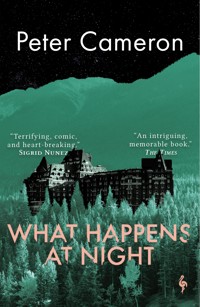
***A SPECTATOR BEST BOOK OF THE YEAR 2021*** "An intriguing, memorable book."―The Times "Like a Kafka story and a Wes Anderson movie combined."―Literary Hub "Terrifying, comic and heart-breaking."—Sigrid Nunez "This beautifully written and wonderfully droll novel brilliantly captures the frustrations and unease of being in a foreign environment."—The Spectator "Full of foreboding, What Happens At Night draws the reader on without questioning. A rich experience."―Literary Review A couple travel to a strange, snowy European city to adopt a baby, who they hope will resurrect their failing marriage. Their difficult journey leaves the wife desperately weak, and her husband worries that her apparent illness will prevent the orphanage from releasing their child. The couple check into the cavernous and eerily deserted Borgarfjaroasysla Grand Imperial Hotel where they are both helped and hampered by the people they encounter: an ancient, flamboyant chanteuse, a debauched businessman, an enigmatic faith healer, and a stoical bartender who dispenses an addictive, lichen-flavoured schnapps. Nothing is as it seems in this baffling, frozen world, and the longer the couple endure the punishing cold the less they seem to know about their marriage, themselves, and even life itself.
Das E-Book können Sie in Legimi-Apps oder einer beliebigen App lesen, die das folgende Format unterstützen:
Seitenzahl: 369
Veröffentlichungsjahr: 2021
Ähnliche




















ALSO BYPETER CAMERON
One Way or Another
Leap Year
Far-Flung
The Weekend
The Half You Don’t Know
Andorra
The City of Your Final Destination
Someday This Pain Will Be Useful To You
Coral Glynn
PRAISE FOR WHAT HAPPENS AT NIGHT
“In his characteristically precise and lucid prose, Peter Cameron invents a virtuosic tale that is by turns terrifying, comic, and heartbreaking. We do not always know whether we are in the realm of the real or the hallucinatory in this thrillingly mysterious and gorgeously written novel. What is never in doubt is that we are in the hands of a ravishing stylist and a supremely gifted storyteller.”—SIGRID NUNEZ, author of The Friend
“The prose in What Happens at Night is faultlessly elegant and quietly menacing, like a tuxedo lined with knives. I can’t think of another book at once so beautiful and so unnerving, so poised between miracle and disaster. Peter Cameron is one of America’s greatest writers, the living stylist I most revere.”
—GARTH GREENWELL, author of What Belongs to You and Cleanness
“This book is a masterpiece—reading it reminds me of the first time I read Kafka. A whole new vision is suddenly revealed: unique, unexpected, unforgettable. Get ready for a new adjective: Cameronesque.”—EDMUND WHITE, author of A Boy’s Own Story
“Peter Cameron is a compassionate and unsparing surveyor of all that comprises human character. What Happens at Night finds its home among the mid-twentieth-century classics of psychological realism, as brutal, in its way, as The Sheltering Sky, and just as memorable, just as peopled with the deep human mysteries. This new novel is a powerful and admirable addition to Cameron’s estimable body of work.”—RICK MOODY, author of The Ice Storm and The Long Accomplishment
“I don’t think I’ve ever read a book by an American or by a living person that’s as exquisitely rendered as What Happens at Night. Every word is exactly as it should be; there is not a single extra word out of place. The novel feels as though it traveled through time to arrive here. Cameron’s prose creates an effect that is literally like a fugue (or cinematic fog): intense, beautiful, inescapable, and so much about grief that has been and grief that is to come, heartbreaking and tender. The story is so intense, such a fine reduction of the enormity of the dreams of marriage, the responsibilities of marriage, of life, of love, and the ways in which—unintentionally or not—we inevitably fail each other and ourselves.”—A. M. HOMES, author of Days of Awe and May We Be Forgiven
“In the beautiful What Happens at Night, Peter Cameron sends a married couple to a mysterious northern country where only the schnapps is reliable. The world he creates is both recognizable and enchantingly strange. I never knew what was going to happen next, and I couldn’t stop turning the pages. A profound pleasure for readers.”—MARGOT LIVESEY, author of Mercury and The Flight of Gemma Hardy
“Peter Cameron’s What Happens at Night is a surreal, funny, heartbreaking story about love and mortality. Cameron’s sense of balance between the comic and the catastrophic, between cynicism and sincerity, is astonishing. This book reminds me of nothing else I’ve ever read, which is high praise indeed.”
—MICHAEL CUNNINGHAM, author of The Hours and The Snow Queen
Europa Editions 8 Blackstock Mews London N4 2BT www.europaeditions.co.uk This book is a work of fiction. Any references to historical events, real people, or real locales are used fictitiously. Copyright © 2020 by Peter Cameron First publication 2021 by Europa Editions The Proprietor hereby asserts the Proprietor’s right to be identified as the author of the Work and the Publishers undertake to print such assertion in every copy of the Work published by the Publishers as follows: ‘The right of Peter Cameron to be identified as the author of this Work has been asserted by him in accordance with the Copyright, Designs & Patents Act 1988’. All rights reserved, including the right of reproduction in whole or in part in any form. Cover Art by Emanuele Ragnisco www.mekkanografici.com Cover image © Getty ISBN 9781787703360
Peter Cameron
WHAT HAPPENS AT NIGHT
WHATHAPPENSATNIGHT
ONE
Evening descended with unnerving abruptness, like a curtain hurriedly lowered on an amateur theatrical gone horribly awry. And then the man noticed that the darkness was not the result of the sun setting but of the train entering a dense forest, leaving behind the open fields of snow it had traversed all afternoon. The fir trees, tall and thick, crowded closely along the tracks, like children pressing themselves up against a classroom window to get a better view of some gruesome accident in the street.
His wife sat on the seat across from him; they were the only two people in the small, wood-paneled carriage of the old-fashioned train. For a long time she had been staring absently out the window, mesmerized, it seemed, by the endless expanse of tundra, but she suddenly recoiled when the train entered the dark woods as if the trees brushing the sides of the carriage might reach in and scratch her. She touched the tender place on her cheek where the skin had been nastily scraped the night before.
They had visited the market of the city where they were staying, for although they were not tourists, they were strangers, and eager to feel a part of some place, any place, if only for a night. And so the woman had been trying to find some charm in the market, for she was at a place in her life where it was necessary to discern and appreciate any charm or beauty she encountered, but this market was singularly without charm, for it contained nothing but fish and meat and root vegetables, and the fish did not look fresh and the meat was not muscle but organs and brains and feet and lips and hearts, and the vegetables were all winter vegetables, roots and tubers and other colorless things that had been savagely yanked from their cold earthen beds. No bright pyramids of tomatoes and peaches, no bouquets of basil and nasturtium, no glistening jeweled eyes of fish, no marbled slabs of beef. And then she had seen, in the distance, one stall that sold spectacular hothouse flowers, and had run toward it, desperate to find something that did not entirely turn one away from life. Her husband had noticed their artifice before she did, and had tried to steer her down another aisle, but she pulled free of him and ran toward the colored brightness of the flowers, wanting to bury her face in their fragrant petal softness, buy an armful of them and carry it around with her, like a bride, like a diva in the footlights, but in front of a fishmonger’s stall she had slipped in a puddle of frigid water and fell to the floor, scraping her cheek and palms on the wet, fishy concrete.
It was not until her husband had caught up with her and helped her to her feet that she realized that the flowers were plastic. Not even silk! She could have at least touched them if they were silk.
After a moment the woman returned her attention to the book that lay open upon her lap. She had found this old book, The Dark Forest by Hugh Walpole, in the waiting room of a train station that they had passed through, obviously abandoned by a fellow traveler. For some time after the darkness fell—or was entered—she continued to read, but suddenly she looked up from her book at the dark rushing windows of the carriage and asked, Is there a light?
There was just enough light remaining in the carriage to see that there was no light.
I don’t see one, her husband said.
You’d think there’d be a light, she said.
Yes, he said, you’d think.
She sighed disappointedly, whether at the lack of a light or at his response to such a lack, he knew not. Probably both, and more.
They had been traveling for days, first by plane, and then by train and ferry, and now once again by train, for their destination was a place at the edge of the world, in the far north of a northern country, and not easily gained. Their journey was like a journey from a prior century, a matter of days rather than hours, the earth serious and real beneath them, constantly insisting on its vastness.
An authentic evening was now occurring, the darkness a product of the sun’s absence rather than its obscurity. They both watched it through the window. The woman touched her reflection, which the darkness outside had just revealed. Look at me, she said, so gaunt. My God, gaunt: how I hate that word. Gaunt and jackal and hubris. Seepage and—what are the other words I hate?
She had begun to do this recently: familiarly allude to odd, supposedly long-held predilections or positions that had never previously been mentioned. Or existed, as far as the man knew. So he ignored her nonsensical question by asking her what the book was about.
For a moment she said nothing, just watched her reflection hurtling along the dark scrim of pines. About? she finally said. In what sense do you mean?
He did not answer, because he did not like to indulge her contrariness.
After a moment she said, It’s about the war.
Which war?
One of the World Wars, she said. The first, I think. They’re in trenches.
And?
And? War is awful. It’s bad enough I’m stuck reading it; don’t make me talk about it too.
Okay, he said. I’m sorry.
She looked at him, her audacity suddenly collapsed. No, she said. Don’t be ridiculous. I’m sorry. I’m just on edge, you know—about everything.
I understand, he said. I’m on edge too.
About everything?
No, he said. Not everything. Just, you know—how this all will go.
Or not go, she said.
* * *
They had both fallen asleep and were simultaneously awoken by a peculiar sensation: stillness. The train had stopped. Outside the carriage window they could see, through the veil of fog that their breaths had condensed upon the glass, a platform and a building. There was no one about and no sound but the tickling sifts of snow gusting against the window. The man thought of the warm molecules of their breath, trapped against the cold glass of the windows, a union outside of, independent of, them.
This must be it, she said. Wasn’t it the first stop?
Yes, he said.
Then this is it, she said.
I don’t see any sign, he said.
No. She rubbed a messy circle on the window, but nothing helpful was revealed, just more of the wooden platform, on which a single lamp separated a conical swath of snow from the huge surrounding darkness.
This must be it, he said. He stood up and opened the carriage door.
Don’t go, she said.
But this must be it, he said.
It can’t be, she said. It’s not a real station. There’s no town, nothing. It must be a way station.
A way station?
Yes, she said. A pause, not a stop.
He stepped out onto the platform, disturbing the perfect blanket of snow. He felt like a barbarian. But once its perfection had been defiled he knew he must continue, for a hairline crack on a beautiful piece of china is more upsetting than the same piece of china shattered on the floor. So he ran about in ever-widening circles, kicking up the snow about him as messily as he could, and drew near enough to the building at the platform’s edge to see, in a sort of echo of faded paint, the name of the town that was their destination.
He suddenly felt foolish and stopped his cavorting, and in the ensuing stillness he became aware of some frightening engagement in the darkness behind him. The train. He turned to see it slowly moving, so slowly that for a moment he thought it must be the darkness moving behind it, but then he knew it was the train, for he could see his wife leaning forward, looking out of the still-opened door, her white face silently surprised, and for a second it felt like death to him, like how one must let one’s beloved depart this world, gliding silently slack-faced into the snow-dark.
But then a sense of emergency successfully obliterated that vision, and he called out to the woman and ran toward and then alongside the hastening train, and she was up and throwing their bags out the open door as if it were all part of a well-rehearsed drill, and just before the place where the platform ended she leaped into his arms.
The train clacked into the darkness, the door of their carriage still flung open, like a dislocated wing.
For a moment he held her closer and tighter than he had held her in a long time. Then they unclasped and went to fetch their bags, which appeared artfully arranged, dark rocks on the snowy Zen expanse of the platform. Then they stood for a moment and looked about them at the darkness.
This can’t be it, she said.
He pointed to the letters on the station wall.
I know, she said, but this can’t be it. There’s nothing—
Let me look around front, he said. Perhaps there’s something there.
What?
I don’t know. A telephone, or a taxi.
Yes, she said. And perhaps there’s a McDonalds and a Holiday Inn as well. She laughed bitterly and he realized that she had finally turned against him, forsaken him as he had watched her forsake everyone else she had once loved, slowly but surely drifting toward a place where anger and impatience and scorn usurped love. She stepped away from him, toward the edge of the platform, and for a moment they silently regarded each other. He waited to see whether her fury was rising or falling; he suspected she was too exhausted to sustain such glaring fierceness, and he was right—after a moment she staggered and reached out to steady herself against the metal railing.
With his outstretched arm, shrouded in his Arctic parka, he swept a cushion of snow off a bench that stood against the station wall. Sit down, he said.
No. I’m coming with you.
No, sit. Are you cold? Do you want my coat?
There’s nothing around the front, she said. There’s nothing anywhere.
Don’t be ridiculous, he said. Sit.
I’m not a dog, she said. But she sat on the bench.
I’ll be right back, he said. He waited for her to object but she did not. He bent down and kissed her cold scraped cheek. Then he walked along the platform and around to the front of the building, where no one was, and even though their encounter had been conducted quietly, he had the disturbing feeling one gets upon leaving a pulsating discotheque late at night—the sudden absence of sound more jarring than its presence.
A few dark cars and trucks stoically amassed garments of snow in the small parking lot. A single road disappeared into the forest that surrounded everything. There was no sign of life anywhere, just trees and snow and silence and the shrouded slumbering vehicles.
And then a light shone from one of the cars in the parking lot, and its engine started. The silence and stillness had been so deep that witnessing the car come to life was as eerie as watching an ambered insect unfurl its frozen wings and fly away. A bubble of white at the center of the car’s snow-covered roof glowed from within, suggesting that the car was—might be—a taxi. The door opened, and the man watched the driver light a cigarette and throw the still-flaming match into the air, where it somersaulted into the snow, and died.
The man assumed that it was his appearance that had roused this vehicle from its slumber, yet the driver gave no indication that this was the case; he smoked his cigarette and regarded the parking lot and the train station with disinterest.
So the man walked down the wooden steps and crunched across the hard-packed snow of the parking lot. The driver made no response whatsoever to the man’s approach, not even when he stood in the narrow alley of snow that separated the car from its neighbor.
After a moment the driver flicked his half-smoked cigarette into the snow at the man’s feet.
The man realized that the burden of acknowledgment was his. Hello, he said. Do you speak English?
The driver looked at him with surprised curiosity, as if he had never heard a man speak before. He cocked his head.
Do you speak English? the man repeated.
The driver seemed to find this utterance amusing—he laughed a little and lit another cigarette, and dragged upon it contentedly. He scraped an arc in the snow with his dainty slipper-clad foot.
Confused by everything, the man looked into the warm cavern of the car and saw two stuffed Disney Dalmatians hanging by their necks from the rearview mirror. The incongruity of this sight momentarily suspended the man’s debilitating notions of foreignness and ineptitude. Emboldened, he pulled a slip of paper from his pocket and held it out toward the driver and pointed to the words, as if they were not the only words written on the paper.
BorgarfjaroasyslaGrandImperialHotelFuruhjalli62
For a moment the driver did not respond. Perhaps he wasn’t looking at the words, or perhaps he couldn’t read; it was impossible to tell. But then, in an oddly unaccented voice, he spoke the words aloud: Borgarfjaroasysla Grand Imperial Hotel. And he pointed toward the road, the only road that left the parking lot, narrowing into the dark forest, like an illustration of perspective.
Yes, I know, the man said. But we cannot walk. He marched in place for a second and then wagged his finger in the air: Walk. No.
The driver continued to observe him with silent amusement. He made a little shrug and pointed to the man’s feet, indicating that apparently he could walk.
My wife, said the man. His hands outlined an hourglass in the air between them, and as he did this he thought of his wife’s emaciated angular body. He pointed toward the station house. My wife, he said. My wife no walk.
The driver nodded, indicating that he understood. He shrugged a little and toked on his cigarette, as if there were many worse fates than having a lame wife.
You drive us? The man held an imaginary steering wheel with his hands and turned it back and forth. Then he pointed at the driver. You?
The driver did not respond.
I’ll pay you very good, the man said. He removed his wallet from his coat pocket and showed it to the driver.
The driver smiled and reached out his hand.
You’ll drive us to hotel? the man asked.
The driver nodded and tapped his open palm with the fingers of his other hand.
The man opened his wallet and, holding it so that the driver could not see how much cash it contained, took out two bills. He handed one to the driver.
The driver pointed to the second bill.
I get my wife, the man said. Once again he caressed an hourglass and pointed toward the station house. Then he shook the second bill in the air. I give you this at hotel, he said.
The driver nodded.
The man ran across the parking lot. He slipped and fell on the snow-covered steps and cut his chin on the edge of the deck: he saw the red bloom on the snow. He removed his glove and gingerly touched the abrasion. His teeth hurt, and he could feel the warm saline seep of blood in his mouth. He stood up but felt dizzy, so he steadied himself for a moment against the wall. When he felt a bit better he walked carefully around to the back of the station house.
The woman was still sitting on the bench. She was being slowly covered by the snow. It was falling so quickly and thickly that it had already obscured the disruption he had made by dancing on the platform; there was just a ghostly trace of it remaining.
The woman was so still that for a moment the man thought she was dead, but then he saw the fog of her breath tumble from her half-opened mouth. She was sleeping.
He stood for a moment, watching the snow settle upon her, watching her breaths condense and unfurl in the cold air. For a moment he forgot about the taxi waiting in the parking lot, and he forgot about the Borgarfjaroasysla Grand Imperial Hotel. He forgot their miserable endless journey, and the illness that had left her gaunt and mean. She had rested her head against the wall of the station house, and the lamplight reflected softly off the snow, and like a gentle hand it caressed her face and restored to it a beauty her illness had completely eroded. He forgot everything and for a moment remembered only his love for her, and, by remembering it so keenly, he felt it once again, it flooded him, and he could not contain it, this sudden overwhelming feeling of love, it rose out of him in tears, and he dropped to his knees before her.
* * *
The lobby of the Borgarfjaroasysla Grand Imperial Hotel was dark and seemed cavernous, because its walls could not be discerned in the gloom. They had to cross a vast field of intricately and endlessly patterned carpet in order to arrive at the reception desk, which stood like an altar at the far side of the huge room, opposite the revolving entrance doors. A young woman, wearing an official-looking uniform, stood behind the high wooden counter, on which perched two huge bronze gryphons, each holding a stained-glass iron lantern in its beak. The woman stood rigidly between the two lamps, staring placidly in front of her. She seemed as eerily inanimate as the creatures that flanked her.
It was the final leg of their journey, this trip across the oceanic expanse of lobby. The man and the woman waded through little islands of furniture—club chairs reefed around low circular wooden tables.
It was only when they were standing directly in front of the reception counter that the woman behind it lowered her gaze from the dimness above them all and seemed at last to see the two weary travelers who stood before her.
Welcome to the Borgarfjaroasysla Grand Imperial Hotel, she said. She did not smile.
Thank you, the man said. We have a reservation.
Your name?
He told the woman his name.
Ah yes, she said. We’ve been expecting you. Did you have a pleasant journey?
It’s been a difficult journey, the man said.
It often is, the woman behind the desk allowed. Your passports?
The man handed these over and they were duly scrutinized and returned. Then the woman turned around and contemplated a huge warren of cubbyholes, each containing an enormous key. She reached her arm up and plucked a key from one of the highest cells. She turned back to them and laid the large iron key, which was affixed to a heavy tasseled medallion, on the counter.
Five nineteen, she said. Your room may be chilly, but if you open the radiators it should warm up quickly. The bellboy is away at the moment, but if you leave your bags, he will bring them up to you later.
I think I can manage them, said the man.
The woman behind the counter said, The bar is open all night. She pointed toward the far end of the vast lobby, where a faint red light shone through a curtain of glass beads. But I am afraid the kitchen is closed.
There’s no food? the man asked.
I’m afraid not. Well, perhaps something inconsequential in the bar.
I just want to go to bed, the woman said. Let’s go.
You’re not hungry? he asked.
I just want to go to bed, she repeated, enunciating each word emphatically, as if it were she who was communicating in a second language, not the woman behind the counter.
The man sighed and lifted the heavy key off the counter and picked up their bags. In an apse behind the reception desk a grand staircase wound up through the dark heart of the building, and a small wire-caged elevator hung from cables in its center. The man opened the outer and inner gates. There was just enough room for the man, the woman, and their bags in the tiny cage, and the limited space forced them to stand so close to each other they almost touched. Their room was on the top floor—the fifth—and each landing they passed flung a skein of pale golden light through the intricately wrought bars of the elevator, so that a delicate pattern of shadow bloomed and faded, again and again and again and again, across their faces.
Surprisingly, the dark gloomy grandeur of the hotel did not extend into their room, which was large and sparsely furnished. The walls were paneled with sheets of fake plastic brick and the floor was covered with a gold shag rug that crunched disconcertingly beneath their feet. The room was, as the receptionist had predicted, very cold.
The woman dropped the bags she was carrying and sat upon the bed. She sat rather stiffly, staring intently at the faux-brick wall.
The man watched her for a moment, and said, How are you feeling?
She turned away from the wall and lay back upon the bed, gazing now at the ceiling. Fine, she said, given that I’m dying.
But we’re here, he said. Doesn’t that count for something?
After a moment she said, Do you want me to live?
What? he asked. Of course I do.
Do you?
Yes, he said.
I think if I were you I wouldn’t, she said.
Of course I do, he repeated.
I think I’d want me to die, she said. If I were you.
I want you to get better, he said. To live.
Perhaps you really do, she said. But it seems odd to me. I know what I’ve become. How I am. What I am.
He sat beside her on the bed and tried to hold her, bend her close to him, but her body remained stiffly upright. He stroked her arm, which felt as thin as a bone beneath her layers of clothing.
Of course you’re the way you are, he said. Anyone would be that way, under the circumstances. But if you recover, you won’t be.
But what if I don’t?
Don’t what?
Don’t recover. Or what if I recover my health, but don’t recover my—I don’t know. You know: myself. My joie de vivre. She gave a hollow laugh.
Of course you will, he said. How could you not?
I think it might be gone, she said. I’m sorry. I didn’t want to be like this.
You’re exhausted, he said. But we’ve made it. We’re here.
I don’t feel it yet, she said. Do you feel it?
Yes.
Perhaps if I take a bath. That always changes things, doesn’t it? At least for me it does.
The woman got up from the bed and opened the bathroom door. She turned on the light. The bathroom was very large and very pink. The ceramic toilet and sink were pink, as was the large bathtub, and all the floor and all the walls were tiled with pink tiles. Even the ceiling was tiled pink.
What a lovely pink bathroom, she said. And look at that enormous tub.
You can have a nice bath in that, said the man. A nice hot long bath.
Yes, the woman said. A nice hot long pink bath. She smiled at him, a real smile. She entered the bathroom and closed the door behind her.
* * *
The man crossed the large crunching field of carpet and knelt beside the radiator. Praying, he turned the knob. It stuck for a moment and then released itself, and a spire of steam gushed out of the ancient Bakelite valve, like the smoke from a train engine in a silent movie. The coiled intestines of the radiator liquidly rumbled like the bowels of a person about to be sick. He placed his hand against the roughened rusty skin and felt it slowly warm to his touch. He kept his hand there until it burned.
He stood up and moved around the perimeter of the room, closing the curtains across the dark freezing windows, and then he turned on both bedside lamps, which wore little pink silk bonnets. He walked back over to the door and shut off the calcifying overhead light, and the room looked almost warm, almost cozy. He sat back upon the bed, which was covered by a quilted spread of slippery golden fabric, and listened for his wife in the bathroom, hoping to intuit from whatever he heard some clue as to how she was, but he heard nothing. After what seemed like a very long time the door open and she emerged, wearing only the long silk underwear they had both layered beneath their clothes ever since arriving in this cold country. She had pulled her damp hair back and gathered it into a ponytail. Her hair had grown in much thicker than it had ever been before the chemotherapy—the only good the poison did, she claimed. She looked very clean and fresh, flushed and almost healthy.
She stood near the bed and looked at him oddly, almost shyly.
I’ve turned on the heat, he said. He pointed toward the hissing radiator. So it should warm up.
Good, she said. Thank you.
He drew back the golden bedspread, revealing the white pillows and sheets it had covered. It was like layers of skin, he thought, one lying atop the other, and somewhere far beneath them all the bones, the blood. He patted the blank space he had revealed. Get in, he said.
No, she said.
It’s cold, he said. He could see the blunt points of her nipples interrupting the smooth silk outline of her underwear. You’re cold. Get in.
No. Wait.
What’s wrong?
Nothing is wrong, she said.
She reached out and touched his face. Don’t you see? We’re here. We made it. So nothing is wrong. Everything is good. This thing we’ve wanted, and planned for, suffered for, this thing we thought we would never have, never share, will soon be ours. I’m amazed. Aren’t you?
Things could still go wrong, the man said. I don’t want to jinx it.
No, she said. Don’t think like that. Believe it now.
I do, he said. I didn’t before, but now I do.
I love you, the woman said. And I’m grateful. I know I forget that sometimes, but I am. Grateful for everything you’ve done for me. Not just now, not just this, but everything. From the beginning.
I love you, he said.
I love you, too, she said. Will you get into bed with me, now? Will you get into bed and hold me?
Yes, he said.
She slid into the bed and moved toward its center. He began to get in beside her but she said, No. Get undressed. Please.
Oh, he said. He undressed beside the bed, aware of her watching him. He let his clothes drop onto the floor, onto the horrible shag carpet. He stood for a moment in his long silk underwear and then began again to enter the bed, but once again she stopped him.
No, she said. Take those off. I want to feel your skin. Please, she said. It’s warm in the bed.
Is it?
Yes. It’s deliciously warm.
He took off his underwear and slid quickly into the bed beside her. He pulled the sheets and coverlet over him. It was freezing in the bed.
It’s freezing, he said. You tricked me.
Wait, she said. Be patient. It will get warm. She pulled him close to her and he held her body tenderly against his own.
When he was sure she was sleeping he carefully slid out of bed. He stood and watched her for a moment. Sleep was a refuge for her, it returned her to a former, undamaged self, and so he liked to watch her sleep.
The room was warm now and so he knelt again beside the radiator and twisted the knob, and it sputtered fiercely at his interference, as if he were throttling it. He persisted and twisted it into silence.
* * *
The lobby was deserted; the woman behind the reception desk was gone and the lanterns the gryphons held no longer glowed.
Because it was now darker in the lobby, the light in the bar that lit up the red glass beads of the curtain seemed brighter than before. The man crossed the lobby and paused for a moment just outside the entrance, and then pushed his hands through the hanging beads and lifted away a space through which he entered.
The bar was as small and intimate as the lobby was cavernous and grand. It was a long, low-ceilinged wood-paneled room, and for a moment the man felt himself back on the train, for in shape it was exactly proportional to the carriage. The bar itself, which stretched across the length of the room, was inhabited by two people, one at each end, as if carefully placed there to maintain balance. At the end of the bar nearest the door the bartender stood, leaning back against the dimly illuminated shelves of liquor, staring far ahead of himself, although the room was very shallow and there was no distance to regard unless it was inside himself. At the far end of the bar, at the point where it curved to meet the wall, at that last and final seat, a woman sat gazing down into her drink in the same rapt way the bartender looked ahead.
The placement of these two people at either end of the bar made clear the position the man should take, and so he sat on a stool midway between them. For a moment neither of them moved, or responded in any way to his presence, and he felt that by positioning himself so correctly he had not upset the equilibrium of the room, and they would all three continue to maintain the quiet stasis he had feared to interrupt, as if he had assumed his given place in a painting, or a diorama. This notion affected him with a debilitating stillness, as if one’s goal in life was simply to find and occupy a particular ordinate in space, as if the whole world were an image in the process of being perfectly arranged, and those who had found their places must not move until the picture was complete.
He gazed through the regiments of bottles that lined the mirrored shelves behind the bar at his reflection, which peered back at him with an intentness that seemed greater than his own, and for a second he lost the corporeal sense of himself, and wondered on which side of the mirror he really sat. In an effort to reinhabit himself he reached out his hand and patted the copper-topped bar, and the touch of the cool metal against his fingertips flipped the world back around the right way, but the bartender interpreted this gesture as a summons and unfurled his leaning body away from the wall, walked over, and placed a napkin on the bar in front of the man, in the exact spot he had patted, as if were applying a bandage to a wound.
The bartender was a young man, tall and dark, vaguely Asiatic and remarkably stiff, as if he had been born with fewer joints than normal; he seemed unable, or unwilling, to bend his neck, so he gazed out over the man’s head and spoke to the alabaster sconce on the wall just behind them. The foreign words he uttered meant nothing to the man; in fact they did not even seem like words. He remembered how for a long time as a child he had thought there was a letter in the alphabet called ellemeno, a result of the alphabet song slurring L M N O together (at least in his mother’s drunken rendition).
He assumed the bartender had asked him for his order, but what if he had not? Perhaps he had told him the bar was closed, or insulted him, or was merely inquiring as to his well-being. The idea that language worked at all, even when two people spoke the same one, seemed suddenly miraculous; it seemed like an impossible amount for two people to agree upon, to have in common.
It was the woman who saved them. She abruptly looked up from the depths of her drink and said, quite loudly: English, English! No one speaks your bloody language, you fool.
The bartender flinched, and waited a moment before speaking, as if he wanted to put a distance between the woman’s admonition and his words, and then said, in perfect English: Good evening. What could I get you?
The man was unsure of what to order. The constellation of bottles was arranged on the glass shelves of the bar in a pattern that seemed to him as intricately undecipherable as the periodic table, and to choose a liquor seemed as daunting as picking one element out of the many that comprised the world. The man shifted his head a bit so he could look around the bartender at the bottles behind him, hoping one bottle would call out to him—he wanted scotch, a large glass of scotch, neat, that he could warm between his palms and sip, he wanted the liquid gold of scotch, the warmth of it, but he had lost some fundamental confidence in himself over the course of the journey that made it impossible for him to ask for what he wanted—but once again, the woman at the end of the bar, apparently displeased with his indecision and the bartender’s inertia, apparently wanting to make something, anything, happen, said, Have you tried the local schnapps? It’s made from lichen, which sounds horrible, but it’s not, I promise you, it’s one of the loveliest schnapps I know. Lárus, give him some schnapps, let him see if he likes it. I think he will like it.
The bartender turned around and selected a large, squared, unlabeled bottle half full of clear liquid. He pulled the silver stopper, which resembled a stag’s antlered head, from its mouth and poured a dram into a large snifter, which he set before the man, who realized the liquid was not clear, but tinged with the silvery blue glow that snow reflects at twilight. He picked up the snifter and swirled the liquid up and around its glass walls, aware of both the bartender and the woman watching him, waiting, and then lifted it to his mouth and smelled the clean bracing smell of institutionally laundered linen and poured a little into his mouth, and let it pool there for a moment, cool and aromatic, tasting faintly of bleach and watercress and spearmint and rice.
He slowly lowered the glass to the bar and said, It’s lovely.
I knew you’d like it, said the woman. Lárus, pour him more.
The bartender once again removed the stopper from the bottle’s throat and held its open mouth above the man’s glass and, when the man nodded, he poured another dram of schnapps into the snifter. He then walked to the far end of the bar and poured more into the woman’s glass. She raised her glass to the man and looked into his eyes. She was old, the man realized, probably in her seventies, but there was something overtly and disconcertingly sexual about her. She wore a tight-fitting black gown adorned with iridescent sequins that reminded the man somewhat of fish scales—he thought of the prismatic bellies of fish lifted out of the water, how their flexing struggle made them gleam—and her long silvery-gray hair was swept back from her face and coiled atop her head in an intricate, antique sort of way. Her face was lean and strong, her eyes dark, her nose sleekly formidable, and her lips polished a deep wine red that separated them irrevocably from her pale skin. Her eyes were large and seemed to be set a fraction too far apart, as if some constant eagerness to see both what was in front of her but also beside her had caused them to become unfixed and migrate to either side of her face.
One shouldn’t shout in bars, she said, especially this late at night. I’m an actress, my voice is trained to project, but allow me to come sit next you, for I know you won’t come sit next to me, and it’s really too ridiculous to have this distance between us.
Without waiting for his reply, she stepped down off her barstool and picked up her drink and walked around the corner of the bar and reseated herself on the stool next to the man. She carefully placed her glass on the bar at the same latitude as his and then looked not at him but at their reflection in the mirror, through the interruption of bottles. Their eyes met and held there in the mirror, and the man felt the strength of the schnapps like electricity coursing through his body.
Are you here for the healer? the woman asked him. Or the orphanage?
The orphanage, said the man. There’s a healer?
Yes. Brother Emmanuel. Surely you’ve heard of him.
I haven’t, said the man. A healer? How do you mean?
How do I mean? What do you mean? He’s a healer. He heals people.
For real?
They say he does. I, myself, have not been healed by him—at least not yet—so I can give you no definitive answer. But why do you ask? Are you looking to be healed?
No, said the man. But my wife is ill. Very ill.
Incurably ill?
Well, said the man, I suppose it remains to be seen.
Of course, said the woman. Everything that’s coming remains to be seen.
The man realized that the bartender had somehow floated back to his original position at the end of the bar and was pretending he could not hear them, or see them, was pretending that he was alone onstage in some different play, a one-man show. The woman sighed and touched her hair, first one side of her head and then on the other, and the man realized she wore it as intricately coiffed as she did so that it could occupy her at moments like these; it could always be attended to, adjusted, primped.
It can work, she said. I’ve seen people arrive here at death’s front door—in the vestibule, even—and a few days later skip merrily away.
The man did not reply.
But I think for it to work you have to believe. Do you believe in that kind of thing?
I don’t know, the man said.
Then you don’t, said the woman. If you did, you’d know. What about your wife? Does she believe in it?
I don’t know, said the man. I doubt it.
Well, I don’t suppose it can hurt her to see him, so you might give it a go, since you got yourselves here. People come from all over the world to see Brother Emmanuel. Fortunately, I’ve never been ill a day in my life. My eyes are fine, my teeth—everything works fine. Knock wood. She rapped the underside of the bar with her knuckles. I don’t know why. I drink. I smoke.
You’re very fortunate, said the man.
Yes, she said. About that. My body has never failed me. Everything else, yes—but my body, no. I wonder how I’ll die. I am Livia Pinheiro-Rima. Do you mind if I smoke a cigarette? It makes me nervous to talk and a cigarette calms me.
The man shook his head, indicating that he had no objection to the woman smoking, and she fished a silver cigarette case out of her bag and sprung it open and slid one out from beneath the clasp. She held it between two of her fingers, and with her thumb she flicked it cartwheeling up into the air and caught it neatly by the filtered end in her mouth.




