


18,99 €
Mehr erfahren.
- Herausgeber: John Wiley & Sons
- Kategorie: Geisteswissenschaft
- Sprache: Englisch
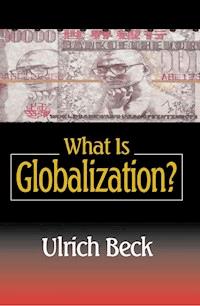
This important new book offers an engaging and challenging introduction to the thorny paths of the globalization debate.
Das E-Book What Is Globalization? wird angeboten von Polity und wurde mit folgenden Begriffen kategorisiert:
debate; important; challenging; globalization; introduction; book; new; thorny paths; ambiguities; reader; types; conceptual traps; various; horizon; political responses; questions; main; focuses; two; politically
Sie lesen das E-Book in den Legimi-Apps auf:
Seitenzahl: 335
Veröffentlichungsjahr: 2015
Ähnliche



















Copyright © this translation Polity Press.
First published in Germany as Was ist Globalisierung? © Suhrkamp Verlag, 1997.
First published in 2000 by Polity Press in association withBlackwell Publishers, a Blackwell Publishing Company
Reprinted 2000 (twice), 2001, 2002, 2003, 2004, 2005, 2008, 2009
Published with the assistance of Inter Nationes.
Polity Press65 Bridge StreetCambridge CB2 1UR, UK
Polity Press350 Main StreetMalden, MA 02148, USA
All rights reserved. Except for the quotation of short passages for the purposes of criticism and review, no part of this publication may be reproduced, stored in a retrieval system, or transmitted, in any form or by any means, electronic, mechanical, photocopying, recording or otherwise, without the prior permission of the publisher.
Except in the United States of America, this book is sold subject to the condition that it shall not, by way of trade or otherwise, be lent, re-sold, hired out, or otherwise circulated without the publisher’s prior consent in any form of binding or cover other than that in which it is published and without a similar condition including this condition being imposed on the subsequent purchaser.
A catalogue record for this book is available from the British Library.
Library of Congress Cataloging-in-Publication Data
Beck, Ulrich, 1944–
[Was ist Globalisierung? English]
What Is globalization? / Ulrich Beck; translated by Patrick Camiller.
p. cm.
Includes bibliographical references and index.
ISBN 978-0-7456-2125-8 (hb.). – ISBN 978-0-7456-2126-5 (pb.)
1. International economic relations. 2. International relations.
I. Title.
HF 1359.B413 2000337—dc21
99-27522
CIP
For further information on Polity, please visit our website: http://www.polity.co.uk
Contents
Preface
Acknowledgements
Introduction
Virtual taxpayers
The national state caught between world economy and individualization: what is to be done?
The globalization shock: a belated discussion
PART I Dimensions, Controversies, Definitions
1 The World Horizon Opens Up: On the Sociology of Globalization
Sociology as the power to create intellectual order: the container theory of society
Transnational social spaces
Logics, dimensions and consequences of globalization
2 Transnational Civil Society: How a Cosmopolitan Vision is Emerging
‘Methodological nationalism’ and its refutation: a provisional appraisal
Symbolically staged mass boycotts: cosmopolitan initiatives and global subpolitics
Place polygamy: towards globalization in personal life
On the possibility of inter-cultural critique
3 Contours of World Society: Rival Perspectives
Third cultures or global civil society?
Cosmopolitan democracy
Capitalist world society
World risk society: the meltdown of the iron cage of modernity
Global society without democratic politics
Prospects for a transnational state
PART II Perspectives
4 Errors of Globalism
Metaphysics of the world market
So-called free world trade
Economic internationalization, not globalization
The staging of risk
Absence of politics as revolution
The linearity myth
Critique of catastrophist thinking
Conservative protectionism
Green protectionism
Red protectionism
5 Responses to Globalization
International cooperation
Transnational state or ‘inclusive sovereignty’
Joint ownership of capital
Reorientation of educational policy
Are transnational corporations undemocratic or anti-democratic?
An alliance for civil labour
What comes after the Volkswagen export nation? New cultural, political and economic goals
Experimental cultures, niche markets and the self-renewal of society
Public entrepreneurs, people working for themselves
A social contract against exclusion?
6 Europe and Globalization
Conclusion
Decline à la Carte: The Brazilianization of Europe
Further Reading
Notes
Index
Preface
The purpose of this book is to offer a trenchant introduction that will assist readers facing the thorny paths of the globalization debate: to clarify its ambiguities of fact and value, and to distinguish more clearly than is usually the case between its various dimensions. Another aim is to warn of a number of conceptual pitfalls, but the most important of all is to open up the horizon for political responses to globalization. Two questions, then, each difficult in its simplicity, will be at the centre of attention. What does globalization mean? How can it be moulded politically?
In connection with this essay, two Readers have been produced in German in which the various arguments, conclusions and controversies regarding globalization are documented and presented with the help of ‘classical’ and more recent texts. The titles of these volumes are: Politik der Globalisierung [Politics of Globalization] and Perspektiven der Weltgesellschaft – Kontroversen, Konflikte, Paradoxien [Perspectives for World Society: Controversies, Conflicts, Paradoxes].
I began work on these volumes two years ago, and their completion was made possible above all by a Distinguished Research professorship that I took up at the University of Wales, Cardiff, in the winter semester of 1995-6. Without the extremely stimulating discussions I had with Barbara Adam, Martin Albrow, Jörg Dürrschmidt, Anthony Giddens, David Held, Scott Lash, John Thompson, Robin White-Grove, Helen Wilkinson, Brian Wynne and many others – but most of all, as ever, with Elisabeth Beck-Gernsheim – this book would never have seen the light of day. I would like to express here my deepest gratitude to them all.
Acknowledgements
The author and publisher gratefully acknowledge permission to reprint from the following:
Zygmunt Bauman: from Globalization (Polity Press, 1998), by permission of the publisher.
Charlotte Bretherton: from ‘Universal Human Rights: Bringing People into Global Politics’, in C. Bretherton and G. Ponton (eds), Global Politics (Blackwell, 1996), by permission of the publisher.
J. N. Pieterse: from ‘Globalization as Hybridization’, in M. Feath- erstone, S. Lash and R. Robertson (eds), Global Modernities (Sage, 1995), by permission of Sage Publications Ltd and the author.
Martin Shaw: from Civil Society and the Media in Global Crises: representing distant violence (Pinter, 1996), by permission of Cassell & Co.
Andreas Zielcke: extract from ‘Der Neue Doppelgänger’, in the Frankfurter Allgemeine Zeitung, 20 July 1996, by permission of the Frankfurter Allgemeine Zeitung.
Introduction
Virtual taxpayers
With the peaceful fall of the Berlin Wall and the collapse of the Soviet empire, many thought that the end of politics was nigh as we entered an age beyond socialism and capitalism, utopia and emancipation. In the years since then, however, the ceremonial farewells to politics have become rather more subdued. The current scare-word ‘globalization’, seemingly unavoidable in any public statement, points not to an end of politics but to its escape from the categories of the national state, and even from the schema defining what is ‘political’ and ‘non-political’ action. For whatever the referent of the new globalization rhetoric (economy, markets, job competition, production, goods and services, financial flows, information, lifestyles), the political consequences of the stage-managed economic globalization risk stand out in sharp relief. Institutions of industrial society which seemed shut tight can be ‘cracked’ and opened up to political intervention. The premises of the welfare state and pension system, of income support, local government and infrastructural policies, the power of organized labour, industry-wide free collective bargaining, state expenditure, the fiscal system and ‘fair taxation’ – all this melts under the withering sun of globalization and becomes susceptible to (demands for) political moulding. Every social actor must respond in one way or another; and the typical responses do not fit into the old left-right schema of political action.1
We may say that what used to be the class question for the workers’ movement in the nineteenth century is the globalization question for transnationally active enterprises at the turn of the twenty-first century – but with the crucial difference that the workers’ movement acted as a countervailing power, whereas global enterprises have for a long time not been challenged by any other (transnational) power.
Why then does globalization mean politicization? It means this because the staging of globalization permits employers and their associations to disentangle and recapture their power to act that was restrained by the political and welfare institutions of democratically organized capitalism. Globalization makes possible things which, though perhaps always there, remained hidden during the stage of the welfare-democratic taming of capitalism. It means that corporations, especially globally active ones, can play a key role in shaping not only the economy but society as whole – if ‘only’ because they have it in their power to withdraw the material resources (capital, taxes, jobs) from society.
Lesen Sie weiter in der vollständigen Ausgabe!
Lesen Sie weiter in der vollständigen Ausgabe!
Lesen Sie weiter in der vollständigen Ausgabe!
Lesen Sie weiter in der vollständigen Ausgabe!
Lesen Sie weiter in der vollständigen Ausgabe!
Lesen Sie weiter in der vollständigen Ausgabe!
Lesen Sie weiter in der vollständigen Ausgabe!
Lesen Sie weiter in der vollständigen Ausgabe!
Lesen Sie weiter in der vollständigen Ausgabe!
Lesen Sie weiter in der vollständigen Ausgabe!
Lesen Sie weiter in der vollständigen Ausgabe!
Lesen Sie weiter in der vollständigen Ausgabe!




