


What is Literature? E-Book
34,99 €
Mehr erfahren.
- Herausgeber: John Wiley & Sons
- Kategorie: Geisteswissenschaft
- Sprache: Englisch
An essential guide to understanding literary theory and criticism in the European tradition
What is Literature? A Critical Anthology explores the most fundamental question in literary studies. ‘What is literature?’ is the name of a problem that emerges with the idea of literature in European modernity. This volume offers a cross-section of modern literary theory and reflects on the history of thinking about literature as a specific form. What is Literature? reveals how ideas of the literary draw on the foundations of Western thought in ancient Greece and Rome, charting the emergence of modern literature in the eighteenth century, and including selections from the present state of the art.
The anthology includes the work of leading writers and critics of the last two thousand years including Plato, Henry James, Virginia Woolf, Edward Said, Gayatri Chakravorty Spivak, Jacques Rancière, and many others. The book is an insightful examination of the nature of literature, its meanings and values, functions and forms, provocations and mysteries.
What is Literature? brings together in one volume influential and intriguing essays that show our enduring fascination with the idea of literature. This important guide:
- Contains a broad selection of the most significant texts on the topic of literature
- Includes leading writers from ancient times to the most recent thinkers on literature and criticism
- Encourages readers to reflect on the varied meanings of “literature”
What is Literature? A Critical Anthology is a unique collection of texts that will appeal to every student and scholar of literature and literary criticism in the European tradition.
Sie lesen das E-Book in den Legimi-Apps auf:
Seitenzahl: 1899
Veröffentlichungsjahr: 2020
Ähnliche




















Table of Contents
Cover
Introduction
References
Further Reading
1 Hamburg Dramaturgy (1769)
Introduction
No. 2.
No. 11.
No. 19.
No. 29.
No. 46.
No. 49.
No. 70.
No. 73.
No. 74.
No. 75.
No. 76.
2 Of the Standard of Taste (1777)
Introduction
3 Critique of Judgment (1790)
Introduction
40
On Taste as a Kind of
Sensus Communis
41
On Empirical Interest in the Beautiful
42
On Intellectual Interest in the Beautiful
43
On Art in General
44
On Fine Art
45
Fine Art Is an Art Insofar as It Seems at the Same Time to Be Nature
46
Fine Art Is the Art of Genius
47
Elucidation and Confirmation of the Above Explication of Genius
48
On the Relation of Genius to Taste
49
On the Powers of the Mind Which Constitute Genius
50
On the Combination of Taste with Genius in Products of Fine Art
4 On the Aesthetic Education of Man (1795)
Introduction
Second Letter
Ninth Letter
Fifteenth Letter
5 On the Study of Greek Poetry (1797) and Philosophical Fragments (1798–1800)
Introduction
On the Study of Greek Poetry
Philosophical Fragments
Critical Fragments
6 Lectures on Dramatic Art (1811)
Introduction
Dramatic Literature
7 Preface to Lyrical Ballads, with Pastoral and Other Poems (1802)
Introduction
Appendix to the Preface (1802)
8 Biographia Literaria (1817)
Introduction
Chapter XIV
9 Aesthetics: Lectures on Fine Art (1835)
Introduction
Chapter III Poetry
Introduction
A. The Poetic Work of Art as Distingushed from a Prose Work of Art
10 The Function of Criticism at the Present Time (1864)
Introduction
11 The Birth of Tragedy (1872)
Introduction
1
2
3
4
7
11
21
12 The Art of Fiction (1884)
Introduction
13 Crisis of Verse (1897)
Introduction
14 Art as Technique (1917)
Introduction
15 The Uncanny (1919)
Introduction
I
II
III
I
II
III
16 Tradition and the Individual Talent (1919) and The Function of Criticism (1923)
Introduction
Tradition and the Individual Talent
I
II
III
The Function of Criticism
I
II
III
IV
17 A Room of One’s Own (1929)
Introduction
3
5
18 The Storyteller (1936): Reflections on the Works of Nikolai Leskov
Introduction
I
II
III
IV
V
VI
VII
VIII
IX
X
XI
XII
XIII
XIV
XV
XVI
XVII
XVIII
XIX
19 Pierre Menard, Author of the
Quixote
Introduction
20 What is Literature? (1948)
Introduction
Why Write?
21 Literature and the Right to Death (1948)
Introduction
22 Language (1950)
Introduction
23 Trying to Understand
Endgame
(1958)
Introduction
24 The Meridian (1960)
Introduction
25 What is an Author? (1969)
Introduction
26 Sorties: Out and Out: Attacks/Ways Out/Forays (1975)
Introduction
27 What is a Minor Literature? (1975)
Introduction
28 Literature and Life (1993)
Introduction
29 The Literary Absolute (1978)
Introduction
The Poem: A Nameless Art
30 Orientalism (1978)
Introduction
I
II
III
31 Autobiography as De‐facement (1979)
Introduction
32 Che cos’è la poesia? (1988) and Before the Law (1982)
Introduction
Che cos’è la poesia?
Before the Law
Before the Law
33 Signs Taken for Wonders (1986): Questions of Ambivalence and Authority under a Tree Outside Delhi, May 1817
Introduction
34 What Is the History of Literature? (1997)
Introduction
35 A Critique of Postcolonial Reason (1999)
Introduction
36 Literature for the Planet (2001)
Introduction
Works Cited
37 The Politics of Literature (2003)
Introduction
38 Close Reading in an Age of Global Writing (2013)
Introduction
Where Is World Literature?
Feint‐Translations
Multilingualism and Nontranslation Studies
From the Word to the Episode
Modernist Translatability and the Future of Literary History
References
Index
End User License Agreement
Guide
Cover
Table of Contents
Begin Reading
Pages
iii
iv
1
2
3
4
5
6
7
8
9
10
11
12
13
14
15
16
17
18
19
20
21
22
23
24
25
26
27
28
29
30
31
32
33
34
35
36
37
38
39
40
41
42
43
44
45
46
47
48
49
50
51
52
53
54
55
56
57
58
59
60
61
62
63
64
65
66
67
68
69
70
71
72
73
74
75
76
77
78
79
80
81
82
83
84
85
86
87
88
89
90
91
92
93
94
95
96
97
98
99
100
101
102
103
104
105
106
107
108
109
110
111
112
113
114
115
116
117
118
119
120
121
122
123
124
125
126
127
128
129
130
131
132
133
134
135
136
137
138
139
140
141
142
143
144
145
146
147
148
149
150
151
152
153
154
155
156
157
158
159
160
161
162
163
164
165
166
167
168
169
170
171
172
173
174
175
176
177
178
179
180
181
182
183
184
185
186
187
188
189
190
191
192
193
194
195
196
197
198
199
200
201
202
203
204
205
206
207
208
209
210
211
212
213
214
215
216
217
218
219
220
221
222
223
224
225
226
227
228
229
230
231
232
233
234
235
236
237
238
239
240
241
242
243
244
245
246
247
248
249
250
251
252
253
254
255
256
257
258
259
260
261
262
263
264
265
266
267
268
269
270
271
272
273
274
275
276
277
278
279
280
281
282
283
284
285
286
287
288
289
290
291
292
293
294
295
296
297
298
299
300
301
302
303
304
305
306
307
308
309
310
311
312
313
314
315
316
317
318
319
320
321
322
323
324
325
326
327
328
329
330
331
332
333
334
335
336
337
338
339
340
341
342
343
344
345
346
347
348
349
350
351
352
353
354
355
356
357
358
359
360
361
362
363
364
365
366
367
368
369
370
371
372
373
374
375
376
377
378
379
380
381
382
383
384
385
386
387
388
389
390
391
392
393
394
395
396
397
398
399
400
401
402
403
404
405
406
407
408
409
410
411
412
413
414
415
416
417
418
419
420
421
422
423
424
425
426
427
428
429
430
431
432
433
434
435
436
437
438
439
440
441
442
443
444
445
446
447
448
449
450
451
452
453
454
455
456
457
458
459
460
461
462
463
464
465
466
467
468
469
470
471
472
473
474
475
476
477
478
479
480
481
482
483
484
485
486
487
488
489
490
491
492
493
494
495
496
497
498
499
500
501
502
503
504
505
506
507
508
509
510
511
512
513
514
515
516
517
518
519
520
521
522
523
524
525
526
527
528
529
530
531
532
533
534
535
536
537
538
539
540
541
542
543
544
545
546
547
548
549
550
551
552
553
554
555
556
557
558
559
560
561
562
563
564
565
566
567
568
569
570
571
572
573
574
575
576
577
578
579
580
581
582
583
584
585
586
587
588
589
590
591
592
593
594
595
596
597
598
599
600
601
602
603
604
605
606
607
608
609
610
611
612
613
614
615
616
617
618
619
620
621
622
623
624
625
What is Literature?
A Critical Anthology
Edited by Mark Robson
This edition first published 2020Editorial material and organization © 2020 John Wiley & Sons Ltd
All rights reserved. No part of this publication may be reproduced, stored in a retrieval system, or transmitted, in any form or by any means, electronic, mechanical, photocopying, recording or otherwise, except as permitted by law. Advice on how to obtain permission to reuse material from this title is available at http://www.wiley.com/go/permissions.
The right of Mark Robson to be identified as the author of the editorial material in this work has been asserted in accordance with law.
Registered OfficesJohn Wiley & Sons, Inc., 111 River Street, Hoboken, NJ 07030, USAJohn Wiley & Sons Ltd, The Atrium, Southern Gate, Chichester, West Sussex, PO19 8SQ, UK
Editorial OfficeThe Atrium, Southern Gate, Chichester, West Sussex, PO19 8SQ, UK
For details of our global editorial offices, customer services, and more information about Wiley products visit us at www.wiley.com.
Wiley also publishes its books in a variety of electronic formats and by print‐on‐demand. Some content that appears in standard print versions of this book may not be available in other formats.
Limit of Liability/Disclaimer of WarrantyWhile the publisher and authors have used their best efforts in preparing this work, they make no representations or warranties with respect to the accuracy or completeness of the contents of this work and specifically disclaim all warranties, including without limitation any implied warranties of merchantability or fitness for a particular purpose. No warranty may be created or extended by sales representatives, written sales materials or promotional statements for this work. The fact that an organization, website, or product is referred to in this work as a citation and/or potential source of further information does not mean that the publisher and authors endorse the information or services the organization, website, or product may provide or recommendations it may make. This work is sold with the understanding that the publisher is not engaged in rendering professional services. The advice and strategies contained herein may not be suitable for your situation. You should consult with a specialist where appropriate. Further, readers should be aware that websites listed in this work may have changed or disappeared between when this work was written and when it is read. Neither the publisher nor authors shall be liable for any loss of profit or any other commercial damages, including but not limited to special, incidental, consequential, or other damages.
Library of Congress Cataloging‐in‐Publication Data
Name: Robson, Mark, 1968– editor.Title: What is literature? : a critical anthology / edited by Mark Robson.Description: Hoboken : Wiley‐Blackwell, 2020. | Includes bibliographical references and index.Identifiers: LCCN 2019060152 (print) | LCCN 2019060153 (ebook) | ISBN 9781405182942 (paperback) | ISBN 9781118606872 (adobe pdf) | ISBN 9781118606889 (epub)Subjects: LCSH: Literature–Philosophy.Classification: LCC PN45 .W46 2020 (print) | LCC PN45 (ebook) | DDC 801–dc23LC record available at https://lccn.loc.gov/2019060152LC ebook record available at https://lccn.loc.gov/2019060153
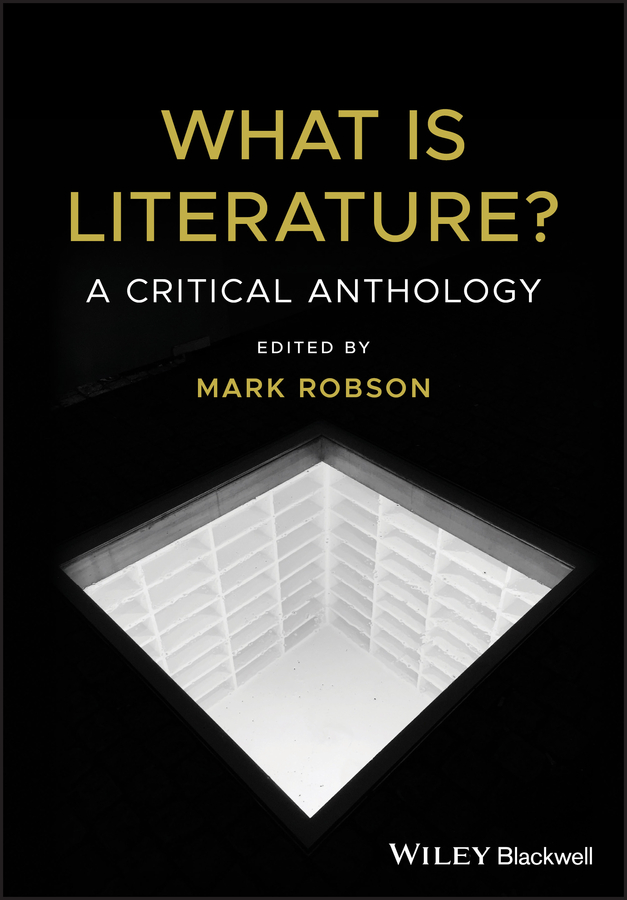
Cover Design: WileyCover Images: “The Empty Library” (1995), memorial to Nazi book burning at Bebelolatz, constructed by Micha Ullman and commissioned by The Berlin Senate for Building and Housing. Photo © EyeEM / Getty Images
Introduction
Let us suppose that literature begins
at the moment when literature becomes
a question.
Maurice Blanchot, this volume p. 321
In this era of global capital triumphant,
to keep responsibility alive in the reading and teaching
of the textual is at first sight impractical.
It is, however, the right of the textual
to be responsible, responsive, answerable.
Gayatri Chakravorty Spivak
Every anthology gathers a series of questions. It is not a display of answers. A true question voices a doubt, expressing a desire to know rather than giving expression to that which is known. To ask the right question entails identifying what it is that you don’t know, and sometimes it is only once something apparently known becomes a question – is called into question, we might say – that in a shimmer of hesitation, of uncertainty, or of doubt, the gap makes itself known. This is what the quotation from Blanchot above invites us to think: what if literature only begins when we are no longer sure (what it is), when we suspend certainty, when we allow something to appear that can bear the name of literature without conforming to what we formerly understood by that name? And yet, as the quotation from Spivak that accompanies it reminds us, this does not allow us to abdicate responsibility. Reading and teaching are each activities or (institutional) spaces in which what is called literature – which remains a privileged domain of the textual – makes demands on all those prepared to read and to learn. Bringing these two thinkers and their words here together, we might say: responding to the unknown, unsure of where we are or what exactly it is that is making these demands, may seem, to borrow Spivak’s term, impractical, but it is the only way to keep responsibility alive in the form of the question, that is, by taking the question seriously as a question.
This anthology bears a question as its title: What is literature? It will still sit there as a question on the cover even after you have read some or all of the contents. ‘What is literature?’ is not a new question. It has a history, and in fact it is historically bounded. Who, then, now, might hold the answer, assuming there is one? If we think of literature as a name, what does it name? Turning to the Oxford English Dictionary (OED), for example, the clearest definition of the modern understanding of literature is found in entry 3a, which refers to a ‘restricted sense’ of ‘writing which has claim to consideration on the ground of beauty of form or emotional effect’. It then adds, almost as an aside, ‘This sense is of very recent emergence both in Eng[lish] and Fr[ench]’, which is why I referred to it as the modern understanding. This is a sense of the word literature that emerges in modernity, and is inseparable from it. The OED’s definition contains two crucial elements for understanding how the word is commonly used, but doesn’t entirely resolve the question of literature’s identity. Quite the opposite.
‘Beauty of form’ makes us think about the shape or structure of the literary work, and at the same time makes us wonder how to define beauty (What are the criteria? Who decides? Is this a subjective or objective judgement? And so on). Then the definition takes a funny turn as it gives us the second element: ‘or emotional effect’. Emotional effect is broad enough to cover everything from being profoundly moved to faintly irritated, from becoming intensely bored to intermittent anger, excitement, disgust, enchantment, fascination, puzzlement, arousal and despair. We can love a poem or hate a novel. All that seems fine, although we might want to add other possible effects that aren’t purely emotional (bodily reactions, or even, now and then, the odd thought or idea). That’s not the funny bit. The oddity, for me at least, is the ‘or’. Is the form (beautiful or otherwise) not contributing to the effect on the reader? Does it have to be one or the other, either beauty or emotional effect, or is the definition simply saying that you only need one to qualify as literature? In both cases, this is only staking a claim to consideration. Who or what does the considering? How is this claim expressed? Maybe it has to be thought of as a kind of multivocal performance, in which a piece of writing – while being beautiful or making us cry or laugh or inspiring us to hurl it across the room – is also at every moment pointing at itself and inaudibly shouting ‘Look, I’m literature’.
Beauty and emotion are not universal. The dictionary’s use of them recognizes that this is a restricted sense of literature, but it has become the common one for us. For most modern critics, literature ‘as such’ is something that emerges in the long eighteenth century, replacing older categories based on poetics and rhetoric. This is the ‘very recent’ emergence of a sense of the word literature noted by the OED (for whom the eighteenth century remains very recent). The notion of literature in this specific sense is part of the foundations for the Romantic – and at the outset largely German – tradition of treating literature and other arts under the heading of the aesthetic. This tradition is the focus for this volume since its influence on later thinking about art remains decisive, both spawning a strong set of ideas that continue to feature in discussion of art and also producing a powerful allergic reaction in which the whole notion of the aesthetic is repeatedly rejected. The idea, for example, that art can open up the possibility of accessing knowledge or truth that could not be gained by any other means is still regularly proposed and equally persistently contested. The idea, then, that there is something special about art objects which marks them out from ‘ordinary’ objects remains controversial. An equivalent argument in literary studies might be the notion that there is something special about literary language that separates it decisively from ordinary language, or that there is something peculiar about the relation of the author to her or his – or more accurately our – language(s). Even if we believe this, we need to be able to explain why. This is territory repeatedly contested in the texts gathered in this anthology.
***
Any question that takes the form ‘what is . . .?’ asks us to think about the essence of something. In this sense, it is a philosophical question, and certainly there have been many philosophical attempts to define literature (often antagonistically, making clear that philosophy is not, even should not be, literature). In a well‐known passage from Plato’s Phaedrus, Socrates suggests that: ‘You must know the truth concerning everything you are speaking or writing about; you must learn how to define each thing in itself; and, having defined it, you must know how to divide it into kinds until you reach something indivisible’. As the citation from the OED indicates, this knowing is not straightforward. What happens if we try to take this prescription and apply it to the discussion of literature?
While their texts do not appear in this anthology, there are two shadows that more than any other have fallen across this question of literature and its definition in the last couple of thousand years. For good or ill, they cannot be ignored. Knowing a little about their central ideas will help in understanding both the terms and the ground of the debates that appear in this book. The tradition of European philosophy that finds its roots in Plato (c. 427–c. 347 BCE) and Aristotle (384–322 BCE) centres on representation in its handling of art and literature – circling around the Greek term mimēsis, which can be translated as either representation or imitation – and is dominated by two issues: can representation bring us any closer to truth, and, what social or political function might representation have? Plato famously has Socrates expel the poets from his Republic, primarily because he thinks that art is fundamentally imitative, and therefore takes us a step away from truth. If we want to know about tables, we learn more by looking at tables than at drawings of tables, for instance. The table is at least made by someone who knows how to make tables. An artist may not even know that much about the object presented, and cannot speak from a position of secure knowledge that guarantees truth.
Aristotle’s thinking on poetry, like Plato’s, is focused on the issue of mimēsis, but Aristotle’s much more positive valuation of imitation and representation may be read as a conscious if indirect challenge to Plato. It is art’s imitative nature that ties it fruitfully to the world, allowing it to become a means for understanding human behaviour and indeed to offer a model of conduct, and it is this positive worldly relation that is stressed over a more abstract notion of truth. What both Plato and Aristotle do in effect is to shift the ground away from literature itself towards something that frames it and, in doing so, gives it significance: truth, moral philosophy in the form of examples of behaviour, or a form of activity that enhances social cohesion (such as communal attendance at theatrical festivals in Aristotle’s Poetics). Art and literature are important because they are philosophically useful, say these philosophers.
Thinking about literature from this functional perspective makes us rethink the question that we ask of literature, and the obvious question becomes no longer ‘What is literature?’ but rather ‘What is literature for?’ Aristotle is perhaps the first to have asked a version of this question, but it persists in relatively recent work such as Rita Felski’s The Uses of Literature (2007). This is another way of asking what literature does in or to the world, leading us on to a series of other questions, including ‘Who decides what literature is for?’ and ‘Who decides whether a particular work meets that expectation?’ From this also stems the range of questions that centre on whose world is represented and how, on whose experience is thought to be suitable for representation, on whose voices can be heard. This can lead us to another set of questions that are equally important, and appear regularly in the texts collected here: Who is literature for? Who has the right or means to produce it? Why write? Who reads, why, and how?
The stakes of literature and its definitions can appear to be very high once we begin to recognize its entanglement with other values within a culture. As Jacques Derrida puts it in an essay in On the Name (1995):
Literature is a modern invention, inscribed in conventions and institutions which, to hold on to just this trait, secure in principle its right to say everything. Literature thus ties its destiny to a certain non‐censure, to the space of democratic freedom (freedom of the press, freedom of speech, etc.). No democracy without literature, no literature without democracy [. . .] And each time that a literary work is censured, democracy is in danger, as everyone agrees. The possibility of literature, the legitimation that a society gives it, the allaying of suspicion or terror with regard to it, all that goes together – politically – with the unlimited right to ask any question, to suspect all dogmatism, to analyze every presupposition, even those of the ethics or the politics of responsibility.
Derrida’s sense of literature acknowledges the point made in the OED definition: what we have come to call literature is in fact a restricted sense of the word’s historical usage, and literature thought of in this way is a ‘modern invention’. In fact, the modernity of literature is part of what gives it its power, linked as it is to modes of expression and political organization that have themselves become characteristic of a certain (self‐)image of modernity: democratic freedom, its conventions, its institutions, and so on. One word might be worth pausing over in this invocation of what might otherwise seem a safely consensual characterization of literature: terror. To pursue rigorously why literature might inspire terror is beyond the scope of this introduction, but it indicates precisely that unsettling sense of literature’s potential to disturb that is tied to its survival.
***
For some readers, this will no doubt appear to be a decidedly odd time to be producing an anthology entitled What is Literature? Isn’t literature a thing of the past? Hasn’t it been superseded by film, TV, streaming or gaming? Doesn’t it demand a form of attention that none of us have time for any more? Hasn’t the image definitively displaced the word?
Certain commentators believe that we are approaching or may already be in a ‘post‐literary’ age. This belief is partly inspired by new technologies and the changing behaviours of the humans who interact with them. They will cite the impact of the internet, increasingly interactive and immersive gaming environments, attention spans more attuned to texting and tweets, the unstoppable flow of narrative from TV, movies, animation, social networking sites, and so on. The time of the printed word, and especially of the book, we are told, has run out. And just as the book has been declared obsolete, so too has literature. The functions of literature can all apparently be fulfilled by other media, or can be displaced by newer forms such as fan fiction, flash fiction, microfictions, collaboratively‐produced internet novels, screenplays, algorithms that can write the perfect narrative, and forms as yet unthought. Such views are often reinforced by a sense that literature was only ever one form of discourse among others, that what has come to be known as ‘creative writing’ is still, in the end, just writing, and that any form of art may – and should – be dissolved into a broader category of ‘culture’. The study of literature should become cultural studies, if it hasn’t already. In both arguments, literature as a distinct entity disappears, and the significance of the question ‘What is literature?’ disappears with it.
But, curiously, there is a more radical notion of literature’s disappearance that might allow us to retain a sense of literature as something demanding our curiosity. In a 1953 piece entitled ‘The Disappearance of Literature’, Blanchot concludes:
The essence of literature is precisely to evade any essential characterization, any affirmation which would stabilize or even realize it: it is never already there, it is always to be rediscovered or reinvented. It is never even certain that the words ‘literature’ or ‘art’ correspond to anything real, anything possible, or anything important. [. . .] Whoever affirms literature in itself affirms nothing. Whoever seeks it only seeks that which slips away; whoever finds it only finds what falls short of or, worse still, lies beyond literature.
This may help us to see why ‘What is literature?’ remains an open question. If Blanchot is right, it must remain open, since any answer to the question always turns out to have seized on something other than literature (which is perhaps what Plato and Aristotle encouraged). But for as long as it poses itself as a question – for as long as it evokes the desire for an answer, that is – literature has a future.
***
All anthologies are defined by what is not in them. Certainly the selection of texts offered here will not meet with universal approval, and there are many omissions that have been made with great reluctance and regret. Some of these are due to being unable to secure permission to reproduce material, or else it only being possible to include them at a cost that would have made this anthology impossible for anyone to afford.
I have favoured substantial and, where possible, complete selections rather than attempting to cover everything with brief extracts. Equally, I have privileged texts which explicitly engage with the nature of literature itself over texts which, however important, vital and interesting, are addressed largely to consideration of what literature represents or should represent, or which limit themselves to specific works or authors. This should not be taken as an indication that these questions are somehow less important than those raised by the pieces included here. The aim of this anthology is modest and more distinct than more general ‘theory’ readers, and so the desire to have a volume that was both focused and manageable has also influenced my selections.
One thing that being confronted with an anthology such as What is Literature? might lead you to think is that there is nothing left to say. The weight of the history of the question might seem disabling. The fact that no satisfactory answer to the title question seems to have been arrived at yet might suggest that it is a question that is no longer – and perhaps never was – worth asking. Alternatively, we can recognize that if we insist on these texts as themselves open to question, if we read them as starting points rather than endings, then working with and against them can give a context to habits of thought (our own and those of others). Unsettling these habits can allow for some of the strangeness and singularity of literary texts, their power to ‘veer’, in Nicholas Royle’s (2011) term, to become legible. Reading becomes riskier, and more pleasurable.
This recognition has to sit alongside a more troubling sense that because literature has been located, defined and associated with a particular moment in European culture, and that this is the same moment that also sees forms of imperialistic and nationalistic thought and action at their height (and depth), literature itself cannot be disentangled from that oppressive history. This braided inheritance of culture and barbarism is a history that needs to be thought through and acknowledged. One of the guiding principles in this anthology is that there is (at least) a counter‐history within the history of literature, and that any counter‐history is legible precisely in the repeated insistence on calling literature into question. To ask ‘What is literature?’ is to refuse to accept the given answers, to insist that literature might be otherwise, and that this ‘might be’ acts retrospectively. Literature’s identity cannot be presumed or assumed, it cannot be given a false stability except by acts of violent circumscription: there is a form of announcing a ‘love of literature’ that amounts to negating all those things that one might wish literature were not. Literature becomes what is left when everything that we want to call not‐literature has been removed. This negative definition of literature can become a weapon.
This is not sufficient. Anthropocentric and ethnocentric definitions of literature have always been fictions. Some fictions may be enabling; these are not. Literature has always been a matter of swerving, spacing, uncertain hesitation, boldly confessing a desire that marks a gap, a blindspot, an ellipsis or exclusion. And these points move, at times dizzyingly fast, at other moments almost imperceptibly. Yet they move. The fact that so many thinkers have been led to consider this question testifies to its ongoing urgency, to the desire for literature, to the desire to know what literature might (come to) mean. And the history of that desire should suggest something of literature’s potential power: its refusal to be reduced to such determinations, its flight from being enclosed in or reduced to that desire, to any single desire. This, I suspect, is literature’s power, and it is a potency that rests in what I am tempted to call its power of flight.
References
Jacques Derrida,
On the Name
(1995)
Rita Felski,
The Uses of Literature
(2009)
Michael Holland (ed.),
The Blanchot Reader
(1996)
Nicholas Royle,
Veering: A Theory of Literature
(2011)
Gayatri Chakravorty Spivak,
Death of a Discipline
(2003)
Further Reading
In addition to the material contained in this volume, you might want to try:
Emily Apter,
Against World Literature: On the Politics of Untranslatability
(2013)
Derek Attridge,
The Singularity of Literature
(2004)
Elizabeth Beaumont Bissell, (ed.),
The Question of Literature: The Place of the Literary in Contemporary Theory
(2002)
Pheng Cheah,
What is a World? On Postcolonial Literature as World Literature
(2016)
Jonathan Culler,
The Literary in Theory
(2007)
David Damrosch,
What is World Literature?
(2003)
Robert Eaglestone,
Literature: Why it Matters
(2019)
Mary Eagleton (ed.),.
Feminist Literary Theory
(3rd edn., 2010)
Henry Louis GatesJr. (ed.),
Black Literature and Literary Theory
(1984)
Sandra M. Gilbert and Susan Gubar (eds.),
Feminist Literary Theory and Criticism: A Norton Reader
(2007)
Peggy Kamuf,
The Division of Literature: or the University in Deconstruction
(1997)
J. Hillis Miller,
On Literature
(2002)
Ankhi Mukherjee,
What is a Classic? Postcolonial Rewriting and Invention of the Canon
(2014)
1Hamburg Dramaturgy (1769)*
G. E. Lessing
Introduction
Gotthold Ephraim Lessing (1729–81) was one of the leading figures of the German Enlightenment, and perhaps its most prominent literary critic. Lessing played a crucial role in the shift that took place in the German tradition towards what is now thought of as modern criticism. Developing the techniques of the philological tradition and supplementing them with a historical awareness that works both to examine the contexts and sources of artworks and to consider their resonances for his own time, Lessing’s thought is a vital step in the emergence of aesthetics as a serious discipline.
Lessing was keen that German literature should not be constrained by the rhetorical and neoclassical models that dominated poetics, suggesting that the plays of Shakespeare, for example, might provide a better template for the development of modern German drama than French classicism. Importantly, Lessing grounds his argument in a thorough reassessment (and in places retranslation) of Aristotle’s Poetics. Since classicism appealed to a certain vision of Aristotelian thought for its validity, Lessing’s unsettling of the very foundations of that appeal proved to be highly effective.
In his conception of criticism, Lessing sought to provoke a response from his readers rather than to provide a doctrine. In place of a form of poetics based on rules, taste and judgement are emphasized. But while the concept of taste often implies a certain universalizing urge – since the judgement of an individual work seeks to go beyond its singularity by comparison, and so on – Lessing insists on the historical determination of taste, and on the rootedness of artworks in their relation to a specific audience. So Greek tragedy takes the generic form that it does by virtue of the relation between drama and its social functions and audience; these generic elements are not appropriate to a modern drama that is addressed to a fundamentally different social relation.
Modern criticism continues to debate the nature of Lessing’s thinking. For some critics, his is essentially an aesthetic and semiotic theory, related to the discussion of genius in, for example, IMMANUEL KANT’s Critique of Judgment and in the wider debates within German Romanticism. For others, Lessing’s work remains tied to the rhetorical tradition, anticipating later eighteenth century developments in hermeneutics. These twin axes may be discerned in his work, both in the Hamburg Dramaturgy and in his famous 1766 text Laocoön: An Essay on the Limits of Painting and Poetry. Lessing’s style as well as his ideas would prove to be deeply influential, especially in the German tradition, and he is acknowledged by Johann Wolfgang von Goethe, A. W. SCHLEGEL and many later critics.
Further reading: A major new translation appeared too recently to be taken into account here: G. E. Lessing, The Hamburg Dramaturgy: A New and Complete Annotated English Translation, trans. Wendy Arons and Sara Figal, ed. Natalya Baldyga (2019). See also Lessing, Laocoön: An Essay on the Limits of Painting and Poetry (1766, trans. 1982). Benjamin Bennett, Beyond Theory: Eighteenth Century German Literature and the Poetics of Irony (1993); Robert Leventhal, The Disciplines of Interpretation: Lessing, Herder, Schlegel, and Hermeneutics in Germany, 1750–1800 (1994); Anthony Savile, Aesthetic Reconstructions: The Seminal Writings of Lessing, Kant, and Schiller (1987); David Wellbery, Laokoon: Aesthetics and Semiotics in the Age of Reason (1984).
No. 2.
Yet another remark, also bearing on Christian tragedies might be made about the conversion of Clorinda. Convinced though we may be of the immediate operations of grace, yet they can please us little on the stage, where everything that has to do with the character of the personages must arise from natural causes. We can only tolerate miracles in the physical world; in the moral everything must retain its natural course, because the theatre is to be the school of the moral world. The motives for every resolve, for every change of opinion or even thoughts, must be carefully balanced against each other so as to be in accordance with the hypothetical character, and must never produce more than they could produce in accordance with strict probability. The poet, by beauty of details, may possess the art of deluding us to overlook misproportions of this kind, but he only deceives us once and as soon as we are cool again we take back the applause he has lured from us. Applying these remarks to the fourth scene of the third act, it will be seen that Sophronia’s speeches and acts could have roused pity in Clorinda, but were much too impotent to work conversion on a person who had no natural disposition to enthusiasm. Tasso also makes Clorinda embrace Christianity, but only in her last hour, only after she has recently heard that her parents were also inclined to this faith, subtle weighty reasons by whose means the operations of a higher power are, as it were, entwined with the course of natural events. No one has better understood how far this point may be carried on the stage than Voltaire. After the sensitive noble soul of Zamor has been shaken to its depths by example and entreaties, by generosity and exhortation, he allows him to divine rather than believe in the truths of a religion whose adherents evince such greatness. And perchance Voltaire would have suppressed even this surmise if it had not been needful to do something for the pacification of the spectator.
Even Corneille’s ‘Polyeucte’ is to be condemned in view of the above remarks, and since the plays made in imitation of it are yet more faulty, the first tragedy that deserves the name of Christian has beyond doubt still to appear. I mean a play in which the Christian interests us solely as a Christian. But is such a .piece even possible? Is not the character of a true Christian something quite untheatrical? Does not the gentle pensiveness, the unchangeable meekness that are his essential features, war with the whole business of tragedy that strives to purify passions by passions? Does not his expectation of rewarding happiness after this life contradict the disinterestedness with which we wish to see all great and good actions undertaken and carried out on the stage?
Until a work of genius arises that incontestably decides these objections, – for we know by experience what difficulties genius can surmount, – my advice is this, to leave all existent Christian tragedies unperformed. This advice, deduced from the necessities of art, and which deprives us of nothing more than very mediocre plays, is not the worse because it comes to the aid of weak spirits who feel I know not what shrinking, when they hear sentiments spoken from the stage that they had only expected to hear in a holier place. The theatre should give offence to no one, be he who he may, and I wish it would and could obviate all preconceived offence.
Cronegk only brought his play to the end of the fourth act. The rest has been added by a pen in Vienna: a pen – for the work of a head is not very visible. The “continuator” has, to all appearance, ended the story quite otherwise than Cronegk intended to end it. Death best dissolves all perplexities, therefore he despatches both Olindo and Sophronia. Tasso lets them both escape, for Clorinda interests herself for them with noble generosity. But Cronegk had made Clorinda enamoured, and that being the case, it was certainly difficult to guess how he could have decided between two rivals, without calling death to his aid. In another still worse tragedy where one of the principal characters died quite casually, a spectator asked his neighbour, “But what did she die of?” – “Of what? Of the fifth act,” was the reply. In very truth the fifth act is an ugly evil disease that carries off many a one to whom the first four acts promised a longer life.
But I will not proceed more deeply with the criticism of the play. Mediocre as it is, it was excellently performed. I keep silence concerning the external splendour, for this improvement of our stage requires nothing but money. The art whose help is needful to this end is as perfect in our country as in any other, only artists wish to be paid as well as in any other.
We must rest satisfied with the performance of a play if among four or five persons some have played excellently and the others well. Whoever is so offended by a beginner or a makeshift in the subordinate parts that he turns up his nose. Nose at the whole, let him travel to Utopia and there visit the perfect theatre where even the candle‐snuffer is a Garrick.
Interspersed moral maxims are Cronegk’s strong point. . . . Unfortunately he often tries to persuade us that coloured bits of glass are gems, and witty antitheses common sense. Two such lines in the first act, had a peculiar effect upon me.
The one:
“Heaven can pardon, but a priest never.”
The other:
“Who thinks ill of others is himself a scoundrel.”
I was taken aback to see a general movement in the parterre and to hear that murmur with which approval is expressed when close attention does not permit it to break out. I thought on the one hand: Most excellent! they love morality here, this parterre finds pleasure in maxims, on this stage Euripides could have earned fame, and Socrates would gladly have visited it. But on the other I noticed as well how false, how perverted, how offensive were these presumed maxims, and I greatly wished that disapproval had had its share in this murmur. For there has only been one Athens and there will ever remain but one Athens, where even the mob has moral feelings so fine and delicate that actors and authors run the risk of being driven from the stage on account of impure morality. I know full well that the sentiments in a drama must be in accordance with the assumed character of the person who utters them. They can therefore not bear the stamp of absolute truth, it is enough if they are poetically true, if we must admit that this character under these circumstances, with these passions could not have judged otherwise. But on the other hand this poetical truth must also approach to the absolute and the poet must never think so unphilosophically as to assume that a man could desire evil for evil’s sake, that a man could act on vicious principles, knowing them to be vicious and boast of them to himself and to others. Such a man is a monster as fearful as he is uninstructive and nothing save the paltry resource of a shallow‐head that can deem glittering tirades the highest beauties of a tragedy. If Ismenor is a cruel priest, does it follow that all priests are Ismenors? It is useless to reply that the allusion refers to priests of a false religion. No religion in the world was ever so false that its teachers must necessarily be monsters. Priests have worked mischief in false religion as well as in true, but not because they were priests but because they were villains who would have abused the privileges of any other class in the service of their evil propensities.
If the stage enunciates such thoughtless judgments on priests, what wonder if among these are found some foolish enough to decry it as the straight road to hell?
But I am falling back into the criticism of the play and I wanted to speak of the actors.
No. 11.
The appearance of a ghost was so bold a novelty on the French stage, and the poet who ventured upon it justified it by such curious reasons, that it really repays the trouble of investigating them a little.
“They cry and write on all sides,” says M. de Voltaire, “that we no longer believe in ghosts and that the apparition of a ghost is held childish in the eyes of an enlightened nation. But how,” he replies to this; “should all antiquity have believed in such miracles and should we not be permitted to adapt ourselves to antiquity? How? Our own religion has hallowed the belief in such extraordinary dispensations of Providence and it should be held ridiculous to revive them!”
These exclamations appear to me to be more rhetorical than philosophical. Above all things I should wish religion to be left out of the question. In matters of taste and criticism, reasons extorted from religion are all very well to silence an opponent, but not well suited to convince him. Religion as religion has nothing to decide here, and regarded as a form of ancient tradition her testimony has neither more nor less value than all other testimonies of antiquity. Consequently in this instance we have only to deal with antiquity.
Very good then; all antiquity believed in ghosts. Therefore the poets of antiquity were quite right to avail themselves of this belief. If we encounter ghosts among them, it would be unreasonable to object to them according to our better knowledge. But does this accord the same permission to our modern poets who share our better knowledge? Certainly not. But suppose he transfer his story into these more credulous times? Not even then. For the dramatic poet is no historian, he does not relate to us what was once believed to have happened, but he really produces it again before our eyes, and produces it again not on account of mere historical truth but for a totally different and a nobler aim. Historical accuracy is not his aim, but only the means by which he hopes to attain his aim; he wishes to delude us and touch our hearts through this delusion. If it be true therefore that we no longer believe in ghosts; and if this unbelief must of necessity prevent this delusion, if without this delusion we cannot possibly sympathise, then our modern dramatist injures himself when he nevertheless dresses up such incredible fables, and all the art he has lavished upon them is vain.
Consequently? – It is consequently never to be allowed to bring ghosts and apparitions on the stage? Consequently this source of terrible or pathetic emotions is exhausted for us? No, this would be too great a loss to poetry. Besides does she not own examples enough where genius confutes all our philosophy, rendering things that seem ludicrous to our cooler reason most terrible to our imagination? The consequence must therefore be different and the hypotheses whence we started false. We no longer believe in ghosts? Who says so? Or rather, what does that mean? Does it mean: we are at last so far advanced in comprehension that we can prove their impossibility; that certain incontestable truths that contradict a belief in ghosts are now so universally known, are so constantly present even to the minds of the most vulgar, that everything that is not in accordance with these truths, seems to them ridiculous and absurd! It cannot mean this. We no longer believe in ghosts can therefore only mean this: in this matter concerning which so much may be argued for or against, that is not decided and never can be decided, the prevailing tendency of the age is to incline towards the preponderance of reasons brought to bear against this belief. Some few hold this opinion from conviction, and many others wish to appear to hold it, and it is these who raise the outcry and set the fashion. Meanwhile the mass is silent, and remains indifferent, and thinks now with one side, now with the other, delights in hearing jokes about ghosts recounted in broad daylight and shivers with horror at night when they are talked of.
Now a disbelief in ghosts in this sense cannot and should not hinder the dramatic poet from making use of them. The seeds of possible belief in them are sown in all of us and most frequently in those persons for whom he chiefly writes. It depends solely on the degree of his art whether he can force these seeds to germinate, whether he possesses certain dexterous means to summon up rapidly and forcibly arguments in favour of the existence of such ghosts. If he has them in his power, no matter what we may believe in ordinary life, in the theatre we must believe as the poet wills.
Such a poet is Shakespeare and Shakespeare only and alone. His ghost in ‘Hamlet’ makes our hairs stand on end, whether they cover a believing or an unbelieving brain. M. de Voltaire did not do well when he referred to this ghost, he only made himself and his ghost of ‘Ninus’ ridiculous by so doing.
Shakespeare’s ghost appears really to come from another world. For it comes at the solemn hour, in the dread stillness of night, accompanied by all the gloomy mysterious accessories wherewith we have been told by our nurses that ghosts appear. Now Voltaire’s ghost is not even fit for a bugbear wherewith to frighten children. It is only a disguised actor, who has nothing, says nothing, does nothing that makes it probable that he is that which he pretends to be. All the circumstances moreover, under which he appears, disturb the illusion and betray the creation of a cold poet who would like to deceive and terrify us without knowing how to set about it. Let us only consider this one thing. Voltaire’s ghost steps out of his grave in broad daylight, in the midst of an assembly of the royal parliament, preceded by a thunder‐clap. Now where did M. de Voltaire learn that ghosts are thus bold? What old woman could not have told him that ghosts avoid sunshine and do not willingly visit large assemblies? No doubt Voltaire knew this also; but he was too timid, too delicate to make use of these vulgar conditions, he wanted to show us a ghost but it should be of a higher type, and just this original type marred everything. A ghost that takes liberties which are contrary to all tradition, to all spectral good manners, does not seem to me a right sort of ghost, and everything that does not in such cases strengthen the illusion seems to weaken it.
If Voltaire had paid some attention to mimetic action he would for other reasons have felt the impropriety of allowing a ghost to appear before a large assembly. All present are forced at once to exhibit signs of fear and horror, and they must all exhibit it in various ways if the spectacle is not to resemble the chilly symmetry of a ballet. Now suppose a troupe of stupid walking gentlemen and ladies have been duly trained to this end, and even assuming that they have been successfully trained, consider how all the various expressions of the same emotion must divide the attention of the spectator and withdraw it from the principal characters. For if these are to make their due impression on us, it is not only needful we should see them but it is well we should see nothing but them. Shakespeare let only Hamlet see the ghost, and in the scene where his mother is present, she neither sees nor hears it. All our attention is therefore fixed on him, and the more evidences of terror and horror we discover in this fear‐stricken soul, the more ready are we to hold the apparition that has awakened such agitation as that for which he holds it. The spectre operates on us, but through him rather than by itself. The impression it makes on him passes on to us, and the effect is too vivid and apparent for us to doubt its supernatural cause. How little has Voltaire understood this artistic touch! At his ghost many are frightened, but not much. Semiramis exclaims once: “Heaven! I die,” while the rest make no more ado about him than we might make about a friend whom we deemed far away and who suddenly walks into the room.
No. 19.
It is permitted to everybody to have his own taste, and it is laudable to be able to give the reasons why we hold such taste. But to give to the reasons by which we justify it a character of generality, and thus make it out to be the only true taste if these be correct, means exceeding the limits permitted to the investigating amateur and instituting oneself an independent lawgiver. [One] French critic [...] begins with a modest “we should have preferred,” and then passes on to pronounce such universally binding dicta, that we could almost believe this “we” was the utterance of personified criticism. A true art critic deduces no rules from his individual taste, but has formed his taste from rules necessitated by the nature of the subject.
Now Aristotle has long ago decided how far the tragic poet need regard historical accuracy: not farther than it resembles a well‐constructed fable wherewith he can combine his intentions. He does not make use of an event because it really happened, but because it happened in such a manner as he will scarcely be able to invent more fitly for his present purpose. If he finds this fitness in a true case, then the true case is welcome; but to search through history books does not reward his labour. And how many know what has happened? If we only admit the possibility that something can happen from the fact that it has happened, what prevents us from deeming an entirely fictitious fable a really authentic occurrence, of which we have never heard before? What is the first thing that makes a history probable? Is it not its internal probability? And is it not a matter of indifference whether this probability be confirmed by no witnesses or traditions, or by such as have never come within our knowledge? It is assumed quite without reason, that it is one of the objects of the stage, to keep alive the memory of great men. For that we have history and not the stage. From the stage we are not to learn what such and such an individual man has done, but what every man of a certain character would do under certain given circumstances. The object of tragedy is more philosophical than the object of history, and it is degrading her from her true dignity to employ her as a mere panegyric of famous men or to misuse her to feed national pride.
The translation of ‘Zelmire’ is in prose. But would we not rather hear nervous melodious prose than vapid and forced verses? Among all our rhymed translations there will be scarcely half a dozen that are tolerable. And I must not even be taken at my word and asked to name them! . . .




