


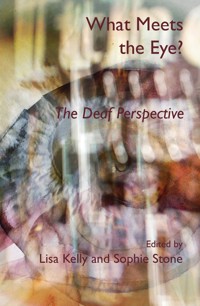
What Meets the Eye? E-Book
Erhalten Sie Zugang zu diesem und mehr als 300000 Büchern ab EUR 5,99 monatlich.
- Herausgeber: Arachne Press
- Kategorie: Poesie und Drama
- Sprache: Englisch
A tree falls in the forest and I am/ there to make sure no one hears it./Beloved: It's not that I am/unwilling to be seized by sound,/ everyday I am undone by it. Khando Langri Our poets and authors were given the theme of Movement. They have intepreted this in many ways: movement as communication and connection, mobility, and stillness, being moved emotionally, movement within and after Lockdown, freedom of movement, and being part of a political movement. Poems, short fiction and scripts from UK Deaf, deaf and hard of hearing writers. Our theme is movement. Stories and poems from Alison Campbell, Ayesha B. Gavin, Bryony Parkes, Charlie Swinbourne, Clare-Louise English, Colly Metcalfe, David Callin, Dee Cooke, Diane Dobson, DL Williams, Elizabeth Ward, Emma Lee, Hala Hashem, Janet Hatherley, Jay Caldwell, John Kefala Kerr, John Wilson, Josephine Dickinson, Julie Boden, Khando Langri, Ksenia Balabina, Liam O'Dell, Lianne Herbert, Lynn Buckle, Maggie Arbeid, Marilyn Longstaff, Maryam Ebrahim, Mary-Jayne Russell de Clifford, Melanie Jayne Ashford, Rodney Wood, Sahera Khan, Samantha Baines, Sarah Clarke, Sarah O Adedeji, Sophie Woolley, Terri Jade Donovan.
Sie lesen das E-Book in den Legimi-Apps auf:
Seitenzahl: 123
Veröffentlichungsjahr: 2021
Das E-Book (TTS) können Sie hören im Abo „Legimi Premium” in Legimi-Apps auf:
Ähnliche




















Contents
Introduction
Lisa Kelly & Sophie Stone
Preface: Poetry, Disability & Vigilance
Raymond Antrobus
Growing Pains
Elizabeth Ward
Label
Mary-Jayne Russell de Clifford
Tracking Sounds Crossing Borders
Emma Lee
Thursday 7th November 2019
Lianne Herbert
No Return – Move On
Maggie Arbeid
Lockdown Lyric
John Kefala Kerr
After Stagnation
Melanie Ashford
Now
Maggie Arbeid
MAPping a New Landscape
DL Williams
Neutral
Sophie Woolley
After the Row
Alison Campbell
Circus of Change
Ksenia Balabina
Coastal Walking for the Hard of Hearing
David Callin
Walking is an Option
Diane Dobson
A Word of Warning
Clare-Louise English
Quiet Twosome
Samantha Baines
Wagging the Dog
Jay Caldwell
de Belder Guido
Rodney Wood
A Map towards Fluency
Lisa Kelly
Loops
Elizabeth Ward
Coffee Shop
Colly Metcalfe
Paper Bags Always Meant One Thing
Alison Campbell
Fish and the Blue-Arsed Fly
Julie Boden
Sea Pool
Marilyn Longstaff
Ailbhe’s Tale
Lynn Buckle
Bones Under Their Feet
Josephine Dickinson
DeLorean
Charlie Swinbourne
Sense of Direction
Ayesha B Gavin
Where is Syria
Hala Hashem
In Memory of our Father
Ayesha B Gavin
One or Two Interesting Facts about Dad
Janet Hatherley
With My Back to the Wall
Janet Hatherley
I , Nyx: (A Daughter’s Daughter)
Sophie Stone
My Glow
Sahera Khan
Ear Trumpet
Lisa Kelly
Moving Words
Bryony Parkes
Deaf Rights
Sarah O Adedeji
The Home Secretary Doth Protest Too Much
Liam O'Dell
Pushing Boundaries
Clare-Louise English
The Dice Players
John Wilson
I Will Talk For You
Maryam Ebrahim
Why Can’t You Learn Sign Language?
Lianne Herbert
The Dancer
Sarah O Adedeji
The Silent Linguist
Sarah O Adedeji
Dream Catcher
Marilyn Longstaff
In Two Minds
Julie Boden
De-stiffen
Dee Cooke
This is Not a Race
Sarah Clarke
La Favorite
Josephine Dickinson
The Cycle(Of Important Nothings)
Terri Donovan
First as Body, then as Metaphor
Khando Langri
Link to BSL Videos
by the authors, and translators
https://bit.ly/3BK0y3k
In Memory of Julie Boden
WHAT MEETS THE EYE?
THE DEAF PERSPECTIVE
Introduction
Lisa Kelly and Sophie Stone
Welcome to What Meets the Eye, an anthology that aims to share a multitude of journeys exploring Deaf, deaf and Hard of Hearing experiences by British writers. If you are looking for a definitive take on deafness, you must look for another anthology; however, if you are looking to join us venturing in exciting and varied territories where mountains of prejudice must be climbed, emotional currents swum, and landmarks reached that lend breath-taking perspectives on what it means to be Deaf, deaf or Hard of Hearing, then you will meet us eye to eye.
This book is part of a series of anthologies produced by Arachne Press loosely linked to a theme of Maps and Mapping, and we took our theme, Movement, from that. When we first discussed putting together this anthology, we knew we wanted wide horizons, not circumscribed by a single vision of form, style or voice – just as deafness is not circumscribed by a single identity, attitude, or political stance. You will meet writers you recognise, writers you are not familiar with, and writers who you will want to search out in other ventures. The one consistent part of the journey is access. From the beginning we decided that however we received work – in British Sign Language (BSL) or English – it should be translated and accessible in both languages (follow the link after the contents or at the end of this book for the BSL version).
As a Deaf, deaf or Hard of Hearing writer, the only certainty is movement. Society, politics, medicine, access, ageing and culture all continue to shape our landscape. How change is navigated lends itself to the richest experiences, which in turn lend themselves to the richest literary expressions. Working with and around the dominance of the hearing world and English speakers, where BSL does not yet have any legal status, unlike the Welsh, Gaelic, and Cornish languages, inevitably gives this anthology a political heart, of which we are proud, and we hope it inspires further activism. At the time of writing, a judge has ruled the UK government broke the Equality Act 2010, by failing to provide a BSL interpreter for its scientific briefings on the coronavirus. The victory followed a campaign led by Deaf activists, #WhereIsTheInterpreter, and shows how much can be achieved through collective action. Individual responses to discrimination, prejudice, and societal injustice, however, will find outlet in artistic expression as each journey is negotiated. We hope you will be moved by how our authors have interpreted the theme of movement. If you are Deaf, deaf or Hard of Hearing, we hope you are moved to consider your own journey and perhaps be inspired to write about your experiences and share writing that connects with you. If you are hearing, we hope you are moved to shared understandings and a broader perspective on what it means to be Deaf, deaf or Hard of Hearing where the hearing culture is dominant. Above all we hope you are entertained by your journey through What Meets the Eye and let your experience move through you and beyond you to reach even wider audiences. This is just the beginning.
PrefacePoetry, Disability & Vigilance
Raymond Antrobus
19th February 2021
My wife Tabitha and I visit a midwifery community centre in Oklahoma. She is ten weeks pregnant. We find ourselves in a room with light green walls with portraits of young mothers smiling into the eyes of newborn babies. We sit on the sofa, I place the cushion on my lap instead of sitting on it, perhaps a sign that I am unwilling to get too comfortable, and yet we are filled with the excitement and anxiety of most expectant parents. I can smell my coffee breath trapped behind my mask, the windowless room has a thick air-conditioned heat and relies on the florescent light in a way that makes the room feel artificial, like an eye that doesn’t blink. It is a pandemic and the midwife in the room with us isn’t wearing a mask so Tabitha and I are already unnerved. When she leaves the room I happen to pick up a leaflet about hearing tests for newborn babies. A trigger warning about ableist language, the leaflet explains how children born with ‘hearing loss’ socially and academically lag behind their hearing peers. It goes on for two pages about language acquisition in the first seven years of a child’s life and the ‘challenges the child will face with hearing loss’; nowhere in the literature does it mention deaf awareness, sign language or the culturally Deaf. I’m not denying there are challenges but pathologising a child’s deafness instead of society’s ableism is a cruel oversight. I don’t keep the pamphlet. I am too angry. I put it back and Tabitha and I leave the building.
That whole week I had been doing readings of my first children’s picture book Can Bears Ski? a story based on my own experience growing up hard of hearing with hearing parents who struggled to guide me through the hearing world. Part of the purpose of the story is to show deafness as an experience rather than a trauma.
I got a range of questions from deaf young readers, some engaged with the story, asking ‘Why does the moon have a face?’ And ‘Can the bears sign?’, and there were young readers looking at the other faces on the zoom call and asking ‘How many people here have cochlear implants?’; another question was ‘Does anyone here have red hearing aids?’, but a common question was ‘What is good about being deaf?’. There is an innocence to this question, but there’s also a self-consciousness, one that some would say ought to not exist for children so young, but alas, from birth we’re lucky to be born in a room that isn’t ableist, let alone a world.
What does this mean to the poet? What is our role, how can we engage and challenge the norms of ableist practice? While browsing in the London Library, I came across the work of John Kitto, a profoundly deaf poet and English Bible scholar born in England. In 1845 Kitto published The Lost Senses: Deafness And Blindness. A fascinating read, Kitto includes a selection of his own sonnets and offers commentary on their inferiority to Shakespeare. He blames his inferiority on his deafness, and in tight iambic pentameter mourns his deafness. As graceful as his writing is, it is still internalised ableism. I don’t mean to say this has no place in literature, it is real, but it is something to notice and interrogate when, and if, it shows up in our own work and our own words, as poets with disabilities. I’m not a scholar, if I were I’d have saved all my notes from the days I spent reading John Kitto. His poems certainly inspired me to develop my own deaf poetics, a lyricism that is at once personal and specific to my experience of deafness, but one that is also subjective and rich. My first full collection, The Perseverance, does this by leaning into the forms of repetition. Much of my experience in the hearing world is asking people to repeat themselves; this is defiance, this is also vigilance.
10th March 2021
Being vigilant in our reading as poets may pay off in our writing as poets, so I want to talk briefly about the Spanish poet Juan Ramón Jiménez and how his work helped me make some decisions in my own writing. I’m a non-Spanish speaker, so the English language translators I’ve relied on are Robert Bly, Mary G Berg and Dennis Maloney.
On 16th January 1916, Jiménez was in his early thirties, already an accomplished poet, prose writer and children’s author. He was leaving on a train from Madrid to board a boat at the port of Cadiz, sailing on to New York where he was due to marry.
He begins a poem in his diary,
How close now to my soul,
What still seems so very far
From my hands!
Jiménez was in love, a young poet in full visceral yearning mode, a poet influenced by the lyric intensity of Rilke and the French Symbolism of Rimbaud. On his sea crossing Jiménez would write some of the most revered poems in Spanish literature. Each of the poems would be dated between 16th January - 3rd October. Some of the poems read like the fragmented internal dialogue of a mystic drifting off to sleep. In Jiménez’s imagination, any boundary between land, sky and sea melts away and we readers find ourselves in the world where colour itself is a kind of destination.
…the train doesn’t go toward the sea ponders the speaker, in a short poem addressed To Cadiz on the Train, January 28th, the line runs on, it goes toward the green summer of gold and white.Yellow and green dominate so much of Jiménez’s metaphysical imagery that the colours become synonymous with his name.
Just over a hundred years after Jiménez took his trip, married and published the poems that became Diary of a Newly Wed Poet, I find myself in my early thirties, having written a poetry collection and a children’s picture book. I’ve just finished a long journey by train to Heathrow where I catch my flight to JFK. I am in a long-distance relationship and am engaged and soon to marry in America. From JFK airport I take a cab to Queens, Ridgewood, and some lines for a poem come to me, which I draft in my notebook:
Give thanks, the wheel touching tarmac at JFK,
Give thanks, the latches, handles, what we squeeze
into cabins, the wobbling wings, the arrivals,
departures, long line at the gates, the held nerve…
the give / of rain on the windows
Each line is a runway, the alliterated lines touching tarmac and wobbling wings create the energetic physical quality of taking off, and the enjambed run on lines keep the reader guessing where the poem may land.
In the sky, I’m a nervous flyer, and on the ground I usually get stopped, searched and questioned at airports, but on this particular trip I’ve gotten past the border swiftly. (It may have had something to do with the fact that I am wearing a suit and tie like the one that Jiménez bears on the cover of the 1916 first edition of Diary Of A Newly Wed Poet).
I haven’t yet read Diary of a Newly Wed Poet, I am a year away from finding Robert Bly’s translation of it in a second-hand bookshop, a year away from resonating with the lines I will leap over the sea / through the sky / I will go far, so very far / that my body won’t remember your body / or mine!
The poem I drafted after landing in JFK is now the opening (untitled) poem of my poetry book All The Names Given (Picador). I’d thought I’d finished writing All The Names Given when I learned of Jiménez, but once I’d felt inspired by Diary of A Newly Wed Poet I rushed back to the manuscript to make tweaks with Jiménez as a literary touchstone or better yet, a kind of poetic time-travelling companion.
16th March 2020
I Am Not I by Jiménez
Translator, Robert Bly
I am not I.
I am this one
walking beside me whom I do not see,
whom at times I manage to visit,
and whom at other times I forget;
who remains calm and silent while I talk,
and forgives, gently, when I hate,
who walks where I am not,
who will remain standing when I die.
Today I was mentoring a young poet on Zoom who said she didn’t like contemporary poetry, she found it too ‘political' and ‘identity based’. In her words, she much preferred the ‘more abstract and visceral poets of the 19th century’. She reeled off a list of mostly straight middle-class white women poets (Emily Dickinson, Christina Rossetti, Elizabeth Barrett Browning). She liked that these poets had ‘quiet’ and ‘private voices’, they wrote in rhyme and strict metered lines, they were remnants of old times, legacy-managed and glorified (by no fault of their own) as pure poets. Somehow their work wasn’t ‘political’ or ‘identity based’. I’d heard Ilya Kaminsky once say that this seems to be a phenomenon in America and the UK, the idea of ‘political poetry’ as a standalone genre, everywhere else in the world, what gets called political poetry is just poetry everywhere else says Kaminsky.
I do agree, that with the visceral nature of some poetry, the air and open-endedness can widen its relatability. Poetry is certainly worthwhile when we are able to pursue our own thoughts through it, despite the separate reaches of space, time (and identity) of the reader and the poet.
Juan Ramón Jiménez wrote his last book in 1958, a poetic autobiography called Time and Space. He writes, Poetry comes to me as an answer, made up from the very essence of my questions.




