


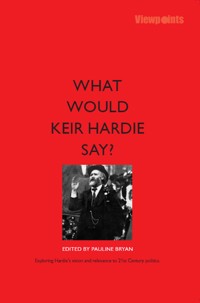
What Would Keir Hardie Say E-Book
Erhalten Sie Zugang zu diesem und mehr als 300000 Büchern ab EUR 5,99 monatlich.
- Herausgeber: Luath Press
- Kategorie: Geisteswissenschaft
- Sprache: Englisch
Keir Hardie is a significant figure in British history. He is known as the founder of the Labour Party but his influence went much wider. 100 years after his death the question is still often asked, "What would Keir Hardie say?" A group of distinguished writers have come together to write about different aspects of Hardie's life and legacy: Fran Abrams, Melissa Benn, Jeremy Corbyn, John Callow, Bob Holman, Cathy Jamieson, William Knox, Richard Leonard, Owen Smith, Dave Watson, Barry Winter. Each of them tackles one aspect of Hardie's varied interests from his support for women's suffrage, his internationalism, to his central role in the foundation of the Labour Party. Each essay considers the relevance of Keir Hardie's work to our lives today. The Foreword by Keir Hardie's great granddaughter, Dolores May Arias, reminds us that as well as his huge public presence, Hardie was a family man. And like so many great figures in history his family paid a price.
Sie lesen das E-Book in den Legimi-Apps auf:
Seitenzahl: 273
Veröffentlichungsjahr: 2015
Das E-Book (TTS) können Sie hören im Abo „Legimi Premium” in Legimi-Apps auf:
Ähnliche




















FRAN ABRAMS is an investigative journalist and author. She spent more than ten years on the staff of various national newspapers including the Independent, the Sunday Telegraph and the Sunday Times. She now makes documentaries for BBC Radio Four’s File on Four programme and writes for the Guardian and other newspapers. She has written five books, the most recent of which is Songs of Innocence: The Story of British Childhood, published by Atlantic Books. Originally from Stockport, Greater Manchester, she lives in Suffolk.
MELISSA BENN is a writer, broadcaster and campaigner. She was educated at Holland Park comprehensive and the London School of Economics where she graduated with a first in history. She has written seven books, including two novels, and has been widely published as an essayist and journalist, particularly in the Guardian and the New Statesman. She is active in the movement for comprehensive education and is currently Chair of Comprehensive Future, a parliamentary based group lobbying for fair admissions in all schools, and a Vice President of the Socialist Education Association. In 2014 she became co-Honorary President of the Keir Hardie Society.
PAULINE BRYAN has worked for both the ILP and the Fabian Society. She is a member of the Scottish Labour Campaign for Socialism, and Convenor of the Red Paper Collective. She co-edited Class, Nation and Socialism: The Red Paper on Scotland 2014, and contributed to The Red Paper on Scotland 2005, Scotland’s Road to Socialism: Time to Choose and A Modest Proposal: For the Agreement of the People. She is a member of the Keir Hardie Society.
JOHN CALLOW is a Political Officer with the GMB trade union. He gained a first class honours degree at Lancaster University, an MA with distinction at Durham University, and was awarded his PhD by Lancaster University. He is the author of 12 books on politics and history. As well as writing the official histories of the Amicus and GMB unions, he has edited new editions of Will Thorne’s autobiography, My Life’s Battles (Lawrence & Wishart, 2014) and Keir Hardie’s From Serfdom to Socialism (Lawrence & Wishart, 2015).
JEREMY CORBYN, Labour MP for Islington North since 1983, is Chair of the Stop the War Coalition and of Liberation, Vice Chair of the Campaign for Nuclear Disarmament and active on human rights issues in Parliament. Jeremy contested the Labour Party leadership election in 2015.
BOB HOLMAN is a writer and community activist. He was clerk in the Post Office and after national service he studied at London University. He was a childcare officer and then an academic before starting a community project on a council estate in Bath. Subsequently, he and wife Annette moved to do similar work in her native Glasgow where they helped start a community project, Family Action, in Rogerfield and Easterhouse. He has written several books, including Keir Hardie: Labour’s Greatest Hero,2010 (to be reprinted this year) and Woodbine Willie: An Unsung Hero of World War One, 2013.
CATHY JAMIESON is a founding member of the Keir Hardie Society, and is currently the society’s President. She was born and brought up in Ayrshire, and served as MSP for Carrick, Cumnock and Doon Valley from 1999–2011 and MP for Kilmarnock and Loudoun from 2010–15. She was Deputy Leader of the Scottish Labour Party from 2000–08. She has been an active trade unionist all of her working life. She is a former trustee of the Barony A Frame Trust, and continues to take in active interest in local political and mining history and heritage in Ayrshire.
WILLIAM KNOX is currently Senior Honorary Research Fellow, University of St Andrews, where he taught for many years after completing his PhD at the University of Edinburgh. He has written widely on labour history, including, Industrial Nation: Work, Culture and Society in Scotland 1800–Present (1999), and James Maxton and Scottish Labour Leaders, 1918–1939: A Biographical Dictionary, and numerous contributions to books and journals. Currently, along with Professor Alan McKinlay, he is researching the life of the late Jimmy Reid, as well as completing a study of interpersonal violence in Scotland, 1700–1850.
RICHARD LEONARD is GMB Scotland’s Political Officer, a former chairperson of the Scottish Labour Party, he is the longest serving member of its elected Executive. He has been the Secretary of the Keir Hardie Society since its establishment in 2010. He is also the Vice-Chairperson of the Scottish Labour History Society. In 2011 he stood for the Scottish Parliament in the Carrick, Cumnock and Doon Valley constituency. For over 20 years he has been a regular writer and campaigner on Scottish politics, the Scottish economy and the importance of working-class and labour history.
OWEN SMITH is Labour’s Shadow Secretary of State for Wales. His constituency and hometown of Pontypridd neighbours the Merthyr Boroughs represented by Keir Hardie. He was elected in 2010 and has served as a shadow minister in the Health and Treasury teams before joining the Shadow Cabinet in 2012. Prior to election, Owen worked as a BBC journalist and as a company director in the biotech industry. In 2012 he co-edited with Rachel Reeves MP, a collection of essays on ‘One Nation Labour’.
DAVE WATSON is Head of Bargaining and Campaigns at UNISON Scotland. He is a past Chair of the Scottish Labour Party and current member of the Scottish Executive Committee. He is Secretary of the Scottish Labour Trade Union Committee and Secretary of the Scottish Health Association. He has contributed to books and journals and is a regular blogger at www.unisondave.blogspot.co.uk.
BARRY WINTER worked for the ILP for many years and is a member of its National Administrative Council. He taught Politics at Leeds Metropolitan University. He is currently rewriting a pamphlet on history of the ILP. He chairs Northern Futures at the Hannah Mitchell Foundation and is on the committee of Leeds Taking Soundings and Leeds for Change.
Viewpoints is an occasional series exploring issues of current and future relevance.
Luath Press is an independently owned and managed book publishing company based
in Scotland, and is not aligned to any political party or grouping.
What Would Keir Hardie Say?
Exploring Hardie’s vision and relevance to 21st Century politics
Edited by PAULINE BRYAN
with contributions by
FRAN ABRAMS, MELISSA BENN, CATHY JAMIESON,
JOHN CALLOW, JEREMY CORBYN, BOB HOLMAN,
WILLIAM KNOX, RICHARD LEONARD, OWEN SMITH,
DAVE WATSON and BARRY WINTER
First published 2015
ISBN: (EBK) 978-1-910324-56-1
(BK) 978-1-910745-15-1
The authors’ right to be identified as author of this book
under the Copyright, Designs and Patents Act 1988 has been asserted.
© Keir Hardie Society and the contributors 2015
Contents
Chronology
Acknowledgements
Foreword by Dolores May Arias
Introduction by Pauline Bryan
GUIDING PRINCIPLES
CHAPTER 1 Socialism: More than a Creed RICHARD LEONARD
CHAPTER 2 Christianity: Christian and Socialist BOB HOLMAN
CHAPTER 3 International Peace: A Legacy for the Peace Movement JEREMY CORBYN
CAMPAIGNS AND CAUSES
CHAPTER 4 Trade Unionism: Independent Labour Representation WILLIAM KNOX
CHAPTER 5 The ILP: Hardie, Evangelist and Strategist BARRY WINTER
CHAPTER 6 Women’s Suffrage: Unfailing Support FRAN ABRAMS
HOME RULE
CHAPTER 7 Home Rule: Socialist, Not Nationalist DAVE WATSONMAKING HIS MARK
CHAPTER 8 West Ham: A Splotch of Red JOHN CALLOW
CHAPTER 9 Merthyr Tydfil: Hardie’s Welsh Odyssey OWEN SMITH
CHAPTER 10 Cumnock: A Lasting Legacy CATHY JAMIESON
BEFORE EVERYTHING ELSE
CHAPTER 11 An Agitator: The Enduring Principle of Agitation MELISSA BENN
APPENDIX 1
Keir Hardie’s maiden speech to the House of Commons,
7 February 1893
APPENDIX 2
The speech given by Keir Hardie in Bradford on 11 April 1914 to mark the 21st anniversary of the formation of the
Independent Labour Party
APPENDIX 3
Keir Hardie’s speech to the anti-war meeting in Trafalgar Square on 2 August 1914, as reported in the Daily Citizen
Endnotes
Opening Quotes – References
Information about the Keir Hardie Society
Chronology
1856 Keir Hardie is born on 15 August in Legbrannock, North Lanarkshire, Scotland.
1864Hardie gains his first job working as a message boy for the Anchor Line Steamship Company.
1866Hardie is hired as a trapper and works in the mines at Newarthill Colliery. Largely self-taught, he begins to attend night school around this time.
1879In August Hardie assumes his first ever union role as a Miners Agent.
1880–81 The First Boer War.
1885 Allan Octavian Hume founds the Indian National Congress in Calcutta in late December.
1888 On 27 April Hardie stands for election as an MP for the first time and comes last in the Mid Lanarkshire by-election.
On 25 August Hardie and other activists form the Scottish Labour Party, with Hardie becoming the party’s secretary.
1892 Hardie stands for election in West Ham South and wins. He takes his seat in Parliament for the first time on 3 August. He is ridiculed by his fellow MPs for the relative informality of his dress.
1893 Hardie founds the Independent Labour Party (ILP) in Bradford in a two-day conference in January that had been planned the previous year.
1894251 miners die in an explosion in a colliery near Pontypridd. Hardie requests that Parliament append a note of condolence to the miners’ families to a Parliamentary address on the new royal baby. When this is refused, Hardie delivers a speech in Parliament criticising the monarchy.
1895 Hardie loses his seat in the House of Commons.
1897 The National Central Society for Women’s Suffrage and the National Society for Women’s Suffrage unite under Millicent Fawcett to form the National Union of Women’s Suffrage Societies.
1899 The Second Boer War begins.
Hardie lodges a motion at the Trade Union Congress to form a distinct labour group within Parliament; this is passed, forming the Labour Representation Committee.
1900 Heavily influenced by the Boer War in what historians refer to as the Khaki election, Lord Salisbury’s Government is returned to power with a Parliamentary majority. Labour wins just two seats, one of which was Keir Hardie in Merthyr Tydfil and Aberdare.
1902The Second Boer War ends.
1903 Emmeline Pankhurst founds the Women’s Social and Political Union. This is more commonly known as the Suffragettes.
1906The Labour Representation Committee, now with 29 seats following the 1906 election, formally adopts the name ‘The Labour Party’. The Independent Labour party affiliates itself to the Labour Party, and Hardie serves as the first Leader of the Labour Party.
1907–1908Hardie embarks on a tour of the British empire, visiting India, Australasia, and South Africa.
Hardie resigns as leader of the Labour Party.
1909 In September the British government introduces force feeding in British prisons to counteract women going on hunger strike in pursuit of suffrage.
1912 Parliament introduces Home Rule for Ireland.
1913 In April, the Cat and Mouse Act (which allows hunger striking suffrage activists to be released and then re-imprisoned after they recover) is passed.
1914 Against the protestation of Hardie, the United Kingdom enters the First World War on 4 August.
1915 Hardie dies on 26 September as a result of several strokes.
1916 From 24 to 29 April an armed uprising attempts to end British rule in Ireland and establish an Irish Republic. The incident, which becomes known as Easter Rising, is swiftly crushed by the British army.
191722–27 February, Russian Revolution and abdication of Tsar Nicholas II, followed by 26 October Revolution when the Bolshevik Party, led by Vladimir Lenin, takes power.
1918 In January, Scot John Maclean is elected to the chair of the Third All-Russian Congress of Soviets. The following month he is appointed Bolshevik consul in Scotland. Sylvia Pankhurst is invited to Moscow by Lenin, leader of the Russian Communist Party.
On 6 February Parliament passes the 1918 Representation of the People Act, giving women over the age of 30 the right to vote for the first time.
On 11 November Germany signs an armistice with the Entente Powers, effectively ending the First World War.
Later in November Parliament passes the Eligibility of Women Act, allowing women to be elected as MPs.
1919– 1921 The Irish War of Independence.
1922 Parliament passes the Irish Free State Constitution Act, establishing what would become the Republic of Ireland. Northern Ireland is given the option of withdrawing from the free state.
1924 Ramsay MacDonald becomes Prime Minister on 22 January, leading the first (minority) Labour government.
1928 On 2 July Parliament passes the 1928 Representation of the People Act, giving women equal voting rights with men in the UK.
1932 The ILP disaffiliates from the Labour Party.
1939 The UK enters the Second World War.
1945 On 26 July Clement Attlee becomes Prime Minister with Labour’s first ever majority in the House of Commons.
Following the atomic bombings of Hiroshima and Nagasaki, Japan surrenders on 15 August, this effectively brings the Second World War to an end.
1946 Parliament passes the National Health Service Act.
1947 The British Raj is partitioned into India and Pakistan as both gain independence from the British empire.
1948 The National Health Service Act comes into effect on 5 July.
1964–70 A Labour Government is returned with a small majority. Harold Wilson becomes Prime Minister. Re-elected in 1966 with a comfortable 97 majority. Enacts legislation on equal pay, decriminalises homosexuality and abortion. The Social Contract with trade unions ends in greater industrial unrest. Conservatives win the 1970 Election.
1974 Edward Heath calls an election in response to the miners’ strike, asking ‘Who Governs Britain?’ Labour wins two elections in the same year with only a slim majority.
1975 The ILP rejoins the Labour party as Independent Labour Publications, a left wing pressure group within the party.
1979 A Conservative Government is elected with Margaret Thatcher as its leader (the first and, so far, only female Prime Minister of the UK). The Conservatives remain in power until 1997.
1981 The Gang of Four – Roy Jenkins, David Owen, Bill Rogers and Shirley Williams – break from Labour to form the Social Democratic Party.
1995 The Labour Party revises Clause IV of its constitution to no longer advocate for the common ownership of the means of production.
1997 Labour is returned with a 179 overall majority. Tony Blair becomes Prime Minister and Gordon Brown Chancellor of the Exchequer. Labour is re-elected in 2001 and 2005. Gordon Brown becomes Leader and Prime Minister in 2007. Labour loses the Election in 2010 with the Conservatives and Liberal Democrats forming a coalition. One of the first acts of the 1997 government is to conduct a referendum on Scottish and Welsh devolution.
1999 The Scottish Parliament, dissolved since the act of Union in 1707, reconvenes on 12 May.
2010 On 15 August the Keir Hardie Society is founded at the Summerlee Museum of Scottish Industrial Life.
Acknowledgements
I would like to thank the authors for their contributions which, when brought together, give us a rounded view of a complex individual. Far from being a mythical figure from history, they make Keir Hardie’s life into a totally relevant touchstone for the present day. A special word of thanks to Jennie Renton of Luath Press for her attention to detail and enthusiasm for the book.
I would also like to thank Dolores May Arias, Hardie’s great-grand-daughter, whose Foreword warmly acknowledges how her mother passed on to her a sense of his values. Her own daughter came with her to Cumnock a few years ago to keep that family link alive. Hardie had a special affinity with children and would always be ready to fight for their future so that they could ‘live for the better day’.
Pauline Bryan
Foreword
WHEN I WAS first asked to write a Foreword for this book about my great-grandfather’s legacy, a panic ensued. Although I always had a general understanding of his role in British labour history, I felt ill-prepared to contribute any profound insights into his life and work. Most of my knowledge of Keir Hardie and his place in Scottish history was based on limited readings and rather vague family stories. But in some ways, he always has been a part of my life as well, and I think it is hard to capture this without recognising my mother, Jean Hardie Scott, as the link. It was she that imparted pride in her grandfather, and felt the importance of passing along his values through her own words and actions.
As my mother would often admit when asked about her memories of her grandfather, she actually had none of her own, as she was born in December 1916, over a year after his death. What she did know was that, while some people in the family’s home town of Cumnock in Ayrshire did not agree with his politics, they admired and respected him as a gentleman.
It may seem strange that Keir Hardie’s only direct descendants are Americans, but my grandfather moved to the US as a young man and settled here, never again returning to Scotland. He married his childhood sweetheart, May Stoddart, a Cumnock girl, in 1912. She was escorted to the US on a ship by her soon to be father-in-law, Keir Hardie. They wed in Brooklyn, NY. Although their only child, Jean, was born in the United States, Scotland was always in her blood and close to her heart. While my grandfather became a US citizen and never returned to Scotland, my grandmother travelled home frequently. My mother often accompanied her. I have a photo of her as a toddler in the gardens of Lochnorris with her grandmother, Lillie Hardie.
At the age of 12, my mother was sent to live with her Stoddart aunts in Cumnock and eventually attended nursing school at the Glasgow Royal Infirmary, graduating in 1940 with her RN and the bronze medal. Her training took her to London during the Blitz, and when the war was almost over, she returned to her parents’ home in Hartford, Connecticut. It is there she met and married my dad, Jorge Lizaso Scott, who was from Cuba and doing his medical residency at the hospital where she was working. I am their only child.
I guess at some level I always knew that my great-grandfather was a special person. Most likely seeing the bust in front of the town hall in Cumnock helped me with this realisation. Of course, each visit to Cumnock had to include a family photo in front of the statue. Then in college I took a British History class, and when the instructor actually knew about Keir Hardie, it was a ‘wow’ moment. So of course, I did some further research, and that was my first introduction to his politics.
Visits to Lochnorris, Keir Hardie’s home in Cumnock, were always fun for me as a child. Uncle Emrys* and his second wife, Aunt Mattie, made it their home. He made sure I knew how important my great-grandfather had been.
In 1992 my mother and I were invited to attend a variety of events celebrating the 1892 election of Keir Hardie to Parliament. In London we were invited to a tea at the Houses of Parliament hosted by Tony Benn MP, saw a showing of the play A BETTER DAY and visited a special commemorative exhibit at a local museum. Cumnock also showed its pride by organising a weekend full of events, including dedication of plaques along Keir Hardie Trail, a luncheon at the Royal Hotel, an evening dance, a lively block (street) party on Keir Hardie Hill and a Sunday church service at Keir Hardie’s place of worship.
When I look back upon my mother’s life and what she valued and strived for, I understand the influence that the Hardie legacy had on her. She was a kind, loyal person who always fought for the underdog, and was not shy about letting her feelings be known when she felt there was an injustice that needed to be corrected. To be honest, my father and I would frequently cringe when she was making her points in public, but she was always the advocate and never shrunk from speaking her mind. I definitely can see that she carried on the Hardie family tradition with integrity. She returned to Scotland to visit many times, but in 1998, shortly after my father died, she asked my family to accompany her to Scotland for her final visit.
Near the end of her days, she often begged me to take her home and I promised that I would try to get her back to her own house for a short stay… it was only a couple of miles away. It was heartbreaking when I realised that when she said she wanted to go ‘home’, she really meant she wanted to go back to Cumnock.
Dolores May Arias, Rhode Island, USA
*Emrys Hughes was Member of Parliament for South Ayrshire 1946–69. His family were long-term friends of Keir and Lillie Hardie and in 1924 he married their daughter Nan.
Introduction
KEIR HARDIE ENTERED Parliament on 3 August 1892 dressed as a working man, a working man in his Sunday best, but clearly and identifiably, a working man. He walked by the vaulted arches, the elaborately engraved ceilings, the murals, the marble floors, the livery wearing messengers and his fellow MPs wearing top hats and morning dress. He wore a cloth cap, checked trousers and a red scarf. He said later in an interview, ‘I had always worn a tweed cap and homespun clothes and it never entered my head to make a change.’1
This wasn’t a faux pas but a deliberate decision about what sort of public representative he was going to be. Some two decades later James Maxton said, in his own maiden speech in Parliament:
We admit frankly that perhaps on the nicer points of good form we have different ideas from Hon members on the other side of the House. Our dialect is somewhat different also, and perhaps our mode of dressing is slightly different. But we think it is the very worst form, the very worst taste, that is shows very bad breeding, to kick a man who is in the gutter, or to withdraw a crust from a starving child.2
Hardie was often booed and laughed at by his fellow MPs, but he exposed them time and again for their lack of compassion and obsequiousness. But as Dolores May Arias says in her Foreword, where it mattered, such as at home in Cumnock, he was admired and respected as a gentleman.
When Hardie died 14 months into the First World War one of the many moving obituaries came from Scottish-born Irish Republican James Connolly. They had disagreed on many occasions, but Connolly wrote:
By the death of Comrade James Keir Hardie labour has lost one of its most fearless and incorruptible champions, and the world one of its highest minded and purest souls.
It is not easy for us who knew him long and personally to convey to the reader how much of a loss his taking away is to the labour movement. We feel it with the keenness of a personal loss.
James Keir Hardie was to the labour movement a prophetic anticipation of its own possibilities. He was a worker, with all the limitations from which no worker ever completely escapes, and with potentialities and achievements such as few workers aspire after, but of which each worker may be the embodiment.3
Connolly’s comment that Hardie ‘was to the labour movement a prophetic anticipation of its own possibilities’ is reflected throughout this book, as each author explores aspects of his full and varied life. The British Labour Party was largely his creation and it did, in its early years embody his spirit.
In his biography, Kenneth O Morgan details the continuing influence of Hardie in the first 30 years of the party; its hatred of unemployment, its support for the League of Nations and colonial liberation and the continuing central role of the trade unions. He identifies 1931 onwards as the period when the party began to ‘emerge from the era of Keir Hardie’.4
The party changed within 30 years, from its early leaders who had little formal education, who had worked in manual jobs but were often great orators, to a very different manner of leader. He cites Hugh Dalton and a group of young economists associated with him, which included Hugh Gaitskell, Anthony Crosland and Roy Jenkins, who set out to transform the Labour Party. While Harold Wilson might have said in his 1961 Labour Party Conference speech ‘The Labour Party is a moral crusade or it is nothing’ these early day modernisers set out to change it from a party of socialism to one of pragmatism. This eventually left it vulnerable to the likes of Tony Blair to adopt clearly neo-liberal policies.
Before 1935, the party had seven leaders who had been a miner, a foundry man, a shipyard worker, a farm labourer, a miner, a mill worker and a manual labourer respectively. After 1935, all but two were Oxbridge or ancient Scottish university educated with very different careers from their early counterparts. It could be argued that when the Labour Party ceased to be the party of Keir Hardie it began to lose the support of working people.
Part of the reason for that loss of support was that it also ceased its role in shaping working people’s understanding of the world from a class perspective and simply presented it through the same prism as the Conservatives and Liberals. All that was left for it was to introduce some minor modifications to the system, but never to change it. Harold Laski, when he was Labour Party Chairman in 1945, claimed that Hardie had provided the ‘two essential keys to the party’s progress. He had stressed the belief in the solidarity of the working class. And he had urged that Labour’s programme must be based firmly on ethical foundations.’5
The aim of this book is to highlight aspects of Hardie’s life and work and to draw from them relevance to the present day.
Guiding Principles
In the opening section on Hardie’s guiding principles, Richard Leonard tackles Hardie’s socialism. Hardie is often dismissed as having no real theoretical underpinning to his socialism. It is clear that his life was spent mostly in action. He certainly never saw his role as constructing a vast critical analysis in the style of Marx, but neither was he a pragmatist like the other MPs elected alongside him in 1892 who entered Parliament on an independent labour ticket and promptly joined the Liberal benches. He wrote copiously, from writing a regular column in a local paper from his mid-20s, to editing The Miner, the Labour Leader, producing numerous pamphlets and, of course, innumerable speeches. Richard argues that he presented an understanding of socialism that was accessible to working people and through that helped build a movement.
Bob Holman writes of Hardie’s Christianity. He was evangelical in his politics, his temperance and his Christianity. He was, however, far from a conventional Victorian Christian. While he may have looked like an Old Testament Prophet, it was as Bob says, the image of Christ being close to the poor that he most identified with. He had many conflicts with more conservative Christians who promised a better after life, most famously with Lord Overtoun who simultaneously forced his employees to work in unbearable conditions on Sunday and campaigned against the running of trams on the Sabbath. Hardie would always expose the hypocrisy of the supposedly Christian ruling class.
The third guiding principle of Hardie’s political life was internationalism. And from that he developed his opposition to colonialism and war. Jeremy Corbyn MP, who could be said to embody much of the spirit of Keir Hardie in the House of Commons today, writes of his lasting contribution in turning the British labour movement outwards to look at the struggles of working people in other lands. Hardie was an early opponent of Britain’s vast appetite for colonies and he supported Indian independence at a time when to most it was inconceivable. He went on to take the most unpopular position of his political life, to campaign against the First World War. No matter the personal cost, he could not do otherwise. In a speech in Parliament at the outbreak of war in 1914, he said, ‘A few years hence… we shall look back in wonder and amazement at the flimsy reasons which induced the Government to take part in it.’6
Causes and Campaigns
All through his life Hardie was a campaigner. Reading about his life at a time when travel and communication took so much time and effort, he appears to have gone everywhere. He endlessly crisscrossed the country and the world in support of campaigns and strikes.
It was, of course, the trade union movement that brought him into politics. William Knox describes Hardie’s most central contribution to the British labour movement, the bringing together of socialist parties and groups together with the trade union movement in order to form a Labour Party. As James Connolly said of Hardie:
Hence I have come to the belief that Keir Hardie was wise in his generation when he worked to form the Labour Representation Committee and that he showed a nearer approximation to the spirit of the much quoted phrase of Marx about the Trade Unions alone being able to form the political party of Labour, than any of our revolutionaries… ever did or do.7
During the years in which he campaigned to establish a party of the labour movement, he helped establish, first the Scottish Labour Party, then the Britain-wide Independent Labour Party and eventually the Labour Party as a federation of political groups and trade unions. As Barry Winter points out, the strained relationship between the ILP and the Labour Party prefigured the challenge faced by many on the left within the Labour Party. It was the ILP, however, that remained closest to Keir Hardie’s heart.
It is perhaps his support for the Women’s Suffrage movement, and most particularly the Pankhursts’ Women’s Social and Political Union, that most troubled many of Hardie’s friends and comrades. Fran Abrams explores why it was so central to him, and why he rejected the alternative campaign supported by most women members of the ILP. There were, of course, many in the labour movement who condemned him for supporting women’s suffrage under any circumstances. In other ways Hardie was a man of his time, but on this issue, as Fran says, he was ahead of his time.
Dave Watson unpicks an issue of immense interest to the present day: was Keir Hardie a nationalist? We know for certain that he supported Home Rule for Ireland, Scotland and Wales. It was, however, not on the basis of nationalist aspirations, but rather to achieve a decentralisation of democracy. He was strongly committed to local democracy in both political and trade union institutions, but also wanted there to be British and Irish solidarity when it came to fighting for working people.
Making His Mark
It was a long journey from being a young trade union representative in Cumnock, in Ayrshire, to becoming the Leader of the British Labour Party, travelling Europe, Africa, Asia and America to campaign for an international movement of socialists. Cathy Jamieson describes the impact that Keir Hardie had in Ayrshire, and how he continues to be a touchstone for judging whether the Labour Party is living up to his standards. While he was away from home for most of his time, he claimed to have kept his watch set at Cumnock time:
By keeping to Cumnock time I could always tell exactly what was being done at home, when the children went to school, when they returned, when they went to bed.8
His upbringing and early experiences kept him rooted and at ease with working people everywhere.
His first time in Parliament as an MP for West Ham South was not a happy experience. He described the House of Commons ‘as a place which I remember with a haunting horror’. This was no reflection on West Ham which was, as described by John Callow, ‘a good fit’ for Hardie. Local voters had become radicalised through the work of trade union leaders such as Will Thorne and when the opportunity presented itself to have an independent labour candidate they chose Hardie. Three years later, however, for various reasons his support had fragmented and the moment passed. A Tory was returned with a much lower turnout by the electors. Hardie learned an important lesson that what was needed was an organised Party, not individual independent MPs.
Hardie’s next experience in Parliament came as the MP for M




