


6,99 €
Mehr erfahren.
- Herausgeber: Atlantic Books
- Kategorie: Gesellschafts- und Liebesromane
- Sprache: Englisch
SHORTLISTED FOR THE OXFORD-WEIDENFELD TRANSLATION PRIZE 1941: In Communist-ruled, war-ravaged Estonia, two men are fleeing from the Red Army - Roland, a fiercely principled freedom fighter, and his slippery cousin Edgar. When the Germans arrive, Roland goes into hiding; Edgar abandons his unhappy wife, Juudit, and takes on a new identity as a loyal supporter of the Nazi regime... 1963: Estonia is again under Communist control, independence even further out of reach behind the Iron Curtain. Edgar is now a Soviet apparatchik, desperate to hide the secrets of his past life and stay close to those in power. But his fate remains entangled with Roland's, and with Juudit, who may hold the key to uncovering the truth... In a masterfully told story that moves between the tumult of these two brutally repressive eras - a story of surveillance, deception, passion, and betrayal - Sofi Oksanen brings to life both the frailty, and the resilience, of humanity under the shadow of tyranny.
Das E-Book können Sie in Legimi-Apps oder einer beliebigen App lesen, die das folgende Format unterstützen:
Veröffentlichungsjahr: 2015
Ähnliche


















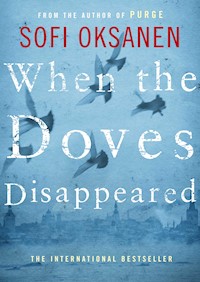
WHEN the DOVES DISAPPEARED
Sofi Oksanen is a Finnish-Estonian novelist and playwright. Purge was her first novel to appear in English. She has received numerous prizes for her work, including the Swedish Academy Nordic Prize, the Prix Femina, the Budapest Grand Prize, the European Book Prize, and the Nordic Council Literature Prize. She lives in Helsinki.
ALSO BY SOFI OKSANEN
Purge
First published in Finland as Kun kyyhkyset katosivat in 2012
by Like Kustannus Oy, Helsinki.
First published in Great Britain in 2015 by Atlantic Books,
an imprint of Atlantic Books Ltd.
Copyright © Like Kustannus Oy, 2012
Translator’s copyright © Lola M. Rogers
The moral right of Sofi Oksanen to be identified as the author of this work has been asserted by her in accordance with the Copyright, Designs and Patents Act of 1988.
The moral right of Lola M. Rogers to be identified as the translator of this work has been asserted by her in accordance with the Copyright, Designs and Patents Act of 1988.
All rights reserved. No part of this publication may be reproduced, stored in a retrieval system, or transmitted in any form or by any means, electronic, mechanical, photocopying, recording, or otherwise, without the prior permission of both the copyright owner and the above publisher of this book.
This novel is entirely a work of fiction. The names, characters and incidents portrayed in it are the work of the author’s imagination and not to be construed as real. Any resemblance to actual persons, living or dead, events or localities, is entirely coincidental.
10 9 8 7 6 5 4 3 2 1
A CIP catalogue record for this book is available from the British Library.
Trade Paperback ISBN: 978 1 78239 125 8
OME Paperback ISBN: 978 1 78239 126 5
E-book ISBN: 978 1 78239 127 2
Printed in Great Britain
Atlantic Books
An Imprint of Atlantic Books Ltd
Ormond House
26–27 Boswell Street
London
WC1N 3JZ
www.atlantic-books.co.uk
Contents
PROLOGUE
Western Estonia, Estonian Soviet Socialist Republic, Soviet Union
PART ONE
Northern Estonia, Estonian Soviet Socialist Republic, Soviet Union
Tallinn, Estonian Soviet Socialist Republic, Soviet Union
Western Estonia, Estland General Region, Reichskommissariat Ostland
Reval, Estland General Region, Reichskommissariat Ostland
Taara Village, Estland General Region, Reichskommissariat Ostland
Taara Village, Estland General Region, Reichskommissariat Ostland
Reval, Estland General Region, Reichskommissariat Ostland
Taara Village, Estland General Region, Reichskommissariat Ostland
PART TWO
Tallinn, Estonian Soviet Socialist Republic, Soviet Union
Tallinn, Estonian Soviet Socialist Republic, Soviet Union
Tallinn, Estonian Soviet Socialist Republic, Soviet Union
Tallinn, Estonian Soviet Socialist Republic, Soviet Union
Tallinn, Estonian Soviet Socialist Republic, Soviet Union
Tallinn, Estonian Soviet Socialist Republic, Soviet Union
PART THREE
Reval, Estland General Commissariat, Ostland National Commissariat
Reval, Estland General Commissariat, Ostland National Commissariat
Reval, Estland General Commissariat, Ostland National Commissariat
Reval, Estland General Commissariat, Ostland National Commissariat
Reval, Estland General Commissariat, Ostland National Commissariat
Reval, Estland General Commissariat, Ostland National Commissariat
Reval, Estland General Commissariat, Ostland National Commissariat
Reval, Estland General Commissariat, Ostland National Commissariat
Vaivara, Estland General Commissariat, Ostland National Commissariat
Reval, Estland General Commissariat, Ostland National Commissariat
Reval, Estland General Commissariat, Ostland National Commissariat
PART FOUR
Tallinn, Estonian SSR, Soviet Union
Tallinn, Estonian SSR, Soviet Union
Tallinn, Estonian SSR, Soviet Union
PART FIVE
Reval, Estland General Commissariat, Ostland National Commissariat
Reval, Estland General Commissariat, Ostland National Commissariat
Reval, Estland General Commissariat, Ostland National Commissariat
Reval & Taara Village, Estland General Commissariat, Ostland National Commissariat
Reval, Estland General Commissariat, Ostland National Commissariat
Reval, Estland General Commissariat, Ostland National Commissariat
Vaivara, Estland General Commissariat, Ostland National Commissariat
Klooga, Estland General Commissariat, Ostland National Commissariat
Reval, Estland General Commissariat, Ostland National Commissariat
Klooga, Estonian SSR, Soviet Union
PART SIX
Tallinn, Estonian SSR, Soviet Union
Tallinn, Estonian SSR, Soviet Union
Tallinn, Estonian SSR, Soviet Union
Tallinn, Estonian SSR, Soviet Union
Tallinn, Estonian SSR, Soviet Union
Tallinn, Estonian SSR, Soviet Union
Tallinn, Estonian SSR, Soviet Union
Tooru Village, Estonian SSR, Soviet Union
Tallinn, Estonian SSR, Soviet Union
Tallinn, Estonian SSR, Soviet Union
Tallinn, Estonian SSR, Soviet Union
Tooru Village, Estonian SSR, Soviet Union
Tallinn, Estonian SSR, Soviet Union
EPILOGUE
Tallinn, Estonian SSR, Soviet Union
Glossary
Propaganda is the collapse of language.
— Lex Rubinstein, Warsaw, 2014
PROLOGUE
Western Estonia, Estonian Soviet Socialist Republic, Soviet Union
WE WENT TO Rosalie’s grave one last time and placed some wild-flowers on the grassy moonlit mound. We were silent for a moment with the blooms between us. I didn’t want to let Juudit go, which is why I said out loud what a person shouldn’t say in that situation:
“We’ll never see each other again.”
I could hear the gravel in my voice, and it brought a gleam of water to her eyes, that gleam that had often knocked me off balance, welling up and sending my rational mind lightly afloat, like a bark boat. Rocking on a stream that flowed from her eyes. Maybe I spoke bluntly to dull my own pain, maybe I just wanted to be cruel so that when she’d left she could curse me and my callousness, or maybe I yearned for some final declaration, for her to say she didn’t want to leave. I was still uncertain of the movements of her heart, even after all we’d been through together.
“You regret bringing me here,” Juudit whispered.
I was startled by her perceptiveness, rubbed my neck in embarrassment. She’d given me a haircut just that evening, and it itched where the hair had fallen down inside my collar.
“It’s all right. I understand,” she said.
I could have contradicted her, but I didn’t, although she hadn’t been a burden. The men had insinuated otherwise. But I had to bring her to the safety of the forest when I heard that she’d had to flee from Tallinn. The Armses’ farm wasn’t a safe place for us with the Russians advancing. The forest was better. She’d been like an injured bird in the palm of my hand, weakened, her nerves feverish for weeks. When our medic was killed in combat, the men finally let Mrs. Vaik come to help us, us and Juudit. I had succeeded in rescuing her one more time, but once she stepped out onto the road that loomed ahead of us, I wouldn’t be able to protect her anymore. The men were right, though—women and children belonged at home. Juudit had to go back to town. The noose around us was tightening and the safety of the forest was melting away. I watched her face out of the corner of my eye. Her gaze had turned to the road that she would leave by; her mouth was open, she was gulping the air with all her strength, and the feel of her breath threatened to undermine my resolve.
“It’s best this way,” I said. “Best for all of us. Go back to the life you left behind.”
“It’s not the same anymore. It never will be.”
PART ONE
Then Mark, the guard, came and took them one at a time to the edge of the ditch and executed them with his pistol.
—K. Lemmick and E. Martinson, 12,000: Testimony in the Case of the Mass Murderers Juhan Jüriste, Karl Linnas, and Ervin Viks, Tartu, January 16–20, 1962, Estonian State Publishing House, 1962
Northern Estonia, Estonian Soviet Socialist Republic, Soviet Union
THE HUM FROM beyond the trees was growing louder—I knew what was coming. I looked at my hands. They were steady. In a moment I would be running toward the oncoming column of vehicles. I would forget about Edgar and his nerves. I could see him from the corner of my eye fiddling with his trousers with trembling hands, his face the wrong color for battle. We had just come from training in Finland, where I’d worried whether he would be all right, as if he were a child, but now that we were in combat the situation had changed. We had a job to do. Soon. Now. I took off running, my grenades whacking against my leg, my hand ready to tug one loose from the side of my boot, my fingers already feeling its spin through the air. The Finnish army shirt I’d put on when we were training on Staffan Island still felt new; it gave strength to my legs. Soon all the men would wear only Estonian gear, nobody else’s, not the occupiers’, not the allies’, only our own. That was our aim, to take our country back.
I could hear the others coming behind me, the ground groaning with our power, and I ran still harder toward the hum of the engines. I could smell the enemy’s sweat, could almost taste the rage and metal in my mouth. It was someone else running in my boots, the same emotionless warrior who in the last battle had leapt over a ditch to throw grenades at the destruction battalion—cap . . . cord . . . throw, cap . . . cord . . . throw. It was someone else—cap . . . cord . . . throw—and that someone was sprinting toward the column. There were more of them than we’d thought. There was no end to the destruction battalions—Russians, and men who looked like Estonians—no end to their vehicles and machine guns. But we weren’t scared. Let them be scared. We had hate running through us, running with such force that our opponents halted, the tires of the Mootor bus spinning in place, our hatred nailing them to the moment when we opened fire. I charged with the others toward the bus and we killed them all.
MY ARMS WERE trembling from the bullets I fired, my wrists heavy from the weight of the grenades I threw, but gradually I realized the fight was over. When my feet adjusted to staying in one place and the shells stopped raining onto the ground, I noticed that the end of the battle didn’t bring silence. It brought noise. Greedy maggots making their way out of the earth toward the bodies, the eager rustle of death’s minions hurrying toward fresh blood. And it stunk the stink of feces, the reek of vomited bile. My eyes were blinded, the gunpowder smoke was starting to disperse, and it was as if a bright golden chariot had appeared at the edge of the clouds, ready to gather up the fallen—not just our men, but also the destruction battalion men, Russians and Estonians. I squinted. My ears were ringing. I saw men gasping, wiping their brows, swaying like trees where they stood. I tried to keep my eye on the sky, the shining chariot, but I couldn’t just stand there leaning against the battered side of the Mootor. The quickest ones were already moving like shoppers at a market. The weapons had to be collected from the dead. The guns and pocket cartridge belts—nothing else. We waded through body parts, twitching limbs. I had just taken an ammunition belt from an enemy soldier when something on the ground grabbed my ankle. The grip was surprisingly strong, pulling me down toward a murmuring mouth. Before I could take aim, my knees gave way and I slid down next to the dying man—as helpless as he was, sure that my moment had come. But he wasn’t looking at me. His words were directed at someone else, someone beloved. I didn’t understand what he was saying, he was speaking Russian, but his voice was the kind a man uses only when speaking to his bride. I would have known even if I hadn’t seen the photograph in his stained hand, the white skirt in the picture. The photo was red with a bridegroom’s blood now, a finger covering the woman’s face. I wrenched my leg free and the life disappeared from his eyes, eyes where I had just seen myself. I forced myself to stand. I had to keep moving.
When the weapons were collected, there was a rattle of engines again from farther off and Sergeant Allik gave the order to retreat. We guessed that the destruction battalion would wait for reinforcements before making another attack or searching for the camps, but we knew they would come. The machine gunners had already made it as far as the edge of the forest when I saw a familiar figure bent over a still flailing body: Mart. His feet had already crushed the skull—brains mixed with mud—but still he hit and hit with his rifle butt, as if he wanted to put it all the way through the body and into the ground. I ran over and skidded into him hard, which made him lose his grip on the rifle. He bucked blindly, not recognizing me, roaring at an invisible enemy and thrashing the air, but I got hold of him, took my belt off, wrapped it around him, and led him to the dressing station, where the men were hurriedly piling up the things they’d found. I whispered that this man needed looking after, tapping my temple, and the medic glanced at Mart—who was gasping, frothing at the mouth—and nodded. Sergeant Allik hustled the men onward, snatched a pocket flask from someone’s hand, and shouted that an Estonian doesn’t fight drunk like a Russky does. I started to look for my cousin Edgar, suspecting that he had run away, but he was perched on a rock with his hand over his mouth, his face wet with sweat. I grabbed his shoulder, and when I let go he started to rub his coat with a filthy handkerchief on the spot where I’d touched him with my bloody fingers.
“I can’t do this, Roland. Don’t be angry.”
A sudden disgust sloshed in my chest, and an image flashed through my mind of my mother hiding coffee, brewing it secretly for Edgar and no one else. I shook my head. I had to concentrate, forget about the coffee, forget about Mart, how I’d recognized what I saw in his addled eyes, a man like the one who had run into battle in my boots. I had to forget the enemy soldier who had grabbed my leg, how I’d recognized myself in his gaze, too, and I had to forget that I hadn’t seen myself in Sergeant Allik’s face. Or the medic’s. This was my third battle since coming back from Finland, and I was still alive, the enemy’s blood on my hands. So where did this sudden doubt come from? Why didn’t I recognize myself in the faces of the men that I knew would survive to see peace come with their own eyes?
“Do you plan to look for more of our men, or stay here and fight?” Edgar asked.
I turned toward the trees. We had a job to do: weaken the Red Army, which was occupying Estonia, and relay information of their progress to our allies in Finland. I still remembered how glad we had been to dress ourselves in our new Finnish gear and form ranks in the evenings, singing, Saa vabaks Eesti meri, saa vabaks Eesti pind—Be free, Estonian sea; be free, Estonian land. When we got back to Estonia, my unit only managed to cut a few phone lines; then our radios stopped working and we decided we’d be more useful if we joined up with the other fighters. Sergeant Allik had proved himself a brave man—the Forest Brothers were advancing at a breakneck pace.
“The refugees may need our protection,” Edgar whispered. He was right. The crowds escaping through the cover of the forest were accompanied by several good men, but they were moving slowly because they were surrounded—the only way out was through the swamp. We’d fought like maniacs to give them time, holding the enemy back, but would our victory give them enough of a head start? Edgar sensed my thoughts. He added, “Who knows what’s happening at home? We haven’t heard anything from Rosalie.”
Before I had a chance to think, I was already nodding and on my way to report that we were leaving, going to protect the refugees, even though I was sure Edgar had suggested it only to avoid another attack, to save his own skin. My cousin knew my weaknesses. We had all left our fiancées and wives at home. I was the only one using a woman as an excuse to leave the fight. Still, I told myself that my choice was completely honorable, even wise.
The captain thought it was a good idea for us to leave. Nevertheless, my mood was strangely detached. Maybe it was because the hearing in my left ear hadn’t returned yet, or because the words of that dying soldier still echoed in my head. It felt as if nothing that had happened was real, and I couldn’t get the stink of death off my hands, even though I washed them over and over when we found a stream. The lines on my palms— the life line, the heart, the head—still stood out in dried blood stamped deep into my flesh, and I walked onward hand in hand with the dead. I kept remembering how my feet had run into battle, how my hands hadn’t hesitated to make my machine gun sing, how when the bullets ran out I grabbed my pistol, and after that some rocks I found on the ground, until in the end I was pounding a Red soldier’s head against the mudguard from the Mootor. But that wasn’t me, it was that other man.
I’d lost my compass in the fight, and we were slogging through unfamiliar forest, but I kept on as if I knew where we were going, and cheered up a bit when I heard a bird singing. It wasn’t long before Edgar noticed that I wasn’t sure of our direction, but he was hardly going to complain. We were safer if we kept our distance from the refugees the destruction battalion was looking for. There was no need for him to say it out loud. A few times he tried to suggest that we should just wait patiently for the Germans to arrive, that anything else we did would be a waste of time, and why take risks at this point? I didn’t listen, I just kept going. I was going to the Armses’ place to protect Rosalie and her family, and to check on Simson Farm—my own family’s place—and if the fighting continued, I would look for a brother I could trust, and join his troop. Edgar followed me, just like he’d followed me over the Gulf of Finland for training. The water seeping up through cracks in the sea ice had turned his cheek pale and he’d wanted to turn back. When our skis froze up, I had hacked the chunks of ice away for him, and we’d kept going, me in front, Edgar behind, just like now. This time, though, I wanted to keep a good distance between us, let his panting fade into the rustling of the trees. My fingers trembled when I took out my tobacco pouch; I didn’t want him to see that. The look on the face of the man who’d grabbed my leg came back into my mind again and again. I quickened my pace. My knapsack weighed me down, but still I went faster, I wanted to leave that face behind, the face of a man who may have died from my bullet, a man whose bride would never know where her bridegroom fell, or that his last thought was I love you.
There were other reasons that I’d left so willingly, left the others to prepare for the next attack. I already had my doubts about our German allies. They’d sent us to attack the rear of the Red Army with a few grenades and pistols and a radio that didn’t work. Nothing more. We hadn’t even been given a decent map of Estonia. We’d been sent there to die, I was sure of it. But I followed orders and kept my mouth shut. As if the last few centuries hadn’t taught us anything, all the times the German barons of the Baltic had flayed the skin off our backs.
Before I went to Finland, I had planned to join the Forest Brothers, had even imagined leading an act of sabotage. My plans changed when I was invited to join the training organized by the Finns. The sea had just then frozen over, making the passage to Finland easy. I thought it was a good omen. In the ranks of the Forest Brothers there had been a kind of bluster and carelessness that wasn’t going to win any wars or drive away our foes or bring anyone back from Siberia or reclaim our homes. I thought the Green Captain took unnecessary risks with his troops. In his shirt pocket he carried a notebook where he wrote down all the information about the men he provisioned and sketched out precise plans for attacks and tunnels. My fears were confirmed by Mart’s daughter. She told me that the destruction battalion had found the food records her mother kept, with careful lists of who came to their house to eat, and when. The Green Captain had promised that she would eventually be repaid for the food and the trouble. But now Mart’s house was a smoking ruin, Mart himself had lost his mind, and his daughter was among the crowds of refugees somewhere ahead of us. Some of the Brothers mentioned in her mother’s provision records had already been executed.
I knew that once Estonia was free again, people of good conscience would want to examine these years, and there would have to be evidence that we acted according to the law. But such thorough record keeping was a risk we couldn’t afford. The acts of the Bolsheviks had already proved that our country and our homes were under the control of barbarians. But I didn’t criticize the captain openly. As an educated man and a hero of the War of Independence, he knew more about fighting than I did, and there was a lot of wisdom in his leadership. He had trained the troops, taught them how to shoot, how to use Morse code, made them spend time every day practicing their running, the most important skill in the forest. I might have stayed in Estonia with his group if it hadn’t been for his habit of taking notes. And the camera. I’d been with the Forest Brothers for some time when one morning they started talking about taking a group photo. I slipped away, said I shouldn’t be in it since I wasn’t really part of the gang. The boys posed in front of the dugout leaning on each other’s shoulders, their hand grenades hanging from their belts, one of them with his head stuck into the horn of a portable gramophone as a joke. The photo included a proudly displayed knapsack full of communist money taken from the town hall. The Green Captain had given it out in bundles. Take your fair share, he’d told them. This is a repayment for the cash the Soviet Union confiscated from the people.
The captain was a legend, but I didn’t want to be that kind of hero. Was it weakness? Was I any better than Edgar?
Rosalie would have been proud to have pictures of my training on Staffan Island or my time with the Green Captain’s group of Forest Brothers, but I didn’t intend to make the same mistake the captain did. I even tore up Rosalie’s picture, though my fingers didn’t want to do it. Her gaze had comforted me at many hopeless moments. I would need that comfort if my life were flowing out of my veins into the earth. I needed it now, as we trekked over the stones and moss, now that I’d left our fighting brothers behind. I needed that look in her eyes. Edgar, clomping along behind me, had never carried a photo of his wife. When he showed up at the cabin where I was waiting to leave for Finland, he made it clear that I shouldn’t say a word to anyone about his being back in his home province. An understandable worry for a deserter, and he knew how fragile Mother’s nerves were. Still, I couldn’t imagine doing such a thing myself, not giving Rosalie any sign that I was alive. I could hear Edgar huffing and puffing behind me and I couldn’t fathom why he wanted to let his wife believe he was still a conscript in the Red Army. I was in a mad rush to get to Rosalie’s house, and Edgar hadn’t said a word about seeing his own wife. I half suspected that he was planning to leave her, that he’d found a new girl, maybe in Helsinki. He’d often been out and about by himself there, traipsing off to the Klaus Kurki restaurant. But he never seemed to let a woman cloud his vision, and he didn’t go in for drinking like the other men did, you could tell by the freshness of his breath when he came back to our quarters. He also wore the same free clothes that I did, although he had puckered up his mouth when he saw the cut and the fabric. You couldn’t take a girl out for a stroll in those clothes, and you couldn’t amuse her on twenty marks a day, let alone sample Helsinki’s brothels. It was just enough money for tobacco, socks, the bare necessities.
The other men had taken one look at Edgar and decided he was different, and I was afraid he’d be sent away from the island as unfit to fight. I really had to work on him after he split his forehead open with the kick of his rifle butt and turned even more gun-shy. I wondered how he’d managed in the Red Army. And where had he gotten so soft around the middle? Red Army provisions were hardly pure lard and white bread. On Staffan Island his belly had disappeared, since everything in Finland was rationed.
Edgar had been forgiven a lot because he was a talker. When members of the Finnish command became instructors, they let him give a lecture about Red Army insignia, smoothly churning out the Russian words. He even tried to teach the other men to parachute, although he’d never once done it himself. He spent the evenings mastering the falsification of papers for when we went back to Estonia, whispering to me about his plans for an elite group made up of men from the island. I let him blather. I’d grown up with him, I was used to his overactive imagination. But the other men pricked up their ears at his nonsense.
We had plenty of free time, moments when most of the men would gawk at every skirt they saw like she was the original Eve. I passed the time thinking about Rosalie and the spring sowing. That June we’d learned about the deportations. No one had heard from my father since his arrest the year before. At the time my mother had wept, said he should have known to take off his hat and sing when the Internationale played, keep his mouth shut about the potato association, not say anything against the nationalization, but I knew my father was incapable of that. And that was why his house was taken, his son was in the forest, and he was in prison. The Bolsheviks wanted to make an example of him. Then they told people that their land wouldn’t be taken away—but who could believe them?
Edgar, on the other hand, wasn’t upset about Simson Farm, even though it was the farm that had paid for his school, the student days in Tartu that he had so many stories about. There were a lot of students on the island, not as many men from the countryside. Edgar and the other university boys hadn’t seen much of life. You could hear it in the way they laughed at anyone who struck them as simpler than they were. For them, “uneducated” was an insult, and they judged a person by whether he’d made it to the third grade, or higher. Sometimes they sounded like they’d been reading too many English spy novels. They got carried away fantasizing about the secret agents they were going to send out from the island, about how the Reds’ days were numbered. And Edgar was right out in front, preaching the gospel. I wrote some of the men off as adventurers, but there weren’t any cowards among them, which gave me some confidence. And we mastered the basics. We were all trained on the radio and in Morse code, and although Edgar was clumsy at loading his gun, his supple fingers were well suited to the telegraph. He’d gotten his speed up to a hundred strokes per minute. My clumsy mitts were made for farmwork. At least we agreed about the most important things; we both had the same politics, the same pro-English position.
I had my own plans: where I used to carry Rosalie’s photo I now kept loose-leaf notebook paper—carrying the entire notebook would have been foolhardy. I’d also bought a bound diary. I wanted to collect evidence of the destruction wreaked by the Bolsheviks. When peace came, I would turn the documents over to someone who was good with words, someone who could write the history of our fight for freedom. The importance of this task gave me strength whenever I doubted that I’d be a part of these grand plans, whenever I felt like a coward for choosing a course of action that avoided combat, because I knew I was doing my part, something that I could be proud of. I had no intention of writing anything that would put anyone at risk or reveal too many identifiable details. I wouldn’t use names; I might not even mention locations. I planned to get a camera, but I wouldn’t be taking any group photos. Spies’ eyes glittered everywhere, greedy for the gold of dead Estonians’ dust.
Tallinn, Estonian Soviet Socialist Republic, Soviet Union
THE GRAIN WAREHOUSES were burning, the sky grew columns of smoke. Buses, trucks, and cars filled the roads, their worn tires screaming like the people were, screaming to get away. And then an explosion. Shrapnel. Shards of glass like a shower of rain. Juudit stood with her mouth open in a corner of her mother’s kitchen. Her mother had escaped to the countryside, to her sister Liia’s house, and left Juudit on her own to wait for the bomb, the bomb that would end everything. The roads from Tallinn to Narva had for some time been clogged with trucks full of evacuees’ possessions, and there were rumors about the evacuation commissariat, rumors that they’d set up commissariats for cattle evacuation, grain evacuation, lentil evacuation—a commissariat for anything they could get their hands on. The Bolsheviks intended to take it all with them, every last crumb, down to the smallest piece of potato. They weren’t going to leave anything for the Germans—or the Estonians. The army had ordered its men to empty the fields, and all of it was headed to Narva or to the harbors. Another explosion.
Juudit put her hands over her ears and pressed hard. She had already accepted that the town would be destroyed before the Germans could get there; she only hoped that her time wouldn’t come until some more ordinary day, that the last sound she heard would be the clink of a spoon on a saucer, the jangle of hairpins in a box, the hollow ring of a milk pitcher set down on a table. Birds! Birds singing! But the Luftwaffe and the antiaircraft guns had devoured the birds, she would never hear them again. No dogs. No cats meowing, no crows cawing, no clatter from upstairs, no sounds of children downstairs, no errand boys running, no squeak of pushcarts, no clank against the door frame as the woman downstairs bumped her bucket coming into the building. Juudit had tried it, too, balancing the washbasin on her head, secretly, in front of the mirror, and wondered why the milliners didn’t design a hat that you could balance a little washbasin or bucket on. It would be a guaranteed success. Women were so childish, so foolish. A bucket hat was just the kind of crazy idea they needed right now. But that clank of tin, that ordinary life, was a thing of the past. Those buckets had been a mark of defeat, tainted by the Bolshevik occupation, but an ordinary thing nevertheless, with an ordinary sound.
HER BROTHER JOHAN had taken her to her mother’s house on Valge Laeva Street in case anything happened, but the days had just continued. He and his wife had been taken away in June and Juudit hadn’t heard from them since, and strangers had moved into his house, important people from the commissariat. Juudit’s husband had been mobilized by the Red Army a long time ago. The woman who lived in the basement had been convicted of counterrevolutionary activity—accused of knowing that her renter was planning to leave the country. Juudit had been interrogated about it, too. And yet the days continued, even after that, and as they continued they became ordinary days, and even those days were better than these days of destruction. Out in the country, at Aunt Leonida’s house, Rosalie went right on milking the cows, even as her fiancé’s family was terrorized. The Simsons’ farm had been taken away; Roland’s father had been arrested and his mother, Anna, had moved to the Armses’ place so Rosalie could take care of her. Juudit was grateful to Rosalie for that. She wouldn’t have been able to cope with Anna Simson, not even in an emergency. She didn’t have Rosalie’s patience. If Juudit’s husband knew about it, he would have one more thing to complain about, would say that Anna didn’t deserve such an uncaring attitude from her favorite nephew’s wife. Maybe not, but Rosalie could fuss over Anna better than Juudit could, and Rosalie would fill the house with little darlings soon enough to make her happy. That was something that Juudit would never see happen.
She tried to think of a sound from the past, something to be the last thing she thought of before the end. Maybe a day in her childhood, the ordinary noises of Rosalie in the kitchen, the sounds of a morning like all the other mornings of that peaceful time, when you knew that today would be just like yesterday, a day when the plywood of her mother’s Luther chair scraped across the floor under the window with that annoying grate, a day when there was nothing very important in her own head, when the most insignificant irritation could make her cross. Or maybe before she died she’d like to think about a day when she was still unmarried, a young lady, a time when there was nothing more exciting than a dress, wrapped in tissue paper, in a box, a dress for her future suitors. Under no circumstances would she think about her husband. She bit her lip. She couldn’t keep her husband out of her mind even if she tried. If that last flash of explosion had hit the house, her marriage would have been the last thing she thought about. Another round of fire made her muscles twitch, but she couldn’t hear anything, didn’t double over.
The idea of staying behind, of going down with the rest of Tallinn, had come to her the day before her mother left, and it had stuck, as if it were the only thing she’d ever wanted. She liked Tallinn, after all, and she didn’t like her husband’s aunt Anna. Anna was staying at the Armses’ place now, with Aunt Leonida and Rosalie taking care of her. Juudit’s mother had tried to get Juudit to go there, too. At times like these it was good to be among loved ones.
“Thank the Lord your father isn’t here to see this. We’re just extra mouths to feed now, one sister taking me in, one taking you in. But it’s just for a little while. And, Juudit, you could at least try to get along with Anna.”
Juudit had pretended to agree so her mother would leave. She wasn’t going to go to Leonida’s house. Juudit wasn’t as confident as her mother about their chances for victory, but she was grateful in a way for the pneumonia that had taken her father when everything was still going well in the country. He wouldn’t have been able to bear it, watching the Bolsheviks’ progress, Johan’s disappearance. The Soviet Union had an endless supply of men—why were things changing now? Why hadn’t they changed before the deportations in June? Why not before her brother was arrested? The din of battle rolled onward, the heavy, muddy wheels of the gun trucks that would kill them all. Juudit closed her eyes. The room lit up. The bursts of light in the air reminded her of the fireworks at Pirita Shore Club at midsummer, back when she had been married for only a year. Her ears were working then, and she’d had other things to worry about, a dull longing for her husband, or rather for the husband she’d imagined he would be. And on Midsummer Night in Pirita she had hoped, hoped so much. She saw herself deep in the Pirita darkness, focused on the flaming barrels of tar that served as torches, the forest sighing with contentment like a hedgehog just awakened to summer. She could taste a bit of lipstick on her tongue, smeared, but she didn’t care, it showed that her mouth was a mouth that had been kissed. The musicians were giving their all, in a song like a fleeting dream of youth, about deer drinking from a stream, unafraid, and the night was full of twittering girls hunting for fern flowers, double entendres said with a hint of a smile, as Juudit’s unmarried friends giggled and shook their bobbed hair defiantly—they had everything ahead of them, and midsummer magic made anything possible. Juudit felt her marriage flow over the flesh of her cheeks, the suppleness of her flesh, the lightness of her breath—these things that were no longer objects of pursuit—and pretended to be more experienced than the other girls, a little better, a little wiser, holding her husband’s hand with the relaxed air of a married woman, trying to drive away the seed of bitter envy, envy of her friends who hadn’t yet chosen anyone, who hadn’t yet been led to the altar. And then her husband swept her onto the dance floor and sang along with the song about his little missus, small as a pocket watch, and the tenderness in his voice carried her far away from the others, and the orchestra started another song, and the carefree deer were forgotten, and Juudit remembered why she had married him. Tonight. Tonight would be the night.
Juudit’s eyes snapped open. She was thinking about her husband again. She could see the sun rising over the Gulf of Finland. But it wasn’t dawn yet; those were the flames of Soviet ships, what was left of Red Tallinn escaping over the sea, their horns shouting like panicked birds. The sound of retreat. Juudit stumbled across the floor, made it to the other side of the room, and leaned against the wall. She couldn’t believe the Bolsheviks were leaving. Light flashed in a corner of the bedroom and she realized that the Luftwaffe’s planes weren’t interested in Tallinn, only in the fleeing ships, but the knowledge didn’t feel like anything. Her twitching legs remembered too well what the sound of a plane meant: run for the bushes, for shelter, run anywhere, like the time in the country helping Rosalie and her aunt with the distilling when the enemy appeared in the sky without any warning and made her aunt kick the kettle over and they bolted under the trees and stood panting and staring at the low-flying plane with its belly, thankfully, emptied.
Juudit pressed her back against the wall, her feet firmly on the floor, readying herself for another explosion. Although the air was heavy with the stench of war, not all the familiar smells were gone. The wallpaper still gave off the smell of an old person’s home, of something safe—and gone. Juudit pushed her nose up against the wallpaper. The pattern was the same, old-fashioned, like the one in the room in Johan’s house where she and her husband had lived while they waited for their own house to be finished. The house was never finished. She would never furnish it. She would never see the new water-lily wallpaper she’d chosen from Fr. Martinson’s after changing her mind several times and fretting over every floral pattern one after the other with her husband and brother, and her sister-in-law, who at least understood how important it was to choose the right wallpaper. When she’d finally made her decision and walked out of the shop, it was a relief to be through with examining samples, comparing them at home, then back at Martinson’s, then at home again. She had gleefully taken a taxi to bring the good news to her husband, who was also relieved to have solved the wallpaper dilemma, and she had announced her decision to her sister-in-law at the Nõmme restaurant, and she’d gotten cream from her pastry on her nose, a nose silky and glowing because she scrubbed her face every night with sugar. Imagine, sugar! Had they drunk cocktails? Had they danced that evening? Had her husband joined them later, and had she thought again, This is it, tonight’s the night? Had she thought that, like she had so many times before?
_______
THE END JUUDIT WAS EXPECTING didn’t come. The town shook, burned, smoked, but it was still standing, and she was still alive, and the Red Army was gone. Happy shouts from outside made her crawl to the window, its panes crisscrossed with paper tape to keep them from shattering, and open it, not caring about the broken glass. The Wehrmacht with their helmets and bicycles filled the street like locusts, a multitude without number, gas-mask canisters waving, the soldiers covered in a downpour of flowers. Juudit stretched her arm out. Smiles sparkled in the air like bubbles in fresh soda, arms waved and sent a breeze sweet with the scent of girls toward the liberators, girls with their hands fluttering like leaves on summer trees, shifting and shimmering. Some of the hands were tearing down the Communist Party posters, the photos honoring communist leaders, tearing their mouths in two, ripping their heads in half, cutting them off at the neck, heels grinding into the leaders’ eyes, rubbing them into the ground, cramming the dust of rage into their paper mouths, the shreds of paper floating into the wind like confetti, the broken glass crunching underfoot like new-fallen snow. The wind slammed the window shut, and Juudit winced.
This wasn’t how it was supposed to happen. Where was the end she’d been expecting? She was disappointed. The solution hadn’t arrived. She breathed in the air of a free Tallinn from the window. Doubtful. Wary. As if the wrong kind of breath could take the peace away again, or cause a woman who didn’t believe in the German victory and the Soviet retreat to be punished. She didn’t dare run into the street—her restlessly squirming legs were hiding inappropriate thoughts, thoughts that rushed in when the neighbor’s little girl ran into the yard and yelled that Daddy was coming home. The little girl’s words made Juudit remember her situation and she had to hold on to the chair for support, like an old woman.
Soon the shops, stripped bare by the Red Army, would be full and would open their doors again, with salesgirls behind the counters to wrap your purchases in paper. The water treatment plant would be repaired, the bridges would rise again, everything that had been plundered, destroyed, and butchered would wind back to how it was before, like a film played backward. Tallinn was still wounded, sucked bare, the streets groaning under horse carcasses and the corpses of Red soldiers swarming with beetles, but soon that would all be gone. The wharves would be rebuilt. The train tracks would be mended. The gashes torn in the roads by the bombs would be patched. Peace would rise from the ruins, plaster would cover the cracks in the walls of the buildings. Journeys would no longer be halted by broken roads. The candles could be taken off the tables and put back in their boxes, the electric lights would come on behind the blackout curtains, maybe the ones who’d been deported would come back, Johan could come home, no one would be taken away anymore, no one would disappear, the knocks at the door in the night wouldn’t come, and the Germans would win the war. Could there be anything better? Things would be ordinary again. But even though that is what Juudit had just been hoping for, the idea of it changed, in the blink of an eye, to something unbearable, and the indifference she’d felt a moment before changed to panic about the future. The ordinary life she would get wasn’t the ordinary life she wanted. Outside the window a Tallinn emptied of Bolsheviks was waiting; the first Estonians were already returning home, their boots already turning the roads to dust. Soon the town would be filled with an assortment of Estonian, Russian, and Latvian uniform jackets new and old, and the girls would swirl around them—maidens, fiancées, widows, daughters, mothers, sisters, an endless horde of clucking, sniffling, dancing females.
JUUDIT DIDN’T WANT to face those women, talking about their husbands coming home, or the women whose fiancés, fathers, and brothers had already come out of the woods or wandered home from fighting in the Red Army in Estonia or on the Gulf of Finland. She wouldn’t have anything to say to them. She hadn’t sent her husband a single letter. She had certainly tried, had gotten out paper and ink, sat down at the table, but her hand couldn’t form any words. Just writing the first letter of his name had been too difficult, thinking what to say in the first sentence impossible. She couldn’t write her husband a letter from a wife who missed him, and that was the only kind of letter to send to the front. All the nights she’d tried and failed, and the nights when she didn’t even try, ate into her memory. All the times she’d tried to lower her neckline a little more, to make him take some notice of her breasts. She remembered vividly how embarrassed she would feel afterward, remembered how it felt when she realized that everything she had imagined about him, everything that had charmed her about him, had been wrong. The memory of how her newly wed husband would push away the breasts she offered him, push her to the other side of the bed like spoiled food shoved away at the table.
JUUDIT’S HUSBAND HAD LEFT in the first phase of Bolshevik rule, along with all the other men who fled conscription to hide in the attics of houses and summer cottages, and she had been relieved. She had the bed all to herself. But she remembered, of course, to knit her brow like she should, to pretend to be a wife who was worried about her husband. When he’d been picked up on his way to get food by Chekists in a black ZIS, Juudit had managed to darken her gray eyes with tears, because that was what she was supposed to do. Even then, she was already hoping that it would be his last trip, that’s what those black cars had meant for so many people, and she was afraid of her own wish, afraid of the wild joy in the possibilities the war had brought her. There were no divorced women in her family. Widowhood was her only option if she wanted her freedom back. But her husband’s auntie got news from the commissariat that he’d been sent to the front, and once again Juudit clutched her handkerchief for the sake of custom. She couldn’t tell anyone how much she enjoyed her bed without her husband. She would have liked to have a lover, but where would she get one? It was wrong to even think such a thing. But she did read Madame Bovary and Anna Karenina several times, and although the women in the books didn’t suffer quite the same marital problems that she did, she’d felt a great spiritual kinship with them, because she knew what it was to yearn.
Before Juudit’s wedding, her mother had slipped in some advice between the lines about marriage and its potential problems, but the problems Juudit had weren’t in her mother’s repertoire. She’d had her doubts even during her engagement, and had told her mother in a roundabout way that, contrary to what she seemed to think, Juudit’s fiancé hadn’t made any physical advances at all. Her girlfriends had a quite different experience with their husbands-to-be, who couldn’t wait to get to the altar. Rosalie, for instance, was constantly hinting at the fiery nature of her dark-browed Roland. Juudit’s mother had smiled at her daughter’s worries, said it was a mark of respect, told her that her father had been just as gentlemanly. Everything would work itself out once they started living together.




