


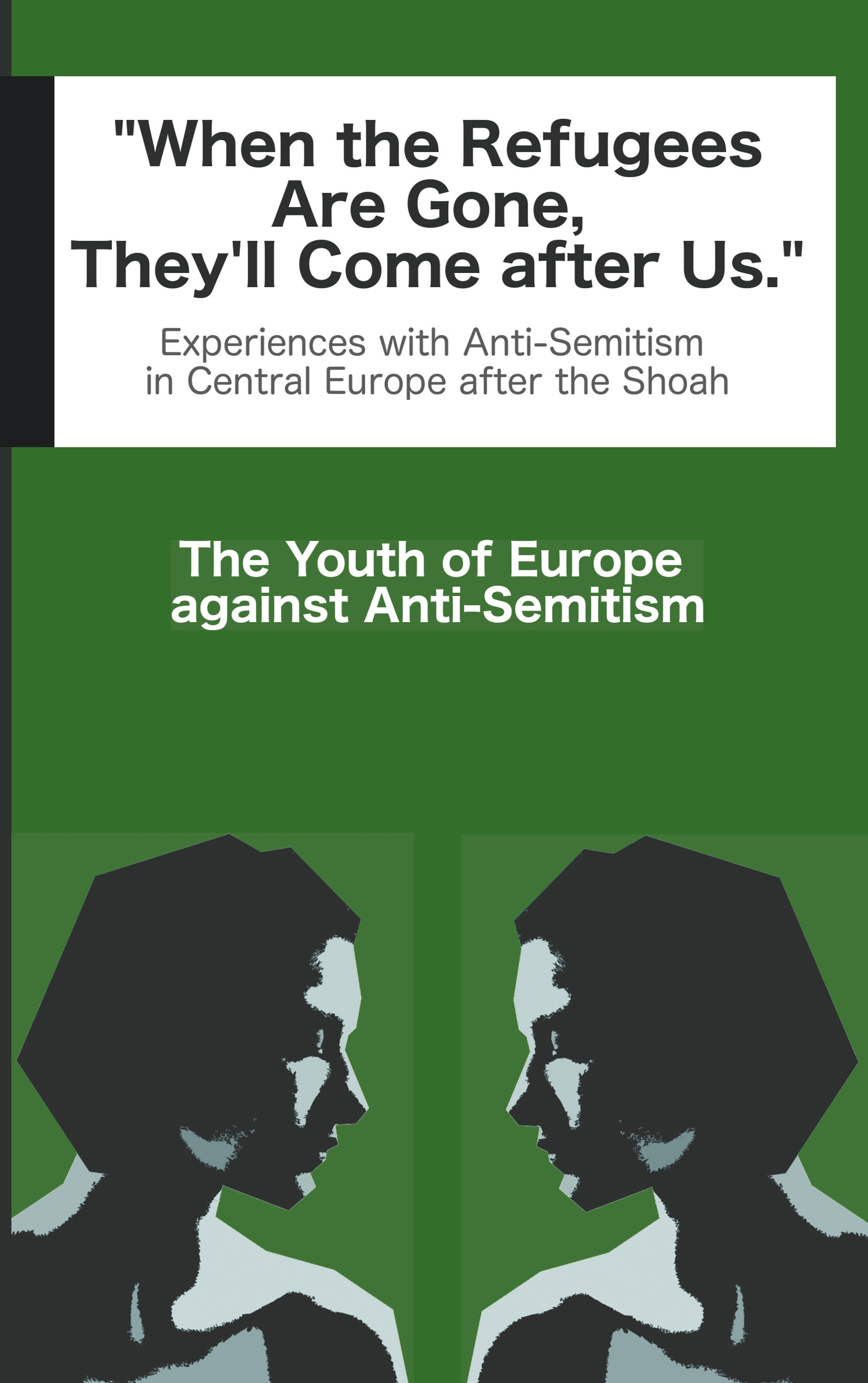
When the Refugees Are Gone, They'll Come after Us E-Book
0,99 €
Mehr erfahren.
- Herausgeber: Books on Demand
- Kategorie: Geisteswissenschaft
- Sprache: Englisch
How have people's knowledge about and attitudes towards the Shoah and anti-Semitism evolved over time? This book compiles various perspectives on anti-Semitism in Germany, Latvia, and Poland. 26 people, Jewish and non-Jewish, working in the field of historical, psychological, or philosophical research, as educators, or as activists against anti-Semitism, have been interviewed between 2016 and 2018 by the project group "The Youth of Europe against Anti-Semitism". This publication documents the experiences that the young adults involved in the project made during the interviews, providing the reader with a mosaic of views on the development of anti-Semitism in the three countries since 1945, its current manifestations and connections to collective memory and history politics, as well as ideas on ways to overcome anti-Semitism.
Das E-Book können Sie in Legimi-Apps oder einer beliebigen App lesen, die das folgende Format unterstützen:
Seitenzahl: 341
Veröffentlichungsjahr: 2020
Ähnliche




















Contents
Creators
Introduction
Poldek (Leopold Yehuda Maimon)
Jakub (Yaakov)
Gienia
Vitali Liberov
David Geballe
Dr. Katja Wezel
Dr. Svetlana Bogojavlenska
Dr Inese Runce
Iļja Ļenskis
Kalevs Krelins
Dieter Hegwein and Robert Sandmann
Dr hab. Steffen Huber, Prof. UJ, Paweł Karpiński, and Krzysztof Turek
Serhii Czupryna
Dr Piotr Setkiewicz
Dr Sonia Ruszkowska
Dr hab. Michał Bilewicz, Prof. UW
Dr. Katrin Stoll
Teresa Klimowicz
Emilia, Esther, Gennadiy, Margaretha, and Sophia
Creators
COORDINATION
Magdalena Freckmann
Rafael Schütz
Agnieszka Smalej
INTRODUCTION
Magdalena Freckmann
Dāvids Gurevičs
Rafael Schütz
COVER DESIGN
Annika Schmidt
TRANSCRIBING
Aleksandra Adamska
Lingita Lina Bopulu
Gabriel Czajka
Magdalena Freckmann
Dāvids Gurevičs
Cathy Hu
Eliza Koprowska
Emilia Kościk
Kamil Kwarciany
Zuzanna Makiel
Johannes Probst
Jonas Röder
Annika Schmidt
Rafael Schütz
Agnieszka Smalej
Dagmara Sokołowska
Patrycja Szala
Myrjam Willberg
Michael Winter
Aleksandra Wodyk
COPY EDITING
Lingita Lina Bopulu
Gabriel Czajka
Magdalena Freckmann
Dāvids Gurevičs
Cathy Hu
Eliza Koprowska
Johannes Probst
Jonas Röder
Annika Schmidt
Rafael Schütz
Agnieszka Smalej
Dagmara Sokołowska
Patrycja Szala
Myrjam Willberg
Michael Winter
TYPESETTING
Magdalena Freckmann
Dāvids Gurevičs
Cathy Hu
Rafael Schütz
PROOFREADING
Magdalena Freckmann
Rafael Schütz
Peter Zinke
Introduction
In 1949, Theodor W. Adorno asked himself and humanity whether one could still write a poem after Auschwitz. This was his way of saying that the delusional and destructive ideology of anti-Semitism, which had led to mass extermination, had transformed European culture and society in a permanent manner: it had become morally impossible not to think of Auschwitz when reflecting about the self-conception of a society or nation and about the way that individuals position themselves towards it.
A widely held belief, especially in Germany, where a reappraisal of the past has always been a central and contentious issue, is that anti-Semitism has been discredited and banned from democratic discourse - however, common experience shows that anti-Semitism persists or gets even stronger, an observation that seems to unmask the much talked about lessons of history as fruitless. The quote that we chose for the title of our publication, based on an interview with Kalevs Krelins, rabbi in the Peitav-Shul synagogue in Riga, shows that Jews today still perceive anti-Semitism as a threat to their own safety. While many groups face hatred, exclusion, or discrimination in each country and might at times be under attack more strongly than the Jewish minority - such as refugees, Muslims, the Russian minority in Latvia, Ukrainians in Poland - anti-Semitism persists as an ideology deeply rooted in European societies that can be drawn upon at any time.
Considering the writings of Adorno and others as well as the fact that the threat of anti-Semitism in Europe persists, one could pose the question how it is possible to be an anti-Semite after Auschwitz - a question that was essential in the project that led to this publication. This book assembles interviews with Jews and non-Jews, experts on Jewish history as well as professionals dealing with anti-Semitism in Central Europe - namely, Germany, Latvia, and Poland - after the Shoah.
The Youth of Europe against Anti-Semitism
We, the collectors of the interviews, are a group of 29 people: high school and university students, apprentices, language teachers, and a historian from Aachen, Berlin, Fürth, Nuremberg, Munich, Riga, and Zamość. Peter Zinke, a historian based in Nuremberg, had the initial idea for the project. A few years ago, he had visited Riga and witnessed what he considered to be a fascist demonstration: the March of Veterans of the Latvian Legion, which takes place in Riga each 16th of March.
Back in Nuremberg, he became concerned with anti-Semitic views among some of his friends, whom he had thought to hold an antifascist and open-minded worldview. Alarmed by these experiences, Mr Zinke developed the idea for a project that should investigate how anti-Semitism had continued to manifest itself since 1945. He began looking for companions. Shortly before, Mr Zinke had finished two oral history projects, gathering the life stories of Shoah survivors together with high school students and teachers from Sderot (Israel), Nuremberg, and Zamość. He convinced some of the participants of these projects to sign up for the new one. These were nine high school students from Nuremberg, who had finished school by that time, and Agnieszka Smalej, a high school teacher from Zamość. Together with Beata Chmura, the head teacher of her high school, Mrs Smalej persuaded nine pupils to take part in the project. Mr Zinke also wrote to several Latvian institutions about his project idea. This way, he got in touch with Karina Barkane, Executive Director of the Centre for Judaic Studies at the University of Latvia. Mrs Barkane called on university students from Riga to apply for the project. From among the applicants, she eventually selected eight.
Thus the group was complete, comprising in alphabetical order the following people: Aleksandra Adamska, Karina Barkane, Lingita Lina Bopulu, Gabriel Czajka, Jānis Dobkevičs, Jānis Dreimanis, Magdalena Freckmann, Dāvids Gurevičs, Lea Himmel, Cathy Hu, Eliza Koprowska, Emilia Kościk, Kamil Kwarciany, Zuzanna Makiel, Edgars Poga, Johannes Probst, Jonas Röder, Annika Schmidt, Rafael Schütz, Agnieszka Smalej, Anastasija Smirnova, Dagmara Sokołowska, Patrycja Szala, Vilmārs Vincāns, Myrjam Willberg, Michael Winter, Aleksandra Wodyk, and Peter Zinke.
Together, we applied to the European Union for a grant under the programme "Erasmus+ - Key Action Cooperation for innovation and the exchange of good practices - Action Strategic Partnerships - Action Type Strategic Partnerships for Youth/Transnational Youth Initiatives".1
Some participants only took part in the first project activities, but most stayed on until the end of the project in June 2019. We all learned a lot about Jewish life in Central Europe and about the histories of the towns and countries we come from. Apart from the 70 interviews that we conducted, we visited Jewish schools, synagogues, and cemeteries, as well as various museums and memorial sites, such as the Memorials and Museums of the concentration and death camps in Auschwitz, Bełżec, and Majdanek.
Subject of Research in our Project
The main question of our project was how anti-Semitism developed after the Second World War in each of the aforementioned countries. For this reason, most of the interviews were centred around the connection between history, politics, and anti-Semitism: how is anti-Semitism related to national self-images, such as feelings of collective guilt and responsibility with regards to the history of the Shoah, or the self-perception as a victim in this historical process? How do the specific roles of the three countries in the Second World War as well as their political development after the war influence the manifestations of anti-Semitism in each of them? Can anti-Semitism be combated through raising awareness of history?
When we refer to the term anti-Semitism, we are aware of the fact that a broad variety of theoretical approaches towards this phenomenon exists, and that its definition is highly contested. The question of which definition one adheres to has far-reaching implications when it comes to investigating the origins of anti-Semitism or the prospects to overcome it. We do not mean to provide a comprehensive overview on or even a positioning in this debate. Still, we would like to state that we see anti-Semitism as a system of thinking following its own rationale and, in line with Haury (2002, cf. Beyer 2015: 576-582), as a mindset that boasts the following principles: personification of abstract global processes such as capitalism or modernity, manichaeism, i.e. the dichotomous division of the world into "good" and "evil", with "the Jews" functioning as a projection surface and representation of all evil, and the construction of homogeneous groups, with Jews being constructed either as "the other" or as a non-group undermining existing group distinctions. These principles operate both on a social or collective and on an individual, psychological level (Ibid.).
As hinted at in our research questions, we were interested in comparing different countries in order to study the connection between the historical development of a country and the expressions of anti-Semitism that can be found there. We believe that the negotiation of a national self-image is at the core of this connection and that each of the three countries boasts some specifics in the way its national self-images refer to the Shoah. In the following section, we will briefly outline these specifics, by no means in a comprehensive manner.
In Latvia, being under the control of a foreign power is an experience that essentially determines the national collective memory, the most recent occupations being the Nazi German occupation from 1941 to 1944 and the Soviet occupation in 1940/41 and from 1944 to 1991. According to the Preamble to the Constitution of the Republic of Latvia, the state condemns both the Nazi and the Communist regime. However, the Soviet occupation of 1940, that involved massive deportations of Latvians to Siberia, is often referred to as the major national grievance; against this backdrop, the Nazi invasion in 1941 is perceived as a "lesser evil" or even as a liberation. Consequently, Jewish suffering tends to be marginalised and the issue of Latvian collaboration or bystander inaction tends to be downplayed. The development of a democratic political culture from 1990 onwards has always involved debates on the question of which historical narrative should be privileged over others, resulting in a reluctance or unwillingness to acknowledge the historical suffering of and the present-day discrimination against ethnic groups other than ethnic Latvians (Misco 2015).
Political and public trends in Latvia substantially depend on the problem of the perception of the events of the Second World War. In June 2019, the liberal party "Development/For!" ("Attīstībai/Par!") intended to submit a law to the Latvian parliament Saeima on compensation to the Latvian Jewish community for the property lost during the Soviet and the Nazi occupations with an amount of 40 million €.2 This initiative invoked an ambivalent reaction of the society and caused a new surge in anti-Semitism; particularly, the Jewish community was misrepresented with regard to its board's connection with political and financial organisations.3 As a result of pressure from society, the party was forced to retract its proposal.4
Analogously, the topic of the collaboration of Latvians during the Nazi occupation and complicity of certain personalities in the Shoah is viewed sorely in Latvia. The role of the prominent war pilot Herberts Cukurs, who was killed by the Israeli intelligence agency Mossad in the mid-1960s, is still ambivalently evaluated. The Jewish community is blamed for intentional defamation of Cukurs and falsification of facts of his biography. Moreover, in February 2019, in spite of the objection of the Jewish community, the Prosecutor General's office decided to dismiss the criminal proceedings against Cukurs, since no evidence had been submitted or collected.5 In addition, it is regularly claimed that during the Second World War, Cukurs saved several Jews.6
In the political constellation sketched above, little attention is being paid to anti-Semitism in public discourse. Findings from Europe-wide surveys show that both the Jewish and the general Latvian population do not perceive anti-Semitism as a major problem in their country: out of 200 self-identified Jews who participated in a 2018 study by the EU Agency for Fundamental Rights (FRA)7, only 12% considered anti-Semitismto be a very or fairly big problem in Latvia, and 77% thought that it had stayed the same in the last five years before the survey. 6% had experienced some form of anti-Semitic harassment in that time, and 8% reported that this had happened to a family member or close friend (FRA 2018: 79). As for the general Latvian society, the Special Eurobarometer 484 that was carried out in December 2018 and investigates research questions similar to those of the FRA study8 found that 14% of the study participants thought of anti-Semitism as a very or fairly big problem and 55 percent felt that it had stayed the same over the past five years. 64 percent of the respondents thought that people in Latvia were not well informed about the history, customs, and practices of Latvian Jews, while 30 percent thought that people were well informed and 6% said that they did not know (European Commission 2019). While these data, giving an indication of the perception of anti-Semitism in Latvian society, boast values much lower than in Poland and Germany, the Anti-Defamation League's Global 100 Survey on anti-Semitism of 20159 finds that agreement with anti-Semitic statements in Latvia is in fact stronger than in Germany. While anti-Semitic conspiracy thinking is stronger in Poland than in Latvia10, some of the statements that represent anti-Semitism as an inter-group conflict are met with about the same agreement in Latvia as in Poland.11 These data must certainly be interpreted with caution; in any case they seem to imply that the significantly lower level of problematisation of anti-Semitism in Latvia does not directly correspond to lower levels of anti-Semitic thinking in the Latvian society.
The European Union against Racism and Intolerance (ECRI) published its fifth report on Latvia on March 5th, 2019. It discusses recent manifestations of anti-Semitism in Latvia, both in public life and in state practice. The report states that the Jewish community reported on five cases of vandalism and desecration at the Jewish cemetery in Riga in 2016 and that Latvian public media reported on four cases of vandalism at the cemetery in Rezekne in 2017 (ECRI 2019: 19).
The Supreme Court of the Republic of Latvia reports on 10 incidents of hate speech against Jews that have been prosecuted in the period from October 2012 until March 2018.
In Germany, more than 70 years after the Shoah, anti-Semitism remains an everyday phenomenon. In the process of dealing with the German past, open expressions of anti-Semitism have become tabooed in mainstream public discourse. However, the ideology continues to fulfil the function of a socially and psychologically relieving interpretation of the world. The tabooing has led to a transformation of anti-Semitism, namely through a shift towards a discourse on Israel loaded with anti-Semitic contents that finds broad acceptance in Germany. At the same time, open expressions of anti-Semitism with "traditional" contents are being condemned, which allows anti-Semitism to be depicted as a marginal and extremist political phenomenon (Busch et al. 2015: 1-3). Recently however, increases in "everyday" anti-Semitic harassment and in anti-Semitic acts of violence can be observed.12 The large majority of anti-Semitic incidents is committed with a right-wing ideological background, but the numbers of offences based on a left-wing, religious, or "foreign" political background have increased just as well. The interview with Dieter Hegwein and Robert Sandmann contains information about how these data are collected.
In the FRA study, 85 percent of the respondents from Germany viewed anti-Semitism as a very or fairly big problem. Manifestations of anti-Semitism on the Internet, on the streets, in public places, and in the media were assessed to be the most problematic. The study shows that manifestations of anti-Semitism can severely affect the feeling of security of Jewish people: 29% (in Poland, by comparison, 32%) of respondents had witnessed other Jewish people being verbally or physically attacked in the last twelve months before the survey. 41% (59% in Poland) were worried about being harassed or insulted, 25% (47%) about being physically attacked. 30% (36%) reported frequently or permanently avoiding to wear, carry, or display in public things that could identify them as Jewish, with security fears being the most frequently reported reason for this avoidance. 74% (91%) thought that the government was not combating anti-Semitism effectively.
64% of the respondents of the Special Eurobarometer 484 considered anti-Semitism to be a very or fairly big problem, 61% thought that it had increased over the past five years. 74% percent of the respondents thought that people in Germany were not well informed about the history, customs, and practices of German Jews, while 22% thought that people were well informed and 4% said that they did not know.
As a means of grappling with its past and specifically with the Nazi German and Soviet occupations, attempts have been made in Polish collective consciousness to restore the national configuration of the interwar period, which signifies stability and autonomy, a process that involved the revival of social institutions such as the Catholic Church and the family. A part of this restauration process was the tendency to avoid the analysis of the younger past, a tendency that sometimes results in a rejection of any responsibility for the wrongs that occurred during the Shoah (Grudzinska-Gross 2014: 664-666). This avoidance discourse, as Katrin Stoll, one of the historians that we interviewed, phrases it, has become a breeding ground for anti-Semitism. For sections of the Polish political spectrum, it has become a core ideology that tends to intertwine with conspiracy thinking and other ideologies such as an anti-EU or anti-cosmopolitan resentment (Zuk 2017: 84-85).
Like in Germany, 85% of the respondents of the FRA study thought that anti-Semitism was a very or fairly big problem in Poland. The manifestations of anti-Semitism that most respondents thought of as a problem were anti-Semitism on the Internet, in the media, and in political life. Respondents were shown eight selected possibly anti-Semitic statements13 and were asked whether they had heard or seen these being made by non-Jewish people. Out of these, most Polish respondents were confronted with the statement "Jews have too much power in Poland" (70% - in Germany, by comparison, 42%), "Jews exploit Holocaust victimhood for their own purposes" (67%, Germany 45%), and "Israelis behave 'like Nazis' towards the Palestinians" (63% in Poland and Germany). 41% of the Polish respondents of the Special Eurobarometer 484 thought of anti-Semitism as a very or fairly big problem, 18% thought that it had increased over the past five years, while another 18% thought it had decreased, 23% thought it had stayed the same, and 41% said that they did not know.
According to the Hate Crime Reporting by the OSCE Office for Democratic Institutions and Human Rights (ODIHR), the Polish police authorities reported on 78 anti-Semitic hate crimes (including physical attacks, vandalism and verbal harassment) that police investigations had been initiated on in 2017. This number was lower than in 2016 (103 crimes reported on), but significantly higher than in previous years.
Method and Selection of our Interviews
We made no attempt to select a representative sample of interviewees. Instead, we tried to talk with people of as diverse backgrounds and perspectives as possible. We spoke with Jews about their personal experiences with anti-Semitism, both youth and ninety-year old Shoah survivors, laypeople as well as clerics. We interviewed scientists from a variety of disciplines, historians, sociologists, psychologists, and philosophers. We listened to a police officer combating politically motivated crime, an educator dispelling stereotypes about Jews already held by small children, a volunteer preserving the Jewish heritage of his town that is no longer home to any Jews, a German-Israeli restaurant owner, a representative of the Human Rights Office in Nuremberg, and even German witnesses of the Shoah holding anti-Semitic views. We conversed with priests, politicians, and publicists. The places where we met our interview partners were Auschwitz Memorial and Museum, Fürth, Forchheim, Ingolstadt, Kraków, Lublin, Nuremberg, Riga, Tel Aviv, Trier, Warsaw, and Zamość. Unless stated differently, all interviews were conducted face-to-face by a part of our group (at least two people).
As diverse as the backgrounds and professions of our interviewees were their conceptions and, resulting from those conceptions, the approaches they regarded to be effective in the combat of anti-Semitism. Some regard anti-Semitism as a false projection and inner necessity of modern capitalist society and are convinced that only critical thinking could lift these projections. Others think that anti-Semitic stereotypes primarily result from a lack of education and would thus disappear if only everybody got to know Jewish people and saw that their personalities are as individual as everyone else's. Some have completely resigned themselves. Many are engaged in different activities against anti-Semitism. They direct their efforts at children and youth, for example, or try to gain political influence, yet others want to reach people of all walks of life. Some are only concerned about violence directed against Jews, while others are also worry about all discursive expressions of anti-Semitism, for example on social media.
On this Publication
By publishing a selection of the interviews we conducted, we intend to present a variety of concepts and views on anti-Semitism. This juxtaposition of different perspectives is not complete in any sense. As the interviews do not directly refer to each other, it is not necessary to read them in any specific order. We have sorted them chronologically.
The interviews should be seen as individual narrations that are not representative for any roles, groups, or attributes the interviewees are associated with (e.g. nationality, religion, profession, biographical aspects), even if their statements are naturally influenced by these affiliations.
The interviews are shortened and grammatically aligned with United Kingdom Standard English. We tried to edit the texts as little as possible and note all major amendments that were necessary. Most of the interviews were conducted in English and we conversed in English within the project group. Nevertheless, some of the interviews were conducted in Polish, German, Latvian, or Russian, as it was easiest for all parties involved. For this publication, we decided to publish the interviews in their original languages. We hope that this way the book will be open for people from backgrounds as various as those of the members of our group, albeit only a few readers may be able to read all the interviews.
We do not raise any scientific claim, as we did not follow a specific method when collecting and evaluating the data. Still, the publication can be of scientific use, e.g. for systematizing, elaborating theories, or illustrating sociological and historiographical concepts related to anti-Semitism. In any case, we hope that the interviews allow our readers to enhance their understanding of anti-Semitism in its connection with Central European societies and that it will encourage reflection, just as it did for us.
A preprint of this book with additional interviews and longer versions of those assembled in here is available at https://ec.europa.eu/programmes/erasmus-plus/project-result-content/80c4f8a0-72a0-4866-b946-d0e549973556/main.pdf
1 We were awarded a grant of up to 54,975 € for a project duration of three years from June 2016 to June 2019 under Grant Agreement Number 2016-1-DE04-KA205-013927.
2 Baltic News Network, June 12th, 2019
3 Pietiek, June 16th, 2019
4Baltic News Network, June 21st, 2019
5Public Broadcasting of Latvia, February 14th, 2019
6 Gabre (2019); Neiburgs (2019). See the interview with Ilya Lensky for further information.
7 The 2018 online survey "Experiences and perceptions of anti-Semitism - second survey on discrimination and hate crime against Jews in the EU" conducted by the European Union Agency for Fundamental Human Rights (FRA) seeks to provide EU-wide data on present levels of anti-Semitism in order to asses to which extent EU member states are fulfilling their obligation to combat anti-Semitism. Therefore, it "analyses data from the responses of 16,395 self-identified Jewish people (aged 16 or over) in 12 EU Member States - Austria, Belgium, Denmark, France, Germany, Hungary, Italy, the Netherlands, Poland, Spain, Sweden and the United Kingdom. These Member States are home to over 96% of the EU's estimated Jewish population" (FRA 2018: 7). As response rates in Latvia were low, recruitment methodology and data collection were adapted in order to reach more respondents. This limits the possibility to compare the results from Latvia with those from the other countries. The size of the Latvian sample was n=200, in Germany n=1,233, and in Poland n=422).
8 The special Eurobarometer 484, a survey which was carried out in December 2018 in 28 member countries of the European Union based on a request by the European Commission, covers the following research questions: (1) To what extent do Europeans consider anti-Semitism to be a problem in their country and how do they assess its recent development? (2) What are the levels of knowledge and education about anti-Semitism? This also relates to the awareness of means to combat anti-Semitism and to adequate Shoah education. (3) How do "conflicts in the Middle East" and the shift of focus influence the way European Jews are perceived in the EU? 27,643 people were surveyed, about 1,000 in each country (Germany: n=1,526, Poland: n=1,011, Latvia: n=1,002). A multi-stage random sample was drawn based on regional administrative units. All interviews were conducted face-to-face in the participant's home.
9 Note that there are some methodological difficulties with this survey. For the purpose of this introduction, it is especially problematic that the survey only asks whether respondents think that a certain statement is "probably true", not giving them the opportunity to answer in a more nuanced way. Nevertheless, the size of the randomly drawn samples (n=500) makes it possible to at least track some general tendencies within the population.
10 The survey includes six statements that can be seen as representations of anti-Semitism as conspiracy thinking. The statements "Jews have too much power in the business world" (Latvia: 51%, Poland: 52%, Germany: 28%) and "Jews have too much power in international financial markets" (Latvia: 47%, Poland: 51%, Germany 29%) are those of which the largest share of the study's participants thinks that they are "probably true", while the sentence "Jews are responsible for most of the world's wars" is met with the least approval (Latvia: 12%, Poland: 14%, Germany: 9%)
11 "Jews are more loyal to Israel than to [Germany/Poland/Latvia]": 49% approval in Germany, 50% in Poland, 56% in Latvia; "Jews think they are better than other people" – Germany 16%, Poland 30%, Latvia 39%; "People hate Jews because of the way Jews behave" – Germany 30%, Poland 34%, Latvia 21%). As for anti-Semitism related to history politics, 51% of Germans, 60% of Poles, and 61% of Latvians participating in the survey thought that the statement "Jews still talk too much about what happened to them in the Holocaust" was probably true.
12 The police crime statistics, which are published annually and report on all offences with a clearly anti-Semitic background that legal procedures have been initiated against, list 1,799 anti-Semitic crimes (such as harassment and vandalism) and 69 anti-Semitic acts of violence. Both numbers exceed those of the last ten years. After the publication of the first online version of our book, the anti-Semitic attack on a synagogue in Halle on October 9th, 2019, with two fatalities has very clearly revealed the potential of anti-Semitic violence in Germany.
13 Respondents were also asked whether they would consider a person voicing one of these statements to be anti-Semitic. The answers given are not itemised by country in the report. For each of the statements listed here, more than 85% of all respondents said that they probably or definitely would.
Acknowledgements
We would like to thank all interviewees for sharing their life stories and expertise with us. We were amazed by their openness and by the amount of time they devoted to answering our questions. We are grateful to Berkan Berkil, Stefanie Dunker, Fabian Fichtner, Emils Metlans, Anja Schoeller, and Dr. Axel Töllner for accompanying us on our journeys and helping us with our work. Also, we would like to express our gratitude for the Erasmus+ fund that made this project possible and to all people who have, via their tax payments, financed this project.
Contact Details
If you would like to learn more about the project, or wish to get access to the original transcripts or other material that we have collected during our journeys, feel free to write to [email protected].
We will be delighted to hear from any person or project that benefits from our work. We are also interested in suggestions for collaboration or further processing of the material.
Poldek (Leopold Yehuda Maimon)
Leopold Yehuda Maimon, called Poldek, was born in Kraków in 1924. He went to a Hebrew elementary school and later to a Zionist grammar school. After the German invasion in 1939, he joined an underground organisation in the Kraków Ghetto. Among other activities, this organisation carried out an attack on a café visited primarily by Wehrmacht officers. At the age of 18, Poldek was deported to Auschwitz, where he also became a part of the underground resistance. Together with four other inmates, he managed to escape during the death march in 1945.
After the liberation, Poldek joined the secret Jewish revenge group Nakam. He is no longer totally convinced of all their deeds today. He emigrated to Palestine illegaly in 1946 and was involved in an Aliyah organisation together with his wife Aviva. Today, Poldek lives in a retirement home in Ramat Gan in the outskirts of Tel Aviv. The interview with him took place there on September 20th, 2016.
Poldek: Urodziłem się w Krakowie w 1924 roku. Miałem starszego brata. Chodziłem do hebrajskiego gimnazjum. To było normalne gimnazjum, takie jak wszystkie. Matura w naszym gimnazjum miała pełne prawa, była jak matura każdego gimnazjum, nie było żadnych kontroli państwowych – mieliśmy pełne prawa.
Jakie ma Pan pierwsze wspomnienia, takie najciekawsze, najpiękniejsze, może wspomnienia właśnie z gimnazjum?
Poldek: Ja mam tylko piękne wspomnienia, to była wspaniała szkoła. Wczoraj do mnie dzwonili z Krakowa, że postawili pomnik jednemu z naszych nauczycieli, który mnie uczył, był wzorem dla nauczycieli. To profesor Ferdhord, uczył języka polskiego. Pisał książki jako Jan Las i był wykładowcą na uniwersytecie. Jak wchodził do klasy, to była taka cisza, że można było usłyszeć muchę. I nigdy nie podnosił głosu, ale miał taki wpływ na uczniów i słuchać go było tak ciekawie, że nikt się nie odważył zrobić czegoś, co by mu przeszkadzało.
Czy jeśli chodzi o język polski, lubił Pan ten język tylko ze względu na nauczyciela, czy miał Pan jakieś zamiłowania humanistyczne?
Poldek: Ja się już wychowywałem w języku polskim, w kulturze polskiej. Wszystko, co czytałem, wszystkie książki były głównie w języku polskim.
Pana polszczyzna jest piękna. Jeśli tyle lat Pan pamięta tak dobrze język polski, to tylko pogratulować. Fantastycznie, że miał Pan takich nauczycieli.
Poldek: Tak. Z wielką miłością wspominam moich nauczycieli – wszystkich, nawet takich, którym przeszkadzałem. Szkoła dała nam wszystko. Bez szkoły nie dało się żyć. Do pół do pierwszej żeśmy się uczyli, a po obiedzie była świetlica i można było uprawiać sport np. ping-pong, można było po dworcu grać w piłkę, był ruch harcerski dozwolony i ja też brałem w nim udział. Ruch harcerski z kierunkiem syjonistycznym, ale głównie to wszystko, co harcerzy cechuje, te same podstawowe wartości. Ja byłem syjonistą, zawsze, od 10 roku życia w tym ruchu harcerskim. Był on w szkole jedynym dozwolonym przez szkołę ruchem młodzieżowym.
Czy wszyscy uczniowie byli do niego przekonani, czy w jakiś sposób byli skłaniani by przyjąć takie podejście?
Poldek: Nie, byliśmy przekonani, to wszystko było dobrowolne, nie było żadnego musu, żeby ktoś brał w tym udział.
Jak Pan wspomina kontakty z młodzieżą z innych szkół, z rówieśnikami, którzy nie byli syjonistami, którzy nie podzielali Pana poglądów i poglądów Pana kolegów ze szkoły?
Poldek: Ja nie miałem żadnych kontaktów, ja w ogóle ich nie znałem, ja byłem za młody, żeby znać, miałem piętnaście lat, jak wojna wybuchła. Przebywałem głównie w szkole, tam się też tańczyło i śpiewało.
Czy Pana trudności zaczęły się, kiedy wybuchła wojna?
Poldek: Wtedy wszystko się całkiem zmieniło. Musieliśmy się przystosować, jeszcze mieszkaliśmy w swoim mieszkaniu do 1941 roku, bo getto powstało w marcu 1941 roku. To było jeszcze w Krakowie, część ludzi uciekła na wschód, gdzieś do Rosji, ale większość została. A myśmy się spotykali, mimo zakazów, młodzież jest młodzieżą i zakazy są zakazami, więc spotykaliśmy się dalej i życie jakoś mijało, jeszcze nie było tak źle, jeszcze nie było tych obozów zagłady. One się zaczęły z końcem 1941 roku. Wtedy Kraków i Polska zostały podzielone na mocy paktu. Część poszła do Rosji, część do Niemiec, a część została środkiem kraju. Została środkowa Polska, a Kraków został stolicą tego kraju.
Jakie trudności zaczęły się dla rodziny po 1941 roku? Jak pan to wspomina, z czym to było związane? Czy z jakąś działalnością Polaków, oczywiście poza okupantem?
Poldek: Trudności były szczególnie ze strony getta, był w sumie jeden pokój w niedużym mieszkaniu, między dwoma rodzinami. .. Życie się zmieniło. Nie było głodu, wydzielano jedzenie. Można było żyć normalnie, nie tak jak to miało miejsce w Warszawie. W Krakowie nie było trupów na ulicy. Kraków był czysty. My się spotykaliśmy przy bloku. Ja pracowałem. Głód się zaczął, jak byłem we więzieniu. Ale było ciężko, sprzedawało się, co się miało. Były kontakty z ludnością polską i sprzedawało się rzeczy i w ten sposób jakoś rodzinę utrzymywało. Pracowałem, ojciec pracował, brat pracował. Trochę żeśmy zarabiali. Jakoś się żyło. Zacząłem pracować już w 1941 roku. Musiałem, bo były łapanki. Musiałeś pracować, żeby mieć legitymację pracowniczą. Wtedy mogłeś dalej pracować. Dla mnie w życiu trudności się zaczęły właściwie w 1942 roku.
Na czym polegał największy ucisk w getcie? Co Państwo odczuwali oprócz tej izolacji, piętna?
Poldek: Prześladowanie było w momencie, kiedy Niemcy weszli. Co tydzień wychodziło jedno rozporządzenie, np. trzeba było nosić opaskę, że się jest Żydem. Nie można było jeździć. Było wiele publicznych łapanek Żydów. Łapano człowieka i musiał iść do pracy, wracał dopiero po dwóch, trzech dniach. Z każdym tygodniem było gorzej. Obelgi były bardzo trudne. Niemcy mieli bardzo wyszukany proces psychiczny.
Próbowali zniszczyć Żydów psychicznie?
Poldek: Tak, dla nich ten, kto znęcał się nad nami psychicznie, bardzo dobrze pracował. Myślę, że obelgi były jeszcze gorsze niż sama śmierć. Bo jak śmierć, to człowiek od razu umiera, a obelgi były stale. Niemcy mogli robić, co chcieli, nie było żadnego sądu. Oni czuli, że wszyscy Niemcy są nadludźmi. Dzisiaj chce się to trochę zamydlić, ale wtenczas wszyscy tak czuli. Widać to na filmach, na których Hitler mówił i wszyscy patrzyli na niego jak na Boga i wszystko, co powiedział, było święte.
Niestety, miał charyzmę, prawda? Złą, negatywną...
Poldek: No tak! Miał kolosalną charyzmę. On wiedział, jak mówić do Niemców.
Niemcy byli nad, a Żydzi byli gdzieś poniżej, a czy naród żydowski odczuwał to, że Polacy byli bliżej w stronę Żydów?
Poldek: Ciężko powiedzieć, to są rzeczy niebadane. Większość Polaków była antyniemiecka, bo Polacy widzieli w Niemcach wroga. To trzeba wiedzieć. Niemcy byli wrogiem Polaków i Polacy o tym wiedzieli. Ta piosenka, Rota polska, „Nie będzie Niemiec pluł nam w twarz", była w sercach Polaków, ale w stosunku do Żydów niestety Polacy dzielili się na kilka rodzajów. Byli tacy, którzy wydawali Żydów – to była mniejszość – wydawali Żydów za jedzenie albo pieniądze, inni wydawali Żydów z radością, bo byli antysemitami.
Czy duży był procent ludzi, którzy wydawali Żydów dla jakiejś satysfakcji, wyższości?
Poldek: Nie powiedziałbym, że było ich dużo. Te rzeczy są jeszcze niebadane. Ale po wojnie Polacy, którzy pomagali Żydom, bali się swoich sąsiadów, że jak się sąsiad dowie, że on pomagał Żydowi... Polak miał karę śmierci za pomoc Żydowi, nie można o tym zapominać.
I wielu ludzi na świecie dzisiaj zapomina, że tylko w Polsce ta kara śmierci obowiązywała, tylko Polacy ginęli za to, że pomagali Żydom.
Poldek: Tego nie można zapomnieć, ale też było dużo Polaków, którzy podchodzili do Żydów z nienawiścią, bo mieli z tego korzyści materialne, na przykład żydowskie domy, które zostały opróżnione przez Niemców. W Polsce był bardzo silny antysemityzm według mnie, kierowany przez Kościół.
Czy chodziło też o to, że Żydom często lepiej się powodziło? Byli zaradniejsi?
Poldek: Nie, to nieprawda. Żydzi byli bardzo biedni. To są tylko opowiadania. Znam Żydów sprzed wojny, bo mój ojciec jeździł po tych miasteczkach, był przedstawicielem rozmaitych firm i na wakacjach z nim jeździłem. Żydzi byli bardzo biedni. Byli też bardzo bogaci, było ich od pięciu do dziesięciu procent, ale zamożnych było jeszcze od piętnastu do dwudziestu pięciu procent. Można powiedzieć, że było dwadzieścia pięć procent Żydów, którzy byli zamożni. Siedemdziesiąt pięć procent to byli Żydzi jak z opowiadań żydowskich, widziałem to na własne oczy. Jeśli Żyd był krawcem, to takim, który robił łaty.
Wspomniał Pan, że to z Kościoła wyszły pierwsze sygnały antysemityzmu. Jak Pan to rozumie?
Poldek: Kościół miał bardzo wielki wpływ na ludność polską, która była bardzo religijna. Nie można pominąć problemu analfabetyzmu w Polsce.
Także w dużych miastach? W Krakowie?
Poldek: Wszędzie. I księża to wykorzystywali. I wiadomość, że Żydzi zabili Jezusa, miała bardzo duży wpływ na mentalność rolników. Rolnik polski też był bardzo biedny. Biedota w Polsce była kolosalna.
Czy spotykał się Pan z tym, że chociaż Kościół w jakiś sposób, bezpośredni lub pośredni, nawoływał do antysemityzmu, to Polacy będąc katolikami pomagali Żydom?
Poldek: Kardynał Sapieha pomagał Żydom. Nie można powiedzieć, że wszyscy. Ja mówię o Kościele na wsiach, bo właśnie ludzie niewykształceni, analfabeci żyli z tego, co usłyszeli w niedzielę w kościele, co ksiądz proboszcz powiedział, było święte.
Ale i wśród tych nieoświeconych, rolników, chłopów, byli tacy, którzy pomagali ryzykując życie, prawda?
Poldek: Wszędzie byli. Ja sam miałem podczas wojny przyjaciół Polaków. Nie można mówić, że w stu procentach ludność polska była antyżydowska. Ale jeśli mówimy o atmosferze, to była ona antyżydowska.
Proszę powiedzieć o początkach buntu w getcie.
Poldek: Myśmy zrobili pierwszy wypad w Europie, nie tylko w Polsce, nie tylko w Krakowie. Pierwszy wypad na Niemców na większą skalę zorganizowała żydowska młodzież w Krakowie 22 grudnia 1932 roku. Byli w kontakcie z Armią Ludową, ale była to czysto żydowska grupa i zrobiliśmy to dwa dni przed Wigilią – pierwszy napad na tę kawiarnię, gdzie byli przed świętami wyżsi oficerowie niemieccy i gestapo. To zrobili Żydzi, ani jednego Polaka tam nie było, tylko napisane na tablicy, że byli Polacy.
Jaka była pana rola w tej grupie?
Poldek: Mieliśmy w kilku miejscach ludzi. Bardzo ciężko było dostać miejsce zamieszkania dla Żyda, bo Żydowi groziła kara śmierci. Podczas tej akcji byłem szefem, byłem odpowiedzialny za tę grupę, która wyszła na główny napad. Na główny napad wyszli z miejsca, gdzie kiedyś był szpital żydowski. To było 22 grudnia. To była główna kawiarnia cyganerii naprzeciwko teatru. Rzuciliśmy flaszki Mołotowa, pełno tam było wyższych oficerów. Część zawiesiła flagi polskie na budynkach administracyjnych, część rozlepiała ulotki, żeby zachęcić Polaków, by zaczęli się bronić, zachęcić do działania. Później zapaliliśmy ogień na ulicach, żeby straż pożarna jechała, żeby był bałagan.
Jak duża była ta grupa?
Poldek: Siedemdziesięciu ludzi.
W jakim wieku? Czy tylko młodzi ludzie?
Poldek: Ja byłem najmłodszy. Miałem wtedy osiemnaście lat, inni mieli osiemnaście, dwadzieścia lat.
Jak zapatrywali się na te działania Polacy, rówieśnicy, młodzi ludzie? Czy współpracowali? Czy w jakiś sposób pomagali?
Poldek: Tak. W Polsce były trzy grupy podziemne. Jedna była Gwardia Ludowa, która była pod nadzorem partii komunistycznej, jedna była nacjonalna narodowa, ona mordowała Żydów, nie przyjmowała Żydów, a kto był w AK albo tacy, co mieli papiery jako Polacy, to tam zgodzili się ich przyjąć, ale z zasady nie przyjmowali Żydów. A Gwardia Ludowa była bardziej była skłonna i ona nam pomagała, współpracowaliśmy.
Jak wyglądało codzienne życie w getcie, gdy zaczął się już bunt młodych ludzi? Jakie akcje podejmowaliście? Z jaką częstotliwością?
Poldek: Byliśmy grupą trzydziestotrzyosobową. Kiedy dowiedzieliśmy się, że mordują Żydów masowo i nie ma właściwie żadnych szans przeżycia, było to bardzo ciężko przeprowadzić wśród inteligencji żydowskiej. Bo żydowska inteligencja w Krakowie była właściwie kulturalnie połączona z kulturą niemiecką. Kraków był pod zaborem austrowęgierskim, wszystko było niemieckie. Językiem był niemiecki, mój ojciec i matka mówili bardzo dobrze po niemiecku. Bardzo ciężko było zrozumieć, że tak kulturalny naród jak Niemcy, który wydał wielkich pisarzy, wielkich uczonych, wielkich kompozytorów, będzie mordował ludzi tylko dlatego, że mają inną wiarę, trudno było w to uwierzyć. Bo to było naprawdę nie do wiary. Myśmy szukali drogi, jak uciec z Polski, żeby wyjechać do Palestyny, bo ta grupa to byli ludzie wychowani w ruchu syjonistycznym. A to się nie udało, bo tak ściśle było wszystko zamknięte. Niemcy byli bardzo dobrze zorganizowani, pod tym względem niestety nie można było wyjść z sideł niemieckich. Przyszły wiadomości z Wilna, że było bardzo mało ludzi. W Krakowie za dużo nie było. W Krakowie było tak dwadzieścia tysięcy Żydów w getcie. Na początku 1942 roku nie było poczty, wiadomości przechodziły przez dziewczęta, które były kurierami. Te grupy syjonistyczne były we wszystkich krajach, bo ruch syjonistyczny był bardzo rozległy przed wojną. Główny ruch syjonistyczny był w Polsce. Tam była kultura żydowska, młodzież żydowska przyjeżdżała tutaj budować kraj, głównie ludzie z Polski budowali ten kraj. Z początkiem 1942 roku dowiedzieliśmy się, że mordują Żydów masowo. Wtedy rozpoczęły się te rozmowy między nami, co powinna młodzież zrobić, czy dać się zamordować bez żadnego oporu, czy stawiać opór. Bardzo łatwo postanowić, że się stawia opór, ale myśmy byli wszyscy studentami, z bronią nie mieliśmy nic wspólnego. Nie było rewolweru, nie było młotka nawet. W końcu przystaliśmy do współpracy z Gwardią Ludową, ona nas przyjęła, pod ich kierunkiem mieliśmy współpracować jako organizacja podziemna. I to polegało na tym, że trzeba było zorganizować jakiś wypad mały na fabryki, gdzieś, gdzie były mundury niemieckie. A raz na kolej, która szła na wschód. Pierwszy rewolwer zdobyliśmy tak, że wyszło nas trzech ludzi na plac otoczony plantami, pod wieczór, było ciemno, napadli na policjanta niemieckiego, z siekierą, zabili go i to był pierwszy rewolwer, jaki zdobyliśmy. Także to były kolosalne trudności budować grupę podziemną, bez pieniędzy, bez poparcia ludności.
I bez przygotowania wojskowego.
Poldek:




