


20,39 €
Mehr erfahren.
- Herausgeber: Saqi Books
- Kategorie: Bildung
- Sprache: Englisch
In November 2011, an agreement brokered by the GCC brought an end to Yemen's tumultuous uprising. The National Dialogue Conference has opened a window of opportunity for change, bringing Yemen's main political forces together with groups that were politically marginalized. Yet, the risk of collapse is serious, and if Yemen is to remain a viable state, it must address numerous political, social and economic challenges. In this invaluable volume, experts with extensive Yemen experience provide innovative analysis of the country's major crises: centralized governance, the role of the military, ethnic conflict, separatism, Islamism, foreign intervention, water scarcity and economic development. This is essential reading for academics, journalists, development workers, diplomats, politicians and students alike.
Das E-Book können Sie in Legimi-Apps oder einer beliebigen App lesen, die das folgende Format unterstützen:
Veröffentlichungsjahr: 2014
Ähnliche



















HELEN LACKNER has been researching the Arabian Peninsula for over forty years and lived in Yemen for close to fifteen. She has worked as a consultant on social aspects of development in over thirty countries and specializes in rural issues, in particular water management and poverty alleviation. Her other publications include A House Built on Sand: A Political Economy of Saudi Arabia, PDR Yemen: Outpost of Socialist Development in Arabia and Yemen into the Twenty First Century: Continuity and Change (co-editor).
‘Why Yemen Matters is essential reading for anyone who wants to know where the future of Yemen lies after the toppling of Ali Abdullah Saleh. Leading scholars of Yemen address a wide range of topics from the structure of the Yemeni private sector and the transformation of tribal relations in the war in Sa‘ada to the geopolitics of the GCC initiative and the relationship of the youth rebellion to the traditional political parties. The authors shed light on the context of the Yemeni uprising in a way that not only helps us understand the current transitional period but also the outlines of Yemen’s future.’
—Charles Schmitz, President of the American Institute of Yemeni Studies
‘An up to date and wide-ranging guide to what is arguably the Arab world’s least known and most misunderstood state. Edited by one of Britain’s foremost authorities on Yemen, Why Yemen Matters brings together an impressive range of experts on the country to examine the contemporary reality of Yemen with all its contradictions and complexities. It will be of use and interest to academics, policy-makers, students and those simply interested in finding out more about Yemen. Politics, economics, culture, society and foreign relations are all addressed in a volume that emphatically explains why Yemen does indeed matter.’
—Michael Willis, Director of the Middle East Centre, St Antony’s College, Oxford University
Other Titles in the Series
British-Egyptian Relations from Suez to the Present Day
Demystifying Syria
The Gulf Family: Kinship Policies and Modernity
Higher Education in the Gulf States: Shaping Economies, Politics and Culture
Oil and Democracy in Iraq
Popular Culture and Political Identity in the Arab Gulf States
Turkey, the US and Iraq
Political Islam: Context versus Ideology
SOAS MIDDLE EAST ISSUES
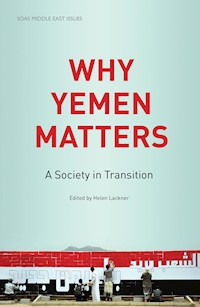
WHY YEMEN MATTERS
A Society in Transition
Edited by Helen Lackner
CONTENTS
Acknowledgements
Note on Transliteration and Abbreviations
Chronology
Maps
INTRODUCTION
PART ONE |POLITICS AND SECURITY
1YEMEN BETWEEN REVOLUTION AND COUNTER-TERRORISM
Sheila Carapico
2TIES THAT BIND AND DIVIDE: THE ‘ARAB SPRING’ AND YEMENI CIVIL–MILITARY RELATIONS
Adam C. Seitz
3YEMENI SOCIETY IN THE SPOTLIGHT: THEATRE AND FILM IN YEMEN BEFORE, DURING AND AFTER THE ARAB SPRING
Katherine Hennessey
PART TWO |REGIONAL ISSUES
4THE SHABAB, INSTITUTIONALIZED POLITICS AND THE ISLAMISTS IN THE YEMENI REVOLUTION
Laurent Bonnefoy
5THE IRREGULARS OF THE SA‘ADA WAR: ‘COLONEL SHEIKHS’ AND ‘TRIBAL MILITIAS’ IN YEMEN’S HUTHI CONFLICT (2004–2010)
Marieke Brandt
6THE ROLE OF THE PDRY IN FORMING A SOUTH YEMENI IDENTITY
Noel Brehony
7MORE THAN HALF OF SOCIETY: SOUTHERN YEMENI YOUTH, UNEMPLOYMENT AND THE QUEST FOR A STATE JOB
Susanne Dahlgren
PART THREE |ECONOMIC DEVELOPMENT
8WATER SCARCITY: WHY DOESN’T IT GET THE ATTENTION IT DESERVES?
Helen Lackner
9CUSTOMARY CONFLICT RESOLUTION IN TIMES OF EXTREME WATER STRESS: A CASE STUDY OF A DOCUMENT FROM THE NORTHERN HIGHLANDS OF YEMEN
Gerhard Lichtenthäler
10LAND DISPUTES IN YEMEN
Jens Kambeck
11THE ROLE OF SMALL AND MEDIUM ENTERPRISES IN THE ECONOMY: THE CASE OF YEMEN
Kais Aliriani
PART FOUR |SOCIETY AND MIGRATION
12ON THE EDGE: THE CHALLENGES OF YEMEN’S HEALTHCARE SYSTEM
Adel Aulaqi
13SOVEREIGNTY OVER THEIR BODIES: RETHINKING THE DETERMINANTS OF WOMEN’S REPRODUCTIVE HEALTH IN YEMEN
Christina Hellmich
14FROM MIGRATION HUB TO ASYLUM CRISIS: THE CHANGING DYNAMICS OF CONTEMPORARY MIGRATION IN YEMEN
Hélène Thiollet
15‘CLOSE TIES’: GENDER, LABOUR AND MIGRATION BETWEEN YEMEN AND THE HORN OF AFRICA
Marina de Regt
16THE EMERGING YEMENI COMMUNITY IN CHINA: THE SOCIALIST LEGACY, THE NEW SILK ROAD AND THE CHíNESE MODEL
Ho Wai-Yip
Select Bibliography
Notes on Contributors
Index
ACKNOWLEDGEMENTS
THIS BOOK AROSE from a conference held at SOAS and organized by the British Yemeni Society (BYS) in association with the London Middle East Institute in January 2013, under the title ‘Yemen: Challenges for the Future’. It brought together experts and academics, and was the first academic conference in the UK on Yemen in over 20 years. The idea of the conference came from Noel Brehony, chairman of the BYS, and Thanos Petouris, a member of the BYS Committee, and was convened by them, working closely with an academic and organizing committee from the BYS and SOAS composed of Dr Adel Aulaqi, Dr Noel Brehony, Dr Gabriele von Bruck, Louise Hosking, Helen Lackner, Thanos Petouris and Dr Shelagh Weir. Members of the BYS Committee offered invaluable advice and assistance.
The conference itself was attended by over 300 people from many different countries, demonstrating a much wider interest in Yemen than the organizers had anticipated. Yemeni participation was high. The contributors to the book are among the 40 people who presented papers at the conference. The conference would not have been possible without the active support and the generous sponsorship of our sponsors and in particular the MBI Al Jaber Foundation. The LMEI and the BYS want to thank all sponsors for their unquestioning willingness to allow the Committee, the conference and the book to take place with absolutely no guidance or interference with our independence. They wish to thank H. E. Sheikh Mohamed bin Issa al-Jaber for both his support and his personal participation in the conference. Particular thanks are due to Dr Hassan Hakimian, MBI Al Jaber Director of the London Middle East Institute, to Louise Hosking, administrator of the LMEI, and her staff for their major contributions, and for ensuring that the conference ran smoothly despite the unexpected number of participants. The BYS is grateful to the Seven Pillars of Wisdom Trust, Menas Associates and to Nexen Inc for supporting the publication of this book.
Above all, thanks to Noel Brehony for having the original idea of the conference and the book. He followed both up closely throughout the process, and patiently managed the complex negotiations between the three concerned institutions – the BYS, LMEI and Saqi Books. As the saying goes, none of this would have happened without his contribution. Thanos Petouris made an indispensable contribution to preparing the conference, handling much of the discussion with potential participants. The editor also wants to thank all those who have provided information, read and criticized earlier drafts, and provided moral and practical support in the completion of this work – in particular Abdul Rahman al-Eryani, Sarah Cleave, Diana Driscoll, Lynn Gaspard, John Gittings, Jamal al-Hajri, Hermione Harris, Christine McLelland, Munitta Muthanna and Charles Peyton. Finally, thanks are due to Dr Abdul Karim al-Eryani, who found the time to read the Introduction despite his extraordinarily busy schedule. Neither the British Yemeni Society nor the London Middle East Institute are responsible for the contents of the book, which does not reflect the views or positions of either institution, but exclusively those of the individual authors of each chapter. The wide range of interpretations of events in Yemen presented here shows that events in the country can be interpreted in a variety of ways, and the book itself reflects the understanding of each author, without implying that either the sponsors, the BYS or LMEI or their honorary presidents agree with any position presented.
NOTE ON TRANSLITERATION AND ABBREVIATIONS
ARABIC TRANSLITERATION IS ALWAYS problematic. In this book we have taken the following approach: we use one of the commonly used transliterations for the most frequently used words, whether names of places, people or organizations. With respect to people, we use the transliteration individuals use for themselves in the case of living personalities, which may lead to some inconsistencies. For words that only appear in a specific chapter, each author has used her/his transliteration system, in most cases that of the IJMES, but diacriticals have been removed to make reading easier.
ADR
adequate dispute resolution
AFAC
Arab Fund for Arts and Culture
AFESD
Arab Fund for Economic and Social Development
AQAP
al-Qa‘ida in the Arabian Peninsula
BC
basin committee
CACB
Cooperative and Agricultural Credit Bank
CCYRC
Coordinating Council of the Youth Revolution of Change
CSO
Central Statistical Organization
DHS
District Healthcare System
DPW
Dubai Ports World
FDI
foreign direct investment
FLOSY
Front for the Liberation of Occupied South Yemen
FPFD
Future Partners for Development
GALSUP
General Authority for Land, Survey and Urban Planning
GAREWS
General Authority for Rural Electricity and Water Supply
GARWS
General Authority for Rural Water and Sanitation
GARWSP
General Authority for Rural Water Supply Projects
GCC
Gulf Cooperation Council
GDP
gross domestic product
GHS
Government Healthcare System
GNI
gross national income
GPC
General People’s Congress
GSCP
Ground and Soil Conservation Project
HWC
High Water Council
ICRG
International Country Risk Guide
IDP
internally displaced person
IIP
Irrigation Improvement Project
IMF
International Monetary Fund
IOM
International Organization for Migration
IWRM
Integrated Water Resources Management
JMP
Joint Meeting Parties
MAI
Ministry of Agriculture and Irrigation
MAWR
Ministry of Agriculture and Water Resources
MENA
Middle East and North Africa
MDG
Millennium Development Goals
MIT
Ministry of Industry and Trade
MOPH
Ministry of Public Health
MSE
micro and small enterprises
MSMES
micro, small and medium enterprises
MWE
Ministry of Water and Environment
NATO
North Atlantic Treaty Organisation
NDC
National Defence Council
NLF
National Liberation Front
NLP
National Land Policy
NWRA
National Water Resources Authority
NWSSIP
National Water Sector Strategy and Investment Program
OCHA
Office for the Coordination of Humanitarian Affairs
OFID
OPEC Fund for International Development
PDRY
People’s Democratic Republic of Yemen
PHCS
Primary Public Healthcare Service
PPP
purchasing power parity
PSIA
Poverty and Social Impact Analysis of Yemen’s Water Sector Reform Program
PRSY
People’s Republic of South Yemen
RPF
Resettlement Policy Framework
ROY
Republic of Yemen
SEDF
Small Enterprise Development Fund
SFD
Social Fund for Development
SMEs
small and medium enterprises
SMEPS
Small and Micro Enterprise Promotion Services
TPAC
third-party arbitration centres
UNHCR
United Nations High Commissioner for Refugees
UNCITRAL
United Nations Commission on International Trade Law
UNCTAD
United Nations Conference for Trade and Development
UNDP
United Nations Development Programme
WHO
World Health Organization
WRAY
Water Resources Assessment Yemen
YAR
Yemen Arab Republic
YAVA
Yemen Armed Violence Assessment
YHRP
Yemen Humanitarian Response Plan
YSP
Yemeni Socialist Party
HISTORICAL CHRONOLOGY OF EVENTS IN YEMEN SINCE 1839
1839
Britain occupies Aden.
1869
Opening of the Suez Canal.
1872
Ottomans occupy Sana‘a, having ruled parts of the area at various points in the past.
1905
Border established between British Protectorates and Ottoman controlled area.
1918
Imamate re-established in Sana‘a after Ottoman defeat in World War I.
1934
Britain and Imamate agree on border. War between Saudis and Imamate, won by Saudis.
1948
Assassination of Imam Yahia. After short ‘liberal’ interlude, Imam Ahmed takes over and his troops sack Sana‘a.
1952
Egypt: overthrow of king; Gamal Abdel Nasser becomes leader.
1956
Egypt: Suez Canal nationalized, followed by invasion by Britain, Israel and France. Yemeni Imamate joins United Arab States, with Egypt and Syria.
1959
Establishment of the Federation of Emirates of the South, bringing together most of the Eastern and Western Aden Protectorates under British domination.
1962
25 September: Aden joins the Federation that becomes the Federation of South Arabia.
26 September: ten days after Imam Ahmed’s death, Zaydi imamate overthrown; Yemen Arab Republic established, soon supported by Nasser’s Egypt.
1962–70
Civil war in YAR; republicans defeat pro-Imamate royalists.
1963
Foundation of the National Liberation Front, and beginning of armed struggle against Britain on 14 October.
1967
June war between Arabs and Israel: closure of Suez Canal.
Britain leaves Aden and the Federation of South Arabia; handover of power to the NLF, who establish the People’s Republic of South Yemen. Royalist siege of Sana‘a fails to oust Republicans.
1969
22 June Movement in Aden, the left wing of the NLF, takes power.
1970s
Mass out-migration of Yemenis for work in Saudi Arabia.
1970
PRSY becomes the People’s Democratic Republic of Yemen.
YAR: end of civil war, government formed including many royalists.
1972
First border war between YAR and PDRY, followed by Unity agreement.
1974
YAR: Abdul Rahman al-Iryani overthrown as president of
YAR in military coup led by Ibrahim al-Hamdi.
Ethiopia: Emperor Haile Selassie overthrown, Mengistu
Haile Mariam takes control. Yemenis start returning to YAR.
1977
YAR: October, al-Hamdi assassinated in Sana‘a.
1978
YAR: June, al-Ghashmi assassinated; July, Ali Abdullah Saleh becomes president.
PDRY: June, Salmeen is overthrown and executed; some of Salmeen’s associates take refuge in YAR. YSP established in October. Abdul Fattah Isma‘il becomes its secretary general and, in December, president, after new constitution approved by referendum.
1979
Second PDRY–YAR war, followed by unity agreement.
1980s
Yemeni jihadists fight Russian occupation in Afghanistan.
1980
PDRY: Ali Nasir Mohammed becomes president and secretary general of YSP, retaining his post as prime minister.
Abdul Fattah Isma‘il goes into exile.
1982
YAR: establishment of General People’s Congress.
1984
YAR: commercial quantities of oil discovered near Mareb.
1985
PDRY: Abdul Fattah Isma‘il returns from exile; Haydar al-Attas becomes prime minister.
1986
PDRY: 13 January ‘events’ lead to short civil war and exile of Ali Nasir Mohammed to YAR.
1989
Fall of Berlin Wall.
1990s
Growth of Zaydi revival movement in governorate of Sa‘ada partly in reaction to aggressive Salafism/Wahhabism.
1990
Unification of YAR and PDRY to create Republic of Yemen;
Ali Abdullah Saleh established as president and Ali Salm al-Beedh as vice president.
Iraq invades Kuwait; ROY votes against use of force at UNSC; 800,000 Yemenis expelled from Saudi Arabia and other GCC states.
1991
Soviet Union dissolved.
Ethiopia: Mengistu overthrown, Meles Zenawi comes to power.
Somalia: Siyad Barre overthrown; start of civil war.
ROY: commercial quantitites of oil discovered in Hadhramaut.
Formation of Islah.
1993
Parliamentary elections in ROY.
1994
Civil war and declaration of Democratic Republic of Yemen in Aden; 7 July: Saleh and his forces defeat southerners.
Changes to constitution give presidency greater powers.
1995
Regime accepts IMF advice and Structural Adjustment.
Yemen–Eritrea conflict over disputed islands; International Court decides in Yemen’s favour in 1998.
1996
First Five-Year Economic and Development Plan issued, 1996–2000.
1997
Parliamentary elections.
1999
Presidential election: Ali Abdullah Saleh elected president.
2000
Saudi Arabia and ROY agree on Jeddah border treaty.
USS Cole attacked in Aden port; 17 US personnel killed.
2001
First elections to local councils.
Second Five-Year Development Plan, 2001–05.
Ali Abdullah Saleh supports Bush in ‘war against terror’.
2002
French super-tanker Limburg attacked in Yemeni waters.
Publication of Poverty-Reduction Strategy Paper (PRSP), 2003–05.
2003
Western invasion of Iraq.
2004
Hussain Badr al-Din al-Huthi killed by government forces during first Huthi war.
2005
Second Huthi war.
Fuel price-rise protests – dozens killed.
2006
Formation of Joint Meeting Parties.
2007
Third Huthi war.
Formation of the Southern Military Retirees organization. Southern street demonstrations begin.
2008
Fourth Huthi war.
2009
Fifth and sixth Huthi wars (operation ‘Scorched Earth’).
Saudi ground and air forces intervene in support of Yemeni government.
Merger of Saudi and Yemeni al-Qa‘ida to form al-Qa‘ida in the Arabian Peninsula (AQAP).
2010
Truce. Huthis control the governorate of Sa‘ada.
2011
February: the anti-regime movement develops and expands throughout the country following the downfall of Tunisian and Egyptian rulers.
18 March: over 50 peaceful demonstrators killed in Sana‘a by snipers suspected of being regime supporters.
3 June: Saleh seriously wounded, and many of his close allies killed and wounded in bomb explosion at the Presidency’s mosque during Friday prayers.
October: UN Security Council adopts Resolution 2014 supporting GCC initiative on transfer of power, need for humanitarian assistance, and concern over activities of al-Qa‘ida.
23 November: Ali Abdullah Saleh signs GCC transfer-of-power agreement. December: Government of National Unity formed.
2012
21 February: Abd Rabbuh Mansur Hadi elected president of Yemen for two-year transitional period. Start of reforms of security and military institutions.
Friends of Yemen pledge US$7.9 billion in economic assistance.
June: UN Security Council adopts Resolution 2051 expressing ‘readiness to consider further measures’ against those undermining government of national unity. UN establishes Office of Special Adviser on Yemen for 12 months.
Government of Yemen issues Transitional Program for Stabilization and Development (TPSD)
2013
January: UNSC meets in Sana‘a.
Restructuring of military institutions; 18 March: national dialogue begins.
YEMEN: ADMINISTRATIVE ORGANISATION
YEMEN: MAIN GEOGRAPHICAL FEATURES
INTRODUCTION
WHY YEMEN MATTERS
Helen Lackner
YEMEN SHARES WITH Tunisia, Egypt and Libya the recent ousting of its longstanding ruler as the chief outcome of popular uprisings in 2011. In Yemen’s case, moreover, this process was relatively peaceful, and initiated a transition that may yet result in a profound political transformation. If this process succeeds despite the many challenges the country faces, it will stand as a valuable example in a region in the grip of social and political turmoil. The consequences of failure, however, are serious not only for Yemen and the Arabian Peninsula, but also in regional and geopolitical terms, to an extent that is poorly understood by key decision-makers. Yemen’s strategic importance, combined with its large and impoverished population and critically limited natural resource base, renders it dangerously vulnerable to both internal upheaval and external interference. Given all of these factors, it is perhaps surprising that so little attention has been focused on Yemen in recent years. This book aims to make a contribution to correcting that neglect.
As in Libya, regime change was supported by foreign intervention, but in this case the intervention was peaceful and contributed to preventing a civil war that might well have led to killings on a Syrian scale. The popular movement that exploded in 2011 encouraged Yemenis to believe in the possibility of significant and fundamental political change. Many hoped that a new governance system would emerge from the movements which would be more responsive to the needs and aspirations of the country’s mainly youthful population. During the transition period (2012–14) a new balance of political forces developed, increasing the influence and participation of women and youth; but this process did not oust the traditional rival elites that have dominated Yemeni politics in recent decades.
Yemen is unique in many ways: it has the only republican regime in the Arabian Peninsula, with regular elections and some degree of pluralism. It is the poorest country in the region, with very limited natural resources. The last decade has been marked by deteriorating economic conditions alongside greater attention from the outside world – albeit focused chiefly on international jihadism and security issues rather than on the country’s social and economic problems. The emergence of new political forces and the activism of ordinary citizens through the popular movements of 2011–12 have raised many hopes. At the time of writing, the attention of Yemenis is focused on the ability of the National Dialogue Conference to create a post-transition political compact more inclusive and responsive to the population’s aspirations and needs.
In coming years, Yemenis will have to address many fundamental challenges: social, with the rise of a youthful population with few employment opportunities and limited skills; economic, with high levels of poverty, water scarcity, and low industrial potential; and political, with the issues of southern separatism, sectarianism in the far north, and miscellaneous class and tribal issues everywhere.
This book will help readers understand why Yemen is in its current situation, and provide in-depth analysis to clarify developments that might otherwise appear surprising. The introduction provides an overview of Yemen’s basic political, social and economic circumstances, which are pursued in more detail in the chapters that follow.
YEMEN AND THE OUTSIDE WORLD
Despite its large population and unique culture, outsiders mostly hear of Yemen only during bouts of political upheaval. While, a few decades ago, most Yemenis hoped that international cultural tourism would become the main reason for Yemen’s fame, the reality has instead been that Yemen has become known to the world as the ancestral home of Usama bin Laden, and more recently as the training ground for a number of Islamist jihadists who have attempted to operate internationally.
For Yemenis, however, these are not the most important issues. Instead, Yemen’s vision of its neighbours is primarily defined by its need, on the one hand, to export its labour and receive remittances and, on the other, to receive budget support and development aid. Saudi Arabia – Yemen’s closest neighbour, whose influence predominates locally – is best known internationally for its oil exports and its autocratic regime, as well as for being home to Islam’s holiest places. Saudi Arabia and Yemen share thousands of kilometres of border and similar-sized populations which, in addition to the republican nature of Yemen’s regime, contribute to Saudi Arabia’s perception of Yemen as a strategic threat. Saudi policy could be said to have been one of containment, at least until the 2000 signing of a border agreement between the two states. This was achieved largely by supporting various mutually opposed political factions in the country, and by inhibiting its already weak government’s ability to exert full and effective control over the country. Like the other Gulf Cooperation Council (GCC) states, Saudi Arabia is concerned about potential Yemeni influence on its own nationals, the example of Yemeni democracy – for all its flaws – attracting particular suspicion from the GCC states. While Saudis have ambiguous feelings about Yemenis, the reverse is also true: Yemenis want to work in the kingdom, earning money to send remittances home, but they also strongly resent being treated by Saudis like a ‘servant’ class. With a fin de règne atmosphere prevailing in Saudi Arabia, there is a heightened sense of expectation in Yemen about the changes that might come about in Saudi Arabia’s policies towards Yemen under a new generation of leaders – or even a different regime.
Yemen’s relations with the other Gulf States are also ambiguous, and have varied over time. Kuwait was a strong supporter of the People’s Democratic Republic of Yemen (PDRY, 1967–90) and the Yemen Arab Republic (YAR, 1962–90), but has effectively not forgiven the unified Republic of Yemen (ROY, established in 1990) for its refusal to support the UN resolution calling for the use of force to expel Iraqi forces from Kuwait in 1990. Qatar has played an increasing role in Yemen in the past decade, starting with efforts at mediation in the Huthi wars and continuing with some economic – and more recently political – support for the transitional regime. The involvement of the United Arab Emirates (UAE) is mainly financial, and focused on allowing a few highly skilled Yemenis into the UAE for work, while avoiding mass in-migration of Yemeni workers. Oman, which had a tense relationship with the PDRY in the early years, saw it improve significantly in the 1980s, though the border between the two countries was only finally agreed in 1992 after Yemeni unification. Oman has provided considerable economic support to al-Mahra governorate on its border. Although it offers asylum to Yemeni political exiles, the Omani government has discouraged them from being politically active.
Beyond the Peninsula, the main states that play an important role are the United States and the major European powers – whose main concerns, unfortunately, are not the future of the Yemeni people, or helping them out of poverty, but rather the perceived threat posed by Yemen as a base for al-Qa‘ida. US policy in the last decade has largely been defined by its counter-terrorism objectives. This goes some way towards explaining the steadfastness of its support for Ali Abdullah Saleh who, astonishingly, was able to persuade the US of his anti-terrorist bona fides despite an absence of any serious evidence of his commitment to the project, which seemed to re-emerge faintly only when military and financial support were at stake.
While Russia and China each have growing interests of their own in Yemen, the former wants to restore its international influence, and has provided military support for all regimes over the past half-century, at the very least through sales of weapons. China earlier mainly provided aid, but is now equally involved in seeking natural resources and contracts.
Other neighbours, across the Red Sea and the Gulf of Aden, also play important roles. Both Ethiopia and Somalia have been important destinations and sources of migration in the past, as in the present. Relations with Eritrea have varied, largely due to the erratic nature of the current Eritrean regime, which finally returned contested islands to Yemen after the International Court of Arbitration in The Hague ruled in its favour in 1998. Yemeni migrants and their descendants provide the main form of contact – mostly through trade – with a variety of East African states.
HISTORY AND POLITICS
A single state within the borders of what is now the Republic of Yemen had never existed before 1990. In past centuries, a variety of states existed covering different parts of the country. After 1872 the territory was divided between what was then Ottoman-dominated Yemen and the British Protectorates. In 1934, the border separating them was finally agreed between the Imamate, which ruled the northern part of the country after Ottoman withdrawal resulting from the end of the World War I, and the British, who controlled the Protectorates in the southern part. Throughout its existence, the Imamate challenged British dominance of the tribal areas in the Western Aden Protectorates. Indeed, the very concept of a ‘border’ is itself problematic. In the terms understood by the area’s Western colonizers, it is defined as a fixed line separating two geographical areas; but for Yemenis a border may separate areas under the control of specific tribes or other institutions, which shift with the changing balance of forces. The country’s northern border remained disputed until 2000, when a final agreement was reached between the ROY and Saudi Arabia providing permanent recognition, with some significant modifications, of the borders temporarily agreed after the 1934 war between the nascent Saudi Arabia and the Imamate.
POPULAR MOVEMENTS
A variety of popular movements have contemporary resonance as precursors of the 2011 uprisings, and clearly demonstrate that Yemenis throughout the country have maintained a long tradition of resistance to autocratic rule. In the 1940s, the Free Yemeni movement in the Mutawakkilite Kingdom was an underground modernizing group, incorporating members of the religious and commercial elites, which sought to introduce ‘constitutional monarchy’. When discovered, its members were variously beheaded or sent for indefinite periods of imprisonment in the Hajjah fortress. In the 1940s survivors took refuge in Aden, where they established newspapers and became involved with migrant compatriots working in the port and elsewhere. They sought both a base for proselytizing their views and opportunities to further their political education, in an environment where literature was more readily available.
While it would be difficult to call the 1962 overthrow of the Imam a popular uprising, it certainly had popular support and came as the culmination of a number of earlier attempts at regime change intending to make it more democratic. The 1948 assassination of Imam Yahia (who had ruled since the departure of the Ottomans in 1918) had been followed by a brief period of ‘modern’ government, focused on expanding education and health services, and increasing international integration through trade and the construction of basic communications infrastructures. This brief ‘Yemeni spring’ lasted a few weeks, until Ahmed Yahia Hamid al-Din, the new Imam, sent his troops to ransack Sana‘a and take revenge for the murder of his father, and then proceeded to restore a highly personalized and autocratic regime.
Within the areas of the British protectorates, popular opposition movements began in the early part of the twentieth century. In Hadhramaut the Irshadi movement saw the emergence of the idea that power should be based on merit rather than on birthright – in other words, it opposed the automatic political empowerment of the sada (who claim descent from the Prophet). In Aden itself a number of early organizations were established, including the Arab Literary Club in 1925 and the Reform Club in 1930. Explicitly political movements developed in Aden in the 1950s, mostly through trade union-related activities, and later through the influence of the Arab nationalist movements. The latter were generally of Nasserist persuasion – their influence disseminated mainly through the Voice of the Arabs radio station. The Movement of Arab Nationalists emerged as a radical faction from this process, giving birth to the National Liberation Front, which was in turn the main ancestor of the Yemeni Socialist Party.
THE YEMEN ARAB REPUBLIC
After the establishment of the Yemen Arab Republic in 1962, and of the People’s Republic of South Yemen in 1967, the two states maintained an ambiguous relationship, and Yemeni unity remained a potent political slogan on both sides of the border – the only one, in fact, with deep and widespread popular resonance. In the context of the revival of a separatist movement in the early 2010s, it is worth recalling that unity was greeted with universal enthusiasm throughout the country, though perhaps due to the over-optimism of all concerned, each hoping that his or her dream of a united Yemen would prevail.
The Yemen Arab Republic started with an eight-year civil war between republicans and supporters of Imam Badr, whose palace was attacked and largely destroyed on 26 September 1962, ten days after he had become Imam. He escaped and took refuge in the mountains, where his supporters regrouped. It is debatable whether the term ‘revolution’ is appropriate for the events of 26 September 1962 in Sana‘a, when Colonel Abdullah Sallal took power; the event itself took the form of a sudden military attack planned and implemented by a small clique of military officers against the recently appointed Imam, rather than a mass popular uprising. While the Republicans rapidly called for, and obtained, military and administrative help from Nasser’s Egypt, the ‘royalists’ were given financial and political support by Saudi Arabia, and (secret) military support and advice from Britain and others. This ensured that the civil war within Yemen would have an international dimension as a proxy war between, on the one hand, Islamist Saudi Arabia in alliance with Britain and the US and, on the other, Arab Nationalism in the form of Nasserism.
After the Arab defeat in the 1967 Arab–Israeli war, Nasser was greatly weakened and had to abandon his support for the Yemeni republicans. President Abdul Rahman al-Iryani (1967–74) oversaw a brief interlude of civilian rule. He was a member of one of the few elite families that has played a continuous part in the administration of the country for several decades. Despite the withdrawal of Egyptian troops and the siege of Sana‘a in 1967, the royalists were unable to win, and by 1970 an agreement was reached that maintained the republican regime while including in the government many of the elite supporters of the Imam, though no members of his family.
In 1974, al-Iryani was overthrown by Ibrahim Mohammed al-Hamdi, a colonel, who remains very popular to this day, though he ruled the country for only three years, being assassinated himself in 1977. He was briefly succeeded by Ahmed Hussain al-Ghashmi, who lasted barely eight months, before being assassinated in turn by an envoy from Aden. Although it was not obvious at the time, this marked the end of the period of instability, as another colonel – Ali Abdullah Saleh – took power in July 1978. Saleh, of course, remained in charge for thirty-three years, making him the longest-lasting ruler anywhere in Yemen since the end of the Ottoman period.
THE PEOPLE’S DEMOCRATIC REPUBLIC OF YEMEN
Faced with the emergence of nationalism in the 1950s and the need to change its approach, Britain tried to establish a Federation of South Arabia. This was an uphill struggle, thanks to the strong rivalries and socioeconomic disparities between, on the one hand, the colony of Aden, populated mostly by a migrant population from the hinterland, India and Somalia, and, on the other, the Protectorates – particularly the Western protectorates, where tribalism and tribal rule had been encouraged and fossilized through a relationship of mutual dependency between the statelets’ rulers and Britain. The Eastern Protectorates had fewer sultanates, including the Qu’ayti and Kathiri, which were closer to states than the tiny entities elsewhere. The failure of this attempt to create a federation provides an interesting contrast with the situation in what were then the Trucial States of Oman, where Britain successfully established the United Arab Emirates prior to its departure in 1971, barely a decade later.
Armed struggle against the British began in 1963, and was initially coordinated by two separate groups that failed to overcome their differences. The Front for the Liberation of Occupied South Yemen (FLOSY), led by Abdullah al-Asnaj, was the descendant of the Aden trades union movement, and was closely allied with Nasserist Arab nationalism and socialism. The National Liberation Front (NLF) was led by mostly obscure young rural people, and was ideologically close to the left of the Movement of Arab Nationalists. While this struggle might have lasted a long time, Britain’s announcement in 1964 that it would withdraw its forces and bases east of Suez gave a strong boost to supporters of independence, and certainly also contributed to the failure of the Federation of South Arabia. The NLF’s military strength in rural areas, its defeat of FLOSY in battles in Aden, and the support of the South Arabian army together persuaded the British to hand over power to the NLF in last-minute negotiations in November 1967 that abandoned the Federation of South Arabia to its fate.
Within two years of independence, the left wing of the NLF ousted its rivals and set up the only socialist state in the Arab world, renaming the country the People’s Democratic Republic of Yemen (PDRY). This regime, which lasted for just under twenty-three years, was supported by the Soviet Union and China, and had difficult relations with its neighbours in the Arabian Peninsula. Its internal politics were characterized by full employment, basic food and economic security thanks to an egalitarian distribution of the state’s limited resources, the development of medical services throughout the country, and a remarkable expansion of education. These developments were accompanied by progressive social policies encouraging women’s education and employment, as well as attempts to reduce tribalism and replace it with allegiance to a nationalist ideology. On the negative side of the balance, the regime was oppressive towards any political opposition, and remained internally divided throughout its existence, with major flare-ups of factional infighting in 1969, 1978 and 1986.
THE REPUBLIC OF YEMEN
In 1990 the YAR and PDRY merged into the Republic of Yemen following an agreement between their respective leaders, Ali Salim al-Beedh and Ali Abdullah Saleh. The details of the negotiations that led to the complete merger are still the subject of tense debate throughout Yemen, but particularly among southerners. A transition period due to last two years was extended to 1993, when elections took place confirming the dominance of the northern parties and governance system over the whole country. The Yemeni Socialist Party (YSP) was supported by only about 20 per cent of those voting – roughly equivalent to the population of the former PDRY, though more widely distributed. The YSP lost influence in favour of the conservative Islah, which joined in coalition with the dominant General People’s Congress (GPC), the organization set up by Ali Abdullah Saleh to bring his supporters together, which hosted members with a variety of political views as well as social and regional backgrounds.
Although relations between the YSP and the GPC ruling clique had rapidly deteriorated after unification, with a series of assassinations of YSP leaders in Sana‘a beginning in 1991, the situation worsened dramatically after the elections, reaching breaking point with the short civil war of 1994. This was decisively won by supporters of Ali Abdullah Saleh, with the assistance of many southerners – who included, on the one hand, Islamist guerrillas who had returned from Afghanistan and, on the other, forces that had taken refuge in the north after earlier internal political struggles within the PDRY. The breach between supporters of the two sides in the short civil war of 1986 is still relevant in the Hiraak separatist movement of the 2010s, with old enemies agreeing in their support for separatism if nothing else.
The period from 1994 to 2010 was characterized by a synergy of negative factors: a narrowing of political freedoms, worsening poverty, reduced state income and economic stagnation. In the realm of politics, there was a gradual restriction of the pluralism that characterized Yemen as the most democratic regime in the Peninsula in the early 1990s. Political control was increasingly monopolized by a small group surrounding President Ali Abdullah Saleh, composed of relatives and close associates mostly from Sanhan, his home area. This has been accompanied by restrictions on the freedom of public media through the prosecution and persecution of journalists.
Economically, there was a general deterioration, reflected in two main ways. On the one hand, the ruling clique intensified its appropriation of any wealth available; on the other, living conditions for the majority of the population worsened. The inability of the regime to address the country’s fundamental economic problems and improve people’s living conditions has resulted in increasing frustration, disaffection and dissatisfaction with the regime. While deterioration was moderated in the earlier years through a patronage system that distributed some oil income to favoured local leaders, the other management mechanism operated through toleration of a level of insecurity and instability that distracted popular attention away from economic problems. This also helped the regime to obtain external financial and military support, thanks to its participation in the US-led ‘war on terror’.
Dissatisfaction emerged in four main ways. First, starting in 2004, the deteriorating relationship between the regime and the Zaydi Shi‘i elite in Sa‘ada governorate erupted in a series of six wars, with the rebels led by the Huthi family, that ended in early 2010 with a ceasefire which still held in mid-2013. They were the culmination of a set of complex interrelated struggles – between Shi‘i Zaydi revivalists and, on the Sunni side, Salafi fundamentalists, who had established a community and schools in Dammaj; an official struggle between the regime and the Huthis; which in turn obscured a struggle taking place within the regime against Ali Mohsen al-Ahmar, officially the head of the military forces sent against the Huthis, who was actively deprived of the support he needed to win the war, thus revealing that one of the objectives of this war was to weaken, if not eliminate him; and finally a regional struggle between Saudi Sunni and Iranian Shi‘i fundamentalisms; this final element is increasing in significance in 2013.
Second, from 1994 onwards, the southern question emerged as the second major issue after 1994, remaining a simmering volcano since then. Faced with widespread frustration and a perception of oppression throughout the former PDRY, rather than take action to alleviate this situation, the regime acted to worsen it. Many former military and security officers from the south were forcibly ‘retired’ after 1994, their pensions paid irregularly or not at all. Land-grabs by powerful northerners (often linked to various military or security institutions) as well as the appointment of northerners to senior political and security positions in Aden and elsewhere in the South did nothing to improve the situation. Internal migrants from the most populated and educated governorates of Ibb and Ta‘iz sought and found employment in all sectors. Over the years, resentment increased as no solutions were found and people’s living conditions continued to deteriorate. Aden, officially the ‘economic capital’ of the country, was neglected; its Free Trade Zone received little investment and failed to take off. Management of the port, which many southerners still see as a panacea for the country’s economic problems, was contracted out to Dubai Ports World (DPW) under conditions perceived to serve the international strategy of DPW rather than that of Yemen, so it stagnated. Continued rapid population increase, drought and floods in rural areas, and deterioration in the quality of education and health services all contributed to worsening living conditions and deepening impoverishment for the majority of the population, with only a small minority (mainly composed of northerners) benefiting from the new opportunities.
In 2007 a movement of ‘retired’ military officers and men emerged in Lahej and Dhala‘ governorates, the home areas of most PDRY military. Following the model initiated in 1996 in Hadhramaut, this movement decided to be ‘peaceful’, and its demands were originally straightforward and economic: reinstatement in their positions or full payment of their pensions at current rates. As if it did not have enough problems with the Huthi rebellion in the far north, Ali Abdullah Saleh’s regime chose to answer their demonstrations with force rather than conciliation. It is unclear whether this was a result of incompetence or deliberate policy.
Confrontations escalated over the following two years, spreading to Aden and Mukalla, where the movement became a more widespread ‘antinorth’ movement, associating all northerners with the hated regime of Ali Abdullah Saleh, and refusing to recognize the equally difficult living conditions of ordinary northerners. This development included physical attacks on workers and other northern immigrants to the south. By the end of 2010, Aden and parts of the south were effectively ‘low-level war zones’, where the state’s army was retrenched behind sandbags in fortified positions fearing attack from local insurgents, and where flags of the former PDRY flew openly and were painted all over the place. In Aden, demonstrations were frequent and usually greeted with the force of guns. As a result the number of deaths increased, and each one was the occasion for further demonstrations and bloodshed. Alienation of the population was widespread, though it is notable that these movements were strongest in Aden, Lahej and Dhala‘.
Third, in Abyan and Shabwa, armed fundamentalists of al-Qa‘ida in the Arabian Peninsula (AQAP) and insurgents from its local franchise Ansar al-Shari‘a overshadowed the southern movement in 2011–12, taking advantage of the withdrawal of army units linked to the power struggle in Sana‘a. Many Ansar fighters appear to be linked to militias who at one time were used by the state to fight Marxists in the south and the Huthis in the north. AQAP itself was able to re-form in the mid 2000s, after being seriously damaged by the regime in the wake of 9/11. Its revival lent support to accusations that the regime used the so-called terrorist threat to extract support from the West. Fourth, elsewhere in the southern governorates, the situation was less clear: in Hadhramaut and al-Mahra, while dissatisfaction with the Sana‘a regime was high, it did not at that time necessarily translate into secessionist ambitions.
Elsewhere in Yemen, constant insecurity was caused by both small and large incidents of community-level, inter-tribal conflict, as well as conflict between tribes and state forces. These incidents might have reflected struggles over water or land, continuations of historic feuds, or other issues. They flourished largely because the regime did nothing to enforce state power through modern judicial or policing methods, and sometimes encouraged them.
THE 2011 UPRISINGS AND THE TRANSITIONAL REGIME
The worsening frustration and anger prevailing throughout the country culminated in the uprisings of 2011. While many had considered the regime to be in terminal decline, no one knew what would trigger change. In the end it was the example of successful popular movements and the overthrow of dictatorships elsewhere in the Arab world that encouraged the transformation of various isolated movements into a mass popular uprising in early 2011. The peaceful political movement in Yemen was more widespread and long-lasting than anywhere else in the region, and involved occupations of public spaces and political encampments – the so-called ‘change squares’ that emerged in cities and towns around the country in response to Saleh’s appropriation of Liberation Square (Midan al-Tahrir) in Sana‘a – throughout 2011 and beyond.
As late as mid 2013, there were still some tents and other temporary structures in Sana‘a, and the fashion of setting up protest sites had become pervasive, often outside public institutions that had disaffected staff or clients, or outside the homes of disliked senior officials; graduate policemen, for example, set up tents outside the police academy demanding promotion to officer status, as should occur after obtaining a university degree. Others demanded back pay or salary increases, or the dismissal of incompetent and/or corrupt managers.
In the face of the steadfastness of the demonstrators, and with a split in the regime between forces loyal to Ali Abdullah Saleh and those supporting the revolutionary movement, it soon became clear that the Saleh regime was no longer sustainable. This was particularly apparent once the president had to face an alliance of his former military right-hand man Ali Mohsen al-Ahmar with his main political rivals – the Islah party, led by the main Hashid tribal leaders, sons of the late Abdullah Hussain al-Ahmar, and their broad opposition alliance, the Joint Meeting Parties (JMP). The GCC states, the USA, the UN, European states and other major world powers realized that Saleh was no longer their best ally in addressing the problem of Islamist insurgency, and they backed what became known as the GCC Initiative, which was designed to bring about a peaceful transition to a new regime and the departure from power of Ali Abdullah Saleh. Having successfully resisted for a number of months, but weakened by defections as well as seriously wounded by an explosion in the presidential palace’s mosque on 3 June 2011, Saleh finally signed the agreement on 23 November 2011 in Riyadh, in the presence of numerous Yemeni and foreign personalities, including the UN secretary general’s special envoy, Jamal Benomar.
Following on the GCC agreement, a Government of National Unity was formed including equal numbers of representatives from the GPC and the JMP, as well as representatives of youth and women. The transitional regime was intended to last two years from the election of the new president, on 21 February 2012. It had been agreed that there would only be one candidate – Vice President Abd Rabbuh Mansur Hadi – and his election turned out to be far more than the expected formality. High voter participation confirmed the popular desire for change.
Thanks to support from Benomar, the GCC agreement has empowered political forces beyond the two ‘traditional’ rival groups of the GPC and the JMP. Benomar insisted that the new institutions should give a significant role to the south, the youth who had spearheaded the street movements, and women and minorities. This was most clearly reflected in their representation in the ‘Comprehensive National Dialogue Conference’ – a major element of the transition process. Women represent 28.5 per cent of the 565 members, civil society 7 per cent, and youth 15 per cent. It is also balanced in favour of the south, with 52 per cent of the originally selected members being southerners – a very high proportion given that the population of the former PDRY constitutes at most 30 per cent of the country’s total population today. The dialogue, due to last six months, started in mid March 2013, and involved members chosen through a variety of mechanisms – by parties, civil society organizations, and the president. It has nine subcommittees to address the following areas: state building, good governance, national issues, military and security affairs, the southern issue, the Sa‘ada issue, development, rights and freedoms, and special entities. Each committee is meant to have members from each of the different categories of representatives.
The third-most-important element of the transition is the reform of the military and security structures. While this appeared to be making little progress in 2012, the early months of 2013 saw not only fundamental changes in personnel, with the transfer of many of the leaders most closely allied with Ali Abdullah Saleh, but also a meaningful change in the structure of the institutions. The importance of reforms to military and security structures cannot be overestimated in a country which, regardless of appearances, has been largely ruled by a military government for the past two decades or more.
The GCC Initiative has prevented the outbreak of a civil war, which was a serious risk in 2011. It is to be hoped that the transition will lead Yemen towards a new governance structure that will enable its citizenry to participate more effectively in the country’s politics and reduce the power of formerly entrenched elites. The new governance institutions must systematically give a voice to ordinary men and women, including young adults. The regime that emerges from this transition process must give priority to addressing the country’s basic social and economic development needs, focusing on water, education, health and employment. Failure to do so will ensure continuing instability and widespread popular frustration, regardless of the quality of the formal political system established. Responding to these enormous challenges will require serious commitment from all Yemenis, as well as support from the international community.
THE SOCIOECONOMICS OF POVERTY
Yemen has a population of about twenty-five million people in 2013, over 50 per cent of whom are under eighteen, and 70 per cent under twenty-five, the median age being 17.8. The economically active (those between fifteen and sixty-four) form just 54 per cent of the population, while only 3 per cent of the population are over sixty-five. Population growth is still estimated at close to 3 per cent per annum. Although cities and towns are expanding rapidly through both natural growth and rural-to-urban migration, nearly 70 per cent of Yemenis still live in rural areas.
The shift in rural income sources is a prime indicator of a fundamental social and economic transformation that is expected to develop further in coming decades. The role of rural youth in the 2011 ‘change squares’ movement and the rise of Islamic fundamentalism are other manifestations of a shift in the perspectives and expectations of youth. The balance of power within communities and households is also undergoing change, as the authority of older men is undermined by their financial dependence on the younger generations, regardless of the ongoing low levels of income and, in many cases, worsening poverty. Young people experience the weight of financial responsibility for extended households without having adequate means to fulfil it.
Poverty has become a defining characteristic of Yemen, both urban and rural. While in the distant past ‘Arabia Felix’ was an apt description of the living conditions of its people, particularly by comparison with the poverty prevailing in the rest of the Peninsula, the situation is now reversed. Yemen is nowadays without doubt the poorest country in the Arabian Peninsula – an island of poverty in a region characterized by the excesses of conspicuous consumption and displays of public and private extravagance. This was not always the case. In the 1960s Aden was the most modern city in the region, surpassing by far what were then the mere villages of Abu Dhabi and Dubai, and probably competing with Riyadh and Jeddah, while the northern part of Yemen was able to sustain its population of a few million thanks to the monsoon rain-fed cultivation of basic staple crops of sorghum, millet and wheat. The last fifty years have seen a complete transformation of the whole Peninsula and of the living standards of its population. While nationals of the GCC states have reached the highest per capita incomes in the world, Yemenis have joined the poorest. In 2011, Yemen’s per capita gross national income (GNI) was US$2,170 while, in 2010, that of Qatar was a staggering US$86,440, the UAE’s was US$47,890, and that of Oman – the next-‘poorest’ country in the region, with limited oil exports – stood at US$25,720.
Falling low in the rankings of the UN’s Human Development indicators (160 out of 186 in 2012), poverty estimates for Yemen vary from one year to another in their details and statistical estimates. But two constant factors are that about half the population live in poverty, and that the overwhelming majority of this half – about 80 per cent – are rural residents. Food insecurity and malnutrition indicators have worsened dramatically in recent years, particularly after the 2011 uprisings and associated price rises, which combined with lower incomes due to higher unemployment. In 2013, Yemen ranked as the eleventh most food-insecure country in the world, with one-third of the population suffering acute hunger. Half of Yemen’s children suffer from chronic malnutrition, and 10 per cent of them die before their fifth birthday; Yemen’s child malnutrition rate is currently the second worst in the world, after Afghanistan.
The early years of the current decade have also been marked by a dramatic deterioration in living conditions for the majority of Yemenis. The country’s poverty is both the cause and consequence of a number of factors acting in synergy: political crises, a very limited natural resource base (in particular, water scarcity), few raw materials suitable for transformation locally, ongoing drought, and worsening extreme climate conditions. These objective conditions are compounded by very low educational standards at all levels, alongside extremely high illiteracy rates, with 39 per cent of the population over fifteen being illiterate (including 77 per cent of women), inadequate infrastructure, and very high unemployment and underemployment rates. On top of all this, remittances are not increasing but are significantly higher than the ‘aid’ the country receives, while the latter is often misallocated and mismanaged through ill-conceived programmes, corruption, and the absence of a development strategy that is effectively focused on alleviating poverty.




