


62,99 €
Mehr erfahren.
- Herausgeber: John Wiley & Sons
- Kategorie: Wissenschaft und neue Technologien
- Serie: Developments in Forensic Science
- Sprache: Englisch
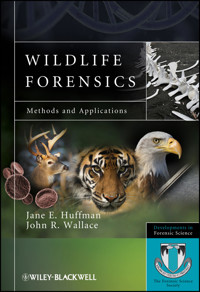
Wildlife Forensics: Methods and Applications provides an accessible and practical approach to the key areas involved in this developing subject. The book contains case studies throughout the text that take the reader from the field, to the lab analysis to the court room, giving a complete insight into the path of forensic evidence and demonstrating how current techniques can be applied to wildlife forensics. The book contains approaches that wildlife forensic investigators and laboratory technicians can employ in investigations and provides the direction and practical advice required by legal and police professionals seeking to gain the evidence needed to prosecute wildlife crimes. The book will bring together in one text various aspects of wildlife forensics, including statistics, toxicology, pathology, entomology, morphological identification, and DNA analysis. This book will be an invaluable reference and will provide investigators, laboratory technicians and students in forensic Science/conservation biology classes with practical guidance and best methods for criminal investigations applied to wildlife crime. * Includes practical techniques that wildlife forensic investigators and laboratory technicians can employ in investigations. * Includes case studies to illustrate various key methods and applications. * Brings together diverse areas of forensic science and demonstrates their application specifically to the field of wildlife crime. * Contains methodology boxes to lead readers through the processes of individual techniques. * Takes an applied approach to the subject to appeal to both students of the subject and practitioners in the field. * Includes a broad introduction to what is meant by 'wildlife crime', how to approach a crime scene and collect evidence and includes chapters dedicated to the key techniques utilized in wildlife investigations. * Includes chapters on wildlife forensic pathology; zooanthropological techniques; biological trace evidence analysis; the importance of bitemark evidence; plant and wildlife forensics; best practices and law enforcement.
Sie lesen das E-Book in den Legimi-Apps auf:
Seitenzahl: 650
Veröffentlichungsjahr: 2012
Ähnliche




















Contents
Cover
Title Page
Copyright
Dedication
Developments in Forensic Science
About the Editors
Contributors
Foreword
Acknowledgements
Chapter 1: Wildlife Ownership
Introduction
Ancient Rome and the Concept of Res Nullius
Common Law England: The King's Ownership
The New World: Hunting for the Market
Management: The Property Right of States
Federal Law and the Regulatory State
Globalization: Working toward Worldwide Conservation Practices
Conclusion
Chapter 2: Society for Wildlife Forensic Science
Introduction
Formation of the Society
The Code of Ethics
Membership of the Society
Member Labs
Proficiency Program
Scientific Working Group for Wildlife Forensic Sciences (SWGWILD)
Conclusion
Chapter 3: The Application of Forensic Science to Wildlife Evidence
Introduction
Overview of Forensic Science
History of Wildlife Forensics
Enforcement of Wildlife Protection Policy
Development of Wildlife Forensic Laboratories
Current Perceptions
Conclusion
Acknowledgements
Chapter 4: Defining a Crime Scene and Physical Evidence Collection
Introduction
Definition of a Crime Scene
Questions to Be Asked
Scene Priority
First Responding Officer
Securing the Scene
Chain of Custody
Processing the Scene
Initial Documentation
Scene Documentation
Remains in an Aquatic Environment
Collection of Evidence
Review of Scene Processing
Final Inspection
Chapter 5: Forensic Evidence Collection and Cultural Motives for Animal Harvesting
Introduction
Wild Animals as Pharmacopeias
Trade in Wild Animals
Recovering Evidence at Poaching Scenes
Locating the Burial: Anomalies on the Surface
Acknowledgements
Chapter 6: Forensic Entomology and Wildlife
Introduction
Application of Forensic Entomology to Wildlife Crimes
Arthropods Commonly Encountered
Diptera
Coleoptera
Sampling
Conclusion
Appendix
Acknowledgements
Chapter 7: Wildlife Forensic Pathology and Toxicology in Wound Analysis and Pesticide Poisoning
Introduction
Wound Analysis
Wildlife Poisoning by Insecticides
Wildlife Poisoning by Rodenticides
Chapter 8: The Use of Hair Morphology in the Identification of Mammals
Introduction
Types of Hair
Hair Structure
Techniques for Studying Hair Structure
Conclusion
Chapter 9: Plants and Wildlife Forensics
Introduction
Plants as Trace Evidence
Poisonous Plants
The Basics of Collecting and Preserving Botanical Evidence
Finding a Forensic Botanist
Conclusion
Acknowledgements
Chapter 10: Identification of Reptile Skin Products Using Scale Morphology
Introduction
International Trade in Reptile Skins
Challenges to Species Identification of Reptile Skin Products
Species and Products Represented in the Reptile Skin Trade
Reptile Scale Morphology Basics and Current Limitations
Identifying Features of Major Reptile Groups
Conclusion
Acknowledgements
Chapter 11: Best Practices in Wildlife Forensic DNA
Introduction
The Need for Appropriate Standards
Wildlife Forensic DNA Best Practices
Standards and Guidelines for Wildlife Forensics
Training
Case File
Laboratory Facility (QA)
Validation
Laboratory Protocols
Data Analysis
Interpretation Guidelines
Vouchers/Reference Samples
Species Identification
Reporting
Contents of the Case Report
Review
Court Testimony
The Way Forward
Acknowledgements
Chapter 12: Statistics for Wildlife Forensic DNA
Introduction
The Central Problem
Genetic Sampling
Lineage Markers
Relatedness
Inbreeding
Testing for Allele Independence
Assignment Testing
Conclusion
Chapter 13: Forensic DNA Analysis of Wildlife Evidence
Introduction
DNA Isolation and Handling
Polymerase Chain Reaction (PCR)
Sample Speciation
Minisatellites (VNTRs)
Mitochondrial Markers (mtDNA)
Additional Genetic Speciation Methods
Limitations of Genetic Speciation
Sample Sexing
Sample Individualization
Sample Localization
Validation of Wildlife Forensic Techniques
Court Admissibility
Conclusion
Chapter 14: DNA Applications and Implementation
Introduction
History
Questions and Techniques: Wildlife Crime Issues
Species Identification
Identification of Geographic Origin
Individual Identification
Exclusion
Practical Applications
Sample Types for DNA Analysis
Laboratory Models: Individual Facilities
Future Developments
Summary
Chapter 15: Conservation Genetics and Wildlife Forensics of Birds
Introduction
Avian Genetics
Avian Taxonomy, Legislation and Conservation
Avian Wildlife Forensics: A Range of Applications
Conservation Genetics and Wildlife Forensics: Identification Using DNA
Conclusion
Chapter 16: Wildlife Forensics in Thailand:
Introduction
DNA Extraction and Amplification
DNA Sequencing
Origin Identification
Species and Subspecies Identification
Results of the Investigations
Conclusion
Acknowledgements
Chapter 17: The Future of Wildlife Forensic Science
Introduction
Technical Challenges
Enhancing Wildlife Protection by Integrating Forensic Science and the Law
The U.S. Endangered Species Act and the Limits of Science
The Future of Forensic Scientists and the Laboratories in which They Work
Conclusion
Acknowledgments
Color Plates
Index
This edition first published 2012 © 2012 by John Wiley & Sons, Ltd
Wiley-Blackwell is an imprint of John Wiley & Sons, formed by the merger of Wiley’s global Scientific, Technical and Medical business with Blackwell Publishing.
Registered office: John Wiley & Sons, Ltd, The Atrium, Southern Gate, Chichester, West Sussex, PO19 8SQ, UK
Editorial offices: 9600 Garsington Road, Oxford, OX4 2DQ, UK The Atrium, Southern Gate, Chichester, West Sussex, PO19 8SQ, UK 111 River Street, Hoboken, NJ 07030-5774, USA
For details of our global editorial offices, for customer services and for information about how to apply for permission to reuse the copyright material in this book please see our website at www.wiley.com/wiley-blackwell.
The right of the author to be identified as the author of this work has been asserted in accordance with the UK Copyright, Designs and Patents Act 1988.
All rights reserved. No part of this publication may be reproduced, stored in a retrieval system, or transmitted, in any form or by any means, electronic, mechanical, photocopying, recording or otherwise, except as permitted by the UK Copyright, Designs and Patents Act 1988, without the prior permission of the publisher.
Designations used by companies to distinguish their products are often claimed as trademarks. All brand names and product names used in this book are trade names, service marks, trademarks or registered trademarks of their respective owners. The publisher is not associated with any product or vendor mentioned in this book. This publication is designed to provide accurate and authoritative information in regard to the subject matter covered. It is sold on the understanding that the publisher is not engaged in rendering professional services. If professional advice or other expert assistance is required, the services of a competent professional should be sought.
Library of Congress Cataloging-in-Publication Data
Huffman, Jane E. Wildlife forensics : methods and applications / Jane E. Huffman, John R. Wallace. p. cm. Includes bibliographical references and index. ISBN 978-0-470-66258-8 (cloth) – ISBN 978-0-470-66259-5 (pbk.) 1. Wildlife crime investigation. 2. Forensic sciences. 3. Wildlife crimes. I. Wallace, John R. (John Robert), 1960- II. Title. HV8079.W58H84 2011 363.25′93367–dc23 2011031523
A catalogue record for this book is available from the British Library.
This book is published in the following electronic formats: ePDF 9781119953135; Wiley Online Library 9781119953142; ePub 9781119954293; Mobi 9781119954309
First Impression 2012
This book is dedicated to all wildlife agents/investigators for their outstanding service in protecting and conserving wildlife resources. We remember those wildlife conservation officers who gave the ultimate sacrifice so that others may enjoy the beauty and bounty of wildlife.
Developments in Forensic Science
The world of forensic science is changing at a very fast pace. This is in terms of the provision of forensic science services, the development of technologies and knowledge and the interpretation of analytical and other data as it is applied within forensic practice. Practicing forensic scientists are constantly striving to deliver the very best for the judicial process and as such need a reliable and robust knowledge base within their diverse disciplines. It is hoped that this book series will be a valuable resource for forensic science practitioners in the pursuit of such knowledge.
The Forensic Science Society is the professional body for forensic practitioners in the United Kingdom. The Society was founded in 1959 and gained professional body status in 2006. The Society is committed to the development of the forensic sciences in all of its many facets and in particular to the delivery of highly professional and worthwhile publications within these disciplines through ventures such as this book series.
Dr. Niamh Nic Daéid Series editor
About the Editors
Dr. Jane Huffman, Ph.D. is the director of the Northeast Wildlife DNA Laboratory at East Stroudsburg University, where her work focuses on the application of genetic methods to wildlife law enforcement and conservation management. She runs wildlife DNA forensic training courses for conservation officers from New Jersey and Pennsylvania.
She, along with her students, has undertaken a wide range of applied research projects including the development of DNA profiling systems for game species in PA and NJ and microscopic hair characterization. The laboratory provides species identification tests for illegally sold wild meat. She provides forensic analysis and expert witness testimony in PA wildlife crime prosecutions
Dr. Huffman is also the graduate student coordinator for the Department of Biological Sciences at East Stroudsburg University.
Dr. John R. Wallace, Ph.D., D-ABFE, F-AAFS, is one of 15 board-certified forensic entomologists and a diplomate of the American Board of Forensic Entomology. Dr. Wallace is a Professor of Biology and focuses on teaching courses in Entomology, Aquatic Biology, Aquatic Entomology, Forensic Entomology, Forensic Science, and Ecology and Evolution. His research interests cover topics such as mosquito and disease ecology as well as mosquito and blackfly surveillance, and the role of aquatic organisms such as insects, algae and crayfish on decomposition within forensic science.
As a forensic entomologist, Dr. Wallace has participated in criminal investigations all over the country since 1995. He has taught forensic entomology courses at the University level and workshops at various universities to law enforcement throughout the United States, published more than 45 articles or book chapters in National/International journals. He is a Fellow of the American Academy of Forensic Science and an active member since 2002. Dr. Wallace is a co-founder and past President of the North American Forensic Entomology Association (NAFEA) in 2005 as well as the editor-elect for the NAFEA newsletter.
Contributors
Barry W. Baker, M.A. U.S. National Fish and Wildlife Forensics Laboratory, United States Fish & Wildlife Service, 1490 East Main Street, Ashland, OR 97520-1310, USA
Jason H. Byrd, Ph.D., D-ABFE, F-AAFS William R. Maples Center for Forensic Medicine, Department of Pathology, Immunology, and Laboratory Medicine, College of Medicine, University of Florida, Gainesville, FL, USA
Suchitra Changtragoon, Ph.D. Forest Genetics and Biotechnology Division, Forest and Plant Conservation Research Office, Department of National Parks, Wildlife and Plant Conservation, 61 Phaholyothin, Chatuchak, Bangkok, Thailand 10900
Elizabeth M. Erhart, Ph.D. Department of Anthropology, Texas State University-San Marcos, 601 University Drive, San Marcos, TX 78666, USA
Edgard O. Espinoza, Ph.D. U.S. National Fish and Wildlife Forensics Laboratory, United States Fish & Wildlife Service, 1490 East Main Street, Ashland, OR 97520-1310, USA
Jesica L. Espinoza, J.D. Office of Law Enforcement, United States Fish & Wildlife Service, 16507 SW Roy Rogers Road, Sherwood, OR 97140-9292, USA
Michelle D. Hamilton, Ph.D., D-ABFA Department of Anthropology, Texas State University-San Marcos, 601 University Drive, San Marcos, TX 78666, USA
Christopher R. Hardy, Ph.D. James C. Parks Herbarium, Department of Biology, Millersville University, Millersville, PA 17551, USA
DeeDee Hawk, M.S. Wyoming Game and Fish Wildlife Forensic Laboratory, Department 3312, 1000 E University Avenue, Laramie, WY 82071, USA
Jane E. Huffman, Ph.D., M.P.H. Northeast Wildlife DNA Laboratory, Department of Biological Sciences, East Stroudsburg University, East Stroudsburg, PA, 18301, USA
Rebecca N. Johnson, Ph.D. Australian Museum, Head of Research DNA Laboratory, 6 College Street, Sydney, NSW 2010, Australia
Shamus P. Keeler, M.Ed., M.S. Southeastern Cooperative Wildlife Disease Study, Department of Population Health, College of Veterinary Medicine, University of Georgia, Athens, GA 30602 Department of Infectious Diseases, College of Veterinary Medicine, University of Georgia, Athens, GA 30602, USA
Lisa Knecht, M.S. Northeast Wildlife DNA Laboratory, East Stroudsburg University, East Stroudsburg, PA 18301, USA
Irving L. Kornfield, Ph.D. Molecular Forensics Laboratory, University of Maine, Orono, ME, USA
David L. Martin, Ph.D. Canorus Ltd., 5669 Snell Ave. #297, San Jose, CA 95123,
David S. Martin James C. Parks Herbarium, Department of Biology, Millersville University, Millersville, PA 17551, USA
Sabrina N. McGraw, D.V.M., M.S. Southeastern Cooperative Wildlife Disease Study, Department of Population Health, College of Veterinary Medicine, University of Georgia, Athens, GA 30602 Department of Pathology, College of Veterinary Medicine, University of Georgia, Athens, GA 30602, USA
Michael McMaster, J.D. 20234 E Lake Cir, Centennial, CO 80016-1281, USA
M. Katherine Moore, M.S. Marine Forensics Program, Center for Coastal Environmental Health and Biomolecular Research, National Centers for Coastal Ocean Science, National Ocean Service, National Oceanic and Atmospheric Administration, 219 Fort Johnson Road, Charleston, SC 29412 USA
Robert Ogden, Ph.D. Program Director, TRACE Wildlife Forensics Network, c/o The Animal Conservation and Education Department, Royal Zoological Society of Scotland, 134 Corstorphine Road, Edinburgh EH12 6TS, UK
Douglas E. Roscoe, M.S., Ph.D. New Jersey Division of Fish and Wildlife, Office of Fish and Wildlife Health and Forensics, P.O. Box 394, Lebanon, NJ 08833, USA
Eric G. Roscoe, J.D., LL.M. 5415 Connecticut Ave. NW, Washington, DC 20015, USA
Jill C. Ross, B.S. Department of Biology, Millersville University, Millersville, PA 17551, USA
Michelle R. Sanford, Ph.D. Department of Entomology 2475 TAMU College Station, TX 77843-2475, USA
William Stansley, M.S. New Jersey Division of Fish and Wildlife, Office of Fish and Wildlife Health and Forensics, P.O. Box 394, Lebanon, NJ 08833, USA
Lerah K. Sutton, B.A. William R. Maples Center for Forensic Medicine, Department of Pathology, Immunology, and Laboratory Medicine, College of Medicine, University of Florida, Gainesville, FL, USA
Jeffery K. Tomberlin, Ph.D., D-ABFE, F-AAFS Forensic & Investigative Sciences Program, Department of Entomology, 2475 TAMU, College Station, TX 77843-2475, USA
Pepper W. Trail, Ph.D. U.S. National Fish and Wildlife Forensics Laboratory, United States Fish & Wildlife Service, 1490 East Main Street, Ashland, OR 97520-1310, USA
John R. Wallace, Ph.D., D-ABFE, F-AAFS Department of Biology, Millersville University, Millersville, PA 17551, USA
B.S. Weir, Ph.D. Department of Biostatistics, University of Washington, Seattle, WA 09195-7232, USA
Foreword
Killing wild animals is big business. While much wildlife trade is legal, a massive black market exists. The species and products involved run the gamut from tarantulas to tigers. The rarer the animal, the more people want it. As a result, wildlife trafficking targets those species already under threat and least able to withstand the losses.
Laws to protect wildlife can be found in international treaties, like the Convention on International Trade in Endangered Species (CITES), and in national legislation, such as the Lacey Act and Endangered Species Act in the United States. Yet, to be effective, those laws require enforcement.
Enforcement involves not only catching poachers and traffickers but also prosecuting and convicting them. For that, one must link a suspect to his or her crime. The problem is, when an animal is hunted down and killed, there aren't any eyewitness accounts. The victims’ relatives and neighbors can't talk. And once the victim leaves the poachers hands, it's sliced and diced and processed until it's eventually transformed into a host of consumable products – from trinkets and high fashion accessories to traditional medicines. Its identity is lost. That makes the prospects for prosecution slimmer and slimmer.
Wildlife forensics changes that. By identifying the victim and allowing the evidence to speak, it connects suspects to their illegal actions.
Wildlife forensics, like human forensics, uses science to answer a legal question. For wildlife forensic scientists, however, most of the time that legal question is to identify the victim. For wildlife crimes, figuring out what the victim is is essential to establish that a crime even took place. That's because some species are protected and others are not. For instance, a wool shawl made from cashmere goats is legal but one from Tibetan antelopes is not. Traffickers know the differences in the laws so that, when caught, they often claim that the item they smuggled is legal because it's from an unprotected species. Unless an investigator proves otherwise, the suspect goes free. That's where wildlife forensics comes in: proving the crime.
Identification of a species from a part or product is extremely complicated. For example, take an item like a feathered headdress. Normally, ornithologists have a lot to go on when they identify a bird: its size, shape, plumage pattern, geographical location, habitat, vocalizations, flight pattern, diet and other behavior. But when a forensic ornithologist receives that item in his or her lab, (s)he has just a fragment of that information to go on – often just an isolated feather.
Most birds have about 5,000 feathers. Within the same species, those feathers will vary depending on their location on the bird and whether they are from males or females, or juveniles or adults. To complicate matters, feathers from one part of the bird – like the wing or tail – might exhibit diagnostic characteristics, meaning something unique to that species, while feathers from another part of that same bird – like the chest – might not. The same thing happens with claws or teeth. A single species can display significant variation, and there may or may not be distinguishing traits for each variation.
Now, imagine you don't even know what the part is. Imagine the evidence is a tooth or tusk that's been carved, so that you no longer have the size or shape to go on. Or a rhino horn or bear gall bladder that's been ground up into a medicine. For each species, wildlife forensic scientists must find some sort of identifying characteristic. Not only that, but they have to do it for each part of each species, and they need to account for the many different ways a part might be processed or manufactured.
The complexities don't stop there. Wildlife forensic scientists have to be ready to answer new types of legal questions as they occur. Sometimes that will still mean answering the “what is it?” question but for species that are newly protected. Other times, it will mean focusing on a different question, like “where did it come from?” When trade is permitted for distinct populations of otherwise protected species, as has happened with the recent one-off sales of elephant ivory from southern African stockpiles, the ability to tell where a sample came from is critical. The “where did it come from?” question of geographic origin is also a critical question to determine whether an exotic pet was captive-bred, which typically is legal, or wild-caught, which is not. For each part of each species, and for the legal question involved, the characteristic might be different, and the method for finding them may also vary.
In my view, Wildlife Forensics: Methods and Applications will go a long way toward helping share information and advancing the field of wildlife forensic science. Every step – whether it's a new case that results in uncovering an identifying characteristic for a species’ part or a budding scientist exploring these issues – pushes the science forward. The end result will be more and more heroes able to link suspects to their crimes – and ultimately a slowdown in the extent of wildlife trafficking.
Rhinos can't call 911. Instead, law enforcement agents, and the wildlife forensic science that support them, give them a voice – one that grows stronger every day. This book will help in that vital mission.
Laurel A. Neme, Ph.D. Author, ANIMAL INVESTIGATORS: How the World's FirstWildlife Forensics Lab is Solving Crimes and Saving Endangered Species May 2011
Acknowledgements
The editors of this work would like to extend our deepest appreciation and gratitude to the contributors of this text. This book would not have been possible without the diverse experiences, professional efforts and research endeavors of those who contributed. JH would like to thank Terri Ombrello and Kim Harle for their invaluable assistance and comments, Alan Semon and Matt Guesto for logistical assistance. JW would like to thank Susan, Harrison and Max Wallace, Peg Wallace, Ann and Bob Stackpole, Ostrowski/Sikora/Sheaffer families for logistical assistance to be able to work on this book and to Laurie Goodrich (Hawk Mountain Sanctuary) and Wallace research lab for their invaluable discussions.
1
Wildlife Ownership
How the state became responsible for management
Eric G. Roscoe and Michael McMaster
Introduction
Forensic techniques that identify wildlife, and assist in linking wildlife crimes to the responsible party are invaluable to the legal community. This book has been devoted to assisting law enforcement in the identification of individuals responsible for wildlife crimes. The identification techniques provided by forensic science are even more important in the courtroom. Oftentimes law enforcement has a good idea as to who committed a crime, and simple investigative techniques will reveal the most likely suspect. However, once that suspect is identified, focus turns to providing enough admissible proof in court so that a conviction can be obtained. DNA identification has permitted attorneys to quantify facts that in the past where left up to impressions. Proof that meat found in a suspect's freezer matches with 98% certainty a carcass found in the woods removes the factual issue from the table. The judge or jury only needs to consider whether the law, as applied to the fact that the freezer meat matched the carcass, requires that the suspect be found guilty or not. There may be due process problems inherent in jurors’ willingness to accept DNA evidence as infallible without being able to properly weigh the effects of mishandled evidence or improper gathering techniques, however, that is beyond the scope this book (DeWitt, 1996).
The question of the law is separate from the factual question in the case. In criminal proceedings the prosecutor decides which law is to be applied, meaning which law has been violated. The prosecutor and, if there is a jury, the judge will explain the law that the suspect is accused of breaking, and what facts the state will prove in order to find the suspect guilty.
The purpose of this section is to address the question of law. State authorities draft most laws regulating the taking of wildlife in the US. The federal government tends to regulate broader issues that concern the transportation of wildlife across state lines as well as internationally. State and federal governmental authority to regulate the taking of wildlife is derived from a legal history stretching nearly 2,700 years. The first half of this section follows the development of wildlife regulation from the property rights of ancient Rome through the royal prerogatives of King Charles’ England to the unlimited resources of Colonial America. The second half focuses on present-day state, federal, and international regulations affecting the taking, transportation, and management of wildlife.
Ancient Rome and the Concept of Res Nullius
Ownership is a pivotal concept in understanding the Roman citizen's relationship with wildlife. Some of the earliest legal writings, dating back to the time of the Sumerians in ancient Mesopotamia, recognize the ability of humans to own or possess animals (Wise, 1996). The concept of wildlife as property allows separation between what is mine and what is yours. This is my dog, not your dog. In the legal realm, ownership is incredibly important when determining schemes of compensation. Laws based upon the economics of owning property allow compensation for damaged or stolen property (ibid.). You have killed my dog so you must give me your dog or financially compensate me. Ownership of the dog as if it were property allows the law to create a resolution to situations in which one suffers a loss. If I could not own the dog, then I would suffer a loss for which there is no compensation if the dog is killed or stolen by another.
Lesen Sie weiter in der vollständigen Ausgabe!
Lesen Sie weiter in der vollständigen Ausgabe!
Lesen Sie weiter in der vollständigen Ausgabe!
Lesen Sie weiter in der vollständigen Ausgabe!
Lesen Sie weiter in der vollständigen Ausgabe!
Lesen Sie weiter in der vollständigen Ausgabe!
Lesen Sie weiter in der vollständigen Ausgabe!
Lesen Sie weiter in der vollständigen Ausgabe!
Lesen Sie weiter in der vollständigen Ausgabe!
Lesen Sie weiter in der vollständigen Ausgabe!
Lesen Sie weiter in der vollständigen Ausgabe!
Lesen Sie weiter in der vollständigen Ausgabe!
Lesen Sie weiter in der vollständigen Ausgabe!
Lesen Sie weiter in der vollständigen Ausgabe!
Lesen Sie weiter in der vollständigen Ausgabe!
Lesen Sie weiter in der vollständigen Ausgabe!
Lesen Sie weiter in der vollständigen Ausgabe!
Lesen Sie weiter in der vollständigen Ausgabe!




