


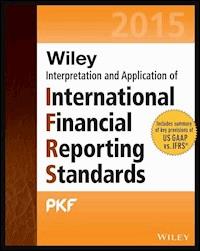
Wiley IFRS 2015 E-Book
91,99 €
Mehr erfahren.
- Herausgeber: John Wiley & Sons
- Kategorie: Fachliteratur
- Serie: Wiley Regulatory Reporting
- Sprache: Englisch
The globally-sourced guide to the latest IFRS, with practical application advice
Wiley IFRS 2015 is a complete guide to the latest International Financial Reporting Standards set forth by the International Accounting Standards Board. Written by an international team of experts in global accounting standards, this guide provides detailed information on the latest changes to the IFRS, with comprehensive coverage of IFRIC interpretations and the tools needed to maintain IFRS-compliance. Readers will find clear, concise explanations delineated by topic for easy navigation, designed for both quick reference in-depth study, with practical advice for implementing IFRS in real-life scenarios.
The goal of the IASB is to achieve global convergence of accounting standards, reducing preparation costs and facilitating the assessment of business outcomes. The IFRS are a key part of the strategy, simplifying reporting for multinational corporations and the analysts and investors tasked with evaluating results. Wiley IFRS 2015 details the most recent changes to the standards, with expert guidance toward implementation. Readers will:
- Grasp the underlying framework of the International Financial Reporting Standards
- Understand how to interpret the standards and apply them in the real world
- Follow the Disclosure Checklist to verify completeness and IFRS compliance
- Learn from the experts when implementing IFRS for the first time
More and more countries are either adopting IFRS or adapting local standards to align with those set by the IASB. The standards change annually, and failure to stay up to date can affect business strategy and outcomes, especially when working internationally. Wiley IFRS 2015 provides the latest information and expert guidance, helping practitioners match IFRS to real-world practice.
Sie lesen das E-Book in den Legimi-Apps auf:
Seitenzahl: 2282
Veröffentlichungsjahr: 2015
Ähnliche




















Contents
Cover
Half Title page
Title page
Copyright page
About the Authors
Chapter 1: Introduction to International Financial Reporting Standards
Introduction
Origins and Early History of the IASB
The Current Structure
Process of IFRS Standard Setting
Convergence: The IASB and Financial Reporting in the US
The IASB and Europe
IFRS for SMEs
Appendix A: Current International Financial Reporting Standards (IAS/IFRS) and Interpretations (SIC/IFRIC)
Appendix B: Projects Completed Since Previous Issue (October 2013 to September 2014)
Appendix C: IFRS for SMEs
Chapter 2: Conceptual Framework
Introduction
Conceptual Framework for Financial Reporting 2010
Conceptual Framework Project
Hierarchy of Standards
IFRS Practice Statement Management Commentary
US GAAP Comparison
Chapter 3: Presentation of Financial Statements
Introduction
Scope
Definitions of Terms
Financial Statements
General Features
Structure and Content
Future Developments
Illustrative Financial Statements
US GAAP Comparison
Chapter 4: Statement of Financial Position
Introduction
Scope
Definitions of Terms
General Concepts, Structure and Content
Classification of Assets
Classification of Liabilities
Classification of Shareholders’ Equity
US GAAP Comparison
Chapter 5: Statements of Profit or Loss and Other Comprehensive Income, and Changes in Equity
Introduction
Amendments Effective During 2011
Future Developments
Scope
Definitions of Terms
Concepts of Income
Recognition and Measurement
Statement of Profit or Loss and Other Comprehensive Income
Presentation in the Profit or Loss Section
Other Comprehensive Income
Statement of Changes in Equity
US GAAP Comparison
Chapter 6: Statement of Cash Flows
Introduction
Scope
Definitions of Terms
Background
Presentation
Other Requirements
Disclosure and Examples
Consolidated Statement of Cash Flows
US GAAP Comparison
Chapter 7: Accounting Policies, Changes in Accounting Estimates, and Errors
Introduction
Scope
Definitions of Terms
Importance of Comparability and Consistency in Financial Reporting
Accounting Policy
Selecting Accounting Policies
Changes in Accounting Policies
Changes in Accounting Estimates
Correction of Errors
US GAAP Comparison
Chapter 8: Inventories
Introduction
Definitions of Terms
Recognition and Measurement
Methods of Inventory Costing Under IAS 2
US GAAP Comparison
Chapter 9: Property, Plant, and Equipment
Introduction
Definitions of Terms
Recognition and Measurement
Derecognition
Noncurrent Assets Held for Sale
Disclosures
Examples of Financial Statement Disclosures
Future Developments
US GAAP Comparison
Chapter 10: Borrowing Costs
Introduction
Definitions of Terms
Recognition and Measurement
US GAAP Comparison
Chapter 11: Intangible Assets
Introduction
Scope
Definitions of Terms
Recognition and Measurement
Disclosures
Examples of Financial Statement Disclosures
Future Developments
US GAAP Comparison
Chapter 12: Investment Property
Introduction
Definitions
Identification
Recognition and Measurement
Presentation and Disclosure
Examples of Financial Statement Disclosures
US GAAP Comparison
Chapter 13: Impairment and Noncurrent Assets Held for Sale
Introduction
Definitions of Terms
Impairment
Noncurrent Assets Held for Sale
Discontinued Operations
US GAAP Comparison
Chapter 14: Consolidations, Joint Arrangements, Associates, and Separate Financial Statements
Introduction
Definitions of Terms
Consolidated Financial Statements
Joint Arrangements
Associates
Equity Method of Accounting
Separate Financial Statements
Disclosure Requirements
Transition Guidance
Future Developments
US GAAP Comparison
Chapter 15: Business Combinations
Introduction
Definitions of Terms
Business Combinations and Consolidations
Business Combinations
Disclosure Requirements
US GAAP Comparison
Chapter 16: Shareholders’ Equity
Introduction
Definitions of Terms
Recognition and Measurement
Presentation and Disclosure
Classification Between Liabilities and Equity
Share Issuances and Related Matters
Examples of Financial Statement Disclosures
Comparison with US GAAP
Chapter 17: Share-Based Payment
Introduction
Scope
Definitions of Terms
Overview
Recognition and Measurement
Equity-Settled Share-Based Payments
Cash-Settled Share-Based Payments
Share-Based Payment Transactions with Cash Alternatives
Share-Based Transactions Among Group Entities
Disclosure
Examples of Financial Statement Disclosures
Future Developments
US GAAP Comparison
Appendix: Employee Share Options Valuation Example
Chapter 18: Current Liabilities, Provisions, Contingencies, and Events After the Reporting Period
Introduction
Definitions of Terms
Recognition and Measurement
Disclosures
Practical Examples
Reporting Events Occurring After the Reporting Period
Future Developments
US GAAP Comparison
Chapter 19: Employee Benefits
Introduction
Definitions of Terms
Background
Basic Principles of IAS 19
Postemployment Benefit Plans
Employer’s Liability and Assets
Minimum Funding Requirement
Other Pension Considerations
Disclosures for Postemployment Benefit Plans
Other Employee Benefits
Future Developments
US GAAP Comparison
Chapter 20: Revenue Recognition, Including Construction Contracts
Revenue Recognition
Introduction
Definitions of Terms
Scope
Identification
Measurement
Recognition
Specific Transactions
Example of Financial Statement Disclosures
Construction Contract Accounting
Introduction
Definitions of Terms
Recognition and Measurement
Disclosure
Examples of Financial Statement Disclosures
Future Developments
US GAAP Comparison
Chapter 21: Government Grants
Introduction
Scope
Definitions of Terms
Recognition of Government Grants
Presentation and Disclosure
Other Issues
Service Concessions
US GAAP Comparison
Chapter 22: Leases
Introduction
Definitions of Terms
Classification of Leases
Recognition and Measurement
Disclosure Requirements Under IAS 17
Future Developments
US GAAP Comparison
Appendix A: Special Situations Not Addressed By IAS 17 But Which Have Been Interpreted Under US GAAP
Appendix B: Leveraged Leases Under US GAAP
Chapter 23: Foreign Currency
Introduction
Definitions of Terms
Scope, Objectives, and Discussion of Definitions
Foreign Currency Transactions
Translation of Foreign Currency Financial Statements
Guidance Applicable to Special Situations
Disclosure
Hedging
Examples of Financial Statement Disclosures
US GAAP Comparison
Chapter 24: Financial Instruments
Introduction
Future Developments and a Summary of IFRS 9
Definitions of Terms
Discussion of Certain Concepts
IAS 32: Financial Instruments—Presentation
IAS 39: Financial Instruments—Recognition and Measurement
Disclosure
Disclosures on Offsetting Financial Assets and Financial Liabilities
Financial Assets to Offsetting, Enforceable Master Netting Arrangements and Similar Agreements
Financial Liabilities Subject to Offsetting, Enforceable Master Netting Arrangements and Similar Agreements
Financial Assets Subject to Offsetting, Enforceable Master Netting Arrangements and Similar Agreements
Net Financial Assets Subject to Enforceable Master Netting Arrangements and Similar Agreements, By Counterparty
US GAAP Comparison
Chapter 25: Fair Value
Introduction
Scope
Definitions of Terms
Fair Value Measurement Principles and Methodologies
Fair Value Disclosure
Education Material
Future Developments
US GAAP Comparison
Chapter 26: Income Taxes
Introduction
Scope
Definitions of Terms
Identification
Recognition and Measurement of Current Tax
Recognition and Measurement of Deferred Tax
Recognition in Profit or Loss
Calculation of Deferred Tax Asset or Liability
Effect of Changed Circumstances
Specific Transactions
Presentation and Disclosure
Examples of Financial Statement Disclosures
US GAAP Comparison
Chapter 27: Earnings Per Share
Introduction
Scope
Definitions of Terms
Concepts, Rules, and Examples
Examples of Financial Statement Disclosures
US GAAP Comparison
Chapter 28: Operating Segments
Introduction
Scope
Definitions of Terms
Identification
Concepts and Requirements Under IFRS 8
Disclosure Requirements
Example of Financial Statement Disclosures Under IFRS 8
New Developments
US GAAP Comparison
Chapter 29: Related-Party Disclosures
Introduction
Definitions of Terms
Identification
Disclosures
Examples of Financial Statement Disclosures
US GAAP Comparison
Chapter 30: Accounting and Reporting by Retirement Benefit Plans
Introduction
Definitions of Terms
Scope
Defined Contribution Plans
Defined Benefit Plans
Disclosures
US GAAP Comparison
Chapter 31: Agriculture
Introduction
Scope
Definitions of Terms
Identification
Recognition and Measurement
Presentation and Disclosures
Examples of Financial Statement Disclosures
Other Issues
Future Development
US GAAP Comparison
Chapter 32: Extractive Industries
Introduction
Definitions of Terms
Exploration and Evaluation of Mineral Resources
Example of Financial Statement Disclosures
Future Developments
US GAAP Comparison
Chapter 33: Accounting for Insurance Contracts
Introduction
Definitions of Terms
Insurance Contracts
Recognition and Measurement Guidance
Disclosure
Future Developments
US GAAP Comparison
Chapter 34: Interim Financial Reporting
Introduction
Definitions of Terms
Alternative Concepts of Interim Reporting
Objectives of Interim Financial Reporting
Application of Accounting Policies
Presentation
Recognition Issues
US GAAP Comparison
Chapter 35: Inflation and Hyperinflation
Introduction
Definitions of Terms
Recognition and Measurement
Financial Reporting in Hyperinflationary Economies
US GAAP Comparison
Appendix: Monetary vs. Nonmonetary Items
Chapter 36: First-Time Adoption of International Financial Reporting Standards
Introduction
Definitions of Terms
First-Time Adoption Guidance
Optional Exemptions
Presentation and Disclosure
Index
2015 Interpretation and Application of International Financial Reporting Standards
BECOME A SUBSCRIBER!Did you purchase this product from a bookstore?
If you did, it’s important for you to become a subscriber. John Wiley & Sons, Inc. may publish, on a periodic basis, supplements and new editions to reflect the latest changes in the subject matter that you need to know in order to stay competitive in this ever-changing industry. By contacting the Wiley office nearest you, you’ll receive any current update at no additional charge. In addition, you’ll receive future updates and revised or related volumes on a 30-day examination review.
If you purchased this product directly from John Wiley & Sons, Inc., we have already recorded your subscription for this update service.
To become a subscriber, please call 1-877-762-2974 or send your name, company name (if applicable), address, and the title of the product to:
mailing address:
Supplement DepartmentJohn Wiley & Sons, Inc.One Wiley DriveSomerset, NJ 08875
e-mail:
fax:
1-732-302-2300
online:
www.wiley.com
For customers outside the United States, please contact the Wiley office nearest you:
Professional & Reference Division John Wiley & Sons Canada, Ltd. 22 Worcester Road Etobicoke, Ontario M9W 1L1 CANADA Phone: 416-236-4433 Phone: 1-800-567-4797 Fax: 416-236-4447 E-mail: [email protected]
John Wiley & Sons Australia, Ltd. 33 Park Road P.O. Box 1226 Milton, Queensland 4064 AUSTRALIA Phone: 61-7-3859-9755 Fax: 61-7-3859-9715 E-mail: [email protected]
John Wiley & Sons, Ltd. The Atrium Southern Gate, Chichester West Sussex, P019 8SQ ENGLAND Phone: 44-1243-779777 Fax: 44-1243-775878 E-mail: [email protected]
John Wiley & Sons (Asia) Pte. Ltd. 2 Clementi Loop #02-01 SINGAPORE 129809 Phone: 65-64632400 Fax: 65-64634604/5/6 Customer Service: 65-64604280 E-mail: [email protected]
Copyright © 2015 by John Wiley & Sons, Inc. All rights reserved.
Published by John Wiley & Sons, Inc., Hoboken, New Jersey.
Published simultaneously in Canada.
No part of this publication may be reproduced, stored in a retrieval system, or transmitted in any form or by any means, electronic, mechanical, photocopying, recording, scanning, or otherwise, except as permitted under Section 107 or 108 of the 1976 United States Copyright Act, without either the prior written permission of the Publisher, or authorization through payment of the appropriate per-copy fee to the Copyright Clearance Center, 222 Rosewood Drive, Danvers, MA 01923, (978)750-8400, fax (978)646-8600, or on the Web at www.copyright.com. Requests to the Publisher for permission should be addressed to the Permissions Department, John Wiley & Sons, Inc., 111 River Street, Hoboken, NJ 07030, (201)748-6011, fax (201)748-6008, or online at http://www.wiley.com/go/permission.
Limit of Liability/Disclaimer of Warranty: While the publisher and author have used their best efforts in preparing this book, they make no representations or warranties with respect to the accuracy or completeness of the contents of this book and specifically disclaim any implied warranties of merchantability or fitness for a particular purpose. No warranty may be created or extended by sales representatives or written sales materials. The advice and strategies contained herein may not be suitable for your situation. You should consult with a professional where appropriate. Neither the publisher nor author shall be liable for any loss of profit or any other commercial damages, including but not limited to special, incidental, consequential, or other damages.
For general information on our other products and services, please contact our Customer Care Department within the United States at 800-762-2974, outside the United States at 317-572-3993 or fax 317-572-4002.
Wiley also publishes its books in a variety of electronic formats. Some content that appears in print may not be available in electronic books. For more information about Wiley products, visit our website at www.wiley.com.
ISBN: 978-1-118-88955-8 (pbk); ISBN: 978-1-118-88953-4 (ebk); ISBN: 978-1-118-88952-7 (ebk); ISBN: 978-1-118-88954-1 (ebk);
Trademarks: Wiley and the Wiley Publishing logo are trademarks of John Wiley and Sons, Inc. and/or its affiliates in the United States and/or other countries, and may not be used without written permission. IFRS is a registered trademark of The International Accounting Standards Board. All other trademarks are the property of their respective owners. Wiley Publishing, Inc. is not associated with any product or vendor mentioned in this book.
ABOUT THE AUTHORS
Asif Chaudhry, FCCA, CPA (K), MBA, is an audit and technical partner at PKF Kenya and is on the Kenyan Institute’s Professional Standards Committee. He has 17 years of experience including 8 years with Deloitte LLP, London. He was assisted by fellow partners Darshan Shah, Salim Alibhai and Patrick Kuria.
Craig Fuller, CA (SA), is a technical manager at PKF International Ltd and serves on PKFI’s International Professional Standards Committee. He qualified at PKF Durban before moving to the technical division of PKF (UK) LLP.
Danie Coetsee, CA (SA), is Professor of Accounting at the University of Johannesburg, specializing in financial accounting.
Edward Rands, FCA, is the Risk and Professional Standards partner at PKF Cooper Parry. He leads the firm’s technical team, which is responsible for maintaining and updating accounting knowledge and for dealing with complex problems and queries as they arise.
Erwin Bakker, RA, is an audit partner, responsible for national and international audits. He serves as chairman of the IFRS working group of PKF Wallast and is a member of the Technical Bureau of PKF Wallast in the Netherlands.
Nees de Vos, RA (NL), is an auditor at PKF Wallast in the Netherlands. He has worked as an audit manager at PwC where he has gained eight years’ public practice experience on audits for large listed companies and large privately owned groups. At PKF Wallast he is responsible for (IFRS) audits and (IFRS) accounting advisory.
Santosh Varughese, CA (Germany), Tax Advisor (Germany), CPA (US), is one of the partners at PKF Germany (www.pkf.de). He is the head of the IFRS Center of Excellence of PKF in Germany. One of his operative focuses is on audits for large listed companies.
Stephen Longmore, FCCA, is an audit senior manager and IFRS specialist at PKF Cooper Parry. He has led a number of local GAAP to IFRS conversions and previously worked as an audit manager for KPMG.
Stephen McIlwaine, ACA (Chartered Accountants Ireland) is a senior audit manager with Johnston Carmichael LLP (PKF member firm in Scotland). As well as being responsible for the provision of audit, accountancy and advisory services to clients across a range of sectors, he is also a member of the firm’s financial reporting technical team, responsible for providing guidance and training on current financial reporting issues across the firm, with a focus on IFRS.
T V Balasubramanian, FCA, CFE, CFIP, is a partner in PKF Sridhar & Santhanam, Chartered Accountants, India and previously served as a member of the Auditing and Assurance Standards Board of the ICAI, India.
Chapter 1
INTRODUCTION TO INTERNATIONAL FINANCIAL REPORTING STANDARDS
Introduction
Origins and Early History of the IASB
The Current Structure
Process of IFRS Standard Setting
Convergence: The IASB and Financial Reporting in the US
The IASB and Europe
IFRS for SMEs
Appendix A: Current International Financial Reporting Standards (IAS/IFRS) and Interpretations (SIC/IFRIC)
Appendix B: Projects Completed the Previous Year
Appendix C: IFRS for SMEs
INTRODUCTION
The stated goal of the IFRS Foundation and the International Accounting Standards Board (IASB) is to develop, in the public interest, a single set of high-quality, understandable, enforceable and globally accepted financial reporting standards based upon clearly articulated principles.
There were once scores of unique sets of financial reporting standards among the more developed nations (“national GAAP”). The year 2005 marked the beginning of a new era in global conduct of business, and the fulfillment of a thirty-year effort to create the financial reporting rules for a worldwide capital market. For during that year’s financial reporting cycle, the 27 European Union (EU) member states, plus many others in countries such as Australia, New Zealand, Russia, and South Africa adopted International Financial Reporting Standards (IFRS).
Since then, many countries, such as Argentina, Brazil, Korea, Canada, Mexico, and Russia have adopted IFRS. China has substantially converted its national standards in line with IFRS. All other major economies, such as Japan and the United States, have established time lines to converge with or adopt IFRS in the near future.
2007 and 2008 proved to be watershed years for the growing acceptability of IFRS. In 2007, one of the most important developments was that the SEC dropped the reconciliation (to US GAAP) requirement that had formerly applied to foreign private registrants; thereafter, those reporting in a manner fully compliant with IFRS (i.e., without any exceptions to the complete set of standards imposed by IASB) do not have to reconcile net income and shareholders’ equity to that which would have been presented under US GAAP. In effect, the US SEC was acknowledging that IFRS was fully acceptable as a basis for accurate, transparent, meaningful financial reporting.
This easing of US registration requirements for foreign companies seeking to enjoy the benefits of listing their equity or debt securities in the US led, quite naturally, to a call by domestic companies to permit them to also freely choose between financial reporting under US GAAP and IFRS. By late 2008 the SEC appeared to have begun the process of acquiescence, first for the largest companies in those industries having (worldwide) the preponderance of IFRS adopters, and later for all publicly held companies. However, a new SEC chair took office in 2009, expressing a concern that the move to IFRS, if it were to occur, should perhaps move more slowly than had previously been indicated.
It had been highly probable that nonpublicly held US entities would have remained bound to only US GAAP for the foreseeable future, both from habit and because no other set of standards would be viewed as being acceptable. However, the body that oversees the private-sector auditing profession’s standards in the US amended its rules in 2008 to fully recognize IASB as an accounting standard-setting body (giving it equal status with the FASB), meaning that auditors and other service providers in the US could now issue opinions (or provide other levels of assurance, as specified under pertinent guidelines) on IFRS-based financial statements. This change, coupled with the promulgation by IASB of a long-sought standard providing simplified financial reporting rules for privately held entities (described later in this chapter), has probably increased the likelihood that a broad-based move to IFRS will occur in the US within the next several years.
The impetus for the convergence of historically disparate financial reporting standards has been, in the main, to facilitate the free flow of capital so that, for example, investors in the United States will become more willing to finance business in, say, China or the Czech Republic. Having access to financial statements that are written in the same “language” would eliminate what has historically been a major impediment to engendering investor confidence, which is sometimes referred to as “accounting risk,” which adds to the already existing risks of making such cross-border investments. Additionally, the permission to list a company’s equity or debt securities on an exchange has generally been conditional on making filings with national regulatory authorities, which have historically insisted either on conformity with local GAAP or on a formal reconciliation to local GAAP. Since either of these procedures was tedious and time-consuming, and the human resources and technical knowledge to do so were not always widely available, many otherwise anxious would-be registrants forwent the opportunity to broaden their investor bases and potentially lower their costs of capital.
Lesen Sie weiter in der vollständigen Ausgabe!
Lesen Sie weiter in der vollständigen Ausgabe!
Lesen Sie weiter in der vollständigen Ausgabe!
Lesen Sie weiter in der vollständigen Ausgabe!
Lesen Sie weiter in der vollständigen Ausgabe!
Lesen Sie weiter in der vollständigen Ausgabe!
Lesen Sie weiter in der vollständigen Ausgabe!
Lesen Sie weiter in der vollständigen Ausgabe!
Lesen Sie weiter in der vollständigen Ausgabe!
Lesen Sie weiter in der vollständigen Ausgabe!
Lesen Sie weiter in der vollständigen Ausgabe!
Lesen Sie weiter in der vollständigen Ausgabe!
Lesen Sie weiter in der vollständigen Ausgabe!
Lesen Sie weiter in der vollständigen Ausgabe!
Lesen Sie weiter in der vollständigen Ausgabe!
Lesen Sie weiter in der vollständigen Ausgabe!
Lesen Sie weiter in der vollständigen Ausgabe!
Lesen Sie weiter in der vollständigen Ausgabe!
Lesen Sie weiter in der vollständigen Ausgabe!
Lesen Sie weiter in der vollständigen Ausgabe!
Lesen Sie weiter in der vollständigen Ausgabe!
Lesen Sie weiter in der vollständigen Ausgabe!
Lesen Sie weiter in der vollständigen Ausgabe!
Lesen Sie weiter in der vollständigen Ausgabe!
Lesen Sie weiter in der vollständigen Ausgabe!
Lesen Sie weiter in der vollständigen Ausgabe!
Lesen Sie weiter in der vollständigen Ausgabe!
Lesen Sie weiter in der vollständigen Ausgabe!
Lesen Sie weiter in der vollständigen Ausgabe!
Lesen Sie weiter in der vollständigen Ausgabe!
Lesen Sie weiter in der vollständigen Ausgabe!
Lesen Sie weiter in der vollständigen Ausgabe!
Lesen Sie weiter in der vollständigen Ausgabe!
Lesen Sie weiter in der vollständigen Ausgabe!
Lesen Sie weiter in der vollständigen Ausgabe!
Lesen Sie weiter in der vollständigen Ausgabe!
Lesen Sie weiter in der vollständigen Ausgabe!




