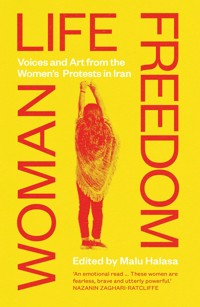
WOMAN
LIFE
FREEDOM
Voices and Art from the
Women’s Protests in Iran
Edited by Malu Halasa
Contents
Introduction
iv
1.
The Girl of Revolution Avenue
1
Anonymous
2.
Queering of a Revolution
6
Alexander Cyrus Poulikakos
3.
The Smarties
10
Shiva Khademi
4.
‘Jin Jîyan Azadî’: The Kurdish Heart of Iran’s Female-led Uprising
24
Kamin Mohammadi
5.
Braving Tehran’s Roundabout, Maidan Valiasr
31
Farnaz Haeri
6.
Rebel Rebel
34
Soheila Sokhanvari
7.
In Her Voice, We Are All Together
48
Niloofar Rasooli
8.
Seven Winters in Tehran
52
Steffi Niederzoll
9.
High Fashion
60
Tahmineh Monzavi
10.
Big Laleh, Little Laleh
66
Shokouh Moghimi
11.
Revolution of the Anonymous
76
Alexander Cyrus Poulikakos and
Niloofar Rasooli
12.
A Revolution Made by Art
84
Pamela Karimi
13.
Graffiti Stencils
100
Khiaban Tribune
14.
‘Fighting VPN Criminalisation Should Be Big Tech’s Top Priority’,
Activists Say
112
Ashley Belanger
15.
Graphic Designers Take Action
124
Iranian Women of Graphic Design
16.
Protest Music in Iran
146
Clive Bell
17.
Keeping the Revolution Alive
154
Roshi Rouzbehani
18.
Be Our Voice
160
Fari Bradley
19.
California Dreaming
164
Marzieh Saffarian
20.
A Beautiful, Tragic Rosette
166
Milad Ahmadi
21.
Don’t Be a Stooge for the Regime
170
Malu Halasa
22.
Drawing the News
182
Mana Neyestani
23.
The One Who Must Walk on Foot
196
Habibe Jafarian
24.
Fragmentation
200
Tasalla
Tabasom
25.
On the Pain of Others, Once Again
204
Sara Mokhavat
26.
Lessons from My Grandmother
207
Vida Zarkeshan
27.
The Last Days
210
Hengameh Golestan
28.
A Changing Dreamscape
218
Mehri Rahimzadeh
29.
In the Time of Eros
228
Vali Mahlouji
30.
Hoor-al-Azim
236
Maryam Haidari
31.
From Hair to Hugs,
Times Are Changing
239
Anonymous
About the Contributors, Translators and Editors
242
Credits
250
Acknowledgements
252
Index
253
IV
Introduction
On 13 September 2022, twenty-two-year-old Jina Mahsa Amini was
detained outside a metro station in Tehran by Iran’s Morality Police.
Despite her attire – a headscarf and robe – she was accused of
breaking the law, which requires women to cover their hair with a
hijab and their arms and legs with loose clothing. The young Kurdish-
Iranian was beaten inside a police van. Three days later, she died in
hospital. The authorities blamed her death on a heart attack, even
though hospital sources said her wounds were indicative of a brain
injury sustained as a result of trauma to the head.
The murky circumstances of her death reverberated with
ordinary Iranian women, who have been no strangers to the
tactics and threats of the
Gasht-e ershad
, the Morality Police,
also known as the Guidance Patrol. This 7,000-strong national
police force began issuing more warnings, fines and arrests after
hard-line president Ebrahim Raisi introduced a new ‘chastity and
hijab’ law in the summer, months before Jina was stopped. Now in
cities across Iran, CCTV surveillance cameras regularly identify
women ‘improperly’ dressed. Government offices and banks
deny entrance to these women. When the protests started,
not wearing a hijab on social media meant the ‘guilty’ faced a
mandatory prison sentence.
After Jina’s funeral, protests led by women spread to 139
cities in all of Iran’s thirty-one provinces. Videos on social media
showed women in the streets with their hair uncovered and, in
some cases, burning headscarves or cutting their own long hair
– traditionally a sign of mourning or to voice dissent. Men joined
the demonstrations. There was footage on Twitter and Instagram
of spontaneous night protests where people danced around
makeshift fires. The most popular anti-government chant – ‘
Zan,
Zendegi,
Azadi
’ in Persian, or in Kurdish ‘
Jin,
Jîyan,
Azadî
’, ‘Woman,
Life, Freedom’ – echoed in the mass uprising. However, the
movement quickly changed from one demanding women’s rights to
one demanding regime change. A nascent revolution was born.
V
VI
VII
VIII
roundabout. Forthright members of Iran’s Gen Z – ‘The Smarties’
– with their dyed hair and rejection of headscarves as early as
2019, stare out of portraits by the photographer Shiva Khademi.
Although the mandatory hijab is symbolic to the regime, the
revolution is much bigger than a piece of cloth. It is a fight for
the rights of women, men and children as well as the different
communities in the country. Alongside the Baha’i, the Arabs,
Baluch and Azeri, the Kurds are another discriminated minority
in Iran. The Iranian-Kurdish journalist Kamin Mohammadi
writes about Jina’s Kurdish identity and the importance of
their community in the women’s protests. The range of themes
in this collection shows the intersectional violence at play,
whether directed against the human body, queerness, clothing,
environment, diaspora, media and technology.
Just as social media has played an important part in
disseminating news and images, art’s role in this historic moment
has been indispensable. It has sustained the uprising in the public
eye and given it continued energy and potency. The centrality of
art is discussed in an interview with Dr Pamela Karimi, a historian
of art, architecture and visual culture of the modern Middle East.
She also makes telling observations on other pertinent topics,
such as feminism, the Western gaze and the positions artists have
long held within Iranian society.
Life in Iran has always elicited a strong reaction in the Iranian
diaspora. Since Roshi Rouzbehani left her country eleven years
ago, she has been a vocal advocate of Iranian women’s rights in
her editorial illustrations for
The
Guardian
and
The
New Yorker
.
The protest art featured in the anthology draws on traditional
iconography from calligraphy and tapestry to cutting-edge digital
illustration. The selection, curated by Emilia Sandoghdar, includes
established artists collected by the British Museum and the
Victoria and Albert Museum, alongside lesser-known artists, who
are equally passionate.
Just as the photographs taped onto city walls during the 1979
Islamic Revolution were an important way of conveying news of
the anti-Shah protests that rocked the country, so today graffiti
also spreads the word. Despite real threats to their lives, street
artists go out and brave government surveillance cameras and facial
IX
recognition technology to spray-paint the streets. The collective
Khiaban Tribune follows their efforts and dodges the same cameras
as this socialist youth group photograph and document graffiti in
Tehran.
The regime’s manipulation of technology has had real and
dangerous ramifications for dissent inside the country. When the
government closes the internet down and activities inside the
country are no longer visible to the rest of the world, people are
arrested or, worse yet, killed. In ‘“Fighting VPN Criminalisation
Should Be Big Tech’s Top Priority”, Activists Say’, Ashley Belanger
provides a full picture of the resistance by ordinary people behind
their computer screens in Iran, aided by tech-savvy activists
elsewhere.
Today, media outlets beyond Tehran’s control, from websites
to satellite channels and dissident radio stations, deliver unfiltered
news and views to millions of Iranians at home. News can be
transmitted in other ways too. For the book, the editorial cartoons
of Mana Neyestani provide a potted history of the women’s
←
The death of Jina Mahsa
Amini in ‘Morality Patrol’
custody in Tehran sparked
a wave of grief and anger
across the country and in
cyberspace. Protests in the
immediate aftermath were
attended by a cross-section
of society and by women and
girls taking a stand against
the state’s misogynistic
social prescriptions by
removing and burning their
hijabs in public. Mana
Neyestani, ‘Mahsa’s Legacy’,
IranWire
, 19 September 2022.
X
protests since Jina’s murder. When Neyestani was living in Iran,
the authorities told the cartoonist that it would be better if he
concentrated on drawing for children. A conversation he drew
between a cockroach and a child landed him in jail. He fled the
country as soon as he was able to.
To understand Iran’s present, one must be cognisant of its
past. The artist Soheila Sokhanvari’s portraits of the country’s
pre-revolutionary feminist icons give an indication of what women
lost (and what they were blamed for), once the new Islamic
Republic of Iran seized power. Those women, cultural movers and
shakers of their time – film stars, musicians, dancers and poets
– were left to fend for themselves. By contrast, Niloofar Rasooli’s
essay about the death of protestor Ghazaleh Chalabi, ‘In Her Voice,
We Are All Together’, demonstrates the power of today’s collective
action.
A Q&A with Steffi Niederzoll, the director of the documentary,
Seven Winters in Tehran
, reveals the shocking legal status of women
in that religious society. Reyhaneh Jabbari was executed for the
murder of a man who attempted to rape her. In addition to women
protecting themselves or walking unencumbered and unveiled in
public, other seemingly innocuous global activities that thousands
do every day have also been outlawed by Iran’s Shi’a clergy. Women
there have long lived bifurcated lives, one public, the other private.
In ‘High Fashion’, for instance, photographer Tahmineh Monzavi
documents illegal, clandestine runway shows in Tehran.
International luxury fashion has also shed light on injustice
in Iran. Milad Ahmadi paid homage to those killed during the
demonstrations by writing their names on a rosette, designed
by Amir Taghi and worn by actress Sepideh Moafi on the red
carpet of the 2023 Golden Globes Awards. Marzieh Saffarian’s
pop art collages, available on clothing and in prints sold by Urban
Outfitters, propose a sunnier future for Iranian women.
For music critic Clive Bell, inspirational music like ‘Baraye’
by Shervin Hajipour – performed the world over, even in the
White House – has provided the soundtrack of dissent. Radio
broadcaster and sound artist Fari Bradley became a full-time
activist after she received a phone call from Iran, with the
instruction: ‘Be our voice’.
XI
The experiences of queer artist Tasalla Tabasom growing up
in Tehran were multi-faceted and divided, as she reveals in her
essay ‘Fragmentation’, about her art of the human body. However,
for some, the pressure of living in the country was too much to
bear. In her memoir piece, the poet Shokouh Moghimi writes about
her sister’s suicide and madness in ‘Big Laleh, Little Laleh’. These
women and others don’t want our pity. Iran’s foremost nonfiction
essayist Habibe Jafarian describes the resilience of her mother
in ‘The One Who Must Walk on Foot.’ It is a difficult path to follow,
confirms filmmaker Sara Mokhavat in her essay, ‘On the Pain of
Others, Once Again’.
Sometimes in a religiously conservative society, it is traditional
women who upend their families for the sake of the daughters they
love and want to educate. Vida Zarkeshan recalls the hard-won
lessons of her grandmother passed down through the female
generations of their family. Meanwhile the doyenne of Iranian
photography, Hengameh Golestan, captures the strength and
outrage of the first women who demonstrated en masse against
compulsory veiling in 1979, after the Islamists came to power.
In Golestan’s black and white imagery, the women are rightfully
resentful. They had fought against the Shah and lost even more
freedoms under the mullahs. A year later, Golestan went to the
Ministry of Islamic Guidance to apply for a permit to cover the
Iran–Iraq War (1980–1988). Officials told her the frontline was
no place for a woman. They said she should stay home and make
‘pickles and jams’ for the men at the front.
As society decays, ecology also falls victim to ideology. Maryam
Haidari tells of the environmental degradation of the traditional
wetlands named Hoor-al-Azim, which have meant so much to
her Iranian-Arab
family
from Khuzestan
.
Under circumstances
like these, the imagination becomes a place of both refuge and
defiance. The photographs in the series ‘A Changing Dreamscape’
reveal Mehri Rahimzadeh as one of the most intriguing
photographers of her day. She also pushes the boundaries in her
commercial work, all shot in Iran, with magazine covers showing
pregnancy tests and women’s hair.
It is against this varied, surprising, remarkable backdrop that
the women’s revolution has taken place. Vali Mahlouji’s essay ‘In the
XII
Time of Eros’ examines how totalitarian states curtail and control
the human body. Simple ancient arts, such as dancing, singing,
even a brief kiss in the street, which dare to envision a different
way of life, have perhaps already defeated the mighty Islamic state.
Another letter from the anonymous writer who opens the book
closes it with the thought that, hope against hope, there might be
no going back.
Homecoming
A friend of mine recently returned from Iran. He had been visiting
his family in one of the smaller cities. Around the dining room
table, his brother talked about the traffic surveillance cameras and
the drivers who transport unveiled women in their cars. First, a
warning comes via the car owner’s mobile phone. The second time,
a fine is threatened. The third time, you could end up in court, with
the car confiscated. He and his wife, the parents of three girls,
expressed concerns about sending their daughters back to school
after the Nowruz break for Persian New Year. Too many schoolgirls
had been poisoned.
My friend told me he worried about ‘the future of smart girls
in a country like Iran.’ He said he took his nine-year-old niece into
the city for a day out. She was testing a pen he wanted to buy her
in a stationery shop. He watched her write three words on a pad of
paper: ‘Woman, Life, Freedom’.
She looked up at him and said, ‘I want everyone to see this.’
Malu Halasa
London, May 2023
1
The Girl of
Revolution Avenue
Letter from Tehran
Anonymous
Dearest __________,
In the heart of Tehran, on Revolution Avenue and a stone’s throw
from the University of Tehran, there is an electricity substation
that found itself suddenly in the spotlight almost exactly five years
ago. This box has a lot to do with the upheavals that have beset
Iran in recent months. On 27 December 2017, a young woman
named Vida Movahed climbed up the large grey gadget, took off
her white hijab, stuck it on a wooden stick and waved it in the air as
a sign of protest. She drew an immediate crowd, and in under ten
minutes was arrested by security officers and taken away.
Movahed came to be known as the Girl of Revolution Avenue.
She was subsequently sentenced in court to a year’s imprisonment
for her act of defiance. A few days after her arrest, workers from
the national power company were sent to solder a triangular
metal piece on top of the rectangular box so that no other woman
would be tempted to climb up there and become the next Girl of
Revolution Avenue. It was a superficial solution to a deep socio-
political divide within the country.
Five years on, if you were to stand at the counter inside the
France Pastry Shop, one of Tehran’s oldest cafés, and look outside
at the substation that Movahed climbed up, the very first thing
you’d notice is that a significant number of women who pass by are
not wearing the hijab.
2
By now, the world knows the story of Mahsa Amini whose
death, following her arrest by the Morality Police in September
2022, impelled the youth of Iran to take to the streets, catching
the entire country off guard. In the subsequent months, much
has been written and said – especially outside Iran – about a
momentous reckoning taking place in the life of the Islamic
Republic. There is an element of wishful thinking here (as often
happens with regard to Iran), but there is also a good deal of
truth. Iran is a complicated nation, and people in Tehran joke that
every six months this sprawling plateau of so many identities and
languages transforms into a different country altogether.
And yet the Islamic Republic endures.
The change which has occurred in recent months is certainly
acute. Walking through the capital will reveal that a significant
portion of the female population willingly continues to wear the
hijab and does so insistently. However, a visible number of women
also walk the streets with their heads entirely uncovered. This
shift is unprecedented in the life of the Islamic Republic. Women
with a variety of hairstyles and colours go about their business
boldly, without revealing, at least on the surface, any fear of the
security forces occupying the corners of the major thoroughfares.
The Woman, Life, Freedom movement that evolved following
Amini’s death, and the appearance of women on the streets of Iran
not wearing the hijab, is not unlike a sprint relay, with the baton
first passed on the day Movahed climbed the substation. A lot of
women whose basic motto is now ‘a normal life’ do not necessarily
know what happened on Revolution Avenue five years ago – and
how fateful it turned out to be. The same goes for the young men
who go out of their way to show solidarity by waving victory signs
and smiling widely at the women who refuse to cover their heads.
In the busy Haft-e (‘Seventh’) Tir Square in the heart of the city,
a young woman not wearing the hijab articulates her view, saying:
‘I want to dress freely. My mother hardly ever removes her hijab,
but I’m not my mother. Respect for difference and diversity is what
makes life beautiful.’
And yet, on the other side of the equation, the Islamic Republic
has considered the hijab a red line, and an ideological foundation,
for the last forty years. Many within the regime consider losing
3
this fight synonymous with surrendering, and surrender has never
been part of the Islamic Republic’s playbook. But what to do when
so many young women in towns large and small across Iran are
rejecting the hijab? One strategic option – the one that the regime
seems to have adopted for the time being – is to do nothing.
This has led to scenes that would have been unimaginable in this
country half a year ago: young women (but not only the young)
passing directly in front of security police, who make no effort
to arrest them. And while in Friday prayers, and other platforms
connected to conservative factions, the cry for a harsh crackdown
continues unabated, the highest echelons of power appear to be
tacitly endorsing the maxim ‘live and let live’.
Young women and men of school and university age are the
flagbearers of the movement and paid a heavy toll during the
earlier street confrontations with the security forces. More
recently, prison terms and a handful of summary executions (not
to mention the winter chill) have brought a hiatus, for now, to the
streets of Tehran and other cities.
1
While the streets are quiet, the youth are still busy in the
virtual world, and Iran’s Generation Z is as internet savvy as youth
anywhere. The regime’s filtering and control of the virtual world
may be able to slow internet access, but it cannot put a stop to it
altogether. A teacher at a Tehran girls’ school says: ‘My students
stand up in the middle of class, shouting that they don’t want to
follow the lesson plan; they want to talk about the problems the
country faces. These kids are angry.’
‘Taking off my hijab is the least I can do,’ says a young woman,
who has not worn a headscarf for the past three months. She
continues: ‘The government must understand that even guns aren’t
1
Translator’s note: The connotation is dual: on the one hand the authorities
have laid off bothering people on the street, on the other hand incarcerations
and executions from the time of the violent demonstrations have subdued the
population from wanting to go out there again. The live-and-let-live basically
says this: do what you want, as long as you don’t go out there and start
demonstrating and turning violent towards the regime itself again, like you did
in the autumn. We don’t care if you don’t wear the hijab, or we’ll pretend for
now not to care. This approach of theirs is not really at variance with how a
dictatorship operates. It’s sticks and carrots.
4
enough to force women to cover their heads anymore. If one day I
have to go back to wearing the hijab, I’ll have betrayed Mahsa and all
the others who’ve already died for us. Every day, I spend hours on
YouTube and other websites. I see what’s going on outside Iran. Why
should there be such a divide between us and the rest of the world?
Why does the government have to control our private lives? Why
are Iranians so poor when our country has so much natural wealth?’
It’s a little past noon on Revolution Avenue, a weekday. I decide
to spend half an hour inside the France Pastry Shop, which is
more than enough time to get a sense of the women who pass by
the celebrated substation. In the thirty-minute interval, sixty-one
women pass by. Thirty-two of them have their heads completely
uncovered. Sixteen wear their headcovers reluctantly, the hair
easily showing. Thirteen either wear a full chador or the
maqnaa
(one-piece head covering) often worn by women in government
offices and schools.
Inside the café, the numbers are similarly telling – several
university-age women wearing no hijab are busy ordering hot
drinks and pastries. Leaning on the café’s window, a young couple
stares out at the pavement. The young woman, with no headscarf,
points to the platform and says, ‘You know, that’s exactly where
Vida took her hijab off for the first time ever and waved it on a
pole.’ As if on cue, at that moment a big black van, accompanied
by a force of twenty motorcycles belonging to the special anti-riot
police, passes the spot on Revolution Avenue.
Nowadays, Tehran’s streets are relatively calm – despite
the exaggerated and often out-of-context claims of imminent
revolution that opposition television channels tiresomely
broadcast into the country. As Generation Z will tell you, Woman,
Life, Freedom is on pause right now. They liken the movement to
an active volcano that erupts now and then, but whose eruptions
are far smaller than the major one which is expected to happen
some day. One of them says, ‘We’re the embers under the
smouldering ash; any day, we could catch on fire.’ The regime and
its shock troops need to get it into their heads once and for all
that Iran will never go back to how it used to be.
Interestingly, the regime and its young people may have the
same objective in mind: not going back to what once was. Why else
5
would the sight of women not wearing the hijab have become so
commonplace here? One could argue that, rather than a volcano
awaiting a
‘
great eruption’, the Islamic Republic – after more than
four decades of practice – has not necessarily perfected, but rather
learned the art of allowing for seismic activity (sometimes even
tectonic in scale) in order to pre-empt something of far larger
magnitude.
This story is still unfolding.
Yours always,
A.
Translated from Persian
6
Queering of a
Revolution
On reappropriation
Alexander Cyrus Poulikakos
This revolution is an act of claiming. This revolution as an act itself
is reappropriating a term that has been tainted since the Islamic
Revolution in 1979. Just see how quickly the meaning of ‘
Enghelabi
’
(‘the revolutionary’) has metamorphosed from the image of a man
in a tie-less white-collar shirt into a young woman, unveiled. This is
performed through a queering of existing articulations, mirroring
and distorting languages of the regime. These languages veil
everyday life in public spaces and practices in order to impose an
ideological facade, an ultra-violence on anybody who enters public
life.
The regime has made use of the walls of the cities to spread
propaganda and impose its theocratic ideology through slogans
and imagery. Sieving through their facade in opposition, anonymous
authors spray their own slogans on the walls of the cities, exposing
unspoken truths, often by warping the governmental propaganda
words and weaving them anew. After being painted over by the
authorities, the newly blank wall is re-sprayed and reclaimed
by protestors with writings such as, ‘Blood can be erased with
nothing.’ The spilled blood is the pen of these anonymous authors.
These writings are shared over social media, predominantly
Instagram and Twitter, and serve as the unidentified collective
script that multiplies and calls on each other, creating recurrences
unrelated to physical boundaries and linear time.
Likewise, the authority’s instrumentalisation of the dead
has been reappropriated. Images of martyrs and the so-called
7
Supreme Leaders have been omnipresent on the walls of the cities
in Iran, in shops, schools and any form of public or semi-public
space. Their faces are installed to instill fear and surveillance and
to remind us of their permanent power. In this revolution, their
stoic permanence is being unspun and the pulsating blood of the
innocent they have shed is leaking through the cracks of lies. The
martyred faces of those who have been murdered for protesting,
with Jina Mahsa Amini as the conveyer, are replacing the icons
imposed by the government. The faces of the new revolutionaries
are sprayed over the walls of the cities anonymously and turned
into art, shared over social media. Jina and her fallen sisters have
become the true signifiers for the uprisings, omnipresent through
the directionless acceleration of flow and multiplication in the
digital realm. Therefore, a unity of places has become possible,
temporarily, without unity of time and physical space.
←
‘Blood can be erased
with nothing’, a wall
that had been repeatedly
painted over; writing
over writing. Anonymous,
Tehran. Image: Instagram
story by @1500tasvir, 27
October 2022.
8
9
In a country with an average age of thirty-two,
1
the power of
the young is at a climactic level. Gen Z is rupturing the enclosed
walls they live behind, to infinite openings. Through these digital
openings, a space and a language have been able to leak out of
Iran. A diasporic community of more than four million documented
people has been invited to join the streets of the
Enghelabi
in their
distant home, with further uprisings being sparked in Afghanistan.
Through the digital windows defying physical obedience and the
reigning forces of ultra-violence, the female body has become
a metaphysical thread burning down the walls of woman’s
oppression.
1
‘Iran Demographics Profile’, Index Mundi 2021.
←
Protesting schoolgirls
joining hands and singing
Shervin Hajipour’s social
media revolutionary anthem
‘Baraye’ (‘For’) as they
chant ‘
azadi
’ (‘freedom’),
on school grounds in Iran.
Shervin was arrested on 29
September 2022, two days
after the song was initially
posted on Instagram. Soon
afterwards the song was
removed from social media,
but not before it had been
heard and shared by millions.
Image: Instagram story still
by @golfarahani, 12 October
2022.