


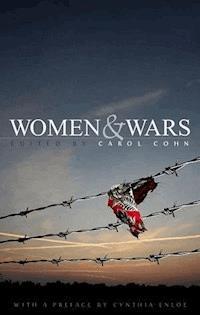
Women and Wars E-Book
25,99 €
Mehr erfahren.
- Herausgeber: John Wiley & Sons
- Kategorie: Geisteswissenschaft
- Sprache: Englisch
Where are the women? In traditional historical and scholarly accounts of the making and fighting of wars, women are often nowhere to be seen. With few exceptions, war stories are told as if men were the only ones who plan, fight, are injured by, and negotiate ends to wars. As the pages of this book tell, though, those accounts are far from complete. Women can be found at every turn in the (gendered) phenomena of war. Women have participated in the making, fighting, and concluding of wars throughout history, and their participation is only increasing at the turn of the 21st century. Women experience war in multiple ways: as soldiers, as fighters, as civilians, as caregivers, as sex workers, as sexual slaves, refugees and internally displaced persons, as anti-war activists, as community peace-builders, and more. This book at once provides a glimpse into where women are in war, and gives readers the tools to understood women’s (told and untold) war experiences in the greater context of the gendered nature of global social and political life.
Sie lesen das E-Book in den Legimi-Apps auf:
Seitenzahl: 754
Veröffentlichungsjahr: 2013
Ähnliche




















Women and Wars
For my daughter Mariel
And in loving memory of Edna Kaplan and Sara Ruddick
Women and Wars
EDITED BY CAROL COHN
polity
Copyright © Carol Cohn 2013
The right of Carol Cohn to be identified as Author of this Work has been asserted in accordance with the UK Copyright, Designs and Patents Act 1988.
First published in 2013 by Polity Press
Polity Press65 Bridge StreetCambridge CB2 1UR, UK
Polity Press350 Main StreetMalden, MA 02148, USA
All rights reserved. Except for the quotation of short passages for the purpose of criticism and review, no part of this publication may be reproduced, stored in a retrieval system, or transmitted, in any form or by any means, electronic, mechanical, photocopying, recording or otherwise, without the prior permission of the publisher.
ISBN: 978-0-7456-6066-0
A catalogue record for this book is available from the British Library.
Printed and bound in Great Britain by MPG Books Group Limited, Bodmin, Cornwall
The publisher has used its best endeavours to ensure that the URLs for external websites referred to in this book are correct and active at the time of going to press. However, the publisher has no responsibility for the websites and can make no guarantee that a site will remain live or that the content is or will remain appropriate.
Every effort has been made to trace all copyright holders, but if any have been inadvertently overlooked the publisher will be pleased to include any necessary credits in any subsequent reprint or edition.
For further information on Polity, visit our website: www.politybooks.com
Contents
Boxes and Tables
Abbreviations
Contributors
Foreword by Cynthia Enloe
Acknowledgments
1 Women and Wars: Toward a Conceptual Framework
Carol Cohn
2 Women and the Political Economy of War
Angela Raven-Roberts
3 Sexual Violence and Women’s Health in War
Pamela DeLargy
4 Women Forced to Flee: Refugees and Internally Displaced Persons
Wenona Giles
5 Women and Political Activism in the Face of War and Militarization
Carol Cohn and Ruth Jacobson
6 Women and State Military Forces
Jennifer G. Mathers
7 Women, Girls, and Non-State Armed Opposition Groups
Dyan Mazurana
8 Women and Peace Processes
Malathi de Alwis, Julie Mertus, and Tazreena Sajjad
9 Women, Girls, and Disarmament, Demobilization and Reintegration (DDR)
Dyan Mazurana and Linda Eckerbom Cole
10 Women “After” Wars
Ruth Jacobson
Notes
References
Index
Boxes and Tables
BOXES
2.1 Definitions of gender-based and sexual violence
2.2 Changing gender roles in Afghanistan
2.3 Double work burdens
2.4 Becoming a forced wife in Sierra Leone
3.1 UN Security Council Resolutions on women, peace, and security
3.2 Sexual slavery: the “comfort women” of the Second World War
3.3 Obstetric and traumatic fistula
4.1 Additional Human Rights Conventions that pertain to the rights of forced migrants
4.2 Key terms: humanitarian assistance versus development aid
4.3 UNHCR Conclusion No. 39 (XXXVI) Concerning Refugee Women and International Protection
4.4 UNHCR definition of “women at risk”
5.1 The Committee of Soldiers’ Mothers in Russia: from “maternalism” to anti-militarism?
5.2 Maternal practice as a potential resource for peace politics
5.3 Laura Bush on the US war in Afghanistan
5.4 The Women’s Peace Camp at Greenham Common
6.1 The “double whammy” for US military women
6.2 Sexual assault and abuse in the North Korean military
8.1 (Where) have women appeared in peace agreements?
8.2 Sudanese women in the processes of building peace
8.3 Issues addressed by UN Security Council Resolution 1325
8.4 1325 in practice: the case of Afghanistan
8.5 After the peace agreement: women building peace in Aceh
9.1 DDR processes: who does what?
9.2 A woman commander speaks on DDR in Burundi
9.3 The Women in Crisis Movement: a response to the challenges of reintegration
9.4 Skills developed by women members of armed opposition groups in Africa
10.1 United Nations Peace Support Operations: where and who?
10.2 Where are the women in PSOs?
10.3 Gaps between gender rhetoric and funding
10.4 Land reform in Mozambique: the battle to protect women’s rights
10.5 Returning to normal life or encountering backlash?
10.6 Peace-building in postwar Kosovo
TABLES
6.1 Proportion of women serving in state militaries around the world
6.2 Examples of countries where women may serve in at least some combat roles
7.1 Women and girls inside armed opposition groups 1990–2011
10.1 Who does what in the postwar environment?
Abbreviations
AIDS
Acquired Immunodeficiency Syndrome
Al-Shabaab
Harakat al-Shabaab al-Mujahideen (Somalia)
AMB
al-Aqsa Martyrs’ Brigade
ASC
Assembly of Civil Society (Guatemala)
AUC
United Self-Defense Forces of Colombia
AusAID
Australian Agency for International Development
BASIC
British American Security Council
BBC
British Broadcasting Corporation
BCPR
Bureau for Crisis Prevention and Recovery (United Nations)
BINGO
big international nongovernmental organization
CDF
Civil Defense Forces (Sierra Leone)
CEDAW
Convention on the Elimination of All Forms of Discrimination against Women
CHRGJ
Center for Human Rights and Global Justice
CIA
Central Intelligence Agency
CNDD-FDD
National Council for the Defense of Democracy/Forces of Defense of Democracy (Burundi)
CPC
Civilian Protection Component (Mindanao)
CRC
Convention on the Rights of the Child
CRSV
conflict-related sexual violence
CSMR
Committee of Soldiers’ Mothers of Russia
CSO
civil society organization
DDR
disarmament, demobilization and reintegration
DFID
Department for International Development (UK)
DPA
United Nations Department of Political Affairs
DRA
Dutch Refugee Association
DRC
Democratic Republic of the Congo
ECOWAS
Economic Community of West African States
EPLF
Eritrean People’s Liberation Front
EU
European Union
FAD
Feminist Approach to Development
FAO
United Nations Food and Agriculture Organization
FARC
Fuerzas Armadas Revolucionarias de Colombia – Ejército del Pueblo
FMLN
Farabundo Martí National Liberation Front (El Salvador)
FORO
Foro Nacional de la Mujeres (Guatemala)
Frelimo
Frente de Libertação de Moçambique
FRODEBU
Front pour la Démocratie au Burundi
GAD
Gender and Development
GAFM
Gender and Forced Migration
GAM
Free Aceh Movement
GBV
gender-based violence
GDP
gross domestic product
GRP
Gender and Reparations Project
GWG
Gender Working Group (Aceh)
HIV
Human Immunodeficiency Virus
HRW
Human Rights Watch
IANSA
International Action Network on Small Arms
IASC
Inter-Agency Standing Committee
IAWG
Interagency Working Group
ICC
International Criminal Court
ICCPR
International Covenant on Civil and Political Rights
ICERD
International Convention on the Elimination of All Forms of Racial Discrimination
ICESCR
International Covenant on Economic, Social and Cultural Rights
ICM
Intergovernmental Committee for Migration
ICRC
International Committee of the Red Cross
ICTJ
International Center for Transitional Justice
ICTR
International Criminal Tribunal for Rwanda
ICTY
International Criminal Tribunal for the former Yugoslavia
IDDRS
Integrated DDR Standards
IDF
Israeli Defense Force
IDMC
Internal Displacement Monitoring Centre
IDP
internally displaced person
IFI
international financial institution
ILO
International Labor Organization
IMF
International Monetary Fund
IMT
International Monitoring Team (Mindanao)
IOM
International Organization for Migration
IRB
Immigration and Refugee Board of Canada
IWGRW
International Working Group on Refugee Women
IWNAM
International Women’s Network against Militarism
JPuD
Women’s Peace Network (Aceh)
JPuK
Women’s Policy Network (Aceh)
LoGA
Law on the Governing of Aceh
LRA
Lord’s Resistance Army (Uganda)
LTTE
Liberation Tigers of Tamil Eelam
MARWOPNET
Mano River Women’s Peace Network
MDRP
Multi-Country Demobilization and Reintegration Program
M4P
Mothers for Peace
MIRF
Moro Islamic Revolutionary Front
MoU
Memorandum of Understanding
MP
Member of Parliament
MPC
Mindanao Peoples Caucus
MWC
International Convention on the Protection of the Rights of All Migrant Workers and Members of Their Families
NATO
North Atlantic Treaty Organization
NGO
nongovernmental organization
NKHR
North Korean Human Rights
NIWC
Northern Ireland Women’s Coalition
NMA
Naga Mothers’ Association
NORAD
Norwegian Agency for Development Cooperation
NSAG
non-state armed group
NWUM
Naga Women’s Union of Manipur
OCHA
United Nations Office for the Coordination of Humanitarian Affairs
OSCE
Organization for Security and Co-operation in Europe
OSRSG/CAC
Office of the Special Representative of the Secretary-General for Children and Armed Conflict
PCR
post-conflict reconstruction
PIJ
Palestinian Islamic Jihad
PKK
Kurdistan Workers’ Party
PLA
People’s Liberation Army (China)
PMS
premenstrual syndrome
PMSC
Private Military and Security Company
POP
people-oriented planning
POW
prisoner of war
PSO
peace support operation
PTSD
post-traumatic stress disorder
RAWA
Revolutionary Women of Afghanistan
RCD
Rassemblement Congolais pour la Démocratie
Renamo
Resistência Nacional Moçambicana
RUF
Revolutionary United Front (Sierra Leone)
SADF
South African Defense Force
SALW
small arms and light weapons
SDN
Sub-Committee on De-escalation and Normalization (Sri Lanka)
SEA
sexual exploitation and abuse
SGI
Sub-Committee on Gender Issues (Sri Lanka)
Sida
Swedish International Development Agency
SIHRN
Sub-Committee on Immediate Humanitarian and Rehabilitation Needs (Sri Lanka)
SPLA
Sudanese People’s Liberation Army
SPLM
Sudanese People’s Liberation Movement
SPLM/A
Sudanese People’s Liberation Movement/Army
SPM
Sub-Committee on Political Matters (Sri Lanka)
SRSG
Special Representative of the Secretary-General
SSNP
Syrian Socialist National Party
SSR
security sector reform
SSWC
Save Somali Women and Children
STD
sexually transmitted disease
STI
sexually transmitted infection
TB
tuberculosis
TCC
Troop Contributing Country
TNT
trinitrotoluene
UK
United Kingdom
UN
United Nations
UNAMID
African Union/United Nations Hybrid operation in Darfur
UNDDR
United Nations Disarmament, Demobilization and Reintegration
UNDP
United Nations Development Programme
UNDPKO
United Nations Department of Peacekeeping Operations
UNECHA
United Nations Executive Committee on Humanitarian Affairs
UNESCO
United Nations Educational, Scientific and Cultural Organization
UNFPA
United Nations Population Fund
UNGA
United Nations General Assembly
UNHCR
United Nations High Commissioner for Refugees
UNICEF
United Nations Children’s Fund
UNIFEM
United Nations Development Fund for Women
UNITA
National Union for the Total Independence of Angola
UNODA
United Nations Office for Disarmament Affairs
UNRWA
United Nations Relief and Works Agency
UNSC
United Nations Security Council
UNSCR
United Nations Security Council Resolution
URNG
Guatemalan National Revolutionary Unity
US
United States
USA
United States of America
USCRI
United States Committee for Refugees and Immigrants
USDOD
United States Department of Defense
VA
United States Department of Veterans Affairs
WAD
Women and Development
WCRWC
Women’s Commission for Refugee Women and Children
WFP
World Food Program
WHO
World Health Organization
WICM
Women in Crisis Movement
WID
Women in Development
WIFM
Women in Forced Migration
WILPF
Women’s International League for Peace and Freedom
WREI
Women’s Research and Education Institute
WSP
Women Strike for Peace
WTO
World Trade Organization
Contributors
Carol Cohn is Director of the Consortium on Gender, Security and Human Rights and Professor of Women’s Studies at the University of Massachusetts Boston. Her major research interests include gender and armed conflict, the gendered discourses of US national security elites, and gender mainstreaming in international security institutions.
Malathi de Alwis teaches in the Faculty of Graduate Studies, University of Colombo, Sri Lanka. She has a PhD in Sociocultural Anthropology and is currently working on postwar processes of memorialization and reconciliation. She is a co-founder of several feminist peace groups and a member of the Women in Conflict Zones Network (WICZNET).
Pamela DeLargy managed the United Nations Population Fund’s (UNFPA) humanitarian programs for almost a decade, advocating for attention to women’s health in humanitarian settings across the world. She played a lead role in the development of UN responses to sexual violence in conflicts. Currently, she is the UNFPA Representative in Sudan.
Linda Eckerbom Cole is the co-founder and executive director of Community Action Fund for Women in Africa, a non-profit organization working with women and girls in conflict and post-conflict areas.
Wenona Giles teaches at York University, working in the areas of gender, migration, refugee issues, ethnicity, nationalism, work, globalization, and war. She coordinated the international Women in Conflict Zones Research Network and recently completed an international research project concerning protracted refugee situations. She is now working on an international collaborative research endeavor to bring higher education degree programs to long-term refugees in camps.
Ruth Jacobson is a former Lecturer at the Department of Peace Studies, University of Bradford in the United Kingdom. In the mid-1980s, she lived and worked in a war zone in Mozambique where she saw the impact on women and girls at close quarters. Subsequently, she has contributed to feminist organizing in the field of humanitarian relief and post-conflict organizations.
Jennifer Mathers is a Senior Lecturer in the Department of International Politics at Aberystwyth University. Her major areas of research and teaching include gender and conflict; from 2007–2010 she edited Minerva Journal of Women and War.
Dyan Mazurana is Associate Research Professor at the Fletcher School of Law and Diplomacy, and Research Director at the Feinstein International Center, Tufts University. She works with a variety of governments, UN agencies, human rights, and child protection organizations regarding improving efforts to assist youth and women affected by armed conflict, and has worked in Afghanistan, the Balkans, southern, west and east Africa, and Nepal.
Julie Mertus, Professor of Human Rights and Director of the Program on Ethics and Peace at American University, has extensive experience working on gender and conflict issues for a number of governmental and nongovernmental human rights and humanitarian organizations from Albania to Zimbabwe.
Angela Raven-Roberts has managed humanitarian and development programs for organizations including Oxfam America, Save the Children USA, and UNICEF, working in countries including Papua New Guinea and Ethiopia. She holds a PhD in Anthropology, and oversaw the design of the first Master’s of Arts in Humanitarian Assistance (MAHA) degree in the USA, at Tufts University.
Tazreena Sajjad is a Professorial Lecturer at the School of International Service at American University. Her research interests include human rights and conflict, transitional justice, humanitarian intervention, human rights in states of emergency and gender and armed conflict. She has also worked as a human rights practitioner and researcher in Afghanistan, Nepal, and Bangladesh.
Foreword: Gender Analysis Isn’t Easy
I can’t tap dance. I watch old Fred Astaire movies and think, “He makes it look so easy.” There are many things I haven’t learned how to do – to do calculus, to speak Turkish. Thanks to the hard, patient tutoring of so many feminist friends and colleagues, what I have learned how to do is gender analysis. Of course, friends continue to teach me – I’m not “there” yet.
That is, gender analysis is a skill. It’s not a passing fancy, it’s not a way to be polite. And it’s not something one picks up casually, on the run. One doesn’t acquire the capacity to do useful gender analysis simply because one is “modern,” “loves women,” “believes in equality,” or “has daughters.” One has to learn how to do it, practice doing it, be candidly reflective about one’s shortcomings, try again. To develop gender analytical skills, one has to put one’s mind to it, work at it, be willing to be taught by others who know more about how to do it than you do. And, like any sophisticated skill, gender analysis keeps evolving, developing more refined intellectual nuance, greater methodological subtlety. One has to get to the point where one can convincingly describe the processes of gender analysis and its value to others, including to those who are skeptical, distracted, and stressed out. It takes myriad forms of energy to do gender analysis and to convince others of its necessity.
Carol Cohn and her smart contributors, first, are offering us a sophisticated, up-to-date gender analytical tool kit. Second, they are showing us what can be revealed if we learn how to use that gender analytical tool kit.
It’s always more engaging to learn a new set of skills if your guides can show you exactly what you’ll see with these tools that you would otherwise miss – and why those new findings matter. For instance, using their gender analytical skills, these contributors expose the diverse forms of violence wielded during wars: guns and bombs aren’t the only weapons. They pull back the curtain on the differences between girls’ and boys’ experiences of being made to serve in adult men’s fighting forces. “Children” turns out not to be a very useful category when trying to rebuild any society after a war. Cohn’s contributors also show us why we will never usefully understand armed conflicts if we stubbornly focus our attention solely on the immediate war zone; we have to learn how to do gender analyses of refugee camps, of markets, of peace negotiations. Their gender analytical skills make it clear, too, that the months and years so comfortably labeled “postwar” in practice are riddled with wartime ideas about men-as-actors and women-as-victims, misleading ideas that serve to perpetuate the very conditions that set off the conflict in the first place.
The contributors whom Carol Cohn has brought together are among the most experienced users of gender analytical skills in the globally important (and maddeningly complex) field of war, armed conflict and postwar peace-building. Their experiences are of using their gender analytical skills while in the midst of confusing relationships “on the ground.” These are analysts who’ve been in refugee camps where water is short, collecting firewood is risky, power hierarchies are dysfunctional, and donors’ attention spans are short. They are analysts who have sat in long hearings where diplomats with no mud on their shoes decide whether or not a Gender Unit in a peacekeeping operation will get a decent budget. They have talked to women quite reasonably afraid to describe what actually happened to them and their daughters when rival male soldiers swept through their villages. They have met with local women’s groups who have tried to get local male military commanders to listen to their proposals. In New York and capital cities, these gender analysts have lobbied government, nongovernmental organizations, and UN agencies to put aside their usual “only men really matter” ways and, instead, to take women seriously when they evaluate their policies’ outcomes, when they write their peacekeepers’ mandates, and when they allocate their funds.
Thus, as readers, we each can read Women and Wars with the triple aims of acquiring new gender analytical skills; finding out what the causes and dynamics of armed conflict look like if we view them through a gendered lens; and learning how to convince others to adopt these crucial gender analytical skills. This is the sort of book you’ll want to make notes on, quote to others, take with you in your knapsack.
Cynthia Enloe
Acknowledgments
No piece of intellectual work is ever solely the product of one mind, and this is perhaps nowhere more true than in the case of a textbook designed to introduce readers to the tremendously rich literature about women and war. This book would not exist without the indefatigable efforts of activists, scholars, and practitioners around the world who work to prevent wars or to bring them more swiftly to an end, to expose wars’ gendered workings, and to construct a less violent, more just world. It has been my pleasure and privilege to get know many of them, and to read and read about many more; I deeply regret that this book cannot begin to do justice to the complexity of their thinking or to the courage of their work, but I am enormously grateful for all they have taught me, and hope that they find at least some of it reflected in these pages.
So many friends and colleagues have contributed to the ideas in this book, it will be impossible to thank them all. But I must start with two friends, Cynthia Enloe and Sara Ruddick, with whom I have been in rich dialogue for so long that my thinking often feels like an extended conversation with each of them. There are no adequate ways to describe what their friendship, nuanced thought, fearless originality, intellectual honesty, and personal generosity have meant to me.
I am tremendously grateful, too, to Ann Tickner, from whom I have learned so much. She has also been a generously supportive friend and colleague, and a vitally important contributor to this journey. More recently, friendship and collaboration with Malathi de Alwis and Ruth Jacobson has stretched and enriched me both intellectually and personally. My work is also enriched by the writings and friendship of Spike Peterson, Ann Runyan, Jindy Pettman, and many other wonderful colleagues in the Feminist Theory and Gender Studies section of the International Studies Association.
I am deeply grateful to Felicity Hill for bringing me into the “women, peace and security” advocacy networks that have coalesced around UNSCR 1325, and for the world that opened up to me. I appreciate her great generosity in all that she taught me, as well as her political acuity, wicked wit, and the kitchen table conversations. Jennifer Klot has been an invaluable guide to the UN system, and has taught me a tremendous amount – perhaps even more than I really wanted to know – about the policy, political and analytic challenges of addressing issues of women and war at the UN. In and around the UN, I have also been lucky to have the friendship and education offered by, among others, Sheri Gibbings, Sylvia Hordosch, Maha Muna, Nadine Puechguirbal, Kristin Valasek, and my sisters in the NGO Working Group on Women, Peace and Security. Additionally, it has been a great pleasure and honor to learn from colleagues such as Balghis Badri, Cynthia Cockburn, Luz Méndez, Ndeye Sow, and Dubravka Zarkov.
I have benefited from a very supportive institutional home in the time I have worked on this book. I wish to thank my faculty and administrator colleagues at the University of Massachusetts Boston, including Ann Blum, Elora Chowdhury, Amani El Jack, Jean Humez, Rajini Srikanth, Dean Donna Kuizenga, and Provost Winston Langley for their friendship, support, vision, and wonderful scholarship. Most critically, I owe an enormous debt of gratitude to my Associate Director at the Consortium on Gender, Security and Human Rights, Sandra McEvoy, who has been exceptionally generous, skilled, committed and hardworking in keeping all of the moving parts of our complex program functioning and making such a success of it – enabling me to pour the necessary time and energy into this manuscript. She is a valued interlocutor, scholar, co-teacher, and all-around co-conspirator who enriches every dimension of my and the Consortium’s work.
This book has truly been a collective effort. The idea for it was hatched between Louise Knight, of Polity Press, and Laura Sjoberg, who brought me into the project. I am grateful to Laura for the extensive work she put into the early stages of this project, and to Louise, Emma Hutchinson, and David Winters at Polity for their support and guidance throughout the development of this book, and for their patience. The early stages of this project also benefited greatly from the collective wisdom of the “April 11th group,” which came together to brainstorm the conceptual framework for the book; participants included Dinu Abdella, Cynthia Enloe, Ruth Jacobson, Ramina Johal, Milkah Kihunah, Jennifer Klot, Dyan Mazurana, Sandy McEvoy, Julie Mertus, Sonali Moonesinghe, Selma Scheewe, and Laura Sjoberg.
I am most grateful to the contributors, not only for their excellent work, but for sticking with this project through delays and innumerable editorial requests. Additionally, Malathi de Alwis, Cynthia Enloe, Ruth Jacobson, and Dyan Mazurana have been treasured compatriots throughout this process, offering moral and intellectual support when it was needed most.
Many colleagues generously shared their time and expertise, reading and commenting on various drafts. In particular, I’d like to thank the following people for their very useful feedback on one or more chapters: Megan Bastik; Joshua Chaffin; Catia Confortini; Malathi de Alwis; Bina D’Costa; Marsha Henry; Sandra Krause; Sarah Masters; Megan Mackenzie; Sandra McEvoy; Dyan Mazurana; Luz Méndez; Nida Naqvi; Isis Nusair; Laura Sjoberg; Inger Skjelsbæk; and Elisabeth Wood. I am also grateful to Polity Press’s two anonymous reviewers for their very helpful comments.
In working to produce a book that is accessible and useful to both undergraduate and graduate students, it has been a great gift to have Consortium interns and students who were willing to read and offer comments on drafts of chapters. In particular, I would like to thank Emily Baum, Katie Davis, Chloe Diamond-Lenow, Cassandra Hawkins, Laura Matson, Mary Helen Pombo, Marie Puccio, Harin Song, Helena Wahlstrom, Jill Williams, Ayala Wineman, and the students of the Fall 2010 Honors Seminar 380-02 at UMass Boston. Additionally, valuable research and manuscript production assistance was also provided by Consortium interns Jane Lief Abell, Emily Campbell, Hyomi Carty, Gina Choi, Alexa Cleary, Brenna Doyle, Delia Flanagan, Mary Glenn, Jodi Guinn, Cassandra Hawkins, Mallory Hennigar, Wendy Jepson, Tavish MacLeod, Laura Matson, Shannon Nolan, Mary Helen Pombo, Anya Priester, Hannah Roberts, Jillian Rubman, Kelsi Stein, Cara Wagner, Jill Williams, and Ayala Wineman.
Critically, there are two main people whose support in the preparation of this manuscript has been extraordinarily generous and skilled, and whose loyalty and endless hours of hard work far surpass anything I could ever repay. Azure Mauche has been the citation wizard, the reference detective, the biblio graphy queen – a tremendous challenge in a book with multiple contributors situated around the world. I am enormously grateful to her for taking on this demanding, frustrating task in the midst of a complicated and demanding life (and claiming to enjoy it). Caitlin Lucey has been a partner extraordinaire in every aspect of getting this manuscript done. Her dedicated and tireless efforts have included multiple readings of every chapter, resourceful research assistance, proofing, formatting, and checking and double-checking everything. She has been intellectual sounding board, technical problem-solver, and morale booster, with the focus of a laser and the patience of a saint. I am in awe, and enormously grateful.
It is customary to “last but not least” thank one’s family; the incommensurability between that formulation and what one’s closest family members both give and put up with is hard to fathom. My family’s love, support, understanding, and forbearance have meant the world to me. I owe special words of appreciation to my grandmother Edna, an extraordinary human being and activist, whose 1916 high school valedictory speech on “Women in the Current War Effort” still tickles and teaches me; to my mother Helen, who taught me more than I can say; and to my daughter Mariel, for all the joy.
CHAPTER 1
Women and Wars: Toward a Conceptual Framework
Carol Cohn
This is a book about the relationships between women and wars: the impacts wars have on women, the ways women participate in wars, the varying political stances women take toward war, and the ways in which women work to build peace.
There is an old story about war. It starts with war being conceived of as a quintessentially masculine realm: in it, it is men who make the decisions to go to war, men who do the planning, men who do the fighting and dying, men who protect their nation and their helpless women and children, and men who negotiate the peace, divide the spoils, and share power when war is over.
In this story, women are sometimes present, but remain peripheral to the war itself. They raise sons they willingly sacrifice for their country, support their men, and mourn the dead. Sometimes they have to step in and take up the load their men put down when they went off to fight; they pick up the hoe, or work in a factory producing goods crucial to the war effort – but only as long as the men are away. To the men in battle, they symbolize the alternative – a place of love, caring, and domesticity, and indeed, all that is good about the nation which their heroic fighting protects.
The gendered reality of war is far more complex than this old story portrays. War itself is more complexly gendered than this masculinized story allows, and women’s role in and experience of war is far more integral and varied. In this book, we will show that one cannot understand either women’s relation to war or war itself without understanding gender, and understanding the ways that war and gender are, in fact, mutually constitutive.
Which women? Which wars?
The starting point for thinking about women and wars must be that women’s experiences of war and their relations to war are extremely diverse. Women both try to prevent wars and instigate wars. They are politically supportive of wars, and they protest against wars. Women are raped, tortured, maimed, and murdered, they are widowed, the children they have nurtured are lost to violence; but women are also members and supporters of the militaries and armed groups that commit these acts. Women stay home, resolutely striving to sustain family and community relationships; and women are displaced, living in camps without any of the structures that they have built to make life possible. Women are empowered by taking on new roles in wartime, and disempowered by being abducted from their homes and forced into armed groups or military prostitution. When the war is over, women work to rebuild their communities, and women are ejected from their families and communities because they have been raped, or been combatants, or lost a limb to a landmine.
The diversity of women’s experiences of and relations to war is due to both diversity among women and diversity among wars. “Women,” of course, are not a monolithic group, but instead individuals whose identities, options, and experiences are shaped by factors including their age, economic class, race, clan, tribe, caste, ethnicity, religion, sexuality, physical ability, culture, geographic location, state citizenship and national identity, and their positioning in both local and global economic processes. Their relations to war are shaped by, but not reducible to, these multiple factors; they are also thinkers who make their own sense of the multiple social, cultural, economic, and political forces which structure their lives. The multiplicity of these factors and the sense women make of them gives rise to contradictory interests among women, and even within any particular woman. This means that attempts to generalize about “women and war,” while in some ways unavoidable in a book of this kind, always run the risk of doing conceptual violence to the realities of women’s lives. And that we must, at a minimum, reject comfortable assumptions such as “women are naturally more peaceful than men” or “women are war’s victims,” and instead commit to exploring the specificity of different women’s relations to wars and the multitude of factors which shape those relations.
Lesen Sie weiter in der vollständigen Ausgabe!
Lesen Sie weiter in der vollständigen Ausgabe!
Lesen Sie weiter in der vollständigen Ausgabe!
Lesen Sie weiter in der vollständigen Ausgabe!
Lesen Sie weiter in der vollständigen Ausgabe!
Lesen Sie weiter in der vollständigen Ausgabe!
Lesen Sie weiter in der vollständigen Ausgabe!
Lesen Sie weiter in der vollständigen Ausgabe!
Lesen Sie weiter in der vollständigen Ausgabe!
Lesen Sie weiter in der vollständigen Ausgabe!
Lesen Sie weiter in der vollständigen Ausgabe!
Lesen Sie weiter in der vollständigen Ausgabe!




