


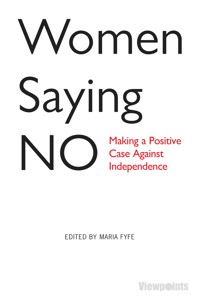
Women Saying No E-Book
Erhalten Sie Zugang zu diesem und mehr als 300000 Büchern ab EUR 5,99 monatlich.
- Herausgeber: Luath Press
- Kategorie: Geisteswissenschaft
- Serie: Viewpoints
- Sprache: Englisch
If a majority of us decide to vote YES on 18 September 2014, then that divorce from the rest of the UK is easy to do. No expensive lawyers. No cost except the travel to the polling station' No need to lift a finger. Just a cross on a ballot paper. But before you say, that's great, think on' This is a decision we will live with for the rest of our lives, and our children's and grandchildren's, for maybe centuries to come. MARIA FYFE It's been noted over and over again that women are more likely to vote NO in Scotland's Referendum 2014. There has been endless speculation as to why this may be, but until now little expression of their views has been heard. In a series of essays arguing for a NO vote at the forthcoming Scottish independence referendum, 14 women varying in age, ethnicity, political views and life experience - including Maria Fyfe, Johann Lamont MSP, Sarah Boyack MSP and Fiona O'Donnell MP - come together to make a positive case against independence. With contributions from leading current and former politicians and citizens, Women Saying No presents the arguments against independence, from a female perspective, in an attempt to widen the debate. Praise for Maria Fyfe The book she has written is a gem. It zips along on a skilful mix of genuinely funny anecdotes, telling vignettes and perceptive political analysis. It serves future historians well too, for it will serve as a necessary counterbalance to the leadership-centric books and diaries which have followed the Tony Blair - Peter Mandelson years. But it has a more immediate attraction than that. The Nats gets a good pre-referendum kicking from Oor Maria. Recalling that the Nats used to call the Scots Labour MPs 'the feeble fifty' she points out the SNP were nowhere to be seen the night a last ditch Tory filibuster failed to halt the Minimum Wage Bill. ALASDAIR BUCHAN, TRIBUNE on A Problem Like Maria A feisty, irrepressible, red flag idealist' the only woman Scottish MP in a gang of fifty. She could not be bullied, bamboozled or bribed. She did not fit comfortably in to the Procrustean bed of a biddable Blair babe. PAUL FLYNN, THE HOUSE MAGAZINE on A Problem Like Maria
Sie lesen das E-Book in den Legimi-Apps auf:
Seitenzahl: 150
Veröffentlichungsjahr: 2014
Das E-Book (TTS) können Sie hören im Abo „Legimi Premium” in Legimi-Apps auf:
Ähnliche




















Women Saying No
Luath Press is an independently owned and managed book publishing company based in Scotland, and is not aligned to any political party or grouping.Viewpointsis an occasional series exploring issues of current and future relevance.
Women Saying No
Making a Positive CaseAgainst Independence
Edited By MARIA FYFE
LuathPress Limited
EDINBURGH
www.luath.co.uk
First published 2014
ISBN (PBK): 978-1-910021-61-3
ISBN (EBK): 978-1-910324-20-2
The authors’ right to be identified as author of this work under the Copyright, Designs and Patents Act 1988 has been asserted.
© Maria Fyfe and the contributors
All royalties from the sale of this book will go to the Remember Mary Barbour fund.
My thanks to all those who have expressed why they were voting NO. They were asked to give it laldy. They did.
Contents
PrefaceWhy we are Voting NOMARIA FYFE
ForewordConstitutional Change is not Enough JOHANN LAMONT MSP
CHAPTER 1Why I’m Voting NOSARAH BOYACK MSP
CHAPTER 2 I’ll Admit It, I’m FeartESME CLARK
CHAPTER 3 The Biggest DecisionPAM DUNCAN-GLANCY
CHAPTER 4 Of Course It Couldn’t Happen Here… Or Could It?ANNA DYER
CHAPTER 5 Why a NO Vote is Best for WomenMARIA FYFE
CHAPTER 6 A Historic Union to Keep and Cherish TRISH GODMAN
CHAPTER 7 An Internationalist View KAINDE MANJI
CHAPTER 8 A Gamble with our Livelihood and Welfare RONNIE McDONALD
CHAPTER 9 Scottish or British or Both? JEAN McFADDEN
CHAPTER 10 So, what about the Pensioners? ELINOR McKENZIE
CHAPTER 11 A Scottish Asian Woman looks at Independence SHABANA NAZ
CHAPTER 12 Four Trees Standing Together FIONA O’DONNELL MP
CHAPTER 13 It’s Not Just a Cross on a Piece of Paper KARA ROSS
CHAPTER 14 SNP – Something Not Proven CLLR KATE STEPHEN
PREFACE
Why We Are Voting NO
MARIA FYFE
I ONCE HAD A workmate who jumped over a wall, assuming that on the other side it was level with where he started. He had thought he was taking a shortcut, but it turned into a trip to the A&E. It could have been a bed of roses on the other side, or a bed of nettles. It was neither – it was the deep drop that put him in plaster. And it could have been much worse, as he ruefully admitted on his return to work.
If a majority of people living in Scotland decide to vote YES on 18 September 2014, then divorce from the rest of the UK will be easy to do. Easier than jumping over a wall. No expensive lawyers. No cost except the bus fare or the wear and tear on your shoes as you walk to the polling station. All the responsibility of bargaining over the share-out of the goods and the debts amassed over the years will lie with others. No need to lift a finger. You can leap into the unknown without even bothering to seek information. Just put a cross on a ballot paper. But the thing is, we are not voting in a General Election, when the outcome has a five-year span. This vote has consequences that could last for centuries to come. Divorcees have occasionally been known to change their minds and get back together again. But on the biggest question that has faced us these past 300 years, there is little or no prospect of getting back together. The Braveheartish sort of Nationalists will no doubt say ‘that’s fine by us, we would never want to do that.’ Others will not want to burn bridges if they can avoid it. They also see our problems as ones we can solve together, rather than by extracting ourselves from the rest of the UK.
Think forward a few decades or even centuries. Why would people in England, Wales and Northern Ireland be in any hurry to let us rejoin a family of nations that we had walked out on, just when all four nations were still striving to recover from the world’s worst recession in many decades? When wages were stagnant or reduced, people in work needed top-up benefits, food banks had grown to numbers never before imagined, housing was scarce and grossly over-priced, young people were without prospects of decently paid work, and our NHS was struggling? All this affecting every nation in the UK, but we had decided to go it alone, instead of working together. And on top of that, if Alex Salmond had his way, we had cut corporation tax with the intention of taking jobs and investment away from England.
On the other hand, if we vote NO, we allow ourselves endless possibilities for how things could change for the better, for all of us in the UK. I say could, not will, because just putting a cross on a ballot paper is not enough. It never has been.
It is simply not true that we will be lumped with the status quo. No political party is offering that. Look at the evidence. The SNP keep harking back to 1979 when the UK Parliament did not deliver devolution. They never mention 1997, when it did, John Smith having declared it ‘the settled will of the Scottish people.’
The very existence of the Scottish Parliament proves the UK Parliament can be persuaded that change is necessary and deliver it. So why would anyone believe that their best option is to jump over a wall and hope for the best? A&E departments deal with this kind of thing every day of the week, but no one is suggesting that’s a good idea.
Ah, but I hear women voting YES say that they do want divorce from the people who brought us the Poll Tax, the bedroom tax, lower taxes for the rich, Trident and unwanted wars.
So here are just a few reminders. The poll tax was brought to us by Scottish Tories. It was they who persuaded Margaret Thatcher, it was not imposed on us by England. The bedroom tax will be repealed if Labour is elected in 2015 – no more need for the Scottish Parliament to compensate victims of this vile policy. Lower taxes for the rich? It is Alex Salmond who promises to cut corporation tax lower than even George Osborne plans to do.
Trident? Not quite the wholehearted commitment to get rid of it that the Nationalists have built so much support on. Read the words in the White Paper and guess how long it will be for Trident to actually go. But there is commitment to NATO, and permission for all its member states’ vessels to visit Scottish ports whether carrying nuclear weapons or not. There is even a declaration from Alex Salmond that the USA could have bases in Scotland. Doing what, precisely, has not yet been revealed.
Wars? We have only recently seen the UK Parliament respond to public opinion and vote against military action in Syria. Attitudes have shifted since Iraq.
Supporters of left-wing pro-independence parties are, of course, republican to the core. So were the Scottish Nationalists in days of old when they used to sing, to the tune of ‘The Sash My Father Wore’:
Oh Scotland hasnae got a king, and she hasnae got a queen. How can there be a saicint Liz when the first yin’s never been? Nae Liz the wan, nae Lillibet the twa, nae Liz will ever dae, For we’ll mak’ oor land republican in a Scottish breakaway.
But to gain a republic enough people will have to be persuaded to vote for parties that advocate it. It may be unkind, but nevertheless true, to point out the minimal success of the Greens. Not one candidate representing any of the ultra-left parties has been elected to the Scottish Parliament, or the UK Parliament, since the downfall of Tommy Sheridan. Many a deposit has been lost. However, I have to congratulate them on their ingenuity in solving the problem of how to advance their cause without exposing their huge differences with the SNP, their mates in the YES campaign, in terms of what they think an independent Scotland should deliver. For the past two years, they have got away with telling groups of like-minded people that they were not nationalists, and thereby avoided having to answer criticisms of the SNP. So convenient to ignore the fact that a YES vote would put the party whose whole reason for existence has now been won, not themselves, well ahead in the following election. And so convenient for the SNP to let their stooges paint a picture that would never be a reality if they were in power.
They carefully avoided open splits with the SNP until as late as June 2014 – three months before the referendum – when they had no choice. What else could they do when the SNP reiterated their intention of keeping the monarchy, and putting this into their draft Constitution?
Other left wingers with republican views but who are committed to voting NO recognise the reality that more work has to be done to achieve widespread agreement that bringing an end to a monarchy that sits at the pinnacle of the class system would be a Good Thing.
It’s been noted over and over again that women are more likely to vote NO than YES. There has been endless speculation about why, but little expression of their views has been heard. It has to be noted that some of those who were asked to set out their thoughts for this collection of essays told me they felt they couldn’t. A few working in fields funded by the Scottish Government felt it would be risky. Some felt physically frightened. They had been shouted at by men unknown to them, telling them to go and live in England if they liked it so much. Others with English accents, when overheard chatting with their mates in a pub, were told to ‘get back to England.’ That is one end of the spectrum, and bad enough. At the other end, one particular individual received death threats at the time of the last referendum, required police protection, and finally had to move house. There have been public meetings where Better Together speakers have been shouted down, unable to be heard. In June 2014 we had the spectacle of the First Minister’s Special Advisor – paid by the public’s taxes – attacking Clare Lally, a young mother of a severely disabled child, who dared to speak publicly in support of a NO vote, immediately joined by cybernats delivering childish insults and abuse. This is a worrying aspect of the referendum campaign that is now getting the exposure it deserves. Is this the kind of Scotland we want to live in?
But here and now we have a collection of essays by women who do speak out clearly and firmly in support of a NO vote. They vary in age, ethnicity, political views and life experiences. They have varying reasons for their decision. Women do not all think the same thoughts, which seems to come as a surprise to some commentators. I thank Luath Press for making this publication possible.
FOREWORD
Constitutional Change is not Enough
JOHANN LAMONT MSP
WHY AM I VOTING NO in the referendum? An interesting question, and one that people across Scotland are contemplating ahead of 18 September.
My decision to vote NO is a positive vote for the politics of co-operation and the politics of change. I am voting NO because I am a proud Scot, not despite it. I am voting NO because I am a socialist and a feminist; I am voting NO because I believe profoundly that the things that drive my politics – the determination to tackle inequality and injustice, to create a fairer world, to ensure our young people can achieve their full potential, to make sure we have dignity in our old age – all of my aspirations for our communities can be better achieved in the UK.
The UK allows us to share and pool resources and risk, redistributing wealth from the richer parts of the country to the poor; it helps us manage economic shocks and uneven economic growth in different parts of the country.
Brought up in inner-city Glasgow, I saw children denied the opportunity to learn and thrive; I saw people who worked hard but whose efforts were poorly rewarded. Every summer I headed for the Isle of Tiree, where people worked just as hard on land they did not own and where the memories of the struggles of the land leaguers against the landowners were still fresh. I learned then that exploitation takes many forms and that the challenge is to confront that exploitation, not to view that exploitation differently, depending on the nationality of the exploiter or the exploited.
Being Scottish did not make the factory owner less resistant to the campaigns to give working people basic rights and being Scottish certainly did not inhibit landowners from clearing people from the land they worked.
Like most Scots, I see the common sense argument that sharing resources for pensions and health across 60 million people is better than across six million.
I know that we as Scots benefit from the UK, but it is clear too that we see the fairness in contributing to the UK as well, whether it is our natural assets, our talents or our creativity. I love that Scots look outwards, are open to new ideas, and confident enough in themselves not to be threatened by co-operating with others.
But there is a bigger question and that is about the purpose of politics and how you create change.
Too often the constitutional debate has become the politics of grievance, that all the ills visited upon us are caused by others – by the rest of the UK. And rather than a Scottish Parliament that uses its powers to make a difference, to show what we can do, we have Scottish Government Minister after Scottish Government Minister telling us what we cannot do, settling for alibi rather than action: using the Parliament as a platform for separation, rather than a forum for developing the measures to improve lives.
That is a politics that is corrosive and a politics in which those who need power to be exercised in their interests most, suffer most.
Where politics should be about choices, often choices amongst many different good things, we see in this debate a constitutional offer where everyone can have what they want, where we can cut taxes and spend more, where everything is promised and nothing costed.
People sometimes say that the decision we face on 18 September is the biggest decision in 300 years. I don’t think it is. I like to think that supporting universal compulsory education, the NHS, universal suffrage, abolishing slavery, protecting workers’ rights, fighting for equality for women, tackling racism, uniting to fight Fascism – and so many more – were all decisions of far greater significance.
But if we collude with the idea that constitutional change is enough, that progressive values are inevitable if we only change the constitution, we deny a simple truth. To win change you have to win the political argument. You have to identify the causes of inequality and win the political case to tackle them.
I know that no step on the road to greater equality was ever easy or granted without a struggle. I want the people of Scotland to vote NO, to resist the easy offers and instead pledge to work with all those who hunger for change, for equality, for all those radical voices, whatever their nationality, willingly to take on the arguments, create the solutions and improve the future for all our children.
There are those who see this referendum as a test of our Scottishness. It is not.
This debate is not Scotland versus England or Scotland versus the Tories. It is an argument amongst Scots, a choice of two visions – one insular and turning away, the other open, embracing the interdependency of our world.
I want a strong, united Scotland, shaping the future of the UK. And at its heart I want a politics of ideas, of discourse, of action; an optimistic politics rooted in our soaring ambition for all to achieve their potential; a politics which will not settle for the swapping of slogans or false hope.
That is the opportunity that voting NO on 18 September offers. I, for one, shall grasp that opportunity with all my might.
JOHANN LAMONT is the Leader of the Scottish Labour Party, the first person to be elected to that role created in 2012. She has been the Scottish Labour and Co-operative MSP for Glasgow Pollok since the establishment of Scottish Parliament in 1999. She was Deputy Minister for Communities from October 2004 to November 2006 and Deputy Minister for Justice from November 2006 to May 2007. She was born in Glasgow in 1957 to a Gaelic-speaking family from Tiree. She is married to Archie Graham and has two children, Fay and Colin. She keeps fit by walking, jogging and dancing. Her political interests are tackling poverty, women’s rights, rights of disabled people and others who experience discrimination. She supports Fair Trade. She attended Woodside Secondary School, Glasgow, then obtained MA Hons at University of Glasgow, the Postgraduate teaching qualification at Jordanhill College of Education and the Certificate of Guidance at University of Strathclyde. Prior to being elected, she worked as a class teacher for 20 years.
CHAPTER 1
Why I’m Voting NO
SARAH BOYACK MSP
I AM VOTING NO because I believe that devolution gives us the best of both worlds, with a strong Scottish Parliament and direct representation at the UK level too.




