


34,99 €
Mehr erfahren.
- Herausgeber: John Wiley & Sons
- Kategorie: Wissenschaft und neue Technologien
- Serie: Bible
- Sprache: Englisch
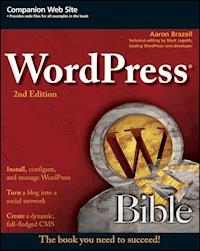
Get the latest word on the biggest self-hosted blogging tool on the market Within a week of the announcement of WordPress 3.0, it had been downloaded over a million times. Now you can get on the bandwagon of this popular open-source blogging tool with WordPress Bible, 2nd Edition. Whether you're a casual blogger or programming pro, this comprehensive guide covers the latest version of WordPress, from the basics through advanced application development. If you want to thoroughly learn WordPress, this is the book you need to succeed. * Explores the principles of blogging, marketing, and social media interaction * Shows you how to install and maintain WordPress * Thoroughly covers WordPress basics, then ramps up to advanced topics * Guides you through best security practices as both a user and a developer * Helps you enhance your blog?s findability in major search engines and create customizable and dynamic themes * Author maintains a high-profile blog in the WordPress community, Technosailor.com * Tech edited by Mark Jaquith, one of the lead developers of WordPress The WordPress Bible is the only resource you need to learn WordPress from beginning to end.
Sie lesen das E-Book in den Legimi-Apps auf:
Seitenzahl: 747
Veröffentlichungsjahr: 2011
Ähnliche



















WordPress® Bible, 2nd Edition
Table of Contents
Part I: Getting Started with WordPress
Chapter 1: Learning About WordPress
A Brief History of WordPress
The creation of WordPress
The WordPress ecosystem emerges
The future of WordPress
Leveraging the WordPress Community
Support
Development
WordPress by the Numbers
Ten Things You Need to Know About WordPress
Generate content with an offline editor
Benefit from built-in SEO features
Widgetize your blog for a unique experience
Install themes, plugins, and core upgrades automatically
Turn your blog into a social network
Extend WordPress with plugins
Provide context with the WordPress taxonomies
Import your blog from any platform
Take advantage of multiple feeds
Make WordPress a full-fledged CMS with custom post types
Generate navigation menus on the fly with no coding required
Understanding Open Source and the General Public License
Summary
Chapter 2: Installing and Configuring WordPress
System Requirements
Choosing a Web Server
Apache
Lighttpd
Nginx
Internet Information Services
Optional modules
Installing WordPress
Configuring the database
Uploading your files
Summary
Chapter 3: WordPress, SEO, and Social Media Marketing
Understanding the Basics of Search Engine Optimization
Canonical URLs
The Meta tag boost
The All in One SEO plugin
Leveraging Social Networks to Extend Your Blog
Summary
Chapter 4: Finding Help in the WordPress Support System
Using the WordPress Codex
Staying in the Loop with Mailing Lists
wp-hackers
wp-testers
wp-docs
wp-xmlrpc
wp-polyglots
wp-svn
wp-trac
Finding Help in the WordPress Support Forums
Understanding the support forum layout
Posting in the support forums
Using IRC to Find Help
Quick Start for IRC
The WordPress IRC Rooms
Summary
Part II: Working with Plugins
Chapter 5: Extending WordPress with Plugins
Understanding WordPress Hooks
The anatomy of a hook
Theme hooks
Writing Your Own Plugin
Extending the WordPress Admin
Creating an admin interface
Adding an admin panel to the WordPress Admin navigation menu
Creating unique nonces for plugin form security
Processing data and interacting with the database
Loading JavaScript libraries
Creating new Dashboard widgets
Creating Events with Actions
Modifying Content with Filters
Using Multi-Argument Hooks
Working with Custom Post Types
Making WordPress a full-fledge CMS
Applying Custom Taxonomies
Localizing Plugins
Enabling plugin code for translation
Providing a textdomain for the plugin
Generating a POT file for translators
Summary
Chapter 6: Building Widgets and Navigation Menus
Using Widgets in WordPress
Building Widgets with the Widget API
Building a new widget plugin
Creating a control interface for the plugin
Saving configuration data
Putting it all together
Replacing existing widgets
Widgetizing Your Theme
Declaring sidebars
Integrating widgetized sidebars in themes
Building WordPress Navigation Menus
Exploring the navigation menu interface
Enabling a theme to use navigation menus
Registering navigation menu locations in a theme
Summary
Chapter 7: Understanding the WordPress Database Class
Examining the Schema and Properties of the Database Class
The database properties
Adding Data to MySQL with WordPress
Inserting new data into MySQL
Updating data in MySQL safely
Retrieving Data from MySQL with WordPress
Retrieving a single value from a table
Retrieving a column of data
Retrieving a row of data
Retrieving a full data set
Performing other queries
Preventing SQL Injection
Summary
Chapter 8: Dissecting the Loop and WP_Query
Defining the Loop
Wrangling the Loop with Plugins
Discovering query hooks
Altering the query with hooks
Developing Custom and Multiple Loops
Using query_posts() and rewind_posts()
Instantiating a new Loop with WP_Query
Using variables to alter the query
Examples of WP_Query in action
Analyzing the Twenty-Ten Loop
Child theming Twenty-Ten
Leveraging get_template_part()
Using Loops Strategically
Summary
Part III: Working with Themes and Template Tags
Chapter 9: Using Free or Premium Themes
Understanding the User Experience
Typography
White space
Fixed or fluid width
Sidebars
Finding and Implementing Free Themes
Finding and Implementing Premium Themes
Exploring Free Theme Frameworks
Twenty-ten theme
Thematic framework
Comparing Premium Theme Frameworks
Builder Theme
Genesis Theme Framework
Summary
Chapter 10: Understanding the Template File Hierarchy
Looking at the Minimum Necessary Template Files
style.css
index.php
Understanding the Common Template Files
header.php
footer.php
sidebar.php
comments.php
single.php
archive.php
page.php
search.php
loop.php
functions.php
screenshot.png
Enhancing the User Experience with Template Files
attachment.php
image.php, video.php, audio.php, and application.php
author.php
loop-{type}.php
tag.php
tag-{slug}.php
category.php
category-{x}.php
date.php
year.php, month.php, day.php
home.php
404.php
Developing Custom Template Files
Taking Advantage of WordPress Theme Features
Post Thumbnails
Navigation Menus
Automatic Feed URLs
Custom Backgrounds
Custom Headers
Summary
Chapter 11: Adding JavaScript and CSS to Themes
Examining the jQuery and Prototype Frameworks
jQuery
Prototype
Comparing the frameworks
Leveraging WordPress' JavaScript Libraries
Prototype: script.aculo.us
Prototype: TinyMCE
jQuery: Autosave
jQuery: hoverIntent
jQuery: Farbtastic
jQuery: jQueryUI
Examining WordPress Plugins that Use JavaScript Effects
jQuery Reply to Comment
Social Bookmarks
WP Conditional Digg This Badge
WPTouch iPhone Theme
Looking at Theme Styles
Queuing styles
Using JavaScript to style elements
Summary
Chapter 12: Dissecting the Comment Loop, Template Tags, and Theme Best Practices
Using Hooks in Themes
Common hooks
Additional hook suggestions
Implementing Scripts in Themes
Using Template Tags to Make Themes Dynamic
Using bloginfo() to access blog metadata
Modularizing themes with get_template_part()
Using template tags in the Loop
Using Loop template tags outside the Loop
Creating Conversations with Threaded Comments and Paged Comments
Personalizing the Reader Experience with Avatars
Summary
Part IV: Creating Content
Chapter 13: Navigating the Content Production Experience
Customizing Your Workspace
Leveraging the Elements of Content Creation
Using the title strategically
Designating an excerpt
Enhancing searchability of content
Looking at categories and tags: What's the difference?
Publishing and scheduling posts
Using custom fields
Hacking Your Experience: Getting the Most Out of Writing
Using the visual text editor
Using Full Screen mode
Using the Press This bookmarklet
Summary
Chapter 14: Using Offline Editors
What Is XML-RPC?
WordPress-supported remote protocols
The bundled XML-RPC library
AtomPub and the upcoming standard of remote management
Understanding XML-RPC Security Risks
Looking at Offline Blog Editors
Windows Live Writer (Windows)
BlogDesk (Windows)
MarsEdit (Mac)
Ecto (Mac)
Drivel (Linux)
ScribeFire (All)
Summary
Part V: Keeping Up with the Joneses: Maintenance and Upgrades
Chapter 15: Performing Automatic Upgrades
Meeting the Minimum Automatic Upgrade Requirements
Disabling the “Upgrade Nag”
Performing Automatic Upgrades
Using SSH for Automatic Upgrades
Using SSH with keys
Using constants to bypass credentials
Summary
Chapter 16: Moving to WordPress and Backing It Up
Moving a Blog to WordPress
Blogger
Blogware
DotClear
LiveJournal
Movable Type and TypePad
WordPress
Importing Tags into WordPress
Converting categories to tags
Looking at Backup Routines
File backups
MySQL backups
Backup scripting
Summary
Chapter 17: WordPress Maintenance and Security
Upgrading WordPress
Upgrading manually with FTP
Debugging problems with FTP upgrades
Choosing an FTP Client
Windows FTP clients
Mac OS X FTP clients
Practicing Sound WordPress Security
Data sanitization
File permissions
Summary
Chapter 18: Caching Strategy to Ensure WordPress Scales
Understanding Caching
Using WordPress Caching Mechanisms
WordPress object cache
The WP Super Cache plugin
Memcached and the Batcache plugin
Optimizing PHP with Opcode Caching
eAccelerator
APC
Caching MySQL with HyperDB and the Query Cache
MySQL query cache
HyperDB
Harnessing the “Cloud”
Summary
Chapter 19: Understanding WordPress Roles and Capabilities
Looking at WordPress Roles and Capabilities
User levels
Adding and removing custom capabilities
Checking capabilities in plugins
Using the Role Manager Plugin
Summary
Part VI: Alternate Uses for WordPress
Chapter 20: Using WordPress for Alternative Blogging
Photoblogging with WordPress
What is a Photoblog?
Examples of notable photoblogs
Great WordPress photoblog themes
Using EXIF data in a photoblog
Implementing a Twitter-style Blog
Using Press This for a Tumble Blog
Summary
Chapter 21: WordPress as a Content Management System
Using WordPress as a Content Management System
Custom Post Types
Custom Taxonomies
Custom Post Formats
Understanding Enterprise WordPress Needs
Single sign-on authentication
Lead generation and CRM integration
WordPress support
Conveying a Consistent Message and Brand
Understanding When a Blog is Not a Blog
Summary
Part VII: Looking at the WordPress Ecosystem
Chapter 22: Leveraging WordPress Multisite Functionality
Installing and Configuring WordPress Multisite
Setting Up WordPress Multisite
WordPress Multisite System Configurations
Managing WordPress Multisite
Sites panel
Users panel
Themes panel
Plugins panel
Settings panel
Updates panel
Understanding WordPress Multisite Plugin Nuances
Blog ID
WordPress Multisite database schema
Adapting to WordPress Multisite
Activating plugins network wide
Constructing image permalinks
Using WordPress Multisite with different domains
Summary
Chapter 23: Adding User Forums with bbPress
Installing bbPress
Finding bbPress Plugins
Understanding the bbPress Theme System
Summary
Chapter 24: Creating Your Own Social Network with BuddyPress
What Is BuddyPress?
Activity Stream
Blog tracking
bbPress integration
Friends
Groups
Private Messaging
Extended Profile
Configuring BuddyPress
General Settings
Component Setup
Forums Setup
Profile Field Setup
Comparing BuddyPress and WordPress Development
Looking at BuddyPress Theme Concepts
Extending BuddyPress
Summary
Chapter 25: Using BackPress as a Development Framework
Defining BackPress
Developing with BackPress
Including BackPress in your PHP project
Understanding the BackPress facilities
Solving BackPress Dependencies
Summary
Chapter 26: WordPress.com and the Automattic Products
About Automattic
After the Deadline
Akismet
Gravatar
IntenseDebate
P2 Theme
Plinky
PollDaddy
VaultPress
VideoPress
VIP Hosting
Taking a Look at Automattic's Open Source Footprint
WordPress
BuddyPress
bbPress
BackPress
WordPress app for iOS
WordPress app for Android
WordPress app for BlackBerry
Using WordPress.com Themes
Getting Your Plugin Included in WordPress.com
Buying Premium WordPress.com Features
Custom CSS
Disk space upgrades
Domain mapping
No-ads
Unlimited Private Users
VideoPress
Summary
Chapter 27: Leveraging Automattic Products
Obtaining a WordPress.com API Key
Using Akismet to Kill Spam
Verify Key
Comment Checking
Submit Spam
Submit Ham
Making Use of WordPress.com Stats
Engaging Readers with IntenseDebate
Crowdsourcing with PollDaddy
Summary
Part VIII: Appendixes
Appendix 1: WordPress Hook Reference
Appendix 2: Template Tags
Include tags
Blog Info tags
Lists and dropdowns
Login/Logout tags
Post tags
Comments tags
Category tags
Tag/Taxonomy tags
Author tags
Date and Time tags
Edit links
Permalink tags
Links tags
Trackback tags
Title tags
Post Thumbnails
Appendix 3: WordPress Hosting
Disk space
Bandwidth provision
Backups
Secure Shell
Dedicated servers
WordPress-optimized Hosting
Shared hosting
Green Web hosting
Appendix 4: WordPress Vendors and Professional Services
Covered Web Services
Crowd Favorite
E.Webscapes
Yoast
WebDevStudios
Appendix 5: WordPress in Government
Government case studies
United Kingdom: 10 Downing Street
South Africa: Province of the Eastern Cape
Appendix 6: WordPress in Major Media
WordPress MU Sitewide Tags
BuddyPress
RSSCloud
Appendix 7: The General Public License
TERMS AND CONDITIONS FOR COPYING, DISTRIBUTION AND MODIFICATION
This section is intended to make thoroughly clear what is believed to be a consequence of the rest of this License.
NO WARRANTY
WordPress® Bible, 2nd Edition
Aaron Brazell
WordPress® Bible, 2nd Edition
Published byWiley Publishing, Inc.10475 Crosspoint BoulevardIndianapolis, IN 46256www.wiley.com
Copyright © 2011 by Wiley Publishing, Inc., Indianapolis, Indiana
Published by Wiley Publishing, Inc., Indianapolis, Indiana
Published simultaneously in Canada
ISBN: 978-0-470-93781-5
Manufactured in the United States of America
10 9 8 7 6 5 4 3 2 1
No part of this publication may be reproduced, stored in a retrieval system or transmitted in any form or by any means, electronic, mechanical, photocopying, recording, scanning or otherwise, except as permitted under Sections 107 or 108 of the 1976 United States Copyright Act, without either the prior written permission of the Publisher, or authorization through payment of the appropriate per-copy fee to the Copyright Clearance Center, 222 Rosewood Drive, Danvers, MA 01923, (978) 750-8400, fax (978) 646-8600. Requests to the Publisher for permission should be addressed to the Permissions Department, John Wiley & Sons, Inc., 111 River Street, Hoboken, NJ 07030, 201-748-6011, fax 201-748-6008, or online at http://www.wiley.com/go/permissions.
Limit of Liability/Disclaimer of Warranty: The publisher and the author make no representations or warranties with respect to the accuracy or completeness of the contents of this work and specifically disclaim all warranties, including without limitation warranties of fitness for a particular purpose. No warranty may be created or extended by sales or promotional materials. The advice and strategies contained herein may not be suitable for every situation. This work is sold with the understanding that the publisher is not engaged in rendering legal, accounting, or other professional services. If professional assistance is required, the services of a competent professional person should be sought. Neither the publisher nor the author shall be liable for damages arising herefrom. The fact that an organization or Website is referred to in this work as a citation and/or a potential source of further information does not mean that the author or the publisher endorses the information the organization or Website may provide or recommendations it may make. Further, readers should be aware that Internet Websites listed in this work may have changed or disappeared between when this work was written and when it is read.
For general information on our other products and services or to obtain technical support, please contact our Customer Care Department within the U.S. at (877) 762-2974, outside the U.S. at (317) 572-3993 or fax (317) 572-4002.
Library of Congress Control Number: 2011924123
Trademarks: Wiley, the Wiley logo, and related trade dress are trademarks or registered trademarks of John Wiley & Sons, Inc. and/or its affiliates, in the United States and other countries, and may not be used without written permission. WordPress is a registered trademark of Automattic, Inc. All other trademarks are the property of their respective owners. Wiley Publishing, Inc. is not associated with any product or vendor mentioned in this book.
Wiley also publishes its books in a variety of electronic formats. Some content that appears in print may not be available in electronic books.
About the Author
Aaron Brazell is a Co-Founder at WP Engine, an Austin, Texas-based startup built to meet the technical needs of WordPress bloggers. He is a WordPress core contributor and has been an active member of the WordPress community since 2004 as a developer, user, and consultant.
He is a frequent public speaker, engaging with the WordPress community at WordCamps around the United States, as well as at marketing, social media, and other industry events. He has organized WordCamp Mid-Atlantic, a WordPress community conference catering to the Greater Capital region, which includes Maryland, D.C., Delaware, and Northern Virginia. He believes in challenging conventional thinking and assumptions, and as a result, often takes actions that are provocative, strategic, and unconventional in an effort to move dialogue and popular opinion forward.
In addition to his work with WordPress and social media, Aaron is an avid photographer and sports fan (his favorite teams are the Boston Red Sox and Baltimore Ravens), and has one son, Devin Michael. He currently lives in Austin, Texas.
Dedication
To Devin, my only son, for giving me something to think about even when I don't realize I need to be thinking about it.
Credits
Senior Acquisitions Editor
Stephanie McComb
Executive Editor
Jody Lefevere
Project Editor
Beth Taylor
Technical Editor
Mark Jaquith
Copy Editor
Beth Taylor
Editorial Director
Robyn Siesky
Editorial Manager
Rosemarie Graham
Business Manager
Amy Knies
Senior Marketing Manager
Sandy Smith
Vice President and Executive Group Publisher
Richard Swadley
Vice President and Executive Publisher
Barry Pruett
Project Coordinator
Sheree Montgomery
Graphics and Production Specialists
Melanee Habig Ronald G. Terry
Quality Control Technician
Melissa Cossell
Proofreading
Evelyn Wellborn
Indexing
BIM Indexing & Proofreading Services
Media Development Project Manager
Laura Moss
Media Development Assistant Project Manager
Jenny Swisher
Media Development Associate Producers
Josh Frank
Shawn Patrick
Doug Kuhn
Marilyn Hummel
Foreword
When Aaron first mentioned he was writing the WordPress Bible, I immediately offered him a hand in editing. I figured it was a safe bet. After all, I'm a PHP guy with five years of Drupal experience and zero years of WordPress. In fact, my only involvement with WordPress was attending WordCamp Mid-Atlantic; I'd never even installed it before. I had to open my mouth. . . .
Fast-forward a couple months and suddenly chapter after chapter fill my inbox. So I started digging into this alien environment from two different perspectives: first, from the community perspective and second, from a developer's perspective.
For open source projects, the community is important to understand. Not only do you need to know how to get involved, but also you also need to know how healthy it is. Is this project going to be active a month or year from now? Therefore, I started reading with the intent to learn about the WordPress community. I wanted to know its motivations, how it interacted, how decisions were made, and how information flows within, into, and out of the team. Delving into the community and help chapters, I learned quite a bit. I found myself dropping into IRC, exploring a mailing list or two, and hitting WordPress forums to see how new voices were welcomed. To be honest, I appreciated the perspective and guidance from someone who “gets it.”
Secondly, one of the joys of open source is looking at things from a developer's perspective. Unfortunately, many open source projects are a pile of messy code with horrible documentation, and you'll find yourself huddled under a desk crying pitifully in under 15 minutes. With WordPress, I didn't have that experience. Sure, there were times when something didn't make sense at first pass, but I kept digging. I asked some harsh questions related to PHP 5 and object-oriented principles and coding standards and APIs and a variety of other things. Each response — even those which I disagreed with — was well-reasoned and internally consistent. More important, the documentation and explanations supporting the system were amazing and provided numerous great examples. In fact, the underlying concepts were useful enough that I've duplicated a few in one of my projects.
All that said, I enjoyed the book, I enjoyed exploring a new community and system, and I appreciated having Aaron as a guide.
And yes, I have installed WordPress now.
D. Keith CaseyCTO, Blue Parabola, LLC http://blueparabola.com
Preface
WordPress, by most accounts, is the most popular self-hosted blogging platform in the world. WordPress.com is the second most popular hosted blogging platform in the world. The ecosystem built on openness and extensibility has helped the software thrive and overcome other rivals that, in some cases, have been around longer than WordPress has.
Developers now have the means to take a platform that was built for blogs and turn it into much more robust applications for content management, contact management, e-mail management, and more. I have yet to find something WordPress cannot be made to do with custom plugins and intuitive theming.
There are many books on WordPress available when you go to your local bookstore. Even if the books are not currently in stock, it's elementary to have them ordered or delivered directly to your home from Amazon.com. However, most of these books cover only a portion of WordPress or examine WordPress from a singular perspective. Until now, there has never been a book that covers the topic holistically and exhaustively and for all levels of expertise.
If you're a newbie just getting involved with WordPress, you should find value in these pages in the form of tutorials and tips. I cover the user interface and plugin management throughout this book and have endeavored to write in such a way that the least technical reader can still grab the concepts that are at work.
If you're a developer and have been hacking around with WordPress for years, you will also get value out of this book. With the extensive reference charts and appendixes, it will become the book that sits next to your computer and becomes a bit worn and dog-eared with torn pages from you picking it up over and over again.
Of course, designers have the opportunity to grasp the principles at work behind themes and templates, template hierarchy, and template tags. Design is much more than simply creating an elegant user interface in Adobe Photoshop and calling it a day. It's also using the tools that WordPress provides to create usable, smart themes that bring the power of WordPress to the reader.
WordPress Versioning
There is, of course, the question of versioning for this book. WordPress maintains a (rough) four-month release cycle for major releases. During the development of the next major release, there are typically security fixes that are released in the form of “dot releases.” During the process of writing, I have been asked about what version of WordPress this book will cover.
Fortunately, 90 percent of WordPress stays the same. Part of the guiding principles of WordPress core development is maintaining backward compatibility unless it is absolutely mandatory that it be changed. To that end, it doesn't really matter for what version I wrote this book.
During the process of editing this book, WordPress 3.1 was released. That is the version this book is based upon. However, it is likely that WordPress 3.2 will be released around the time this book goes to print. Never fear. Though there will be new features in WordPress 3.2 that will not be covered in this book, the bulk of the software will remain intact and version neutral.
Getting the Most out of This Book
The chapters in this book are organized into eight parts. Each part is a selection of chapters that all relate to each other in some way. You probably will not want, or need, to read the book from cover to cover, though I would be flattered if you did. Instead, you will find that different parts of the book address different levels and experiences with WordPress and you should feel free to flip back and forth to find the answers you need at different times.
For example, Part I, “Getting Started with WordPress,” contains the initial introductory stuff that describes installing WordPress and basic steps to getting a WordPress blog off the ground, as well as background information to help you understand the philosophies that have guided the development of the software.
Part II, “Working with Plugins,” gets more technical by examining plugins and describing the plugin application programming interfaces (APIs) in WordPress. This is the part that developers will likely use often to understand how to write new plugins for WordPress.
In Part III, “Working with Themes and Template Tags,” I talk about the aspects of WordPress that have to do with themes and templates. If you have an Adobe Photoshop layout and need to hack it up into a WordPress theme, this is the series of chapters you'll want to get into. It is most suited for designers who need to understand how the WordPress theme system works.
Part IV, “Creating Content,” is going to be the go-to series of chapters for the newbie who just wants to use WordPress to write or create content. This is not a super-technical part, and it doesn't assume that the reader is changing his theme. It does, however, describe the concepts and principles behind using the WordPress Admin and creating content.
No blogger wants to be caught with a hacked site because she did not keep up to date with upgrades and security fixes. To that end, Part V, “Keeping Up with the Joneses: Maintenance and Upgrades,” is all about maintaining your WordPress blog, and provides suggestions, routines, and concepts behind the maintenance and upgrade routine. It also covers caching, an essential topic for anyone who owns a blog that receives, or will receive, a large amount of traffic.
In Part VI, “Alternate Uses for WordPress,” I stretch the bounds of what WordPress can do. Hopefully by reading this part, you will be inspired to find alternate uses for WordPress and will see that WordPress is not just for blogging. I look forward to seeing how WordPress is used in new and creative ways.
In Part VII, “Looking at the WordPress Ecosystem,” I bring everything full circle by talking about the surrounding community and ecosystem around WordPress. It seems that there is a new venture or product released around WordPress regularly. Many of these are associated with WordPress.com and Automattic, the owner of WordPress.com and patron of the WordPress project.
Part VIII, “Appendixes,” includes all of the appendixes that are important corollary pieces to this book. In some cases, such as with Appendix A and Appendix B, they are reference guides that will be popular among developers who purchase this book. Other appendixes include articles that I have written for the WordPress Bible that describe an aspect or use of WordPress that is not necessarily relevant as “chapter material” but add to an understanding of the greater WordPress community. My favorite appendix? Appendix F, “WordPress in Government.” Did you know that the United States intelligence community has more than 7,000 WordPress blogs across 14 different intelligence agencies? Exactly... who knew? And they aren't the only ones using WordPress in federal, state, and local governments around the world.
Using the Margin Icons
Throughout the book, you will find icons in the margin that address important things you should be aware of. Take note of these icons because they indicate important things that are relevant to the content you are reading.
Note
Notes highlight useful information that you should take into consideration.
Tip
Tips provide additional bits of advice that make particular features quicker or easier to use.
Caution
Caution warns you of potential problems before you make a mistake.
Cross-Reference
Watch for the Cross-Ref icon to learn where in another chapter you can go to find more information on a particular topic.
Web Resource
The Web Resource icon directs you to other material available online.
On the Web
This icon points you toward related files available on the book's Web site, www.wiley.com/go/wordpressbible.
Please note that some special symbols used in this eBook may not display properly on all eReader devices. If you have trouble determining any symbol, please call Wiley Product Technical Support at 800-762-2974. Outside of the United States, please call 317-572-3993. You can also contact Wiley Product Technical Support at www.wiley.com/techsupport.
Acknowledgments
Though I get the credit for this book, the load that is carried through the process is one that is shouldered by more than just me. In fact, if it wasn't for the incredible team of people behind it, it would only be vapor passing in the air. As an author, I have come to lean and rely on these people, whether they were directly involved or pure mental and emotional support. These are my friends, colleagues, and the battle mates in getting this job done, in both the first and second editions of this book.
First of all, thank you, Stephanie McComb, my acquisitions editor, for originally reaching out to me. I was working in a local coffee shop in Arlington, Virginia, when her initial inquiry to write this book popped into my inbox in April of 2009. It was Stephanie indicating that she had heard of my work and extending that initial hand of opportunity for me to bring my knowledge to bear in this book. She has been a tremendous support through this process. Thank you for having the faith in me.
To Lynn Haller, my agent at StudioB, who took care of all the heavy lifting and even threw some blocks for me along the way. When I first started to consider this, I consulted with other authors. Some told me to get an agent and some said I should “go it alone.” I'm glad you were there to take care of the business.
To Keith Casey, my friend, colleague, and fellow PHP rumbler. You had no idea about how WordPress worked as you come from a Drupal background. I asked you to be a safe valve for me since you didn't know WordPress but are an expert in PHP and could give an objective outside opinion. You agreed to bring your high level of expertise to bear to help me with sanity checks in this book before I submitted each chapter and caused me to think twice on more than one occasion.
To Mark Jaquith, the technical editor of this book, my friend, and WordPress colleague. Mark and I have worked together in one form or another since 2007. When Wiley asked me if I had recommendations for a technical editor, Mark was the only name that I wanted in that role. He is a rock star and could have written this book himself. There are only a few people on the face of the planet who know WordPress as well as Mark. I am not one of them.
To Erin Kotecki Vest, my best friend, who knows absolutely nothing about any of this stuff, but offered mental support all along the way. Often during the process of writing, I would hit a point of mental exhaustion at some point midday. It was at times like these that she was always available for a quick chat and encouraged me every step of the way. Thank you!
To my colleagues at WP Engine, particularly Jason Cohen, who shamelessly plugs this book and my expertise here in Austin, on the web and around the country. You make me feel like more of a pro than I think I am.
To the community on my blog, Twitter, Facebook, and all the other social networking outlets I participate in. You have been patient with me as I constantly talked about this book, the processes of writing, and the mental exhaustion I experienced at times. Your excitement has buoyed my efforts. Now go buy five of these books and give them to your families and friends as stocking stuffers during the holidays.
Part I: Getting Started with WordPress
IN THIS PART
Chapter 1
Learning About WordPress
Chapter 2
Installing and Configuring WordPress
Chapter 3
WordPress, SEO, and Social Media Marketing
Chapter 4
Finding Help in the WordPress Support System
Chapter 1: Learning About WordPress
IN THIS CHAPTER
A brief history of WordPressLeveraging the WordPress communityWordPress by the numbersTen things you need to know about WordPressUnderstanding open source and the General Public License
Long before Johann Gutenberg invented the printing press and the first printed Holy Bible was mass-produced, humans were instinctually creating content. Civilizations scribed their experiences and histories on scrolls and in massive tomes by hand. In some cases, it was little more than pictures on the walls of caves.
Though these processes were tedious, they filled the human need to articulate thoughts and pass stories on to the next generation. The printing press has enabled humans to evolve scribing to another level. Content can be passed on in many forms, such as in personal or commercial literature, and is widely accessible.
Today, via the Internet, humanity has taken content production to yet another level with blogging platforms and content management systems. WordPress, a project of this evolution, has emerged as a preferred platform for content production and continues to evolve to meet our ever-changing content needs. It provides a vehicle to pass down stories, accounts, and histories to this, and future, generations.
Lesen Sie weiter in der vollständigen Ausgabe!
Lesen Sie weiter in der vollständigen Ausgabe!
Lesen Sie weiter in der vollständigen Ausgabe!
Lesen Sie weiter in der vollständigen Ausgabe!
Lesen Sie weiter in der vollständigen Ausgabe!
Lesen Sie weiter in der vollständigen Ausgabe!
Lesen Sie weiter in der vollständigen Ausgabe!
Lesen Sie weiter in der vollständigen Ausgabe!
Lesen Sie weiter in der vollständigen Ausgabe!
Lesen Sie weiter in der vollständigen Ausgabe!
Lesen Sie weiter in der vollständigen Ausgabe!
Lesen Sie weiter in der vollständigen Ausgabe!
Lesen Sie weiter in der vollständigen Ausgabe!
Lesen Sie weiter in der vollständigen Ausgabe!
Lesen Sie weiter in der vollständigen Ausgabe!
Lesen Sie weiter in der vollständigen Ausgabe!
Lesen Sie weiter in der vollständigen Ausgabe!
Lesen Sie weiter in der vollständigen Ausgabe!
Lesen Sie weiter in der vollständigen Ausgabe!
Lesen Sie weiter in der vollständigen Ausgabe!
Lesen Sie weiter in der vollständigen Ausgabe!
Lesen Sie weiter in der vollständigen Ausgabe!
Lesen Sie weiter in der vollständigen Ausgabe!
Lesen Sie weiter in der vollständigen Ausgabe!
Lesen Sie weiter in der vollständigen Ausgabe!
Lesen Sie weiter in der vollständigen Ausgabe!
Lesen Sie weiter in der vollständigen Ausgabe!
Lesen Sie weiter in der vollständigen Ausgabe!
Lesen Sie weiter in der vollständigen Ausgabe!
Lesen Sie weiter in der vollständigen Ausgabe!
Lesen Sie weiter in der vollständigen Ausgabe!
Lesen Sie weiter in der vollständigen Ausgabe!
Lesen Sie weiter in der vollständigen Ausgabe!
Lesen Sie weiter in der vollständigen Ausgabe!
Lesen Sie weiter in der vollständigen Ausgabe!
Lesen Sie weiter in der vollständigen Ausgabe!
Lesen Sie weiter in der vollständigen Ausgabe!
Lesen Sie weiter in der vollständigen Ausgabe!
Lesen Sie weiter in der vollständigen Ausgabe!
Lesen Sie weiter in der vollständigen Ausgabe!




