


25,99 €
Mehr erfahren.
- Herausgeber: John Wiley & Sons
- Kategorie: Wissenschaft und neue Technologien
- Serie: RGS-IBG Book Series
- Sprache: Englisch
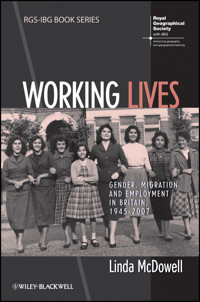
Full of unique and compelling insights into the working lives of migrant women in the UK, this book draws on more than two decades of in-depth research to explore the changing nature of women’s employment in post-war Britain.
- A first-rate example of theoretically located empirical analysis of labour market change in contemporary Britain
- Includes compelling case studies that combine historical documentation of social change with fascinating first-hand accounts of women’s working lives over decades
- Integrates information gleaned from more than two decades of in-depth research
- Revealing comparative analysis of the similarities and differences in the lives of immigrant working women in post-war Britain
- Features real-life accounts of women’s under-reported experiences of migration
Sie lesen das E-Book in den Legimi-Apps auf:
Seitenzahl: 626
Veröffentlichungsjahr: 2013
Ähnliche















Contents
List of Figures and Tables
Figures
Tables
Series Editors’ Preface
Preface: Leaving Home and Looking for Work
Part One Migration and Mobilities
Chapter One Leaving Home: Migration and Working Lives
Introduction: Geographical Journeys
Transforming Lives
Ordinary Lives
A Recent History: The Post-war Era
Note
Chapter Two Gendering Labour Geographies and Histories
Theoretical Locations
Women and Work, Gender and Waged Employment
Theorising Gender Divisions of Labour
The Inferior ‘Other’
Memories of Home: Diasporic Identities and Translation
Memory, Migration and the Making of Self
Dividing the Post-war Period
Chapter Three The Transformation of Britain
Migrant Workers in the Post-war Decades
The Numbers of Migrants in the UK
The Changing Origins of In-migrants
Managed Migration
Note
Part Two Out to Work: Embodied Genealogies
Chapter Four Post-war Reconstruction, 1945–1951
Displaced Persons and Post-war Austerity
Why Immigration was Needed: Post-war Labour Shortages in the UK
State Constructions of Difference
The Lives of Working Women
Separate Lives
Notes
Chapter Five Coming Home: The Heart of Empire, 1948–1968
Remembering the 1950s
Never Had It So Good?
Caring for the British
Labour Shortages in the Health Service
Recruitment and Nurse Training in the Post-war Decades
Stereotypes and Discrimination in the Wards
Irish Nurses: ‘The fools, the flirts, the failures and the Irish’
Women’s Work: Natural Talents and Innate Skills
Second-class Citizens
Notes
Chapter Six Years of Struggle, 1968–1979
Restricting In-migration
The End of Fordism and Industrial Unrest
The New South Asian Minority
Striking Women: The Dispute at Ford Dagenham
The Grunwick Strike, 1976–1978
Conclusions: A New Era?
Notes
Chapter Seven Privilege and Inequality, 1979–1997
Introduction: Good Times?
Social Change and Race Relations
Women Bankers in the City of London
Conclusions: Growing Inequality
Note
Chapter Eight Back to the Future: Diversity and Precarious Labour, 1997–2007
New Europeans
New Employment Relations and New Forms of Work?
Precarious Work
Employment Agencies and Migrants
Agency Workers at the Bottom End of the Labour Market
Top-end Agency Employment: Working in the NHS
Transnationalism, Cosmopolitanism and Inequality
Note
Chapter Nine Full Circle, 1945–2007
Global Migration and Labour Rights
At Home in the UK
Going Home
Cross-generational Connections
The Diverse Population of the UK
Conclusions: Migrant Women’s Place as Workers, Mothers and Cosmopolitan Hybrids
References
Appendix Post-war Legislation
Changes in Immigration Legislation
Other Recent Legislation that Improved Migrant Women’s Lives
Post-war Changes in Women’s Lives in the UK
Index
RGS-IBG Book Series
Published
Working Lives: Gender, Migration and Employment in Britain, 1945–2007Linda McDowellFashioning Globalisation: New Zealand Design, Working Women and the Cultural EconomyMaureen Molloy and Wendy LarnerDunes: Dynamics, Morphology and Geological HistoryAndrew WarrenSpatial Politics: Essays for Doreen MasseyEdited by David Featherstone and Joe PainterThe Improvised State: Sovereignty, Performance and Agency in Dayton BosniaAlex JeffreyLearning the City: Knowledge and Translocal AssemblageColin McFarlaneGlobalizing Responsibility: The Political Rationalities of Ethical ConsumptionClive Barnett, Paul Cloke, Nick Clarke and Alice MalpassDomesticating Neo-Liberalism: Spaces of Economic Practice and Social Reproduction in Post-Socialist CitiesAlison Stenning, Adrian Smith, Alena Rochovská and Dariusz ŚwiątekSwept Up Lives? Re-envisioning the Homeless CityPaul Cloke, Jon May and Sarah JohnsenAerial Life: Spaces, Mobilities, AffectsPeter AdeyMillionaire Migrants: Trans-Pacific Life LinesDavid LeyState, Science and the Skies: Governmentalities of the British AtmosphereMark WhiteheadComplex Locations: Women’s Geographical Work in the UK, 1850–1970Avril MaddrellValue Chain Struggles: Institutions and Governance in the Plantation Districts of South IndiaJeff Neilson and Bill PritchardQueer Visibilities: Space, Identity and Interaction in Cape TownAndrew TuckerArsenic Pollution: A Global SynthesisPeter Ravenscroft, Hugh Brammer and Keith RichardsResistance, Space and Political Identities: The Making of Counter-Global NetworksDavid FeatherstoneMental Health and Social Space: Towards Inclusionary Geographies?Hester ParrClimate and Society in Colonial Mexico: A Study in VulnerabilityGeorgina H. EndfieldGeochemical Sediments and LandscapesEdited by David J. Nash and Sue J. McLarenDriving Spaces: A Cultural-Historical Geography of England’s M1 MotorwayPeter MerrimanBadlands of the Republic: Space, Politics and Urban PolicyMustafa DikeçGeomorphology of Upland Peat: Erosion, Form and Landscape ChangeMartin Evans and Jeff WarburtonSpaces of Colonialism: Delhi’s Urban GovernmentalitiesStephen LeggPeople/States/TerritoriesRhys JonesPublics and the CityKurt IvesonAfter the Three Italies: Wealth, Inequality and Industrial ChangeMick Dunford and Lidia GrecoPutting Workfare in PlacePeter Sunley, Ron Martin and Corinne NativelDomicile and DiasporaAlison BluntGeographies and MoralitiesEdited by Roger Lee and David M. SmithMilitary GeographiesRachel WoodwardA New Deal for Transport?Edited by Iain Docherty and Jon ShawGeographies of British ModernityEdited by David Gilbert, David Matless and Brian ShortLost Geographies of PowerJohn AllenGlobalizing South ChinaCarolyn L. CartierGeomorphological Processes and Landscape Change: Britain in the Last 1000 YearsEdited by David L. Higgitt and E. Mark Lee
Forthcoming
Smoking Geographies: Space, Place and TobaccoRoss Barnett, Graham Moon, Jamie Pearce, Lee Thompson and Liz TwiggMaterial Politics: Disputes Along the PipelineAndrew BarryPeopling Immigration Control: Geographies of Governing and Activism in the British Asylum SystemNick GillThe Geopolitics of Expertise: Knowledge and Authority in an Integrating EuropeMerje KuusThe Geopolitics of Expertise in the Nature of Landscape: Cultural Geography on the Norfolk BroadsDavid MatlessFrontier Regions of Marketization: Agribusiness, Farmers and the Precarious Making of Global Connections in West AfricaStefan OumaArticulations of Capital: Global Production Networks and Regional TransformationsJohn Pickles, Adrian Smith and Robert Begg, with Milan Buček, Rudolf Pástor and Poli RoukovaOrigination: The Geographies of Brands and BrandingAndy PikeMaking Other Worlds: Agency and Interaction in Environmental ChangeJohn WainwrightEveryday Moral Economies: Food, Politics and Scale in CubaMarisa Wilson
This edition first published 2013© 2013 John Wiley & Sons, Ltd
Wiley-Blackwell is an imprint of John Wiley & Sons, formed by the merger of Wiley’s global Scientific, Technical and Medical business with Blackwell Publishing.
Registered OfficeJohn Wiley & Sons, Ltd, The Atrium, Southern Gate, Chichester, West Sussex, PO19 8SQ, UK
Editorial Offices350 Main Street, Malden, MA 02148-5020, USA9600 Garsington Road, Oxford, OX4 2DQ, UKThe Atrium, Southern Gate, Chichester, West Sussex, PO19 8SQ, UK
For details of our global editorial offices, for customer services, and for information about how to apply for permission to reuse the copyright material in this book please see our website at www.wiley.com/wiley-blackwell.
The right of Linda McDowell to be identified as the author of this work has been asserted in accordance with the UK Copyright, Designs and Patents Act 1988.
All rights reserved. No part of this publication may be reproduced, stored in a retrieval system, or transmitted, in any form or by any means, electronic, mechanical, photocopying, recording or otherwise, except as permitted by the UK Copyright, Designs and Patents Act 1988, without the prior permission of the publisher.
Wiley also publishes its books in a variety of electronic formats. Some content that appears in print may not be available in electronic books.
Designations used by companies to distinguish their products are often claimed as trademarks. All brand names and product names used in this book are trade names, service marks, trademarks or registered trademarks of their respective owners. The publisher is not associated with any product or vendor mentioned in this book. This publication is designed to provide accurate and authoritative information in regard to the subject matter covered. It is sold on the understanding that the publisher is not engaged in rendering professional services. If professional advice or other expert assistance is required, the services of a competent professional should be sought.
Library of Congress Cataloging-in-Publication Data
McDowell, Linda, 1949–Working lives: gender, migration and employment in Britain, 1945–2007 / Linda McDowell.pages cmIncludes bibliographical references and index.
ISBN 978-1-4443-3919-2 (cloth) — ISBN 978-1-4443-3918-5 (pbk.)1. Women foreign workers—Great Britain—History—20th century. 2. Immigrant women—Employment—Great Britain—History—20th century. 3. Immigrant women—Great Britain—Social conditions—20th century. 4. Great Britain—Emigration and immigration—Social aspects—History—20th century. 5. Great Britain—Emigration and immigration—Economic aspects—History—20th century. 6. Great Britain—Economic conditions—20th century. 7. Great Britain—Social conditions—1945HD8398.A2M2955 2013331.4—dc23
2012051591
A catalogue record for this book is available from the British Library.
Cover image: Young women from Calcutta in London, 1957. © Popperfoto / Getty ImagesCover design by Workhaus
For my mother, Olive Morgan Leigh, born in September 1926, and my grandson, Toby Christopher McDowell, born in July 2009
List of Figures and Tables
Figures
4.1
Young women EVWs from the Baltic, queuing for a medical inspection at a reception camp in Britain, in September 1947, before being allocated employment
5.1
A young woman from the Caribbean arriving in England by ship, May 1961
6.1
The leader of the Grunwick strike: Mrs Jayaben Desai, 1976
7.1
One woman (at ten to the hour) among the male brokers on the floor of The Atrium, Lloyd’s of London
8.1
A migrant worker mopping the floor in a large hotel
Tables
3.1
UK population by nationality and birthplace, 2009–10
3.2
Foreign-born population in the UK in the second half of the twentieth century
3.3
Foreign-born population living in the UK, largest 25 groups, 2001
4.1
Total arrivals in the UK under the Baltic Cygnet and Westward Ho! schemes
5.1
The Caribbean population in Great Britain, 1951–84
6.1
Country of birth, Great Britain, 1971
7.1
Change in the earnings distribution in Great Britain, 1979–95, full-time employees
7.2
Principal employers of women in the UK, 1997
7.3
Non-British-born population of working age, UK, 1979 and 2000, by birthplace, %
8.1
The numbers of foreign nationals allocated a national insurance number in 2006/7
9.1
Ethnic composition of the population in 2001, UK
9.2
Economic activity of the working-age population by ethnic group, UK, 2004
Series Editors’ Preface
The RGS-IBG Book Series only publishes work of the highest international standing. Its emphasis is on distinctive new developments in human and physical geography, although it is also open to contributions from cognate disciplines whose interests overlap with those of geographers. The series places strong emphasis on theoretically informed and empirically strong texts. Reflecting the vibrant and diverse theoretical and empirical agendas that characterize the contemporary discipline, contributions are expected to inform, challenge and stimulate the reader. Overall, the RGS-IBG Book Series seeks to promote scholarly publications that leave an intellectual mark and change the way readers think about particular issues, methods or theories.For details on how to submit a proposal please visit:
www.rgsbookseries.com
Neil CoeNational University of Singapore
Joanna BullardLoughborough University, UK
RGS-IBG Book Series Editors
Preface: Leaving Home and Looking for Work
This book is about the migration of women in search of work and a better standard of living. It is also a book primarily about the UK. My purpose is to explore the changing character of the British economy and society over the long post-war years between 1945 and the economic crisis in 2008 through the eyes of women born elsewhere. It is a book for students, for my own and my children’s generation, and for the general reader who wants to know more about Britain in the past, and about the lives of their mothers and grandmothers over the sixty years that were perhaps one of the most optimistic periods in Britain’s history. It was certainly a time in which women’s lives changed almost immeasurably, as well as when the population became more diverse in its origins. There are many books about Britain in the post-war era, some straddling the entire period, others focusing on particular decades, but very few place women’s lives and voices, especially working-class women born elsewhere, at the centre of the text. This is their place here.
I want to illustrate the assumptions that are dominant at different times over more than half a century about who belongs in Britain and who does not, about how employment and motherhood are connected, about who gets what sorts of jobs and why, and the standards of living that these jobs permit. I also want to document the place of migrant women in Britain’s labour history, illustrating their contributions to economic growth and change and to providing for the needs of the population, often through working in caring roles. Some of the women whose lives I explore came to the UK by choice, others did not. Some might have been able to go home and chose not to, others were unable to return to their homeland. All these women made significant contributions to the UK through waged work and for some of them through their involvement in struggles and strikes to improve their own and others’ working conditions. Through their eyes, the huge changes that occurred in post-war Britain – in social attitudes, in politics, in sexual mores, in gender relations and in women’s rights, as well as in the structure of employment – are revealed, showing the ways in which migrant women were differentially included and excluded from these changes. The focus on women also helps to challenge assumptions – now less common than at the start of the post-war era – that work and employment is a male domain; that women, if they work at all, do so for ‘pin money’. Participation in waged work for these women was an economic necessity, through which they made a crucial contribution to household budgets and children’s lives. Further, as feminist scholars have insisted, waged work is but one part of women’s work. Domestic labour in the home is also work and needs analysis. Many of the women in this book not only undertook domestic work in their own homes but were paid a wage for doing the same tasks in someone else’s home.
My key aim is to explore the changing connections between immigration, employment and gender relations since 1945. Moving between places and going out to work typically challenge and reshape conventional assumptions about gender divisions of labour and the different responsibilities of men, women and children, in the home as well as in the workplace. The coincidence of the rise of women as workers in their own right and the focus on women’s lives in feminist scholarship has transformed the analysis of labour history and migration theory, giving women a new place at the centre of analysis. It is this coincidence that stimulated this book, which looks at women’s employment and migration histories and memories of their working lives in the post-war era.
The book has had a long gestation. Its origins lie in part in the history of migration for employment in my own family. My paternal great-grandparents were German Jews from Alsace-Lorraine who came to Manchester in the 1870s, both of whom found work in the then-expanding cotton textile industry. Their son, born in Manchester, married a woman from Scotland whose family had moved to England before the First World War. His early death meant that Margaret Dick Magee (her maiden name) had to seek waged work to support two young sons both during and just after the Second World War. On my mother’s side, there were Scots too who had also moved south to find work. And the men on this side of the family also died early. My maternal grandmother had to look for waged work on the death of her husband, picking up a range of casual jobs, ‘women’s work’ in housekeeping and casual charring jobs. My husband’s father too was a migrant: in his case from Northern Ireland, part of that generation of young men who joined the British armed forces at the end of the Second World War. Like many of his age and generation he lived in England until retirement, when he then went ‘home’. Our daughter, through marriage, has now provided another link in the history of Britain’s migrant population, as her husband’s father came to the UK, also to join the armed forces, but twenty years later than my own father-in-law. He came to the UK from Dominica and now in his fifties is also thinking of returning ‘home’.
Stories about these men and women’s transnational moves and new lives in Britain had always been in the background of my family’s history, but it was not until the late 1990s, when they merged with the work I had just begun on migrant women’s lives in the UK after the end of the Second World War, that I began to ponder the connections between the working histories of the migrant women in my own family and those of thousands of unknown others. I wanted to put women at the centre of a history of post-war migration as they too often feature only in the margins of the growing number of books exploring the relatively recent past. For a variety of reasons, however, it has taken me more years than I expected to complete the research for this book. Over these years I have accumulated a large number of debts – to colleagues, students, friends and family too numerous to all be mentioned individually. I must thank, however, the people who have undertaken, with and without me, some of the interviews on which the book is based. They are, alphabetically, Sundari Anitha, Anna Badyina, Adina Batnitzky, Gill Court, Sarah Dyer, Jane Dyson and Adam Ramadan. Sarah Daisy found some of the statistics I needed, checked the references and did some editing, as well as insisting that I did not forget to include women in professional occupations.
Writing the book coincided with a new set of family responsibilities which, as for many women, raised questions about how to negotiate different demands – from family, workplace colleagues, current and former graduate students. Like many women of my age – a baby boomer – rising longevity has produced what is sometimes termed a sandwich generation, with responsibilities for parents well into one’s own retirement age when children may not yet be launched on a career or may need help with their own children. Being part of a four-generational family brings great pleasures but often corresponding demands on time and money. This book took second place between 2010 and 2011 to sharing a household with my son, daughter-in-law and their son, Toby, whose presence brought me enormous joy but also distracted me from academic efforts. Nevertheless, this book is dedicated to my grandson, as well as to his great-grandmother. His life may also be one of migration – he and his parents moved in 2011 to Scotland from Oxford – but I expect it will be marked in different ways by gender divisions than my own life has been or those of the women whose histories are at the heart of this book. For some of them, migration entailed leaving their own family behind – a necessity that I find deeply moving. This book is also for all of them.
The research reported here has been funded variously over the years by the Economic and Social Research Council, the British Academy, the Arts and Humanities Research Council, St John’s College, Oxford, and the University of Oxford. I am extremely grateful to these bodies for their support and to all the colleagues, students and friends who have listened to me talk about different parts of the study at different times over many years now. Parts of some chapters include rewritten extracts from a number of journal articles published in Progress in Human Geography (2008), British Journal of Industrial Relations (2008), Social and Cultural Geography (2012) and Gender, Place and Culture (2012) and edited extracts from my books Capital Culture (Blackwell, 1997), Hard Labour (UCL Press, 2005) and Working Bodies (Blackwell, 2009). I thank the publishers, journal editors and co-authors of a number of the papers (Sundari Anitha, Adina Batnitzky, Sarah Dyer and Ruth Pearson) for their agreement to the inclusion of these extracts. While short extracts from a number of oral testimonies have been included in these publications, many of the testimonies have not and appear for the first time in this book.
This is the second book for which Jacqueline Scott, at Wiley-Blackwell, has been the commissioning editor. I should like to thank her, as well as Kevin Ward, who was the editor of the IBG series when I began to write, and Neil Coe, who had replaced him as I handed the book over. Brigitte Lee Messenger was a wonderful copy editor who pointed out and deleted all my stylistic tics. Finally, an anonymous reviewer provided valuable feedback: whoever you are, thank you.
Linda McDowellOxford
Part One
Migration and Mobilities
Chapter One
Leaving Home: Migration and Working Lives
Introduction: Geographical Journeys
One of the key rites of passage for growing numbers of young women is leaving home. Once associated for the majority with marriage and the move from a parental to a conjugal home, many young women now live independently for varying periods of time. In the industrial West, this has been related to the rising numbers of women in universities and with the growth in women’s labour market participation, enabling women increasingly to become financially independent and establish their own home. While once women’s lives were associated with the private spaces of the home and the local scale of the domestic, women in Britain are now part of the public sphere of waged work, where they participate in almost equal numbers to men. About 11 million men and women are now in waged work at the end of the first decade of the twenty-first century and the social construction of femininity is no longer as closely linked with domesticity as it once was.
These changes have in the main been a post-Second World War phenomenon. While something like a third of all women worked for wages for some part of their lives in the century before that war, the numbers began to rise after it, accelerating from the 1970s. Between the end of the Second World War and the new millennium, then, there has been a transformation of employment, class, culture and relationships between gender and employment that have radically changed many people’s lives. Men, as well as women, found that the older certainties about their place in the labour market were challenged by the rise of new forms of work, new patterns of labour market participation and growing diversity in the social characteristics of employees. Perhaps the most significant change in the last three decades or so in the UK, however, has been the extended participation of women, especially mothers, in the workforce.
For many women, however, leaving home to take part in the labour market has not been a growing privilege, associated with educational participation, but an economic necessity. In different ways, sometimes on a casual basis or for cash in hand, working-class women have always contributed to their households and single women, without the support of a wider household, have also of necessity had to look for employment. For all but the few who work at ‘home’, in their own domestic arena, earning a living, going out to work, necessarily involves a journey, as Alice Kessler-Harris (1982) signalled in the title of her now classic history of US women’s working lives: . Long before the establishment of capitalist social relations and the type of regulation that now characterises the formal labour markets of many societies, providing the daily essentials for everyday life often involved both long journeys and absences from the home. Travelling considerable distances was common among nomadic hunters and gatherers before the establishment of agriculture. From herders engaged in transhumance, moving between pastures on a seasonal or annual basis, to the peripatetic tramps, hobos and casual workers of national depressions, leaving home has been a correlate of making a living. For some, the migrations associated with employment have been more permanent or larger scale, across significant distances. In the transition to industrial capitalism and urbanisation in the West, hundreds of thousands of people moved from the countryside to the city; others moved across national boundaries to start a new life far from their country of birth. It is this group of people for whom leaving home also entails leaving their homeland that is the subject here.
Lesen Sie weiter in der vollständigen Ausgabe!
Lesen Sie weiter in der vollständigen Ausgabe!
Lesen Sie weiter in der vollständigen Ausgabe!
Lesen Sie weiter in der vollständigen Ausgabe!
Lesen Sie weiter in der vollständigen Ausgabe!
Lesen Sie weiter in der vollständigen Ausgabe!
Lesen Sie weiter in der vollständigen Ausgabe!
Lesen Sie weiter in der vollständigen Ausgabe!
Lesen Sie weiter in der vollständigen Ausgabe!
Lesen Sie weiter in der vollständigen Ausgabe!
Lesen Sie weiter in der vollständigen Ausgabe!
Lesen Sie weiter in der vollständigen Ausgabe!




