


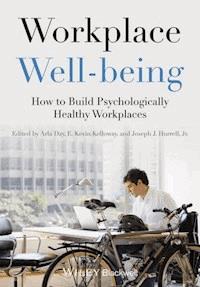
Workplace Well-being E-Book
44,99 €
Mehr erfahren.
- Herausgeber: John Wiley & Sons
- Kategorie: Geisteswissenschaft
- Sprache: Englisch
Workplace Wellbeing is a complete guide to understanding and implementing the principles of a psychologically healthy workplace for psychologists and other practitioners.
- Grounded in the latest theory and research yet filled with plenty of case studies and proven techniques
- Introduces the core components of psychologically healthy workplaces, including health and safety, leadership, employee involvement, development, recognition, work-life balance, culture and communication
- Addresses important issues such as the role of unions, the importance of leadership, healthy workplaces in small businesses, respectful workplace cultures, and corporate social responsibility
- Discusses factors that influence the physical safety of employees, as well as their physical and psychological health
- Brings together stellar scholars from around the world, including the US, Canada, Europe, Israel, and Australia
Sie lesen das E-Book in den Legimi-Apps auf:
Seitenzahl: 774
Veröffentlichungsjahr: 2014
Ähnliche




















CONTENTS
Cover
Title page
Copyright page
About the Editors
Contributors
Preface
References
Part I: Introduction
1 Building a Foundation for Psychologically Healthy Workplaces and Well-Being
The Historical Development of the Psychologically Healthy Workplace Construct
The Workplace as a Source of Demands and Stressors
The Workplace as a Health Resource
Definition and Components of a Psychologically Healthy Workplace
Discussion
References
2 Business Benefits of a Healthy Workforce
Workforce Health: Key Trends Affecting Businesses
Why a Healthy Workforce Is Good for Business
Reduced absence from work
Reduced accidents at work
Improved retention
Higher Employee Commitment
Higher Labor Productivity
Enhanced Employer “Brand”
Greater Employee Resilience
Persuading Business to Engage
Future Research on Workplace Health Interventions
Chapter Summary
References
3 Positive Psychology and the Healthy Workplace
A Societal Call for Positive Psychology
A Disciplinary Call for Positive Psychology
Positive Organizational Scholarship and Positive Organizational Behavior: Perspectives on Positive Psychology
Positive Organizational Research: The Debate
Broaden-and-Build Theory
Orientations to happiness
Psychological capital
Sustainable Happiness Theory
References
Part II: The Psychologically Healthy Workplace
4 Occupational Health and Safety
Conceptualizing OHS: Managing What Is Measured
Uses of OHS Performance Metrics
Classifications of OHS Performance Metrics
Limitations of Using Lagging OHS Measures
Key Individual Factors That Shape OHS Performance
Key Work Contexts That Shape OHS Performance
Key Organizational Factors That Shape OHS Performance
Challenges and Future Research Directions
References
5 Introduction to Work–Life Balance
Work–Life Constructs
Overview of Work–Family Theoretical Frameworks
Role Theory
Systems Theory
Boundary Theory
Work–Family Border Theory
Antecedents and Outcomes of Work–Family Conflict
Organizational and Policy Implications
New Directions in the Work–Family Field
Organizational Best Practices and the Corresponding Need for Intervention Evaluation
Concluding Comments
References
6 Employee Empowerment and Engagement
Introduction
What Is Empowerment?
The Measurement of Empowerment
Antecedents of Empowerment
Consequences of Empowerment
How Does Empowerment Enhance Engagement at Work?
Empowerment as a Driver of Work Engagement
A Theoretical Framework: The HERO Model
Empowering Work Engagement: Some Practical Strategies
A General Overview of the Chapter and Conclusions
Acknowledgment
References
7 Employee Development and Growth
What Do We Know?
Individual Differences Matter
Learners Need to be Active Not Passive
Learning Needs to be Challenging but Not Overwhelming
Postlearning Interventions are Useful
Climate can Facilitate (or Inhibit) Learning
What do We Need to Know?
Best Practices
Conclusion
References
8 Employee Recognition
Characteristics of Employee Recognition Programs
Motivational Bases for the Effects of Employee Recognition
Countereffects of Employee Recognition Programs
Conclusions and Implications
References
9 Culture, Communication, and Making Workplaces Healthier
Organizational Culture
Communication
Making Organizations Healthier
Examples of Best Practice
Directions for Future Research
Conclusions
References
Part III: Building a Psychologically Healthy Workplace
10 Respectful Workplaces
Respect as a Vital Resource
Workplace Mistreatment as a Workplace Demand
Conclusion
References
11 Leadership and Climate in a Psychologically Healthy Workplace
Leadership and Climate in Psychologically Healthy Workplaces: Relational Perspectives
Behavioral Leadership: Transformational Leaders’ Role in Creating Healthy Organizations
Transformational Leaders in Eldercare: An Example of Best Practice
Integrating Relational and Behavioral Perspectives on Leadership
Leaders Managing Healthy Organizational Change
Future Research on Leadership and Climate in Creating Psychologically Healthy Workplaces
References
12 Unions and Changes in Working Life
Challenges
Psychologically Healthy Workplaces: The Union Perspective
Health and well-being initiatives
Discussion
Concluding Remarks
References
13 Corporate Social Responsibility and Psychologically Healthy Workplaces
Academic Focus on CSR
Construct Definitions
CSR and Psychologically Healthy Workplaces
Conclusion
References
14 Creating a Healthy Small Business
Small Businesses and the Healthy Workplace
Health Promotion Interventions and Small Businesses
How to Invest for Success: Interventions to Create a Healthy Organization
Creating a Healthy Climate for Small Businesses
Recommendations for the Creation of a Healthy Small Business
Directions for Future Research
References
15 Designing Healthy Workplaces
Introduction
Total Worker Health
Healthy Workplace Practices: Individual and Organizational Outcomes
Key Aspects of High-Performance Work Systems
Barriers to High-Performance Work Systems
High-Performance Work Systems and Total Worker Health
High-Performance Work Systems: Then and Now
High Involvement through Information Sharing and Participative Decision Making
Growth and Development (Training and Knowledge beyond Basic Job Skills)
Employee Recognition (Including Incentives and Reward Practices Linked to Performance)
High-Performance Work Systems and the Workforce of the Future
High-Performance Work Systems in an International Context
Directions for Future Research
Conclusion
Practical Questions for Managers in Designing High-Performance Work Systems Leading to Total Worker Health
Note
References
16 Concluding Comments
Health and Safety
Involvement, Empowerment, and Engagement
Work–Life Balance
Employee Growth, Development, and Recognition
Culture and Climate
References
Index
End User License Agreement
List of Tables
Chapter 09
Table 9.1 Summary of Change Process for Creating Healthy Workplaces.
Chapter 15
Table 15.1 Comparison of Various High-Performance Work Systems Definitions.
List of Illustrations
Chapter 01
Figure 1.1 Illustrative model of healthy workplaces.
Chapter 02
Figure 2.1 Consequences of poor workforce health.
Chapter 06
Figure 6.1 Adding empowerment to the HERO Model.
Chapter 09
Figure 9.1 Model of health culture and climate.
Chapter 13
Figure 13.1 Nomological network of CSR, organizational ethics, and psychologically healthy workplaces.
Chapter 15
Figure 15.1 The PATH model—practices for achievement of total health.
Guide
Cover
Table of Contents
Begin Reading
Pages
iii
iv
vii
viii
ix
x
xi
xii
xiii
xiv
xv
xvi
xvii
1
3
4
5
6
7
8
9
10
11
12
13
14
15
16
17
18
19
20
21
22
23
24
25
26
27
28
29
30
31
32
33
34
35
36
37
38
39
40
41
42
43
44
45
46
47
48
49
50
51
52
53
54
55
56
57
58
59
60
61
62
63
64
65
66
67
68
69
70
71
73
75
76
77
78
79
80
81
82
83
84
85
86
87
88
89
90
91
92
93
94
95
96
97
98
99
100
101
102
103
104
105
106
107
108
109
110
111
112
113
114
115
116
117
118
119
120
121
122
123
124
125
126
127
128
129
130
131
132
133
134
135
136
137
138
139
140
141
142
143
144
145
146
147
148
149
150
151
152
153
154
155
156
157
158
159
160
161
162
163
164
165
166
167
168
169
170
171
172
173
174
175
176
177
178
179
180
181
182
183
184
185
186
187
188
189
190
191
192
193
194
195
196
197
198
199
200
201
203
205
206
207
208
209
210
211
212
213
214
215
216
217
218
219
220
221
222
223
224
225
226
227
228
229
230
231
232
233
234
235
236
237
238
239
240
241
242
243
244
245
246
247
248
249
250
251
252
253
254
255
256
257
258
259
260
261
262
263
264
265
266
267
268
269
270
271
272
273
274
275
276
277
278
279
280
281
282
283
284
285
286
287
288
289
290
291
292
293
294
295
296
297
298
299
300
301
302
303
304
305
306
307
308
309
310
311
312
313
314
315
316
317
318
319
320
321
322
323
324
325
326
327
328
329
330
331
332
333
334
335
336
337
338
Workplace Well-being
How to Build Psychologically Healthy Workplaces
Edited by
Arla Day, E. Kevin Kelloway, and Joseph J. Hurrell, Jr.
This edition first published 2014© 2014 John Wiley & Sons, Ltd.
Registered OfficeJohn Wiley & Sons, Ltd, The Atrium, Southern Gate, Chichester, West Sussex, PO19 8SQ, UK
Editorial Offices350 Main Street, Malden, MA 02148-5020, USA9600 Garsington Road, Oxford, OX4 2DQ, UKThe Atrium, Southern Gate, Chichester, West Sussex, PO19 8SQ, UK
For details of our global editorial offices, for customer services, and for information about how to apply for permission to reuse the copyright material in this book please see our website at www.wiley.com/wiley-blackwell.
The right of Arla Day, E. Kevin Kelloway, and Joseph J. Hurrell, Jr. to be identified as the authors of the editorial material in this work has been asserted in accordance with the UK Copyright, Designs and Patents Act 1988.
All rights reserved. No part of this publication may be reproduced, stored in a retrieval system, or transmitted, in any form or by any means, electronic, mechanical, photocopying, recording or otherwise, except as permitted by the UK Copyright, Designs and Patents Act 1988, without the prior permission of the publisher.
Wiley also publishes its books in a variety of electronic formats. Some content that appears in print may not be available in electronic books.
Designations used by companies to distinguish their products are often claimed as trademarks. All brand names and product names used in this book are trade names, service marks, trademarks or registered trademarks of their respective owners. The publisher is not associated with any product or vendor mentioned in this book.
Limit of Liability/Disclaimer of Warranty: While the publisher and authors have used their best efforts in preparing this book, they make no representations or warranties with respect to the accuracy or completeness of the contents of this book and specifically disclaim any implied warranties of merchantability or fitness for a particular purpose. It is sold on the understanding that the publisher is not engaged in rendering professional services and neither the publisher nor the author shall be liable for damages arising herefrom. If professional advice or other expert assistance is required, the services of a competent professional should be sought.
Library of Congress Cataloging-in-Publication Data
Day, Arla.Workplace well-being: how to build psychologically healthy workplaces/edited by Arla Day, E. Kevin Kelloway, and Joseph J. Hurrell, Jr.pages cmIncludes bibliographical references and index.
ISBN 978-1-118-46946-0 (cloth) – ISBN 978-1-118-46945-3 (pbk.) 1. Industrial psychiatry. 2. Psychology, Industrial. 3. Employees–Mental health. 4. Employee health promotion. 5. Work–Psychological aspects. 6. Work environment–Psychological aspects. I. Kelloway, E. Kevin. II. Hurrell, Joseph J. III. Title.RC967.5.D39 2014158.7–dc232013050098
A catalogue record for this book is available from the British Library.
Cover image: © Creatas Images/ThinkstockCover design by Richard Boxall Design Associates
About the Editors
Arla Day, Saint Mary’s UniversityArla Day is Professor and Canada Research Chair in Industrial/Organizational (I/O) Psychology at Saint Mary’s University and a fellow of the Canadian Psychological Association. Dr Day is a founding member of two research and community outreach centers: the CN Centre for Occupational Health and Safety and the Centre for Leadership Excellence. She conducts research in psychologically healthy workplaces and has helped promote healthy workplaces through her work as chair of the Nova Scotia Psychologically Healthy Workplace Program and as steering committee member of the American Psychological Association (APA) Center for Organizational Excellence. She is an associate editor at the Journal of Occupational Health Psychology. Her research focuses on developing healthy employees and healthy organizations, in terms of creating and assessing interventions aimed at improving working conditions, psychological and physical health, and work and life balance.
Joseph J. Hurrell Jr., Saint Mary’s UniversityJoseph J. Hurrell Jr. is an adjunct Professor of Psychology at Saint Mary’s University in Halifax, Nova Scotia, and an affiliate of the Canadian National Center for Occupational Health and Safety. He is the current editor of the Journal of Occupational Health Psychology (which he cofounded) and holds Bachelor’s and Doctor of Philosophy degrees in Psychology from Miami University and a Master’s in Clinical Psychology from Xavier University. Prior to his current appointments, he was employed for over 30 years as a researcher and administrator by the U.S. CDC’s NIOSH. Dr Hurrell has authored over a hundred scientific publications and eight books, serves on the advisory boards of major U.S. occupational health and safety research and education programs, and is internationally recognized for his work.
E. Kevin Kelloway, Saint Mary’s UniversityKevin Kelloway is the Canada Research Chair in Occupational Health Psychology and professor of Organizational Psychology at Saint Mary’s University. A prolific researcher, he has published over 150 articles, book chapters, and technical reports in addition to three authored/edited books. In 2007, Dr Kelloway received the SMU President’s Award for Excellence in Research, and in 2009 he was named a fellow of both the Society for Industrial and Organizational Psychology and the Association for Psychological Science. In 2010, he was named a fellow of the Canadian Psychological Association. He is the Associate Editor of Work & Stress and the Journal of Organizational Effectiveness: People and Performance. He also serves on the editorial boards of the Journal of Applied Psychology and the Journal of Leadership and Organizational Studies, and Canadian Psychology. He is the Section Editor (Conceptual Reviews) for Stress and Health. He maintains an active consulting practice working with private and public sector organizations on issues related to occupational health, leadership, and human resource management.
Contributors
Julian Barling, Queen’s UniversityJulian Barling is the Borden Chair of Leadership in Queen’s University’s School of Business. His research focuses primarily on the antecedents and development of transformational leadership, the effects of leaders’ own mental health on their leadership, and counterproductive workplace behaviors (e.g., workplace aggression, sexual harassment). Julian is a fellow of the Royal Society of Canada, the Society for Industrial and Organizational Psychology, the Association for Psychological Sciences, the European Academy of Occupational Health Psychology, and the Canadian Psychological Association. His book The Science of Leadership: Lessons from Research for Organizational Leaders will be published by Oxford University Press in 2014.
Stephen Bevan, Lancaster UniversityStephen Bevan is Director of the Centre for Workforce Effectiveness at The Work Foundation, Lancaster University, and an honorary Professor at Lancaster University Management School. Previously Associate Director at the Institute for Employment Studies at Sussex University, Stephen has conducted applied research and policy evaluation in the fields of workforce health, human resource management, and reward strategy. Stephen has carried out research and policy work for the No. 10 Policy Unit, HM Treasury, the Cabinet Office, the Department of Health, the Department for Work and Pensions, and the European Commission. He has also advised many blue-chip companies on aspects of HR strategy and practice. In 2010, he was named in the Top 10 Most Influential HR Thinkers of the last five years by HR Magazine.
Peter Y. Chen, University of South AustraliaPeter Chen is Professor of Management, a fellow of the Society for Industrial and Organizational Psychology, and a member of the board of directors for MATES in Construction SA Ltd. He served as Associate Editor of the Journal of Occupational Health Psychology (2005–2010) and President of the Society for Occupational Health Psychology (SOHP) (2006–2007). Professor Chen was ranked 29th (2000–2004) based on ISI citation impact in 30 management journals. He has written or cowritten over 90 journal articles, book chapters, and encyclopedia entries.
Sharon Clarke, University of ManchesterSharon Clarke is Professor of Organizational Psychology at Manchester Business School, University of Manchester. She gained a first-class degree in psychology (Manchester, 1990) and a PhD in Organizational Psychology (Manchester, 1993), before becoming a lecturer in Applied Psychology at Aston University, and later joined UMIST (now the University of Manchester) in 1996. She has research interests in safety culture, safety climate, leadership, occupational stress, well-being and health. Her work has been widely published in leading academic and practitioner journals, national and international conferences, and coauthored books, including Human Safety and Risk Management (CRC Press, 2006). She has held a number of funded research grants, including from IOSH- and government-funded Knowledge Transfer Partnership (KTP). She is currently Associate Editor for the Journal of Occupational and Organizational Psychology and on the editorial boards of the International Journal of Stress Management and the Journal of Occupational Health Psychology.
Cary Cooper, Lancaster UniversityCary Cooper is Distinguished Professor of Organizational Psychology and Health at Lancaster University, United Kingdom; Chair of the Academy of Social Sciences; and President of RELATE. In 2001, he received the CBE from The Queen for services to organizational health. He serves on the Global Agenda Council on Mental Health and Well-Being of the World Economic Forum.
David M. DeJoy, University of GeorgiaDavid M. DeJoy (PhD, Pennsylvania State University) is Professor Emeritus of Health Promotion and Behavior and Founding Director of the Workplace Health Group in the College of Public Health at the University of Georgia. Dr. DeJoy has worked in the area of workplace safety and health for over 35 years as a researcher, instructor, and consultant. His areas of research include climate/culture, work organization, safe work practices, integrated programming, and theory-based intervention design/intervention effectiveness. Dave DeJoy is Professor Emeritus of Health Promotion and Behavior in the College of Public Health at the University of Georgia and founding director of the Workplace Health Group at the university. Dr DeJoy has served on numerous editorial boards, expert panels, review committees, and advisory panels at the national and international levels.
Lindsay J. Della, University of LouisvilleLindsay J. Della, PhD, is an Associate Professor of Communication at the University of Louisville. Dr Della received her PhD in health promotion and behavior from the University of Georgia in 2006 and holds a Master of Science in Integrated Marketing Communication from Northwestern University. Over the last decade, Dr Della has served as a research consultant for CDC, Oak Ridge Institute for Science and Education, and several hospital systems in the Midwest. She possesses expertise in health communication, social marketing campaign planning, workplace health promotion, and theory-based health promotion intervention development and evaluation. In 2013, she was the recipient of the James A. Applegate Annual Award for Excellence in Research from the Kentucky Communication Association.
Caitlin A. Demsky, Portland State UniversityCaitlin A. Demsky, MSc, is a doctoral student at Portland State University in the Department of Psychology. Her research focuses on employee health and well-being, with an emphasis on the work–nonwork interface, recovery from work, workplace aggression, and intervention development. She received her MSc in Applied Psychology from Portland State University and is currently pursuing her PhD in Industrial/Organizational (I/O) Psychology with a focus in occupational health psychology.
Stephanie Gilbert, Saint Mary’s UniversityStephanie Gilbert is a doctoral candidate in I/O Psychology at Saint Mary’s University. Her dissertation research focuses on leader motivation, and her research interests also include positive psychology and occupational health psychology. Stephanie has a Master of Science degree from the University of Western Ontario in health and rehabilitation sciences and a Bachelor of Arts degree from Wilfrid Laurier University.
Clifford R. Haimann, George Mason UniversityClifford R. Haimann is an I/O Psychology PhD student at George Mason University. He studies a wide range of topics such as organizational support and the uses of personality in the selection context. He has also published on legal issues in I/O psychology.
Leslie B. Hammer, Portland State UniversityLeslie B. Hammer is a Professor of Psychology at Portland State University. She is the director of the Center for Work-Family Stress, Safety, and Health, one of six centers that make up the National Work, Family, and Health Network. Dr Hammer is also the Director of the Occupational Health Psychology Graduate Training Program at Portland State University that is funded through a training program grant from the NIOSH. She is the associate director of the NIOSH-funded Oregon Healthy Workforce Center (OHWC), one of four centers of excellence in Total Worker Health. Her research focuses on ways in which organizations can help reduce work and family stress and improve positive spillover among employees by facilitating both formal and informal workplace supports, such as family supportive supervisor behavior (FSSB) training.
Michael P. Leiter, Acadia UniversityMichael P. Leiter is Professor of Psychology at Acadia University in Canada and Director of the Centre for Organizational Research and Development (COR&D) that applies high-quality research methods to human resource issues confronting organizations. He holds the Canada Research Chair in Occupational Health and Well-Being at Acadia University. He is a registered psychologist in Nova Scotia, Canada. Dr Leiter has received ongoing research funding for 30 years from the Social Sciences and Humanities Research Council of Canada (SSHRC) as well as from international foundations for his work on job burnout and work engagement. He is internationally renowned for his work in these areas. As a coinvestigator with On the Move, he focuses on the impact of mobility on developing and sustaining productive, fulfilling relationships at work.
Yiqiong Li, University of South AustraliaYiqiong Li is a postdoc research fellow at the University of South Australia. Her research focuses on human resource management and industrial relations. She has shown an early career record of high-quality research and has been collaborating with other scholars in the areas of workplace bullying, safety, leadership, and employee well-being.
Susana Llorens, Universitat Jaume ISusana Llorens is Associate Professor of Work Psychology at Universitat Jaume I, Castellón, Spain; member of the Work Organization Network (WoNT) Research Team (www.wont.uji.es); and Codirector of the Master’s in Work, Organizations, and Human Resources Psychology. Beside publications about burnout, technostress, workaholism, self-efficacy, work engagement, flow, trust, and healthy and resilient organizations, she is also developing research projects and immersed in organizational consultancy. She is also a fellow of the European Association of Work and Organizational Psychology (EAWOP), Spanish Society of Positive Psychology (SEPP), and Spanish Scientific Society of Social Psychology (SCEPS) and a member of the editorial board of the Spanish journal Psicología del Trabajo y de las Organizaciones. She currently serves as the secretary of the SEPP (http://www.sepsicologiapositiva.es).
Catherine Loughlin, Saint Mary’s UniversityCatherine Loughlin is a Canada Research Chair in Management at the Sobey School of Business at Saint Mary’s University. Prior to this, she taught at the University of Toronto and the Queen’s School of Business. She is interim director of the Centre for Leadership Excellence and teaches in the PhD program, Master’s in Technology Entrepreneurship and Innovation (MTEI), and master’s in business administration (MBA) programs at Sobey, where she has twice been nominated for MBA Professor of the Year. Her background is in occupational health psychology, and she supervises graduate student research in both management and psychology. She publishes in journals such as Human Relations and Human Resource Management and is on the editorial board of the Journal of Business and Psychology. Her research is funded by the Social Sciences and Humanities Research Council of Canada and the Nova Scotia Health Research Foundation (NSHRF). She regularly consults with industry and coaches senior executives in the area of leadership and health.
Danielle Mercer, Saint Mary’s UniversityDanielle Mercer is a second year PhD in management student at Saint Mary’s University. Prior to becoming a PhD student, she completed both her MBA and Bachelor of Commerce degrees at Memorial University of Newfoundland. Recently, she was awarded the SSHRC Joseph-Armand Bombardier Canada Graduate Scholarship for Doctoral Studies. Her research interests relate to leadership, gender, and healthcare.
Katharina Näswall, University of CanterburyKatharina Näswall is a professor at the University of Canterbury in New Zealand. The primary focus for her research is on work-related stress and well-being, with a special interest for uncertainty in the workplace, balance between work and life outside work, as well as factors that aid in coping with work-related stress, such as social support and leadership factors. She is also interested in the development and measurement of work stressors that may be associated with emerging factors in working life, such as how the expansion of the service sector changes the nature of work tasks. Currently, she is involved in research focusing on organizational and employee resilience, with a special focus on measuring employee resilience and organizational factors that enhance employee well-being and resilience during turbulent times. In addition to her research, she teaches and supervises students enrolled in the Applied Psychology Master’s Program at the University of Canterbury.
Karina Nielsen, University of East AngliaKarina Nielsen is Professor of Work and Organizational Psychology at Norwich Business School, University of East Anglia, United Kingdom. Her research interests lie within the area of new ways of working and changing organizations. She has researched extensively in the ways transformational leaders may influence employee well-being, in an individual as well as in a group context. She has published her work in journals such as Human Relations, Work & Stress, and The Leadership Quarterly. She currently serves on the editorial boards of Human Relations, The Leadership Quarterly, and the Journal of Business and Psychology and is an Associate Editor of Work & Stress.
Raymond A. Noe, Ohio State UniversityRaymond A. Noe is the Robert and Anne Hoyt Designated Professor of Management in the Department of Management and Human Resources at The Ohio State University. He received his BSc in Psychology from The Ohio State University and his MA and PhD in Psychology from Michigan State University. Professor Noe’s teaching and research interests are in human resource management, organizational behavior, and training and development. He has published articles on training motivation, employee development, work–life issues, mentoring, web-based recruiting, and team processes in leading academic journals. He has also authored three textbooks, which are widely adopted for undergraduate- and graduate-level courses in colleges and universities around the world. They include Fundamental of Human Resource Management (5th ed.), Human Resource Management: Gaining a Competitive Advantage (9th ed.), and Employee Training and Development (6th ed.), all published with McGraw-Hill/Irwin.
Ashlyn Patterson, University of GuelphAshlyn Patterson is currently a PhD student in I/O Psychology at the University of Guelph under the supervision of Dr M. Gloria Gonzalez-Morales. Her research focus is primarily in the area of workplace incivility. More specifically, she is interested in the role of negative emotions and emotion regulation in the spread of incivility. She is currently a consultant with Organization and Management Solutions (OMS) and in the past has worked at the COR&D. She previously completed her MA in I/O Psychology at the University of Guelph and her honors BA in Psychology at Acadia University.
Krista D. Randell, Saint Mary’s UniversityKrista Randell holds a Bachelor of Arts honors degree in Psychology from Memorial University of Newfoundland and a Master of Science in I/O Psychology from Saint Mary’s University. Her research has been focused on psychologically healthy workplaces—specifically the factors that define such workplaces and the outcomes for organizations. Krista is currently working in the private sector in a human resources specialist role for a technology company.
Jennifer L. Robertson, Western UniversityJennifer L. Robertson is an Assistant Professor of Human Resource Management in the Department of Management and Organizational Studies at Western University in London, Canada. Her research focuses on psychological issues involved in organizational environmental sustainability and the nature and prediction of leadership. Together with Julian Barling, she is the editor of The Psychology of Green Organizations, which will be published by Oxford University Press in 2014. Jennifer’s research has been published in the Journal of Organizational Behavior and The Leadership Quarterly.
Marisa Salanova, Universitat Jaume IMarisa Salanova is a full Professor of Social Psychology, specializing in work and organizational psychology, at the University Jaume I, Castellón, Spain. She is director of the WoNT Research Team at that university (http://www.wont.uji.es). She currently serves as the President Elect of the SEPP (http://www.sepsicologiapositiva.es). She has over 300 national and international publications on occupational health psychology (i.e., work stress, burnout, technostress, workaholism) and on positive psychology applied to work and organizations (i.e., work engagement, flow at work, self-efficacy, positive and healthy organizations, and organizational resilience). She is Associate Editor of Revista de Psicología Social and a member of international scientific associations such as EAWOP, International Association of Applied Psychology (HPAI), SOHP, and International Positive Psychology Association (IPPA).
Magnus Sverke, Stockholm UniversityMagnus Sverke is Professor of Work and Organizational Psychology and Head of the Division of Work and Organizational Psychology, Stockholm University, Sweden. He is also Extraordinary Professor at WorkWell: Research Unit for Economic and Management Science, North-West University, South Africa. His research interests include organizational change and its effects on employees, downsizing and job insecurity, labor market flexibility and employment contracts, employee attitudes and well-being, work climate and employee motivation, as well as career development. Several of the studies he is involved in investigate the effects of organizational characteristics (e.g., structure, climate, leadership, pay) and change (downsizing, mergers, privatization) on the individual. He has a special interest in union member attitudes and behavior and the role of unions in the contemporary world of work.
Lois E. Tetrick, George Mason UniversityLois Tetrick is the Editor of the Journal of Managerial Psychology and is the Director of the Industrial and Organizational Psychology Program at George Mason University. She is a fellow of the European Academy of Occupational Health Psychology, the the American Psychological Association (APA), the Society for Industrial and Organizational Psychology, and the Association for Psychological Science. Dr Tetrick’s research interests are in the areas of occupational health and safety, occupational stress, and the work–family interface. Her other area of research focuses on psychological contracts and the exchange relationship between employees and their organizations. A common underlying interest in both of these lines of research is incorporating a global perspective in understanding employees’ experiences of the work environment.
Michael J. Tews, Penn State UniversityMichael J. Tews, PhD, is an Assistant Professor in the School of Hospitality Management at the Pennsylvania State University. He received his PhD in Human Resource Management from the School of Hotel Administration at Cornell University and his MSc in Industrial Relations from the London School of Economics. His research addresses issues relating to employee selection, training and development, and retention in hospitality and service contexts. His research has appeared in outlets such as Academy of Management Annals, Group and Organization Management, International Journal of Selection and Assessment, Journal of Service Management, Journal of Vocational Behavior, Organizational Research Methods, and Personnel Psychology.
Preface
One of the trends of the 21st century is the notion of a healthy workplace. Although this concept is not new—the influential Work in America report is more than 30 years old and the NIOSH statement on work stress is nearly 25 years old (Sauter, Murphy, & Hurrell, 1990)—the suggestion that work can, and should, foster individual health has only recently become firmly ensconced in the corporate lexicon. A Google search of the phrase “healthy workplace” resulted in 43 million hits. Researchers have articulated models of healthy work (e.g., Grawitch, Gottschalk, & Munz, 2006; Kelloway & Day, 2005; Warr, 1987), and practitioner guidelines or “best practices” are readily available for organizations that wish to implement healthy workplace programming (see, e.g., http://www.healthy-workplace.org/bestpractices.html).
As researchers and practitioners, we applaud these efforts. The focus of most of our professional work is on the development of healthy workplaces, and we see this book as a natural outgrowth of these activities. Specifically, our intent in establishing this collection was to provide a comprehensive overview of the concept of psychologically healthy workplaces. To do so, we contacted leading figures in occupational health psychology and asked them to summarize the theory, empirical evidence, and organizational practices that lead to healthy work and healthy workplaces.
Each author, or team of authors, was asked to address a unique aspect of the healthy workplace, and we are confident that the resulting book is a comprehensive review of the “state of the art” in healthy workplace research and implementation.
The book is divided into three main sections. In the first three chapters, the authors “set the stage” for a more detailed consideration of the components of a healthy workplace. In Chapter 1, Arla Day and Krista D. Randell present the historical development and conceptual background of healthy workplaces, providing an overview and a framework for designing psychologically healthy workplaces. In Chapter 2, Cary Cooper and Stephen Bevan present the business case for developing healthy workplaces, examining both the individual and organizational outcomes. Finally, in Chapter 3, Stephanie Gilbert and E. Kevin Kelloway examine the influence of the positive organizational scholarship movement on healthy workplaces.
The specific psychologically healthy workplace components are reviewed in Chapters 4–11. A fundamental prerequisite for a psychologically healthy workplace is a physically safe workplace. In Chapter 4, Peter Y. Chen and Yiqiong Li examine occupational safety. In Chapter 5, Leslie B. Hammer and Caitlin A. Demsky examine the role of work–life balance in a healthy workplace. The research surrounding the components of employee empowerment and engagement is examined in Chapter 6 (Marisa Salanova and Susana Llorens). Raymond A. Noe and Michael J. Tews discuss organizational contributions to employee development and growth in Chapter 7. Issues around the underresearched area of employee recognition are discussed in Chapter 8 by Lois E. Tetrick and Clifford R. Haimann. David M. DeJoy and Lindsay J. Della examine how culture change and effective communication are integral to promoting a psychologically healthy workplace (Chapter 9). Both Chapters 10 and 11 deal with the importance of interpersonal relationships at work. In Chapter 10, Michael Leiter and Ashlyn Patterson focus on civil and respectful interactions and explore the flip-side of respect, including a discussion on the impact of bullying, harassment, and aggression on healthy workplaces. In Chapter 11, Karina Nielsen examines the specific role of organizational leaders in creating and maintaining a healthy workplace.
The next four chapters address the contextual elements of healthy workplaces and expansion of the healthy workplace models. In Chapter 12, Katharina Näswall and Magnus Sverke examine the role that labor unions have in substantially affecting the ability of an organization to create and sustain a psychologically healthy workplace. Jennifer L. Robertson and Julian Barling focus on the trend of organizations to contribute to healthy workplaces by “doing good” for their community in terms of corporate social responsibility (Chapter 13). In Chapter 14, Sharon Clarke reviews the concepts of a healthy workplace with special reference to the concerns and constraints of small and micro businesses. In Chapter 15, Catherine Loughlin and Danielle Mercer examine the context of creating healthy workplaces, linking work well-being to high-performance work systems.
Finally, in the last chapter of the book (Chapter 16), Joseph J. Hurrell, Jr. offers his perspective as a longtime occupational health researcher and observer of the field of occupational health psychology, presenting his thoughts on healthy workplaces and providing a consolidation of the themes and literatures from the previous chapters.
We believe that the resulting collection of work presents a strong overview of the healthy workplace movement. Although there is much work left to be done in creating healthy workplaces, we believe that this work rests on a strong conceptual and empirical base. Many researchers and practitioners, some of whom are represented in the current volume, have shown that it is possible and desirable to improve organizational practices. We hope that this collection spurs your interest in the topic and assists you in developing your own healthy workplace.
References
Sauter, S. L., Murphy, L. R., & Hurrell, J. J. (1990). Prevention of work-related psychological disorders: A national strategy proposed by the National Institute for Occupational Safety and Health (NIOSH).
American Psychologist
,
45
(10), 1146.
Part IIntroduction
1Building a Foundation for Psychologically Healthy Workplaces and Well-Being
Arla Day and Krista D. Randell
Saint Mary’s University, Halifax, NS, Canada
Healthy workplace awards, employee choice awards, and “top workplaces” honors have gained a high profile in the media in recent years, with both small businesses and large corporations being recognized as being among the best places to work, in terms of their tangible perks and psychological supports and benefits to employees, their business productivity, and their focus on social responsibility. In 2013, Google retained their title, leading Forbes list of 100 Best Companies to work for, for two consecutive years based on the “100,000 hours of subsidized massages it doled out in 2012 [as well as] three wellness centers and a seven-acre sports complex, which includes a roller hockey rink; courts for basketball, bocce, and shuffle ball; and horseshoe pits” (CNN Money, 2012). In Glassdoor’s 2013 Employee Choice Awards, Facebook was named Best Place to Work, offering benefits that “help employees balance their work with their personal lives, including paid vacation days, free food and transportation, $4,000 in cash for new parents, dry cleaning, day care reimbursement, and photo processing … employees also commented favorably about the opportunity to impact a billion people, the company’s continued commitment to its hacker culture, and trust in their chief executive Mark Zuckerberg” (Smith, 2012a).
Lesen Sie weiter in der vollständigen Ausgabe!
Lesen Sie weiter in der vollständigen Ausgabe!
Lesen Sie weiter in der vollständigen Ausgabe!
Lesen Sie weiter in der vollständigen Ausgabe!
Lesen Sie weiter in der vollständigen Ausgabe!
Lesen Sie weiter in der vollständigen Ausgabe!
Lesen Sie weiter in der vollständigen Ausgabe!
Lesen Sie weiter in der vollständigen Ausgabe!
Lesen Sie weiter in der vollständigen Ausgabe!
Lesen Sie weiter in der vollständigen Ausgabe!
Lesen Sie weiter in der vollständigen Ausgabe!
Lesen Sie weiter in der vollständigen Ausgabe!
Lesen Sie weiter in der vollständigen Ausgabe!
Lesen Sie weiter in der vollständigen Ausgabe!
Lesen Sie weiter in der vollständigen Ausgabe!
Lesen Sie weiter in der vollständigen Ausgabe!
Lesen Sie weiter in der vollständigen Ausgabe!
Lesen Sie weiter in der vollständigen Ausgabe!
Lesen Sie weiter in der vollständigen Ausgabe!




