


World Literature in Motion E-Book
22,99 €
Mehr erfahren.
- Herausgeber: ibidem
- Kategorie: Geisteswissenschaft
- Serie: Studies in World Literature
- Sprache: Englisch
By bringing in different degrees of circulation in different regions and languages, this collection shows that while literary centers do exist in what Pascale Casanova calls “the international literary space”, their power does not operate unilaterally and modes of intercultural circulation do exist beyond their control. The title “World Literature in Motion” highlights the fact that world literature is always already the product of certain modes of conceptual and material mobility and mediation.
Das E-Book können Sie in Legimi-Apps oder einer beliebigen App lesen, die das folgende Format unterstützen:
Seitenzahl: 766
Veröffentlichungsjahr: 2018
Ähnliche




















Table of Contents
Foreword
Introduction: A Manifesto for Critical World Literature Studies
Section 1: Postcolonial Institutions
The Zimbabwe International Book Fair and the Idea of Book Development
Athol Fugard as “Regional Writer”: Oxford University Press, Three Crowns, and Three Port Elizabeth Plays
The Politics of Censorship: The Making of The Penguin Book of South African Verse (1968)
Penguin’s People: The Information Research Department and British Publishing
Section 2: Recognition through Prizes
V. S. Naipaul's Booker Prize for In a Free State
Resituating the Author: Arundhati Roy, the Booker Prize and the Rhetoric of Authenticity
The Caine Prize for “African Writing”: A Continental Reading and Rewarding
The Failure of the Man Asian Literary Prize and the Politics of Recognition
Section 3: Minor Locations
Minor Literature, Minor Prizes: The Case of Mauritius
Cypriot Literatures and the World: Language, Nationalism, and the bildungsroman, 1960–1974
“The Page Becomes a Tape Recorder”: The Development of an Oral Literary Aesthetic through Caribbean Radio
Section 4: Translations beyond the Anglophone
Making a World of Literary Relations: The Representation of Indian Literature in the Chinese Journal Yiwen/Shijie wenxue, 1953-1962
The Curious Case of Exotic Translations in the South-East Balkans
The Arabian Nights in Chinese and English Translations: Differing Patterns of Cultural Encounter and World Literature
Kuunmong in Translations: A Visual Linkage Between the Past and the Present
Afterword
Notes on the Contributors
Acknowledgement
ibidem-Press, Stuttgart
Foreword
Peter D. McDonald and Michelle Kelly
That Flair Donglai Shi and Gareth Guangming Tan have elected to frame their first collective research publication as a manifesto for and example of a “critical world literary studies” is a source of particular pride to us, as co-teachers of the course in which the seeds of this wonderful collection of essays were sown. With impressive insight into the approaches, canons, and methods currently operating under the sign of “world literature”, Shi’s Introduction cuts through the various polemics to identify one of the fundamental questions for students and scholars of the field: what does one study when one studies world literature? Building on the injunction articulated by Stefan Helgesson and Pieter Vermeulen that world literature should be “investigated in its actuality”, Shi and Tan have assembled a group of early career and established scholars from around the world who offer various accounts of how literature emerges to prominence as world literature, and what is at stake in the scholarly framing of it as such. By focusing on the materiality of the object of study, in its full linguistic and institutional complexity, they reflect both the methodological necessity of giving definition to the emphasis on circulation by many of the field’s leading proponents and the institutional context from which Shi and Tan’s crucial questions first emerged. It seems in keeping with the self-reflexivity at the heart of this collection to sketch that context.
Many of the essays collected in this volume developed initially from Oxford University’s Master of Studies (M.St.) in World Literature in English, specifically the so-called “B-Course” that we have been co-teaching since 2013. While the programme’s “A-Course” offers students a grounding in some of the prevailing debates in world and postcolonial literature, the “B-Course” encourages them to approach these debates from a different perspective. With its origins in the scholarly traditions of early modern European humanism, this part of the masters programme reflects Oxford’s longstanding commitment to manuscript studies, editing and bibliography, though it is now officially billed as “Research Skills (Bibliography, Palaeography, Transcription, Book History etc.)”.
For us that “etc” has always been reassuring. For one thing, it creates space to think with and beyond the founding assumptions of the course, its European origins, and its established methods. For another, it gives us room to encourage students from all over the world to reflect on their own diverse experiences of literary studies, to develop new skills, questions and methods, and ultimately to produce new kinds of writing.
This is why we begin the seminar series on world book history with two, seemingly straightforward questions. How, we ask, did your academic training so far construe your primary object of study? And how did it expect you to engage with it?
About the first question, there is usually a debate. Some students point out that their courses, though primarily literary, included options on film and other visual media or advertising and other language-related cultural phenomena. The discussion does not last long, however. After a few minutes, a consensus begins to emerge: broadly speaking, their previous degrees privileged the text, specifically, the linguistic text, as the object of study. The approach or activity? Again, there is some debate because most of their courses required them to think about various critical methods and traditions. But, as with the first question, they soon agree that some or other version of “close reading” was always paramount.
Bearing in mind that we have students from a diverse range of countries and regions with very different linguistic and cultural backgrounds, the conclusion is surprising, perhaps even dismaying. At the start of the 21st century, no matter if you are studying in Africa, Asia, Oceania, Europe, or the Americas, it appears that you spend most of your undergraduate years as a student of literature analysing texts up close. The “B course”, we then explain, does something different. In fact, it actively encourages students to question the guiding assumptions of their undergraduate courses, first by re-imagining the objects of study, and second by re-construing the basic protocols of critical enquiry.
If the centrality of the “B-Course” to Oxford’s masters programmes is in part an accident of institutional history, it has nonetheless converged with the challenge that has emerged in some articulations of world literature studies to give greater definition to the material realities of world literature. In this regard, Shi’s manifesto for a critical world literature studies, following Helgesson and Vermeulen, is to some extent building on the legacy of Pascale Casanova’s (2005) efforts to chart the contours of a “world literary space”. In “Literature as a World” she postulates “a mediating space [. . .] between literature and the world”, one that is “relatively autonomous” of politics and economics (as well as “relatively dependent” on them), and therefore a space in which “questions, debates, inventions of a specifically literary nature” and “struggles of all sorts—political, social, national, gender, ethnic—come to be refracted, diluted, deformed or transformed according to a literary logic, and in literary forms” (71–72, 85). While her World Republic of Letters offers one map through this space, and has been critiqued for its Eurocentricity among other things, she insists in the later essay that the world literary space she imagines “is no more than a tool that should be tested by concrete research, an instrument that might provide an account of the logic and history of literature, without falling into the trap of total autonomy” (72).
The collection of essays gathered here by Shi and Tan offers new routes through this world literary space, emphasising the ways in which its texts, forms and scholarly debates are shaped by “Postcolonial Institutions”, “Recognition through Prizes”, “Minor Locations”, and “Translations beyond the Anglophone”. Its objects of study are literary texts, archival resources, and paratextual and translational materials, and its methods are primarily bibliographic, book historical, and sociological—exactly the kind of “concrete research” that can test the textures and limits of Casanova’s world literary space.
This too reflects the aspirations of the Oxford “B” course, which we deliberately start outside the seminar room. In the first term of teaching, students are introduced to manuscript materials, rare books, artefacts and printed ephemera at the Bodleian’s Weston Library. The world book history seminars then begin with a morning in the archives of Oxford University Press, followed by an afternoon at Oxford Brookes University, which has among its collections the complete records of the Booker Prize. While these visits allow the students to develop their research skills in a practical, hands-on way, they also give them the chance to experience the pleasures of discovery, to see how theoretical and archival enquiry ideally inform each other, to consider the acts of curation shaping the various collections they encounter, and, perhaps most importantly, to get a feel for the creative possibilities the “B-Course” affords. The methods and materials of the course enable students to rethink the theoretical assumptions of their subject, whether the emphasis falls on the postcolonial or the world. Moreover, the dynamic processes of circulation and translation that we engage with put particular pressure on the idea of a world literature in English.
This wonderful volume of essays demonstrates the productivity of this line of critical inquiry. As it shows, once you lift your eyes from the screen or page, there are essentially no limits to the questions you can ask about the workings of a literary culture, its shaping power and your own place in it. All the expressive media come into view—gestural, oral, scribal, print and digital—as do the many ways in which texts of all kinds are created, published, sponsored, circulated, translated, read and prized. Even the category of “World Literature”, the academic field of “World Literary Studies” and the presumed anglocentricity of both come under scrutiny, since they are themselves caught up in these processes, rather than safely outside or above them.
Casanova begins “Literature as a World” with a key question: “Is it possible to re-establish the lost bond between literature, history and the world, while still maintaining a full sense of the irreducible singularity of literary texts?” (2005, 71). As her own work shows, she has been better at answering the first part. As this volume makes clear, however, much remains to be done when it comes to the second. How much room does critical world literary studies have for innovative literary writing and the worlds it creates? And how might a more sustained engagement with this encourage us to re-imagine, not once but repeatedly, the bonds between literature, history and the world that are never secure, always in the making? Moving deftly and self-reflexively across continents, institutions, languages, and media, the essays in this volume testify to the energy, ingenuity and creativity with which the exceptional group of students and colleagues with whom we have been lucky to work over the past five years have begun to address these questions. They have taught us, and now they can teach you.
Works Cited
Casanova, Pascale. 2005. “Literature as a World.” New Left Review 31 (Jan-Feb): 71–90.
Introduction: A Manifesto for Critical World Literature Studies
Flair Donglai Shi
When Franco Moretti (2000) declares that “world literature is not an object, it’s a problem” (55) in his now classic article “Conjectures on World Literature”, he is nonetheless envisioning a field of inquiry where “world literature” as such constitutes the primary object of study for his proposed method of “distant reading”, a mode of reading that produces “graphs, maps, and trees” of patterns, tropes, and other connections of form in literary works produced all over the world (1). However, a more pertinent and relatable way to conceive of “world literature” as a “problem” in the more mundane sense may come through imagining what “world literature” as a subject of study entails, for the average student or researcher identifying it as their primary discipline. This is especially relevant in the context of social settings where a certain level of existential anxiety is consistently evoked around self-reflective (and often self-deconstructive) questions of disciplinary boundaries, methodologies, efficacies and purposes. For example, in the most common scenario of academic socialising, where simple introductory questions such as “what do you study?” and “what is your research about?” come up, the answer “World Literature”, compared to more conventional terms like “English Literature” and “German Politics”, or even relatively new ones like “Neuroscience” and “Cybersecurity”, can immediately provoke presumptuous, even contemptuous, reactions: “What is that? Do you mean all of the literatures in the world? How many language classes do you have to do?” Each of these questions presents a unique set of challenges to the very legitimacy of “world literature” as an organising concept. While we may find it hard to give any succinct and definitive answer to the first question (even David Damrosch’s [2003] book-length effort, What is World Literature?, has generated more questions and contentions than easy answers, after all), it is equally difficult for us to summon the arrogance necessary to say yes to the second question. As for the last question, regarding linguistic competence, we are, first and foremost, obliged to admit that we rely on translations (especially into or from the English language), to the point that, in Susan Bassnett’s (2016) words, “we cannot conceive of World Literature without translation” (312). At the same time, we are also impelled to clear ourselves of the tacit sense of shame (for the implied lack of expertise in specific languages) associated with such reliance by arguing, à la David Damrosch, that translations afford an “expansion in depth” for literary texts and thus constitute independently productive and creative sites of scholarly investigation (2003, 289).
What such common social scenarios reveal is the high degree of self-reflexivity wired into the very ontological and conceptual foundation of “world literature”. To mitigate the confusion induced by this self-reflexivity, it is necessary to separate, rather than conflate, individual examples of “world literature” as objects of study (i.e. a set of literary texts and events to be analysed) and “World Literature” as a subject of study (i.e. a set of academic discourses and methodological debates). Understandably, such a separation can be difficult to envision or maintain because the latter is a meta-language in relation to the former, the conceptual boundaries of which in turn depend on this very meta-language. One solution to this “problem” of tautological tendencies, this volume contends, is to triangulate, and in effect clarify and affirm, this separation between “world literature” and “World Literature” with what Stefan Helgesson and Pieter Vermeulen (2016) call “critical world literature studies”. Helgesson and Vermeulen have proposed this term in their edited book, Institutions of World Literature, to highlight that world literature does not need to “be ‘defended,’ but [. . .] should be investigated in its actuality”, and the editors of this current volume believe that “critical world literature studies” as a discursive coinage can realise its full theoretical potential when it is applied to the investigation of the academic discourses of “World Literature” as well (2). That is to say, a critical approach to world literature studies takes as its object of study the very subject of World Literature itself, and more importantly, this critical gesture should be seen as a highlighted continuation of, rather than radical breakaway from, the self-reflective qualities of the subject. As Haun Saussy (2017) puts it, “the question has never been, ‘What is world literature?’, but ‘Whence comes this fantasy, and what is the hold it still has on us?’” (403). Utilising primary data such as literary texts, archival resources, and paratextual and translational materials, critical world literature studies reflects on the disciplinary motivations, theoretical validities, and discursive effects of the various academic discussions on world literature, rather than simply taking sides in the ongoing debate. In essence, critical world literature studies emphasises the materially-grounded specificity of socio-historical contexts, and it participates in the current debate on world literature with a sustained sense of meta-academic suspicion, especially with regards to the tautological, totalising, and reductive tendencies in the many theories of World Literature. As an alternative response to the aforementioned question of “What do you study?”, “critical world literature studies” may be a more complicated answer, yet it also more effectively pre-empts judgmental assumptions associated with “world literature” writ large, and allows the student or scholar in conversation to demonstrate the self-reflective and investigative power of what he or she actually does—“I study how certain literary texts come to be regarded as world literature” or “I study how people define and debate world literature as such”.
This introductory chapter presents a summative explanation of how critical world literature studies works. It is divided into four main sections to outline the different schools of thought in the ongoing debate in World Literature and synthesise them into the particular analytical angles and literary events this volume seeks to emphasise, including colonial institutions, global book prizes, and comparative translation studies. The first section identifies four major schools of thought in the post-millennial revival of world literature as a theoretical concept, including the idea of circulation proposed by David Damrosch (2003), the focus on international recognition found in the works of Pascale Casanova (2004) and Shu-mei Shih (2004), the prioritisation of politico-economic systems by Franco Moretti (2000), Mads Rosendahl Thomsen (2008), Alexander Beecroft (2015), and Warwick Research Collective (2015), and lastly, the philosophical shift towards “literary worlds” championed by Eric Hayot (2012) and Pheng Cheah (2016). To set up the opposition camp for these different propositions of world literature, the second section then presents three major responses from different disciplines, which argue against the notion of world literature and question the validity and desirability of many of the proposed methods of doing World Literature. They are the postcolonial response from Peter Hitchcock (2010), Magdi Youssef (2015), and Elleke Boehmer (2015), the comparatist response from Haun Saussy (2011) and Matthew Reynolds et al. (2015), and the provocative response from Emily Apter (2013) and Tim Parks (2015) from the vantage point of untranslatability. Situated in this more or less antagonistic structure of definitional, and sometimes ideological, contention, the third section singles out the sociological approach to world literature inspired by Robert Darnton’s (1982) “communication circuit” and Pierre Bourdieu’s (1986) theories on cultural capital. Highlighting the situatedness and analytical productivity of this particular approach, the current volume is closely associated with the pioneering research of scholars like Graham Huggan (2001), Sarah Brouillette (2007) and Peter McDonald (2016). Finally, the last section of this introduction identifies four key issues in the creation of world literature made more visible by the sociological approach and argues that they constitute a set of specific literary phenomena particularly germane to critical world literature studies. These four key issues serve as organising agendas corresponding to the four sections of this volume—“Postcolonial Institutions”, “Recognition through Prizes”, “Minor Locations”, and “Translations beyond the Anglophone”—and together they demonstrate both the inclusionary and the exclusionary power of world literature (as well as “World Literature”) as institutions and discourses.
What is World Literature? Circulation, Recognition, Systems, and Worlds
David Damrosch’s What is World Literature? is widely cited and regarded as the academic monograph that reactivated World Literature as a field of inquiry in the post-millennial age of intensified globalization, even though many of the primary texts used in this book have been, or at least could have been, studied in a range of pre-existing disciplines such as Classics, Modern Languages, and Comparative Literature. According to Damrosch, “world literature” is a useful organising concept for literary studies in so far as it allows us to see how much the process of circulation constitutes literature as such. For him, world literature refers to “all literary works that circulate beyond their culture of origin”, and when he states that “world literature is writing that gains in translation” (as a specific kind of circulation), the implicit emphasis is put upon the creative quality of literary texts as opposed to other more utilitarian forms of writing such as legal documents (2003, 4 and 281). In accordance to the meta-analytic spirit of critical world literature studies, this circulational mode of world literature can be applied to the so-called origin of the idea of world literature itself: the German writer Johann Wolfgang von Goethe’s notion of Weltliteratur, as recorded by his disciple Johann Peter Eckermann, was inspired by his reading of a contemporary Chinese novel (in translation, of course) and thus the product of literary circulation par excellence. However, as Jing Tsu (2011) has noted, this circulation was only possible because of the western missionaries based in the southern province of Canton—a geopolitical situation foreshadowing the rise of European imperialism in China. Like the Chinese novel read by Goethe, all literary circulations take place under specific conditions influenced by a set of political, economic, and cultural structures, and the problem with Damrosch’s definition of world literature, as Harish Trivedi (2013) rightly points out, is that “it need involve no more than what we are reading anyhow because it is already in circulation” (22). In other words, when critically examined, Damrosch’s idea of circulation has served as a productive point of departure for different interpretations of world literature exactly because it is overtly generic and has to be challenged by specific case studies. Since all texts can be said to be circulating in one way or another and the idea of “culture of origin” can only be as vague or clear as it is discursively (and subjectively) constructed (Thornber 2016, 108), it makes sense that, in following or refuting Damrosch’s definitions, many schools of thought have focused on the aforementioned structural factors shaping literary circulations instead.
This structural focus is most prominent in the theoretical approaches taken by a range of world literature scholars, who can be divided into two related schools of thought based on the different emphases in their methodologies and primary arguments. Firstly, Pascale Casanova’s La République Mondiale des Lettres and Shu-mei Shih’s proposition of “technologies of recognition” focus on the fixed range of mechanisms and structures of international recognition as the problématique of world literature (Shih uses the term “global literature” instead, but in this case the difference is only nominal). Informed by Pierre Bourdieu’s theories, Casanova’s “world republic of letters” is organised by the unequal distribution of literary capital, which results in a dichotomy between the international literary space, which she regards as the “autonomous pole” of world literature, and the national literary space, pertaining to the “politico-literary pole” of the same structure (2004, 105). In Casanova’s paradigm, Paris serves as the centre of world literature, followed by New York and London, because these places hold strong economic advantages, and more importantly, power of consecration, over the literary output of other regions and nations. With a much stronger anti-hegemonic stance, Shu-mei Shih’s article highlights four specific “technologies of recognition” employed by “the West” to secure its dominant position as “the agent of recognition” vis-à-vis “the rest” as “the object of recognition”, including “the systematic”, “the allegorical”, “global multiculturalism” and “the exceptional particular” (2004, 17). Notably, both Casanova and Shih cite the Chinese-French Nobel laureate Gao Xingjian as a prime example of the importance of western recognition for a writer’s mobility and reputation; Casanova even goes so far as to say that it is “owing to his knowledge of French” that Gao is able to make use of “Western literary innovations and techniques and [. . .] the aesthetic norms of the literary present” and become “the incarnation” of an international writer (2004, 152). However, this heavy emphasis on the power of western recognition has also been criticised by many scholars, who argue that such a lopsided emphasis on literary capital may perpetuate the “French (or Western) hegemony” of such oppressive structures as it neglects writers’ agency to negotiate their own (non-)recognition by different circles (Graham et al 2012, 467; Fang 2018, 7).
Secondly, another diverse group of scholars is also interested in structural inequalities, but their theoretical agenda differs from the recognition school in that they seek to describe or picture the overarching system(s) by which literary texts and their circulations are governed. Following the recent development of digital humanities, Franco Moretti’s method of distant reading testifies to his ideas on centres and peripheries borrowed from Immanuel Wallerstein’s world-system theory. Much like Wallerstein’s division of the world into dominant centres and dominated peripheries based on political and socioeconomic analyses, “world literature”, especially in the form of the modern novel, follows certain “law(s) of literary evolution” and consists of different combinations of “European literary forms” and “local (i.e. non-European) materials” (2000, 58 and 60). In relation to Casanova and Shih’s claims, such systemic descriptions of world literature can explain why “the west” holds the power of recognition in the first place. Taking this focus on the systemic further, the Warwick Research Collective (WReC) insists on “a single world-literary system” governed by “capitalism as a world-system” (2015, 8 and 14; original emphases). Guided by Fredric Jameson’s idea of a singular modernity and the Marxist interpretation of world literature as a result of the expansion of bourgeois capital, the WReC rejects the totalising division between the west and the rest and regards world literature as “the literature of the modern capitalist world-system” (15): literary texts that register the reality of capitalist modernity formally and thematically to various degrees. More recently, some scholars closely associated with the WReC, such as Sharae Deckard and Stephen Shapiro (2019), have sought to further extend this line of critique to examine the dynamics between neoliberalism and world cultures in more generic terms. Differing from the political inclinations of these paradigms, Mads Rosendahl Thomsen (2008) and Alexander Beecroft (2015) treat world literature as a more loosely connected kind of system. For Thomsen, it is made up of thematic constellations of literary texts that are “far apart in time and place” but nonetheless connected by what Ludwig Wittgenstein calls “family resemblances” (4); for Beecroft, it is a set of “empirically derived [. . .] ecologies”, which trace the development of literary texts in different historical periods in a non-evolutionary manner (2015, 27). Notably, for both of them, these systems and categories of “world literature” do not possess any essential meaning and only become meaningful when employed as modes of reading that serve to bring together a diverse range of texts and enable collaborative scholarly investigations. As such, they echo Damrosch’s original proposition that “world literature is not a set canon of texts but a mode of reading: a form of detached engagement with worlds beyond our own place and time” (2003, 281).
Dissatisfied with the privileging of “literature” over “world” in these interpretations of world literature as circulational or structural, a more recent addition to the definition debate can be found in the works by Eric Hayot (2012) and Pheng Cheah (2016). Informed by the philosophies of Mikhail Bakhtin and Martin Heidegger, they regard world literature not as mere material objects that exist and circulate in the physical world but as creative activities with world-constructive capabilities. For Hayot, literature generates and interacts with different “chronotopes”, or time-space formations, and its “resistance to the social and the normative locates itself precisely at this level of ungeneralisability” (2012, 16). Cheah’s book, What Is a World? (2016), draws on Edward Said’s discussion on “worldliness” and also emphasises the temporal dimension of world literature. For him, world literature as a temporal category possesses “an active power in the making of worlds that is both a site of processes of worlding and an agent that participates and intervenes in these processes” (2). Moreover, this philosophical shift to the internal power of literature warrants a distinction between this creative world literature and what Cheah, à la Jacques Derrida, regards as literatures of “the globe”—texts produced by the WReC’s singular system of global capitalism. On the one hand, this conceptual distinction is useful as it enables this philosophical school of world literature studies to align itself with the anti-global politics of scholars like Gayatri Spivak (2010), Duncan Chesney (2017), and Jaouad El Habbouch (2019) and at the same time affirms the interventionist agency of literature at global levels. On the other hand, as Karolina Watroba (2017) has argued, the contrast between such theoretical affirmation and promotion for “creative world literature” and the sometimes more-than-subtle scholarly disdain against global “popular literature” reveals an ironic tendency of certain academic discourses to fall back on “the tradition of Eurocentric elitism”, with their value judgements against the “low-brow” now packaged in a quasi-geopolitical language characterised by an increasingly moralistic tone (57).
Against World Literature: The Postcolonial, the Comparative, and the Untranslatable
As much as the definition of world literature remains in contention, there have also been many scholarly responses against the idea of world literature. Firstly, despite, or perhaps because of, the significant overlap in the range of contemporary literary texts they address, postcolonialism and world literature tend to encounter each other in conflict. For example, Peter Hitchcock (2010) is of the opinion that “world literature [. . .] allows one to consume postcolonialism without that nasty taste of social struggle in which a reader’s own cosmopolitanism may be at stake” (5). Focusing on the pedagogical effects of the discourse of world literature, Magdi Youssef (2015) has called for a decolonisation of world literature in order to prevent the field from being reduced to “the dominant and generally recognised European–US literary canon” (125). Similarly, Elleke Boehmer (2014) has expressed the worry that the “convergence of the postcolonial and the world” may usher in a kind of “post-postcolonial world literary studies” that in practice involve “the overwriting of the specificity of the former by the universal cultural values implied by the latter” (304–05). However, scholars like Helgesson (2014) and Cheah (2016) have sought to reconcile postcolonialism and world literature from different angles, and this effort is followed by 2019 special issues on this exact topic in the Journal of World Literature (Volume 4, Issues 3–4), edited by Bhavya Tiwari and David Damrosch. In a contribution that echoes Cheah’s emphasis on postcolonial creativity and literature as world-making activities, Helgesson notes that “because of their heightened awareness of the rift between subjective experience and institutionally sustained literary language, writers from colonies and postcolonies have been at the vanguard of world literature” (2014, 498). More indicatively, Boehmer has also moved towards this reconciliatory stance in her latest monograph, Postcolonial Poetics (2018), and affirms that
if world literary studies were to take on board radical postcolonial energies, this could produce a more mobile, expansive, and genuinely horizontal conception of the world than previously existed in the former domain, and, as a corollary, a constructive interrogation of still-definitive Eurocentric paradigms in both fields. (165)
As the chapters in the first section of this current volume demonstrate, these eclectic views are shared by many of our contributors.
Secondly, some Comparative Literature scholars have also expressed concerns for the intellectual rigour and institutional implications of World Literature as a disciplinary force. In a published conversation with David Damrosch, Haun Saussy contends that World Literature “may aid in a long-standing project of academic administrators, the reduction of all language and literature departments to subsets of the English department” (2016, 662). Not only has he called for the abandonment of “the use of ‘world literature’ to designate an international Winner’s Circle” (2011, 290), but Saussy is also worried that World Literature is “reining in [. . .] the wild interdisciplinarity of the founders (of Comparative Literature)” (2016, 662). Similarly, Matthew Reynolds et al. (2015) have declared that “the point of comparative criticism is to be a thorn in the side of ‘world literature’” as it gives “more opportunity for the texts at issue to challenge the critical categories that are brought to bear on them” (148 and 157). Finally, with regards to World Literature’s reliance on translated texts for many of the systemic statements in the field, Emily Apter (2013) argues that “incommensurability and what has been called the Untranslatable are insufficiently built into the literary heuristic” (3). Together with Tim Parks (2015), Apter has cautioned against World Literature’s tendency to homogenise and erase the linguistic and cultural specificities of literary texts which are brought into comparison or simply grouped together. Ironically but perhaps unsurprisingly, this abstract evocation of “the Untranslatable” has been criticised by scholars in Translation Studies, such as Lawrence Venuti (2016, 202) and Susan Bassnet (2019), as a “dubious” way of “side-stepping investigation into the actual processes of translation and the ideological frames within which translations happen” (6). Notwithstanding the polemical complexity of much of these disagreements, the editors of this volume acknowledge that the method of comparative criticism actualises the self-reflective and meta-academic spirit of critical world literature studies. To be specific, we believe that the analytical act of cross-cultural, and more importantly, cross-linguistic, comparison, when grounded in solid primary data from specific locations, makes clear the structural mechanisms and limitations of world literature in whichever definition mentioned so far. This method, explicitly or implicitly, can be found in all of the chapters collected in this volume (but most notably in those in the final two sections).
Creating World Literature: The Sociological Approach
As the two previous sections have summarised, the post-millennial debate on the idea of world literature has focused on the power of literary creativity vis-à-vis political, economic, and cultural structures, and much of it is driven by a predetermined set of ideologies and philosophical positions always already in conflict with one another. While we agree with Matthew Reynolds et al. that ideological reductionism is hard to avoid and “any critical or scholarly event (and theory, really) is necessarily to some extent hegemonic” (2015, 157), the editors of this volume believe that there is a need for a more ideologically neutral, materially grounded, and self-reflective way to study world literature (as well as the academic field of World Literature). As such, the very concept of world literature employed throughout this volume is “at best only a means, a way of pointing to the many worlds it both inhabits and creates” (McDonald 2019, 32). Applying Pierre Bourdieu’s theories on cultural capital to Book History as an interdisciplinary “field”, we follow Helgesson and Vermeulen’s advocacy of a sociological approach to world literature. Differing from the polemical efforts to determine what world literature is or should be, the sociological approach highlights the various processes in which world literatures are created as such—“an interrelated set of social phenomena” including “production, circulation, distribution and consumption”, and at the same time it allows literary works to manifest, via distant or close readings, as “disruptive acts of institution in their own right” (Helgesson and Vermeulen 2016, 12 and 14).
In his field-defining essay “What Is the History of Books?” (1982), Robert Darnton proposes “the Communication Circuit” to demonstrate that “the life of a book” is much more than its textual content and readership and requires an interdisciplinary approach from historians, sociologists, economists, and literary scholars to be fruitfully examined in full detail (81). He includes “publisher”, “printers”, “shippers”, “booksellers” and even “binder” and “ink” as important agents or factors in the making of a book, which interacts with an intersecting force of “intellectual influences”, “political and legal sanctions” and “economic and social conjuncture” (68). With the post-Cold War acceleration of global capitalism, recent scholarship in Book History has paid much more attention to the marketisation of the international book industry aided by a series of institutional publicities, such as book cover designs, academic endorsements, and book fairs and prizes. Taking the “global literary marketplace” as a field where different “forms of capital” circulate and intermingle, the editors and contributors of this volume seek to join this effort as we believe that these particular institutions offer valuable entry points towards a more grounded and productive critical world literature studies (Brouillette 2007, 44; Bourdieu 1986, 47).
This volume considers the sociological approach to be particularly germane to a more critical mode of world literature studies in relation to both its analytical features and methodological specificity. Firstly, it is more descriptive than prescriptive of literary texts and events and can be combined with other political and theoretical readings, which should facilitate, rather than dictate, the interpretation and analysis of the sociological observations and descriptions at hand. Secondly, it is inherently self-reflective in its awareness of both the constructive effects of academic meta-discourses and their limited capacities to “change the fundamental structuring realities that dictate which works are taught and read” (Brouillette et al. 2017, xxix). Indeed, as Raphael Dalleo’s (2016) edited volume, Bourdieu and Postcolonial Studies, shows, there has been a sociological turn in Postcolonial Studies that reflects upon “the neoliberal context of its own emergence” (2). Graham Huggan’s monograph, The Postcolonial Exotic (2001), has convincingly argued that the commercialisation of postcoloniality (often as thematic concerns regarding authenticity and identity) is now “integral to [. . .] the postcolonial field of cultural production—a field in which ‘commercial’ and ‘academic’ products intermingle” (121). Sarah Brouillette carries this claim further and uses her close reading of a range of popular or consecrated postcolonial writers to argue that this “marketability of postcolonial self-consciousness” has also come to be integrated into the textual content of much literature marketed as “postcolonial” or “global”. As these postcolonial critics’ scholarship has shown, not only has the rise of postcolonialism resulted in a kind of “strategic exoticism” that performs postcolonial identities for the global literary marketplace dominated by Euro-American institutions, but this “strategic exoticism” also keeps updating itself with heightened awareness of the political force of postcolonial critique in response to the reader’s “exoticising tendencies” (Brouillette 2007, 7). Similarly, sociological meta-analyses of the institutionalisation of “world literature” as a marketing/consecrating strategy and more importantly, as “a literary act” of intervention, can reveal both the “internal” and “external” forces that shape this “field of cultural production” (McDonald 2016, 42 and 51). This edited volume exerts and effectuates this institutional focus in many forms, including archival research on the founding of a particular book series (Katelyn Edwards), the observation on the evolution of book covers of a consecrated postcolonial classic (Carmen Thong), the successes and failures of multilingual book prizes in a specific location (Rashi Rohatgi), the rediscovery of socialist literary connections beyond the Western world (Yan Jia) and many more. The archival and comparative work underpinning all these projects guarantees that their critical reflections on the current debate on world literature are both original and grounded.
As Kelly Yin Nga Tse (2018) comments in her combined book review for the recent major publications in World Literature, despite the diverse views and agendas expressed by all the different schools of thought mentioned, their accounts of world literature are better viewed “as complementary rather than competing or conflicting” (452). The sociological approach to critical world literature studies, we want to stress, is an indispensable addition to the constellation of theories and methodologies in literary studies broadly conceived. Its materialist (but not necessarily a priori Marxist) mode of critique can both assist scholarship conducted from particular theoretical and ideological angles and re-evaluate their validities and effects, especially when “world literature” as such is prone to generic and totalising claims. Through the consistent emphasis on the agency of the primary data and contexts in question, we hope that the flexible and holistic qualities of this critical approach can offset the sense of fragmented territorialisation in the ever-expanding field of World Literature.
World Literature in Motion: Key Issues and Chapter Outlines
As the title of this volume suggests, critical world literature studies regard world literature as dynamic processes shaped and mediated by certain conceptual and institutional forces, which materialise in physical and organisational forms that can be taken as sociological evidence for scholars. The meaning of the thematic keyword “motion” in the title of our book, which brings all of the chapters together, is twofold. First, it refers to movement, mediation, and mobility and serves to emphasise the very dynamism of world literature. No matter whether it is taken as material circulation, institutional recognition, comparative or systemic modes of reading and interpretation, the creative acts of translation, or a combination of any or all of these different aspects of literary engagement, world literature is always already shaped by (inter-)textual movements. As an organising concept, it cannot intervene meaningfully in the global literary marketplace or in our current system of reading and critique without the mobility and flexibility to travel across different socioeconomic, politico-cultural, and intellectual contexts. Second, “motion” can also mean “proposal” and “discussion”, especially in the context of a debate, and the phrase “in motion” as employed in the title of our volume is to highlight the self-reflective nature of critical world literature studies. As mentioned in the opening section of this introduction, World Literature as an academic discipline can be confusing for “outsiders” and inconvenient for “insiders” because it conflates the object and subject of study. As long as this field of research keeps using the haughty modifier that is “(the) world” as one of its defining signifiers, meta-academic (self-)reflections are needed to keep the discipline in motion/check. What are the pragmatic gains of framing or defining world literature in a certain way, and for whom? As such, critical world literature studies may not make it any easier to pinpoint what world literature is, but it certainly makes clear what it is not: isolated and static.
With the characteristics of the sociological approach in mind, we propose the following four motions, each of which actively leads to a productive principle or original point of departure for research in critical world literature studies:
Postcolonial Studies is constructive of, rather than in conflict with, critical world literature studies, and the combination of the former’s attentiveness to colonial legacies and neo-colonial power structures and the latter’s grounded analysis of the institutional structures of a given literary activity can yield illuminating discoveries on the bigger picture of the political, economic, and cultural developments in the world today.
The literary prize, as the most important form of institutional recognition and consecration for authors and publishers, provides a particularly productive site of research for cases studies on the creation of world literature.
The discourse of world literature and its institutionalisation in the literary marketplace and academia can deliver pragmatic benefits by increasing the visibility and accentuating the importance of minor literatures in these fields.
Translations beyond the Anglophone, that is, between different languages that are not English (or at least between different contexts where English is not the primary linguistic medium), have been one of the blind spots in the current discussion in World Literature; however, combined with comparative criticism, they can be the most indicative object of research for world literature and complicate our understanding of how literary centres and margins work in practice.
The four sections of this volume are guided by these motions respectively, but the chapters in each section also use archival resources and/or multilingual close reading to testify to and reflect on the connections between them. The first section, “Postcolonial Institutions”, not only shows that both postcolonialism and world literature are disruptive of the neat divisions in national literatures but also highlights the continued relevance of colonial histories and repercussions in the institutionalisation of world literature in the postcolonial era. The four chapters in this section focus on the decolonisation period of the 1960s–70s and discuss how the state apparatus, publishers or literary events managed to fulfil their own ideological agendas through their interactions with and promotion of postcolonial texts as world literature. Rivkah Brown’s paper on the Zimbabwe International Book Fair examines UNESCO’s developmental agenda that lies behind the Fair, linking the intricate relations between its economic and social aspects to earlier colonial perceptions of the book as an economic tool. Similarly, Katelyn Edwards’s discussion of Oxford University Press and the career of Athol Fugard points out a new paradigm of exploitation of African textbook markets by using the “regional” label. Such exploitation of (post-)colonial connections also constitutes the central concern of Meleesha Bardolia’s and Gareth Tan’s archival research on the British company Penguin and the British Information Research Department respectively. Bardolia’s analysis of the correspondence between Penguin, Longmans Publishing and the South African editors of The Penguin Book of South African Verse (1968) reveals the way in which the book was modified to get through the censorship system in South Africa for commercial and political reasons. Rather than providing a univocal account of how external and global institutional pressures shape a national text, her chapter adds complexity to the story of the intersections between world literature and anthologies by highlighting the internal national complexity of this case study in apartheid South Africa. Offering a broader viewpoint, Tan’s paper shows that in the context of the anti-Soviet “Cultural Cold War”, the domestic publishing industry of the UK retained significant power over the ideological developments in the newly independent post-colonies. Together, these chapters constitute a holistic effort to bridge the gap between “the astuteness of postcolonialism as a symptomology of the contemporary world and the broader (but distinctly literary) comparative concerns of world literature” (Helgesson 2014, 498).
Taking this effort further and in more concrete forms, the second section, “Recognition through Literary Prizes”, moves from the ideological exploitation of books during periods of decolonisation to the politics of recognition of books in the contemporary era. The chapters in this section offer four different case studies on prominent international book prizes and their engagements with non-western writers. Drawing on a wide range of letters, media reports and paratextual materials such as book covers, Carmen Thong’s study of V.S. Naipaul’s 1971 award of the Booker Prize for In a Free State provides fresh insights into the many institutional contingencies of literary categories as well as the writer’s negotiation between institutional forces and their own creative agency. Her analysis reveals the process of adaptation the judges and coordinators of the prize had to undergo in order to capitalise on Naipaul’s unconventional “novel”. She also observes that as Naipaul accrues more cultural capital in his career, he is more willing to compromise his sense of agency. This forms a nice comparison with Lubabah Chowdhury’s chapter, which focuses on Arundhati Roy’s dealings with a forced notion of authenticity after receiving her Booker Prize in 1997. With particular attention to the management of the Booker’s public relations, Chowdhury argues that the compulsory marketing of Roy’s literary identity as a life writer is indicative of a wider problematic of postcolonial sexism in the international literary space. Moving from these two prominent postcolonial writers from the Caribbean and India, Sana Goyal’s study on The Caine Prize for African Writing shifts the focus to regimes of literary recognition related to the vast continent of Africa and problematises the very concept of “African Writing” itself. Engaging with Sarah Brouillette’s theories, she demonstrates the different struggles faced by African authors on their journey to literary authenticity and singularity. Finally, my own chapter on the Man Asian Literary Prize as an interesting phenomenon of institutional failure points to the partial agency of top-down recognition regimes in today’s neoliberalised global literary market. I seek to provide concrete examples of the practical difficulties of overcoming the ideologically entrenched expectations on non-western writers and literatures in a world literature space still dominated by American and European institutions. The four chapters in this section create intersecting critical dialogues as they all point towards the hierarchical power structures within the cultural domain in which the postcolonial marketplace and the space of world literature overlap. Moreover, all of them engage with James English’s (2005) discussion on the “economy of prestige” in relation to “the agency of the cultural prize” and demonstrate the need for a more nuanced understanding of this agency as a process of negotiation and compromise between the different institutional forces shaping the “international literary space” (320).
The third section, “Minor Locations”, shifts the institutional focus from recognition to location, and explores how texts may or may not transcend sociocultural boundaries in small island countries and regions. In accordance with Deleuze and Guattari’s (1986) concept of “minor literature”, this section addresses literary texts and events that originate in marginal geopolitical locations but operate in dominant European languages as efforts “to counter the hegemony of the majors” (D’haen 2016, 37). Rashi Rohatgi’s chapter offers a continuation of, as well as transition from, the previous section as it discusses the failure of two important local literary prizes in Francophone Mauritius. Rohatgi shows that the contradictory ideological forces behind these two prizes have contributed to the same nationalistic pretension of internationalism that fails to make Mauritius the centre of any literary worlds. In contrast, Daniele Nunziata uses the literary bifurcation in the island nation of Cyprus as a case study to show how international translations may provide a means by which writers of minor literature can escape divisive local politics and its multilingual oppressions. His chapter offers a compelling analysis of Cypriot writers’ constant negotiation with the Greek and Turkish hegemonies on the island and the balance they have managed to achieve by entering the anglophone markets. Lastly, Lucy Steeds’s chapter calls for a more inclusive view of (post-)colonial literary history by investigating the role played by multiple media forms in the making of anglophone Caribbean literature. The archival research in her chapter brings due attention to the role BBC radio programs played in the creation and dissemination of a particular kind of Caribbean aesthetic, which functioned as a unique aural design of marketing strategies and enabled a select group of writers to move from minor locations to being included in one of the major postcolonial canons in world literature. On the one hand, the three chapters in this section come together to emphasise that world literature is indeed “always necessarily located” and it is this geopolitical situatedness and sociocultural specificity that makes minor literatures particularly indicative of the larger institutional forces that govern the international circulation and recognition of world literature (Orsini et al 2018, 4). On the other hand, the very concept of “minor” is employed differently in each chapter and always discussed in relation to the structural influence exerted by certain larger systems—it is “a fungible attribute dependent on a comparative perspective and shifting cultural networks” (Bachner 2017,155). As long as there is “no getting away from major/minor questions” in World Literature (D’haen 2016, 37), it is our belief that to improve the visibility of minor literatures (especially those written in minor or indigenous languages not yet covered by this section) and to assert their value will continue to be important pragmatic tasks of critical world literature studies. After all, the sheer breadth of an interdisciplinary formation like critical world literature studies can at least create an enabling condition for us to embrace and highlight the contribution of such (ultra-)minor languages and literatures, which tend to be marginalized or ignored in the existing fields of academic research based on large geopolitical divisions (the Area Studies model) or Eurocentric theoretical frameworks (i.e. the different -isms in literary and cultural studies developed in Europe and North America).
Following the trans-regional and trans-lingual approach advocated by Karen Thornber (2009), Waïl Hassan (2013), Helgesson and Kullburg (2018), and Banerjee and Fritzsche (2018), the final section, “Translations beyond the Anglophone”, deepens the discussion on location through a series of specially solicited chapters on under-explored translational directions of regional literatures written by multilingual scholars. Yan Jia’s and Galina Rousseva-Sokolova’s case studies offer unique insights on literary exchanges outside of the Anglophone and Francophone spheres focussed on by most existing research in World Literature. Yan Jia’s study on the representation of Indian literature in the Chinese journal Yiwen/Shijie Wenxue uncovers the forgotten history of anti-Eurocentric literary relations guided by the dominant socialist ambitions during the Cold War. He contends that the journal constitutes an alternative “world of literary relations” without the west, which was constructed through a great deal of curatorial work, including the selection and interpretation of texts, the (re)framing of authors’ literary and political identities, and the strategic use of editorial devices. His analysis of this constructive process not only reveals but also reflects on this particular vision of world literature mediated by the diplomatic politics between India and China before their “rise” in the later game of global capitalism. In a more informative manner, Rousseva-Sokolova’s chapter provides a comprehensive overview of how the Bulgarian literary market is adapting to the change of socio-political environment after the Cold War and negotiates with the rising tide of translated literature from Asia, a form of (inter-)national and centripetal literary engagement beyond the postcolonial paradigm. As her chapter shows, the use of Russian and English translations in these inter-regional engagements has been diminishing but will not disappear soon due to practical considerations of the literary market and structural constraints imposed by the residual but still strong geopolitical power of Russia in East Europe and the global cultural hegemony of the English language.
Taking the relationship between translation and trans-location further, Wen-chin Ouyang’s and Yeogeun Kim’s papers offer comparative analyses of different translations of classical Asian texts into different languages. Ouyang’s comparative close reading of the English and Chinese translations of The Arabian Nights challenges the assumed effects of “Orientalism by proxy”—the migration of “western orientalism” into the Chinese view of the Islamic Middle East. Focusing on the particular editorial changes made to the plots and tropes in these different translations, she observes that in the process of such cross-cultural communication, literary norms and aesthetic traditions matter as much as the political and cultural structures surrounding the context of translation. Similarly, in the final chapter of this volume, Kim uses Kuunmong (Cloud Dream of the Nine), one of the most important classical Chinese texts from Korea, as an indicative case study for the translational circulation of world literature from a minor location. It covers Kuunmong’s centrifugal transnational afterlives in multiple East Asian and European languages, including modern Chinese, Japanese, Korean, Russian, German, Italian, Spanish, English and French, and offers a great terminal link between the multilingual trans-regionalism of this section and the concerns on the major/minor division of the previous one. Reflecting on the institutional (mal)functioning of the Literature Translation Institute of Korea (LTI Korea), an outreach project established by the South Korean government, Kim puts doubt on the efficacy of such top-down approaches to promoting literary circulation and notes that cultural appropriations of Kuunmong take place in both textual and visual forms despite the interventionist agendas of the government and publishers.
The editors of this volume consider the final section to be a particularly enriching contribution of this book to the field of World Literature for two reasons. First, even though postcolonialism and world literature can be fruitfully reconciled via the sociological approach highlighted in the first two sections, the current discussion on world literature has indeed been affected by the linguistic limitations of the former. As much as we see this book as an elaborate companion to Helgesson and Vermeulen’s Institutions of World Literature (2016), ours is also an attempt to overcome its conflation of postcolonial literature and world literature by bringing more languages to the table than the four dominant European languages (English, French, Spanish and Portuguese) to which their volume is limited. Notably, in a more recent publication that has emerged from the ongoing research program “Cosmopolitan and Vernacular Dynamics in World Literatures”, Stefan Helgesson (2018) and his colleagues in Sweden have started to emphasise the multiplicities of language, register, and genre within literary texts to further caution against the “equation between world literature and the global anglophone market for literary publishing” (6). Continuing this effort, this volume, especially in the last two sections, includes chapters on translation activities and book industries that operate through a more diverse range of languages (English, Bengali, Punjabi, Bulgarian, Italian, Japanese, German, Russian, Spanish, Chinese, Hindi, French, Arabic, Korean and Greek), involving regional circulations in East Asia, South Asia, the Middle East, Eastern Europe and Africa, in ways that are not necessarily mediated by postcolonial conditions. Through this wide coverage, these two sections illustrate our emphasis that the “world” in world literature is much more than the Anglo-sphere or the postcolonial world. Second, the trans-regional and trans-lingual focus of the final section demands significant revisions of Franco Moretti’s systemic claim that “movement from one periphery to another (without passing through the centre) is almost unheard of” (2003, 75). While all of the chapters in this section do reveal that English does operate as a “vanishing mediator” across the world’s disparate cultural–linguistic spaces and thus still exerts a significant amount of influence on the creation and circulation of world literature as such (Mufti 2016, 16), they also caution against the tautological and totalising application of Moretti’s model (with “centre” readily defined as the institutional or cultural space that “peripheries” have to pass through) and gesture towards a more democratic cartography of world literature that is fundamentally constitutive of its own multilingual, multi-directional development. Opposite to Moretti’s deterministic vision fixated on the hegemonic centre, we hope that the observations and arguments presented in this section can challenge literary scholars to at least imagine the very significance of “the translation of literature from one small peripheral language to another small peripheral language” in reshaping our ideas about the world and the operation of its cultural flows (Leppänen 2018, 97).
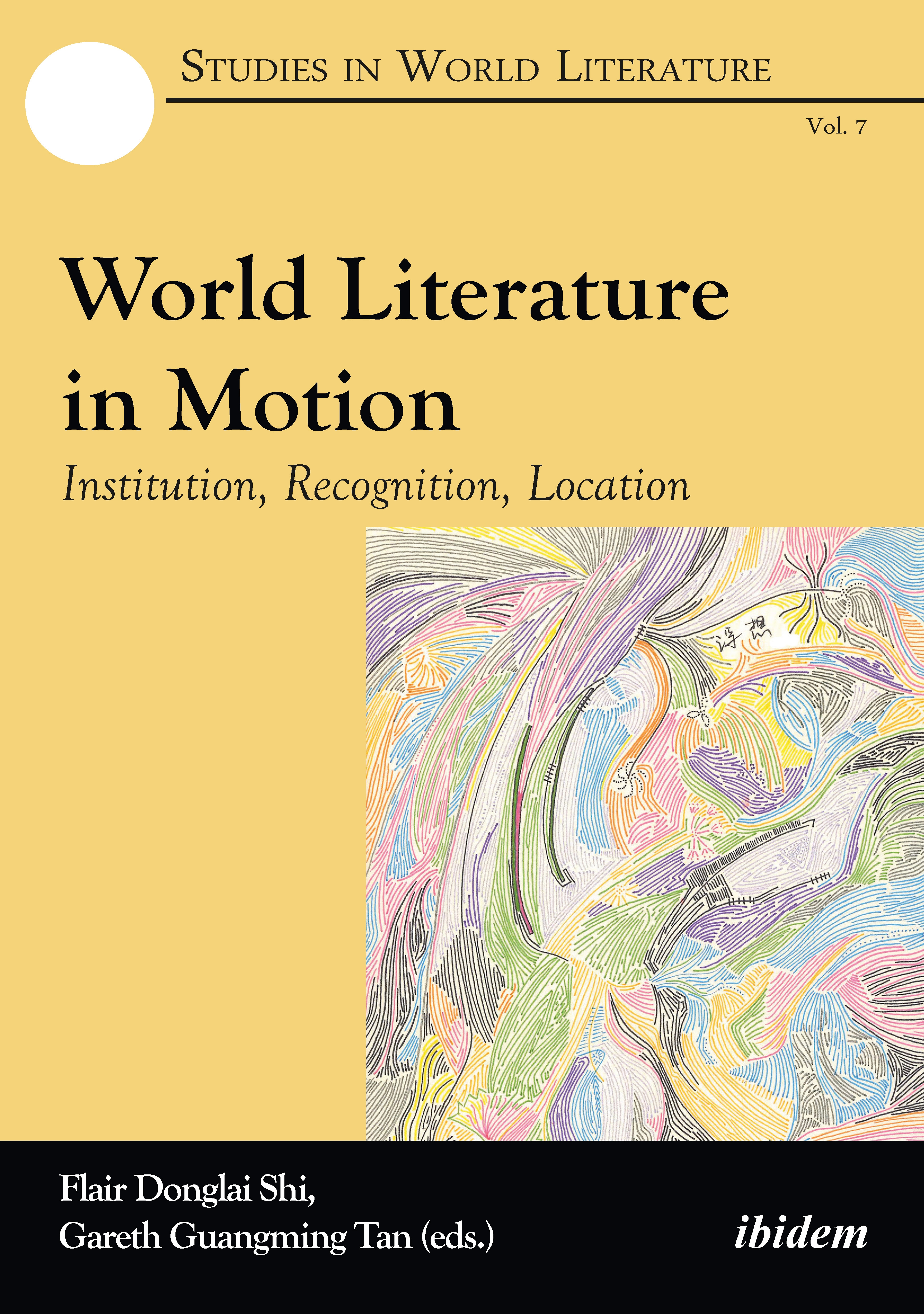
As a collection of theoretically informed, materially grounded case studies, this volume seeks to demonstrate how critical world literature studies can be practiced in the most concrete ways. However, as trained literary scholars, we are also highly aware of the irreducibility of literary texts and contexts and the analytical and performative nature of academic discourses. Indeed, texts, contexts, and (academic) meta-texts, much like world literature, are always in motion, as the boundaries and characteristics of “(the) world(s)” will always be different when examined through different perspectives or methods. In this sense, my amateur art piece featured on the cover of this book is to be taken as a visual representation of world literature, or rather, an abstract manifesto for critical world literature studies. Named “浮想 (floating ideas)”, it is a picture of kaleidoscopic motion with detectable traces of patterns or directions of various movements, and yet, upon closer look, there are always details that escape the rule and stand out. A constant flux of floating ideas, it implies, is what critical world literature studies consists of.
Bibliography
Apter, Emily. 2013. Against World Literature: On the Politics of Untranslatability. New York: Verso.
Bachner, Andrea. 2017. “At the Margins of the Minor: Rethinking Scalarity, Relationality, and Translation.” Journal of World Literature 2 (2): 139–57.
Banerjee, Anindita and Sonja Fritzsche, eds. 2018. Science Fiction Circuits of the South and East. Oxford: Peter Lang.
Bassnett, Susan. 2016. “The Figure of the Translator.” Journal of World Literature 1 (3): 299–315.
—. 2019. “Introduction: The Rocky Relationship between Translation Studies and World Literature.” In Translation and World Literature, edited by Susan Bassnett, 1–14. London: Routledge.
Beecroft, Alexander. 2015. An Ecology of World Literature: From Antiquity to the Present Day. London: Verso.
Boehmer, Elleke. 2014. “The World and the Postcolonial.” European Review 22 (2): 299–308.
—. 2018. Postcolonial Poetics: 21st-Century Critical Readings. London: Palgrave Macmillan.
Bourdieu, Pierre. 1986. “The Forms of Capital.” In Handbook of Theory and Research for the Sociology of Education, edited by J. G. Richardson, 46–58. New York: Greenwood.
Brouillette, Sarah. 2007. Postcolonial Writers in the Global Literary Marketplace. New York: Palgrave Macmillan.
Brouillette, Sarah et al. 2017. “Introduction.” In Literature and the Global Contemporary, edited by J. G. Richardson, xv–xxxviii. Cham, Switzerland: Palgrave Macmillan.
Casanova, Pascale. 2004. The World Republic of Letters. Trans. M. B. Debevoise. Cambridge, MA: Harvard University Press.
Cheah, Pheng. 2016. What Is a World? On Postcolonial Literature as World Literature. Durham, NC: Duke University Press.
Chesney, Duncan McColl. 2017. “An Essay against Global Literature: Literature and the Global Public.” Concentric: Literary and Cultural Studies 43 (20): 251–274.
Dalleo, Raphael. 2016. “Introduction.” In Bourdieu and Postcolonial Studies, edited by Raphael Dalleo, 1–16. Liverpool: Liverpool University Press.
Damrosch, David. 2003. What is World Literature? Princeton, NJ: Princeton University Press.
Darnton, Robert. 1982. “What Is the History of Books?” Daedalus 111 (3): 65–83.
Deckard, Sharae and Shapiro, Stephen, eds. 2019. World Literature, Neoliberalism, and the Culture of Discontent. Cham, Switzerland: Palgrave Macmillan.
Deleuze, Gilles, and Félix Guattari. 1986. Kafka: Toward a Minor Literature. Translated by Dana Polan. Minneapolis, MN: University of Minnesota Press.
D’haen, Theo. 2016. “Major/Minor in World Literature.” Journal of World Literature 1 (1): 29–38.
El Habbouch, Jaouad. 2019. “Decentering Globalization: World Literature, Terror, and the Postcolonial.” Interventions 21 (1): 1-34.
English, James. 2008. The Economy of Prestige: Prizes, Awards, and the Circulation of Cultural Value. Cambridge, MA: Harvard University Press.
Fang, Weigui. 2018. “Introduction: What is World Literature?” In Tensions in World Literature: Between the Local and the Universal, edited by Fang Weigui, 1–65. Singapore: Palgrave Macmillan.
Graham, James, et al. 2012. “Postcolonial Studies and World Literature.” Journal of Postcolonial Writing 48 (5): 465–71.
Hassan, Waïl. 2013. “Which Languages?” Comparative Literature 65 (1): 5–14.
Hayot, Eric. 2012. On Literary Worlds. New York: Oxford University Press.
Helgesson, Stefan. 2014. “Postcolonialism and World Literature.” Interventions 16 (4): 483–500.
— 2018. “General Introduction: The Cosmopolitan and the Vernacular in Interaction.” In World Literatures: Exploring the Cosmopolitan-Vernacular Exchange, edited by Stefan Helgesson et al., 1–14. Stockholm: Stockholm University Press.
Helgesson, Stefan and Pieter Vermeulen. 2016. “Introduction: World Literature in the Making.” In Institutions of World Literature: Writing, Translation, Markets, edited by Stefan Helgesson and Pieter Vermeulen, 1–20. London: Routledge.
Helgesson, Stefan and Christina Kullberg. 2018. “Translingual Events: World Literature and the Making of Language.”




