


World Press Photo Yearbook 2024 E-Book
29,99 €
Mehr erfahren.
- Herausgeber: Hatje Cantz Verlag
- Kategorie: Geisteswissenschaft
- Sprache: Englisch
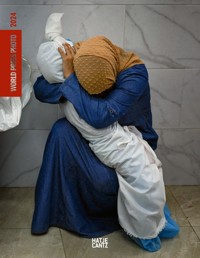
Independent photojournalism and documentary photography are indispensable tools of political education for a democratic society and an essential part of shaping public opinion—especially in our so-called 'post-factual' times. In recognition of this, the independent non-profit organization World Press Photo Foundation, based in Amsterdam, has been presenting the World Press Photo Award for the best photo, the best story, the best longterm project of the year for more than six decades. The winning images in the various categories tell bold stories and provide invaluable insights into the state of our world. A photograph by Mohammed Salem for Reuters from the Gaza war is the press photo of the year and also the cover illustration - it shows a Palestinian woman holding her five-year-old niece, who was killed when a missile hit her home in Khan Younis, Gaza, tightly on her lap.
Das E-Book können Sie in Legimi-Apps oder einer beliebigen App lesen, die das folgende Format unterstützen:
Seitenzahl: 90
Veröffentlichungsjahr: 2024
Ähnliche




















ABDALLAH ALWAN
Israel and the Occupied Palestinian Territory
ABDULHADI HABIB*
Israel and the Occupied Palestinian Territory
ABDULLAH DARWISH
Israel and the Occupied Palestinian Territory
ADEL ZOROB
Israel and the Occupied Palestinian Territory
ADHAM HASSOUNA
Israel and the Occupied Palestinian Territory
AHMAD JAMAL AL MADHOUN
Israel and the Occupied Palestinian Territory
AHMED ABU MHADI
Israel and the Occupied Palestinian Territory
AHMED AL-QARA*
Israel and the Occupied Palestinian Territory
AHMED FATIMA*
Israel and the Occupied Palestinian Territory
AHMED KHAIREDDINE
Israel and the Occupied Palestinian Territory
AHMED SHEHAB
Israel and the Occupied Palestinian Territory
ARMAN SOLDIN
Ukraine
ASSAAD SHAMLAKH
Israel and the Occupied Palestinian Territory
ASSEM KAMAL MOUSSA
Israel and the Occupied Palestinian Territory
AYAT KHADOURA
Israel and the Occupied Palestinian Territory
BILAL JADALLAH
Israel and the Occupied Palestinian Territory
BOHDAN BITIK
Ukraine
CRIS BUNDOQUIN
Philippines
DUAA JABBOUR
Israel and the Occupied Palestinian Territory
DUAA SHARAF
Israel and the Occupied Palestinian Territory
DUMESKY KERSAINT
Haiti
DYLAN LYONS
USA
FARAH OMAR
Lebanon
FRANCISCO JAVIER RAMÍREZ
Honduras
GOLAM RABBANI NADIM
Bangladesh
HALIMA IDRIS SALIM
Sudan
HANEEN KASHTAN
Israel and the Occupied Palestinian Territory
HASSOUNEH SALIM*
Israel and the Occupied Palestinian Territory
HISHAM ALNWAJHA
Israel and the Occupied Palestinian Territory
HOSEIN NADERI
Afghanistan
HUSAM MUBARAK
Israel and the Occupied Palestinian Territory
IBRAHIM MOHAMMAD LAFI*
Israel and the Occupied Palestinian Territory
ISSAM ABDALLAH*
Lebanon
ISSAM BHAR
Israel and the Occupied Palestinian Territory
IYAD MATAR
Israel and the Occupied Palestinian Territory
JABR ABU HADROUS
Israel and the Occupied Palestinian Territory
JAMAL AL-FAQAAWI
Israel and the Occupied Palestinian Territory
JAMAL MOHAMED HANIYEH
Israel and the Occupied Palestinian Territory
JEAN-JACQUES OLA BEBE
Cameroon
KHALIL ABU AATHRA
Israel and the Occupied Palestinian Territory
MAJD FADL ARANDAS*
Israel and the Occupied Palestinian Territory
MARTINEZ ZOGO
Cameroon
MOHAMAD AL-BAYYARI
Israel and the Occupied Palestinian Territory
MOHAMAD AL-IFF*
Israel and the Occupied Palestinian Territory
MOHAMED ABU HASSIRA
Israel and the Occupied Palestinian Territory
MOHAMED FAYEZ ABU MATAR*
Israel and the Occupied Palestinian Territory
MOHAMED MOUIN AYYASH*
Israel and the Occupied Palestinian Territory
MOHAMED NABIL AL-ZAQ
Israel and the Occupied Palestinian Territory
MOHAMED NASER ABU HUWAIDI
Israel and the Occupied Palestinian Territory
MOHAMMAD BALOUSHA
Israel and the Occupied Palestinian Territory
MOHAMMAD JARGHOUN
Israel and the Occupied Palestinian Territory
MOHAMMED ABU HATAB
Israel and the Occupied Palestinian Territory
MOHAMMED AL-SALHI*
Israel and the Occupied Palestinian Territory
MOHAMMED ALI
Israel and the Occupied Palestinian Territory
MOHAMMED IMAD LABAD
Israel and the Occupied Palestinian Territory
MOHAMMED SOBH*
Israel and the Occupied Palestinian Territory
MONTASER AL-SAWAF*
Israel and the Occupied Palestinian Territory
MOSSAB ASHOUR*
Israel and the Occupied Palestinian Territory
MOSTAFA BAKEER
Israel and the Occupied Palestinian Territory
MOSTAFA EL SAWAF
Israel and the Occupied Palestinian Territory
OLA ATALLAH
Israel and the Occupied Palestinian Territory
RABIH AL MAAMARI
Lebanon
RALIKONELO JOKI
Lesotho
ROEE IDAN*
Israel and the Occupied Palestinian Territory
ROSHDI SARRAJ*
Israel and the Occupied Palestinian Territory
SAED AL-HALABI
Israel and the Occupied Palestinian Territory
SAEED AL-TAWEEL
Israel and the Occupied Palestinian Territory
SALAM MEMA
Israel and the Occupied Palestinian Territory
SALMA MKHAIMER
Israel and the Occupied Palestinian Territory
SAMEEH AL-NADY
Israel and the Occupied Palestinian Territory
SAMER ABU DAQQA
Israel and the Occupied Palestinian Territory
SARI MANSOUR
Israel and the Occupied Palestinian Territory
SHAIMA EL-GAZZAR
Israel and the Occupied Palestinian Territory
SHASHIKANT WARISHE
India
YAHYA ABU MANIH
Israel and the Occupied Palestinian Territory
YANIV ZOHAR*
Israel and the Occupied Palestinian Territory
YASSER ABU NAMOUS
Israel and the Occupied Palestinian Territory
YOUSEF MAHER DAWAS*
Israel and the Occupied alestinian Territory
The list of names of journalists killed in 2023 was compiled using the database of the Committee to Protect Journalists (CPJ) in collaboration with Free Press Unlimited (FPU). The list and methodology are accessible via www.cpj.org/data. CPJ and FPU collaborate with Reporters Without Borders on addressing impunity for journalist killings in the project A Safer World for the Truth. All journalists in CPJ’s database known to work as photographers are indicated with *
According to the Committee to Protect Journalists (CPJ), 78 journalists were killed worldwide in reprisal for their work in 2023. Many more faced threats of violence and imprisonment for simply doing their job. Ongoing conflicts, rising authoritarianism, and divisive elections continue to imperil the work of journalists everywhere. World Press Photo seeks to raise public awareness of this urgent issue by showcasing the names of each journalist who was killed for their work in 2023, regardless of affiliation. CPJ researchers independently investigate and verify the circumstances behind each death listed here and consider a case “confirmed” only when it appears certain that a journalist was murdered in retaliation for their work; killed in combat or crossfire; or killed while carrying out a dangerous assignment. Each of the journalists listed here are confirmed deaths.
Based on the data, the Israel-Gaza war is one of the deadliest wars for the media on record. 65 of the 78 journalists killed in relation to their work in 2023 were killed in the war. 60 journalists were killed in Gaza, 2 Israeli journalists were killed in Israel from the Hamas raid, and 3 were killed in Lebanon. Israel is denying foreign journalists access to Gaza to freely report on the war, while local journalists are working under extremely dangerous conditions to document the conflict and help people understand its severity. World Press Photo acknowledges the bravery of this work and of the lives of all journalists lost in 2023.
WORLD PRESS PHOTO 2024
World Press Photo connects the world to the stories that matter. It is our mission to uphold press freedom and freedom of expression. Our work is guided by accuracy, trustworthiness, transparency, and authenticity. Our new strategy and focus for the contest over the past few years has been regional, aiming to represent stories from all parts of the world.
By showcasing the outstanding work of photojournalists and documentary photographers, and by placing their work in context, we hope this book will help create mutual understanding, foster discussion, and mitigate growing polarization. Amidst the hype and discussion around images generated by artificial intelligence, it’s useful to remember what makes a photograph unique.
We ask the jury to choose the stories that matter by awarding exceptional projects. We also ask the jury to award the work, not the situation. Choosing the winners of the contest is not about choosing sides, nor is it possible to show all perspectives. We ask the jury to choose personal stories with the power to speak universally.
OUR EFFORTS IN PERILOUS TIMES
JOUMANA EL ZEIN KHOURY EXECUTIVE DIRECTOR, WORLD PRESS PHOTO FOUNDATION
The period when the global jury of the World Press Photo Contest goes through its judging process is always my favorite time of year. I get to listen in while the jury reviews the events and discusses the images that have been submitted from around the world, and it is exciting! I feel it is a privilege to dive into so many stories, seeing and hearing perspectives on events from the previous year. Often, they are stories that have not made it into the global news. But ironically, this time of year is also very painful, as I am faced with how difficult, violent, and sometimes horrendous life can be.
Unfortunately, this past year has been no exception. It is not an exaggeration to say that we live in perilous times. It is not just the suffering in regional wars that threaten to escalate, or domestic political conflicts that seem intractable, or even new weather events that are increasingly severe and destructive. Humankind has lived through crises before. Believe me, as the director of an organization that has captured the history of news for almost 70 years, I know. But why do these times feel more perilous, more desperate? For me, the answer lies in a new rigidity, a dominance of fixed ideas, a failure, even a refusal, to understand others' perspectives: in sum, a disastrous lack of dialogue.
And that touches directly on what I see as the central role of World Press Photo: to showcase the work of photojournalists and documentary photographers and to provide additional information that places their work in context. The goal is to create better understanding, which can foster dialogues that break through fixed ideas and polarization.
As a major and respected visual institution with a very wide reach around the world, World Press Photo does not take this task lightly. It is at the forefront of everything we do. Placing stories in context every year requires rigorous research and fact-checking. We are extremely mindful of the sensitivity of language and take great care with the wording of our captions and publications.
After 7 October 2023, the most difficult ongoing story for photojournalists became the war in Gaza. Apart from the horrific humanitarian impact of the war, that conflict has also dramatically demonstrated the enormous pressure that photojournalism is under, starting with huge obstacles to access. It has been nearly impossible for foreign journalists to enter Gaza and report on the situation. Palestinian journalists in Gaza documenting what is happening cannot escape risking their lives, plus they often face the agonizing loss of colleagues, family and friends. According to the Committee to Protect Journalists, as of 4 April 2024, 95 journalists and media workers have been killed in the Israel-Hamas war, making it one of the deadliest on record for the media. Of those confirmed dead, 90 were Palestinians, 2 were Israeli, and 3 were Lebanese. The conflict claimed the lives of more journalists in three months than have ever been killed in a single country over an entire year. For us, as an organization that advocates photojournalism and documentary photography, the toll of this conflict is devastating.
Gaza has captured the world’s attention, but we are acutely aware that there are many other situations around the world where journalists are putting themselves in danger in order to document grim realities that otherwise would go unseen. World Press Photo believes it is essential to highlight legitimate stories produced by professionals, especially where they have taken risks to report stories that should matter.
That presents us, as an organization not driven by breaking news, with the question of how, in this searing news moment, we should strive to be fair. Is it our role to show all sides of a situation? Is it our role to offer answers? Both are impossible tasks. Still, fairness is our constant concern.




