


5,99 €
Mehr erfahren.
- Herausgeber: Frouse Books
- Kategorie: Fantasy und Science-Fiction
- Serie: House of Werth
- Sprache: Englisch
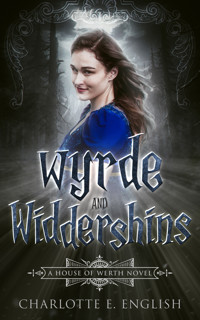
The best of times and the worst of tidings: it’s Hallowe’en at the House of Werth…
Augusta Honoria Werth. Deceased October 31st, 1821.
What passes for family peace is shattered (yet again) with the arrival of Nell, and the Book of Spectres. There, written in good black ink, is the date of Gussie’s death: three days from now, on Hallowtide itself.
Not just Gussie, but all the Werths are slated, somehow, to die. With a maleficent Book as the bearer of bad news, the recalcitrant tomes must be involved; but who’s behind the boisterous books, and why have they got it in for Gussie?
With no time at all to stave off disaster, and more than the family honour on the line, the Werths must pull together in the face of their greatest crisis yet. Not such a tall order, surely?
Rejoin the worst and Wyrdest of families at the spookiest time of the year! The Werths versus inevitable doom: what could possibly go wrong? WARNING, this tale will expose you to: rambunctious revenants, garrulous ghouls, and tumultuous (and terrifying) tomes, handle with care.
Das E-Book können Sie in Legimi-Apps oder einer beliebigen App lesen, die das folgende Format unterstützen:
Veröffentlichungsjahr: 2025
Ähnliche


















Wyrde and Widdershins
Charlotte E. English
Copyright©[Yearof First Publication] by [Author or Pen Name]
All rights reserved.
No portion of this book may be reproduced in any form without written permission from the publisher or author, except as permitted by U.S. copyright law.
Contents
Note:Thisisa partial, uncorrected proof copy that has been incorrectly distributed to you. If you’re seeing this, please contact customer support to have your copy updated to the final version.
October31st,evening
Dearest Booke,
I think I always knew, did not I? From the first moment that I saw you, lying upon the doorstep, patently intended for me. I knew when I took you up in my hands, felt the silk-smooth leather of your perfect covers. I knew when I readied my pen, and marked your pristine pages with the black scrawl of my thoughts.
I knew in my heart that, someday, you would try to kill me.
It is not that I blame you for the impulse; please do not think it. An urge to rend flesh from bone has come upon every one of us at one point or another, even if the benighted majority are too courteous to act upon it. And the fledgling tentacles you have manifested are not without their charm, like the soft down on the breast of a newly hatched robin. Quite appealing, in their way.
Still, I cannot agree with your apparent conclusion that my allotted time upon this earth has come to an end. Nor can I muster any enthusiasm for dear Great-Aunt Honoria's highly anticipated alternative, even if she is by far the most stylish revenant I have ever had the fortune to count among my acquaintance.
Nor can I forgive your sister-booke for its treatment of Theo. Yes, he is the grubbiest of souls, and unquestionably deserves to die, but was that really any excuse?
It pains me beyond expressing to say it, dearest booke, but the friendship we have so much enjoyed since our introduction has palpably come to an end. Friends do not murder one another. Relatives, certainly, but a higher standard of etiquette is expected of more distant relationships.
These are the last words I shall ever write in your crisp, snowy pages, though the thought quite cuts me to the heart. There, I am bleeding upon you, and it is all your own doing. If you will savage my hands as I write, you can hardly object to the consequences--oh, dear. That was extremely rude.
I must pin all my hopes upon the Coven. Naught but a grave and eldritch power can have any hope of retrieving Theo, or of countering your despicable machinations, dear booke. I cannot help but think Lord Felix would say, 'I told you so,' and with perfect justice.
How lowering a thought.
THREE DAYS EARLIER
A carriage drew up in a certain street in London--not too fashionable, this address, a cobbled road shadowed on both sides by tall, handsome townhouses. One of them hosted a family of some repute, a very strange family indeed, and it was at this abode that the carriage stopped, and disgorged its passenger.
The carriage was nothing to occasion much remark, and nor was its lady; the former being a little old and a little shabby, and the latter (if it is not too impolite to say so) much the same. Not that Mrs. Thannibour had yet arrived at any very advanced age, but motherhood had taken its toll; there were threads of grey in her dark mane of hair, and laugh lines etched around her eyes.
She was not smiling as she stood at the door, and knocked upon it. She clutched a book to her ample breast, a weighty tome of some antiquity. The firmness of her grip upon the thing might betoken fondness, perhaps.
The butler answered, an elderly, dignified sort with an air of reassuring efficiency: Goodspeed. 'Mrs. Thannibour,' he greeted her. 'A pleasant surprise. Miss Werth will be delighted.'
'Yes, I ought rather to have given notice of my coming, hadn't I?' Nell agreed. 'Only it all came about rather suddenly.'
She was ushered inside, of course, and her luggage (a pair of bandboxes) collected by a footman. She was not to be persuaded to relinquish her hold upon the book, however; knowing the family as he did, Goodspeed could only consider this a bad sign.
Miss Gussie Werth had heard the carriage's wheels clattering over the cobbles outside; heard it stop, too, and came down to investigate, for visitors were no daily occurrence at Werth House.
The sight of her elder sister crossing the hall in Goodspeed's wake brought her hurrying down the carpeted stairs in a burst of delight. 'Nell!' she crowed. 'You sly thing, not a word of warning? Though your usual chamber can be got ready for you in no time, I am sure--' Feeling, for a moment, unwontedly affectionate, she engulfed her sister in an embrace, through which the unyielding bulk of the tome Nell clutched, still, to her bosom, became too apparent to ignore.
As did Nell's unusually solemn demeanour. 'Dear Gussie,' she said, rigid in her sister's arms, 'I'm afraid I come on no very merry errand.'
'And here I thought it was the season that's brought you to us,' Gussie answered lightly, attempting to ignore a curl of unease.
'Well, and so it has, after a fashion.' Nell's grip on her book tightened further still, a sight that turned Gussie's unease into a flare of alarm. 'Is anybody else at home?'
Gussie shook her head. 'My aunt is out visiting, my uncle at some club or other, and Theo's at his rooms. There is only me.'
Goodspeed, lingering nearby, announced his continued presence with a delicate cough. 'I shall have Mrs. Thannibour's rooms made up, Miss Werth. If you intend to consult together, might I suggest Lord Werth's book-room?'
'Yes, thank you, Goodspeed,' Gussie answered, taking Nell's arm. 'And do pray send up some cakes and wine, poor Nell must be famished after her journey.' A wan complexion and a drawn visage suggested a night spent in ceaseless travel; Nell, patently tired, permitted herself to be shepherded into the book-room, and gently pressed into a chair. But when Gussie attempted to take the book from her, she shook her head.
'Don't,' she said briefly. 'I will show you, in a moment.'
Gussie withdrew to an armchair opposite, a comfortable piece she sank into with a sigh. Her uncle had had a fire laid earlier in the day, and the embers still glowed in the hearth. The book-room, ordinarily a cosy, comforting space, lay presently sunk in the gloom of a waning afternoon. The tall, upholstered chairs, polished reading tables and towering bookcases cast long shadows over the parquet floor. The arrival of the tea-tray, laden with lemon cakes and ratafia, came as a relief, and the maid being so obliging as to light several pungent beeswax candles before she departed, Gussie's feelings of foreboding eased.
Nell, however, evinced no immediate interest in either the food or the wine. She waited until the maid had gone, then said: 'Will you lock the door?'
'Lock the--?' Gussie stared. 'Surely that isn't necessary.'
'I hope it will not be.'
Gussie, wondering, rose, and turned the heavy iron key smartly in the lock. It clicked to with a snap. 'Now, please, tell me everything. My curiosity really will not permit me a moment's peace until you do.'
Moving with the caution of a woman handling a wild animal, Nell released her book, set it gently into her lap. Gussie waited, her breath suspended, expecting something to happen, but nothing did.
She recognised the book, she found. Aged, green leather covers, worn with use; thick vellum pages, the colour of bones; a large "W" embossed into the spine in gold. 'The book of spectres?' she guessed.
Nell nodded. 'I have had it with me these several months, ever since--well, you know.'
Ever since a fire had destroyed half of Werth Towers; Gussie nodded. Happily, much of the library had survived.
'I consult it quite often,' Nell continued. 'There is so frequently somebody coming to me with a question, or some difficulty, and the answers are sometimes to be found in here.' She rapped her knuckles against the book's cover; it thudded hollowly.
'Somebody deceased, you mean?' Gussie prompted. Nell's Wyrde blessed--or, in Gussie's opinion, cursed--her with the ability to converse with ghosts with as much ease as she interacted with the living. Nell exercised her maternal instincts as much on the spirits and spectres of Fothingale and Werth Towers as she did on her husband or her four children, and never resented it; miraculous.
'Yes, these are usually spectral consultations.' Nell gingerly opened the front cover, and paged through the heavy old tome. 'The thing is, Gussie, it's been... changing.'
'Oh! Is that all?' Gussie felt a wave of relief, and relaxed into the embrace of her chair. A long swallow of ratafia fortified her. 'I thought at least that something abominable had happened to the children.'
'No, no, they are all well. And Arthur. But, Gussie, is it not strange? There are entries in here that I never saw before, and I certainly did not write them there myself.'
'Neddie's doing, perhaps?' Gussie suggested. 'He may wish to practice his penmanship, or to play a prank on his parents--'
'It's not Neddie, nor any of the children. Look.' Nell turned the book. Two broad vellum pages lay open for Gussie's perusal, both scrawled in cramped black script. 'This one is original,' Nell said, tapping the first page. 'And this one appeared three days ago.'
They did appear identical, Gussie was bound to admit. Not only was the handwriting the same, but the ink, too, a shade of black thick and dark as midnight.
'Intriguing,' Gussie allowed. 'And what does the new entry say?'
'There are more. There's been a new one every day for the past three days, and I am persuaded I shall find another tomorrow.' She offered Gussie the book.
How heavy it was. The tome settled into Gussie's lap with the weight of a brick, or possibly several. The script truly was awful, almost indecipherable. 'Theodore Werth, Lord Bedgberry,' she read with an effort. 'Date of death: October 31st, 1821.' It took a moment for the import of the words to sink in. 'But that's--'
'Three days away. Yes.'
Gussie read on. The remainder of the entry described Theo's habits and haunts as the spectre he would become; manifests chiefly anywhere there is to be found a quantity of books, it claimed. Plausible. An uncongenial spirit with a confrontational manner. Do not approach without good cause.
There was more, most of it detailing the notable events of Theo's life up until his death. All of it was accurate.
Gussie looked up. Nell's face was a mask.
'Oh, dear,' Gussie said, faintly. 'I am not going to much like the next two entries, am I?'
Slowly, Nell shook her head.
Gussie turned the page.
Eleanor Thannibour, nee Werth. Deceased October 31st, 1821.
She hardly needed glance at the third and final of the new entries; she knew what it would say.
And there, inevitably, it was. Augusta Honoria Werth. Deceased October 31st, 1821.
'I hardly know what to think,' Gussie said. 'Are we to die, then, every one of us?'
'And at Hallowtide,' Nell answered. 'Gussie, the book has never predicted a death before, only recorded past such events. But I have never known its information to be incorrect.'
'Perhaps it has always worked this way.'
'Perhaps it has. In which case, we must take it at its word.'
'We had better put our affairs in order. I must say, it is an advantage to have a few days' notice; we shall be able to leave everything quite tidy. Oh! I have just thought! Great-Aunt Honoria. She'll be so delighted.'
'Doubtless, Gussie, but I shall not. Neddie and the girls need their mother, and a spectre will not quite suffice.'
Gussie sobered at once. 'True, I had not thought of that. The world may do very well without Theo, or me either, but by all means let us attempt to save you.' She beamed, and returned to poring over the book. 'I could wish it might be so obliging as to furnish us with details as to how we are to perish. It must be difficult to prevent your abrupt decease if we do not know what to be on the watch for.'
'I suppose that was not thought to be of much relevance,' offered Nell.
'I shall not mind a gruesome death, I think, though I must confess I hope it will not be excessively painful. I should not like to begin my existence as a revenant in a very dreadful mood.'
Either way, it was like to be an interesting death; far more so than expiring in one's sleep at an advanced age, of nothing in particular! These reflections could not but be fortifying to Gussie's spirits.
Nell, though, sat chewing on a fingernail, a habit she had not exhibited in some time. 'I do not know whether to remain here, or to go home,' she said. 'I do not know where it is that the danger lies, and if I am to die--' She broke off.
'Yes, yes,' said Gussie, a little absently; her thoughts were elsewhere. 'If you are to die, of course you would wish to spend these last few days with Arthur and Neddie and the girls.' She shot out of her chair, the befuddling book in her arms, and was halfway to the door before another thought occurred to her. 'Nell,' she said, pausing. 'Why exactly did you ask me to lock the door?'
'There is something else a bit odd about that book,' Nell admitted.
It was at this precise moment that Gussie felt something cool and slitherish slide around her wrist, and cling.
A tentacle, erupting from between the pages and intent, apparently, upon bodily harm.
'Oh, no,' Gussie sighed. 'Not this again.'
Infact,Theowas not in his rooms in London. He had been, as the week opened; but a chance encounter with a vague acquaintance had resulted in an invitation, which Theo (rather uncharacteristically) had, on some inexplicable impulse, accepted. By Wednesday, he was installed in a sumptuous guest-room at Ashford House, on the bleak Norfolk coast, and far removed from the bosom of his loving family.
One might ask what could have possessed him to accept such an invitation from a near stranger; what could have prompted a man of entrenched habits to abandon London at the drop of a proverbial hat, and travel some distance on very little notice.
The fact is, that Ashford House is in possession of a famous library, and a wyrde one, at that. By the time of his cousin Nell's arrival at Werth House, Theo was ensconced in a comfortable chair in the midst of this library, with a stack of books before him some twelve or fifteen tall, and disposed to remain there until Christmas at least.
He was also, of course, beyond the reach of Nell's extremely bad news.
He had a book of his own along with him, blank of pages, though increasingly filling up with his own impenetrable scrawl. In this he jotted notes, from time to time, as he perused the contents of the new Lord Ashford's library. We have met this book before; you may recall it. Its provenance remains a mystery, its maker equally so; the thing itself isn't much to look at, simply bound and uninscribed. Its only interesting feature is its way of turning up wherever Theo happens to be; first, at his rooms in London, and subsequently other places.
Lord Bedgberry derives some inexplicable satisfaction from adding ink to its pages.
28th October, Ashford
Trencham's Twelve Principles of Undeath, Wilbert Trencham (published John Murray, 1806). Father might have something to say about the seventh principle--shouldn't think it would work at all, myself--third and fifth principles sound enough. Twelfth outright impossible (see: Aunt Honoria). Ashford bothers me about shooting, as though I'm in the least likely to care about bagging pheasants and pigeons. Leave the poor beasts in peace, I say, and me along with them. Still, suppose I must show my face sometime--am being given unrestrained access to the library, after all.
Lord Ashford himself put paid to this frank stream of Theo's thoughts by appearing at the door to the library. He was a young man of emphatic manners and exuberant spirits; he came in shouting. 'Bedgberry! Come, have some sport with us. I cannot have you sitting about in this idle manner all the day together. Why, a man must give his brains a break!' He laughed heartily at this reflection.
Theo cast him a look of veiled dislike. Really, he would never tolerate such a fellow were it not for his excellent library. So hale and hearty! So bluff and jovial! He had the figure of a sporting gentleman, all shoulders, though a tendency to embonpoint would grow more pronounced as he aged. He had the sleek, glossy locks of a young spaniel, and the manner to match. Insufferable.
'Oh, very well,' Theo sighed, aware that there would be no peace until he capitulated. He folded up his mysterious little book in some haste, and dropped it atop his towering stack of borrowings.
'There's a good fellow! I'll find you a gun.' Ashford left, trusting to Theo to follow--which he would, absolutely he would, only there had been something odd that just caught his eye as he turned...a something that had seemed, for a moment, to flash a glinting amber.
It was his book, his own book, the receptacle of all his secret thoughts. Its plain leather cover had shifted in some strange way, had altered itself--in short, an eye had opened in it, and blinked at him.
Theo blinked back. The eye was a large one, glittering orange, and with a pupil as black as midnight.
'What the devil?' Theo swept up the book, and turned it about; there was nothing on the back that shouldn't be there; when he turned it over once more, the eye had vanished, quite as though it was never there at all.
It never was there at all, of course. Whoever heard of a book with an eyeball in it? What would it even want with one? Theo laughed, in a strangled way, and set the book down again. Perhaps Ashford was right, he thought as he hurried out of the library. Perhaps a fellow did need to give his brains a break, once in a while.
Shooting at things did not much answer the purpose, Theo soon concluded. The grey, overcast skies did nothing to refresh his spirits, or gladden his eyes; the penetrating chill of the morning made him long for the cheerful blaze he'd enjoyed in the library's grate; and, firing at random every time a bird fled squawking through the air, his own lack of interest (or skill) robbed him of the dubious satisfaction of scoring any hits.
'You've got to take aim, Bedgberry,' Ashford instructed, levelling the barrel of his own shotgun at a hapless pheasant, and firing (he missed).
Theo observed this without in any way profiting by it. 'In fact, you've got to account for the creature's trajectory,' he pointed out. 'Aim at where it is going to be, in the few seconds it'll take for your shot to reach it. You're not doing that, Ashford, and neither am I, because I can't in the least be bothered.'
Lord Ashford lowered his gun. 'Devil take it, you're right.' And he tried, to give him due credit; if only he had possessed the smallest modicum of skill, any number of fat game birds would have gone home with him, stone dead. As it was, his shots stripped the bark from several bronze-leafed oak and elm trees, and startled many creatures into abrupt flight--that was all.




