


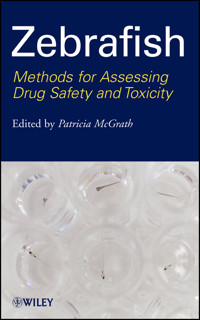
Zebrafish E-Book
107,99 €
Mehr erfahren.
- Herausgeber: John Wiley & Sons
- Kategorie: Fachliteratur
- Sprache: Englisch
Zebrafish: Methods for Assessing Drug Safety and Toxicity offers a practical guide for using zebrafish as a tool for toxicology studies.
Consolidating key protocols and approaches to help researchers navigate the important and evolving field of zebrafish models for toxicity screening, this new title describes the methods for using the zebrafish as a model organism to assess compound-induced toxicity on all major organs. Individual chapters that concentrate on assays for each organ system are included and various analytical tools including microscopy, microplate readers, high content imaging systems, ECG, blood pressure monitors, high speed video and motion detectors are described.
Sie lesen das E-Book in den Legimi-Apps auf:
Seitenzahl: 559
Veröffentlichungsjahr: 2012
Ähnliche




















Contents
Cover
Title Page
Copyright
Preface
Contributors
Acknowledgments
Chapter 1: The Reproductive Biology and Spawning of Zebrafish in Laboratory Settings
1.1 Introduction
1.2 Overview of Zebrafish Reproductive Biology and Behavior
1.3 Spawning Techniques and Technology
1.4 Determining Factors for Reproduction in Laboratory Stocks of Zebrafish
1.5 Conclusions
References
Chapter 2: Developmental Toxicity Assessment in Zebrafish
2.1 Introduction
2.2 Methods
2.3 Results
2.4 Discussion
References
Chapter 3: Use of Emerging Models for Developmental Toxicity Testing
3.1 Importance of Assessing Developmental Toxicity
3.2 Current Methods for Assessing Developmental Toxicity
3.3 Use of Emerging Models for Developmental Toxicity Testing
3.4 New Guidelines for Chemical Testing Using Zebrafish
3.5 Conclusions
References
Chapter 4: Assessment of Drug-Induced Cardiotoxicity in Zebrafish
4.1 Introduction
4.2 Zebrafish Heart
4.3 Summary of Cardiotoxicity Study Design and Results
4.4 Materials and Methods
4.5 Results
4.6 Conclusions
References
Chapter 5: Cardiotoxicity Studies in Zebrafish
5.1 Introduction
5.2 Repolarization Toxicity
5.3 Initial Screening: Bradycardia
5.4 High-Resolution Assays of Repolarization
5.5 Future Directions
References
Chapter 6: In Vivo Recording of the Adult Zebrafish Electrocardiogram
6.1 Introduction
6.2 Optimization of Zebrafish Electrocardiogram Recording
6.3 Basic Intervals
6.4 Drug Effects
6.5 Conclusions
References
Chapter 7: Hematopoietic and Vascular System Toxicity
7.1 Introduction
7.2 Hematopoiesis and Vascular Development in the Zebrafish
7.3 Morphological and Functional Assays to Assess Toxicity
7.4 Summary
Acknowledgment
References
Chapter 8: Hepatotoxicity Testing in Larval Zebrafish
8.1 Introduction: The Larval Zebrafish Model
8.2 Liver Development
8.3 Hepatic Gene Knockdown and Mutation
8.4 Hepatotoxicity Testing in Drug Discovery
8.5 Phenotypic-Based Larval Zebrafish Hepatotoxicity Screens
8.6 Secondary and Mechanistic Liver Assays
8.7 Conclusions
References
Chapter 9: Whole Zebrafish Cytochrome P450 Assay for Assessing Drug Metabolism and Safety
9.1 Introduction
9.2 Background and Significance
9.3 Materials and Methods
9.4 Results
9.5 Conclusions
Acknowledgment
References
Chapter 10: Methods for Assessing Neurotoxicity in Zebrafish
10.1 Introduction
10.2 Limitations of Current Neurotoxicity Testing
10.3 Assessing Neurotoxicity in Zebrafish
10.4 Summary
Acknowledgments
References
Chapter 11: Zebrafish: A Predictive Model for Assessing Cancer Drug-Induced Organ Toxicity
11.1 Introduction
11.2 Materials and Methods
11.3 Results
11.4 Conclusions
Reference
Chapter 12: Locomotion and Behavioral Toxicity in Larval Zebrafish: Background, Methods, and Data
12.1 Introduction
12.2 Background
12.3 Locomotion
12.4 Zebrafish Models
12.5 Analyzing Larval Locomotion
12.6 Chemical Effects on Larval Locomotion
12.7 Conclusions
12.8 Acknowledgments
References
Chapter 13: Zebrafish: A Predictive Model for Assessing Seizure Liability
13.1 Introduction
13.2 Materials and Methods
13.3 Results
13.4 Conclusions
References
Chapter 14: Zebrafish: A New In Vivo Model for Identifying P-Glycoprotein Efflux Modulators
14.1 Introduction
14.2 Materials and Methods
14.3 Results
14.4 Conclusions
Acknowledgment
References
Chapter 15: Assessment of Effects on Visual Function in Larval Zebrafish
15.1 Introduction
15.2 Development of Visual System in Zebrafish
15.3 Methods for Assessing Visual Function in Larval Zebrafish
15.4 Conclusions
References
Chapter 16: Development of a Hypoxia-Induced Zebrafish Choroidal Neovascularization Model
16.1 Introduction
16.2 Materials and Methods
16.3 Results
16.4 Discussion
Acknowledgments
References
Chapter 17: Zebrafish Xenotransplant Cancer Model for Drug Screening
17.1 Introduction
17.2 Background and Significance
17.3 Materials and Methods
17.4 Results
17.5 Conclusions
References
Chapter 18: Zebrafish Assays for Identifying Potential Muscular Dystrophy Drug Candidates
18.1 Introduction
18.2 Materials and Methods
18.3 Results
18.4 Discussion
Acknowledgment
References
Chapter 19: Cytoprotective Activities of Water-Soluble Fullerenes in Zebrafish Models
19.1 Introduction
19.2 Materials and Methods
19.3 Results
19.4 Discussion
19.5 Conclusions
19.6 Acknowledgments
References
Chapter 20: Fishing to Design Inherently Safer Nanoparticles
20.1 Introduction
20.2 Application of Embryonic Zebrafish
20.3 Tier 1: Rapid Toxicity Screening
20.4 Tier 2: Cellular Toxicity and Distribution
20.5 Tier 3: Molecular Expression
20.6 Embryonic Zebrafish Data to Design “Safer” Nanoparticles
20.7 Conclusions
References
Chapter 21: Radiation-Induced Toxicity and Radiation Response Modifiers in Zebrafish
21.1 Introduction
21.2 Materials and Methods
21.3 Validation of Zebrafish Embryos as a Model System for Radiation Protectors/Sensitizers
21.4 Gross Morphological Alterations Associated with Radiation Exposure
21.5 Radiation-Associated Apoptosis Incidence
21.6 Radiation-Associated Gastrointestinal Toxicity
21.7 Radiation-Associated Nephrotoxicity
21.8 Ototoxicity in Irradiated Zebrafish
21.9 Radiation Protectors in Zebrafish
21.10 Summary
References
Chapter 22: Caudal Fin Regeneration in Zebrafish
22.1 Introduction
22.2 Signaling and Epimorphic Regeneration
22.3 Caudal Fin Architecture
22.4 Stages of Epimorphic Regeneration
22.5 Methodology
22.6 Strategies Used to Manipulate Gene Function During Fin Regeneration
22.7 The Larval Fin Regeneration Model
22.8 Summary
Acknowledgments
References
Index
Color Plates
Copyright © 2012 by John Wiley & Sons, Inc. All rights reserved
Published by John Wiley & Sons, Inc., Hoboken, New Jersey
Published simultaneously in Canada
No part of this publication may be reproduced, stored in a retrieval system, or transmitted in any form or by any means, electronic, mechanical, photocopying, recording, scanning, or otherwise, except as permitted under Section 107 or 108 of the 1976 United States Copyright Act, without either the prior written permission of the Publisher, or authorization through payment of the appropriate per-copy fee to the Copyright Clearance Center, Inc., 222 Rosewood Drive, Danvers, MA 01923, (978) 750-8400, fax (978) 750-4470, or on the web at www.copyright.com. Requests to the Publisher for permission should be addressed to the Permissions Department, John Wiley & Sons, Inc., 111 River Street, Hoboken, NJ 07030, (201) 748-6011, fax (201) 748-6008, or online at http://www.wiley.com/go/permission.
Limit of Liability/Disclaimer ofWarranty: While the publisher and author have used their best efforts in preparing this book, they make no representations or warranties with respect to the accuracy or completeness of the contents of this book and specifically disclaim any implied warranties of merchantability or fitness for a particular purpose. No warranty may be created or extended by sales representatives or written sales materials. The advice and strategies contained herein may not be suitable for your situation. You should consult with a professional where appropriate. Neither the publisher nor author shall be liable for any loss of profit or any other commercial damages, including but not limited to special, incidental, consequential, or other damages.
For general information on our other products and services or for technical support, please contact our Customer Care Department within the United States at (800) 762-2974, outside the United States at (317) 572-3993 or fax (317) 572-4002.
Wiley also publishes its books in a variety of electronic formats. Some content that appears in print may not be available in electronic formats. For more information about Wiley products, visit our web site at www.wiley.com.
Library of Congress Cataloging-in-Publication Data:
Zebrafish: methods for assessing drug safety and toxicity / edited by Patricia McGrath.
p. cm.
ISBN 978-0-470-42513-8 (cloth)
1. Logperch–Genetics. 2. Drugs–Safety measures. 3. Toxicology–Animal models. 4. Fish as laboratory animals. 5. Animal models in research. I. McGrath, Patricia, 1949–
QL638.P4Z43 2011
5970.482–dc22
2011009822
Preface
The zebrafish model organism is increasingly used for assessing compound toxicity, safety, and efficacy and numerous studies confirm that mammalian and zebrafish toxicity profiles are strikingly similar. This convenient, predictive animal model can be used at an intermediate stage between performing cell-based assays and conventional animal testing. Although in vitro assays using cultured cells are commonly used to evaluate potential drug effects, they are frequently not predictive of the complex metabolism that affects drug efficacy and causes toxicity in animals. Therefore, many compounds that appear effective in vitro fail during costly animal trials.
Currently, there is no single reference source for toxicity testing using this emerging model organism. Investigators seeking general information on toxicity methods and results currently refer to toxicology textbooks that focus on mammalian models. The target readership of this timely book includes students (undergraduates and graduate level) and professionals in all biomedical sciences, including drug research and development, environmental testing, and product safety assessment.
This initial volume describes methods for assessing compound-induced toxicity in all major organs, including heart (Chapters 4, 5, 6, and 11), liver (Chapters 8, 9, and 11), kidney (Chapter 11), central nervous system (Chapters 10, 11, 12, 13, and 14), eye (Chapters 15 and 16), ear (Chapter 19), hematopoietic system (Chapter 7), and overall development (Chapters 2 and 3).
This vertebrate model offers several compelling experimental advantages including drug delivery directly in the fish water, small amount of drug required per experiment, statistically significant number of animals per test, and low cost. Animal transparency makes it possible to visually assess compound-induced effects on morphology and fluorescently labeled probes and antibodies can be used to localize and quantitate compound effects in physiologically intact animals. Compounds can be assessed using wild-type, mutant, transgenic, knockdown, and knock-in animals. In addition, several chemical-induced disease models, phenocopies, designed to identify potential drug candidates, are described (Chapters 14, 16, 17, 18, 19, and 21). Assays used to develop disease models can also be used to assess compound-induced toxicity on specific end points. Several widely used cell-based assay techniques have been adapted for use with this small model organism and quantitative morphometric image analysis (Chapters 10, 14, and 18) and microplate formats (9, 16, and 17) offer unprecedented throughput for assessing compound effects in whole animals. Additional analytical tools adapted for use with zebrafish, including ECG (Chapter 6) and motion detectors (Chapters 10, 12, 13, 15, and 18), are described.
Improvements in breeding and spawning, which address requirements of industrial scale screening, are discussed (Chapter 1). As a reference source to be used as a companion document for assessing data presented in individual chapters, we have reprinted a description of zebrafish stages during organogenesis. An interesting recent development that successfully pairs this emerging model with an emerging market need is the use of zebrafish for assessing safety of nanoparticles (Chapter 20), which are now incorporated in virtually all product categories. In addition, the unique ability of this animal to regenerate tissue and organs offers potential for compound screening for cell-based therapies (Chapter 22).
An important recent development impacting wider use of zebrafish for toxicity testing is that the Organization for Economic Cooperation and Development (OECD), an international organization helping governments tackle the economic social and governance challenges of the globalized economy, is developing standards for using zebrafish to assess chemical toxicity.
Further supporting wider use of this emerging model organism, the European Union recently enacted Registration, Evaluation, Authorisation and Registration of Chemicals (REACH) legislation that requires toxicity assessment for any chemical imported or manufactured in the region and is expected to have far-reaching impact on new product introductions and animal testing, including zebrafish.
Confounding interpretation of drug-induced toxicity and limiting wider acceptance of this model organism, reported results show that inter- and intralaboratory standards vary widely, although cooperation among academic and industry laboratories to develop standard operating procedures for performing compound assessment in zebrafish is increasing. Understanding all aspects of current toxicology testing will facilitate more uniform approaches across industries and enhance acceptance from regulatory authorities around the world. Full validation of this model organism will require assessment of large numbers of compounds from diverse classes in a wide variety of assays and disease models. I hope that methods and data reported here will facilitate standardization and support increased use of zebrafish for compound screening.
Patricia McGrath
Cambridge, MA
Contributors
Wendy Alderton, CB1 Bio Ltd, Cambridge, UK
Jessica Awerman, Phylonix, Cambridge, MA, USA
Florian Beuerle, The Institute für Organische Chemie, Universität Erlangen-Nürnberg, Erlangen, Germany
Louis D'Amico, Phylonix, Cambridge, MA, USA
Myrtle Davis, NCI, NIH, Bethesda, MD, USA
Anthony DeLise, Sanofi-Aventis, Bridgewater, NJ, USA
Adam P. Dicker, Department of Radiation Oncology, Thomas Jefferson University, Philadelphia, PA, USA
Elizabeth Glaze, NCI, NIH, Bethesda, MD, USA
Maryann Haldi, Phylonix, Cambridge, MA, USA
Maegan Harden, Phylonix, Cambridge, MA, USA
Uwe Hartnagel, The Institute für Organische Chemie, Universität Erlangen-Nürnberg, Erlangen, Germany
Adrian Hill, Evotec (UK) Ltd, Abingdon, Oxfordshire, UK
Andreas Hirsch, The Institute für Organische Chemie, Universität Erlangen-Nürnberg, Erlangen, Germany; and C-Sixty Inc., Houston, TX, USA
Deborah L. Hunter, Integrated Systems Toxicology Division, National Health and Environmental Effects Research Laboratory, Office of Research and Development, U.S. Environmental Protection Agency, Research Triangle Park, NC, USA
Terra D. Irons, Curriculum in Toxicology, University of North Carolina, Chapel Hill, NC, USA
Gabor Kari, Department of Radiation Oncology, Thomas Jefferson University, Philadelphia, PA, USA
Christian Lawrence, Aquatic Resources Program, Children's Hospital Boston, Boston, MA, USA
Russell Lebovitz, C-Sixty Inc., Houston, TX, USA
Chunqi Li, Phylonix, Cambridge, MA, USA
Yingxin Lin, Phylonix, Cambridge, MA, USA
Liqing Luo, Phylonix, Cambridge, MA, USA
Robert C. MacPhail, Toxicity Assessment Division, National Health and Environmental Effects Research Laboratory, Office of Research and Development, U.S. Environmental Protection Agency, Research Triangle Park, NC, USA
Calum A. MacRae, Cardiovascular Division, Brigham and Women's Hospital, Boston, MA, USA
Patricia McGrath, Phylonix, Cambridge, MA, USA
Joshua Meidenbauer, Phylonix, Cambridge, MA, USA
David J. Milan, Cardiovascular Research Center and Cardiology Division, Massachusetts General Hospital, Boston, MA, USA
Stephanie Padilla, Integrated Systems Toxicology Division, National Health and Environmental Effects Research Laboratory, Office of Research and Development, U.S. Environmental Protection Agency, Research Triangle Park, NC, USA
Demian Park, Phylonix, Cambridge, MA, USA
Chuenlei Parng, Phylonix, Cambridge, MA, USA
Ulrich Rodeck, Department of Radiation Oncology, Thomas Jefferson University, Philadelphia, PA, USA; and Department of Dermatology, Thomas Jefferson University, Philadelphia, PA, USA
Katerine S. Saili, Department of Environmental and Molecular Toxicology, Environmental Health Sciences Center, Oregon State University, Corvallis, OR, USA
Wen Lin Seng, Phylonix, Cambridge, MA, USA
Sumitra Sengupta, Department of Environmental and Molecular Toxicology, Environmental Health Sciences Center, Oregon State University, Corvallis, OR, USA
Michael T. Simonich, Department of Environmental and Molecular Toxicology, Environmental Health Sciences Center, Oregon State University, Corvallis, OR, USA
Breanne Sparta, Phylonix, Cambridge, MA, USA
Willi Suter, Novartis Pharmaceuticals, East Hanover, NJ, USA
Tamara Tal, Department of Environmental and Molecular Toxicology, Environmental Health Sciences Center, Oregon State University, Corvallis, OR, USA
Jian Tang, Phylonix, Cambridge, MA, USA
Susie Tang, Phylonix, Cambridge, MA, USA
Robert L. Tanguay, Department of Environmental and Molecular Toxicology, Environmental Health Sciences Center, Oregon State University, Corvallis, OR, USA
Alison M. Taylor, Stem Cell Program and Division of Hematology/Oncology, Children's Hospital Boston and Dona Farber Cancer Institute, Harvard Medical School
Lisa Truong, Department of Environmental and Molecular Toxicology, Environmental Health Sciences Center, Oregon State University, Corvallis, OR, USA
Patrick Witte, The Institute für Organische Chemie, Universität Erlangen-Nürnberg, Erlangen, Germany
Yi Yang, Novartis Pharmaceuticals, East Hanover, NJ, USA
Lisa Zhong, Phylonix, Cambridge, MA, USA
Leonard I. Zon, Stem Cell Program and Division of Hematology/Oncology, Children's Hospital Boston and Dona Farber Cancer Institute, Harvard Medical School
Acknowledgments
Special thanks to the contributing authors who are at the forefront of developing methods for compound screening in zebrafish. Thanks also to the Phylonix team for their patience and for taking a backseat while this book took shape; Yingli Duan, Kristine Karklins, Demian Park, and Wen Lin Seng doggedly edited all chapters and generated data describing state-of-the-art assays for compound assessment in zebrafish.
Chapter 1
The Reproductive Biology and Spawning of Zebrafish in Laboratory Settings*
Christian Lawrence
Aquatic Resources Program, Children's Hospital Boston, Boston, MA, USA
1.1 Introduction
There is growing demand for new, robust, and cost-effective ways to assess chemicals for their effect on human health, particularly during early development. Traditional mammalian models for toxicology are both expensive and difficult to work with during embryonic stages. The zebrafish (Danio rerio) has a number of features that make it an excellent alternative model for toxicology studies, including its small size, rapid external development, optical transparency during early development, permeability to small molecules, amenability to high-throughput screening, and genetic similarity to humans (Lieschke and Currie, 2007; Peterson et al., 2008).
A major underpinning of the use of zebrafish in this arena is their great fecundity, which supports high-throughput analysis and increases the statistical power of experiments. Adult female zebrafish can spawn on a daily basis, and individual clutch sizes can exceed 1000 embryos (Spence and Smith, 2005; Castranova et al., 2011). However, consistent production at these high levels is greatly dependent upon sound management of laboratory breeding stocks, which must be grounded in a thorough understanding of the reproductive biology and behavior of the animal. Management practices must also address key elements of husbandry, most notably water quality, nutrition, and behavioral and genetic management.
1.2 Overview of Zebrafish Reproductive Biology and Behavior
1.2.1 Natural History
Zebrafish are native to South Asia, and are distributed primarily throughout the lower reaches of many of the major river drainages of India, Bangladesh, and Nepal (Spence et al., 2008). This geographic region is characterized by its monsoonal climate, with pronounced rainy and dry seasons. Such seasonality in rainfall profoundly affects both the physicochemical conditions in zebrafish habitats and resource availability. These factors also shape reproductive biology and behavior.
Data gathered from the relatively small number of field studies suggest that zebrafish are primarily a floodplain species, most commonly found in shallow, standing, or slow-moving bodies of water with submerged aquatic vegetation and a silt-covered substratum (Spence et al., 2008). Environmental conditions in these habitats are highly variable in both space and time. For example, pooled environmental data from zebrafish collection sites in India in the summer rainy season (Engeszer et al., 2007) and Bangladesh in the winter dry season (Spence et al., 2006) show that pH ranges from 5.9 to 8.5, conductivity from 10 to 2000 μS, and temperature from 16 to 38°C. These differences, which reflect changes in seasonality and geography, provide strong evidence that zebrafish are adapted to wide swings in environmental conditions. Results of laboratory experiments demonstrating their tolerance to both thermal (Cortemeglia and Beitinger, 2005) and ionic (Boisen et al., 2003) fluctuations support this hypothesis.
Zebrafish feed mainly on a wide variety of zooplankton and insects (both aquatic and terrestrial), and to a lesser extent, algae, detritus, and various other organic materials (McClure et al., 2006; Spence et al., 2007a). Gut content analyses of wild collected animals indicate that they feed primarily in the water column, but also take items off the surface and the benthos (Spence et al., 2007a).
Lesen Sie weiter in der vollständigen Ausgabe!
Lesen Sie weiter in der vollständigen Ausgabe!
Lesen Sie weiter in der vollständigen Ausgabe!
Lesen Sie weiter in der vollständigen Ausgabe!
Lesen Sie weiter in der vollständigen Ausgabe!
Lesen Sie weiter in der vollständigen Ausgabe!
Lesen Sie weiter in der vollständigen Ausgabe!
Lesen Sie weiter in der vollständigen Ausgabe!
Lesen Sie weiter in der vollständigen Ausgabe!
Lesen Sie weiter in der vollständigen Ausgabe!
Lesen Sie weiter in der vollständigen Ausgabe!
Lesen Sie weiter in der vollständigen Ausgabe!
Lesen Sie weiter in der vollständigen Ausgabe!
Lesen Sie weiter in der vollständigen Ausgabe!
Lesen Sie weiter in der vollständigen Ausgabe!
Lesen Sie weiter in der vollständigen Ausgabe!
Lesen Sie weiter in der vollständigen Ausgabe!
Lesen Sie weiter in der vollständigen Ausgabe!
Lesen Sie weiter in der vollständigen Ausgabe!
Lesen Sie weiter in der vollständigen Ausgabe!
Lesen Sie weiter in der vollständigen Ausgabe!
Lesen Sie weiter in der vollständigen Ausgabe!
Lesen Sie weiter in der vollständigen Ausgabe!




