


16,99 €
Mehr erfahren.
- Herausgeber: John Wiley & Sons
- Kategorie: Fachliteratur
- Sprache: Englisch
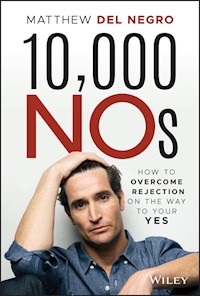
Learn how to persevere and pivot to achieve your goalsfrom a celebrated Hollywood actor 10,000 NOs: How to Overcome Rejection on the Way to Your YES chronicles actor Matthew Del Negro's tough journey from humble beginnings, through a sea of rejections, on the way to his eventual rise to become a recognizable face on some of history's most acclaimed television shows. Along the way, he learned hard lessons about perseverance, persistence, and resilience.Teaching readers how to make it through the tough times and deal with massive uncertainty by retaining the flexibility to change course and pivot to follow your passion, Del Negro explains how to achieve success in even the most competitive industries. The book, which delves into his personal story from Division I athlete to his professional dream of becoming an actor without any show business connections, shares the wisdom and knowledge Del Negro has gained from both his failures and successes in one of America's most competitive industries: professionalacting. Amidst his own stories from life and acting, Del Negro weaves anecdotes and quotes from interviews he has had with a wide range of inspirational people from all walks of life on his popular podcast, 10,000 NOs. The list of high-achievers includes professional athletes, bestselling authors, Forbes list entrepreneurs, cancer survivors, Hollywood elite, and more. His celebrated and top-ranked podcast in the U.S., Canada, and Australia, continues to inspire others to keep going even when their progress seemsinfinitesimallyslow.
Sie lesen das E-Book in den Legimi-Apps auf:
Seitenzahl: 320
Veröffentlichungsjahr: 2020
Ähnliche



















Table of Contents
Cover
Introduction
CHAPTER 1: Getting Started
Keep It Simple, Stupid
Before You Take Your First Step, Ask Yourself Why You're Moving
Everybody Needs Some Billy Sometimes
CHAPTER 2: Work Ethic
Nature versus Nurture
Getting to Know Fear
The West Wing
Experience
Nobody Walks on the Hill!
CHAPTER 3: Performance, Anxiety, and Instinct
Two Sides of the Same Coin
You Can Take the Kid Out of the Black Box …
Doesn't Take Much to Be Knocked Off Course
There Are Hit Shows … and There Are Hits in Shows
Instincts: Trust Your Gut
CHAPTER 4: Discipline and Training
The Game Is Won or Lost Before You Even Take the Field
Buy Speed
If You're Gonna Talk the Talk, Ya Gotta Walk the Walk
The Right Way Is the Way that Works for You
CHAPTER 5: Risk
Conquer or Die
Don't Take It Personally, Take It Professionally
What Goes Up Must Come Down
Free-fallin'
CHAPTER 6: Perseverance
Perseverance Is for Everyone
Sometimes Life Is Going to Pancake You
Is Your Biggest Break a Few Doors Down the Hallway?
CHAPTER 7: Reframing
It's Not the Canvas, It's What You See in the Canvas
There's No Business Like Show Business
Out of Work? Start a Podcast!
CHAPTER 8: Surrender
The Art of Fighting Without Fighting
The “All Is Lost” Moment Is Not Only in Movies
Grown Men Shouldn't Punch Walls
Take Your Medicine and the Cure Will Find You
CHAPTER 9: Transformation
The Caterpillar, the Cocoon, and the Butterfly
There Are No Small Parts, Only Small Actors
A Cobbled-Together “Career”
Breathing in Rarefied Air
CHAPTER 10: Leadership
You Can't Have
Leadership
Without
Relationships
Don't Be a Grinch: Serve
Humility: Next-Level Leadership
Delegating: The Art of Getting Help
Big Star Does Not Mean Oversized Ego
CHAPTER 11: Meditation and Relaxation
Welcome to the New Age
Being a Straight-A Student Is Overrated
“You Are Enough”
CHAPTER 12: Belief and Faith
Don't Be the Guy (or Gal) Who Woke Up on Third Base Thinking He Hit a Triple
Create Your Own System for Gratitude
Why Not Me?
Losing the Battle but Winning the War
Keep Your Own Scorecard and Start with Easy Wins
You Don't Need a Scorecard to Know If You Won or Lost
CHAPTER 13: The Subconscious
Dreamwork
A Hollywood Nightmare of Self-Sabotage
Chapter 14: Just Be a Good Person
Live the Golden Rule
Nice Guys Don't Always Finish Last
Chapter 15: Focus and Singularity
To Catch a Rabbit, You Can Only Chase One at a Time
To BBQ or Not to BBQ? That Is the Question
My Very Unsexy Manhattan Apartment
“All That Matters Is That F*ckin' Box”
CHAPTER 16: Facade versus Reality
Don't Believe the Hype
Beyond the Facade of the Red Carpet
I've Finally Made It to That City on a Hill
Epilogue
Acknowledgments
About the Author
Index
End User License Agreement
Guide
Cover
Table of Contents
Begin Reading
Pages
i
iii
iv
v
ix
x
xi
xii
1
2
3
4
5
6
7
8
9
10
11
12
13
14
15
16
17
18
19
20
21
22
23
25
26
27
28
29
30
31
32
33
34
35
36
37
38
39
41
42
43
44
45
46
47
48
49
50
51
52
53
54
55
56
57
58
59
60
61
62
63
65
66
67
68
69
70
71
72
73
74
75
76
77
78
79
80
81
82
83
84
85
86
87
89
90
91
92
93
94
95
96
97
98
99
100
101
103
104
105
106
107
108
109
110
111
112
113
114
115
116
117
118
119
120
121
122
123
124
125
126
127
128
129
130
131
133
134
135
136
137
138
139
140
141
142
143
144
145
146
147
148
149
150
151
152
153
154
155
156
157
159
160
161
162
163
164
165
166
167
169
170
171
172
173
174
175
176
177
178
179
180
181
182
183
184
185
186
187
189
190
191
192
193
194
195
196
197
198
199
200
201
202
203
205
206
207
208
209
210
211
212
213
“This book is a chance for people to benefit from the humanity and wisdom Matt Del Negro has acquired by grinding through his own 10,000 NOs for so long. His value far exceeds his art. His talent is only outweighed by his humility and ability to connect with others and make them feel better about their own journey.”
—Bedros Keuilian, CEO, FitBody Bootcamp, bestselling author, Man Up
“Being told ‘no’ can either define you or ignite you. Matt's powerful book gives you the courage and confidence to turn that devastating ‘no’ into inspiration. Through his resilience, determination, and breathtaking honesty, Matt shows how to navigate the sting of rejection and convert it into the satisfaction of success! This book is a serious life changer!”
—Sue Hollis, Cofounder, The TravelEdge Group, Coach, Adventurepreneur, Top 10 Women Entrepreneurs in Australia, author of Riding Raw: A Journey from Empty to Full, motorbike racer
“If you want a reality check, a connection to what it takes to get where you want to go in life… advice about the reality of getting past 10,000 NOs to the one ‘Yes’ you desire and will commit to, then make this your Life Bible. Absorb it. Listen to the words. Then go no further. Settle in. And make Matt's experience… yours.”
—Roger Fishman, Adventure Photographer, author, What I Know, former Head of Marketing, CAA
MATTHEW DEL NEGRO
10,000 NOs
HOW TO OVERCOME REJECTION ON THE WAY TO YOUR YES
Copyright © 2021 by John Wiley & Sons, Inc. All rights reserved.
Published by John Wiley & Sons, Inc., Hoboken, New Jersey.Published simultaneously in Canada.
No part of this publication may be reproduced, stored in a retrieval system, or transmitted in any form or by any means, electronic, mechanical, photocopying, recording, scanning, or otherwise, except as permitted under Section 107 or 108 of the 1976 United States Copyright Act, without either the prior written permission of the Publisher, or authorization through payment of the appropriate per-copy fee to the Copyright Clearance Center, Inc., 222 Rosewood Drive, Danvers, MA 01923, (978) 750-8400, fax (978) 646-8600, or on the Web at www.copyright.com. Requests to the Publisher for permission should be addressed to the Permissions Department, John Wiley & Sons, Inc., 111 River Street, Hoboken, NJ 07030, (201) 748-6011, fax (201) 748-6008, or online at http://www.wiley.com/go/permissions.
Limit of Liability/Disclaimer of Warranty: While the publisher and author have used their best efforts in preparing this book, they make no representations or warranties with respect to the accuracy or completeness of the contents of this book and specifically disclaim any implied warranties of merchantability or fitness for a particular purpose. No warranty may be created or extended by sales representatives or written sales materials. The advice and strategies contained herein may not be suitable for your situation. You should consult with a professional where appropriate. Neither the publisher nor author shall be liable for any loss of profit or any other commercial damages, including but not limited to special, incidental, consequential, or other damages.
For general information on our other products and services or for technical support, please contact our Customer Care Department within the United States at (800) 762-2974, outside the United States at (317) 572-3993 or fax (317) 572-4002.
Wiley publishes in a variety of print and electronic formats and by print-on-demand. Some material included with standard print versions of this book may not be included in e-books or in print-on-demand. If this book refers to media such as a CD or DVD that is not included in the version you purchased, you may download this material at http://booksupport.wiley.com. For more information about Wiley products, visit www.wiley.com.
Library of Congress Cataloging-in-Publication Data is Available:
ISBN 978-1-119-69182-2 (Hardcover)ISBN 978-1-119-69177-8 (ePDF)ISBN 978-1-119-69185-3 (ePub)
Cover Design: WileyCover Image: © Corey Nickols
Deirdre, for standing by when the “no”s felt heaviest
Donovan and Bronwyn, may you never let the critic count
Everyone else, for helping and encouraging me to keep going
Introduction
I had coffee recently with a very successful documentary filmmaker friend. The feature documentary he made a few years ago won the Sundance Film Festival documentary competition and sold for a lot of money. The next one he made was also quite lucrative, which is no easy feat for a documentary film. His most recent film, however, did not immediately find worldwide distribution the way the others had, so he reached out to me to share the news and talk through his frustrated feelings on the matter. When I realized the intent of his coffee meeting request I said, “Wow, I guess I really am a Rejection Expert, huh?” He laughed before explaining that he hadn't called me because of my own punishing track record. It was just that his very supportive wife, who is not in our industry, did not have the comparable experience of seeing two years of work deflate in front of her eyes due to the changing tides of opinion. And his fellow documentary filmmaker friends were somewhat in competition with him, so they might not completely commiserate. It was at this point that I fully realized the need for this book.
This book will change you as much as you let it. It will not “solve” your life or tell you how to turn every “no” into a “yes.” But it will crack open more questions and deepen your quest for success if you allow it. It does not contain magic, just truth. It sheds light on many of the principles so many of us have pondered for years: perseverance, performance, work ethic, risk, belief, hope, faith. I focus the chapters in this book on these principles as well as on getting started, instinct, discipline and training, reframing, surrender, transformation, leadership, meditation and relaxation, the subconscious, being a good person, and facade versus reality. Some topics and chapters overlap as they are interrelated, and all present real-world perspectives. You can devour it in one sitting, as an actor's entertaining albeit sometimes cringe-worthy memoir, or jump around willy-nilly when inspiration and curiosity beckon you, using it more like a self-development manifesto. Either way, I hope that it will make you laugh, inspire you, and encourage you to take one more step toward whatever it is that brings fulfillment for you and makes your life feel well spent.
Author Malcolm Gladwell proposed that people only become experts in a field after they've dedicated themselves to it for 10,000 hours. I agree with him. But I've also pondered the ability and practice of withstanding the word “no.” What defines my career, or anyone's for that matter, is the way I have chosen to react to constant rejection, perceived failures, and “lucky breaks” that have fallen apart due to forces outside of my control. That type of reaction, both when it was admirable and when it was embarrassingly petty, is what most people would call attitude, outlook, or perspective. For all of us, our ability to persevere is derived from a combination of innate instincts embedded deep in our DNA and lessons from the major influences and influencers in our lives, including our parents, teachers, coaches, bosses, friends, siblings and so many others. It is our choice to seek out others who strengthen our resilience, as well as situations that test it, or to gravitate toward smaller-minded people who wish to keep us where they are or where they think we should be rather than encouraging our growth and challenging their own self-imposed limits.
In July 2017, after racking up over two decades' worth of rejections, I launched a podcast, 10,000 NOs, in an attempt to find out how men and women in every field imaginable, facing seemingly insurmountable obstacles, overcame their “no”s. What followed in the next three years has become the education of my life. This book contains quotes from some of my podcast guests that so perfectly reinforce the principles I have learned mostly through trial and error. Some of those guests are famous, some are not; two has died since our conversation and most are thriving. But the common thread is that each and every one of them is as flawed and as full of contradictions, pain, sadness, worry, joy, laughter, sorrow, and victory as the rest of us. They are human. They do not possess “the answers” nor were they born on the Island of “Yes.” All of them have stumbled upon the same tough truths by grappling with, battling, and overcoming a mountain of “no”s. It's not just a matter of learning from the tough times we experience, but what we learn, why it's important to learn from it, when we learn it—from hours to years after—and how we use those lessons to persevere.
No matter who you are, or where you are in your career, you will have setbacks. You will be in need of counsel from friends and other supporters. And no book or piece of advice will make your pain go away immediately. There is no magic pill. But knowing that others have suffered in ways similar to you and somehow made it through is enough to help you pick up the pieces, reflect on them, and move on. Ironically, when I sat down with my documentary filmmaker friend I was feeling particularly terrible and self-judgmental about this book. That was when he told me about the Five Stages of Creativity, which somehow, I had never heard before:
Stage 1 - I'm really excited about this.
Stage 2 - This isn't as good as I thought it was.
Stage 3 - This is terrible.
Stage 4 - This is actually better than I realized.
Stage 5 - I'm really excited about this.
If everything were easy all the time, you would not value that ease. If “yes” were the answer to your every wish and demand, every victory and windfall would be meaningless. You think you want comfort, but what you really need is progress. Progress only arrives when a struggle is overcome. So, while I wish I could send you off into the world telling all your friends that this book solved everything for you, I know that would be unrealistic. Instead, I send you off into the world urging you to lean into your 10,000 “no”s. I urge you to really feel their pain and let that pain guide you past the “no” to greener pastures. I urge you to learn from them what not to do the next time, so you can turn those “no”s into a “yes.” I urge you to be grateful for them, for in them lies the wisdom of humanity and experience. There is no greater teacher than that which reminds you that your salvation lies in always striving, until your last dying breath.
Matthew Del Negro
January 2020
CHAPTER 1Getting Started
“You never know when those other supportive factors are going to want to converge around your work, but they won't if you don't take the first step.”
—Jessica Blank, Writer, The Exonerated
There are many things that can muddy the waters and make something so simple, like trying a new hobby or ditching a bad habit, seem complex. As crazy as it sounds, most humans will come up with excuse after excuse to try to wiggle out of doing the one thing they know they need to do in order to accomplish their deepest desires. But really, it all begins with one step. I believe you will only take that step, and change the course you are on, when the thought of not doing something becomes more painful to you than the thought of giving it a try. It really is that simple.
Keep It Simple, Stupid
The truth that most people fail to acknowledge, however, is that doing something, even if you're following a dream, can still be painful a lot of the time. When you're following a dream, though, there's a pot of gold at the end of the pain. That pot may not be filled with literal gold, but it should at least hold the gold of fulfillment. That fulfillment usually comes in the form of peace, satisfaction, and a pride that only comes from living with purpose.
“We don't tell ourselves, ‘I'm never going to write my symphony.’ Instead we say, ‘I'm going to write my symphony; I'm just going to start tomorrow.’”
—Stephen Pressfield, The War of Art
People these days, myself included, are obsessed with the origin stories of those who have broken away from the pack to take the road less traveled. This is not surprising given the difficulty required to take the first step down any path. The question I'm asked the most, besides how I memorize all my lines, is how I became a professional actor. The trite answer I usually give in interviews is that it started with a girl. That leads to a story about a breakup in college while studying abroad, which ultimately led to my decision to quit playing lacrosse my junior year at Boston College. Then, seemingly out of nowhere, I auditioned for a play, and the rest is history. But perhaps a more truthful and accurate answer is that it started with a plethora of proverbial “no”s throughout my childhood.
Before You Take Your First Step, Ask Yourself Why You're Moving
Most people can trace their why back to some pain, rejection, or perceived loss in childhood that they are now trying to fix. I am no different. For me, my why was forged in the pain of my parents' marriage, which looked one way to my immediate family and another to the rest of the world. As the youngest member of the family, and the peacekeeper, I was constantly interpreting one family member's actions to another. Socially, my role was similar. I could always relate to most people so I'd find myself explaining one person to another, even if they were part of vastly different social subsets. The price I paid for keeping the peace was that I internalized everything and carried it around with me. Looking back now, it is easier to see that my career choice did not really come out of nowhere, the way I previously viewed it, as my job now is to interpret the words of writers and the experiences of the characters I play. But I had zero awareness of this link back then.
On top of carrying other people's secrets around, as well as my own pain and frustration, I could never to seem to attain the things I wanted the most. As far back as the fifth grade, I'd pursue a girl I liked, get close to her, and muster up the courage to ask her out. But, one way or another, I'd end up alone after it fell apart due to a change of heart or some other obstacle I never saw coming until it was too late. Rejection is defined as the dismissing of an idea or the spurning of a person's affections, and I had plenty of both. I feel bad for a certain girl I “loved” in fifth grade because, while I've only run into her on rare occasions since we graduated high school, I never miss the opportunity to remind her of our date that never happened. I had charmed her enough to eventually elicit a “yes” when I asked her to the year-end town carnival, but on the night of the event, she stood me up. Two friends of mine still love to laugh about the memory of me riding The Whip alone in the rain. And while I can laugh at myself about it now, back then it added to the feeling that I was not where I wanted to be emotionally, and not sure I'd ever get there.
While I was not a child actor, I still managed to get a “no” when I auditioned for the role of the Cowardly Lion in an elementary school production of The Wizard of Oz. I had forgotten this story for a long time because it occurred long before I thought of acting as a viable career. It's only been in recent years, as I've reflected about the lessons I've learned in the course of my career, that I've remembered it. It was a play in which the kids in my class were required to participate. I really thought I could get the role of the Cowardly Lion until the new girl, upon whom I had a massive crush, completely outshined me with her audition. (Side note: this was a different crush. I moved on from the carnival stander-upper. But I screwed this one up, too—it wasn't until eighth or ninth grade, when I admitted to liking her three years prior, that she revealed she had a crush on me when she first moved to our school. Talk about missed opportunities. More on self-dispensed “no”s later.)
In the present day, I motivate myself by the thought that there is always someone out there more talented than me ready to take my roles. Perhaps it started back then, with my grade-school crush. She could sing and dance, and she had what people might call “it.” My talent, on the other hand, was rewarded with the consolation prize of playing Uncle Henry. I still remember my sole line, telling Auntie Em I had to fix the incubator. It was an illustrious beginning to my career, I assure you. This “no” was thrown onto the ever-increasing pile of rejections, but I didn't think much of it, at least consciously, because I didn't care about acting back then.
Sports, on the other hand, felt like my life when I was growing up. Unfortunately, my desire to be good at them was not matched by my talent. I'd work my butt off obsessively only to remain skinny, weak, and slow. The fact that I made it as far as I did in athletics is a sheer reflection of a burning desire in me to be accepted and valued. On my own, despite the many things I had going for me and the many great friends and family members who surrounded me, I largely felt like I was not enough.
No matter which “no” I credit as the origin of my career, it was somehow forged in the pain of rejection and the desire to overcome it.
Obviously, all of those childhood “no”s didn't kill me and neither did the “no” of my emotionally harrowing experience in Italy over the summer of 1992. Perhaps the expression “That which does not kill you will make you stronger” is popular because it reflects a truth. The breakup in Italy is what forced me to dig deeper and find something more fully satisfying than being a member of my college lacrosse team. Confusing feelings had been percolating inside me prior to my trip to Italy, inducing a full-blown panic attack long before I had ever heard that term. But, like many people, rather than examine the origins of my unrest, I chose to ignore my anxiety because I was too scared to take the first step.
On the surface, things were looking good for me by the spring of my sophomore year in Chestnut Hill. I had a beautiful girlfriend, a spot on the varsity team, grades that kept me on the Dean's List, and a lot of friends. But beneath the surface lurked a different story. Despite the fact that I thought I was in love for the first time, the panic attacks were brought on by the fact that I had been questioning the relationship subconsciously. I was just too scared to do anything to jeopardize it because I thought it was everything I wanted. There was a chasm deep within me that I had been avoiding and it created a gap between my inner self and the facade I presented to the world. That facade began to crumble in Italy when my girlfriend had the courage to do what I had feared by breaking off our relationship.
The truth inside me rose up, grabbed me by the throat, and got my attention. Uncharacteristically, I skipped out of all the classes I was supposed to be taking and, instead, found a patch of grass in front of a small church in Perugia where I dumped all of my jagged thoughts into the journal my sister had given to me prior to my trip. It was as though there was an angry artist inside of me, no longer allowing me to put a muzzle on him, writing it. He told me that I couldn't continue to go down the path upon which I was traveling. It was an exhilarating yet frightening experience. That journal contains the first traces of my desire to act and write. I look back on this period as fortunate now, but it is no exaggeration to say that, at the time, I feared I was going to die in Italy with no friends or family around to witness it.
“I went back to my room, pulled my pistol out and put it in my mouth and was getting ready to blow my head off. Thankfully, I had a picture of my wife and kids on the desk across from me. I saw that as I was sitting there with a gun in my mouth and thought, ‘What're you doing?’ So I put my gun away and I went and sought help for the first time. And I'd love to say that I woke up. I didn't. I stayed on the X for a while. I still played the victim. I tried to convince myself, ‘You're being thrown under the bus. You're doing the right thing.’ But it literally took me about five months. I hadn't hit rock bottom yet.”
Jason Redman, Retired Navy SEAL, New York Times Best-Selling Author
The result of this breakdown/breakthrough was that the following spring at Boston College, after a brief period of going back to lacrosse and the beaten path I had traveled for so long, I quit the team, stepped out of my comfort zone, and auditioned for a play. After losing out to my roommate, who was also auditioning for the first time, I gave it another shot and scored the lead in a one-act play. It was performed in a lecture hall, rather than an actual theater. But despite the humble venue, I enjoyed the experience so much that I told anyone who would listen that I was going to be an actor. While this may sound dramatic and grand, over a year later, after that one-act play, I had not done any more plays.
Upon graduating, I moved back home with the plan to save enough money to move to New York City and pursue a career in acting. I had taken an acting class my senior year and added a Film Studies minor to my English Literature major, but I had not acted aside from that lecture-hall production. On top of this, after 27 years of marriage, my parents decided to split that summer, so moving back into the house where I grew up without my Dad living there was an adjustment. There were many thoughts swimming through my head, but the primary one was how I could turn my new dream into a reality.
There is no standard how-to manual containing a list of the first steps in becoming an actor, because the how is unique for each individual. Classes can be attended, mentors can be sought out, and the skills required to excel can be attained through training. But the why is the fuel that will propel you. A strong why will obliterate all of the inevitable blockades and barriers you will undoubtedly face no matter what field you choose. If your why is not aligned with your innermost joy and your biggest dreams, you may find success, but eventually you will experience some version of the breakdown I had in Italy. It may not crumble your life or turn you 180 degrees the way it did me. It may not cause you panic attacks. But there will be cracks in your facade. Eventually, if you're not careful, you'll look back wondering whose life you lived.
“I drove a cab for years, I proofread in law firms, I worked in a factory when I kind of dropped it all out and went out to Colorado. I cleaned Greyhound buses on Eleventh Avenue from eleven at night ‘til seven in the morning in summers while I went to school. No, I didn't start making a living for real until my son was born.”
—Richard Schiff, Actor, Emmy Award Winner, The West Wing
That experience in Italy, when everything bubbled out of me, made me certain that I wanted to pursue something that required all of my faculties. I wanted to somehow relieve the knot of emotions and unfulfilled desires tangled in my gut. Thus, my why was a desire to express myself psychologically, spiritually, physically, and mentally and the way I guessed I could do that was through acting. But just because I'd found my why, did not mean I knew exactly how to start.
Everybody Needs Some Billy Sometimes
The challenge for me to begin my pursuit as an actor was that I had almost no experience. Everyone needs to start somewhere and I was no different. The pain of not acting, for me, outweighed the fear of falling on my face in front of others. I wanted to start as soon as possible, so I scanned a local paper and found a casting notice. A community theater a few towns over from where I grew up was doing the musical The Mystery of Edwin Drood. The audition required each hopeful actor to sing 16 bars of music, accompanied by a pianist. I called the phone number and admitted that I didn't have 16 bars of music to sing. I explained that I could play a little piano, even less guitar, and I could carry a tune. When I asked if it would it be okay if I just “sang some Billy Joel” there was a long pause. After what felt like an eternity, I heard, “Sure. Just bring the sheet music.”
The following week I drove over to the theater after a full day of my summer job laying patios with a mason. I'd had time to shower and change, but my choice of wardrobe was hardly appropriate for a musical set in the 1860s. I entered the theater in jeans, a white t-shirt, and a pair of beaten up, low-cut Converse Chuck Taylors. To say I stuck out like a sore thumb would be an understatement. I looked like I was headed to a frat party while the rest of the hopeful actors wore some semblance of period garb similar to the setting of the musical. The way the audition was set up—which I have never experienced since—was that every person who went up on stage to sing did so in front of everyone else waiting to go. Once you were done, you were free to leave. Suddenly, I wished that I had showed up late so there would be no one else to watch this potential debacle, but I hid my insecurity and sat seemingly confidently in the back of the theater waiting for my turn. Heart pounding underneath my increasingly sweaty t-shirt, I began to coach myself. Running through a list of things I'd accomplished up until this point in my life in a desperate attempt to quell my nerves and convince myself this was nothing I couldn't handle, I began to find my confidence.
This lasted until the first girl got up on stage. She was beautiful and blonde, a few years younger than me, but she appeared older because of her formal period wardrobe and the way she carried herself. She handed her sheet music to the pianist as though she'd done this a million times before. The pianist began to play. When this young woman began to belt out her tune, all my insecurities came rushing back. She was amazing. I sat questioning my decision to volunteer for this torture and wondered why I thought I deserved to be here. Somehow, by the time her 16 bars came to an end, I had convinced myself that she was just a fluke. I told myself the rest of the auditionees would be normal, like me.
This theory crashed to the ground when the next person was called to the stage. This young man, dressed appropriately in a suit, was also classically trained. He had the kind of voice you hear on Broadway, and as his song hit its climax, I realized they might all be like this. That realization proved to be true when the next three or four actors, even those who were considerably younger than me, blew the doors off the place. I was looking around for the exit and thinking about sneaking out when my name was called.
Oh boy, I thought, here comes the moment of truth.
I walked up to the front of the theater, feeling all eyes on me. Hopping onto the stage as casually as I could, I thought if I wasn't the most classically trained, I was at least going to appear the most confident. Fake it 'til you make it, son. When I hit the stage, something shifted inside me. I remembered why I was there. I might not be classically trained, but I loved to perform. I remembered my plan to stick out by embracing the fact that I was different. I walked to the center and planted my feet. The pianist asked for my sheet music and I stared back. Mustering all the confidence and courage I could, I told him I'd be singing a cappella. The sheer audacity of it, knowing I was outclassed but forging ahead anyway, was like a rush of adrenaline. After taking a deep breath and exhaling, I began snapping my fingers and tapping my foot. I fell back on what I knew: Billy Joel.
While I didn't have much real stage experience, I did spend many a day and night in junior high and high school, sometimes with friends, sometimes alone, playing piano and singing. Somewhere inside me was a performer dying to get out and all he needed was for me to take this first step and give him the opportunity. I was alive. Whereas just minutes before the attention had nearly crumbled me, as I sang now, I felt everyone's eyes on me and I liked it. I was where I was supposed to be. And even though the odds that they'd think I was right for this play were slim to none, I didn't care. I had taken the leap and I'd be right for something, some day.
In a beautiful twist of fate, my courage was rewarded and I was offered a role. And not a small role, either. I was the Chairman. The Mystery of Edwin Drood is a play within a play, so prior to the curtain going up they needed someone to improvise with audience members as they entered the theater, in a British accent, no less. Breaking the fourth wall of the theater and speaking directly to the audience throughout the play, the Chairman was to introduce the play, narrate it, and jump into the action as Mayor Sapsea for several songs and scenes. He was one of the leads and I had the time of my life.
At the end of the run, the director pulled me aside and told me she had worried about finding the right person to play the Chairman because it required different skills than any of the other roles. When I had hopped on stage in jeans and a t-shirt and started snapping my fingers, she knew immediately that I was her guy. My differences, the very thing I feared would embarrass me, were the reason I got the gig. But I never would have learned that if I hadn't taken the first step to get started.
Too many people I speak with get in their own way because they're judging themselves as if they're at the finish line even though the starting gun has barely sounded. Rome wasn't built in a day, and neither was any good business, physique, or skyscraper. Things take time to grow, and usually that timetable is a lot slower than you hope for it to be. Self-judgment and crippling self-criticism are not the path to your goal. There are many paths to success, depending on who you are and what you want to do. Those paths are as varied and different as the number of people in the world, but they share one thing in common: each one begins with a first step.
Top Three Takeaways
Before starting something new, remind yourself that “failure is built into the game.”
You don't need to know
how
to do something. Often the things that people
think
make them qualified for a job or a calling are not really the deciding factor anyway. The most important factor is
why
you are chasing this goal in the first place.
If
you
say “no” to yourself, you never give
them
the chance to say “yes.”
They
usually don't know what they need anyway, until they see it.




