


Erhalten Sie Zugang zu diesem und mehr als 300000 Büchern ab EUR 5,99 monatlich.
- Herausgeber: Saqi Books
- Kategorie: Geisteswissenschaft
- Sprache: Englisch
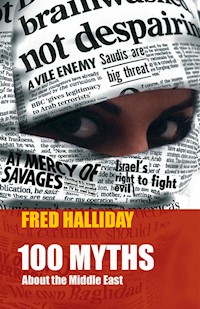
Much has been written in recent years about the Middle East. At the same time, no other region has been as misunderstood, nor framed in so many clichés and mistakenly-held beliefs. In this much-needed exposé Fred Halliday selects one hundred of the most commonly misconstrued 'facts' – in the political, cultural, social and historical spheres – and illuminates each case without compromising its underlying complexities. The Israel-Palestine crisis, the Iran-Iraq war, the US-led Gulf incursions, the Afghan-Soviet conflict and other significant milestones in modern Middle East history come under scrutiny here, with conclusions that will surprise and enlighten many for going so persuasively against the grain.
Sie lesen das E-Book in den Legimi-Apps auf:
Seitenzahl: 257
Veröffentlichungsjahr: 2005
Das E-Book (TTS) können Sie hören im Abo „Legimi Premium” in Legimi-Apps auf:
Ähnliche



















100 MYTHS ABOUT THE MIDDLE EAST
Other works by the Author published by Saqi
Nation and Religion in the Middle East
Arabia Without Sultans
Two Hours that Shook the World
Fred Halliday
ONE HUNDRED MYTHSABOUT THE MIDDLE EAST
SAQI
‘When I wished him a good trip and good luck in his new life, he replied with such typically Moslem phrases that I observed, “But you are Jewish. How is it that you speak of God in this manner?” His visage transfigured, he launched into a discourse of striking eloquence, and a crowd gathered around us. Only an askari looked disapproving and protested to me: “Why do you listen to this Jew?” I replied that everybody had the right to speak, and the majority of the crowd agreed with me. With astonishing oratorical ability for a simple peasant, the blacksmith proclaimed the glory of God, “Who is the same for all men”, and “Who is present throughout the world”.’
Claudie Fayein, A French Doctor in the Yemen, 1951
‘Go into the London Stock Exchange … there you will see the representatives of all nations assembled for the benefit of mankind. There the Jew, the Mohammedan and the Christian treat each other as if they were of the same religion, and they give the name of infidel only to those who are bankrupt.’
Voltaire, Lettres Philosophiques, 1728
‘As best I could I had answered their many questions. They were surprised when I told them that Europeans were, with minor differences, exactly like them, marrying and bringing up their children in accordance with principles and traditions, that they had good morals and were in general good people.
“Are there any farmers among them?” Mahjoub asked me.
“Yes, there are some farmers among them. They’ve got everything – workers and doctors and farmers and teachers, just like us.”
I preferred not to say the rest that had come to my mind: that just like us they are born and die, and in the journey from the cradle to the grave they dream dreams some of which come true and some of which are frustrated; that they fear the unknown, search for love and seek contentment in wife and child; that some are strong and some are weak; that some have been given more than they deserve by life, while others have been deprived by it, but that the differences are narrowing and most of the weak are no longer weak. I did not say this to Mahjoub, though I wish I had done so, for he was intelligent; in my conceit I was afraid he would not understand.’
Tayib Salih, Season of Migration to the North
Contents
Preface
One Hundred Myths about the Middle East
A Glossary of Crisis: September 11, 2001 and its Linguistic Aftermath
Index of Myths
Index of Names
Preface
‘We hear a lot about the roots of the Iberian Peninsula and of places beyond. We hear about the roots of our societies and historical communities … But man is not a tree. He does not have roots, he has feet, he walks.’
Juan Goytisolo, ‘Metaforas de la migración’,
El País, 24 September 2004
In 1984 the British historians Eric Hobsbawm and Terence Ranger edited a book with the challenging title The Invention of Tradition (Cambridge University Press, 1992). In it, with a wealth of examples drawn from different countries, they showed how what is presented as a legacy of the past – as ‘tradition’ or ‘heritage’, as something given by history – is often a reflection of the contemporary imagination, an act of selection when not of invention. In the British Isles the modern ‘family Christmas’ and the Scottish kilt are examples of this, as is, in the years since the book was published, the celebration of St George’s Day, 23 April, as an English national holiday and the prominence, not seen before in modern times, of the flag of St George itself.
The general significance of this book and of its central argument, is, however, enormous, since it goes to the heart of one of the most pervasive claims of modern times, of modern political culture and political ideology – that there is a given past, a set of established traditions, to which we in whatever country, culture and tradition can relate in both an analytic and a moral sense, i.e. which we can use to explain how the world is as it is, and also to provide a set of moral and sometimes religious principles, on the basis of which we can and should live. Such claims have, in many ways, become stronger in recent decades, in both the developed world – Europe, Japan and North America – and in the Third World, not least the Middle East. The most obvious form of this is the strengthening of claims based on interpretation of religious texts, what is generically and not wholly inaccurately termed ‘fundamentalism’, a trend evident in Islam, Judaism, Christianity and Hinduism. But the stronger claims of nationalism in general, across most of the world, also involve the invocation of the past, as something given and good. Whereas a generation or two ago, much was made of the campaign against the past, of the need to cast off the shackles of tradition, backwardness, superstition, obscurity in all its forms, in favour of a new aptly termed ‘Enlightenment’, we seem now to have reversed the argument. In politics, religion, customs, and, not least, food, the cult of the past, of the supposedly given and traditional, holds sway.
100 Myths about the Middle East is an attempt to engage with this trend, and rests on three broad arguments. The first is, in the spirit of Hobsbawm and Ranger, to question the historical accuracy of what is presented as the traditional and the authentic. The Middle East appears to be a region where the past, political, national and religious, holds sway – but on closer examination this is far from being the case. Whatever their claims to antiquity, all the states of the Middle East are modern creations, a result of the collapse of the Ottoman and Czarist Russian empires at the end of World War I, and of the interaction of these states with a modern global system of political, military and economic power.
When it comes to particular forms of claim and symbol, a similar modernity applies. Neither the claims of Islamist nor of Zionist politicians to be recreating a lost past are valid. The concept of the Islamic state, propounded in Shi‘ism by Ayatollah Khomeini through the Iranian Revolution of 1978–9, and that of a revived Caliphate, endorsed by conservative Sunnis including al-Qa‘ida, are modern political projects. The state of Israel, for example, bears no relation except rhetorically to the ancient kingdoms of Solomon and David. Many of the most potent symbols of contemporary politics are also recent creations. Thus the Saudi monarchy’s claim to be khadim al-haramain (‘Servant of the Two Holy Places’) was introduced only in 1986, and then in order to head off rival claims by King Hussein of Jordan to be the patron of the al-Aqsa mosque in Jerusalem; while Osama Bin Laden’s comparable term for Arabia, bilad al-haramain, (‘Land of the Two Holy Places’) is an invention of his. All the monarchies of the Middle East claim ancient, ritualised, legitimacy, but they are, in fact, creations of the twentieth century, of the vogue for kingship that, late in the day, swept the Arab world, and, not least, of attentive, and at times military, support given to them at times of crisis by their more powerful friends in Europe and the US.
Much is made of the ancient, atavistic, millennial character of the Arab-Israeli conflict. This is pretext, and a misleading one at that – the causes of the contemporary Arab-Israeli conflict lie in the formation of two rival social and ethnic communities in Mandate Palestine in the period from 1920. They have nothing – except in the selective use of symbolism – to do with the texts of supposedly sacred books or events of 1,000, 2,000 or 3,000 years ago.
The conflict provides, indeed, good examples of how symbols are created and charged with modern meaning; of how, in effect, tradition can be invented. The two most potent visual symbols of Jewish identity are the menorah or seven-pronged candelabra, and the six-pointed star, known as the Star of David (magen david; literally, ‘Shield of David’ in Hebrew), the symbol on the Israeli flag. The menorah certainly is an ancient symbol of Jewish identity, but the Star of David is nothing of the kind: as a mystical symbol of the unity of mankind, it was for centuries used by Christians, Muslims and Jews and is to be found today on many mosques in Iran and the Persian Gulf area. It was only at the end of the nineteenth century that it was given this particular status, when adopted by the Zionist movement, and has nothing, in religion or history, to do with King David.
On the Palestinian side, perhaps the most prominent symbol is the checkered headdress worn by Yasser Arafat and adopted by supporters of Palestine across the world; it is derived from a military headdress designed by a Manchester trading house – itself of Syrian origin – in the 1920s, for the newly created Arab Legion force in Jordan. The same historical correction can be made for many elements of Turkish and Iranian nationalism. That these symbols and terms acquire meaning and are used to consolidate political power, if not to kill, is indisputable. But their impact, including the ability to kill, is given not by the weight of history but by modern political choices, emotions and purposes.
The second aim of this book is to challenge the assumption on which much contemporary discussion of religion, culture and civilisation is based, namely that in looking at religions or cultures we are looking at separate, discrete and monolithic entities. There are obviously distinct cultures in this world, as there are distinct languages and ethnic types, but they are far from being closed and have, over time, interacted creatively as well as antagonistically with each other. Much of what is supposedly ‘European’ comes from other places, and is nonetheless European for that: the dominant – but never sole – religion in Europe derives from events in Palestine two millennia ago; the scripts and mathematics of Europe have a similar Middle Eastern provenance; the languages of Europe, including in regard to domestic matters such as food and sex, bear a Middle Eastern imprint. How much of European food comes from Europe is another matter too – without tea, coffee, the potato, rice, the tomato and sundry fruits, herbs and spices, we would be left with a pretty miserable gruel indeed. The same is true of literature: the great writers of all nations, like Shakespeare and Cervantes, drew on other cultures, stories, motifs. At the Frankfurt Book Fair in 2004, dedicated to Arab literature, the Egyptian novelist Naguib Mahfuz argued that Arab literature drew on three great sources of inspiration: pre-Islamic poetry and told tales, Islamic culture and modern Western literature. So it has always been. The history of peoples is not national but cosmopolitan; not one, as nationalist myth would have us believe, of separate blocs gradually and belligerently getting to know each other, but of a constant process of cultural and commercial interaction, redefinition of boundaries and mutual enrichment. This is true today, in an age of globalisation, hybridity and ‘world music’, but was true centuries and millennia ago.
The third argument of this book is an ethical one, an assertion of the need – despite the current grovelling before tradition, the past, the authentic which besets us – to take a critical distance from this identification with history. The critical, historically sceptical perspective on myth, symbol and language is all the more important because, in many ways, these elements of public life have become more, not less, important in the contemporary world. Far from the world being swept by a wave of rationality, historical accuracy and universality, the very turmoil produced by globalisation, by the collapse and discrediting of the dominant radical ideologies of the twentieth century, of left and right, and by a world where violence in many and unexpected forms is prevalent, has led to a strengthening of myth and emotional claims. We are aware, through the work of sociologists and students of nationalism, of the role of such myths in mobilising people and enabling them to make sense of their complex and often bewildering lives. Hence we can recognise that the more rapidly the world changes, and the more interaction and conflict there are between peoples, the more potent these ideas become. That they are true or false, historically or linguistically accurate or not, is unimportant compared to the uses to which they are put, and the emotions with which they are upheld. All the more need, then, for some informed, measured doubts about such ideas and claims.
It is against this background that the following book has been compiled. Its purpose is, in a necessarily partial and at times haphazard way, to address these questions in regard to one particular region, the Middle East, and with a focus on two components of this debate: claims about the history of the region itself and the uses to which language is put, both by people in the region itself and by those relating to it from outside, the latter with a particular focus on changes and innovations in vocabulary since 11 September. It makes no claims to being comprehensive, definitive or even-handed. It is based on a reassertion of a critical view of claims about history and language, and on the relevance of what, in another context, I have termed ‘international reason’ – that is, a belief in a set of shared criteria, analytical and moral, for assessing international relations and in the power of rational argument to evaluate claims made by political, nationalist and religious forces about the contemporary world.
This book is part of a broader project of research and publication on the critique of national and religious thinking and the reconstitution of a theory of cosmopolitanism and internationalism, generously funded by the Leverhulme Trust, and which will hopefully lead to further works on issues of political theory and of contemporary international relations At the same time, it draws on both the main bodies of work that I have written in recent years: on one hand, a set of studies of the modern Middle East and its conflicts; on the other, the development of a set of ideas about world politics and, in particular, about the role of international theory in analysing them.
My central concern in both areas is to develop an argument as to how ‘international reason’, shorn of its determinist and monolithic aspirations but resolute in opposition to particularism, claims of national and religious authority and general rhetorical muddle, can help to understand and provide a moral vocabulary for discussing the contemporary world. We certainly need it, in the Middle East and elsewhere. In this way it is hoped that this book will contribute, beyond helping to cast light on particular events and ideas, to promoting a more informed and confident reassertion of cosmopolitan and internationalist thinking in the contemporary world.
ONE HUNDRED MYTHSABOUT THE MIDDLE EAST
1
The Middle East is, in some fundamental way, ‘different’ from the rest of the world and has to be understood in terms distinct from other regions.
This idea is to be heard as often in the Middle East, where people are prone to vaunting their exceptionalism, as it is in hostile discussions in the West. If it is supposed to mean that there are distinct languages, religions, cuisines and customs in the Middle East this is indeed the case, but one that can only be made if it recognises the enormous differences between Middle Eastern societies and states themselves as much as between the region and the rest of the world. However, if it is meant to mean that the forms of social and political behaviour found in the region are somehow unique or cannot be explained in broad analytic terms used for other parts of the world, the claim is false. The main institutions of modern society – state, economy, family – operate in the Middle East as they do elsewhere. The modern history of the region, conventionally dated from 1798 – the French occupation of Egypt – is very much part of the broader expansion of European military, economic and cultural power in modern times, and has to be understood in broad terms comparable to the experience of other subjugated and transformed areas of the non-European world – Africa, Latin America, South Asia and East Asia.
The main features of Middle Eastern society to which those claiming its exceptionalism draw attention – dictatorship, rentier states, national-religious ideologies, subordination of women – are by no means specific to it. Of course, political actors in the region, be they conservative monarchies or radical Islamists, like to proclaim their originality and uniqueness, but this is part of the drive for political legitimacy, not a historical or analytic statement. If the region is supposed to be unique because of the impact of oil on its economies and societies, a brief study of other oil-producing states such as Indonesia, Nigeria, Venezuela and, above all in recent years, Russia and the former Soviet republics, will soon dispel any such illusion. If it is said to be unique because of the ferocity of its inter-ethnic conflicts, particularly the Arab-Israeli dispute, this too does not survive any comparative judgement: far more people have been killed in inter-ethnic conflicts in Rwanda, the former Yugoslavia and, be it not forgotten, twentieth-century central Europe, than in the more than half-century of the Palestine question.
Terrorism, too, is by no means peculiar to Islam or the Middle East; within the modern history of the region all religions have been used for purposes of mass murder and ethnic discrimination – as Jewish underground groups like Lehi and Irgun demonstrated in the 1940s, and as the Christian Maronites showed in Lebanon in the 1970s and 1980s. Elsewhere in the world, not to forget one of the historic proponents of terrorism along with the Irish and Bengalis in the nineteenth century and beyond, were the Christian Armenians. That particular bane of the 2000s, suicide bombings, were first pioneered by the (Hindu) guerrillas of Sri Lanka, the Liberation Tigers of Tamil Eelam. All regions, religions and peoples, like individuals, are in some ways unique in origin and characteristics; but characteristics shared with others are far greater by degree than those which distinguish. It is for this very reason that states, peoples and demagogues from all directions make such efforts to exaggerate their own, and their enemies’, singularity.
The Middle East therefore shares far more with the rest of the world than it exhibits differences: all its societies, states and peoples are part of a world economy and subject to its changes; all uphold principles of national independence and culture and reject what they see as alien impositions; all protest when they are not accorded the rights and respect that the modern world, rightly, proclaims as being universal entitlements.
Beyond all of this, its peoples share the human emotions common to all mankind. In the words that Shakespeare wrote for his Jewish character Shylock in The Merchant of Venice: ‘If you prick us, do we not bleed?’ It is here, in the need and demand for universal respect and for a just place in the modern world, that the greatest source of anger and confusion in the Middle East resides – not in some supposed singularity, irrationality or peculiarity of religion, race or region. The roots of so-called ‘Arab Rage’ lie not in some purported cultural or religious pecularity of the Arabs, but in the adherence by the peoples of the Arab world to the universal claims of justice and equality which the rest of the world has propagated these two centuries past, and has now largely taken for granted.
2
The Middle East is a region dominated by hatred and solemnity; its peoples have no sense of humour.
Such things are not quantifiable; there is no UN Global Intercultural Hilarity Index. But my own impression, based on having visited several other regions of the world, including Eastern Europe, North and South America and East Asia, is that the peoples of the Middle East are less thin-skinned, more able to laugh about their rulers, their neighbours and themselves, than those of any other part of the world. You can spend weeks in Western Europe or the US without ever hearing a political joke, whereas in the Middle East no conversation, party or meeting with a friend in a café is complete without some anecdote, nokta (Arabic: ‘joke’; literally, ‘point’) or report of the indiscretions of the powerful, real or imagined.
There are long traditions of such story-telling and jokes, some involving complex linguistic and literary variations and puns, in several Middle East countries – notably featuring Mullah Nasruddin in Iran and Nasrettin Hoca in Turkey. Jewish culture has its own long traditions and styles of humour, although with Zionist Jews, as with other peoples the world over who have become devotees of nationalism (the Irish being another case in point), this tradition has been eroded in recent times. Israeli humour, while bitter and literary in its own way, pales before that of the Jewish diaspora. However, the very discredit in which so many Middle Eastern rulers are held means that jokes about and against them abound, much as they did in Eastern Europe under Soviet communism. Many of these stories are of an unprintable kind, involving lecherous mullahs; donkeys; the more outrageous claims of religious authorities be they mullahs or rabbis; personal hygiene; and the IQ of sons of incumbent presidents, if not of the presidents themselves. All of this, and more, is explored in a fine book by Khalid Qishtayni, Arab Political Humour.
In Iran, one of many examples of popular humour could be seen in Tehran in the summer of 1979, just after the revolution: at traffic lights little boys would be selling the usual oddments – chewing gum, shoe polish etc – but they also offered something else, a little volume titled Kitab-i shukhi-yi ayatollah khomeini (‘The Ayatollah Khomeini Joke Book’). This turned out to be a selection of Khomeini’s most preposterous writings on sex, hygiene and all matters personal and intimate. Another case of such anti-authoritarian Iranian irony came in 1989 with the controversy over Salman Rushdie’s novel The Satanic Verses. The novel, which includes a satirical treatment of the early history of Islam, was denounced by Khomeini and became the subject of an international controversy. No right-thinking supporter of the Islamic Republic could be seen to indulge such a tome. But an Iranian opposition group, knowing well the suspicious and imaginative propensities of the people, and precisely in order to attract a wider audience, started a new radio station called ‘The Voice of The Satanic Verses’. Years later I met an Iranian man, a merchant from a provincial town on his first visit to the West. ‘Please tell me,’ he said, ‘what did dear Mr Rushdie say? It must have been something great, because he annoyed those stupid mullahs so much!’
3
The incidence of war in modern times in the Middle East is a continuation from earlier times of violence and conquest, and of a culture that promotes violence.
The incidence of war in the post-1945 period has nothing to do with the earlier incidence of wars, or with a ‘culture of conflict’ inherited from pre-modern times. States, warriors and propagandists make much of such continuity, be it the Israelis invoking the warrior-king David, Saddam Hussein the Battle of Qadissiya or the Turks their conquering sultans; but this is symbolic usage, not historical explanation. As for there being a ‘culture of violence’ in the Middle East, this is a nebulous phrase that is almost without analytic purchase: certainly there are values and practices in these societies, such as parading small boys with guns and holding pompous military revues, that are usable for militaristic mobilisation and indoctrination, but so are there in other cultures – notably those of the former imperial powers of Europe, the US and Japan. The history of Europe in the twentieth century, and the brutality visited by some of its rulers on their own peoples, far outstrips anything seen in the modern Middle East.
4
Middle Eastern peoples have a particular sense of ‘history’, their own great part in it at some point in the past, their more recent humiliations and the need to prove themselves in terms of it.
Throughout the Middle East there is frequent reference to, and use of, ‘history’ to explain and justify current activities and events. However, according to any plausible criteria of the instrumentalised past, such a use and abuse of history is found just as much in other parts of the world – for example, the Balkans, Ireland, East Asia, Russia – as in the Middle East. Moreover, as with religious texts and traditions, the invocation of history reflects not the real effect of the past on the present, but the ransacking, selection and, where appropriate, invention of an ever-powerful history to justify current concerns. ‘History’ is here not a form of explanation, but of ideology.
5
Social behaviour, including attitudes to power, can be explained in terms of a distinctive, identifiable mindset, of all Arabs or Muslims or, more frequently, of Egyptians, Iraqis, Saudis, Turks and their various specific counterparts.
All peoples, and the politics and population of each modern state, have some distinct elements of political culture. Moreover, every state and society requires there to be certain values necessary for the sustenance of that system. But this is distinct from claiming some specific national ‘mindset’ based on ethnic, historically essentialist and too often stereotyped characteristics attributed to a people. Many of the ‘special’ attributes assigned so easily to one people or another, often by representatives of those peoples themselves, are shared with other peoples. A parallel process is latent in the often-made assertion as to some saying, folk wisdom or phrase supposedly embodying the uniqueness and history of a particular people: on closer, and comparative, inspection these nearly always turn out to be local variants of much wider, if not universal, observations.
6
Different European nations have ‘special’ relations to the Arab world and/or Middle East – e.g. the English, Greeks, Spanish, Germans, Irish …
The claim of some ‘special’ relation to the region is found in almost every European country with the exception of the Netherlands, which famously avoided the region by circumnavigating Africa. The Greeks, for example, like to present themselves as the yefira (‘bridge’) between Europe and the Arab world. The English hold onto some historical idea of their empathy for the desert Arab. The French make much of their involvement of more than a century with North Africa (le Maghreb), an association reflected in the presence of many Arabic words in contemporary spoken French – e.g. baraka for ‘good luck’, bled for ‘countryside’, flouze for ‘money’, truchement from the Arabic for ‘translator’, the equivalent of the English ‘Dragoman’ and niquer from the Qur’anic term for sexual relations. The Germans, who sought an alliance with Ottoman Turkey against the British, French and Russians before World War I, portray themselves as free of the colonialist associations of their British, Italian and French counterparts. The Spanish, who refused to recognise Israel until after the death of the fascist dictator Francisco Franco in 1975, make much of their own historic links to the Islamic world. But all of this is piety, when not a cover for commercial promotion. In modern times no European state has made good relations with the Muslim or Arab worlds a special priority and all have – as a function of imperial and post-imperial strategy, not endemic anti-Muslim sentiment – taken territorial and other advantage of them. All have, moreover, without exception, been pusillanimous and evasive on the rights of the Palestinian people.
7
The Arabs are a desert people.
This was not true in the seventh century, and is not true now. Indeed, the whole perception of the Arab world through the desert and its nomadic inhabitants is a grotesque distortion of the reality of these societies. One version of this is the use made by Arab and Western scholars of the theories of the mediaeval Tunisian writer Ibn Khaldun (1332–1406), through which these analysts seek to apply the conclusions about North African nomadic society (in its own time very brilliant) in his Muqaddimah or Prolegomena to the contemporary Arab world as a whole. This is like using an account of seventeenth-century English rural life to explain modern Britain. A more contemporary and self-serving version is the image portrayed of the Arab world by writers such as T. E. Lawrence, St John Philby, Wilfred Thesiger and others, the stock-in-trade of English travel writing about the Arabian Peninsula. These men may have been valiant and courageous explorers, but they tell us very little about the society of the modern Arab world, or even about the Arabian Peninsula; most people in the Peninsula are not nomads, but are either agricultural labourers (Yemen, Oman) or inhabitants of the eight or so major maritime and cosmopolitan cities that mark the coast of the Peninsula, from Kuwait City in the northeast via Manama, Dubai, Muscat, Mukalla, Aden and Hodeida to Jeddah in the southwest.
One further contributing factor to this myth may be the confusion which surrounds two potent but ill-defined words: ‘desert’ and ‘tribe’. Strictly speaking, ‘desert’ refers to somewhere where nothing grows, in which case it accounts for only a quarter of the Arabian Peninsula, but it in conventional usage it also covers areas of land which should be more accurately termed as steppe, semi-arid land, brushland or thornland. Equally the association of Arabs with the ‘desert’ is assisted by mixing together the distinct categories of ‘nomad’, ‘bedouin’ (who may be settled) and ‘tribe’, this latter term being equally applicable to settled peasants or modern city dwellers. (See also Myth 88.)
8
The hostility of Arabs to Israel is a continuation of the hostility of European anti-Semites, especially the Nazis, towards the Jewish people.
The Arab and Muslim worlds were, compared to Europe, the scene of relatively less hostility to Jews in the centuries prior to the twentieth. It was, after all, to the Ottoman Empire to which the Jews expelled from Spain (known as Sephardim




