


15,99 €
Mehr erfahren.
- Herausgeber: Parkstone International
- Kategorie: Geisteswissenschaft
- Sprache: Englisch
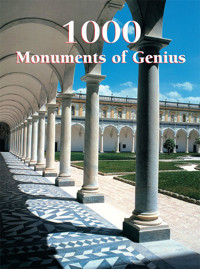
Since the mythical Tower of Babel, humans have continuously tried to erect monuments to match their oversized egos. With ancient ziggurats, the Taj Mahal or the Empire State Building, man has for centuries demonstrated his force by raising structures for purposes both religious and profane. As international cultural statements without words, symbols of a peoples values devotion, patriotism, power symbols of a civilisationÊs grandeur, these monuments still fascinate and attract an ever-growing public who is captivated by the createvity and ingenuity of these architects and stonemasons. Their historical message goes far beyond mere art history, for they tell us of the lives and evolution of the peoples of the past, as does the Parthenon in Athens, many times destroyed, rebuilt, reused, attacked, pillaged, and restored once again today. This work, featuring 1000 monuments chosen from around the globe, retraces human history, the techniques, styles, and philosophies necessary for the construction of so many splendours over the centuries, providing a panorama of the most celebrated monuments while evoking the passion of their makers. The reader can explore the changing values of humanity through the edifices it has built and understand these structures as triumphs of humankind
Das E-Book können Sie in Legimi-Apps oder einer beliebigen App lesen, die das folgende Format unterstützen:
Seitenzahl: 405
Veröffentlichungsjahr: 2014
Ähnliche




















Author: Christopher E. M. Pearson
Design:
Baseline Co Ltd.
61A-63A Vo Van Tan Street
4th Floor
District 3, Ho Chi Minh City
Vietnam
© Confidential Concepts, worldwide, USA
© Parkstone Press International, New York, USA
Credits:
Parkstone Press International would like to thank Klaus Carl for graciously letting us use his picture library.
For the other photographers:
© Alexandra Gnatush-Kostenko -Fotolia.com(n°600)
© Ali Ender Birer -Fotolia.com(n°767)
Casa Mila, La Pedreda (Barcelona).Thanks to Fundació Caixa Catalunya (n°629)
© Daniel BOITEAU -Fotolia.com(n°405)
© Delphine -Fotolia.com(n°83)
© domi4243 -Fotolia.com(n°238)
© Dreef |Dreamstime.com(n°549)
© Fedor Sidorov -Fotolia.com(n°426)
© Frédéric GUILLET -Fotolia.com(n°404)
© gRaNdLeMuRieN -Fotolia.com(n°381)
© GRUENER JANURA AG, Glarus, Swizerland (n°729)
© Haider Yousuf -Fotolia.com(n°81)
© Inavanhateren |Dreamstime.com(n°409)
Jacques Evrardand Christine Bastin for the photographs of pictures n°606,607,608
© jerome DELAHAYE -Fotolia.com(n°882)
© Jgz -Fotolia.com(n°60)
© Joachim Wendler -Fotolia.com(n°91)
© Lullabi |Dreamstime.com(n°581)
© maccoyouns -Fotolia.com(n°891)
© Marie-Jo Golovine -Fotolia.com(n°231)
© Martin Atkinson -Fotolia.com(n°855)
© Masterlu |Dreamstime.com(n°111)
© Mikejroberts|Dreamstime.com(n°301)
© m8k -Fotolia.com(n°673)
© Nicolas Van Weegen -Fotolia.com(n°499)
© pat31 -Fotolia.com(n°120)
© Peter Mozden (n°778)
© Phillipminnis |Dreamstime.com(n°176)
© Pierdelune |Dreamstime.com(n°865)
© Posztós János -Fotolia.com(n°552)
© Preckas |Dreamstime.com(n°221)
© Rostislavv -Fotolia.com(n°529)
© Sds2003196 |Dreamstime.com(n°727)
© Sebastien Windal -Fotolia.com(n°462)
© Sedmak |Dreamstime.com(n°333)
© Snowshill -Fotolia.com(n°308)
© Starper |Dreamstime.com(n°129,519)
© Taiwan National Cultural Assiciation (n°190)
© Timehacker |Dreamstime.com(n°591)
© Typhoonski |Dreamstime.com(n°869)
© UNESCO (n°131,205,290,814,831)
© UNESCO/ Ariane Bailey (n°588)
© UNESCO/ C. Manhart (n°262)
© UNESCO/ Dominique ROGER (n°694)
© UNESCO/ E. de Gracia Camara (n°87)
© UNESCO/ F. Bandarin (n°43,49,50,59,97,133,144,154,191,244,836)
© UNESCO/ G. Boccardi (n°104,106,160)
© UNESCO/ J. Williams (n°45,820)
© UNESCO/ Messe.Meyer (n°348)
© UNESCO/ Peter. Sare (n°320)
© UNESCO/ V. Vujicic-Lugassy (n°119)
© unflushable -Fotolia.com(n°113)
© Valeria73 |Dreamstime.com(n°461)
© BlueRidgeKitties:http://www.flickr.com/photos/blueridgekitties/4156381049/sizes/o/in/photostream/
ISBN: 978-1-78310-941-8
All rights reserved. No part of this publication may be reproduced or adapted without the permission of the copyright holder, throughout the world. Unless otherwise specified, copyright on the works reproduced lies with the respective photographers. Despite intensive research, it has not always been possible to establish copyright ownership. Where this is the case, we would appreciate notification.
1000
Monuments
Contents
Introduction
What is Architecture?
Structure and Materials
Architecture as Theory
Africa and the Middle East
Asia and Oceania
India and Southeast Asia
China
Japan and Korea
The 19th and 20th Centuries
Australia and Oceania
Europe (including Russia and Turkey)
The Americas
Biographies
Alvar Aalto
Robert Adam
Leon Battista Alberti
Tadao Ando
Luis Barragán
Peter Behrens
Gian Lorenzo Bernini
Mario Botta
Donato Bramante
Marcel Breuer
Filippo Brunelleschi
Michelangelo Buonarroti
Le Corbusier
Johann Bernhard Fischer von Erlach
Hassan Fathy
Norman Foster
Richard Buckminster Fuller
Antoni Gaudí
Frank Gehry
James Gibbs
Michael Graves
Eileen Gray
Walter Gropius
Zaha Hadid
Victor Horta
Thomas Jefferson
Philip Johnson
Inigo Jones
Filippo Juvarra
Louis Kahn
Rem Koolhaas
Louis Le Vau
Daniel Libeskind
Adolf Loos
Charles Rennie Mackintosh
Richard Meier
Erich Mendelsohn
Charles Moore
Julia Morgan
Richard Neutra
Oscar Niemeyer
Jean Nouvel
Andrea Palladio
Ieoh Ming Pei
Auguste Perret
Renzo Piano
Henry Hobson Richardson
Richard Rogers
Aldo Rossi
Eero Saarinen
Jacopo Sansovino
Karl Friedrich Schinkel
Sir John Soane
James Stirling
Louis Henry Sullivan
Kenzo Tange
Ludwig Mies van der Rohe
Robert Venturi
Otto Wagner
Sir Christopher Wren
Frank Lloyd Wright
Chronology
3000-2000 BCE
AFRICA
ASIA
EUROPE
AMERICAS
2000-1000 BCE
AFRICA
ASIA
EUROPE
AMERICAS
1000 BCE – 0
AFRICA
ASIA
EUROPE
AMERICAS
0-550 CE
AFRICA
ASIA
EUROPE
AMERICAS
550-1000 CE
AFRICA
ASIA
EUROPE
AMERICAS
1000-1500
AFRICA
ASIA
EUROPE
AMERICAS
1500-1700
AFRICA
ASIA
EUROPE
AMERICAS
1700-1800
AFRICA
ASIA
EUROPE
AMERICAS
1800-1900
AFRICA
ASIA
EUROPE
AMERICAS
1900-2002
AFRICA
ASIA
EUROPE
AMERICAS
Glossary
Index
Introduction
What is Architecture?
Among the major visual arts, architecture has always had something of a reputation for being difficult to appreciate. This is not solely because it would seem to require a large degree of professional skill both to design and to understand, at least in a technical sense. Unlike a painting or a sculpture, a building does not tell an easily decipherable narrative or attempt to ‘represent’ some aspect of reality in artistic terms. Rather, the nature of architecture is at least in part utilitarian, serving to shelter various human activities. At the same time, architecture dignifies our daily actions by giving them a distinctive public presence in the form of a building envelope or façade, one that in the case of many historical edifices may present us with a bafflingly complex articulation. In this sense, the busy external appearance of, say, Chartres Cathedral or the Pompidou Centre may indeed prove intimidating to the visitor who encounters them for the first time. In many cases, the means of creation of a given building, including its structural techniques and even its materials, may not be immediately evident or easily comprehended by the casual viewer. Its stylistic, historical and iconographic points of reference may be obscure and unfamiliar. Should one know, or care, for example, that the colossal Ionic columns fronting the 19th-century British Museum are based on those of the Temple of Athena Polias at Priene from the 4th century BCE? What insight might such an observation give us into the nature of the later edifice? Moreover, the very function of a building may often be inaccessible from a purely visual inspection, especially if its original purpose has been forgotten or has changed over time: what was Stonehenge used for, and what does one do inside a basilica, a pagoda or a martyrium, for instance? On the other hand, unlike our encounter with a work of art in a museum, we generally experience architecture in a state of distraction: as the German philosopher Walter Benjamin once noted, we do not see and appreciate buildings so much as we simply use them or walk past them or through them. Buildings become invisible to us. This points, however, to the major reason why the study of architecture should never be daunting to the beginner: it is the art we all use every day, and each of us has a lifetime of experience with it. In this sense, as we move from home to office to shopping mall to museum to hotel, we are all architectural experts, formed by a quotidian process of the visual assessment, navigation, tactile engagement and habitation of three-dimensional spaces that have been designed by professional builders or architects.
Most of the structures in this book, however, could not be described as everyday. Rather, they are exceptional for various reasons, and on these grounds could be designated as ‘monuments’. (The term ‘monument’ in this context does not refer simply to those constructions of a largely symbolic or commemorative character—the Washington Monument, for example, or London’s Monument to the Great Fire of 1666—but to any building of fundamental architectural distinction.) Here we are largely concerned with edifices that required much time, money, labour and ingenuity in their creation. The architectural historian and theorist Geoffrey Scott wrote that civilisation ‘leaves in architecture its truest, because its most unconscious record’, and it is a truism worth repeating that architecture is inevitably an index of power—secular, religious and economic. Architecture, by this definition, is represented by large, formal buildings, often of a showy appearance, crafted of permanent materials and dedicated to high purposes. A Greek temple, a Gothic cathedral or a palatial residence like Versailles, the Alhambra or White Heron Castle might come to mind. It is clear that the planning and construction of such impressive structures only become feasible with the emergence of large concentrations of wealth and influence, whether in the hands of a single ruler or a ruling caste. The resulting monuments, whose enduring nature has allowed them to far outlive their designers, patrons and originating cultures, bespeak an ability to marshal and deploy dozens or perhaps even thousands of workers over long periods of time, using forced, salaried or (most rarely) volunteer labour. This is as true of the Great Pyramids of Giza as it is of the latest awe-inspiring skyscraper in Beijing or Dubai. Architecture, like history, is created on behalf of those who have prevailed through the wielding of power, those who are able to command the spoils of war and to reap the profits of commerce. As with all such manifestations of power, the great monuments of the world are in this sense more often than not the products of despotic rule, inhumane value systems or an unfair division of resources, and could certainly be condemned as such. The Victorian art critic John Ruskin, for example, could even launch a contrarian attack on the ancient Greek temples—erstwhile symbols of fledgling democracy, humanistic culture and refined aesthetic sensitivity—as oppressive and dehumanising. Ruskin particularly objected to the Classical buildings’ demand for monotonously repetitive carved ornament (such as mouldings, dentils or capitals), the manufacture of which would seem to have demanded a machine-like subservience on the part of the stonemasons. Even today a visit to the Colosseum in Rome or the great Mesoamerican pyramid-temples (n° 814; n° 821; n° 823) may well arouse uneasy thoughts of the mass slaughter that occurred there over the centuries, if not the backbreaking labour that went into their creation. The world’s largest church, the Basilica of Our Lady of Peace (1985-90) in Yamoussoukro, Côte d’Ivoire, is generally seen as a self-indulgent folly on the part of that impoverished country’s onetime president rather than as an architectural masterpiece of the first order. More often than not, however, and especially in the case of the venerated relics of older civilisations, we have an understandable tendency to set aside the questionable morality of their patronage and simply to appreciate the splendour, mystery and ingenuity of their built creations. With the passage of time, even the survivals of Nazi architecture, those morally repugnant but undeniably impressive reminders of recent atrocities, have gone some distance towards being the subject of dispassionate academic interest and even a measure of professional (rather than political) admiration from some practising architects, who see in them the evidence of a continuing European debt to the still-relevant legacy of Greece and Rome. Ideologically offensive regimes, it can easily be demonstrated, do not automatically produce either good or bad results in architecture, and from a purely aesthetic or technical standpoint the question of politics might even be left out of the discussion altogether—a rationalisation that continues to allow some contemporary architects to work for politically suspect patrons. More generally, as the Maltese architect Richard England has observed: ‘When all is said and done there remains the building.’
Perhaps a more basic—though equally unsatisfactory—aspect of the ‘elite’ definition of architecture lies in its inherent bias towards monumentality: what about those cultures that, for whatever reason, chose not to build durable or extravagant monuments? Would not this definition exclude the extraordinarily skilful but often small-scale or impermanent structures of many Native American, Oceanic or African tribal groups, the domestic buildings of the ancient Greeks, or any number of localised traditions making use of fragile materials or given to humble, everyday uses? This perhaps unrealistic discrimination lies behind architectural historian Nikolaus Pevsner’s famous comparison of a cathedral and a bicycle shed in his Outline of European Architecture (1943): the former was held to represent ‘architecture’ (perhaps even with a capital A) with distinct ‘aesthetic appeal’ while the latter was seen as mere ‘building’ of a strictly functional character. As this example suggests, the question is at the same time complicated by the professional divide between architecture and engineering (and indeed building and contracting). Can purely utilitarian structures, whatever their technical merits, be seen as architecture? The success of the modern movement in deliberately merging or blurring the parameters of both fields has perhaps rendered the question less pressing in the present day, but the status of ancient shelters, barns, warehouses and the like has yet to be dealt with.
Having laid out this series of caveats, we can now see that this book presents a selection of monuments that fits a more traditional definition of architecture. (The number of houses included in the later sections, reflecting a growing theoretical interest in the dwelling over the last few centuries, may represent a countercurrent.) Illustrated here are some of the most prominent examples of historical architecture to have survived above ground. Eschewing monuments that have vanished without a trace or which have left only scanty remains on the surface, the guiding principle has been to choose buildings that are still visible, even in mutilated or partial form, and which can be serviceably represented by a photograph. Apart from the fact that increasing world population and affluence over the last century has dramatically increased the sheer amount of monumental (or at least large-scale) architecture being erected, this editorial decision may help to explain why relatively few pre-medieval structures appear here while the number of buildings from after 1900 is so great. In consequence, this book cannot give a full account of, say, Hellenistic architecture, many of whose masterworks—like the Mausoleum at Halicarnassus or the Pharos of Alexandria—have disappeared from view almost entirely, leaving only a few scattered stones and shattered statues to evidence their onetime existence.
The definition of architecture also raises the question of the classification and sequencing of monuments. Older texts on architecture tended to simplify the process of historical classification by creating only two basic categories: ancient and modern. This has long been overlaid by the historiographical investigations of the last two centuries, and has further been complicated by a growing understanding of non-Western building traditions. A complete global chronology of architecture, though highly complex, can now be established. The beginning student of Western art and architecture soon learns that a great number of specialised terms—’Renaissance’, ‘Neo-Palladian’, ‘Churrigueresque’, ‘Postmodern’ and so on—are used to describe historical buildings. (Similarly, the study of non-Western architectural cultures demands the assimilation of another set of historical labels, such as the Heian period in Japan, the Qing dynasty in China, or the Umayyad dynasty in Muslim countries.) These pigeonhole terms are at once chronological, regional and stylistic in character. But in any modern text on architecture, the introduction of such terms is immediately followed by qualifications: none is absolute, and their value lies primarily in their usefulness rather than their innate truth or accuracy. The chronological division between the Middle Ages and the Renaissance, for example, is notoriously difficult to gauge with any degree of accuracy: classicising tendencies can be traced far back into medieval thought and practise, while medieval building traditions continued long into the 17th century in many parts of Europe. The Baroque, which is generally held to run from the later 1600s to about 1750 in Europe and the Americas, is untidily overlapped on either end by the Renaissance and the Neoclassical age, and indeed can even be held to define a stylistic tendency toward exuberant formal experimentation that cuts across historical or cultural divisions: it is quite possible to talk of ‘Baroque’ tendencies in late Roman provincial architecture or in Japanese shrines of the early Edo period, for example. It is therefore wise to see such labels as indicating relatively loose architectural affinities rather than as airtight categories in the manner of botanical taxonomy.
Structure and Materials
The earliest buildings that have been revealed by archaeological investigation are relatively simple shelters of mud, stone, wood and bone—well suited, indeed, to William Morris’s primal definition of architecture as ‘the moulding and altering to human needs of the very face of the earth itself’ (1881). Perhaps the most interesting aspect of many of these prehistoric buildings is the intimation that practical concerns played only a secondary role in so many of them: just as the magnificent but largely inaccessible cave paintings at Lascaux and Altamira may appear to have served no immediate ends in terms of basic survival, the great monolithic constructions of Stonehenge and Carnac—which clearly demanded inordinate amounts of sheer physical labour—were intended purely for ritual usage. Many elaborate tomb structures would also fit this definition. Even domestic space, as suggested by foundations excavated in the very ancient Neolithic city of Çatalhöyük in Anatolia, is often indistinguishable from spaces of a sacred character. This observation perhaps serves simply to underline that a putative distinction between those activities associated with day-to-day existence and those connected with spirituality and the supernatural was by no means as clear in earlier times as it may seem to be today.
The mud ziggurats and palaces of the Mesopotamian civilisations set the precedent for the more durable stone architecture of ancient Egypt. This, in turn, was to inspire the limestone and marble temples of the Greeks, who evolved that elegant and aesthetically sophisticated mode of building that we have come to term the Classical. Based on the basic building unit of the column and making use of a complex and finely-tuned canon of proportions and ornaments, the Classical system of design that was first evolved by the Greeks for the articulation and embellishment of their religious buildings proved irresistibly appealing to later generations. The Classical Orders—Doric, Ionic, Corinthian and a few other variations—thus established their architectural pre-eminence in the West, and have been endlessly imitated by later cultures in Europe and the Americas. That the initially arbitrary or culture-specific nature of the Classical system—one attuned to the ritual needs of a particular religion focused on offering animal sacrifices to a pantheon of nature-related deities—was soon to be obscured by an impenetrable wall of unquestioned authority is largely due, of course, to the Romans, who imitated the Greek manner of building as they did most aspects of Greek culture. From the Romans, the Classical legacy was then taken up and reinterpreted intermittently throughout the Middle Ages, re-embraced actively in the Italian Renaissance, and thence handed down to the modern world. The Greeks thus bequeathed a legacy of Classical building that has lasted some two and a half millennia and still shows signs of life in the 21st century.
The enduring nature of the Classical system, which is almost entirely based on the principles of masonry construction, may again serve to underline the fact that until the last two hundred years builders could rely only on naturally-occurring materials to construct durable shelters. (Concrete, requiring the sourcing, preparation and admixture of such specialised materials as ash and quicklime, may be a partial exception.) Here the list of serviceable substances is a short one: earth (tamped, mixed with water, dried or baked), sand (for foundations), stone, wood, and—more rarely—animal parts (bone, leather) and various organic materials that are susceptible to weaving (reeds, twigs, bark). Wood has the advantage of being both relatively easy to process into framing units and relatively sturdy, though it is always vulnerable to rot, fire and insects; few ancient buildings using timber construction survive today. As the following pages will confirm, it is stone, because of its durability and great compressive strength, which has remained the material of choice for monumental buildings over many thousands of years. (And it might even be argued that concrete, which has supplanted stone in almost all modern constructions, presents itself simply as a more liquid, and hence more easily malleable, form of stone.) The most conservative method of masonry construction, as in a conventional load-bearing wall or the Egyptian pyramids, is simply to lay brick on brick or stone on stone; this can be done to some height before the foundations are crushed by the increasing weight. If the building is of multiple stories, however, this simple technique tends to demand extremely thick walls with small openings, allows little or no scope for useable internal space, and is wasteful of materials and labour. The driving technical question through much of architectural history has therefore been: how can we come up with a structural method that will allow a stone building to have both larger openings and spacious interiors? The greatest liability of stone is its heaviness and brittleness, and much ingenuity has been spent trying to find methods to get stone to span greater and greater distances without the danger of collapse. Likely drawing on now-vanished timber prototypes, one early solution was trabeation, the structural basis of Classical architecture: in conjunction with solid wall construction for the inner sanctuary, Greek temples relied almost exclusively on a simple post-and-beam method. The greatest danger here is in proposing bays of excessive length; i.e., leaving too much space between upright supports, which risks cracking the horizontal members that are made to span them. In large rooms, the low tensile strength of stone necessitates the use of either a grid of vertical supports (posts or piers) to hold up the ceiling, or a lighter timber superstructure, though the latter will again be subject to fire or other hazards. Preferentially, therefore, roofs and ceilings were often to be built using masonry, and various methods of vaulting were developed. An early technique, known as corbelling, simply extends each successive layer of stone slightly beyond the one below until a ceiling of tapered section is formed. The true arch, making use of a semicircle of voussoirs (individual blocks of trapezoidal form) and secured on top by a keystone, was much used by the Romans in both honorific and utilitarian contexts. The extension of an arch in a single direction in space results in a semicircular barrel vault (a half-cylinder), while its rotation through 360 degrees creates a hemispherical dome. Such forms provided the best method of vaulting into the early medieval period, though they often required the use of lighter materials (usually brick) and heavy buttressing in order to counteract the lateral thrust that was thrown onto the external walls. It remained for the master masons of the Gothic period to perfect a more daring and effective form of stone vaulting, one which took the material to the limits of functionality. Making use of a pointed arch for both arcades and interlacing rib vaults, as well as a series of flying buttresses to provide lateral stability, the Gothic builders were able to realise elegantly skeletal constructions that made minimal use of load-bearing wall construction and soared to unprecedented heights.
The story of architectural technique from the late 18th century through the present day is largely one of the increasing mastery of metallic construction. Following the innovations of the Industrial Revolution, first iron and then steel were pressed into use for utilitarian structures: warehouses, factories, stores and other commercial buildings could be erected quickly and cheaply, using cast-iron elements for internal framing and external cladding. Increasingly, iron framing also began to be used for larger public buildings, notably the new Houses of Parliament in London, but these were inevitably clad in a veneer of stone or terracotta to gave the impression of traditional load-bearing construction, thus catering to genteel notions of how architecture was supposed to look. This was also true of the early skyscrapers of Chicago and New York, whose façades did not begin to make clear formal acknowledgement of their internal steel frame construction for some decades. Later in the 19th century the first experiments began to be made with reinforced concrete, which optimally combined the tensile strength of iron or steel rebar with the compressive strength of concrete. At the same time, the development of such new building technologies introduced a vexing split into architectural practise: the field of engineering was now emerging as a specialised discipline in its own right, and techniques and aesthetics thus became estranged. A telling comparison might be made between two prominent buildings erected in Paris after the mid-19th century: Charles Garnier’s new Opera house (1861-1875) and the Eiffel Tower (1889). The Opera, designed by an academically trained architect, epitomised the French belief that Paris was the centre of world culture, and that its major opera house should exemplify the grandest formal design and the most sophisticated and allusive veneer of sculptural and painted ornamentation, both inside and out. Stylistically, the Opera synthesises over two thousand years of Classical architecture, drawing on the formal vocabulary of the Greeks and Romans as filtered through the Renaissance and Baroque, and thus presented itself as a summation, if not an apotheosis, of the European cultural tradition. The Eiffel Tower, on the other hand, designed as a temporary structure for a world fair, had aims that were technical and commercial rather than strictly cultural in nature, namely: reaching an unprecedented height, minimising weight and wind resistance, and making a dramatic demonstration of the new techniques of iron construction that had been developed by French engineers. Obeisance to historical precedent or accepted canons of taste played no part in this venture, and upon its erection the tower was roundly condemned as a brutal monstrosity by a coalition of prominent French artists and writers. The question seemed clear: was architecture to be a matter of good design in the humanistic tradition, or was it instead to be a technologically-driven search for scale, economy and efficiency?
It was left to the ideologists of the Modern movement in the early 20th century to attempt to forge a reconciliation between art, architecture and industry. The key ingredient, as it turned out, was modern painting and sculpture, which provided architects with a new language of abstract form and space creation that seemed suited both to the Fordian and Taylorian exigencies of modern industry and to the increasingly collective (i.e., anti-individualistic) nature of contemporary society. This is not to say that modern architecture was conceived as simply cheap, functional, expedient or anonymous, but rather that it evinced a carefully considered ‘machine aesthetic’ that was seen to be in tune with the modernist Zeitgeist of mass production, standardisation and collectivism. At the same time, modern architects made great inroads into the creative deployment of newer materials—notably glass, steel and reinforced concrete—to fashion envelopes and spaces of compelling beauty and originality. In the work of contemporary modernists like Norman Foster or Santiago Calatrava, the line between technology and art has been completely effaced, and whether a given architectural element can be seen to have a technical or aesthetic motivation within the building as a whole necessarily becomes a moot question. What can also be said with certainty is that architecture has reforged a vital partnership with engineering that has allowed tectonic forms of unprecedented complexity and irregularity to be realised. In recent years this process has been accelerated to blinding speed by the introduction of computers into the design, construction and costing processes, and the expressionist fantasies of a Frank Gehry or a Daniel Libeskind can now be achieved within reasonable parameters of time and expense.
Architecture as Theory
Architecture, as distinguished from building, might further be characterised by its reliance on written theory rather than on established folk traditions. In this light, the history of architecture is as much a matter of texts as it is of actual structures. It may not be coincidental that the emergence of formal, monumental architecture in the Fertile Crescent of Mesopotamia was accompanied by the development of the first writing systems, and architecture is in this sense always a product of literate cultures. The composition of self-consciously theoretical manuals on architecture is at the same time a record of the growing status and social aspirations of the architectural profession. Such texts are rare before Roman times, and the first real landmark we have in this field is the famous treatise written by the Roman architect Vitriuvius in the 1st century BCE. Though largely technical in nature, incorrect or obscure in certain passages and often rather dull, Vitruvius’ De Architectura is the lone survivor of the architectural texts of antiquity, and as such necessarily remained a touchstone for practise in the West for some two thousand years. Vitruvius covered the basics of construction, the correct plans and proportions of public and religious buildings, and set out the details of the Classical orders. The organisation and subject matter of Vitruvius’ text set the precedent for the Renaissance treatises of Alberti (De Re Aedificatoria, 1442-52), Cesariano (Di Lucio Vitruvio Pollione de Architettura, 1521), Serlio (Tutte l’opere d’architettura et prospettiva, 1537 and later), Vignola (Regola delli cinque ordini d’architettura, 1562) and others. European architectural theory at this time tended towards promulgating refinements to the Classical system rather than mounting any serious challenge to its hegemony, and we further begin to sense a growing divide between practise (on-site constructional expertise) and theory (the essentially intellectual or antiquarian debates underpinning the study and practise of Classical architecture). Ultimately, the most influential of all Renaissance architectural texts was that of the Venetian Andrea Palladio. His I Quattro Libri dell’Architectura of 1570 had the advantage of clear woodcut illustrations showing the details and proportions of the Orders, reconstructions of Roman buildings, and numerous villas and city buildings of his own design. Notable for his characteristic addition of Roman-style temple fronts to the façades of relatively modest domestic buildings, Palladio bequeathed to amateurs, architects and common builders a simplified but elegant version of Classicism that could be applied to many different typologies with minimal expense. The Palladian legacy was to persist throughout the eighteenth century and beyond in both Europe and America.
The Enlightenment saw the emergence of a new kind of architectural treatise in Europe, one that was less technical and more theoretical or speculative in nature, and which attempted to reconcile the new faith in reason with the traditional reliance on Classical precedent. Most notable here is the Essay on Architecture (1753) of Abbot Laugier, who put forward the idea that the Classical system derived from the most ancient building type, a hypothetical construction of tree trunks which has often been termed the ‘primitive hut’. This entirely conjectural proposal served to anchor Classicism in both reason and nature, thus ensuring its continuing intellectual attractiveness. Other writers of a Neoclassical persuasion continued to subject Classicism to the new forces of reason, a process which nevertheless acted only to reinforce its supremacy. This was further confirmed by the many folio volumes of etchings put out by the Venetian architect Giovanni Battista Piranesi, who aimed to demonstrate the superiority of Roman architecture solely on the basis of its great size, complexity and engineering prowess. Almost unwittingly, however, Piranesi’s unforgettably dense and moody depictions of the monumental ruins of Rome also served to affirm that Classical architecture could be turned to ends of pure emotion rather than strict rationalism, thus laying the ground for the Romanticism of Soane, Ledoux, Boullée, Schinkel and others.
The 19th century nevertheless witnessed new challenges to the Classical monopoly from architects who espoused a return to medieval building practises. This initiative was taken, as often as not, on the basis of moral or religious principles rather than on technical grounds. John Ruskin, who had no professional or technical training in building whatsoever, proposed that the most important aspect of architecture was its ornamentation, which could engage the uncoerced and creative talents of a variety of people in society. His model was the Gothic churches and cathedrals of Europe, and most particularly the highly ornate and colourful version of Gothic to be found in Venice. As laid out in his Seven Lamps of Architecture (1849) and TheStones of Venice (1851-1853), Ruskin’s emphasis on the dignity of the craft traditions was soon to inspire many writers and practitioners of the Arts and Crafts school, led by the socialist philosopher William Morris. Their goal was to recapture the timeless vernacular building traditions of a given region, which automatically foregrounded an appreciation of the inherent beauty of simple, natural materials. This idealistic line of thinking was ultimately to serve as the foundation of Frank Lloyd Wright’s personal conception of an ‘organic’ architecture, one that drew inspiration from natural growth, responded directly to the nature of materials and the structures and forms they suggested, and which took root in a distinct region and socio-cultural environment—in this case, American capitalism, individualism and democracy. A rather different stream of thought, though one equally indebted to the precedent of the Middle Ages, was represented by the voluminous writings of the French architect and architectural restorer Eugène Viollet-le-Duc, who asserted that the true lesson of the Gothic cathedrals was to be found in their innovative construction techniques, and that these might even be applicable to modern constructions in cast iron.
The true literary proponents of the Industrial Revolution in architecture, however, were only to make an appearance after the turn of the twentieth century. The writings of Walter Gropius, Sigfried Giedion, and above all those of the Swiss-French architect Le Corbusier, set the basic agenda for the modern movement: the harmonisation of art, design, industry and architecture. Taking cues from modern art as well as the rational and calculating attitude of the engineer, Le Corbusier proposed that architecture should make use of the abstract language of geometry, eschewing all historicising forms in favour of a fresh and unbiased approach to the fundamental questions of building; e.g., what is a house? Le Corbusier’s famous response was that a house is, in essence, a ‘machine for living in’, just as a sewing machine is a machine for sewing, an airplane a machine for flying in, and so forth. At the same time, Le Corbusier’s discourse could often veer off into unexpectedly idealistic or mystical territory, proposing that the visual effect of finely handled geometrical volumes transcended the merely aesthetic to access realms of emotion and even spirituality. Le Corbusier’s thought—provocative, engaging and fundamentally dialectical in nature—was to prove inspiring to generations of modern architects, and to this day the most-thumbed volumes in architectural libraries are usually those of the eight volumes of his Oeuvre complète. A perhaps unexpected by-product of Le Corbusier’s polemical success was the reactivation of the architectural treatise as an instrument of philosophical reflection, as well as a means by which architects could make their mark in the profession without the necessity of actually building anything. Following in the wake of Le Corbusier, the next most important body of writings was arguably that of the American Robert Venturi and his associates, whose ironic and self-consciously ‘complex and contradictory’ take on building design was informed by an academic familiarity with historical buildings as well an appreciation of contemporary Pop Art. The larger trend that eventually took wing from these ideas came to be known as Postmodernism, and from its origins in architecture it came to permeate all of the creative arts and Humanities through the 1980s. More recent architectural theory, though not infrequently hermetic to the point of incomprehensibility, has tended to be less cohesive and single-mindedly polemical in nature, and the idea of establishing a particular avant-garde school or position presently seems to have fallen by the wayside. This may in part be attributable to an understandable fatigue with tracing the putative rise and fall of categorical ‘movements’ in architecture, but also to the increasing tempo of electronic media, which barely allows readers the time to absorb a new design concept before it is replaced by an even newer one. Perhaps for this reason, contemporary architectural treatises, such as those of Rem Koolhaas, tend to rely just as much on dense layerings of photographic or computer imagery than on pure text. This, in turn, again calls into question our definition of the architectural monument: in a time when the computer threatens to dematerialise the most stable social traditions, architecture, too, appears to be moving into a virtual phase, one in which the previously inert and (literally) concrete products of architectural design may soon become indissociable from the flow of digitised information and the unending manufacture of virtual realities. The prospects for the future of monumental architecture are indeed dizzying, not to say disorienting, for all boundaries have become fluid. Perhaps even more than we realise, traditional architecture has provided the existential matrix for our lives, the reliability of four solid walls granting us a sense of belonging, stability and orientation in a world of change and apparent chaos. As we contemplate the great building achievements of past civilisations and the exhilarating but often bewildering presentiments of the future represented by contemporary practise, we might do well to recall Walter Gropius’s reminder that ‘there is no finality in architecture, only continuous change.’
1. The Great Sphinx, Giza, c. 2530 BCE (Egypt)
Africa and the Middle East
It may seem curious that monumental architecture was first developed in a land that was so poor in such building resources as timber and stone. But from the 4th millennium BCE a series of diverse and warring civilisations residing in the ‘Fertile Crescent’ between the Tigris and Euphrates Rivers succeeded in inventing both writing and urban society, including mankind’s first essays in architectural building on a monumental scale. That these Mesopotamian cultures were able to accomplish this using only sun-dried mud bricks is remarkable, and is perhaps a testament to the extreme degree of social control wielded by their rulers. The exact sequence of peoples who inhabited and fought over this region over many hundreds of years constitutes a notoriously complex historical patchwork, yet archaeology has revealed a recognisable consistency among them, especially in regard to architectural and urbanistic form.
The monumental architecture of the ancient Sumerians, who established a series of city-states near the Tigris-Euphrates delta, was largely religious in nature. The Mesopotamian temple soon came to assume a standardised arrangement, consisting of a taller central chamber (cella) flanked by lower spaces. As the older mud temples crumbled and were replaced by new ones on the same foundations, these shrines came to be set on tall hills, and these, ultimately, took on the form of stepped pyramids, or ziggurats—the real-life inspiration, in fact, for the Biblical Tower of Babel. Lifting the holy sanctuary as close to the sky as possible, the profile of ziggurats was further meant to recall that of a mountain, a vertical axis by which the supernatural realm could be accessed. After the Akkadian conquests of the mid-3rd millennium BCE, we find early (though limited) use of the round arch, the dome and the vault. Perhaps just as importantly, there also appear the first aesthetic impulses in monumental building: the external appearance of temples, whose simple, load-bearing masonry construction meant that they were necessarily massive, cubic and closed, came to be modulated by the addition of evenly spaced pilasters or decorative buttresses, thus creating a sculptural sense of strength and an attractively regular patterning of light and shade in the strong sunlight. In societies ruled by god-kings, in which little distinction was made between secular and religious powers, temples came to form larger precincts with royal palaces and administrative buildings. Much of this architecture was defensive in function and appearance, though often clad with fired or glazed terra-cotta tiles for both aesthetic and practical reasons. Individual domestic buildings, such as those comprising the city of Ur on the Euphrates, were again inwardly focused, and consisted of an inner courtyard surrounded by smaller rooms, thus serving as a prototype for Middle Eastern and Mediterranean houses for millennia to come.
From the 9th through the 7th centuries BCE the warlike Assyrians built palaces of immense size at their successive capital cities of Nimrud, Khorsabad and Nineveh. The fortified citadel of Khorsabad, erected during the 8th century BCE by Sennacherib, consisted of some 25 acres of palaces, courtyards, temple chambers and a tall ziggurat. Technically, the Assyrians made no great strides beyond their Sumerian predecessors, but their temples became increasingly large, lavish and colourful. The last great surge of monumental building in Mesopotamia took place after the fall of the Assyrians, with the erection of Nebuchadnezzar’s great city of Babylon in the 7th century BCE. Its palaces and temples, their external walls decorated by glazed terracotta tiles of animals and mythological beasts, were arranged along a great processional way. In the following century the accomplishments of the Assyrians would come to be rivaled by those of the neighbouring Persians, as epitomised by the great royal palace at Persepolis, built atop a broad terrace of native rock. Every element of architecture and relief sculpture here served to glorify the ruler, and the great audience chamber (apadana, or hypostyle hall) and nearby throne hall were notable for their numerous tall stone columns set in grid formation, some topped with addorsed bulls’ heads.
While the Sumerian culture was rising, further to the west the pharaohs were consolidating their power in Upper and Lower Egypt. Here an architecture of extraordinary monumentality and stability emerged, founding a tradition that was to last almost three thousand years. Though favouring structurally conservative techniques, the Egyptians created the world’s first large-scale buildings in finely carved stone, and developed stonemasonry to a peak of skill that has rarely been surpassed. It has nevertheless been demonstrated that Egyptian honorific architecture was to a large extent modelled on the forms and building materials of their much more modest domestic constructions of mud, timber and papyrus, and traces and reminiscences of these older techniques can be discovered in many temple structures. Most monumental buildings were religious and/or funerary in character, beginning with the great pyramid of Djoser at Saqqara and the unprecedentedly colossal Old Kingdom pyramids at the edge of the desert at Giza, both dating from the mid-3rd millennium BCE. There was a relative lull in monumental construction during the Middle Kingdom period (1991-1650 BCE), but from the beginning of the New Kingdom (1570 BCE) the freestanding temple again came to the fore and assumed a standardised typology, rarely departed from afterwards: as at Luxor, a central axis leads through a monumental gateway (pylon), a forecourt and a columned hall towards a smaller sanctuary in which the cult image was kept, inaccessible to all but a handful of upper-caste individuals. Egyptian tombs, like the pyramids, were inevitably associated with nearby temples. One of the most notable temple-tombs is that of Queen Hatshepsut in the 18th Dynasty, which was partly set on ramped terraces and partly cut into a stone cliff. Cult temples, which usually took shape gradually over many centuries, were places of holy dread, for they were seen as the literal dwelling place of the Egyptian deities. In all cases the desire of Egyptian architecture was to evoke a sense of religious mystery and awe, an effect heightened by the necessarily thick walls and dark interiors. A secondary aim, as in the Pyramids, was to foil tomb robbers through the inclusion of internal portcullises, false chambers and corridors and the like, though such strategies almost always proved ineffective and virtually all Egyptian funerary architecture has long since been looted. The Egyptians apparently felt little need to expand their interior spaces, and large enclosed areas were only made possible, as in the great hypostyle hall at Karnak, by the insertion of a closely-spaced forest of thick columns to support the roof. Externally, walls were often battered (canted inwards) so as to give a greater effect of strength, and could be covered with large areas of intricately incised hieroglyphics and low-relief scenes, thus leaving us a vivid record of the beliefs and everyday life of Egyptians of all classes. With only a little exaggeration one might say that down through the millennia Egyptian architecture was to remain essentially unchanged, mirroring—if not a lack of intellectual curiosity or desire for innovation—the underlying stability of social life and religious belief. The Egyptians built for eternity, and their architecture is correspondingly massive, stable and timeless.
Until recently the study of the historical architecture of sub-Saharan Africa was largely the province of the anthropologist rather than the architectural historian. This is because few of the building traditions of the continent’s innumerable ethno-linguistic groups matched Western notions of monumentality. Even by this rather limited definition of architecture, however, sub-Saharan Africa has produced some remarkable but still lesser-known architectural masterpieces. In early times we find traces of skilled stonemasonry being practised in Ghana, by the Kush civilisation in Sudan, and in the Ethiopian kingdom of Aksum. In the medieval period the spread of Islam produced major monuments throughout East and West Africa, most notably the Great Mosque of Djenné in Mali. And in southern Africa, the curvilinear stone walls of Great Zimbabwe make up the largest medieval city of sub-Saharan Africa. The Royal palaces at Abomey, Benin (1625-1900) constitute one of the most historic sites in West Africa; built over many years as part of the capital of the ancient kingdom of Dahomey, the elaborately decorated edifices record the history and religion of their builders. Although such international bodies as UNESCO have taken up the cause in recent years, it has to be said that much remains to be done in the archaeological investigation, scholarly study, and popularisation of African achievement in architecture, and historical preservation has now become a pressing need at many sites.
Moving once again to the east, we encounter in the Arabian Peninsula the birthplace of the Islamic religion, which began its remarkable expansion through the Middle East, Asia, Africa and Europe from the 7th century. As a largely tribal and nomadic people, the first Muslims had few real architectural traditions of their own, but took over local building forms and techniques in every country they conquered. The Muslim house of worship, or mosque, can be found in its most essential form as early as 622, when the Prophet’s own mosque was built in Medina. Here, based around an extensive colonnaded courtyard with a central fountain for ritual cleansing, we find the basic elements of Islamic typology: the large prayer room, the mihrab (prayer niche indicating the direction of Mecca), the minbar (elevated stand), the muhajar (balustrade), the pulpit, the midha (purification room) and one or more minarets (tall towers from which the call to prayer is made, a feature originally derived from converted church towers in Syria).
Islam’s first great ruling dynasty, the Umayyads, were based in Damascus, and oversaw the creation of some of the most enduring monuments of Islam, including the Dome of the Rock (technically a sanctuary or shrine rather than a mosque) and the Al-Aqsa Mosque in Jerusalem, as well as the Great Umayyad Mosque at Damascus, which incorporated a Classical temple that had since been converted into a church. Typically Islamic building features, such as the horseshoe arch and barrel-vaulted masonry tunnels, as well as a love of rich ornamentation, emerged here. At about the same time, the Tulunids in Cairo initiated a great program of mosque-building in that city, and by the 9th century monumental mosques were being erected across North Africa. The Seljuks in Persia introduced several innovations in mosque design at the start of the second millennium, notably the incorporation of a huge iwan (giant arch) on each side of the courtyard, a feature taken from the earlier Sassanian culture. The extraordinarily beautiful mosques at Isfahan, Iran, built from the 11th century, exemplify the Islamic genius for colourful and geometrically complex tilework. In the meantime the last of the Umayyads, expelled from the east, had taken up residence in Spain, and the Great Mosque of Córdoba, with its famous forest of arcaded columns, was built and rebuilt from the 8th century. In conquered Constantinople, now renamed Istanbul, the Muslims took the church of the Hagia Sophia as the pre-eminent prototype for new mosque design, and the 16th-century structures of the architect Sinan, which draw clear lessons from Byzantium, are among the most masterful and attractive of all mosques. In terms of domestic architecture, the Alhambra palace in Granada, Spain




