


6,99 €
Mehr erfahren.
- Herausgeber: THP Ireland
- Kategorie: Geisteswissenschaft
- Sprache: Englisch
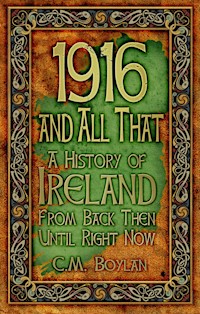
1916 And All That is as an extremely funny and irreverent satirical history of Ireland. The central assumption behind '1916 And All That' is that, despite all of the compulsory school lessons and exams taken, there are only a few muddled facts of our history that most people retain into adulthood. We recall snatches of events, names and dates, and few of us can piece together a coherent narrative or offer up any description of events in detail. We all know Robert Emmet's name, but what did he do, why did he do it, and when? This book references the fuzzily remembered facts, but plays very fast and extremely loose with the details of our history.
Das E-Book können Sie in Legimi-Apps oder einer beliebigen App lesen, die das folgende Format unterstützen:
Veröffentlichungsjahr: 2012
Ähnliche



















CONTENTS
Title
Short Introduction
1.
Settling Early
2.
Third Best Metal
3.
Fiery, Warlike
4.
Shamrocks
5.
Vikings and High Kings
6.
Anglo-Normans
7.
Tu dor or not Tu dor
8.
Gardening
9.
William Fight War
10.
Protestants Ascending
11.
Irishmen United
12.
Kingdoms United
13.
Very Liberating
14.
Blight and Children
15.
Ruling Home
16.
More Ruling Home
17.
Rising na Cásca
18.
Fine Big Lads
19.
Camán
20.
Amen
21.
Other Parties
22.
Séan the Mass
23.
Grace and Paisley
24.
Slightly Better
25.
Boom!
26.
Right Now
Epilogue
Appendix A
Appendix B
Appendix C
Appendix D
Appendix E
Copyright
SHORT INTRODUCTION
The word ‘historiography’ can be defined as all the accumulated writings on a topic of history. The historiography of Henry VIII’s reign, for instance, is all the books and articles that have been written about Henry VIII’s time as king. This body of work will include any number of controversies and disagreements between scholars of Henry VIII as to what he said, what he did, what he meant by what he said, what he meant to say he did and what he said he meant to do.
I mention historiography, firstly, and most importantly, to sound intelligent. I mention historiography, secondly, and quite importantly, to explain that I will not be drawing upon the historiography of Irish historical happenings. This is because this is not an ‘academic history’. Academic histories habitually make use of historiography, which they like to point out in footnotes. Footnotes are references to the work of other historians whose writings you are ‘citing’, ‘drawing upon’, ‘employing to enhance your own argument’ or ‘stealing’. This is an example of an academic footnote.1 Aside from ignoring the historiography and excluding footnotes, there is one other way in which this book differentiates itself from academic history: its wholesale neglect of what are commonly called ‘facts’. These are considered important by academic historians, who spend minutes and even hours looking for them in old letters, manuscripts, diaries, books and Google. In this account, where any facts appear, they occupy the status of happy accidents or nice surprises.
The Irish have been noted for their obsession with their own history. Some say the Irish are obsessed with their history because they have had such a bad one; others because the Irish mind inclines towards narrative; others still because as islanders we are naturally insular and vain. I won’t be drawn on this topic, but I’m sure you have your own opinion on the matter. Which brings me to one final point in this short introduction: if I unintentionally express any ‘opinion’ in this history, it is, just like the joyous coincidence that I may recount any facts, an inadvertent accident.
I sincerely hope that, like most history books, this one helps you to understand fleetingly and forget instantly everything that you read.
C.M. Boylan, 2012
Note
1 For a detailed account of this argument see Sellars & Yeatman et. al., op. cit, 1066 & All That (London: Methuen, 1930) 812th edition, ibid., pp 1-1,003.
1
SETTLING EARLY
Irish history started when people arrived on the island. At least, that is when history really got going. Before that things were rather quiet: mountains rose groaning from the ground, rivers carved long, deep valleys, and trees peacefully spread their roots and branches. The first people, or ‘earliest settlers’ as they are sometimes known, came from Continental Europe to disturb this calm. They were Stone Age people, so named because they adored stone. They made everything from stone – or ‘flint’ as it was known at the time – even their shoes and clothes. As a result, they rarely had good posture.
These earliest settlers arrived a very long time ago, before the wheel was invented and long, long before pillowcases. Eventually, they began to farm, which was much less taxing than spearing berries and gathering boar, and they settled into communities.
Aside from farming, their favourite activity was building tombs; in particular, megalithic tombs such as court cairns, portal dolmens and passage tombs. These were often large, impressive and, perhaps unsurprisingly, stone based. Tomb-building was nothing short of a mania and eventually the tombs vastly outnumbered the amount of available dead. It was therefore agreed to bury much-loved household pets in the superfluous tombs, leading to entire portal dolmens housing the bones of a single ungrateful cat.
The most famous of all ancient Irish tombs is the narrow passage tomb at Newgrange in County Meath, which proves beyond doubt that claustrophobia did not exist in 3200 BC but is an entirely modern ailment. About 200,000 tonnes of stone were used during the construction of Newgrange, begging the question: what were they thinking?
Note:
Historians often begin with questions such as this one, which they use to guide their research. For instance, nobody would know anything about the Battle of Waterloo unless one inspired historian had asked, ‘Where did Napoleon go that week?’ It turned out that he had gone to battle, at Waterloo.
The people at this time drew spiral decorations on every available surface from stones to rocks and boulders. Historians are deeply divided over whether this represented a primitive attempt to hypnotise one another or a simple love of twirling. This is called a ‘historical debate’.
One final point to be noted about these early settlers is that they appear to have worshipped the otter as some form of god or emperor, as evidenced by the many forty-foot statues of otters that have been unearthed across the country dating from this period, most of which depict the otter standing upright on its hind legs, looking magisterial.
Test Your Knowledge:
1. In this stone-based economy, how many pebbles did a pebble necklace cost?
2. What is a historical debate and who won?
3. Why was stone called ‘flint’ and not some other word?
2
THIRD BEST METAL
People in Europe eventually discovered how to mine for metal and make infinitely sturdier weapons and tools than the granite axes and limestone screwdrivers they had previously employed. After a while they created a metal called bronze. This was the third best metal ever made, but it was still quite effective. The next age, therefore, was the Bronze Age.
Eventually, some Bronze Age people moved to Ireland. Ireland’s early metalworkers were also called the ‘Beaker’ people because they evidently enjoyed conducting science experiments. Laboratory after laboratory has been unearthed by archaeologists all over Ireland, littered with countless numbers of beakers, pipettes and primitive Bunsen burners. Quite what these experiments were aimed at is unclear, as precious few hardback science copybooks were found amongst the remains of these ancient labs.
The further back in time one goes, the more difficult it is for historians to reconstruct a detailed picture of the society at the time. This is down to a lack of remaining sources from the past. Professor Gonigle McGonigle of a university explains:
It is very difficult to ‘converse’ with the past at a great distance, to ask it questions or receive any clear replies. It is the equivalent of having an exasperating afternoon sandwich with a drunken Dutchman – only snippets of sense can be gleaned.
You might therefore assume that history books about the distant past would be shorter. You would be wrong. This is because in the absence of source-based facts, historians instead proffer fanciful conjectures on how things might have been. That a great many works on early history lapse into fantasy novels featuring dragons and magic trees is one unfortunate upshot of this historiographical travesty.
While these Bronze Agers made many progressive strides in metallurgy and state science exams, our knowledge of their lives is still rather hazy. We do know that they made lovely pottery and jewellery. From this we might postulate that they were very house-proud and glamorous.
Indeed, jewellery-making replaced tomb-building as the main activity, to the extent that the only tombs that were invented during this period were wedge tombs, a comparatively perfunctory form of burial house when compared with its impressive funerary predecessors. The jewellery, by contrast, was exquisite and of such variety – from earrings to bracelets and leg ornaments – that it is very likely that people dressed entirely in jewellery rather than clothes.




