



Erhalten Sie Zugang zu diesem und mehr als 300000 Büchern ab EUR 5,99 monatlich.
- Herausgeber: IEXE Editorial
- Kategorie: Geisteswissenschaft
- Sprache: Englisch
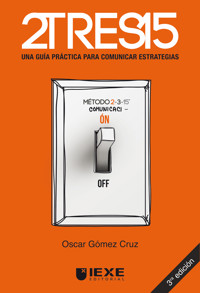
2THREE15 shows communication tools that will be very useful for the decision maker, public work in the public or private sector, the elements to communicate ideas in a clear and practical way. Having a good idea is no longer enough, now it is necessary to learn to communicate and base a practical strategy. The great contribution of the author is the creation of the communication tool 2THREE15, the quality has the purpose of identifying and selecting the means and the optimal channels so that the ideas adapt to the understandable form. It is an ideal book for the desire to convey an idea in a powerful and convincing way.
Sie lesen das E-Book in den Legimi-Apps auf:
Seitenzahl: 345
Veröffentlichungsjahr: 2020
Das E-Book (TTS) können Sie hören im Abo „Legimi Premium” in Legimi-Apps auf:
Ähnliche



















http://dostresquince.com/e-learning/
I want to know which are the most common mistakes when communicating an idea.
I wish to know the main kinds of decision-makers I might face.
I want to know how to apply the 2-3-15 method to strategically convey and convince.
I wish to know how to make convincing and persuasive audiovisual presentations and shocking messages that I can share on social media.
I want to make an impactful paper to persuade a decision-maker.
1 wish to have a quick, portable guide that gathers the 2-3-15 method steps.
Oscar Gómez Cruz He translates complex information into accesible communication.
For twenty years, he has advised luxury product companies and all kinds of different public agencies, supporting them into achieving their goals through strategic communication schemes.
He is a passionate expert on the subject, has a Columbia University master's degree on International Affairs focused on Finances and Business, and a National Institute master's degree on Public Administration. He graduated from Harvard University Business School Strategy Program and has an UDLAP bachelor's degree in Accountancy and Finances. He has recently finished his PhD on Public Policies at IEXE University.
He has held different governmental positions. He has been a master's degree academic at Anahuac University. He is co-author of the books La Campaña, Guía Práctica para Estructurar una Candidatura Competitiva (The Campaign, A Practical Guide to Create a Competitive Candidacy), (IEXE Publishing, 2019) and Gobierno Inteligente, Hacia un México Competitivo (Intelligent Government, Towards a Competitive Mexico), (Noriega-Limusa, 2006).
At present, he is chairman of 2-3-15, an advisory company specialized on strategic communication and business consulting agency. In it, he has led governmental projects at both state and federal levels, and in private and public universities as well, at different business turns. He has worked at the legislative power and with political parties to integrate their campaign strategies.
www.dostresquince.com
/DosTresQuince
@DosTresQuince
+52 222 211 29 70
“A very necessary tool.”Pedro Aspe ArmellaFormer Secretary of treasury
Edition:
Arturo Abascal Zarco
Omar García Heredia
Araceli Molina Diz
Traslation:
Mariana Guevara Robles
Design:
Nallely del Carmen Carrasco Castillo
Indira Espino Alvarado
Adriana Lara Duarte
Margie Vianey Martínez Pineda
2THREE15
A practical guide to convey strategies
Oscar Gómez Cruz
First edition: 2011
Second edition: 2014
Third edition: 2017
First edition in english: 2019
Second edition in english: 2023
Comments on this book:
IEXE University
www.iexe.edu.mx
All rights reserved.
D.R. © 2023, Oscar Gómez Cruz
D.R. © 2023, Grupo Editorial y de Investigación Polaris S.A. de C.V.
ISBN: 978-607-8571-21-5
Prohibited, under the established law sanctions, all partial or total reproduction of this book by any means or procedure, including typography or informatics, without written authorization from the Copy owners.
Editing: Grupo Editorial y de Investigación Polaris S.A, de c.v.
Adress: Boulevard Esteban de Antuñano, # 2702 B, Puebla, México. Postal 72160.
To Gaby, Fer and Gabo.My reason of living.To my parents and family,by whom I exist.To all those who have been therealong my life,so that I can be here.
“This book offers, in an easy and accurate way, the necessary tools for efficient political communication. The contents are commonly known, but not the way to do it properly.
Facing the lack of books related to communication, Oscar Gómez Cruz contributes to improve, in an effective and proper way, the transmission of the message, to finally turn communication into a tool of action. This book is an essential reference book.”
Francisco Abundis LunaSkilled on social psychology and quantitative methodology; he is associate director of Parametria.
“The establishment of a route to strategically convey in accordance to our objectives and audience is a pillar to building success. The key resides in what we say, but also in how we say and deliver it according to our ideas. This is how one of the main challenges we face in a context where a quicker flux of information demands shorter processing times and the need of fulfilling goals and giving results is constantly increasing requires a method to convey strategies, both personally and professionally.
As an academic and official at the public and private sectors, I have promoted the use of communication tools that help decision making. 2-3-15 is a practical guide to communicate strategies, and it gathers the easiest elements to identify mistakes, to better understand our audiences and to know how to behave before them. It describes the necessary steps to prepare a truly motivating presentation for decision makers.”
FEDERICO BERRUETO PRUNEDAChairman of Strategic Communication Office
“In the world of politics and business, and in everyday life as well, the ability to make decisions and achieve the expected results implies a great deal of efficient communication. Oscar Gómez displays, with the correct methodology and a practical sense, useful tools that matter to modern decision-makers and public policy. Without a doubt, 2-3-15. A practical guide to convey strategies fits not only in a new business trend, but in a new way of thinking that ponders the importance of understanding the person whom we are trying to convey, in order to be efficient.”
ESTEBAN MOCTEZUMA BARRAGÁNAmbassador of Mexico to the United States
“An essential book to those who want to succeed in today’s world. Having great ideas is no longer enough; it is crucial to display them in powerful and convincing ways. Oscar Gomez Cruz offers a text about the art of communicating them to the great circles of power and influence, with practical tips for persuading.”
FERNANDO SEPULVEDA VILDOSOLAGeneral director of Impulsa
“An interesting book with important recommendations to obtain positive results when facing leaders.”
ALFONSO SILICEO AGUILARExpert in psychology, organizational development and leadership; author of El Liderazgo Que México Necesita (The Leadership Mexico Needs).
CONTENTS
INTRODUCTION
2-3-15: A PRACTICAL GUIDE TO CONVEY STRATEGIES
CHAPTER 1
MISTAKES ON PRESENTATIONS
INCLUDES AN INTERVIEW WITH PEDRO ASPE ARMELLA
CHAPTER 2
EVERY MIND IS A WORLD OF ITS OWN
CHAPTER 3
2-3-15, THE STRATEGY TO CONVEY A STRATEGY
INCLUDES AN INTERVIEW WITH FRANÇOIS-MARC SASTRE
CHAPTER 4
AUDIO-VISUAL AND ONLINE COMMUNICATION TOOLS
INCLUDES INTERVIEWS WITH MANUEL ANDRADE DÍAZ AND MÁRCELO GARCÍA ALMAGUER
CHAPTER 5
THE DELIVERABLE DOCUMENT
INCLUDES INTERVIEWS WITH LUIS CARLOS UGALDE RAMÍREZ
CONCLUSIONS
INCLUDES AN INTERVIEW WITH BRUNO CATATTORI AND ALFONSO DE FLORIDA
APPLYING THE 2-3-15 METHOD
PRACTICAL BOOKLET
BIBLIOGRAPHY
THIRD EDITION NOTICE
More than five years have passed since this book’s first edition. It could seem a relatively short period of time, but lots of things have changed in Mexico and worldwide, and all the same it’s been happening at the Strategy + Communication 2-3-15, the company where we turn complex information into shocking, plain communication.
All along this time we have taken part on diverse kinds of projects, always with the mission of helping our clients to achieve their goals by means of personalized strategies and particular focusing.
The needs we have detected and the experience acquired have led us to polish and perfect the 2-3-15 method by applying it to different contexts, situations and tools, all of which share everyone's need of conveying and selling an idea or product, in most cases with life-altering expectations.
Aware about the increasing deepening of knowledge and skills into an interconnected digital context, we have developed the “2-3-15 Method online course: A practical guide to communicating”. From any web platform, the user is given pleasant, clear and understandable practical lessons on our methodology, which is explained in videos and interactive sections.
As it is an all online course, it is very practical and resilient, for it may be seen anytime and anywhere from a PC or a mobile device.
As a society, throughout these years we have adopted a totally new language. Now we speak with likes, hashtags, followers, trending topics and many other concepts that have completely changed our way of communicating. In this sense, this third edition also tackles the way in which we can apply our method to digital communication.
Another one of our goals is coaching high rank decision-makers and their executive teams, thanks to this companies can improve their interaction patterns and take care of the most valuable asset for any company: time.
On one hand, directors can clearly express instructions and requirements to their subordinates, while at the same time the team can show the decision makers only the necessary information. That way they prevent long meetings that only go around in circles and cost a lot of time and money.
With this service, we have been able to help many organizations to improve their internal patterns in order to create a strategic communication culture by levering their efficiency and productivity.
Throughout these years we have had the opportunity of advising many companies, societies, governments and individuals. The projects developed have been varied.
Intervention 1) Finances for non-financials
An Office of Finances in Mexico intended to inform the citizenry about the way the annual budget is planned on the basis of the income-outcome Law. The challenge was to tackle such a complex and boring topic on an appealing way for everybody.
To that objective we created a strategy including communication tools addressed to two main kinds of audiences: those who use data for work or research purposes, and those who probably don’t have any idea about the subject. In both cases we used shocking elements based on higher values.
The result was that the Ministry managed to improve its connection with the people, so it has repeated the strategy more than four consecutive years.
Intervention 2) Home construction
It was a college project aiming to give dignified homes to poor people, so the university needed to widen up its supporting base and donations in order to benefit more people.
We created a social media campaign with a digital and printed tools portfolio, aimed on one hand to persuade more donations from businessmen (through benefitting their trademarks), and on the other to invite the general public to take part and support the cause.
The result was that the campaign had a higher impact than expected, so the project achieved to help more people in need of a home.
Intervention 3) Electric transformer
A huge state company in charge of providing the country with electricity had been on a deep transformation process and wanted to clearly communicate its consumers what the changes would be and how this would benefit them.
The strategy was based on clear and concise communication, by means of drawing animations that explained all the information related to the process.
The result is that today the company counts on high impact tools to communicate complex and sensitive information on a direct and understandable way for massive audiences.
Intervention 4) International luxury on wheels
A group of businessmen had to convince an important luxury cars brand that they were the best option to represent them in central and southeastern Mexico.
The challenge was not simple because even though the team was skilled enough to do the task and reach the endorsement from such a globaly renowned brand, it required not only to be qualified, but also to be capable of conveying an idea of excellence.
In order to do so, we created an impactful persuasion strategy through which it was made clear that there was no doubt about their decision being the best one.
The result: success. Today they are consolidated as an automotive corporation with a great future, due to the fact that the market they target doesn’t need massive volume sales.
Intervention 5) Energy efficiency
A giant hydrocarbons production center wanted to improve its communication towards both high direction levels and the operative sectors, aiming to elevate efficiency.
The outcome is that today they are ongoing a training process at managing and operative levels, which makes inner communication more efficient, simple and clear. All of this is reflected on the highest decision maker’s planner, since now his meetings last 15 or 20 minutes, instead of the two-hour sessions he was used to.
Intervention 6) Happiness through 2-3-15
A civil association led the most important study worldwide, which looked to measure happiness on Mexican municipality’s life, an unprecedented analysis that took a great effort.
A project of this dimension didn't need a strategy to be conducted; it was essential to suitably communicate its importance at both the work it meant and the topic itself.
The organization became a national model, acknowledged by public, private and philanthropic institutions. It is also now an authority on the topic of happiness and satisfaction, working hand on hand with the country’s most important statistics institutions and reputed international academics.
Intervention 7) Effective and convincing exercise
Working with the 2-3-15 method is equally effective whether it is with a transnational business or a civil association, or even if we’re looking with personal or professional goals at a smaller scale.
One time, I had the opportunity of helping an internationally experienced physical trainer who used to explain his services with drawings and diagrams about his method by scribbling them on a napkin.
By means of the right analysis and planning we created a communication strategy aiming to show his method and experience, and selling his products.
The result is that this sporting professional has increased his customers list and income on more than two hundred percent.
Intervention 8) In case of emergency use 2-3-15
The successful experiences of the 2-3-15 method may also be seen on the public sector. For example, we have been involved in designing a strategy and an operative document, including communication, for a governmental office in charge of mobilizing hundreds of thousands of people in case of meteorological or volcanic contingencies.
This huge effort implied the coordination of the role and resources of federal offices and those of state, municipal, civil and private associations.
The consequences: An integral planning that allows knowing in simple, structured ways the responsibilities, timing, resources and results expected from each of the parties involved. It will also allow the saving of thousands, if not millions, of people in case we have a natural dissaster.
•The moment we designed the communication or sales strategy we always had in mind that high decision makers don’t have time to waste in hearing nonsense.
•Nothing is diffucult for those who understand it. Once we have a clear definition of the core message we want to convey, it is possible to do it in a concise, clear and appealing way.
•Time, effort and money were invested in order to prepare exceptional materials to support communication. Economizing on good videos capable of explaining in one minute, and in a pleasant way, what the speaker would say in one hour and without the same impact, is a mistake.
Likewise, investing on good graphic design and editing in order to present, either a one page document, a supporting presentation or a complex report is one of the most intelligent decisions one can make. Revenues from the invested money will come back almost immediately.
Five years of experience and the frequent succeeding tests of our method are reflected on this 2-3-15third edition.
I kindly ask that, in case this is the first time you have this book in your hands, your read the introduction to the first edition, since it contains the motivations that led me to write it, which haven’t changed in time; on the contrary, they strengthen day after day.
Enjoy this practical guide to convey strategies. Please, on your next presentation, whether at school or a job interview, when you present a proposal to a decision-maker at work, or with your coleagues, and want to communicate common objectives, plan activities or deliver a key message, remember that you have:
•Two minutes to impact
•Three minutes to sell/convey
•Fifteen minutes to discuss
If you don’t achieve communication or transmition, or influence your audience in 20 minutes, it is quite likely you won’t be able to do it later on.
Oscar Gómez Cruz
INTRODUCTION
2-3-15: A PRACTICAL GUIDE TO CONVEY STRATEGIES
I’ve always wondered why school classes or, later on, all kinds of oral presentations along my professional life were so boring. A school teacher won’t get his students to understand the importance of learning history, or even less to enjoy mathematics. We spend many hours with people who intend to transmit a message without being able to get our attention. Either in the meeting room of a multinational company, or in high governmental spheres, we interact with people who speak a lot, which is of no use at all for those who make decisions.
The inability to transmit the importance of a message becomes dramatic the first day of sales. An attractive saleswoman who uselessly tries to sell an exclusive, expensive tie (despite her best effort), and the bright, recently graduated young man who cannot manage to offer a new product or service on his first try, have something in common: having too much confidence in the sole virtue of the product. However, no matter how good the product or service is, if they don’t succeed in capturing the attention, if they don’t transmit a plain message, and if they don’t convey knowledge, passion and clarity, no customers will be captivated.
The strategies we usually formulate, both in our personal life and at school or work, can be either well or badly planned. This will be evident in the final results: a calm life with a family and a dog, first academic places with honors, scholarships in important universities, big profits from a good deal. The truth is that, in most cases, we don’t have the proper strategy to convey our message, so it is quite difficult for people to understand and be willing to pay for our real value.
Being good or having a good product for sale is not enough; it is necessary to be good at delivering our message. Having an approach to reach our customers is crucial. Owning lots of data is not enough for a governor or a high executive to realize how much you work is worth: what you need is to show the relevant information to the people that actually make the decisions.
The book you have in your hands is the result of many years of studying and more than twenty years of collaboration with the highest decision makers, both national and international, in the public and private sectors. This is not a book for sellers. It doesn’t teach the thousand strategies -some of which are ethical, others not so much–that have been developed in order to train professional and successful sellers.
This book will please and be useful to you if you have never understood the purpose of studying algebra or chemistry at school, if you fell asleep at college even if the professor was really renowned and the author of the text book he taught with, or if you are one of those people who suffer from too many meetings at work, from which every new one seems to be duller than the other.
This book will be most helpful if you aim to work with a high rank decision maker, whether from the public service or the private one, for it will provide you with the elements that you need in order to have successful meetings with your coleagues. Thus, you will be able to sell anything you want -a product, a project, an idea. If you are a decision maker, this book will help you decide more efficiently. You won’t have to deal with papers that have more useless words in them than useful data, in order to make financial, political and even sometimes personal high rank decisions.
I am positively sure that the 2-3-15 strategy will change your way of communicating both at work and personal levels. It is necessary to emphasize that the 2-3-15 strategy is not a recipe to magically improve your life. It is a tool, a practical guide to successfully convey a long-term strategy. It will become a helpful discipline towards communicating better.
Three reasons led me to write this book:
1. My academic experience in Mexico. For many years, ever since basic school, I’ve felt frustrated about the fact that studying subjects such as mathematics, chemistry, physics and even others that seemed to me more interesting, such as economics, were true torture. Such suffering was due to the fact that many of the teachers didn’t accomplish to appeal us; they couldn’t make us understand the importance or even the enjoyableness of the subjects. All along high school, on more than one occasion, I had to find external teachers to tutor me in order to get good grades. In college and post graduate school I asked my classmates to explain to me in a simple way what in the classroom seemed to be so complicated.
The funny thing is that those external teachers, and my nice classmates as well, did nothing else but explain in a more interesting way what the professor had so dully done in the classroom. I recall when I asked my tutors and classmates: “What is this useful for? Why is it important?” The answers to these questions, explained in a simple, almost magical way, made me understand algebra, trigonometry, calculus and econometrical problems that in the classroom seemed to be from a different planet.
Later on, in my professional life, something even worse happened. In meetings, while listening to ideas told in very complicated ways, I understood that the people's intent of acting as a protagonist was the cause for them lasting hours without ever getting anywhere. Such unnecessary reunions went in detriment of productivity and led to personal clashes.
2. My experience with alternative education models. From basic school to college, I was used to the traditional Mexican education model in which the professor teaches and the student listens and takes notes. When taking exams, it was enough to review my notes or the text book to get a good grade.
Besides, if someone has a good memory and is good at talking, it is easier that may succeed in presentations and oral exams. This is a quite comfortable model for the student, who doesn’t have to strive to gather much knowledge in order to get a good grade.
Doing activities in teams was generally easy as well: we divided the topics among the members and each one worked individually. Frequently, the final paper consisted in transcribing what we had previously written on our notebooks, or in copying from the text book, and gathering the parts done independently. Generally, each member of the team presented his own part -in those times it consisted on f l ipcharts or acetates–and the general assignment was completed by everybody, no matter the lack of talent.
When I studied abroad I found a completely different model. There, the teacher is a facilitator and the students are the ones who discuss and analyze the subjects that they have previously read about on several books, not just one. If a student did not read or study before class, he contributes little and is not able to make the most out of the session. It is actually more likely that they won’t attend, for all the teachers take into account the amount and quality of contributions that students make to the debate.
When working in teams, the presentations were not divided, but carried out by every one of the members. They had the purpose of showing the teacher the amount of information that had been gathered and the books that have been consulted, instead of transmitting or selling an idea, message or product. Maybe because of the fact that they were carried out on an academic space, presentations abused of definitions, data, formulas, quotations and references. Despite the differences between both types of education, again I found the excess of information, paper sheets and images, dull.
3. My interaction with high rank decision makers. After starting my working life from the bottom, I understood that decision makers are eager to meet people with skills for presenting information in a simple, understandable, structured, visually appealing and easy way. We talk about achieving something rather difficult: conveying technical, theoretical and complicated matters in simple, clear, understandable manners. This doesn’t imply that they want papers that look like comic books, without numbers or data. Not at all. For this, we need a strategy to successfully convey projects about finances, politics or programs that target exclusion and poverty.
During those years I learned that no matter the origin of the person I deal with, or the level of the conference room we are sitting in, simplicity and clarity are always welcome. If the information is not presented within a strategically planned paper or presentation, it will be boring and dull. I understood that you have to invest money and time so presentations and papers are visually appealing, with clear images, and based on analysis, data and well-defined and grounded decision proposals.
I then developed the 2-3-15 strategy, which has never failed me. I don’t mean that I have always persuaded people to accept the proposal I was showing them; I would be quite arrogant and false to say so. When I say that the 2-3-15 strategy has never let me down, I mean that I have never made a high rank decision maker waste his time by standing before him and presenting a solution to his problems.
When speaking to such people in a meeting room, I have never bored them to death. Whether they agreed or not to my proposal, I always gave them a presentation and the supporting documents that contained analysis, data and alternative proposals. Besides, on each opportunity I ever had, I always answered two questions, no matter if they asked them or not: what is useful about my proposal and why it is important.
The next time you make a presentation, a paper or a car sale, remember you have 2 minutes to impress, 3 minutes for selling or proposing, and 15 minutes to argue. Whatever you don’t sell or communicate within 20 minutes, you won’t do even if you have two more hours. Remember, too, that if you make the best out of your first five minutes, the next 15 could become a dinner with your boss, a golf game with someone from the administration staff or the development of a loyal relationship between your brand and your costumers.
This book includes seven interviews with high rank decision makers, which could be considered part of the theoretical-practical support: 1) Manuel Andrade Díaz, former governor of Tabasco; 2) Pedro Aspe Armella, former secretary of treasury; 3) Bruno Catori Alfonso de Florida, chairman of Chrysler México; 4) François-Marc Sastre, Cartier’s General Director for the SouthEastern Europe markets; 5) Luis Carlos Ugalde Ramírez, former counselor president of the Federal Electoral Institute (IFE); and 7) Marcelo García Almaguer, expert on digital political communication. All of them share their ideas and experiences about what they deem good or bad communication strategies and performances.
The interviews allow us to lean out into the thoughts of people who have lived in the flesh the situations described throughout the book and their search for tools to assist decision making. I hope that you will find these interviews as valuable as I do, given that it is very seldom that one can find a communication guide for decision makers proposed personally by them.
This book contains wide technical and theoretical support, but in the same way that I never provide a high rank decision maker the mathematical calculations or the bibliography that I consulted, on the development of the book I’ll make quotations just when I cite hard data. I intentionally avoided hundreds of extracts and complicated definitions. I paid attention, in every moment, to write an enjoyable, easily read book, by using examples of made-up people that truly reflect the performance’s variations and the decision making. The idea about this book is that it may be read quickly and joyfuly, and used the very next day.
One time, I asked my friend Julio Franco Corzo to lend me a book that allowed me to understand macro and microeconomics. He kindly gave me one that I always carry with me: Naked Economics, Undressing the Dismal Science, written by Charles Wheelan, who was his professor at Chicago University. With this book you understand economics without a single graphic, econometric equations or complex definitions. It doesn’t mean that the author was irresponsible or lacked respect towards such an important social science. That book achieved what a couple of Nobel prizes couldn’t at Columbia University: that I felt captivated by economy. Therefore, I owe Julio the motivation to write this book the way I did.
Enjoy!
CHAPTER 1
MISTAKES ON PRESENTATION
In the brilliant and well-furnished meeting room of a governmental office, Miguel Ángel, an approximately 27 year old young man, plugs the wires of a projector to his computer. He makes sure that everything goes well; his data is backed up on cd’s, usb’s, and even on a website.
He wears his best suit, the same he wore on his Cum Laude graduation on Public Administration, two years back. The same suit he wore two weeks earlier during his PHD graduation on Public Policies. “The suit and tie are the least important”, he keeps repeating to himself while checking that his presentation doesn’t have spelling mistakes and the colors of the graphics won’t be distorted by the projector lent at the Ministry for such an important event for him.
For a 27-year old man it is quite an event to have the opportunity of showing a proposal to a Secretary Of State. To even get the appointment required a lot of effort and a bit of luck. Nicolás, a close collaborator to the secretary, was his classmate at school and they spent a lot of time doing class projects together. More than once, Nicolás met Miguel Ángel at his office in order to work on topics related to economics, public policies, political science, project evaluation and policy marketing, in the middle of ringing telephones and people constantly coming in and out of the office.
Nicolás always showed a natural ability to interact with people. He is a charming person, with an incredibly strategic mind that seems to have a vision about what is to come in the future. This has allowed him to be assistant to one of the most powerful men in the administration and to coordinate more than 35 people be longing to the closest circle of the general Secretary Of State Ricardo Cabrera, called “The President’s natural dolphin” by the media.
Miguel Ángel has always been a brainiac, a passionate reader. He absorbs information about math and political science just the same. He has usually gotten the highest grades, which has led him to become academic adviser to many acquaintances that asked him to explain how to solve econometric problems or Robert Dahl’s vision about power.
To Miguel Ángel, this day is his great opportunity. To Nicolás, just another day at work and the opportunity to thank his best friend for the two years of support while they were studying their master's degree. Besides, Nicolás knows that if his friend’s proposal moves forward, not only the work will benefit, but his own influence amongst the group of power aspiring to rule the state will increase as well.
The appointment is at 9 a.m. People start to walk into the meeting room where Miguel Ángel has waited for more than one hour. The first one is a 35 year old thin woman, impeccably dressed, wearing very modern black glasses. Absorbed by her cell phone, she barley waves at him. She sits in the main chair, which always belongs to the boss.
Right away, Nicolás comes in, accompanied by other four people. He kindly approaches Miguel Ángel, greets him with a hug, and says:
–Allow me to introduce miss Alejandra Rodarte, Undersecretary of Strategic Analysis. This is doctor Eduardo García, Advisers' Coordinator. Here is Arturo Aguirre, Adviser to the Secretary, José Luis Jaramillo, General Director of Information Technologies, and doctor Julio Almazan, General Director of Evaluation.
–Pleased to meet you–says Miguel Ángel, and the first signs of nervousness show up as a tingling in the legs. He knew the meeting was high level, with Secretary Cabrera's close group, and so many big names began to cause him nervousness.
He was aware about the governmental habit of giving complex and very long names to positions, more as a symbol of power than as a reflection of the job’s operation and functions. He felt particularly stressed about the presence of two people: Arturo Aguirre, Adviser to the Secretary, and miss Rodarte, known for being harsh and implacable, the power behind the throne and Secretary Cabrera’s alter ego.
Those who are familiar with the government’s bureaucratic culture know that an adviser usually fulfills one of two functions: either nothing at all, earning a juicy income product of political compromises, or being someone highly educated, reliable to men/women in power, and that even if he she was not given a high rank position, he/she is offered the job of adviser so that he or she can be involved in all important matters. The latter was the case of Aguirre, a bright young man who assisted strategic and individual matters for Secretary Cabrera; it was even said that he was already organizing the secretary’s pre-campaign.
Undersecretary Rodarte kept texting, alien to everything else. At a certain moment, she looked at her watch and said:
–How long will the meeting last? I have many things to attend to. Is the Secretary coming, or can we start?
–The secretary is coming any time now. He is in a meeting with the Governor - answered Nicolás, knowing that it wasn’t true, but that was the usual excuse for politics when arriving late to meetings, which happens very often.
The Undersecretary's words felt like cold water to Miguel Ángel, for whom his presentation was crucial, and whose contents were to last at least one hour. Miss Rodarte’s rush and restlessness increased his nervousness drastically: he knew that without the approval of such an important official he would hardly sell his proposal.
It was nine thirty and the Secretary did not show up. Multiple ideas went through in Miguel Ángel’s mind. On one hand, he was upset because of the Secretary’s delay; on the other, he disliked the arrogant attitude of the Undersecretary, who kept calling and texting during the half hour they had shared in the meeting room. To him, that kind of attitude was the main cause for the politicians’ bad reputation, and of the lack of results of the governments. He was firmly convinced that corruption itself was the product of that behavior taken by some politicians who believe that everything is possible within power, even stealing without consequences.
Waiting for the secretary for half an hour and feeling ignored by the undersecretary made Miguel Ángel start to argue with himself about the many reasons for studying the imperious need to count on more efficient governments who are closer to people. “It is because of stuff like this that we are how we are”, he said to himself.
The wait seemed endless to him while, at the table, the other people talked passionately about football, the next elections or work matters. Suddenly, the door opened and powerful Secretary Cabrera came in, dressed in a dark blue, striped, tailor made Brioni suit, Hermes tie, white, starched collar shirt, Patek Philippe cufflinks matching his Calatrava white gold watch and shiny black bostonian shoes.
Cabrera, aproximately 45, was an admirable man who transmitted power just by entering a room. His way of speaking was that of cultivated and educated but nice person, not presumptuous despite the opposite message his clothes gave. He was convinced that the government could do things better; he was not a man who talked the double language that makes politics such a dirty and complicated thing to understand.
The Secretary’s passion towards the State's issues date back to his childhood, when he attentively listened to his grandfather speak passionately about corruption and the lack of professionalism of many public workers who go from one job to another, without more merit than being friends with the man in power. He kept in mind his grandfather’s words about the three things one needs to be a good governor: training, sensitivity and character.
With that in mind, Ricardo Cabrera had been trained in the best universities in the world thanks to several scholarships he got, and whenever he could, he did community work, which allowed him to link the reality to the books. He began his career as an Analyst of Social Programs and went on climbing positions until he finally became the most powerful Secretary, with plenty of possibilities to succeed his boss as State governor.
The instant Secretary Cabrera came into the room, everybody stood up, practically at the same time, an almost ceremonial action in governmental circles whenever an officer arrives to a meeting. The Secretary approached the people in the room to greet them. He tapped his good friend Arturo Aguirre’s shoulder and asked him: “What time did you leave yesterday?”
–Early– Aguirre said.
That detail did not go unnoticed either by Miguel Ángel, nor by the rest of the crowd. Such showings of affection, trustfulness and friendship are symbols of power longed by any man with political aspirations or authority yearnings on a governmental organization.
When greeting the only woman at the table, the secretary kissed her cheek. -Good morning, Ale, how is it going with that thing that I asked you? –he said.
–Very well, Mr. secretary, on my way to solve it; I'll give you my report at noon - she solemnly answered.
–Perfect. It’s quite urgent that all that is ready because the governor is impatient -stressed the secretary. The Undersecretary nodded.
–Alright, gentlemen, what do we have for today? -the Secretary asked, kindly but firmly, while opening the bottle of water in front of him.
Standing near the secretary, holding some folders in his hands, Nicolás answered:
–Mr. Secretary, as I had already told you, Miguel Ángel Tapia has brought a proposal for a control panel for immediate access to information related to decision making, both technical and political.
Right away, Nicolás briefly cited Miguel Ángel’s résumé, highlighting his academic achievements and PhD’s acknowledgements. He also made a brief comment about some of his publications in specialized magazines and his current work as independent adviser.
The secretary was pleased; in some way he appeared to feel identified with the young man in front of him, who seemed to be in control of his own future. His résumé was that of a young man who had not wasted any time, something that was admirable to Cabrera, for his working team was full of people like that. It was common to see in the corridors many enthusiastic young men and women carrying papers, computers or folders. It was said that the environment at work was very pleasant, since the duties were fulfilled by a team that had both experience and youth, which made the office a good place to learn and grow within the public administration.
–Go ahead - Cabrera said kindly, turning off his cell phone.
Miguel Ángel took a breath and a sip of water, and began, hesitantly.
–Good morning, Mr. secretary. Thank you for sparing me some of your time. I know you are a very busy man, so it is an honor to be received by you.
“As you know, the public administration government’s executive arm runs in most inefficient ways, which has caused a bad image of public administrators, whose responsibilities are often mistaken with those of politicians, but they are totally different.”
This last comment made undersecretary Rodarte lift her eyebrow. Miguel Ángel went on:
–The analyzed and drawn up public policies very rarely succeed as expected due to the huge bureaucratic apparatus, the lack of equipment and controls, the processes and procedures and the deficiency of a culture oriented towards productivity. Such is the government office's norm. Besides, those who occupy the highest positions don’t have any idea of what must be done because they are not experts in the fields they should master, but mere politicians rewarded for favors or campaign arrangements.
Secretary Cabrera’s adviser coordinator moved in his chair and drank some water, his face showing a little discomfort. Miguel Ángel carried on, his feet in the same place, his hands crossed in front of him.
–Now, the only controls available in some offices are archaic and just allow printed, sporadic reports that you, for sure, receive several days after having requested them. In communication systems matters -Miguel Ángel carried on–it is frequent to work with obsolete technology because there isn’t any technology development plans in the short term, much less in the long. The lack of resources and the already mentioned bureaucracy do not allow to count on modern technology in a globalized world that moves at an amazing speed.
The screen behind him showed the same words he had just said, like the page of a book or a journal, just like the ones that usually criticize the government or the politicians. He went on.




