


89,99 €
Mehr erfahren.
- Herausgeber: Carl Hanser Verlag GmbH & Co. KG
- Kategorie: Fachliteratur
- Sprache: Englisch
This book is a clear and concise guide to Additive Manufacturing (AM), now a well-established valuable tool for making models and prototypes, and also a manufacturing method for molds and final parts finding applications in industries such as medicine, car manufacturing, and aerospace engineering. The book was designed as a supporting material for special courses on advanced manufacturing technology, and for supplementing the content of traditional manufacturing lessons. This second edition has been updated to account for the recent explosion of availability of small, inexpensive 3D printers for domestic use, as well as new industrial printers for series production that have come onto the market. Contents: • Basics of 3D Printing Technology • Additive Manufacturing Processes/3D Printing • The Additive Manufacturing Process Chain and Machines for Additive Manufacturing • Applications of Additive Manufacturing • Perspectives and Strategies of Additive Manufacturing • Materials and Design • Glossary of Terms, Abbreviations, and Definitions
Das E-Book können Sie in Legimi-Apps oder einer beliebigen App lesen, die das folgende Format unterstützen:
Seitenzahl: 275
Veröffentlichungsjahr: 2018
Ähnliche
















Andreas Gebhardt Julia Kessler Laura Thurn
3D Printing
Understanding Additive Manufacturing
The authors:
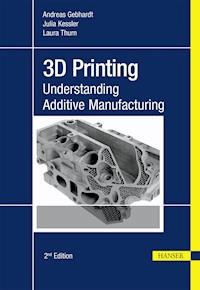
Prof. Dr.-Ing. Andreas Gebhardt Managing Director, CP – Center of Prototyping GmbH, Erkelenz/Düsseldorf, Germany Professor at the FH Aachen University of Applied Sciences, Germany Subject specialty: high-performance methodology for production engineering and Additive ManufacturingDr. Julia Kessler Managing Director, IwF GmbH, Institute for Toolless Fabrication, Aachen, Germany Subject specialty: high-performance methodology for production engineering and Additive ManufacturingLaura Thurn, M. Eng. Doctoral student at the FH Aachen University of Applied Sciences, Germany Subject specialty: high-performance methodology for production engineering and Additive Manufacturing Cover picture: the chair for Digital Additive Production (DAP) of the RWTH Aachen University in cooperation with the Ford Motors Company designed and manufactured an improved cooling concept of a cylinder head by the use of additive manufacturing.
Distributed in the Americas by: Hanser Publications 6915 Valley Avenue, Cincinnati, Ohio 45244-3029, USA Fax: (513) 527-8801 Phone: (513) 527-8977www.hanserpublications.com
Distributed in all other countries by Carl Hanser Verlag Postfach 86 04 20, 81631 München, Germany Fax: +49 (89) 98 48 09www.hanser-fachbuch.de
The use of general descriptive names, trademarks, etc., in this publication, even if the former are not especially identified, is not to be taken as a sign that such names, as understood by the Trade Marks and Merchandise Marks Act, may accordingly be used freely by anyone. While the advice and information in this book are believed to be true and accurate at the date of going to press, neither the authors nor the editors nor the publisher can accept any legal responsibility for any errors or omissions that may be made. The publisher makes no warranty, express or implied, with respect to the material contained herein.
The final determination of the suitability of any information for the use contemplated for a given application remains the sole responsibility of the user.
Cataloging-in-Publication Data is on file with the Library of Congress
Bibliografische Information Der Deutschen Bibliothek Die Deutsche Bibliothek verzeichnet diese Publikation in der Deutschen Nationalbibliografie; detaillierte bibliografische Daten sind im Internet über http://dnb.d-nb.de abrufbar.
All rights reserved. No part of this book may be reproduced or transmitted in any form or by any means, electronic or mechanical, including photocopying or by any information storage and retrieval system, without permission in writing from the publisher.
© 2019 Carl Hanser Verlag, Munich
Editor: Dr. Mark Smith Production Management: Jörg Strohbach Coverconcept: Marc Müller-Bremer, www.rebranding.de, Munich Coverdesign: Stephan Rönigk
ISBN 978-1-56990-702-3 E-Book ISBN 978-1-56990-703-0
Table of Contents
Title page
Copyright page
Table of Contents
Preface
Acknowledgments
About the Authors
1 Basics of 3D Printing Technology
1.1 Basic Terms and Definitions
1.1.1 Additive Manufacturing
1.1.2 The Principle of Layer-Based Processes
1.2 Application Levels
1.2.1 Direct Processes
1.2.2 Indirect Processes
1.3 Classification of Machines for Additive Manufacturing
1.3.1 Generic Terms for AM Machines
1.3.2 Classification of Machines and Properties of Parts
1.4 Conclusions
1.5 Questions
2 Additive Manufacturing Processes/3D Printing
2.1 Direct Additive Processes
2.1.1 Polymerization
2.1.2 Sintering and Melting
2.1.3 Extrusion/Fused Layer Modeling
2.1.4 Powder-Binder Process
2.1.5 Layer Laminate Manufacturing (LLM)
2.1.6 Hybrid Processes
2.1.7 Further Processes
2.2 Indirect Processes/Follow-Up Processes
2.3 Conclusions
2.4 Questions
3 The Additive Manufacturing Process Chain and Machines for Additive Manufacturing
3.1 Data Processing and Process Chains
3.1.1 AM Process Chain
3.1.2 Data Structure, Errors, and Repair
3.2 Machines for Additive Manufacturing
3.2.1 Personal Printer
3.2.2 Professional Printers
3.2.3 Production Printers
3.2.4 Industrial Printers
3.3 Conclusions and Outlook
3.4 Questions
4 Applications of Additive Manufacturing
4.1 Automotive Industry and Sub-Suppliers
4.1.1 Automobile—Interior Components
4.1.2 Automobile-Exterior Components
4.2 Aerospace Industry
4.3 Consumer Goods
4.4 Toy Industry
4.5 Art and History of Art
4.6 Mold and Die Making (Rapid Tooling)
4.7 Medical Engineering
4.8 Architecture and Landscaping
4.9 Miscellaneous Applications
4.9.1 Mathematical Functions
4.9.2 3D Decoration Objects and Ornaments
4.9.3 Aerodynamic and Freeform Objects
4.10 Conclusions
4.11 Questions
5 Perspectives and Strategies of Additive Manufacturing
5.1 Potential of Additive Manufacturing
5.1.1 Complex Geometries
5.1.2 Integrated Geometry
5.1.3 Integrated Functions
5.1.4 Multi-Material Parts and Graded Materials
5.2 Strategies of Additive Manufacturing Processes
5.2.1 Customized Mass Production
5.2.2 Personal Production
5.2.3 Distributed Individualized Production
5.3 Conclusions
5.4 Questions
6 Materials and Design
6.1 Materials
6.1.1 Anisotropic Properties
6.1.2 Isotropic Basic Material
6.1.3 Graded Materials and Composite Materials
6.2 Construction—Engineering Design
6.2.1 Tolerances—From the Digital Design to the Part
6.2.2 Design Freedom
6.2.3 Relative Fit
6.2.4 Flexures, Hinges, and Snap-Fits
6.2.5 Orientation and Positioning of Parts in the Build Space
6.2.6 Bores (Holes), Gaps, Pins, and Walls
6.3 Selection Criteria and Process Organization
6.4 Conclusions and Outlook
6.5 Questions
7 Glossary
Additive manufacturing (AM), 3D printing, desktop manufacturing, and some others are identical terms for the technology of layer-based manufacturing and its application.
The different terms describe these new manufacturing processes, from which the establishment of another industrial revolution is expected. They are suitable for acceleration of product development by production of complex prototypes quickly and with improved quality. But they also allow production of final parts, independent from the size of the lot.
Thus, they indeed mark a revolution in manufacturing techniques: the change from a production technology for the manufacture of large series of identical parts to a mixed series production of different parts, even down to one-of-a-kind parts.
3D printing is applicable in all branches of industry. Anybody engaged in engineering design and production, but also in strategic product planning, should know at least the basics of AM in order to perform a qualified evaluation and selection of the best applicable technology.
This book, 3D Printing, is a new edition of Understanding Additive Manufacturing, which was originally published in 2011. It has been extensively updated and expanded to reflect the major new developments in the field that have taken place since then.
Suitable for the practitioner, this book imparts a basic knowledge of the processes and thoroughly demonstrates exemplary applications. Almost all currently available machines are presented in a systematic way that also allows the classification and evaluation of future systems. The large and fast-growing variety of different machines for additive manufacturing processes is also classified.
Besides processes, also discussed are new working strategies that result from the digital, mixed production, allowing a decentralized manufacture that could thoroughly change the organization of today’s production.
A glossary is provided to clarify common terms and abbreviations used in 3D printing, and so to assist a quick approach into AM.
Aachen, November 2018 Andreas Gebhardt, Julia Kessler, and Laura Thurn
The interdisciplinary character of additive manufacturing (AM) or 3D printing and the enormous developmental speed of AM worldwide make it almost impossible for an individual to portray this discipline completely and correctly.
Therefore, we are very thankful for the diverse assistance we have received.
Many thanks to the specialists of the center of prototyping (CP-GmbH), Erkelenz, Germany, mainly for providing the insights into practice. Special thanks go to Mrs. Besima Sümer, Mr. Christoph Schwarz, and Mr. Michael Wolf.
Thanks to the members of the “GoetheLab for Additive Manufacturing”, the AM Lab of the FH Aachen University of Applied Sciences, for their useful contributions. In particular we thank Alexander Schwarz (now at IWF-GmbH), Prasanna Rajaratnam, Karim Abbas, Dawid Ziebura (now at FhG-ILT), Dr. Miranda Fateri (now at DLR), Mirjam Henkel (now at LMI-GmbH), Max Kunkel (now at Siemens), and Stefan Thümmler (now at CP-GmbH).
We are very grateful for the diverse support we received from Bob Bond in terms of conception as well as regarding interpretation. Bob was the longtime Director of the Industry Grid of the Tshwane University (TUT), Pretoria, RSA, and since the late 1980s he was an early adopter of the AM technology in South Africa. For this, he was awarded the “Big Five Award of Additive Manufacturing” in 2017.
Special thanks go to the publishing house Hanser, particularly to our editor Mrs. Monika Stüve.
Andreas Gebhardt, Julia Kessler, and Laura Thurn
Andreas Gebhardt, born in 1953, studied mechanical engineering at the Technical University Aachen (RWTH), Germany, with the main emphasis on engine and turbine design and construction. In 1986 he passed his doctoral exam (Dr.-Ing.) at the same university with a thesis on the “Simulation of the Transient Behavior of Conventional Power Plants”. From 1986 to 1991 he was general manager of a company that specialized in engine refurbishment and the manufacturing of special engines and engine parts.
In 1991 Mr. Gebhardt moved to be general manager at the LBBZ-NRW, a service center in the German federal state of North Rhine-Westphalia for the application of laser-supported material processing, where from 1992 he started working on rapid prototyping.
In 1997 the CP-GmbH (Center of Prototyping GmbH) was founded in Erkelenz/Düsseldorf, Germany, to which Andreas Gebhardt transferred as general manager. CP-GmbH is a rapid prototyping service company and manufactures prototypes from plastics and metals as one-of-a-kind or in small series. Starting with 3D CAD via additive production units to tool fabrication, CP-GmbH has at its disposal all elements of a fully closed additive manufacturing chain.
The practical experience with CP-GmbH forms the professional backbone for the subject matter of this book.
In the summer term of 2000 Andreas Gebhardt was appointed Professor for “Additive Fabrication Technology and Rapid Prototyping” at the University of Applied Sciences in Aachen, Germany. There he managed, in the framework of the “GoetheLab for Additive Manufacturing”, a group of researchers, working on laser sintering of metals (SLM process), polymer printing, 3D printing (powder-binder process), the extrusion process (FDM), and applications of various fabbers. To the GoetheLab also belongs the worldwide first “Technology Bus”, a rolling laboratory in a double-decker bus, called the “FabBus”.
Since the winter term 2000 Andreas Gebhardt has been guest professor at the city college of the City University of New York. In autumn 2014 he was appointed “Professor Extraordinaire” at the Tshwane University of Technology, TUT, in Pretoria, South Africa.
Since 2004 Andreas Gebhardt has been editor of the RTeJournal (www.rtejournal.de), an “open access peer review” online journal on rapid technology.
Dr. Julia Kessler graduated as Bachelor for Bio-Medical Technology and as Master for Product Development at the University of Applied Sciences, Aachen, Germany.
From 2012 to 2015 she worked as research associate of the research group “GoetheLab for Additive Manufacturing” of the University of Applied Sciences, Aachen. Between 2015 and 2017 she was the head of the GoetheLab team that works on additive manufacturing of metals, plastics, and ceramics. Julia Kessler worked intensively on the concept of a study course for digital dental technology and a research project for jawbone augmentation by using additive manufacturing.
In cooperation with Laura Thurn she initiated and realized the project “FabBus”, a mobile 3D printing laboratory. Also, the realization of the online module “Additive Manufacturing/3D Printing” was mutually developed by Julia Kessler and Laura Thurn. Within the framework of her doctorate, Mrs. Kessler worked on the structural optimization and the additive manufacturing of bionic lattice structures made from titanium and stainless steel, as well as new areas of application for these design elements.
In October 2017 she successfully passed her doctoral exam. In 2015 Julia Kessler was appointed general manager of IwF GmbH (Institute for Toolless Fabrication), which is affiliated with the University of Applied Sciences, Aachen. IwF GmbH supports industrial partners, particularly in optimization and design of the total process chain regarding additive manufacturing. Customer-oriented research and development, practice related training, and individual consulting are among the core competencies of IwF GmbH.
Laura Thurn, M. Eng. studied at the University of Applied Sciences, Aachen, Germany and gained a bachelor degree in industrial engineering with the main emphasis on mechanical engineering and a master degree in product development.
As project engineer at the “Institute of Toolless Fabrication (IwF)” she worked on the study “Generative Fertigungsverfahren in Deutschland” (GENFER; Additive Manufacturing in Germany), which investigated the potentials and challenges, and the consequences and perspectives, of the 3D printing technology in Germany.
Laura Thurn has worked since 2014 as research associate in the research group “GoetheLab for Additive Manufacturing” at the University of Applied Sciences, Aachen. She is head of the department “Plastics for AM”, which, among other things, deals with the design, development, and optimization of personal printers. The activities of her group also include metallurgical investigations regarding the workability of extrusion materials and the mechanical-technological behavior of printed parts regarding their usability as products. Mrs. Thurn has dealt intensively with issues of training and further education in the field of 3D printing and conceives courses in the field of AM for different target groups. In cooperation with Julia Kessler she developed among other things the online module “Additive Manufacturing/3D Printing”. Laura Thurn is one of the initiators of the rolling 3D printing laboratory “FabBus”. She was co-responsible for the realization of the idea, conceives the courses in cooperation with Julia Kessler, and both mutually organize the operation.
In this book the subject of 3D printing is considered from the user’s point of view and the industrial application of additive manufacturing (AM) is discussed.
Chapter 1 contains a brief overview of the technology of additive manufacturing and basic principles of the layer manufacturing process. It includes substantial definitions as well as a classification into equipment classes for additive manufacturing.
All terms will be linked in an overview diagram, organized as AM application levels, which summarizes the definitions and interdependencies of the various applications. Later they will be illustrated by typical examples of different applications. The complete overview diagram of AM application levels is represented in Figure 1.1.
Figure 1.1Additive manufacturing, AM; overview diagram; definition of technology and application levels
Additive manufacturing (AM) is characterized as an automated process for the production of scaled, three-dimensional physical objects directly from 3D CAD data (computer-aided design). The process is based on the principle of layer manufacturing and does not require any part-dependent tools, for example a milling or a drilling device. The parts are generated by building up and connecting volume elements (voxels). Originally this process was called rapid prototyping, and this is often still the case today.
In combination with subtractive production processes like milling or turning, and formative production processes like casting or forging, additive manufacturing processes represent the third column of total production technology [1].
When the first approaches to additive manufacturing processes were released to the market in 1987, these were called rapid prototyping or generative manufacturing. Both terms are still in use and in the subsequent years many differing names were presented and frequently others were added (e.g., desktop manufacturing, freeform manufacturing, etc.). Although each of the terms is considered to be ideal from the point of view of the inventor, many of them cause confusion. This is the reason why newcomers to the field of 3D printing and additive manufacturing sometimes feel isolated.
Additive manufacturing is standardized in the U.S. by the common standards ISO/ASTM [ISO/ASTM 52900:2015].
3D printing now supersedes all other terms. The reason is that this term can be easily understood because it is more generic and of wider appeal to users. Everyone who is able to work with a text program (word processor) and to print the result as a letter by means of a 2D printer will immediately understand that, by means of a design program (part processor) and a 3D printer, a three-dimensional physical part can be produced.
The term 3D printing is accepted worldwide as the generic term for all automated layer manufacturing processes, as is the term 3D printer.
3D printing as a generic term should not be mistaken for the similarly named three-dimensional printing, such as the drop on powder processes (Section 2.1.4 "Powder-Binder Processes").
For a first overview a small selection of frequently used terms is provided to complete the group of key terms:
Table 1.1 Overview of Selected Terms and Corresponding Key Terms
Additive
3D printing Additive manufacturing, AM Additive layer manufacturing, ALM Additive digital manufacturing, DM
Layer
Layer manufacturing, layer-based manufacturing, layer-oriented manufacturing
Rapid
Rapid technology Rapid prototyping Rapid tooling Rapid manufacturing
Digital
Digital fabrication Digital mock-up
Direct
Direct manufacturing Direct tooling
3D
3D printing 3D modeling
Many possible combinations of these key terms have been created. Caution: some of these terms are protected as trademarks! Other terms are in use, which in connection with new and innovative manufacturing processes include:
Desktop manufacturing
On-demand manufacturing
Freeform manufacturing
With time new terms in common use generally become the norm. Some terms are adopted and promoted by manufacturers, and some of these compete for wider acceptance.
The terms 3D printing, additive manufacturing, and AM include any possible process regarding the arrangement of material for the production of a physical part. The technical execution of AM is exclusively based on layers and therefore is called layer-based technology or layered technology. Therefore, today terms such as 3D printing, additive manufacturing, and layer-based technology are in use.
If in future new additive technologies become available, these need to be integrated into the structure of the AM terms. For example, a process called ballistic particle manufacturing (BPM) was introduced in the early 1990s, but vanished shortly thereafter. In this process, material was fed to the part from all directions of the build space by attaching discrete volumes (voxels) to the developing object by means of jets. This technology is considered as additive but not layer-based.
Additive Manufacturing Process Chain
Additive manufacturing processes are characterized by a process chain, which is represented in Figure 1.2. The process starts with a (virtual) three-dimensional CAD data file, which represents the part to be produced. In the engineering phase the data file will be typically generated by means of 3D CAD design (CAD), scanning, or imaging processes like computerized tomography (CT scanning).
Figure 1.2Additive manufacturing; process chain
Independent of how the 3D data set is generated, in a first step it is split by means of special software into slices or layers. As a result a data set containing contour data (x-y), thickness data (dz), and the layer number (or z-coordinate) of each layer will then be transmitted to a machine, which carries out two basic process steps for each layer, to generate the part.
In a first step each layer will be generated according to the defined contour and layer thickness. This can be performed in different ways using different physical principles. The simplest method is to cut the contour out of a foil or a sheet.
In a second step, each layer will be connected with the previous one and the new layer then forms the top layer of the growing part. Layer by layer the physical model thus grows from the bottom to the top until the part is finalized.
Depending on the uniform thickness of the layers, all parts produced by means of layer technology show a so-called stair-step effect, as shown in Figure 1.3 (right).
Figure 1.3Principle of layer manufacturing: contoured layers (left); 3D-object; generated by staggered layers (right) (Source: HASBRO/MB puzzle)
These basic steps, called process chains, are the same for more than 200 different AM machines. The machines only differ in the method of generating single layers and in how adjacent layers are connected to form the part.
Therefore, all machines which are discussed in Chapter 3 "The Additive Manufacturing Process Chain and Machines for Additive Manufacturing" are characterized by numerous common properties.
All machines use a 3D data base, a three-dimensional virtual object, which also is called a digital product model.
The manufactured parts are all generated by means of layers with uniform thickness, related to the cross-sections of the product model. Additive manufacturing thus represents basically a 2½D process.
The build processes do not have any reciprocal (or feedback) effect regarding the product development. They are solely facsimiles of the digital product model.
The machines therefore can be used in any stage of product development and for production.
The build processes use process-oriented and therefore generally machine-specific materials. This provides a close linkage between machine, process, and build material.
In this context it needs to be stressed that additive manufacturing processes are production processes.
People interested in additive manufacturing generally like to know how this new technology can be used and which novel products can be developed from it. Moreover, it is imperative to use correct and uniform terms in discussions within product development groups.
Often it is assumed that each of the different additive manufacturing processes, which are described in detail in Chapter 2 "Additive Manufacturing Processes/3D Printing", is linked to a certain application in a way such that a specific AM process can only be used for a particular application or a small number of applications. This interpretation results in interested people studying multiple processes, before they start to deal with suitable applications.
Practically, the selection of the best suitable additive manufacturing process starts with the requirements of a specific application. In the next step, certain requirements like dimensions, requested surface quality, allowable mechanical loads, temperatures, etc. lead to the selection of the suitable material and finally to the selection of a process or a machine that can fulfill these requirements to a satisfactory degree. Basically, different additive processes are suitable to address a specific requirement.
Before the various additive manufacturing processes are presented (Chapter 2 "Additive Manufacturing Processes/3D Printing"), the application fields have to be structured.
It is necessary to distinguish between the terms technology and application. Technology is defined as the science of a technical process. It describes the scientific disposition.
Application is understood as use of the technology for the benefit of the user and is therefore also defined as practical disposition. For a better overview, so-called application levels are defined. These definitions are generally accepted, although they are not yet standardized and, despite all endeavors for standardization, different terms are partly in use. As designated in Figure 1.4, AM technologies are characterized by the main application levels rapid prototyping and rapid manufacturing.
Rapid prototyping includes all applications that result in prototypes, models, or mock-ups. Rapid manufacturing is applied when final products or simply products are to be generated.
Figure 1.4AM: Technology level and the two application levels rapid prototyping and rapid manufacturing
All additive manufacturing processes are named direct processes to express that, out of the digital data model by means of an additive machine, a physical object – called a part – is directly generated. In contrast, some processes are named indirect processes. These processes do not apply the principle of layer manufacturing, and are consequently not considered as AM processes. Indeed, indirect processes are copy work, which normally is executed as vacuum casting using silicone molds (see Section 1.2.2 "Indirect Processes").
As for indirect processes, additively generated parts (prototypes) are used as masters; the term indirect rapid prototyping process was introduced, probably because it sounds more innovative. The procedure is described in Section 1.2.2 "Indirect Processes".
With regard to the application level rapid prototyping, two sublevels can be identified: solid imaging (generating a three-dimensional mock-up or a sculpture) on the one hand and concept modeling (generating a concept model) on the other (Figure 1.5 and Figure 1.8).
Figure 1.5AM: application level rapid prototyping; sublevel solid imaging and concept modeling
By solid imaging or concept modeling a parts family is generated, which serves to verify a basic concept. The parts resemble a three-dimensional image or a sculpture. In most cases, they cannot be loaded physically. They merely show a special representation to judge the general appearance and the proportions. Therefore, these parts are also called show-and-tell models. Scaled concept models are often used, to illustrate complex CAD drawings. In this context, they are also designated as data control models (Figure 1.6). The examination of the dimensions not only serves to check the CAD data, but is also the basis for upcoming interdisciplinary discussions, e.g. regarding packaging problems. Concerning the concept model for the roof of a convertible (cabriolet), according Figure 1.6, it allows a balance of ideas in the involved design departments regarding the different aspects of the convertible roof—the electrical drive as well as the kinematics.
Figure 1.6Solid image or concept model; scaled arrangement of a roof design of a convertible; laser sintering, polyamide (Source: CP-GmbH)
Colored models manufactured by means of 3D printing (see Section 2.1.4 "Powder-Binder Process") are estimation tools for concept development. Coloring helps in the recognition of difficult zones of a product and to shorten discussions. Figure 1.7 shows a solid image of a cut-away model of a combustion engine. Different colors of the model can be, for example, linked to the main topics of the items for discussion. In reality, the part is of course not colored.
Figure 1.7Solid image or concept model. Cut-away demonstration part of a combustion engine; 3D printing (Source: 3D Systems)
Functional prototyping (see Figure 1.8) is applied to examine and verify one or multiple separate functions of the later product or to take the decision for the production, even if the model cannot be used as a final part [2].
Figure 1.8AM: application level rapid prototyping; sublevel functional prototyping
As shown in Figure 1.9, the model of an adjustable air-outlet grille for the air conditioning of a passenger car can be used to check the air distribution at a very early stage of the product development. The part was manufactured in one piece by means of laser stereolithography.
Figure 1.9Functional prototyping: adjustable air-outlet grille for a passenger car; laser stereolithography (Source: 3D Systems)
The stereolithography process provides a smooth surface, imitating the quality of the subsequent serial manufacture. However, this kind of manufacturing is not suitable for serial manufacture, with respect to the mechanical and especially the thermal properties of the material, as well as to the color and the final price.
To manufacture the movable parts, a connecting layer within the hinges was not cured (see Section 6.2.4 "Flexures, Hinges, and Snap-Fits"). Finally, the finished part was cleaned and specifically the uncured material was removed (mainly manually). After that, the device was ready for testing.
Figure 1.10 shows the casing of a mobile phone which was designed for the installation of a local telecommunication grid for poor communities. The mobile phone was derived from a low-cost walkie-talkie (portable two-way radio equipment). To use it as a mobile phone, the loudspeaker and microphone had to be arranged in a way that simultaneous speaking and listening was possible, and ergonomic handling was achieved. The two-piece test casing is made from ABS plastics by fused deposition modeling (FDM) (see Section 2.1.3 "Extrusion/Fused Layer Modeling").
Figure 1.10Casing for a mobile phone; extrusion process: fused deposition modeling FDM (Source: GoetheLab, University of Applied Sciences, Aachen)
The lower part of the casing is designed to house the electronics, while the upper part serves as cover for the casing. Both parts have to fit perfectly.
The prototype of the casing was used to prove the correct fit as well as for testing of the handling. Due to the clearly visible extrusion structure and the production costs, which are too high for serial production, use as a final product has to be ruled out.
The application level rapid manufacturing includes all processes that produce final products or deliver parts that have to be assembled afterwards to produce a product. A part generated by additive manufacturing (AM) will be designated as (final) product if it shows all properties and functions which have been determined during the development process of the product. If the generated part is a positive, the process is called direct manufacturing. In the case of a negative, e.g. a die, mold, or gauge, it is called direct tooling. Direct manufacturing leads to products which are generated directly by means of an AM process (Figure 1.11). A large variety of materials of all main material types (plastics, metals, and ceramics) is available (see Section 6.1.2 "Isotropic Basic Materials").
Figure 1.11AM: application level rapid manufacturing; sublevel direct manufacturing
It is essential for the function of the part that material and manufacturing process are generating exactly those mechanical-physical properties which have been defined during the design process (generally the engineering). If this is achieved, they mimic their behavior.
Figure 1.12 shows a dental bridge, made of three elements from a CoCr alloy, which was manufactured by means of selective laser melting, SLM. The data file was generated by a digitized dental imprint of the patient.
Figure 1.12Direct manufacturing: dental bridge (three elements directly after manufacturing; without removing of support structure (left), after finishing (right); selective laser melting (SLM), CoCr alloy (Source: GoetheLab, University of Applied Sciences, Aachen)
The dental bridge was designed applying professional dental software (3 shape), and directly manufactured by means of SLM. After finishing and adjustment, the bridge was ready for fitting to the patient. Compared with traditional technology, the production of a directly manufactured bridge was faster with customized fit and comparable costs.
A hinge for the cover of an aircraft turbine (Figure 1.13, above) was redesigned for the production by means of direct manufacturing and then tested. A bionic design was applied, which led to a weight reduction of 50%. However, it could no longer be produced by traditional machining. It was finally manufactured by means of an AM metal process, by selective laser melting (SLM). The part passed the customary tests and functioned perfectly (Figure 1.13).
Figure 1.13Direct manufacturing: hinge of a cover of an aircraft turbine (below) compared to a traditional manufactured hinge (above). Selective laser melting, SLM; stainless steel (Source: EADS)
Rapid tooling encompasses all additive manufacturing processes, resulting in cores, cavities, or inserts for tools, dies, and molds. In addition, two sublevels can be distinguished: direct tooling and prototype tooling.
From the technical point of view, direct tooling is equivalent to direct manufacturing, but is confined to tool inserts, dies, and molds, which are produced for quantity serial manufacture (Figure 1.14).
Figure 1.14AM: application level rapid manufacturing, sublevel direct tooling
Although design of tools is the inversion of the product data set (inversion of a positive into a negative), it requires complex detail design.
Moreover, production by means of tooling requires the definition of parting areas, consideration of shrinking allowance, provision of chamfers with release angles for de-molding, and design of ejectors, etc. Tool production usually requires a metal-handling process and machines which have been designed to facilitate this process.
Direct tooling does not mean that a complete tool is manufactured. In fact, mainly cavities (tool inserts) or sliders are generated. The complete tool is made by assembling the inserts and standard components, as it is done during conventional tool manufacturing.
The layer-based technology of all additive manufacturing processes enables the generation of tool-internal hollow structures. This allows the production of mold inserts with internal conformal cooling channels (Figure 1.15, right) which follow the outlines of the tool insert below its surface.
Figure 1.15Direct tooling: mold insert with conformal cooling channels (dark) and pneumatic ejectors (white); laser sintering/laser melting (laser fusing); tool steel (Source: Concept Laser GmbH)
This method is called conformal cooling, as the arrangement of the cooling channels follows the outlines of the mold. Due to the forced cooling, the cycle time for a plastics injection molding machine can be reduced significantly and thus the productivity increases. Moreover, it is possible to design an integrated heat distribution system by means of the arrangement of heating and cooling channels and thus create a more efficient tool.
To generate a steel mold for the production of golf balls high precision is required. By means of direct laser metal sintering (DLMS, technically equivalent to SLM) a near net shape structure was manufactured additively (Figure 1.16). It is a good example of how by an additive manufacturing processes and subsequent high-precision mechanical processing, like high-speed milling and electric discharge machining (EDM), the total process can be optimized.
Figure 1.16Steel mold for injection molding; direct laser melting (SLM) (Source: EOS GmbH/Agie Chamilles)
Prototype tooling: For the production of small series, manufacture of a mold in series quality is often too time- and cost-consuming. If only a few parts are required, or frequently details have to be modified, usually a pilot mold made from a substitute material meets the requirements.
Molds of this type show the quality of functional prototypes; however, they belong—at least partly—to the functional application level direct tooling. The corresponding application level ranges between rapid prototyping and rapid manufacturing. This sublevel is called prototype tooling (manufacturing of prototype tools); see Figure 1.17. It is also called bridge tooling. This expression is also used for secondary rapid prototyping processes (see Section 1.2.2 "Indirect Processes").
Figure 1.17AM: application level rapid prototyping/rapid manufacturing; sublevel prototype tooling
A prototype tool made from polyamide is shown as an example in Figure 1.18. It is used for the production of a small series of a newly designed sole of a rubber boot. The soles are used for the completion of the prefabricated bootleg, without manufacturing in advance metal tools suitable for series production. Different profiles and materials for the soles can be evaluated very quickly by casting, even on small budgets.
Figure 1.18Prototype tooling: model of a sole of a rubber boot. Laser sintering; polyamide (PA) (Source: EOS GmbH)
A prototype tool made from plastics which can be used in a plastics injection molding machine is shown in Figure 1.19. The tool prototype is manufactured in a special stereolithography process (see Section 2.1.1 "Polymerization") which is named




