


Erhalten Sie Zugang zu diesem und mehr als 300000 Büchern ab EUR 5,99 monatlich.
- Herausgeber: Literare Books
- Kategorie: Fachliteratur
- Sprache: Englisch
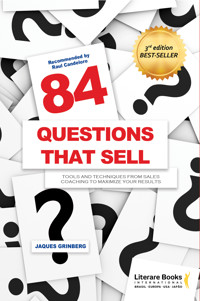
A success in Brazil, now also available in English for salesmen, entrepreneurs and managers. In this book you'll find powerful questions that will help you sell far more and serve your customers in an exceptional way. In 84 Questions that Sell you will learn to: - Improve sales communication skills; - Improve your results with coaching; - Connect and empathize with the buyer; - Identify in advance the desires of those who buy; - Direct and negotiate sales based on customer responses; - Assertively close deals; - Measure results and set goals; - Create an environment conducive to business closure; - Develop irrefutable arguments; - Offer immediate solutions to problems; - Add value to products; - Maximize results; - Overcome objections.
Sie lesen das E-Book in den Legimi-Apps auf:
Seitenzahl: 94
Veröffentlichungsjahr: 2019
Das E-Book (TTS) können Sie hören im Abo „Legimi Premium” in Legimi-Apps auf:
Ähnliche



















Copyright© 2018 by Literare Books International Ltda.
All rights to this edition are reserved to Literare Books International Ltda.
President:
Mauricio Sita
Proofreading:
Prof. Fernando dos Santos Costa
Graphic Design, Layout:
Maria Carolina Romanelli
Cover:
Zeca Mádio
Project Director:
Gleide Santos
Director of Operations:
Alessandra Ksenhuck
Executive Director:
Julyana Rosa
Customer Relations:
Claudia Pires
Translated by:
Ivy Fernanda Tomao
International Cataloging-in-publication data (CIP)
(Câmara Brasileira do Livro, Brazil)
1. Personal marketing and sales success:
Business administration 658.85
2. Sales success and personal marketing:
Business administration 658.85
Literare Books International Ltda
Rua Antônio Augusto Covello, 472 – Vila Mariana – São Paulo, SP.
Zip Code: 01550-060
Site: www.literarebooks.com.br E-mail: [email protected]
ACKNOWLEDGEMENTS
This book represents one more dream that has come true. A dream turned into texts which in turn mean the goals of a rewarding and decent professional life.
For the achievement of this idea, I have to thank a very special human being. A tremendous dreamer. A teacher – in fact a master – that has never tired or will tire of transforming our country with the tools of education.
Many Brazilians are proud to have stood shoulder to shoulder with - and learned from - this master. I am one of them. I have found the real importance of my life and what I really needed to have in order to live life to the fullest.
I learned something else: how important it is to always surround ourselves with the people we love.
Father, thank you for being part of my life.
PREFACE
With the huge success of the lecture
“The Coach Salesperson:
How To Turn QuestionsInto Sales”
I have decided to write this book with 84 suggestions of intelligent questions for you to become a Coach Salesperson and be able to maximize your sales results.
At first glance, you may think these questions are impossible to be asked. I certainly understand; new things can be scary. In sales courses I have given, I met salespeople who thought this way. However, they progressively changed their minds as they started to practice. They realized they could actually use the questions and that they really work. Managers and directors later praised the great customer loyalty achieved.
Try them! I am sure that if you give them a shot, you will be surprised with the results, for the questions are that efficient.
Dare to move out of your comfort zone, get a move on: believe in your potential and reach success, increasing your sales numbers.
Make the best of this book! Read it reflectively, imagining your own customers’ reactions...
With certainty, your friend,
Jaques Grinberg
INTRODUCTION
To understand the 84 questions that sell, it is important to first learn and assimilate what the following terms mean:
Coaching, Coach, Coachee, Intelligent questions, Selling and being a Coach Salesperson
Coaching is a training process that directs and pushes the client (Coachee) to think of new pathways, seeking the best, creative and quick options to achieve a certain goal. At the basis of this process, you have questions that are instrumental to create conditions and incite motivation to generate change and assist in reaching the proposed goal.
Coach is what we call the professional who offers Coaching, also known as a motivator, the one who helps the Coachee overcome obstacles and explore their creative and emotional potential to the fullest, encouraging pro-activity. Coach is the one who trains, guides and prepares.
Coachee is what we call the client who goes through the Coaching process.
The Coaching process, therefore, moves the Coachee out of his or her comfort zone, leading him or her to the desired state of action, i.e., to pro-activity.
The word Coach1 originates from the Hungarian language and it means a type of four-wheeled carriage, also adopted by the English language later on, exactly for this kind of transportation that was utilized to take people to a variety of places. In 1830, at Oxford University, the term begins to be used for the sports manager who is responsible for a team. But only in 1950 it is used for the first time in business with the current meaning.
There are different types of Coaching, but the two most popular are: executive coaching and life coaching. The executive coaching aims to develop leadership competence and the Life (or personal) Coaching aims to develop competences related to any areas of life, such as relationships, family issues, health, career, finances etc. There are also other names for specific situations in performance development; e.g., sales training or public contest tests, university entry tests; among many others.
Coaching as a technique and tool to increase results in sales has been used in many countries, but still not so much in Brazil. Since it is an innovative process, only companies that want to grow in an ever competitive market with demanding customers and products with little space for clear features invest in Coaching to enhance sales and customer loyalty.
Intelligent questions are tools to lead the Coachee (client) to think and reflect on what is known already and how to broaden ideas and knowledge. They allow needs and objectives to be identified and a profile can be determined for the customer. With the gathered data, it is possible to keep on guiding the customer, via new questions, to find the best route to reach the objective, the need and therefore, to buy. A unique experience is created, as if custom-made for that one customer.
Selling is to guide someone (customer) to acquire a product, a service etc. It is a relationship process, based on communication between the salesperson and the customer, assisting such customer to purchase, to acquire what is offered. All sales are a form of customer seduction, but at the end of the process, the customer must feel the choice was his or hers in buying what is needed. Many customers, for instance, look for a product or service due to lack of information about other options that could satisfy their needs even more completely. The Coach salesperson has to know his or her customers as well as their needs, to be able to sell them what they in fact need - not always what they want - because this is the only way they will truly be satisfied and loyal.
The Coach salesperson is a skilled and responsible professional who can enhance results, focusing on sales. This professional is the interlocutor who is source of motivation, who represents the company when dealing with the customers; guiding this relationship and communication process with intelligent questions, as the ones you will read in this book.
Always remember that knowing the questions is not enough; you need to listen carefully to your customers’ answers so you can profile them and their needs. This way, new questions emerge and better arguments come up for possible future objections. This process is crucial in guiding the customers to buy what they need or wish.
It is also important to understand that nobody is born a salesperson, even if some people feel more at ease with selling. Keep this in mind: do not settle for being just a person who sells, strive to be really innovative, go after more success and become a Coach salesperson. In order to achieve this, you have to practice and invest in yourself. You do not have to be a person who just takes orders. You can be more. You can use the sales coaching, which gives you added tools, enhancing results.
Customers’ behavior has changed and will keep on changing constantly. They are less and less loyal to the brands and companies, they seek promptness when buying, they search more before buying and use a new language to get information (communication).
The Coach salesperson keeps up-to-date with these changes and knows very well the purchase process:
1st - Customers identify a dream (wish) or a need to buy.
2nd -They search and assess alternatives to satisfy the current issue (need and/or dream).
3rd -They decide on the purchase.
4th - Post-sales: time for assessing and checking the satisfaction level. If they are satisfied, they will become loyal to you and your company.
Also about the customer behavior topic, there are a few challenges for the Coach salesperson:
1st - Get to know your customers.
2nd - Understand why they buy, to maximize your sales.
3rd - Identify what to do to increase loyalty and sell more to the same customers.
Here are the 7 laws to maximize your sales results:
1st - Listen carefully and with intent focus to what your customers say.
2nd - Decide to be – yourself – the difference between your company and the competition.
3rd - Be persistent, work with what you like and believe, do not listen to friends and family’s criticism and know things are not easy, that you have to work hard to be successful.
4th - Keep your focus on what matters: the customers’ needs. Not your personal concerns. Reaching the month’s target is a consequence to providing customers a good service and closing deals.
5th - Pay close, exclusive and special attention to your customers. They buy mostly because of good service.
6th - Qualification is as key to salespeople as it is to doctors and lawyers. Be the best at what you do, be prepared and qualified.
7th - Time is the number one enemy of salespeople. Learn how to manage yours and sell more.
1In Portuguese, the word ‘coche’ also exists and it means a closed carriage.
Open and closed questions
You already know what intelligent questions are, now you will understand the practical difference between open and closed questions to increase sales effectiveness.
All open or closed questions can and must be intelligent questions too. It is possible to use closed or open questions (or both) in a negotiation. The first step is to find out the customers’ profile to assess which questions are to be asked.
Open questions
Answers are broad, customers need to think before answering. With these answers, one can profile and identify needs in a very comprehensive manner. Ordering and assessing these answers, due to their varied contents, can be hard, as they come from different peoples’ lines of thought.
Through open questions it is possible to get to know the customers, their needs, and define the best products or services to offer them. Always striving to add value instead of giving discounts. Open questions help to develop important arguments to close the deal.
9 tips for open questions
1. If you bought this service or product, what would it feel like to satisfied with it?
Comment: the answer can be any feeling the customer believes to have, allowing for a truly open and comprehensive answer.
2. I understand the value is somewhat high and I also know this product or service is important for you. What can you go “without” for a few months so you can acquire this something that is important for you?
Comment: when you ask what one can go “without”, the answer could be literally anything. The answer might be random, like saving on meals at restaurants, not traveling on weekends, financial savings, among other possibilities.




