


9,99 €
Mehr erfahren.
- Herausgeber: 50Minutes.com
- Kategorie: Geisteswissenschaft
- Serie: History
- Sprache: Englisch
Keen to learn but short on time? Get to grips with the events of 9/11 in next to no time with this concise guide.
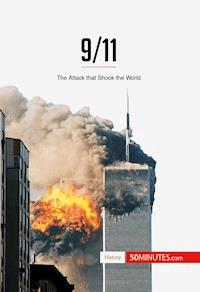
50Minutes.com provides a clear and engaging analysis of 9/11. At 8.46am on the morning of September 11th 2001, the first hijacked plane hit the World Trade Center’s North Tower. The hours that followed were filled with more attacks and desperate attempts to save the people trapped in towers as well as those injured at the Pentagon. Almost 3000 people died that day; the 9/11 attacks were the worst terror attacks on US soil in history and changed America forever. It triggered the war in Afghanistan and a ten-year manhunt for Osama bin Laden, but it has also been the subject of much controversy and many conspiracy theories.
In just 50 minutes you will:
• Learn about the 9/11 attacks and how Osama bin Laden was finally caught ten years later
• Understand what actually happened on that horrific day and the effect it had on America and the rest of the world
• Analyse how the US responded to the attacks and whether their response was sufficient and appropriate
ABOUT 50MINUTES.COM | History & Culture
50MINUTES.COM will enable you to quickly understand the main events, people, conflicts and discoveries from world history that have shaped the world we live in today. Our publications present the key information on a wide variety of topics in a quick and accessible way that is guaranteed to save you time on your journey of discovery.
Das E-Book können Sie in Legimi-Apps oder einer beliebigen App lesen, die das folgende Format unterstützen:
Seitenzahl: 33
Veröffentlichungsjahr: 2017
Ähnliche



















The 9/11 attacks
Key information
When: 11 September 2001Where: New York City, USAKey figures: George W. Bush, American statesman (born 1946)Osama bin Laden, Saudi-Arabian Islamist extremist (1957-2011)Khalid Sheikh Mohammed, al-Qaeda military leader (born 1965)Impact:The war against AfghanistanThe hunt for Osama bin Laden The Patriot ActNumber of fatalities: 2976On 11 September 2001, the entire world was shocked to discover the news of a series of attacks on American soil. With no apparent warning on one fateful Tuesday morning, nineteen terrorists hijacked four flights and crashed them almost simultaneously into the World Trade Centre, the Pentagon and a field in Shanksville, Pennsylvania. Two hours later, the Twin Towers collapsed, bringing down with them two other nearby buildings that had not been targeted by the planes. Official figures place the death toll at 2976 victims and 19 hijackers.
This was not the first time that America was subject to an insurmountable attack by a foreign enemy. The Pearl Harbor attack by the Japanese in 1941 or the USSR’s launch of Sputnik in 1957 had already seen both American hegemony and the country’s image weakened in the past. However, 9/11 marked the first instance of an enemy attack on American soil. In the space of twenty minutes, the USA came hurtling into the 21st century and landed with a resounding thud.
Political and social context
A contested election
The USA was attacked by al-Qaeda on 11 September 2001, just a few months after George W. Bush had entered the White House. He had emerged victorious from the election which pitted him against Democrat candidate Al Gore (born 1948), the former vice president under Bill Clinton (born 1946). The election was something of a saga, full of scandal and dramatic twists. In November 2000, the day after the vote, Bush seemed to have won the vote in Florida with the incredibly narrow majority of just 500 out of 5.9 million votes cast. Gore quickly raised concerns about various irregularities during polling, giving rise to legal and political controversy as authorities tried to establish who exactly had won; the winning candidate in Florida would be the next President of the United States.
35 days after the vote, five Supreme Court judges, appointed by George Herbert Walker Bush (born 1924) and Ronald Reagan (1911-2004), ruled in the Republican candidate’s favour. Therefore, George W. Bush succeeded Bill Clinton as president thanks to 271 electoral college votes versus Al Gore’s 267. The population remained calm amid this electoral chaos, however the election served to illustrate the weaknesses embedded in the American democratic system. Throughout the deliberations, the tension was palpable, not only with regards to the candidates themselves but also those close to them. When the former Texas governor arrived in the White House, it was certainly not an undisputed victory. Furthermore, the Senate was divided between the two parties, with the Republicans having just one more senator than the Democrats. As such, Bush found himself faced with a dilemma - should he concentrate on reuniting a divided nation or instead seek to strengthen Republican dominance? In any case, he was left little time to reflect on such a question, with the shocking interruption of the 9/11 attacks becoming the key factor shaping the policies of his administration.




