


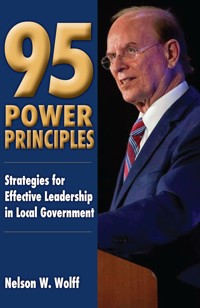
9,35 €
Mehr erfahren.
- Herausgeber: Elm Grove Publishing
- Kategorie: Geisteswissenschaft
- Sprache: Englisch
San Antonio, Texas is the seventh largest city in the United States; Bexar County encompasses the city of San Antonio, as well as 26 other suburban cities and a
large unincorporated area. Nelson Wolff served two terms as Mayor of San Antonio and five terms as County Judge for Bexar County (Chief Executive Officer and its highest authority). He has also served in the Texas House of Representatives and the Texas Senate.
Under his leadership, the San Antonio/Bexar County community became recognized as a leader in environmental restoration, therapeutic justice, the arts, sports and healthcare, among many other accomplishments.
These 95 principles are derived from his 33 years in government as well as 36 years as a business leader. The principles can be applied in any American city or county—and are equally relevant to success in the private sector as they are to achieving political goals.
Das E-Book können Sie in Legimi-Apps oder einer beliebigen App lesen, die das folgende Format unterstützen:
Seitenzahl: 245
Veröffentlichungsjahr: 2024
Ähnliche




















Praise for 95 Power Principles
“Nelson Wolff started his long career in public service at the capitol in Austin. Fortunately for the citizens of San antonio and Bexar County, he later focused on municipal government. His 95 Power Principles should be on the reading list of every aspiring local politician who wants to avoid learning the hard way.”
—Joe Straus, former Speaker of the Texas House of Represenatives.
“In 95 Power Principles, Judge Wolff showcases such proactive and incisive servant leadership with his characteristic wit and honesty. This is a book and these are the principles with which I will teach future leaders.”
—Jill Fleuriet, Professor of Anthropology, University of Texas at San Antonio.
“Those following in his footsteps have a new gift with this book. It is a well-written guide to success and failure and the appropiate use of power based on his many years of experience, his wins and losses, and that great instinct he has for service. It is just like Judge Wolff to keep giving back to us, even after he’s left office.”
—Kirk Watson, Mayor of Austin and former Texas State Senator
“An essential read for anyone interested in the governance of cities and counties. A great ‘good governance’ handbook for any serious leader.”
—John Montford, former State Senator and Chancellor of Texas Tech University System
“An entertaining and insightful book on how political leadership works at the local level and all levels, for that matter. Many of the principles also apply to running a major corporation.”
—Edward Whitacre, former CEO of AT&T and General Motors
“During the COVID pandemic, Judge Wolff’s leadership style, smarts, and work ethic were an inspiration to me and helped save countless lives across Texas. This entertaining and informative book lays out the blueprint to become, and excel as, an elected public servant in local government.”
—Travis County Judge Andy Brown
“Nelson Wolff is a legend in local government. His advice is highly valuable and forged from a lifetime of servant leadership.”
—Dallas County Judge Clay Lewis Jenkins
“I admire Nelson Wolff as the gold standard for public servants. His focus, throughout his career, doing the right thing for the right reasons, all the time. This book reveals how leadership should be exercised.”
—Eric Johnson, Mayor of Dallas
“95 Power Principles offers a roadmap to effective leadership in the public sector, and serves as inspiration. Judge Wolff infuses the book with genuine passion in public service and reminds us of the profound impact that dedicated leaders can have in our society.”
—Hope Andrade, former Secretary of State and former Chair of the Texas Transportation Commission.
“I don’t know of any elected official who understands and optimizes every aspect of governing like my friend and colleague, Nelson Wolff. Great lessons in this book.”
—Ricardo A. Samaniego, El Paso County Judge
“Nelson Wolff’s book, 95 Power Principles, includes lessons learned from decades of public service, lessons essential to success in transforming Bexar County and the city of San Antonio through strategic collaboration and innovation.”
—Patricia E. Roberts, Dean, St. Mary’s University School of Law
“Nelson Wolff hasn’t just been a leader, he’s gotten big things done. For those of us who served with him, we’ve seen that work firsthand. Serving both in state government and in local government myself, I know these 95 Power Principles cannot be ignored. If you believe governing is about getting results, learn these lessons. They have certainly benefited me.”
—Sylvester Turner, Mayor of Houston
© 2023 Nelson W. Wolff. All rights reserved. No part of this book may be scanned, copied, uploaded or reproduced in any form or by any means, photographically, electronically or mechanically, without written permission from the copyright holder.
ISBN: 978-1-958407-16-5 (Hardback)
ISBN: 978-1-958407-17-2 (Soft Cover)
ISBN: 978-1-958407-18-9 (eBook)
www.elmgrovepublishing.com
Elm Grove Publishing is a legally registered trade name of Panache Communication Arts, Inc.
CONTENTS
PREFACE
SPECIAL RECOGNITION
ACKNOWLEDGEMENTS
PATHWAYS TO POWER
1 Establish civic virtue, then test your mettle.
2 Become a sorcerer's apprentice.
3 Define your turf on a crosstown road map of neighborhoods.
4 Get your personal life straight before jumping in.
5 If the incumbent is teetering on the edge, give a push.
6 Apply “Game Theory” in a mayor's race.
7 Finesse an appointment.
GRASP POWER OUICKLY AND SUSTAIN IT
8 Two for the price of one enhances power.
9 Embrace the aura of mayoral power.
10 Generate symbolic acts of purification.
11 Pick an early fight and win.
12 Act first, create tension, get things done.
13 Uncover the hidden and embedded elements of county power.
14 Crowd out superfluous issues by setting a yearly agenda.
15 Get tough on crime.
16 Establish youth prevention programs.
17 When you have the Big Mo, double down.
18 Move into vacuums created by vacated power.
19 When facing a major legislative battle procure a cardinal.
20 Accumulate, dispense, and use information effectively.
21 When you lose big, pivot big.
22 Do not get caught crystal gazing.
23 When facing a choice between time and money, choose time.
24 When you don't have the horses, wait them out.
25 A motion to delay is a motion to kill.
26 Don't let fear of free speech and assembly change who we are.
27 Don't let process eat you up.
28 Expect the unexpected.
CREATE AN EFFECTIVE MANAGEMENT STRUCTURE
29 De-matrix.
30 Appoint a Thomas Cromwell as your county manager.
31 Break up the criminal-industrial complex.
32 Don't let labor disputes get out of control.
33 Develop a team of hot and cold lawyers.
34 Only hire consultants to find a way to your end game.
35 Adopt a conservative but flexible budget.
36 Inspire and take care of your people.
37 Build a chamber that exemplifies political power.
WORK COLLEAGUES WITH HONEY AND SPICE
38 Take advantage of new colleagues for they know not what they do.
39 Establish decorum, absorb the hits, and defend your colleagues.
40 Develop a systematic web of persuasion with your colleagues.
41 Develop an underboss.
42 Squelch groupthink before it leads to mush.
43 Trade five nickels for a quarter.
44 Rescue bipartisanship from clans and tribes.
45 Muffle county-city disputes.
BUILD COMMUNITY SUPPORT
46 Don't let loose a tsunami of task forces.
47 Identify and catch the wave of changing power blocs.
48 Street smarts are in the streets you know.
49 Don't punt tough decisions to voters.
50 Put the kibosh on raising tax rates.
51 Follow Quintus Tullius Cicero's "rule of yes.”
52 Take people to places they resist or never envisioned.
53 Persistence is a close cousin to stubbornness.
54 Tap the power of religious leaders.
55 Support the small who think big.
56 Form regional alliances.
OVERPOWER FRIENDS ENEMIES, HUSTLERS AND OPPONENTS
57 Don't ride with outlaws.
58 Use humor to disarm and deflate your critics.
59 Retaliation is best served on a plate of obscurity.
60 Conquer, embrace, and assimilate useful opponents.
61 Get another job if you can't work with people you loathe.
62 When you clean house, expect dust to fall back on the floor.
63 Prepare for a landscape covered with bones of broken friendships.
64 Dance with the devil if he will bring gold to your city.
65 Refuse to dance with sports hustlers, the handmaidens of Beelzebub.
66 Don't hack off straight-shooting guys who carry suitcases of money.
67 Streamline an appointment process.
68 Beware, the hunter can become the hunted.
69 Fight the state for local freedom and authority.
COMMUNICATE WITH KNOWLEDGE, TRUTH AND CLARITY
70 Become an attention merchant.
71 Dress with sartorial splendor.
72 Jump on newspaper stories.
73 Monitor and analyze media coverage.
74 Buy paid media to highlight your major projects.
75 In a public showdown, EI carries the day over IQ.
76 Don't over-react to the “Precautionary Principle.”
77 Know when to shut up.
78 Rescue truth that is shoved into the abyss of social media.
79 Say what you have to say and get out of the way.
80 Prepare a monster defense system before you hit the sack.
81 Don't smoke and mirror a controversial proposal.
82 Stay out of an echo chamber.
83 Accept no slight of your public office.
SET THE TABLE TO CREATE SMART JOBS
84 Expand and diversify your local economy.
85 Develop and recruit a skilled workforce.
86 Embrace creative artists.
87 Disrupt and innovate to break down barriers to digital information.
88 Create a tech ecosystem.
89 Build transforming projects in the urban core.
90 Restore, preserve, and enhance fauna and flora.
91 Invest in government economic generators.
SET A TIME TO LEAVE
92 Leave at the top of your game.
93 A long goodbye is best.
94 Get a new name.
95 Write to have the last say.
To my wife Tracy who has been my partner in politics for the last 34 years.
She is the love of my life.
PREFACE
Cities and counties touch people’s lives in more direct ways than either national or state governments. They are responsible for streets, drainage, public safety, court systems, public hospitals, parks, and thousands of other services.
Smart cities and counties are also incubators for innovation. They foster a creative economic environment by attracting, developing, and retaining entrepreneurial firms and creating a talented work force. Smart cities also support cultural amenities, a vibrant urban lifestyle, clear air, and preserve green space.
San Antonio is one of approximately 20,000 incorporated cities, towns, and villages in the nation. It is the seventh largest city with a population of 1.5 million people.
With two million people, Bexar County is the 19th most populous county in the United States. It includes the city of San Antonio as well as 26 suburban cities and a large unincorporated area.
Mayors and county executives have the opportunity to use their power to significantly change the trajectory of a local community, moving it forward to create a dynamic, prosperous city and county. The change agent for San Antonio was Mayor Henry Cisneros who served as mayor from 1981 to 1989. He changed the role of city government into a powerful proactive engine that led us into a progressive era.
The county judge in Texas is the chair of the five member Commissioners Court and the chief executive officer of the county. When I became county judge in 2001, I focused on restructuring and streamlining county government and putting it on a path to be a major player with an active role in environmental restoration, therapeutic justice, the arts, sports facilities and health care.
The following principles are derived from my 33 years in government as well as my 36 years of experience as an entrepreneur and CEO. About five years ago, I began writing down principles that I have followed in obtaining, exercising, and enhancing executive power. I eventually came up with 95.* The principles are universal and can be applied in any American city or county.
Under each principle, I have included a short vignette about how the principle was applied in our community. The stories include the actions of other mayors and county executives as well as mine. In most of the episodes, you could substitute players in your own community. I write as if I were speaking directly to a mayor/county executive candidate or officer holder.
The following principles and vignettes will illustrate to the public the attributes of mayoral/county executive leadership necessary to move a community.
* There’s no magic to that number—but purely by coincidence, Martin Luther listed his Ninety-five Theses, a series of observations criticizing the Roman Catholic Church, which he posted on the door of the Wittenberg Castle Church in Germany on October 31, 1517. The Ninety-five Theses eventually led to the Reformation of the Church.
SPECIAL RECOGNITION
I had been working on this book for over five years when it finally occurred to me to give Tom Brereton a call. He had worked with me 26 years ago on the book “Mayor” that I wrote in 1997.
I ask him to review a draft that I had written for this book. He called me back and in his blunt way said, “It needs a lot of work.”
One must not let your ego get in the way, so I swallowed hard and said, “Maybe you’re right.”
For the last several months we exchanged drafts back and forth, making changes and checking facts. It is now a much better book because of his input.
Tom graduated from Syracuse University with a doctorate in metropolitan studies and is former professor of urban studies at Trinity University. He is a consultant in planning and urban affairs. He has also been active in local politics since being an advisor to Mayors Henry Cisneros, Howard Peak, Ron Nirenberg and me.
ACKNOWLEDGEMENTS
Let me first thank my wife Tracy for her suggestions. She filled in some gaps and struck out some statements where I was a little too caustic.
I want to thank Dr. Sandi Wolff, my daughter-in-law, who did a superb job of editing this book. It was a huge undertaking on her part and the book is much better because of her.
I thank Bruce Davidson, Communications Director for Mayor Ron Nirenberg, and the former editorial page editor of the San Antonio Express-News, for his recommendations.
I appreciate Gilbert Garcia, columnist for San Antonio Express-News, for his insight on some the issues.
I thank Mick and Diane Prodger at Elm Grove for publishing for this book, as well as for their insight on the issues I wrote about.
PATHWAYS TO POWER
1
ESTABLISH CIVIC VIRTUE, THEN TEST YOUR METTLE.
You do not wake up one morning and decide you want to be a mayor/county executive without first establishing a political beachhead. Although you may have developed many skills in the private sector as a business or non-profit executive or in academia, it isn’t enough for the challenges of obtaining the office of mayor/ county executive, nor in providing leadership if you are elected.
In my case, although I had been a state representative and state senator, I had been out of office for 13 years when I set my sights on the office of mayor. I knew I couldn’t just come out of nowhere and expect to be elected mayor when practically every sitting City Council member already had similar ambitions.
So, I started by accepting a high profile, non-political role that would give me some public visibility and let me establish a record of demonstrated civic virtue. Mayor Henry Cisneros appointed me chairman of the “Target ’90 Commission,” an organization established by the San Antonio City Council in 1983 to set goals for the city to-achieve by 1990.
I served two one-year terms from 1985 to 1987, during a time that we began to accomplish many of the 93 goals and 353 specific implementation mechanisms. During my chairmanship, we successfully supported a $100 million bond issue that provided funding for several of the goals. We helped defeat a “spending cap” charter amendment that would have hampered achievement of the goals. We also accomplished a significant number of the goals that did not require funding.
Target ‘90 became a national model. Numerous cities sought information from us about how to establish such an organization. This became the launchpad for my entry into city politics. In 1987, when I completed my second term as chair of the Target ‘90 Commission, Mayor Cisneros announced that he would be running for his last two-year term. I then decided to run for City Council. If I could be elected to Council and establish a significant record as a council member, I would be in a strong position to run for mayor two years later.
It was no secret to anyone that my intention in running for Council was to use the position as a steppingstone to the mayor’s office. There was, however, one small problem. I had to defeat the incumbent councilman, a suburban real estate developer named Ed Harrington, who had the support of the establishment.
Plus, I was a Democrat in a largely Republican district and Harrington was a Republican. Fortunately, San Antonio’s municipal elections are non-partisan and the issues of delivering city services do not break along party lines.
Harrington tried to make issues of both my partisan identity when I was in the state legislature and of my obvious mayoral ambitions, but it turned out his constituents didn’t care. They knew there are no Democratic or Republican ways of picking up the garbage or filling the potholes. And they knew that if I wanted to be a credible candidate for mayor sometime in the future, I would have to deliver for them first. Then if I were elected mayor two years later, they would have two members on City Council while everyone else in San Antonio had only one.
And so, I took the plunge, knowing that a term on Council would be the best possible preparation for the bigger race. I would be able to establish a record and develop mutually beneficial working relationships with my colleagues. If I lost, I would remain where I belonged, in the pasture of political has-beens looking for another career.
The previous year, in 1986, I had moved into District 8 (one of ten council districts) on the north side of San Antonio. I was thinking ahead by choosing a council district with a large population of well-educated and politically active constituents. It included the sprawling South Texas Medical Center, the University of Texas at San Antonio and the insurance giant USAA, San Antonio’s largest employer.
Because Mayor Cisneros had nominal opposition, the San Antonio Light newspaper called my race “The Real mayor’s race.”
I won with 65 percent of the vote and Harrington conceded early on election night. A local magazine carried my picture on its cover and predicted that I would become the next mayor after Cisneros.
Names and times change but principles remain the same. Twenty-six years later in 2013 Ron Nirenberg, a former executive at the Trinity University radio station, ran in the same District 8, letting it be known he wanted to eventually run for mayor. Nirenberg used his civic virtue gained by opposing a proposed Walmart location, thereby establishing himself as a champion of neighborhoods. Although the incumbent councilman did not run for re-election, Nirenberg also had to run against a well-funded candidate. He beat him in a run-off with 54 percent of the vote. He was now positioned to run for mayor.
Show some love and care for your community before you ask for citizens’ political support. Best to do something meaningful in a civic venture that will get you visibility. Then run for City Council to establish credibility and learn the ropes.
2
BECOME A SORCERER'S APPRENTICE.
After winning the 1987 council race, I became Mayor Cisneros’ shadow, watching him like a wide-eyed hawk. Six years earlier, in 1981 at the age of 33, Cisneros had become the first Hispanic mayor of a large American city.
My “sorcerer” had the charisma to make things happen. He was tall, good-looking, young, charming, persuasive, and dedicated to politics, as powerful as a wizard with supernatural powers, but used for good rather than evil. He was the cat’s meow and made San Antonio into a modern city.
Cisneros had a master’s degree in city planning from Harvard and a Doctor of Public Administration degree from George Washington University. He served in the local Model Cities administration before successfully running for City Council. He served three two-year terms as councilman, preparing for his successful mayoral race in 1981.
I learned how Cisneros put together a yearly agenda and then created trust and friendship with the council and staff to make it happen. I watched how he used the media to get his message out to the public. I kept notes and hung around after council meetings to talk and spend time with him. I supported his initiatives and eventually became his friend and confidant while preparing myself to succeed him.
I also became acquainted with key players in the bureaucracy who could make things happen. I worked to create a good relationship with other council members. I was able to establish a progressive council record by taking a leadership role on water issues, the public library and recycling.
Not every aspiring mayor will have as clever a sorcerer to follow as I did. Nevertheless, as a councilperson looking ahead you should carefully observe the mayor to understand his shortcomings and mistakes as well as things he does well.
Likewise, after winning his district race in 2013, District 8 Councilman Ron Nirenberg carefully observed the effective leadership of Mayor Julian Castro, who had created thousands of housing units in the central city through city incentives. When Castro resigned to become Secretary of HUD, Councilwoman Ivy Taylor was appointed to replace him as mayor. Although she was no wizard, Nirenberg made note of her mistakes as well as her successes. He also used his time to learn the ropes of government and establish himself as an environmentalist and advocate for affordable housing.
Studying an incumbent mayor’s actions while serving on the council will prepare you for the mayoral race as well as allow you to hit the ground running if you are elected mayor.
3
DEFINE YOUR TURF ON A CROSSTOWN ROAD MAP OF NEIGHBORHOODS.
When I successfully ran for the Texas House and then the Texas Senate, we organized our campaign in the 300 voting precincts in Bexar County. We recruited volunteer leaders who worked with party precinct leaders. They were charged with grassroots campaigning and then getting our supporters to the polls.
Unlike a partisan race, neighborhoods are the key to winning in a non-partisan mayor/council race. Active neighborhood leaders pay attention to what happens at city hall and stay engaged. They are acutely attuned to everything that affects their neighborhood, from zoning and land use to public safety, to animal control, to parks and libraries and streets and sidewalks. In fact, these city issues are more important to them than any of the issues that divide a partisan state legislature or Congress. Therefore, it is critically important to gain their support.
During my 1987 council race, we tapped into the leadership of the neighborhood organizations in my council district. Neighborhood leaders like Bill and Elinor Fries, Dan and Ellie Bump, and Bennie Newman took the lead in organizing neighborhood support in my council race.
After being elected I was the first city councilman to open a district office and staff it with neighborhood leaders. This put me in sharp contrast to my former opponent, a suburban developer whom neighborhood leaders regarded as one of their natural enemies. Fries, Bump and Newman were also active in leading the effort to expand the district 8 neighborhood associations into the Northside Neighborhoods for Organized Development. In preparation for the mayor’s race we extrapolated our northside neighborhood organization into a citywide neighborhood plan. Our cross-town map highlighted the boundaries of distinct neighborhoods throughout the city including inner city neighborhoods like River Road, Monte Vista, Beacon Hill, Alta Vista, and King William.
Unlike the more affluent northside neighborhoods that are led by secular moderates and conservatives, the inner city neighborhoods are mostly less affluent and led by faith-based coalitions centered around the Catholic church. While we campaigned in those neighborhoods, we chose to target the neighborhoods on the north side that surrounded my council district, and the southeast part of town where I was born and grew up. We block-walked and mailed out several pieces of literature.
Likewise, many years later when District 8 Councilman Ron Nirenberg ran for mayor in 2017, he developed support from a citywide coalition of neighborhoods. He also expanded his network of environmentalists who were also active in neighborhoods. He now had a roadmap to victory in his future mayoral race.
Without the support of neighborhood leaders in your mayoral campaign you will probably end up as burnt toast. So, get to know neighborhood leaders and commit to the issues that will make their neighborhoods better.
4
GET YOUR PERSONAL LIFE STRAIGHT BEFORE JUMPING IN.
There was a time when your private life was separated from your political life. Not so anymore. In a high-profile mayoral race, you can expect that every aspect of your personal life will be scrutinized.
On September 12, 1988, Henry Cisneros announced that he would not run for another term, and I jumped into the race to succeed him. But I had a little problem. I had gone through an uncontested divorce, but the property settlement, which was more than a few bucks, was not final. Moreover, I was already falling in love with a wonderful woman.
Two agonizing months after announcing my candidacy, I decided it was time to seek the advice of my sorcerer who had been through a conflicted love for another woman. In early November 1988, I had breakfast with Mayor Cisneros at the Holiday Inn on Loop 410. I told him I was falling in love with a woman and that we had decided to not reveal our love until after the mayor’s race.
Henry said, “I have been so bonded to politics that I feel like I am made of wire and plastic and metal instead of flesh and blood.
If you love someone, get out of the race. If you do not, the media will follow every move you make and speculate about your personal relationship. The price is not worth an unhappy personal life.”
Henry was right; I finally realized that the price of higher political office was above my southside price limit. So, I chose love over politics, knowing that I had given up my great ambition to become mayor. I called a press conference on November 9, 1988, and withdrew from the race.
On January 1, 1989, I married the love of my life, Tracy. I ran for re-election to the city council winning with 80 percent of the vote in the May election.
Former Mayor Lila Cockrell, who had preceded Cisneros as mayor, came back and easily won the mayoral race.
Scrub, polish and get your personal life in order before announcing for office.
5
IF THE INCUMBENT IS TEETERING ON THE EDGE, GIVE A PUSH.
Lila Cockrell had been the perfect mayor (1975-81) during a turbulent time of transition from a council elected at-large to one elected from single member districts that were forced upon the city under the Voting Rights Act in 1977. Single member districts empowered the city’s “minority majority” for the first time. The newly empowered “minority majority” aggressively asserted their authority leading to conflicts with the Anglo minority councilmembers.
Cockrell offered no substantial agenda of her own, but she did an outstanding job guiding the city through the difficult transition to an ethnically diverse political system. But this wasn’t what San Antonio needed at the cusp of the 1990s, after eight years of dynamism under Henry Cisneros.
At our first council meeting in June 1987 as expected, she did not lay out her agenda. Instead, advisory committees, whom she had appointed before she took office, reported back to her. One of these was on the city budget and fiscal policy.
The city had a history of depending on economic growth and one- time revenues to cover budget expenses. But we were now facing an economic slowdown. Property values were declining, and unemployment had risen to 7. 9 percent.
Cockrell’s budget committee recommended several good changes to the budget process. They also recommended an increase in property taxes by 22 to 34 percent.
After delaying her decision for several months, Cockrell supported a tax increase of 12 percent that was recommended by the city manager. The City Council, including me, voted 9-2 to increase taxes by 12 percent.
Around the same time, it also became public that the recently approved police union contract would cost several times the amount City Council had been told and that the budget office had been excluded from the negotiations.
Councilmen Jimmy Hasslocher, Weir Labatt and I met with Mayor Cockrell and asked her to seek City Manager Lou Fox’s resignation. She decided not to.
Citizens were enraged and gathered petitions to overturn the tax increase. As a result, her mayor-mobile started skidding around on the slick streets of San Antonio, sliding toward the edge of a cliff.
Then on January 26, 1990, only a week before the tax “rollback” election day, Cockrell blamed former Mayor Cisneros for spending too much. The break with Henry clearly measured her desperation in a losing battle. Voters overturned the tax increase with 65 percent of the vote.
With all her missteps she was now teetering on the edge of a cliff. I decided a little push would do the trick. I jumped in and announced my candidacy.
Although she was vulnerable, she still had an extraordinary advantage with name recognition and in holding onto almost all high-profile community leaders. But in a highly visible race, endorsements have little influence. Voters will make up their own mind.
But you must have the bucks to overcome the mayor’s establishment support. I committed $300,000 of my own money and got commitments of $700,000 more, mostly from my former business associates.




