


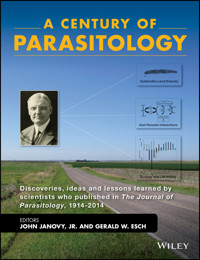
A Century of Parasitology E-Book
85,99 €
Mehr erfahren.
- Herausgeber: John Wiley & Sons
- Kategorie: Wissenschaft und neue Technologien
- Sprache: Englisch
Reviews key areas in ecological, medical and molecular parasitology
- Features essays from some of the world's leading parasitologists
- Each topic is set in context by featuring a key paper from the Journal of Paraistology over the past 100 years
Sie lesen das E-Book in den Legimi-Apps auf:
Seitenzahl: 794
Veröffentlichungsjahr: 2016
Ähnliche




















Table of Contents
Cover
Title Page
Copyright
Dedication
List of contributors
Preface
Chapter 1: A century of parasitology: 1914–2014
Literature cited
Part I: Systematics and Diversity
Chapter 2: Some New Gregarine Parasites from Arthropoda
Parasitic protozoology and the scientific lessons of intellectual elegance
A lesson learned from the history of parasitology
Diversity
Suitability
Malleability
Feasibility
Comparability
Scalability
Conclusions and lessons
Acknowledgments
Literature cited
Chapter 3: Notes on Two Cestodes from the Spotted Sting-Ray
Helminth biodiversity research transformed by a century of evolutionary thought
Rules of nomenclature
Technology
Phylogenetic (analytical) methods
Synthesis and integration of knowledge and ideas
Applications to helminth biodiversity studies
Present day
The future
Lessons learned
Literature cited
Chapter 4: Eorhynchus: A Proposed New Name for Neorhynchus Hamann Preoccupied*
Acanthocephala in The Journal of Parasitology, 1914–2014
Classical taxonomy
Molecular-evolutionary taxonomy
Life cycles
Behavioral studies
Ecological, seasonal and geographical distribution, and host-parasite relationships
Anatomy and ultrastructure
Experimental studies
Surveys, other endeavors, and conclusions
Literature cited
Chapter 5: Tocotrema Lingua (Creplin) the Adult Stage of a Skin Parasite of the Cunner and other Fishes of the Woods Hole Region
A century (1914–2014) of studies on marine fish parasites published in The Journal of Parasitology
The database on parasites of marine fishes in
JP
and the trends of its sub-disciplines divided into 10-year periods
Methods for using parasites as bioindicators of environmental quality
Where have we come from? The first 80 years of knowledge on parasites of marine fishes in
JP
Where are we now? Modern times and the arrival of the Internet
The meta-analysis
The performance of
JP
in comparison with other journals
Where do we go from here?
Environmental drivers of the probability of occurrence of the parasites of flatfishes in the southern Gulf of Mexico
General conclusions
Acknowledgments
Literature cited
Part II: Ecology and Life History
Chapter 6: Seasonal Fluctuation in the Infestation of Planorbis Trivolvis with Larval Trematodes*
An overview of the history and advances in the population ecology of parasites
The early years
Theoretical advances
Key studies
Cecal nematodes in red grouse
Methodological and conceptual advances
Conclusions and lessons
Acknowledgments
Literature cited
Chapter 7: Microevolution and the Genetic Structure of Parasite Populations
History of microevolutionary thought in parasitology: The integration of molecular population genetics
A very brief recap of population genetics history
The snail's pace flow of molecular population genetics into parasitology
History of a few parasite population genetics topics
A few personal thoughts
Acknowledgments
Literature cited
Chapter 8: A Probable Case of Non-Specific Immunity Between Two Parasites of Ciscoes of the Trout Lake Region of Northern Wisconsin
The worm's eye view of community ecology
Crowding and competition
Interspecific interactions among parasites
A new paradigm
Parasite infracommunities
Parasites and food webs
Final comments
Acknowledgments
Literature cited
Chapter 9: The Life History of Gongylonema Scutatum
The iron wheel of parasite life cycles: Then and now!
General insights about helminth life cycles and how to solve them
Ransom and Hall and the tool kit for elucidating the life cycle of
Gongylonema scutatum
Wendell Krull, miniature zoos, and elucidation of trematode life cycles
Life cycles then and now: Using a comparative approach
Conclusions and lessons
Acknowledgments
Literature cited
Chapter 10: A Survey of Meat Samples from Swine, Cattle, and Sheep for the Presence of Encysted Toxoplasma
Transmission of Toxoplasma gondii—From land to sea, a personal perspective
The scientific scene in 1960 and significance of the quoted paper
Discovery of the organism now known as
Toxoplasma gondii
Discovery of the full life cycle
Acknowledgments
Literature cited
Part III: Host-Parasite Interactions—The Challenge
Chapter 11: Tick Paralysis*
Tick paralysis: Some host and tick perspectives
Synopsis of current knowledge of tick paralysis
Toxins involved in tick paralysis
Vaccines protective against tick paralysis
Could tick paralysis be an evolutionary strategy of ticks?
Lessons learned
Literature cited
Chapter 12: Effect of Low Temperatures on Trophozoites of Giardia Muris*
Giardia intestinalis biochemistry and regulation: An evolutionary tale
Four decades of
Giardia intestinalis
research
Glucose metabolism in growing (non-encysting) trophozoites
Arginine dihydrolase pathway (ADIHP)
Mitosomes and the evolution of
Giardia
Glucose conversion to giardan during encystment
Nitric oxide regulation of metabolic shifting in encystment
Carbohydrate metabolism and nitroimidazoles
Where next?
Acknowledgments
Literature cited
Chapter 13: Development of an Acquired resistance In rabbits By repeated Infection with an Intestinal Nematode, Trichostrongylus Calcaratus Ransom, 1911.*
The early history of immunoparasitology in the United States
Contributions to the American Society of Parasitologists of some of these pioneers
Literature cited
Chapter 14: Some Practical Principles of Anthelmintic Medication
Chemotherapy of helminth infections: A centennial reflection
Stocking the armamentarium
Learning how medications work
Discovery and evaluation
Consequence and strategy
Overview, with lessons from a bygone century
Acknowledgments
Literature cited
Chapter 15: Anthelmintic drug discovery: Into the future
The future of drug discovery for parasitologists
Phenotypic screens
Mechanism-based screens
Looking ahead from behind: The lessons learned
Literature cited
Part IV: The First Figures Published in
The Journal of Parasitology
Part V: Overview and Conclusions
Chapter 16: Reflections: Closing comments for the centennial celebration of The Journal of Parasitology
Literature cited
Taxonomic index
Index
End User License Agreement
Pages
xi
1
2
3
5
7
8
9
10
11
12
13
14
15
16
17
18
19
20
21
22
23
24
25
26
27
28
29
30
31
32
33
34
35
36
37
38
39
40
41
42
43
44
45
46
47
48
49
50
51
52
53
54
55
56
57
58
59
60
61
62
63
64
65
66
67
68
69
70
71
72
73
74
75
77
78
79
80
81
82
83
84
85
86
87
88
89
90
91
92
93
94
95
96
97
98
99
100
101
102
103
104
105
106
107
108
109
110
111
112
113
114
115
116
117
118
119
120
121
122
123
124
125
126
127
128
129
130
131
132
133
134
135
136
137
138
139
140
141
142
143
144
145
146
147
148
149
150
151
152
153
154
155
156
157
158
159
160
161
162
163
164
165
167
168
169
170
171
172
173
174
175
176
177
178
179
180
181
182
183
184
185
186
187
188
189
190
191
192
193
194
195
196
197
198
199
200
201
202
203
204
205
206
207
208
209
210
211
212
213
214
215
216
217
218
219
220
221
222
223
224
225
226
227
229
230
231
232
233
234
235
236
237
238
239
241
242
243
244
245
246
247
249
250
251
252
Guide
Cover
Table of Contents
Preface
Begin Reading
List of Illustrations
Parasitic protozoology and the scientific lessons of intellectual elegance
Figure 1 G. Robert Coatney. Early in his career searching for avian malaria at Peru State College (left, from the 1936
Peruvian
) and 40 years later as President of the American Society of Parasitologists (right, from Coatney, G. R. 1976. Relapse in malaria: An enigma. Journal of Parasitology
62:
2–9). Reproduced with permission from: left—1936
Peruvian
, the Yearbook of Peru State College; and right—with permission of Allen Press Publishing Services.
Figure 2 Robert Hegner. In early mid-career (ca. 1920) at the Marine Biological Laboratory, Woods Hole, Mass. (left, from the Copeland/Bloom photograph album, History and Philosophy of Science Repository, URI: http://hdl.handle.net/10776/3270, Licensed as Creative Commons) and 16 years later as President of the American Society of Parasitologists (right, from Hegner, R. W. 1937. Parasite reactions to host modifications. Journal of Parasitology
23:
1–12). Reproduced with permission of Allen Press Publishing Services.
Figure 3 William Trager in his Rockefeller University Laboratory while President of the American Society of Parasitologists (right, from Trager, W. 1975. On the cultivation of
Trypanosoma vivax
: A tale of two visits in Nigeria. Journal of Parasitology
61:
2–11). Reproduced with permission of Allen Press Publishing Services.
Figure 4 Maynard Mayo Metcalf in a photograph distributed in the press by Science Service during the 1925 “Scopes Monkey Trial”. (Acc. 90–105—Science Service, Records, 1920s–1970s, Smithsonian Institution Archives.)
Figure 5 John Janovy
,
Jr in the Swallow Barn Laboratory, Cedar Point Biological Station, Keith Co., Nebraska (Courtesy of John Janovy, Jr)
A century (1914–2014) of studies on marine fish parasites published in The Journal of Parasitology
Figure 1 Number of papers on parasites of marine fishes contributed by country. (a) Number of papers on parasites of marine fishes published by country during the first 80 years (1914–1994) of
JP
. (b) Number of papers on parasites of marine fishes published by country during the last 20 years (1995–2014) of
JP
.
Figure 2 Average effect sizes ( intervals) of time on the number of citations for the sub-disciplines in which the
Journal of Parasitology
is divided. The effect size estimator was the Pearson's correlation coefficient . The values for overall effects are significantly different from zero if the confidence interval (CI) does not overlap zero. For each abbreviation (e.g., System-Phylo), the value of is presented, followed by the lower and upper limits of confidence intervals at 95%, the
Z
-value and the
P
-value for . The symbol is the overall effect of time on the number of citations for all the sub-disciplines, that in this case was positive and significant (). Abbreviations: System-Phylo, Systematics-Phylogenetics; EcoEpiBent, Ecology, Epidemiology and Behavior; Life cycles, Life Cycle-Survey; Pathology; Therapeutics, Therapeutics-Diagnostics; Molecular Biology, Molecular-Cell Biology; Biochemistry, Biochemistry-Physiology; Functional Morphology; Genetics-Evolution; Invertebrates, Invertebrate-Parasite Relationships.
Figure 3 Comparison of journals similar in scope and impact factor publishing on parasites of marine fishes for the period 1996–2014 (information obtained from the web of science). (a) Percentage of papers published on parasites of marine fishes by five scientific journals with respect to their whole production between 1996 and 2014. (b) Percentage of citations acquired by the papers from (a) for the same time period. Abbreviations: Vet Par,
Veterinary Parasitology
, IJP,
International Journal of Parasitology
, Par Res,
Parasitology Research
, Paras,
Parasitology
, and
JP
,
The Journal of Parasitology
.
Figure 4 The relationship between time (independent variable) and the number of citations received by the sub-disciplines in which
JP
is divided (dependent variable) for the period 1914–2014. These models were chosen because they had the lowest values of the Akaike Information Criterion (AIC; data not shown).
Figure 5 Geographical distribution of
Oncomegas wageneri
(Cestoda: Trypanorhyncha) in the southern Gulf of Mexico. (a) Presence (+) and absences (o) of
O. wageneri
on the 162 sampling sites of the oceanographic expedition Xcambo 2 between September and October, 2005. (b). Total number of
O. wageneri
per sampling site. (c) Probability of occurrence of
O. wageneri
using a boosted General Additive Model for the “full area” (n = 162 sampling sites). (d) Probability of occurrence of
O. wageneri
using a boosted General Additive Model for the “polygon area” (n = 134 sampling sites 1500 m depth or above). (e) Probability of occurrence of
O. wageneri
using MaxEnt for the “full area.” (f) Probability of occurrence of
O. wageneri
using MaxEnt for the “polygon area.”
Figure 6 Geographical distribution of
Acanthocephaloides plagiusae
(Acanthocephala: Arhythmacanthidae) in the southern Gulf of Mexico. (a) Presence (+) and absences (o) of
A. plagiusae
on the 162 sampling sites of the oceanographic expedition Xcambo 2 between September and October, 2005. (b). Total number of
A. plagiusae
per sampling site. (c) Probability of occurrence of
A. plagiusae
using a boosted General Additive Model for the “full area” (n = 162 sampling sites). (d) Probability of occurrence of
A. plagiusae
using a boosted General Additive Model for the “polygon area” (n = 134 sampling sites 1500 m depth or above). (e) Probability of occurrence of
A. plagiusae
using MaxEnt for the “full area.” (f) Probability of occurrence of
A. plagiusae
using MaxEnt for the “polygon area.”
An overview of the history and advances in the population ecology of parasites
Figure 1 Schematic representation of the gains and losses in numbers of individuals for a direct life-cycle macroparasite (
P
) in a hypothetical host (
H
). Gains and losses in a hypothetical parasite population are defined by parasite birth rate , parasite death rate , transmission rate and by the death of hosts due to infection and other causes (
b
). (Figure courtesy of Lori Goater, from Goater, Goater & Esch 2014. Reproduced with permission of Cambridge University Press.)
Figure 2 Relationship between parasite intensity and total body lipid (a), and parasite intensity and survival following onset of dropping water temperature (b) for bluegill (
Lepomis macrochirus
) from Reed's Pond, November 1981 through October 1982. Data are for fish held in outdoor aquaria at ambient temperature or in live boxes in the littoral zone. All fish were naturally infected with
U. ambloplitis
. The dotted line indicates the maximum intensity observed for bluegill that overwintered successfully in Reed's Pond. (Reprinted from Lemly and Esch (1984); Reproduced with permission of Allen Press Publishing Services.)
Figure 3 Schematic representation of how host behaviour and parasitism with the nematode
Trichostrongylus tenuis
have direct effects on population processes in red grouse (
Lagopus scoticus
), as well as interactions between them. Solid lines reflect positive interactions and dashed lines reflect negative interactions. Indirect interactions, such as selective predation on parasitized individuals are not shown. Modified from Martínez-Padilla et al. (2014).
History of microevolutionary thought in parasitology: The integration of molecular population genetics
Figure 1 I conducted a Web of Science search on the terms “microsatellite” and either “fish” or “parasite” on March 6, 2014. The search was for each year separately. Extreme caution is advised in strictly interpreting results. All papers may not actually be population genetic studies or may not be using microsatellites in the respective organisms. Indeed, I know the three papers in 1995 under “parasite” are not studies on the population genetics of parasites two are not even on parasites. The Figure is mainly of exploratory value and, while the exact numbers are incorrect, I suspect an approximate 10-year lag would be present even if proper scientific scrutiny were used. Keep in mind the search was only for one group of vertebrates as no one uses “free-living” as a keyword. Inclusion of other vertebrates would only increase the discrepancy. Thus, if anything, I suspect the Figure gives a gross underestimate of parasites relative to free-living animals. I was not able to do a similar analysis for allozymes as Web of Science does not have abstracts or author provided keywords for most papers prior to 1995; thus, word searches will be less inclusive based on titles alone.
The worm's eye view of community ecology
Figure 1 Degree of infection of an individual fish. Redrawn from Figure 1 of Cross (1934) Journal of Parasitology 20: 244–245. Reproduced with permission of Allen Press Publishing Services.
Figure 2 Effects of concurrent infection on the intraintestinal distribution of
Hymenolepis diminuta
and
Monilformis dubius
. Light bars are single infections; dark bars are concurrent infections. Redrawn from Figure 1 of Holmes (1961) Journal of Parasitology 47: 209–216. Reproduced with permission of Allen Press Publishing Services.
Figure 3 Parasite community assembly is influenced by processes operating at a range of spatial and temporal scales. Parasite species are found within a regional species pool that is constrained by evolutionary processes. A subset of the species from the regional pool will colonize a particular site depending on dispersal and exposure probability. This, in essence, suggests that the observed parasite community within a host is the result of infective stages passing through abiotic and biotic filters. Modified from HilleRisLambers, J., P. B. Adler, W. S. Harpole, J. M. Levine, and M. M. Mayfield. 2012. Rethinking community assembly through the lens of coexistence theory. Ann. Rev. Ecol. Evol. Syst., 43: 227–248.
The iron wheel of parasite life cycles: Then and now!
Figure 1 Life cycle of
Haematoloechus parviplexus
(=
Pneumonoecus parviplexus
). (
A
) 32-day-old adult
H. parviplexus
from the lungs of the bullfrog,
Rana catesbeiana
. (
B
) Bullfrog, showing the escape of the metacercariae from the dragonfly in the stomach and their migration to the lungs; adult worms depositing eggs and the route of the eggs to the external environment. (
C
) Egg. (
D
)
Gyraulus parvus
eating eggs; releasing cercariae. (
E
) Sporocyst from the digestive gland of
Gyraulus parvus
with cercariae in various stages of development. (
F
) Cercaria showing body, tail, stylet, oral sucker, pharynx and cecae, ventral sucker, and excretory bladder. (
G
) Larva of the eastern pondhawk dragonfly,
Erythemis simplicicollis
, showing the swimming cercariae being taken into the branchial basket respiratory organ of the larva. (
H
) Lamella from the branchial basket of eastern pondhawk dragonfly larva containing two encysted metacercariae. (
I
) Teneral eastern pondhawk dragonfly with encysted metacercariae within the vestige of the branchial basket of the larva. (
J
) Encysted metacercaria. Drawings not to scale. All drawings are original but modified after Krull (1930).
Figure 2 Original photomicrographs of the developmental stages of
Halipegus occidualis
. (a) Adult worm (arrow) under the tongue of a green frog,
Rana clamitans
. Scale bar = 1.0 cm. (b) Adult worm full of eggs. Scale bar = 1.5 mm. (c) Egg. Note the long abopercular filament and well developed miracidia. Scale bars = 20 µm. (d) Redia. Note the developing cercariae. Scale bar = 100 µm. (e–f) Cystophorous cercaria. Note the coiled cercaria body (cb), coiled delivery tube (dt), handle (h), encysted tail (t), and inner (iw) and outer (ow) membranes. Scale bars = 20 µm. (g–i) Expulsion of the delivery tube (dt) through the handle (h) followed by the cercaria body (cb) traveling through the delivery tube until its expulsion. Scale bars = 50 µm. (j–k) Metacercariae (arrows) within the hemocoel of
Cyclops
sp. and
Phyllognathopus
sp. copepods. Scale bars = 200 µm in (j) and 10 µm in (k). (l) Metacercaria removed from the intestine of a dragonfly larva. Scale bar = 85 µm.
Figure 3 Original photomicrographs of cercariae of
Haematoloechus
spp. in the process of attaching and penetrating a damselfly host. (a) Free swimming cercaria of
Haematoloechus coloradensis
. Note the stylet. Scale bar = 40 µm. (b–d) Attachment, crawling behavior and penetration of a cercaria of
Haematoloechus coloradensis
on the leg of a larval damselfly. Note the loss of the tail (small arrow) from the cercarial body (large arrow) in the process of penetration in (d). Scale bars = 200 µm. (e–g) Attachment, crawling behavior and penetration of a cercraira of
Haematoloechus longiplexus
on the anal gill of a larval damselfly. Scale bars = 300 µm.
Figure 4 Original photomicrographs of metacercariae of
Haematoloechus
spp. removed from larval dragonflies. (a) Encysted metacercaria of
Haematoloechus coloradensis
. (b) Unencysted metacercaria of
Haematoloechus longiplexus
. Scale bars = 20 µm.
Figure 5 Arthropod host specificity, metacercaria type, and geographical distribution among species of
Haematoloechus
indicated on a phylogenetic tree derived from internal transcribed spacer rDNA data by Snyder and Tkach (2001) and Bolek (2006). Generalist parasites have the ability to form metacercariae in odonate and non-odonate arthropods. Species in gray indicate that the life cycle is unknown. NA = North America; E = Europe.
Figure 6 Variations on the life cycle of
Gorgoderina attenuata
and the anuran hosts which are infected. (a) Line drawing of an adult
G. attenuata
from the urinary bladder of a northern leopard frog,
Rana pipiens
. (b) Truncated two host life cycles where the cercaria is ingested by a tadpole. This transmission strategy is used to infect newly metamorphosed leopard frogs and Woodhouse's toads. (c) Three host life cycle where the cercaria is ingested by an odonate second intermediate host. This transmission strategy is used to infect adult leopard frogs and adult bullfrogs. (d) Three host life cycle using a tadpole as a transport host. This transmission strategy is used to infect adult bullfrogs. Adapted from Bolek, Snyder & Janovy, Jr (2009a). Reproduced with permission of
Journal of Parasitology
, Allen Press Publishing Services.
Transmission of Toxoplasma gondii—From land to sea, a personal perspective
Figure 1 Sugar fecal float of cat feces showing unsporulated oocysts of
T. gondii
(arrows),
Cystoisospora
(
Isospora) felis
(f), and C.
rivolta
(r).
Toxoplasma gondii
oocysts are the smallest of all feline coccidia, averaging .
Cystoisospora felis
oocysts are pear-shaped and average .
Cystoisospora rivolta
oocysts are ovoid and measure about . All three coccidian oocysts are compared to the size of a
Toxocara cati
(c) egg, the common feline round worm (from Dubey, 2010).
Giardia intestinalis biochemistry and regulation: An evolutionary tale
Figure 1
Giardia
glucose metabolism in trophozoites. 1. hexokinase; 2. glucose phosphate isomerase; 3. pyrophosphate-dependent phosphofructokinase; 4. fructose biphosphate aldolase; 5. glycolytic enzymes- (glyceraldehyde-3-phosphate dehydrogenase, phosphoglycerate kinase, phosphoglycerate mutase, enolase); 6. pyruvate kinase; 7. Pyruvate; orthophosphate dikinase; 8. Phosphoenolpyruvate carboxyphosphotransferase (GTP dependent); 9. aspartate aminotransferase; 10. malate dehydrogenase; 11. malate dehydrogenase (decarboxylating); 12. Alanine aminotransferase; 13. pyruvate: ferredoxin oxidoreductase; 14. acetyl-CoA synthetase; 15. primary alcohol dehydrogenase (NAD); 16. hydrogenase. Abbreviations used; oxidized ferredoxin (Fdo), reduced ferredoxin (Fdr)
Figure 2 Arginine dihydrolase pathway in
Giardia
trophzoites. 1. arginine deiminase 2. ornithine transcarbamoylase 3. carbamate kinase.
Figure 3 Model polysaccharide chains constructed from disaccharide and linkage information randomly selected from appropriate conformational regions. All polysaccharides contain 30 monosaccharide residues. The polymer constructed from region Ia forms a right-handed (clockwise) helix, whereas the polymer built from region Ib has a left-handed helical conformation. The polysaccharide assembled from regions Ia and Ib (4:1) shows a random coil conformation. (Gerwig et al., 2002. The
Giardia intestinalis
filamentous cyst wall contains a novel β(1–3)-N-acetyl-D-galactosamine polymer: A structural and conformational study. Glycobiology
12
: 499–505. Reproduced with permission of Oxford University Press).
Figure 4 Giardan synthesis pathway. 1. glucosamine 6-P deaminase; 2. glucosamine 6-P N-acetylase; 3. phosphoacetylglucosamine mutase; 4. and UDP-N-acetylglucosamine pyrophosphorylase; 5. UDP-N-acetylglucosamine 4'-epimerase; 6. cyst wall synthase (β 1, 3 GalNAc transferase).
Figure 5 Mechanism(s) for the reduction and activation of metronidazole and other nitroimidazoles in
Giardia.
Metronidazole and nitroimidazoles (NO-R) are pro-drugs activated by cellular reduction. It is suspected that the nitro radical anion species R-NO
.-
is responsible for toxicity. Three mechanisms of drug reduction are proposed; 1. Interaction of drug with reduced ferredoxin (Fdr) linked to pyruvate: ferredoxin oxidoreductase activity (PFOR), 2. The action of a nitroreductase (NR) and 3. Via an FADH
2
linked thioredoxin reductase (TrxR).
Figure 6 Graphic representation of alanine, ornithine and acetate concentrations from
Giardia
trophozoites metabolism as determined by GC-MS/MS analysis of growth medium after 8hr incubation. Each data point was compiled from a minimum of five independent replicates. Each spot represents one isolate and the two spots circled are results obtained from two metronidazole resistant isolates (determined by MIC). The data from these two are significantly different (
P
= 0.01). Alanine and acetate are products of glucose fermentation in
Giardia
and ornithine is produced via the arginine dihydrolase pathway. Values presented are in nmol h
−1
10
−6
cells.
The early history of immunoparasitology in the United States
Figure 1 (A) Emil von Behring, (B) Paul Ehrlich, (C) Ilya Mechnikov, (D) George Nuttall, and (E) Almroth Wright.
Figure 2 Robert Hegner (
Journal of Parasitology
23
:1 (1937). Reproduced with permission from
The Journal of Parasitology
, Allen Press Publishing Services.)
Figure 3 William Walter Cort (
Journal of Parasitology
39
:4 (1953). Reproduced with permission from
The Journal of Parasitology
, Allen Press Publishing Services.)
Figure 4 Norman R. Stoll (
Journal of Parasitology
33
:1 (1947). Reproduced with permission from
The Journal of Parasitology
, Allen Press Publishing Services.)
Figure 5 William H. Taliaferro (
Journal of Parasitology
20.3 (1934). Reproduced with permission from
The Journal of Parasitology
, Allen Press Publishing Services.)
Figure 6 Asa C. Chandler. (Courtesy of Woodson Research Center Fondren Library, Rice University. Reproduced with permission.)
Chemotherapy of helminth infections: A centennial reflection
Figure 1 Some anthelmintics used in the twentieth century for treatment of nematode infections.
Figure 2 Some anthelmintics used in the twentieth century for treatment of trematode and cestode infections.
List of Tables
A century (1914–2014) of studies on marine fish parasites published in The Journal of Parasitology
Table 1 Environmental variables, nutrients and pollutants selected by the boosted general additive model for the “full area” and “polygon area” models for
Oncomegas wageneri
(
O. wageneri
) and
Acanthocephaloides plagiusae
(
A. plagiusae
). The mboost algorithm uses bootstrap estimates to undertake a cross-validation to prevent overfitting. This cross-validation generates a variable selection process that provides the frequency (Fr (%)) at which each variable is selected during a bootstrap process. These frequencies are a proxy of the importance (expressed in percentage) of each variable within the model. Abbreviations were as follows: bbs = a penalized regression spline base learner, bspatial = a bivariate tensor product P-spline base learner, DD = decimal degrees, PAHH = polyaromatic hydrocarbons of high molecular weight, PAHL = polyaromatic hydrocarbons of low molecular weight, S = sediment, W = water. The principal coordinates of neighbour matrices (PCNM) variables were used to factor the contribution of unknown environmental variables acting at three different spatial scales (see Santana-Piñeros et al., 2012 for a detailed explanation)
Table 2 Performance statistics of the GAMmboost and MaxEnt models for
Oncomegas wageneri
(
O. wageneri
) and
Acanthocephaloides plagiusae
(
A. plagiusae
) for the “full area” (n = 162 sampling sites) and the “polygon area” (n = 134 sampling sites). Acronyms are as follows: Kappa = Cohen's Kappa, AUC = Area under the curve, pROC = Partial receiver operator curve. Kappa ranges from −1 (total disagreement) through 0 (random classification) to 1 (total agreement). For AUC and pROC curves, values below 0.5 indicate a performance no better than random, values between 0.7 and 0.8 are considered useful, and values >0.8 are excellent (Hosmer and Lemeshow, 2000)
Tick paralysis: Some host and tick perspectives
Table 1 Tick species reported to cause tick paralysis.
*
A Century of Parasitology
Discoveries, Ideas and Lessons Learned by Scientists Who Published in The Journal of Parasitology, 1914–2014
EDITED BY
John Janovy, Jr and Gerald W. Esch
This edition first published 2016 © 2016 by John Wiley & Sons Ltd
Registered office: John Wiley & Sons, Ltd, The Atrium, Southern Gate, Chichester, West Sussex, PO19 8SQ, UK
Editorial offices: 9600 Garsington Road, Oxford, OX4 2DQ, UK
The Atrium, Southern Gate, Chichester, West Sussex, PO19 8SQ, UK
111 River Street, Hoboken, NJ 07030-5774, USA
For details of our global editorial offices, for customer services and for information about how to apply for permission to reuse the copyright material in this book please see our website at www.wiley.com/wiley-blackwell.
The right of the author to be identified as the author of this work has been asserted in accordance with the UK Copyright, Designs and Patents Act 1988.
All rights reserved. No part of this publication may be reproduced, stored in a retrieval system, or transmitted, in any form or by any means, electronic, mechanical, photocopying, recording or otherwise, except as permitted by the UK Copyright, Designs and Patents Act 1988, without the prior permission of the publisher.
Designations used by companies to distinguish their products are often claimed as trademarks. All brand names and product names used in this book are trade names, service marks, trademarks or registered trademarks of their respective owners. The publisher is not associated with any product or vendor mentioned in this book.
Limit of Liability/Disclaimer of Warranty: While the publisher and author(s) have used their best efforts in preparing this book, they make no representations or warranties with respect to the accuracy or completeness of the contents of this book and specifically disclaim any implied warranties of merchantability or fitness for a particular purpose. It is sold on the understanding that the publisher is not engaged in rendering professional services and neither the publisher nor the author shall be liable for damages arising herefrom. If professional advice or other expert assistance is required, the services of a competent professional should be sought.
Library of Congress Cataloging-in-Publication Data applied for.
ISBN: 9781118884768
A catalogue record for this book is available from the British Library.
Wiley also publishes its books in a variety of electronic formats. Some content that appears in print may not be available in electronic books.
As co-Editors, we are honored to dedicate this book to the memory of our mentor, \hbox{Professor} J. Teague Self, a long-time member of the Department of Zoology, University of Oklahoma. We were privileged to secure our M.S. and Ph.D. degrees with the guidance of this man. Yes, he taught us a lot about parasitism and parasitology. But, one of our favorite memories was the real excitement of attending our annual ASP meetings because we knew Dr. Self would offer to introduce us to our heroes, e.g., people like Ray Cable, Norman Stoll, William Trager, Clark Read, Theodore von Brand, and so many others of their generation. It was always such a huge treat!
We also agree that his wisdom in dealing with people and his consistency as a professional were equally important to whatever success we have had over the past 50+ years. He was a true ``giant'' in our careers, and we thank him for helping us to focus in the right direction.
John Janovy, JrGerald W. Esch
List of contributors
M. Leopoldina Aguirre-Macedo
Laboratorio
de Parasitología, Centro de Investigación y de Estudios Avanzados del Instituto Politécnico Nacional. México, U.S.A.
Omar M. Amin
Institute of Parasitic Diseases. Arizona, U.S.A.
Tavis K. Anderson
Virus and Prion Research Unit National Animal Disease Center, U.S.A.
Matthew G. Bolek
Department of Integrative Biology, Oklahoma State University, U.S.A.
Conor R. Caffrey
Center for Discovery and Innovation in Parasitic Diseases, Department of Pathology, University of California, San Francisco, U.S.A.
Janine N. Caira
Department of Ecology and Evolutionary Biology, University of Connecticut, U.S.A.
William C. Campbell
Research Institute for Scientists Emeriti, Drew University, U.S.A.
Richard E. Clopton
Department of Natural Science, Peru State College, U.S.A.
Charles D. Criscione
Department of Biology, Texas A&M University, U.S.A.
J. P. Dubey
United States Department of Agriculture, Agricultural Research Service, Beltsville Agricultural Research Center, U.S.A.
Lance A. Durden
Department of Biology, Georgia Southern University, U.S.A.
Gerald W. Esch
Department of Biology, Wake Forest University, U.S.A.
Timothy G. Geary
Institute of Parasitology, McGill University, Canada.
Cameron P. Goater
Aquatic Biodiversity Section, Watershed Hydrology and Ecology Research Division, Water Science and Technology Directorate, Science and Technology Branch, St. Lawrence Centre, Canada.
Kyle D. Gustafson
Department of Integrative Biology, Oklahoma State University, U.S.A.
John Janovy, Jr
School of Biological Sciences, University of Nebraska-Lincoln, U.S.A.
Edward L. Jarroll
Department of Biological Sciences, Lehman College, U.S.A.
Kirsten Jensen
Department of Ecology and Evolutionary Biology and the Biodiversity Institute, University of Kansas, U.S.A.
Raymond E. Kuhn
Department of Biology, Wake Forest University, U.S.A.
Ben J. Mans
Agricultural Research Council, South Africa Onderstepoort Veterinary Institute Pretoria, South Africa
David J. Marcogliese
Aquatic Biodiversity Section, Watershed Hydrology and Ecology Research Division, Water Science and Technology Directorate, Science and Technology Branch, St. Lawrence Centre, Canada.
Timothy A. Paget
Sunderland School of Pharmacy, University of Sunderland, Sunderland, U.K.
Judy Sakanari
University of California San Francisco,
California, U.S.A.
Heather A. Stigge
Department of Integrative Biology, Oklahoma State University, U.S.A.
Michael V.K. Sukhdeo
Department of Ecology, Evolution, and Natural Resources, and Center for Research on Animal Parasites, Rutgers University, U.S.A.
Edgar Torres-Irineo
Laboratorio de Parasitología, Centro de Investigación y de Estudios Avanzados del Instituto Politécnico Nacional. México, U.S.A.
Victor Manuel Vidal-Martínez
Preface
The idea for this book, as well as for the reviews published in Volume 100 of The Journal of Parasitology (2014), originated with Gerald Esch, editor of the Journal for 20 years. Dr. Esch picked a group of potential authors and subjects, a list that expanded and contracted over a period of several months as we contacted individuals, answered their questions, and at times twisted their arms (gently). He envisioned a celebration of the long shelf life and intellectual breadth of this journal, along with the rich history of parasitology, especially as manifest by American parasitologists and their colleagues from around the world. An initial gathering of potential authors was held in 2013 in Quebec City, during the annual American Society of Parasitologists meeting. There was considerable discussion about the scope of such an edited volume, and during the next few months there were extensive communications between authors and editors on a variety of topics. Dr. Esch initiated discussions with Ward Cooper, Commissioning Editor at Wiley, and eventually those talks led to a draft contract for the project. That's when the real work started.
Both of us express our deepest appreciation to the parasitologists who contributed to this book and who put up with the requests involved. Everyone associated with this project has learned quite a bit about the history of parasitology, as well as the history of ideas, the manner in which technology has shaped research in our discipline, and how research experiences lead to life lessons. Thus after reading the initial contributions, we decided to ask authors for comments on lessons learned, not only from their own work, but from an examination of history. The 2014 ASP President's Symposium in New Orleans consisted of papers delivered by the authors, and their chapters are elaborations of those talks.
All of the contributed chapters except the last one by Timothy Geary, Judy Sakanari, and Conor Caffrey are preceded by what the authors believed to be the first paper published in The Journal of Parasitology (JP) in their particular subject areas. We were all impressed with the insight, and sometimes foresight, of these parasitologists, some whose work appeared in Volume 1. Because JP is such a visually rich publication, we also looked for some representative first figures, for example, the first drawing of a new species, or the first transmission electron micrograph, and have included a number of those figures along with their original legends and some commentary.
We would also like to thank Mike Sukhdeo and Vickie Hennings for help with material derived from The Journal of Parasitology, and in particular the chapter entitled “Antihelmintic drug discovery: Into the future,” by Timothy Geary, Judy Sakanari, and Conor Caffrey. After reading the initial draft of their manuscript, we both felt it would be an excellent review article in JP, so recommended that it be expedited through the publication process. We also felt that this final chapter was such a logical extension of the one by Bill Campbell that it didn't need a “first JP paper” beyond the one by Maurice Hall.
While reading through this volume, including the Table of Contents, you may find scientific names that are not italicized in some of the publication titles. In reprinting those original papers from JP, we kept the fonts, spelling, and nomenclature exactly as they were published in the journal when we listed those items in the Table of Contents.
The Wiley editor who took over this project from Ward Cooper is Kelvin Matthews. He has been a patient, communicative, and helpful editor and we greatly appreciate his work on this book.
Finally, we would like to thank Talia Everding, an undergraduate at the University of Nebraska-Lincoln, who served as an editorial assistant, reading all the chapters, often more than once, doing research in the back issues, and suggesting numerous ways to clarify the wording. We may have turned her into a parasitologist, in spirit if not in kind, with this assignment!
John Janovy, Jr and Gerald W. Esch
Chapter 1A century of parasitology: 1914–2014
John Janovy, Jr
School of Biological Sciences, University of Nebraska-Lincoln, U.S.A.
The hundred years between 28 June 1914, when the assassination of Austrian Archduke Franz Ferdinand precipitated World War I, and 27 July 2014, closing day of the American Society of Parasitologists' 89th annual meeting, represent one of the most stressful, complex, yet in some ways wondrous, periods of human history. Samantha Power (2002) called this time the “Age of Genocide;” Albert Einstein's equations completely re-structured our image of the universe; nuclear weapons entered our political negotiations; and, molecular biologists obliterated some of our most cherished views of nature. A decade after the Wright brothers' first sustained flight in a heavier-than-air craft, in December 1903, military airplanes took to the skies over Europe; today, some authors claim that airports are our current versions of the thirteenth-century cathedrals (Binney, 1999). Robert Goddard began his experiments with solid-fueled rockets in 1915 (Lehman, 1963); by 2014, intercontinental ballistic missiles were hiding in silos scattered across the Great Plains of North America, an International Space Station circled Earth, and the first Apollo moon landing was a mostly forgotten historical event. Even as we spent the past century obliterating much of Earth's terrestrial biological diversity by clearing tropical forests, satellite telescopes were discovering exo-planets at an increasing rate. In 1914, a successful scientist like H. B. Ward, founder of the American Society of Parasitologists as well as driving force behind a new scientific journal, The Journal of Parasitology, could buy a new Royal Model 10 typewriter; a century later we stop teaching cursive to elementary school students largely because kids are communicating via QWERTY keyboards (designed in 1873) on hand-helds with temperature-sensitive screens. Senior citizens today can recite, largely from personal experience, the origin and impact of what we now call the “Information Age.”
The new century in which we live should be an interesting one too, with projected climate change potentially wreaking havoc on coastal ecosystems and human populations expected to (phrased euphemistically) “level off.” Some things have not changed very much, however; parasitic organisms still infect not only humans and our domestic animals, but also, to our knowledge, virtually every eukaryotic species on planet Earth. Despite Ronald Ross' (1902) claim, in his Nobel Prize acceptance speech—“It is my privilege in this lecture to describe particularly the steps by which this great problem has at length received its full solution”—malaria remains one of humanity's most persistent scourges. Schistosomiasis, filariasis, and geohelminth infections still cause untold misery, along with their protistan counterparts such as leishmaniasis and amebiasis, especially in the tropics. But these infectious diseases also have inspired generations of parasitologists to apply their time, talents, and intellectual resources to find cures, or develop control methods, and thus provide relief from the economic and social burdens caused by parasitic organisms (Kuris, 2012; Loker, 2013).
In their quests to develop treatment and control technologies, parasitologists have indeed produced some major successes over the past century, but in the process they also have made conceptual contributions that might arguably be described as “metaparasitology”—an intellectual realm that includes the “rules” for pursuing the discipline. Although it may not always have been their intent, parasitologists have done research that in turn shapes our ideas about interactions between hosts and parasites. Excellent examples, among many, of concepts published very early if not originally in The Journal of Parasitology, include molecular mimicry in schistosomes (Damian, 1962, 1964, 1987), the relative immortality of cestodes (Read, 1967), and amphiparatenesis in Alaria marcianae as demonstrated by Shoop and Corkum (1987), who then extended the concept to those nematode species known to exhibit developmental arrest and transplacental transmission. With time, sometimes a surprisingly short time in historical terms, these kinds of contributions become principles of parasitism—the most common way of life among animals and animal-like eukaryotes.
Our goal in assembling this volume of contributed chapters is to bring the phenomenon of concept-driven research to the forefront, especially in the minds of younger readers. We also hope to provide historical perspective in the form of lessons learned from both successful and unsuccessful research endeavors. Thus, our contributing authors have been asked to step outside their immediate comfort zones, those places so often constructed and constrained by legitimate demands of proper methodology, statistical analysis, correct identification, and anonymous reviewers, and instead reflect on the historical development of their subjects. To quote from an early memo to our authors:
In most of the correspondence and discussion so far, we've mentioned the hope that these chapters would be heavy on ideas, and that authors would show us how research has inspired further work, how concepts demonstrated by particular papers have served a heuristic role in parasitology, and how historical precedents have been established. Our hope is that this volume will be unique in its role as a demonstration of how parasitologists think about their discipline and sub-disciplines, and how our material provides so many research opportunities yet can be quite uncooperative in sometimes unexpected ways. In the best of all worlds, students read this book, and come away with new ideas about their current research, an expanded view of how parasitologists pursue their careers, and a feeling that their own work, sometimes with obscure organisms that have little economic importance, has the potential to open up new areas of investigation. In other words, we understand that the subject is science, but we encourage all of you to think in terms of the history of science and what we have learned about how to do our science from having done it for years, if not decades.
Nobody needs reminded that mid-career scientists are fully occupied, and that statement certainly applies to the authors who have contributed to this volume. It is true, as Asa Chandler noted in his Presidential address during the 1945 American Society of Parasitologists meeting (Chandler, 1946), that parasitologists are “slow in going to seed,” so even our retired colleagues are busy with projects that consume their time and energies. Therefore, as must be the case for all such ambitious endeavors, this particular volume is not as inclusive as it might have been. But in our defense, after reading the initial chapter drafts, we editors came to the conclusion that it would require a whole shelf of such books to truly do the subject justice. We expect that some of you will take on this future task!
We also hope that this book sells enough copies to generate some net income. By written agreement between the editors and publisher, such “profits” have been assigned to the American Society of Parasitologists for support of The Journal of Parasitology, and especially to defray page charges for authors who have accepted papers, but are not in a position to pay costs for longer articles or essential color figures. The Journal of Parasitology is indeed an amazing publication with very long shelf life, rather like some of the authors who have published in it. If a student is able to read through a single issue, for example, and both understand and appreciate most of the work reported, that student will be broadly educated in a decidedly empowering manner. So our real dream, beyond some welcome support for authors who publish in the Journal, is that these chapters, which are mostly senior scientists' reflections on how our research has been shaped by ideas, will serve as conversation starters for younger scientists.
Literature cited
Binney, M. 1999.
Airport builders
. Academy Editions, Chichester, U.K., 223 p.
Chandler, A. C. 1946. The making of a parasitologist.
Journal of Parasitology
32
: 213–221.
Damian, R. T. 1962. A theory of immunoselection for eclipsed antigens of parasites and its implications for the problem of antigenic polymorphism in man.
Journal of Parasitology
48
: 16.
___________. 1964. Mimicry: Antigen sharing by parasite and host and its consequences.
American Naturalist
98
: 129–149.
___________. 1987. The exploitation of host immune response by parasites.
Journal of Parasitology
73
: 1–13.
Kuris, A. M. 2012. The global burden of human parasites: Who and where are they? How are they transmitted?
Journal of Parasitology
98
: 1056–1064.
Lehman, M. 1963.
This high man; The life of Robert H
. Goddard. Farrar, Straus, New York, NY, 430 p.
Loker, E. S. 2013. This de-wormed world?
Journal of Parasitology
99
: 933–942.
Power, S. 2002. “A problem from hell”:
America and the age of genocide
. Basic Books, New York, NY, 610 p.
Read, C. P. 1967. Longevity of the tapeworm,
Hymenolepis diminuta
.
Journal of Parasitology
53
: 1055–1056.
Ross, R. 1902. Researches on malaria.
In Nobel lectures, physiology or medicine, Nobel Foundation
. Elsevier, Amsterdam, The Netherlands, p. 26–116.
Shoop, W. L., and K. C. Corkum. 1987. Maternal transmission by
Alaria marcianae
and the concept of amphiparatenesis.
Journal of Parasitology
73
: 110–115.
Part ISystematics and Diversity
Chapter 2Some New Gregarine Parasites from Arthropoda*
Minnie Elizabeth Watson
*Contributions from the Zoological Laboratory of the University of Illinois, under the direction of Henry B. Ward, No. 48.
Lesen Sie weiter in der vollständigen Ausgabe!
Lesen Sie weiter in der vollständigen Ausgabe!
Lesen Sie weiter in der vollständigen Ausgabe!
Lesen Sie weiter in der vollständigen Ausgabe!
Lesen Sie weiter in der vollständigen Ausgabe!
Lesen Sie weiter in der vollständigen Ausgabe!
Lesen Sie weiter in der vollständigen Ausgabe!
Lesen Sie weiter in der vollständigen Ausgabe!
Lesen Sie weiter in der vollständigen Ausgabe!
Lesen Sie weiter in der vollständigen Ausgabe!
Lesen Sie weiter in der vollständigen Ausgabe!
Lesen Sie weiter in der vollständigen Ausgabe!
Lesen Sie weiter in der vollständigen Ausgabe!
Lesen Sie weiter in der vollständigen Ausgabe!
Lesen Sie weiter in der vollständigen Ausgabe!
Lesen Sie weiter in der vollständigen Ausgabe!
Lesen Sie weiter in der vollständigen Ausgabe!
Lesen Sie weiter in der vollständigen Ausgabe!
Lesen Sie weiter in der vollständigen Ausgabe!
Lesen Sie weiter in der vollständigen Ausgabe!
Lesen Sie weiter in der vollständigen Ausgabe!
Lesen Sie weiter in der vollständigen Ausgabe!
Lesen Sie weiter in der vollständigen Ausgabe!
Lesen Sie weiter in der vollständigen Ausgabe!
Lesen Sie weiter in der vollständigen Ausgabe!
Lesen Sie weiter in der vollständigen Ausgabe!
Lesen Sie weiter in der vollständigen Ausgabe!
Lesen Sie weiter in der vollständigen Ausgabe!
Lesen Sie weiter in der vollständigen Ausgabe!
Lesen Sie weiter in der vollständigen Ausgabe!
Lesen Sie weiter in der vollständigen Ausgabe!
Lesen Sie weiter in der vollständigen Ausgabe!
Lesen Sie weiter in der vollständigen Ausgabe!
Lesen Sie weiter in der vollständigen Ausgabe!




