


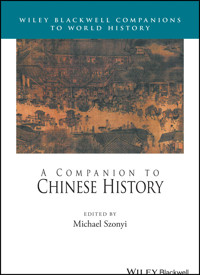
A Companion to Chinese History E-Book
139,99 €
Mehr erfahren.
- Herausgeber: John Wiley & Sons
- Kategorie: Geisteswissenschaft
- Serie: Blackwell Companions to World History
- Sprache: Englisch
A Companion to Chinese History presents a collection of essays offering a comprehensive overview of the latest intellectual developments in the study of China’s history from the ancient past up until the present day.
- Covers the major trends in the study of Chinese history from antiquity to the present day
- Considers the latest scholarship of historians working in China and around the world
- Explores a variety of long-range questions and themes which serves to bridge the conventional divide between China’s traditional and modern eras
- Addresses China’s connections with other nations and regions and enables non-specialists to make comparisons with their own fields
- Features discussion of traditional topics and chronological approaches as well as newer themes such as Chinese history in relation to sexuality, national identity, and the environment
Sie lesen das E-Book in den Legimi-Apps auf:
Seitenzahl: 1244
Veröffentlichungsjahr: 2016
Ähnliche



















Table of Contents
Cover
Title Page
Notes on Contributors
Acknowledgments
Chapter One: Introduction
Conventions
PART I: States of the Field
Chapter Two: How Do We Know What We Know about Chinese History?
Introduction
I. Paleontology and archaeology
II. The writing of history
III. Transmitted texts
IV. New sources
V. Digitization
VI. The Republic of China (to 1949)
VII. Post‐1978 Chinese historical writing
Chapter Three: Chinese History in China
Introduction
Social history: Grand narratives versus trivialization
Regional approach: More than the sum
Historical anthropology: Till now a happy marriage
Problematizing “China”
More “new”: New institutional history and new political history
Generation Y and e‐research
Not yet a conclusion: the “Second Revolution”
Suggestions for further reading
Chapter Four: Chinese History in Japan
Written and unwritten laws
Social and economic history
Conclusion
Suggestions for further reading
Chapter Five: Chinese History in Europe
Highlights of published Chinese historical studies by European authors since 1995
Problems and prospects of Chinese historical studies in Europe
Suggestions for further reading
Chapter Six: Chinese History in the Era of the China Dream
Suggestions for further reading
Chapter Seven: Chinese History in World History
What
is
world history?
China and world history in the west, World War I to 1978
Rethinking China in the PRC’s early reform era
The “new world history” and some alternatives
A shift of focus in political‐economic history: China approaches center stage
Other perspectives, other interests
Closing remarks
Suggestions for further reading
PART II: Chronologies
Chapter Eight: Early China in Eurasian History
The geography of Eurasia
Animal and plant domestication
The Bronze Age states of Eurasia
Chariots
The Bronze Age dynasties of the North China plain
The rise of pastoral nomadism in the steppe
First millennium BCE
China in the first millennium BCE
The age of empires
Geographical limits to the empires of the North China plain
Reactions against empire
Salvationist religions
Late antiquity
The Silk Road
The legacies of the early period
Suggestions for further reading
Chapter Nine: Was Medieval China Medieval? (Post‐Han to Mid‐Tang)
Historical synopsis
A cycle of Cathay?
Was medieval China “medieval”?
Conclusion: The state of the field
Suggestions for further reading
Chapter Ten: A Tang–Song Turning Point
The Naitō thesis
The sociopolitical elite
Institutions and political culture
Economy
Thought and religion
Women and gender
Foreign relations and “proto‐nationalism”
The Five Dynasties period
Suggestions for further reading
Chapter Eleven: Periods of Non‐Han Rule
Main players: The non‐Han dynasties
Historiographical frameworks: From Sinicization to Inner Asian polities
Suggestions for further reading
Chapter Twelve: Song to Qing
The Song
Foreign rule
The Ming
The Qing (1644–1911)
Suggestions for further reading
Chapter Thirteen: Nineteenth‐Century China
The old nineteenth century
The new nineteenth century
Suggestions for further reading
Chapter Fourteen: Republican History
The early years
The opening of the archives
Civil society and its discontents
The Nationalist regime reborn
Decentering the Republic, from the late Qing to post‐1949
Conclusion
Suggestions for further reading
Chapter Fifteen: Rethinking the History of Maoist China
Archives and new sources
How the new historiography is changing our view of the Mao era
Reflections
Suggestions for further reading
Chapter Sixteen: The Reform Era as History
Three narratives of reform, experimentation, and rejuvenation
Ideological moments: Viewing the reform period in segments
Reviewing notable events
Current state of the field
Suggestions for further reading
PART III: Themes and Approaches
Chapter Seventeen: Women, Gender, the Family, and Sexuality
Organizing gender and the family: Confucian discourses
The family
Marriage
Working and writing
Sexuality
The twentieth century: Transformations and limitations
Conclusion
Suggestions for further reading
Chapter Eighteen: History of Premodern Chinese Literature
Introduction
Early Era (1500 BCE–317 CE)
Middle Era (317–1260)
Late Era (1260–1900)
Suggestions for further reading
Chapter Nineteen: Modern Chinese Literature
Obsession with China
Revolution and involution
History after “History”
Toward Sinophone spheres
Suggestions for further reading
Chapter Twenty: The Environmental History of China: Past, Present, and Future
Introduction
Classical writers on the environment
Modern reflections
The basic story
Environmental history in China today and tomorrow
Suggestions for further reading
Chapter Twenty‐One: Science, Technology, and Medicine
A Portrait of the Discipline as a Young Field
The field
The period
The body
The nation‐state
The empire
The future
Suggestions for further reading
Chapter Twenty‐Two: Legal History
The historical conventional wisdom
The field changes
The past in the present
Suggestions for further reading
Chapter Twenty‐Three: Ethnicity, Nationalism, and Identity in the Study of Modern China
Ethnicity and empire in the Qing
Ethnicity and national identity in China
Suggestions for further reading
Chapter Twenty‐Four: The Religious Core of Local Social Organization
The structure of local society
Territorial and charismatic cults
Creating a moral universe
New lay‐religious movements
Repression and revival in the twentieth and twenty‐first centuries
Suggestions for further reading
Chapter Twenty‐Five: Beyond the Great Divergence
Paradigm shifts in the study of the Chinese economy
The ancient economy
Maturation of the market economy
New perspectives on the late imperial economy
Conclusion
Suggestions for further reading
Chapter Twenty‐Six: Taiwan: Margin, Center, Node
Taiwan’s first human settlers
Dutch, Spanish, and early Chinese settlement
Taiwan under the Qing
Taiwan under Japanese rule
“Retrocession” to “economic miracle”
Democratization and the opening to China
Taiwan in the twenty‐first century
Suggestions for further reading
Chapter Twenty‐Seven: Chinese Migrations
Chinese migration as migrant networks
Suggestions for further reading
Chapter Twenty‐Eight: China in the World
Suggestions for further reading
Glossary of Selected Terms
References
Index
End User License Agreement
List of Tables
Chapter 11
Table 11.1 Major non‐Han dynasties (in comparison to the Song)
Guide
Cover
Table of Contents
Begin Reading
Pages
ii
iv
x
xi
xii
xiii
xiv
xv
1
2
3
4
5
6
7
9
11
12
13
14
15
16
17
18
19
20
21
22
23
24
25
26
27
28
29
30
31
32
33
34
35
36
37
38
39
40
41
42
43
44
45
46
47
48
49
50
51
52
53
54
55
56
57
58
59
60
61
62
63
64
65
66
67
68
69
70
71
72
73
74
75
76
77
78
79
80
81
82
83
84
85
86
87
89
90
91
92
93
94
95
96
97
98
99
100
101
102
103
104
105
106
107
108
109
110
111
112
113
114
115
116
117
118
119
120
121
122
123
124
125
126
127
128
129
130
131
132
133
134
135
136
137
138
139
140
141
142
143
144
145
146
147
148
149
150
151
152
153
154
155
156
157
158
159
160
161
162
163
164
165
166
167
168
169
170
171
172
173
174
175
176
177
178
179
180
181
182
183
184
185
186
187
188
189
190
191
192
193
194
195
196
197
198
199
200
201
202
203
204
205
207
208
209
210
211
212
213
214
215
216
217
218
219
220
221
222
223
224
225
226
227
228
229
230
231
232
233
234
235
236
237
238
239
240
241
242
243
244
245
246
247
248
249
250
251
252
253
254
255
256
257
258
259
260
261
262
263
264
265
266
267
268
269
270
271
272
273
274
275
276
277
278
279
280
281
282
283
284
285
286
287
288
289
290
291
292
293
294
295
296
297
298
299
300
301
302
303
304
305
306
307
308
309
310
311
312
313
314
315
316
317
318
319
320
321
322
323
324
325
326
327
328
329
330
331
332
333
334
335
336
337
338
339
340
341
342
343
344
345
346
347
348
349
350
351
352
353
354
355
356
357
358
359
360
361
362
363
364
365
366
367
368
369
370
371
373
374
375
376
377
378
379
437
438
439
440
441
442
443
444
445
446
447
448
449
450
451
452
453
454
455
456
457
458
459
Modern China. Map by Lex Berman.
WILEY BLACKWELL COMPANIONS TO HISTORY
This series provides sophisticated and authoritative overviews of the scholarship that has shaped our current understanding of the past. Defined by theme, period and/or region, each volume comprises between twenty‐five and forty concise essays written by individual scholars within their area of specialization. The aim of each contribution is to synthesize the current state of scholarship from a variety of historical perspectives and to provide a statement on where the field is heading. The essays are written in a clear, provocative, and lively manner, designed for an international audience of scholars, students, and general readers.
WILEY BLACKWELL COMPANIONS TO BRITISH HISTORY
A Companion to Roman BritainEdited by Malcolm Todd
A Companion to Britain in the Later Middle AgesEdited by S. H. Rigby
A Companion to Tudor BritainEdited by Robert Tittler and Norman Jones
A Companion to Stuart BritainEdited by Barry Coward
A Companion to Eighteenth‐Century BritainEdited by H. T. Dickinson
A Companion to Nineteenth‐Century BritainEdited by Chris Williams
A Companion to Early Twentieth‐Century BritainEdited by Chris Wrigley
A Companion to Contemporary BritainEdited by Paul Addison and Harriet Jones
A Companion to the Early Middle Ages: Britain and Ireland c.500‐c.1100Edited by Pauline Stafford
WILEY BLACKWELL COMPANIONS TO EUROPEAN HISTORY
A Companion to Europe 1900–1945Edited by Gordon Martel
A Companion to Eighteenth‐Century EuropeEdited by Peter H. Wilson
A Companion to Nineteenth‐Century EuropeEdited by Stefan Berger
A Companion to the Worlds of the RenaissanceEdited by Guido Ruggiero
A Companion to the Reformation WorldEdited by R. Po‐chia Hsia
A Companion to Europe Since 1945Edited by Klaus Larres
A Companion to the Medieval WorldEdited by Carol Lansing and Edward D. English
A Companion to the French RevolutionEdited by Peter McPhee
A Companion to Mediterranean HistoryEdited by Peregrine Horden and Sharon Kinoshita
WILEY BLACKWELL COMPANIONS TO WORLD HISTORY
A Companion to Western Historical ThoughtEdited by Lloyd Kramer and Sarah Maza
A Companion to Gender HistoryEdited by Teresa A. Meade and Merry E. Wiesner‐Hanks
A Companion to the History of the Middle EastEdited by Youssef M. Choueiri
A Companion to Japanese HistoryEdited by William M. Tsutsui
A Companion to International History 1900–2001Edited by Gordon Martel
A Companion to Latin American HistoryEdited by Thomas Holloway ]take back[
A Companion to Russian HistoryEdited by Abbott Gleason
A Companion to World War IEdited by John Horne
A Companion to Mexican History and CultureEdited by William H. Beezley
A Companion to World HistoryEdited by Douglas Northrop
A Companion to Global Environmental HistoryEdited by J. R. McNeill and Erin Stewart Mauldin
A Companion to World War IIEdited by Thomas W. Zeiler, with Daniel M. DuBois
A Companion to Chinese HistoryEdited by Michael Szonyi
A COMPANION TO CHINESE HISTORY
Edited by
Michael Szonyi
This edition first published 2017© 2017 John Wiley & Sons, Ltd
Registered OfficeJohn Wiley & Sons, Ltd, The Atrium, Southern Gate, Chichester, West Sussex, PO19 8SQ, UK
Editorial Offices350 Main Street, Malden, MA 02148‐5020, USA9600 Garsington Road, Oxford, OX4 2DQ, UKThe Atrium, Southern Gate, Chichester, West Sussex, PO19 8SQ, UK
For details of our global editorial offices, for customer services, and for information about how to apply for permission to reuse the copyright material in this book please see our website at www.wiley.com/wiley‐blackwell.
The right of Michael Szonyi to be identified as the author of the editorial material in this work has been asserted in accordance with the UK Copyright, Designs and Patents Act 1988.
All rights reserved. No part of this publication may be reproduced, stored in a retrieval system, or transmitted, in any form or by any means, electronic, mechanical, photocopying, recording or otherwise, except as permitted by the UK Copyright, Designs and Patents Act 1988, without the prior permission of the publisher.
Wiley also publishes its books in a variety of electronic formats. Some content that appears in print may not be available in electronic books.
Designations used by companies to distinguish their products are often claimed as trademarks. All brand names and product names used in this book are trade names, service marks, trademarks or registered trademarks of their respective owners. The publisher is not associated with any product or vendor mentioned in this book.
Limit of Liability/Disclaimer of Warranty: While the publisher and author have used their best efforts in preparing this book, they make no representations or warranties with respect to the accuracy or completeness of the contents of this book and specifically disclaim any implied warranties of merchantability or fitness for a particular purpose. It is sold on the understanding that the publisher is not engaged in rendering professional services and neither the publisher nor the author shall be liable for damages arising herefrom. If professional advice or other expert assistance is required, the services of a competent professional should be sought.
Library of Congress Cataloging‐in‐Publication Data
Names: Szonyi, Michael, editor of compilation.Title: A companion to Chinese history / edited by Michael Szonyi.Description: Hoboken, NJ : John Wiley & Sons, Inc., [2017] | Includes bibliographical references and index.Identifiers: LCCN 2016025375 (print) | LCCN 2016025451 (ebook) | ISBN 9781118624609 (cloth) | ISBN 9781118624548 (pdf) | ISBN 9781118624579 (epub)Subjects: LCSH: China–History. | China–Historiography.Classification: LCC DS735 .C575 2016 (print) | LCC DS735 (ebook) | DDC 951–dc23LC record available at https://lccn.loc.gov/2016025375
A catalogue record for this book is available from the British Library.
Cover image: China: ‘Qingming Shang Tu’or ‘Along the River During the Qingming Festival’ (detail), Zhang Zeduan (1085–1145) original scroll painting dating from the Northern Song Dynasty (960–1127) / Pictures from History / Bridgeman Images
Notes on Contributors
William P. Alford is the Henry L. Stimson Professor of Law, Vice Dean for the Graduate Program and International Legal Studies, and Director of the East Asian Legal Studies Program at Harvard Law School. He is the author of To Steal a Book Is an Elegant Offense: Intellectual Property Law in Chinese Civilization (1995), editor of Raising the Bar: The Emerging Legal Profession in East Asia (2007), and co‐editor of A Study of Legal Mechanisms to Protect Persons with Disabilities (2008, in Chinese) and Prospects for the Professions in China (2011). He also chairs the Harvard Law School Project on Disability and has been an honorary faculty member of several Chinese universities.
Geremie R. Barmé is an independent historian, cultural critic, filmmaker, translator and web‐journal editor who has worked on Chinese cultural and intellectual history from the early modern period (1600s) to the present. He founded the Australian Centre on China in the World (CIW) at the Australian National University in 2010 and his latest book, with Lois Conner, is Beijing: Contemporary and Imperial (2014).
Michal Biran is a historian of Inner Asia and a member of the Israel Academy of Science and Humanities. She is the Max and Sophie Mydans Foundation Professor in the Humanities and the director of The Louis Frieberg Center for East Asian Studies at the Hebrew University of Jerusalem, where she also leads the ERC‐funded project “Mobility, Empire and Cross‐Cultural Contacts in Mongol Eurasia.”
Gregory Blue is an Emeritus Professor in the History Department of the University of Victoria, British Columbia, Canada, where from 1990 to 2014 he taught world history, comparative history, and historiography. His primary field of research is on the histories of Sino‐western relations, Chinese studies, and western interpretations of Chinese society and history. His publications include Science and Technology in the Transformation of the World (1982, with A. Abdel‐Malek and M. Pecujlic), Death by a Thousand Cuts (2008, with T. Brook and J. Bourgon), and Zheng He’s Maritime Voyages (1405–1433) and China’s Relations with the Indian Ocean World: A Multilingual Bibliography (2014, with Y. Liu and Z. Chen).
Timothy Cheek is Professor and Louis Cha Chair in Chinese Research, Institute of Asian Research and Department of History, University of British Columbia. His research, teaching and translating focus on the recent history of China, especially the role of Chinese intellectuals in the twentieth century and the history of the Chinese Communist Party. His books include The Intellectual in Modern Chinese History (2015), A Critical Introduction to Mao (2010), Living with Reform: China Since 1989 (2006), Mao Zedong and China’s Revolutions (2002), and Propaganda and Culture in Mao’s China (1997).
Janet Y. Chen is Associate Professor of History and East Asian Studies at Princeton University. She received her BA from Williams College (1994) and PhD from Yale University (2005). She is the author of Guilty of Indigence: The Urban Poor in China, 1900–1953 (2012).
May‐bo Ching is a Professor of the Department of Chinese and History, City University of Hong Kong, the “Distinguished Professor of the Pearl River Scholars” of Guangdong province, PRC, and a Research Fellow at the Centre of Historical Anthropology, Sun Yat‐sen University. For the past eighteen years she has been working at Sun Yat‐sen University, Guangzhou. Her major research area is the social and cultural history of modern China, focusing in particular on South China and its connection with other parts of the world. She is the author of Regional Culture and National Identity: the evolution of the idea of “Guangdong Culture” since the late Qing (in Chinese, 2006).
Paul A. Cohen is Wasserman Professor of Asian Studies and History Emeritus, Wellesley College, and a long‐time associate of the Fairbank Center for Chinese Studies, Harvard University. His books include Discovering History in China: American Historical Writing on the Recent Chinese Past and the award‐winning History in Three Keys: The Boxers as Event, Experience, and Myth. His most recent book is History and Popular Memory: The Power of Story in Moments of Crisis (2014).
R. Kent Guy is Professor Emeritus of History and East Asian Studies at the University of Washington. His works include The Emperor’s Four Treasuries: Scholars and the State in the Late Ch’ien‐lung Era (1987) and Qing Governors and Their Provinces: The Evolution of Territorial Administration in China, 1644–1796 (2010).
Charles Holcombe is Professor of History at the University of Northern Iowa. He is the author of three books and numerous articles on China and East Asia, focusing especially on the post‐Han through mid‐Tang period.
Weijing Lu is Associate Professor of History at the University of California, San Diego. She is the author of True to Her Word: The Faithful Maiden Cult in Late Imperial China (2008) and guest editor of a special issue on China for the Journal of the History of Sexuality (May 2013). Her current research focuses on family and marital practices in China from the seventeenth through the nineteenth centuries.
Thomas S. Mullaney is Associate Professor of Chinese History at Stanford University. He is the author of Coming to Terms with the Nation: Ethnic Classification in Modern China (2011) and principal editor of Critical Han Studies: The History, Representation and Identity of China’s Majority (2012).
Carla Nappi is Associate Professor of History and Canada Research Chair in Early Modern Studies at the University of British Columbia. Her first book was The Monkey and the Inkpot: Natural History and its Transformations in Early Modern China (2009). She is currently working on the histories of translation and embodiment in Ming and Qing China from the fifteenth through nineteenth centuries.
Peter C. Perdue is Professor of History at Yale University. He has taught courses on East Asian history and civilization, Chinese social and economic history, the Silk Road, and historical methodology. He is a member of the American Academy of Arts and Sciences. His first book, Exhausting the Earth: State and Peasant in Hunan, 1500–1850 A.D. (1987), examined long‐term agricultural change in one Chinese province. His second book, China Marches West: The Qing Conquest of Central Eurasia (2005), discussed environmental change, ethnicity, long‐term economic change and military conquest in an integrated account of the Chinese, Mongolian, and Russian contention over Siberia and Central Eurasia during the seventeenth and eighteenth centuries. He is a coeditor of two books on empires, Imperial Formations (2007) and Shared Histories of Modernity (2008), and a co‐author of Global Connections, a world history textbook (2015) and Asia Inside Out, three volumes on inter‐Asian connections (2015). His current research focuses on Chinese frontiers, Chinese environmental history, and the history of tea.
Michael Puett is the Walter C. Klein Professor of Chinese History at Harvard University. He is the author of The Ambivalence of Creation: Debates Concerning Innovation and Artifice in Early China (2001) and To Become a God: Cosmology, Sacrifice, and Self‐Divinization in Early China (2002), as well as the co‐author, with Adam Seligman, Robert Weller, and Bennett Simon, of Ritual and Its Consequences: An Essay on the Limits of Sincerity (2008).
Shelley Rigger is the Brown Professor of East Asian Politics at Davidson College. She is the author of three books about Taiwan, including Why Taiwan Matters: Small Island, Global Powerhouse (2011).
Graham Sanders (PhD, Harvard University) is Associate Professor of Classical Chinese Literature in the Department of East Asian Studies at the University of Toronto. His books include Words Well Put: Visions of Poetic Competence in the Chinese Tradition (2006), and a translation of Shen Fu’s (b. 1763) Six Records of a Life Adrift (2011). He is translating two collections of Tang poetry anecdotes for De Gruyter’s Library of Chinese Humanities.
Eric T. Schluessel is Assistant Professor of History and Political Science at the University of Montana. He is the author of “Muslims at the Yamen Gate: Translating Justice in Late‐Qing Xinjiang” (2016).
Shiba Yoshinobu is the Executive Librarian, Toyo Bunko. He is a Member of the Japan Academy, and author of Commerce and Society in Sung China, translated by Mark Elvin (1970), as well as other books on Chinese economic history.
S.A. (Steve) Smith is author of A Road Is Made: Communism in Shanghai, 1920–27 (2000), Like Cattle and Horses: Nationalism and Labor in Shanghai, 1895–1927 (2002), and Revolution and the People in Russia and China: A Comparative History (2008). He is a Senior Research Fellow at All Souls College, Oxford.
Michael Szonyi is Professor of Chinese History and Director of the Fairbank Center for Chinese Studies at Harvard University. A specialist in Ming social history, his books include Practicing Kinship: Lineage and Descent in Late Imperial China (2002), Cold War Island: Quemoy on the Frontline (2008; Chinese edition 2016), and the forthcoming Everyday Politics in Late Imperial China: Soldiers and their Families in the Ming Dynasty.
Nicolas Tackett is Associate Professor in the History Department at the University of California, Berkeley. His first book, The Destruction of the Medieval Chinese Aristocracy (2014), explores how a circumscribed network of families maintained power for centuries only to disappear completely at the end of the ninth century. He has just completed a second book examining how unusual social, political, and geopolitical factors during the eleventh century spurred new ideas about China’s place in the world.
Barend J. ter Haar teaches at the University of Oxford, after posts at the Universities of Leiden and Heidelberg. He has written on various topics, ranging from violence and local identity to lay Buddhism, new religions, and local cults. His monograph Practicing Scripture: A Lay Buddhist Movement in Late Imperial China recently appeared with the University of Hawaii Press (2014). His book manuscript on the divine career of Guan Yu has been accepted by Oxford University Press. His next book projects are the social history of the (non‐) persecution of witchcraft and an English language history of imperial China.
Richard von Glahn is Professor of History at the University of California, Los Angeles, where he teaches Chinese and world history. His primary field of research is the economic history of premodern China, mainly focused on the period 1000–1700. In addition to three monographs on Chinese history, several edited volumes, and a co‐authored textbook of world history, his most recent book is The Economic History of China from Antiquity to the Nineteenth Century (2016).
David Der‐wei Wang is Edward C. Henderson Professor in Chinese Literature and Comparative Literature at Harvard University. His specialties are Modern and Contemporary Chinese Literature, Sinophone Studies, Late Qing fiction and drama, and Comparative Literary Theory. His recent works include The Lyrical in Epic Time: Modern Chinese Intellectuals and Artists through the 1949 Crisis (2015) and The Harvard New Literary History of Modern China (editor, 2017).
Endymion Wilkinson is a scholar‐diplomat who during 30 years of service in Tokyo, Brussels, Bangkok, and Beijing continued to publish on Chinese and Japanese history (Studies in Chinese Price History (1980), Japan Versus the West (1990), Chinese History: A Manual (1998). His last post was European Union Ambassador to China and Mongolia (1994–2001)). The third edition of his Chinese History: A New Manual was awarded the Stanislas Julien Prize for 2014. The fourth edition appeared in 2015.
John E. Wills, Jr. is Emeritus Professor of History at the University of Southern California. He took his PhD at Harvard under the direction of John K. Fairbank and Lien‐sheng Yang. His research has focused on China’s foreign relations from 1500 to 1800, drawing on European‐language archives and library resources in Europe, Asia and the United States and Chinese‐language archives and special collections in Beijing, Taipei, Hanoi, Europe, and the United States.
Henry S.N. Yu is an Associate Professor of History, and the Principal of St. John’s College, at the University of British Columbia. Professor Yu received his BA in Honours History from UBC in 1989 and an MA in 1992 and PhD in History from Princeton University in 1995. After teaching history and Asian American studies at UCLA for a decade, Yu returned in 2003 to UBC to build new programs focused on migrations between North America, Asia, and the Pacific. Since 2007, he has been the Director of INSTRCC (the Initiative for Student Teaching and Research in Chinese Canadian Studies), exploring the use of multimedia and digital tools in research and public education, which is now part of the new Asian Canadian and Asian Migration Studies program at UBC launched in 2014. He is completing several book projects: “How Tiger Woods Lost His Stripes” on the fascination with interracial sex and marriage, a history of “Pacific Canada,” and the “Cantonese Pacific” in the making of the modern world.
Harriet Zurndorfer is affiliated with the Leiden Institute for Area Studies, Leiden University, where she has worked since 1978. Her major publications include Change and Continuity in Chinese Local History: The Development of Hui‐chou Prefecture 800 to 1800 (1989), and China Bibliography: A Research Guide to Reference Works about China Past & Present (1995). She is also the founder and editor of the journal Nan Nü: Men, Women and Gender in China, published since 1999.
Acknowledgments
The editor acknowledges with thanks the Chiang Ching‐kuo Foundation for International Scholarly Exchange for generously supporting a workshop that allowed the contributing authors to discuss one another’s work, greatly strengthening the cohesiveness of the volume as a whole. Additional support was provided by several units at Harvard: the Asia Center; the Harvard Yenching Institute; the Provostial Fund for the Arts and Humanities; the Fairbank Center for Chinese Studies; the Department of East Asian Languages and Civilizations. I thank all of these sponsors, as well as Xiaosu Sun who provided gracious and expert logistical support and Christopher Olsen for their help with the workshop. I am also grateful to Joanna Handlin‐Smith, who attended the workshop and provided many helpful comments, and to Bruce Tindall, who was an outstanding and diligent copy editor and indexer, and whose work has much improved the book. I also thank Eldo Barhuizen and Shyamala Venkateswaran for their thorough work in preparing the text for publication.
Chapter OneIntroduction
Michael Szonyi
Everyone should know something about China’s history. One could justify this statement purely on the banal grounds of China’s considerable and rising importance in the contemporary world. But this approach ignores the many other more interesting reasons why the study of Chinese history is important and relevant today. New research on China’s past is challenging broadly held ideas about the norms of development of human societies and contributing to the emergence of whole new fields of historical knowledge. It is offering new ways of thinking about and new tools for addressing present‐day concerns such as the status of women, climate change, and rule of law. An understanding of Chinese history is essential moreover to making sense of critical political debates in China today. This Companion aims to provide a wide range of readers with an understanding of the state of the field of Chinese history, of some exciting recent developments, and of promising future directions. We hope the chapters will appeal not only to scholars of Chinese history but also to China specialists in other disciplines; to scholars who work on other parts of the world or with other disciplinary approaches that can be enriched by the new approaches presented here; to teachers, present and future, and to a general interested readership.
The Companion is timely because Chinese history—in the sense of the scholarly effort to understand China’s historical experience—is changing rapidly. Everyone knows about the dramatic changes that have taken place in China in the four decades since the death of Mao Zedong. But the remarkable transformation in the study of China’s past is less well known. Each of the chapters in this volume conveys this transformation from a different point of view. Together they convey the diversity and ferment of the field as a whole.
How is China’s history changing? First, core assumptions of the field have been shaken. These assumptions include some of the most high‐level generalizations—such as the idea that China’s history in the centuries before the arrival of the west was one of stasis and isolation—as well more specific arguments. Lu shows in her chapter for example that the history of women in China can no longer be told as a simple tale of unending suffering and victimization; Alford and Schluessel show in theirs that China, far from being an exemplar of imperial tyranny and rule by fiat, actually has a long tradition of law and legal culture. Some of these assumptions and generalizations about Chinese history, while largely abandoned by scholarly historians, linger in the general public, and the chapters of the Companion should also help teachers encourage their students to question what they think they know about China.
The ways historians work is changing. Among the most obvious of the changes is the explosion of source materials for the study of the Chinese past. Wilkinson’s chapter demonstrates that this is true for virtually any period and theme of Chinese history. For some periods and issues, new sources have been literally unearthed. For others, historians can now access sources that were previously unavailable. For still others the prevailing views of what constitutes a historical source have expanded. Tackett’s study of the changing character of Chinese elites about a thousand years ago offers an example of how new digital tools make possible new analyses, even using sources that have long been part of the historian’s toolkit.
The methodological approaches of previous generations of historians have been undermined. Rather than looking at China as a whole as the only meaningful unit of analysis, historians are proposing new geographical units—local society within China, the Eurasian landmass, even the entire world—to frame their analysis. Rather than accepting conventional approaches to periodization, meaning the way in which historians divide their subject of study into different periods, scholars are suggesting new ones.
The kinds of questions that historians are asking are also changing. In the light of the changes since the Deng Xiaoping era, questions that previously animated the field—Why did China fail to make the transition to rapid economic growth? How has Maoism reshaped the lives of the Chinese people?—today seem irrelevant, trivial, and even misguided.
New networks are developing among scholars working in different parts of the world, among historians of other parts of the world, and even among scholars in different disciplines. Chapters in this volume by Shiba, Ching, and von Glahn illustrate the fruitful interaction of Chinese historians in Japan, China, and the United States in the field of economic history. Perdue proposes even wider forms of collaboration, suggesting that the future of China’s environmental history lies in networks encompassing historians, natural scientists, and activists.
The field’s sense of its own significance and relevance is changing. For most of the twentieth century knowledge of China’s past seemed utterly irrelevant to China’s present and future. But a number of developments today, including the revival of popular religion described by ter Haar, and the revitalization of informal networks of Chinese Overseas described by Yu, challenge this assumption. New interest in global history (on which see Blue’s chapter) has generated new historical subfields in which China’s role cannot be ignored: environmental history (Perdue) and comparative legal history (Alford and Schluessel) are examples.
Historians are also exploring how China fits into the larger task of historical theorizing. Whereas previous generations of historians typically sought to show either how China stood outside the patterns of world history or fit squarely into theories of historical development derived from the western experience, Blue’s chapter shows younger scholars increasingly seeking to use China to challenge and ultimately to contribute to and revise broader theory. There is a growing sense that China’s historiographical significance lies not simply in confirming or refuting historical theories but in generating them.
Finally historical narratives and historical claims also figure in contemporary politics in interesting and distinctive ways, as Barmé and Szonyi show in their chapter. (This itself is nothing new; Chinese history has always been political, as several authors show.)
We have deliberately conceived of this Companion as speaking to a wide and diverse audience, even at the risk that not all of its parts are equally accessible or equally of interest to everyone. Among the goals of this work is to address the lag—mentioned above—between recent scholarly developments on one hand and the conventional wisdom and the picture to which students are typically exposed on the other. Popular understandings of China often confuse and conflate normative and empirical dimensions of China’s past. For example, the tribute system—a normative model for the conduct of foreign relations—is often equated with the actual conduct of foreign policy, an error that Wills’s chapter serves to correct.
The conventional wisdom and the picture given to college students converge in journalist Fareed Zakaria’s extraordinary account, cited in Blue’s chapter, of a meeting with Singaporean Prime Minister Lee Kuan Yew. Lee handed Zakaria some photocopied pages from an old college textbook as a way to convey his ideas about Chinese distinctiveness. Specialist scholars might use these same pages to convey everything that was wrong with previous perspectives that oversimplified and essentialized Chinese culture and history.
The authors treat their subjects from a variety of approaches: chronological, historiographical, and at times even personal. The chapters are organized into three sections. Part I consists of overviews of the field from different perspectives: the changing sources for the study of the past (Wilkinson); China’s changing position in global and world history (Blue); the role of history in contemporary Chinese politics (Barmé and Szonyi); and three geographically defined chapters on the state of the field in Europe, China, and Japan (Zurndorfer, Ching, and Shiba). Why these three and only these three? Since North America is the default perspective for many of the contributors (and much of the expected audience) it did not seem helpful to give further representation to this already much over‐represented set of scholars. The absence of chapters on other continents is obviously a product of the unequal distribution of educational resources around the world; no comment is intended on the value of scholarship produced by scholars working in areas not represented in this Part.
The general conclusion that emerges from these chapters is that while scholarship is increasingly globalized, the world of Chinese history is far from flat. The trajectory of historical studies in different places has been profoundly different. To give one example from Zurndorfer’s chapter, unlike in the United States, where a ‘regional studies’ approach that was driven by Cold War funding priorities is the norm, in many European universities the philological tradition with which China studies began remains central. Important differences persist to the present day, rooted in different professional and intellectual constraints and institutional traditions.
Differences in approach mean different research outcomes, as becomes evident in the historiographical sections of later chapters. For example, PRC scholarship aimed at identifying the ‘sprouts of capitalism’ was intended to contribute to a vision of Chinese history consistent with Marxism and the agenda of the Chinese Communist Party (CCP). But this scholarship generated new knowledge of economic prosperity and dynamism in the last five centuries. This in turn helped fuel some exciting debates in Japan and the west about Chinese economic development and in turn new studies of social and economic organizations and practices.
Of all the geographic areas discussed, the growth of the historical profession in China both quantitatively and qualitatively has been most striking. As Ching’s chapter shows, new freedoms to move beyond narrow politically shaped scholarly agendas have had a huge impact on the field. That being said, there are still limits. As in most other countries, national history is the dominant form of history in China. Scholars in the PRC must still be cautious when writing and teaching about many topics, including the history of the Chinese Communist Party (and especially its leaders), religion, minorities, and border regions (and, needless to say, specific topics such as Taiwan, Tibet, and the Tiananmen movement of 1989).
Part II consists of nine chapters on the chronology of Chinese history. Individual authors have decided the appropriate balance between narrative, historiography, and their own interpretations. The organization of the section as a whole reflects the diversity of current opinion about how best to periodize Chinese history. Had the Companion been published some decades ago, this section might have been organized in terms of dynasties, with one chapter for every dynasty. Biran and Guy explore why the imperial dynasty is no longer seen as the natural unit for historical analysis. Or it might have been organized, according to a periodization scheme derived from the European experience, into subsections labeled Ancient, Medieval, and Modern. But Holcombe shows that China cannot easily be assimilated into such models. Instead, the boundaries between the chapters of this section are defined by a multitude of overlapping, cross‐cutting, occasionally contradictory periodization schemes. Indeed, virtually every chapter situates itself in relation to one or more different schemes. There are chapters defined in terms of a meaningful phase in the history of Eurasia as a whole (Puett on “Early China in Eurasian History”); in terms of a period derived from the European experience (Holcombe on “Was Medieval China Medieval?”); in terms of a specific historical shift (Tackett on “A Tang‐Song Turning Point”); in terms of the ethnicity of the imperial ruling house (Biran on “Periods of Non‐Han Rule”); and even in terms of the policy priorities of a single regime (Cheek on “The Reform Era as History”). Paul Cohen’s chapter on the nineteenth century seems almost a relieving break, with its chronological limits specified in a way that is clear and familiar. But even Cohen, like his co‐authors, asks tough questions about the meaningfulness of the temporal limits of his chapter. This is part of the larger challenge of placing Chinese history in a truly comparative framework rather than, as has been done so often in the past, simply assuming that Chinese history is derivative of the universal western experience, passing through a series of stages dictated by the course of European history.
In their attention to periodization the chapters in this section address the tension between the impulse to cross temporal divides and resistance to the old notion of an unchanging China, in which chronology becomes virtually irrelevant, or other simplistic approaches to chronology. One such simplistic approach in contemporary China is the Great Revival of the Chinese People, a central motif of the current leadership. The idea rests on a three‐part schema of past glory, decline in the face of imperialism, and recovery that harkens back to modes of understanding chronology that seem ludicrously simple today.
The resolution of this tension lies in more precise attention to what is changing and when. Broadly speaking, the chapters challenge two conventional understandings about the periodization of Chinese history. While the period of imperial rule all the way from the Qin unification to the 1911 revolution was once seen as basically of a piece, today scholars identify a fundamental shift in politics, society, the economy, culture, and thought at about the midpoint of this period. This shift is mentioned by Holcombe, Guy, and Shiba and is the main focus of Tackett’s chapter. The other dramatic rethinking of continuity and change concerns the question of 1949 as a dividing line. Current scholarship discussed in Chen’s chapter on the Republic and Smith’s on the Maoist period shows that despite the revolutionary break there were many ways in which life under the new regime resembled life under the regime it replaced or even under its predecessors. This historiographical change is more than just about finding change where once there was thought to be continuity and vice versa. It also means reevaluating the historical register in which events are situated. The reform movement of 1898 used to be seen as an aberration in the dying years of the Qing; today scholars see it more as part of a long upswell of reformism that culminated in 1911 (which in turn set off a new chain of reformist and revolutionary impulses).
Part III turns from chronology to thematic approaches. These chapters do a different type of work, and generally focus more on new historiographical questions. Several of the chapters in this section—Alford and Schluessel on law, Lu on gender, Mullaney on ethnicity, and Perdue on the environment among others—bear directly on contemporary debates in China. They are shaped by, derive much of their energy from, and in turn contribute to pressing concerns facing the Chinese people today, and thus show another way in which knowledge of history is relevant. Turning the issue around, Rigger’s chapter on Taiwan shows how seemingly academic historical questions can become wrapped up in contemporary politics. Among other things, the modern historical experience of Taiwan provides an important empirical challenge to claims from the PRC about the appropriate mode of political organization for Chinese societies.
Part III is where editorial decisions were heaviest and gaps in coverage most obvious. Certainly a volume of this kind cannot aim to be comprehensive, and there are many topics missing that I would have liked to have included. Some important topics, like the history of Confucianism, of ideologies in general, or of the political system, did not lend themselves easily to the format of the Companion chapters. Other did not seem to have the critical mass of interesting recent work that would justify a chapter. Topics such as demography or the history of print culture could easily have been the subject of their own chapter but are instead touched on in other chapters. Several topics that could have been in this book are covered instead in the recently published Companion to Chinese Religions and Companion to Chinese Art. The decision to include two chapters on Chinese literature was in part a gesture to a sinological tradition that is important in the history of the field, that is, of efforts to understand China in toto rather than as simply the particular object of study to be studied within a specific discipline. But this is not the only reason. As Sanders’s chapter illustrates, sources which are broadly literary are among the most relevant for historical study, especially for the premodern period, and the very division between history and literature is artificial. Wang’s chapter likewise shows that the rise of Chinese literature is inseparable from the story of Chinese nationalism.
While the format of the Companion means that there are inevitably gaps in the coverage, it also allows for interesting juxtapositions. Both Puett and Guy, writing of the early and late imperial periods respectively, discuss the notion of Sinicization, the idea that conquest dynasties established by non‐Han rulers typically adopt many of the attributes of the people they have conquered, won over by the superiority of Chinese civilization. In her chapter Biran shows how the assumption that Sinicization is inevitable has profoundly colored the historiography of non‐Han dynasties. Perdue adds an environmental dimension in his chapter, suggesting that the relationship with the natural world was part of how the boundaries between Han and barbarians was constructed. This in turn sheds light on Mullaney’s discussion of the creation of ethnic categories in the twentieth century.
Many of the chapters point to the importance of attending to the complexity of key terms, both Chinese‐language terms like Zhongguo and Han, and English‐language terms like China and Chineseness. None of these terms has meanings that are self‐evident or unchanging. There are inconsistencies and internal contradictions to their common usage, and long histories of debates over their meaning within China. A single term may serve, in different contexts, as a geographic, cultural, linguistic, ethnic or historical descriptor, and as both autonym and exonym. At times key terms are used as political designations; at others as deliberately non‐political terms. Each of these different meanings and valences needs to be disentangled. Even the seemingly straightforward term “China” has often been and continues to be used as an expression of nationalist propaganda, asserting historical continuity and unity, rather than a neutral description. This assertion can be linked to deliberate programs of identity construction with political implications. More broadly, many chapters seek to question categories and binaries that to previous generations of historians seemed self‐evident or universal. The divisions between civil and criminal in law or between sex and gender turn out both to be historically contingent and to operate very differently if at all in the Chinese context.
Just as the chronological chapters challenge traditional schemes of periodization, several contributors ask questions about the most appropriate geographic and political units for historical analysis. The Companion points to numerous contemporary shifts in the registers in which historians situate China. Some shift the register up to the global or continental level—as Puett does when he interprets the Qin unification in terms of a Eurasia‐wide phenomenon. Others shift it down to the regional level, as Ching does when she points to the significance of local history in leading developments in social history in China. Regional divisions and identities can be straightforwardly geographic or more abstract; that they endure even after centuries of political unity raises many interesting questions.
Several chapters speak to the contemporary relevance of history and historical understanding. Some debates, for example on the significance of the Chinese institutional matrix for economic development, rule of law, and political stability, hinge on particular historical interpretations that need to be assessed critically. Historical narratives of community matter to identity. This is particularly evident in Rigger’s chapter on Taiwan and Mullaney’s on nationalism. In other areas, such as women’s history or the history of the environment, a knowledge of history can be a useful tool in identifying resources for better policies in the future. The Chinese state also deploys historical arguments explicitly and implicitly in support of current policy. Thus history is relevant as a tool to understand, engage, and perhaps critique the dominant political power, the subject of Barmé and Szonyi’s chapter.
There are many reasons why everyone should know something about China’s history. It should now be clear that by this I mean more than that everyone should know something about what happened in China in the past. I also mean that everyone should know something about how the past in China has been studied and written about, and how historical narratives are implicated in contemporary China. Scholars in the field today are engaged in complicating monolithic and oversimplistic accounts, overturning cherished assumptions, and generally seeking to convey the complexity of China in times past. Its practitioners are studying China’s interaction with other places, exploring comparisons between China in different times and between China and other places, and seeking to use China to refine existing theories and even to develop new ones. The chapters in this Companion, whether read individually or as a whole, convey some of the exciting changes in the field. They show how history matters in China, and how China matters to history.
Conventions
Two essential sources for China’s history are the Cambridge History of China and the Harvard History of Imperial China series. For material that can easily be found in either of these series, no citations are provided. The suggestions for further reading at the end of each chapter are also highly abbreviated. The first place to turn for sources is contributor Endymion Wilkinson’s Chinese History: A New Manual. For secondary scholarship, consult also the Oxford Bibliographies Online in Chinese studies.
PART IStates of the Field
Chapter TwoHow Do We Know What We Know about Chinese History?
Endymion Wilkinson
Introduction
Pre‐1250 BCE (pre‐writing)
. The data for prehistory is provided by specialists, including paleontologists, evolutionary geneticists, archaeologists, and archaeoastronomers.
1250 to third century BCE
. Texts (both transmitted and excavated) and archaeology constitute the main evidence. Royal records were kept, archives maintained, and annals written by court scribes. But most of their output has long since been lost. Therefore, inscriptions (on oracle bone and on bronze) provide the fullest written sources on the Shang and Western Zhou. Transmitted works, including the Confucian classics and some 50 other philosophical, ritual, legal, military, and medicinal works, are extant from the Eastern Zhou. Newly excavated texts on bamboo and wood (the earliest dating from the late fourth century BCE) in some cases provide variant readings of transmitted texts and a considerable number of hitherto unknown works (see Section IV of this chapter).
Third century BCE to tenth century CE
. During the first 1,200 years of the empire Chinese governments gradually established an increasingly specialized bureaucracy to keep records, publish laws, and write narrative histories of each reign (and private individuals also wrote histories). These are far more detailed and elaborate than the court chronicles of early China and include institutional as well as political history. Most have been lost but at least one history of each major dynasty has survived. In the eighteenth century they were formed into the canon of
24 Standard Histories
(
24 zhengshi
). In addition, the development of new genres of literature, both devotional and imaginative, during period 3 (concomitant with the replacement of bamboo and silk with paper as the medium for writing) provide important supplementary sources especially useful for tracing belief systems and practices, the life of the mind, and the lives of individuals.
Tenth to nineteenth centuries
. The range of written sources that survive increases greatly thanks to the introduction of block printing and by the end of the period, the proximity in time (more written and more archival sources survive from the late Qing by far than from all of the rest of previous Chinese history put together).For all four of these periods, archaeology provides details of material life—settlement patterns, major cities, palace life, funerary practices of the elite, production and technological processes, and much else besides, including the material remains of hitherto unknown Neolithic and Bronze Age cultures. Specialized branches of the subject, for example, underwater archaeology, reveal much about Chinese ships, overseas trade, and naval warfare.
Late nineteenth century to the present
. Changes introduced in Chinese society, economy, and government are recorded in new genres and on new media in far greater quantities than ever before thanks to the printing press and camera, film, and sound recordings. Historians also changed their horizons in the twentieth century. From a concentration on the political history of dynasties and the public lives of the literate elite they turned to the “new history” of the nation and of the economy and society. In the process the old written sources were reinterpreted and many new types of evidence (manuscript, excavated, and archival) were brought into play.
Because of the length of Chinese history, the number and variety of sources, and changes in the Chinese language itself historians of China tend to specialize in either premodern or in modern history. Those who do premodern usually focus on the pre‐Qin or on a single dynasty of imperial China and on a type of history (political, religious, economic, social, etc.) and to use one or more disciplines. Modern historians also specialize by period (Republic, the People’s Republic, Taiwan) and by type of history and discipline.
Faced with 3,200 years of recorded history and confined by their special fields academic historians who write general histories of China tend to do so in teams. The few who try it alone of necessity rely largely on previous narrative histories, both ancient and modern.
It is often said that that the quantity of Chinese historical sources exceeds by far those of other cultures. This is a misleading simplification. The moment that we divide Chinese history into the five periods above, we find that while it is true that the Chinese archaeological record for the millennia before writing is a magnificent one and is constantly being expanded by new discoveries and at a pace not found to the same extent in other ancient civilizations, nevertheless, when we come to period 2 we find that the transmitted sources for ancient Greece and Rome are comparable to, if not more numerous than, those in China. However, as with the archaeological record, this balance is currently being altered by the discovery of newly excavated texts in China. While Chinese sources for the early empire (to the end of the Tang) are probably more plentiful than those for the early middle ages in Europe, the quantity of sources for European history in the late medieval period starts to catch up with those in China for the same centuries and from about 1400 it surpasses them. Finally, Chinese sources for modern history until very recently have not been as available or in such quantities as those for other nations such as Japan, Germany, or the United States where the publication of historical materials and the opening of archives started earlier and has been more thorough than in China.
The remainder of this chapter is divided into seven short sections: (I) Paleontology and archaeology; (II) The writing of history; (III) Transmitted texts; (IV) New sources; (V) Digitization; (VI) Republic of China (to 1949); (VII) Post‐1978 Chinese historical writing.
I. Paleontology and archaeology
Origins of humans in China
While it is generally accepted that Homo erectus migrated from Africa to Eurasia, including the China area, between 1.3 and 1.8 million years ago, there are at least three models as to how the transition to Homo sapiens took place: (1) as the result of a second radiation from Africa (the out‐of‐Africa or replacement thesis); (2) as the descendants of Homo erectus from the original migration (the multiregional evolution or regional continuity model); (3) as the result of Homo sapiens migrants from Africa interbreeding with local hominids (out‐of‐Africa with admixture model) (Shelach‐Lavi 2015). Those who favor model 2 have Chinese nationalist sentiment on their side, but there are crucial gaps in the evidence for continuity. Moreover, recent studies based on human genome diversity research, especially the analysis of Y‐chromosome and mitochondrial DNA variation, confirm the fundamental distinctions between the populations of North and South China. Those in the North are more closely related to their northern neighbors outside the present borders of China than they are to the peoples in South China. These are in turn more closely related to their neighbors in Southeast Asia than they are to the northerners. This suggests that these two major groups arrived by different migration routes and very likely at different times.
Archaeology
The selection of archaeological sites to excavate in China (as in other countries) has come about in three main ways:
The exploration of sites accidentally discovered by people who are not archaeologists (including research stimulated by damage to sites by looters).
Explorations carried out in a planned way, usually as part of a major construction or civil engineering project (“rescue archaeology”); recent large‐scale examples include the Three Gorges Project and the South–North Waterway Project.




