


A Companion to Contemporary Art in a Global Framework E-Book
36,99 €
Mehr erfahren.
- Herausgeber: John Wiley & Sons
- Kategorie: Geisteswissenschaft
- Serie: Blackwell Companions to Art History
- Sprache: Englisch
A Companion to Contemporary Art in a Global Framework explores the ways specialists and institutions in the fine arts, curation, cultural studies, and art history have attempted to situate art in a more global framework since the 1980s. Offering analyses of the successes and setbacks of these efforts to globalize the art world, this innovative volume presents a new and exciting way of considering art in its global contexts. Essays by an international panel of leading scholars and practicing artists assert that what we talk about as ‘art’ is essentially a Western concept, thus any attempts at understanding art in a global framework require a revising of established conceptual definitions.
Organized into three sections, this work first reviews the history and theory of the visual arts since 1980 and introduces readers to the emerging area of scholarship that seeks to place contemporary art in a global framework. The second section traces the progression of recent developments in the art world, focusing on the historical and cultural contexts surrounding efforts to globalize the art world and the visual arts in particular global and transnational frameworks. The final section addresses a wide range of key themes in contemporary art, such as the fundamental institutions and ontologies of art practice, and the interactions among art, politics, and the public sphere.
A Companion to Contemporary Art in a Global Framework is essential reading for undergraduate and graduate students, scholars, researchers, and general readers interested in exploring global art beyond the traditional Euro-American context.
Sie lesen das E-Book in den Legimi-Apps auf:
Seitenzahl: 1500
Veröffentlichungsjahr: 2023
Ähnliche




















WILEY BLACKWELL COMPANIONS TO ART HISTORY
These invigorating reference volumes chart the influence of key ideas, discourses, and theories on art, and the way that it is taught, thought of, and talked about throughout the English-speaking world. Each volume brings together a team of respected international scholars to debate the state of research within traditional subfields of art history as well as in more innovative, thematic configurations. Representing the best of the scholarship governing the field and pointing toward future trends and across disciplines, the Wiley Blackwell Companions to Art History series provides a magisterial, state-of-the-art synthesis of art history. The series is edited by Dana Arnold, Professor of Art History, the University of East Anglia, UK.
A Companion to Contemporary Art since 1945edited by Amelia Jones
A Companion to Asian Art and Architectureedited by Rebecca M. Brown and Deborah S. Hutton
A Companion to Renaissance and Baroque Artedited by Babette Bohn and James M. Saslow
A Companion to British Art: 1600 to the Presentedited by Dana Arnold and David Peters Corbett
A Companion to Modern African Artedited by Gitti Salami and Monica Blackmun Visona
A Companion to Chinese Artedited by Martin J. Powers and Katherine R. Tsiang
A Companion to American Artedited by John Davis, Jennifer A. Greenhill and Jason D. LaFountain
A Companion to Digital Artedited by Christiane Paul
A Companion to Dada and Surrealismedited by David Hopkins
A Companion to Public Artedited by Cher Krause Knight and Harriet F. Senie
A Companion to Islamic Art and Architecture, Volumes 1 and 2edited by Finbarr Flood and Gulru Necipoglu
A Companion to Modern Artedited by Pam Meecham
A Companion to Nineteenth-Century Artedited by Michelle Facos
A Companion to Contemporary Design since 1945edited by Anne Massey
A Companion to Medieval Art: Romanesque and Gothic in Northern Europe, 2nd Editionedited by Conrad Rudolph
A Companion to Illustrationedited by Alan Male
A Companion to Feminist Artedited Hilary Robinson and Maria Elena Buszek
A Companion to Curationedited by Brad Buckley and John Conomos
A Companion to Korean Artedited by J.P. Park, Burglind Jungmann, and Juhyung Rhi
A Companion to Contemporary Drawingedited by Kelly Chorpening and Rebecca Fortnum
A Companion to Textile Cultureedited by Jennifer Harris
A Companion to Impressionismedited by André Dombrowski
A Companion to Modern and Contemporary Latin American and Latina/o Artedited by Alejandro Anreus, Robin Adèle Greeley, Megan A. Sullivan
A Companion to Australian Artedited by Christopher Allen
A Companion to Contemporary Art in a Global Frameworkedited by Jane Chin Davidson and Amelia Jones
A Companion to Contemporary Art in a Global Framework
Edited by
Jane Chin Davidson and Amelia Jones
This edition first published 2024
© 2024 John Wiley & Sons Ltd
All rights reserved. No part of this publication may be reproduced, stored in a retrieval system, or transmitted, in any form or by any means, electronic, mechanical, photocopying, recording or otherwise, except as permitted by law. Advice on how to obtain permission to reuse material from this title is available at http://www.wiley.com/go/permissions.
The right of Jane Chin Davidson and Amelia Jones to be identified as the authors of the editorial material in this work has been asserted in accordance with law.
Registered Office
John Wiley & Sons Ltd, The Atrium, Southern Gate, Chichester, West Sussex, PO19 8SQ, UK
For details of our global editorial offices, customer services, and more information about Wiley products visit us at www.wiley.com.
Wiley also publishes its books in a variety of electronic formats and by print-on-demand. Some content that appears in standard print versions of this book may not be available in other formats.
Trademarks: Wiley and the Wiley logo are trademarks or registered trademarks of John Wiley & Sons, Inc. and/or its affiliates in the United States and other countries and may not be used without written permission. All other trademarks are the property of their respective owners. John Wiley & Sons, Inc. is not associated with any product or vendor mentioned in this book.
Limit of Liability/Disclaimer of Warranty
While the publisher and authors have used their best efforts in preparing this work, they make no representations or warranties with respect to the accuracy or completeness of the contents of this work and specifically disclaim all warranties, including without limitation any implied warranties of merchantability or fitness for a particular purpose. No warranty may be created or extended by sales representatives, written sales materials or promotional statements for this work. This work is sold with the understanding that the publisher is not engaged in rendering professional services. The advice and strategies contained herein may not be suitable for your situation. You should consult with a specialist where appropriate. The fact that an organization, website, or product is referred to in this work as a citation and/or potential source of further information does not mean that the publisher and authors endorse the information or services the organization, website, or product may provide or recommendations it may make. Further, readers should be aware that websites listed in this work may have changed or disappeared between when this work was written and when it is read. Neither the publisher nor authors shall be liable for any loss of profit or any other commercial damages, including but not limited to special, incidental, consequential, or other damages.
Library of Congress Cataloging-in-Publication Data
Names: Davidson, Jane Chin, editor. | Jones, Amelia, editor.
Title: A companion to contemporary art in a global framework / edited by Jane Chin Davidson, CSU San Bernardino; Amelia Jones, University of Manchester.
Description: Hoboken, NJ : Wiley-Blackwell, 2024. | Series: Wiley Blackwell companions to art history; 21 | Includes bibliographical references and index.
Identifiers: LCCN 2023018559 (print) | LCCN 2023018560 (ebook) | ISBN 9781119841784 (hardback) | ISBN 9781119841791 (adobe pdf) | ISBN 9781119841807 (epub) | ISBN 9781119841814
Subjects: LCSH: Art, Modern--20th century. | Art, Modern--21st century. | Art and society--History--20th century. | Art and society--History--21st century.
Classification: LCC N6490 .C656148 2024 (print) | LCC N6490 (ebook) | DDC 709.04/8--dc23/eng/20230727
LC record available at https://lccn.loc.gov/2023018559
LC ebook record available at https://lccn.loc.gov/2023018560
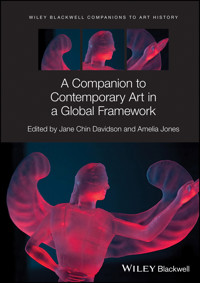
Cover Image: © Raqs Media Collective, Pamphilos, 2019
Photo Credit: Georges Salameh and Fast Forward Festival, Athens
Cover Design: Wiley
Set in 10/12.5pt Galliard by Integra Software Services Pvt. Ltd, Pondicherry, India
Contents
Cover
Series Page
Title Page
Copyright Page
List of Illustrations
Series Editor’s Preface
About the Editors
Notes on Contributors
Editors’ Acknowledgments
Introduction: The Eurocentrism of Contemporary Art, Staging the Project
Part I Decades
1980–1990
1 I Live in the Fourth Dimension When I Create Landscapes: Artist Statement
2 Seeing Beyond East/West Divides: Contemporary Art in and Around 1980s China
1990–2000
3 Is There a Line that Connects All Things? Artist Statement
4 Why Contemporary Art Is Post-Soviet
2000–2010
5 Art and Politics: Artist Statement
6 Māori and Pacific Art at the Turn of a New Millennium
2010–2020
7 Art for Abolition: Artist Statement
8 Situating African Diasporic Art
Part II Themes
Institutions/Ontology
9 “The Whole World in his Hands”: A Decolonial Approach to European Concepts of Art
10 PEDAGOGY The Blank Canvas and Other Myths
11 CRAFT Craft and the Making of “Global” Contemporary Art
12 PERFORMANCE Dreams and Visions in the Interval
13 EMBODIMENT/MATERIALITY Love Songs (to End Hetero-Patriarchal, Settler-Colonial, Extractivism)
Politics/Public Sphere
14 REVOLUTION Revolution is a Circle
15 ART AND ITS MARKETPLACES It Was a Small World, After All
16 PUBLIC SPHERES The Politics of Public Space in Postrevolutionary Iran
17 (ANTI-)CAPITALISM The Imminent Promise and Fear of a Getaway Car
18 ENVIRONMENT Envisioning a More Just Future: Feminist Activist Art, Climate Change, and the Anthropocene
Identity/Subjectivity
19 INDIGENEITY Global Futurisms: Prophetic Practices of Reclamation, Liberation, and Transcendence
20 DIASPORA Transnational Collectivities of Solidarity and Affect
21 GENDER/SEXUALITY Performing the Intersection: Camp and the “Cat Lady”
22 RACE/ETHNICITY Three Forms of Appropriation: Carrie Mae Weems, Glenn Ligon, and Nao Bustamante
23 DISABILITY Disability Justice, Community, and Performance
Methods/Theories
24 POSTCOLONIAL/DECOLONIAL Post-/Anti-/Neo-/De- Colonial Theories and Visual Analysis
25 MARXISM/POST-MARXISM History, Marxism, Reality, and Utopia: The Bishan Project in China (2010–2016)
26 CRITICAL RACE THEORY “The Blast Work”: Situating Critical Race Theory in Contemporary Art and Curatorial Practice
27 POSTSTRUCTURALISM/POSTMODERNISM/POSTCOLONIALISM Mapping Poststructuralism, Postmodernism, and Postcolonialism
28 GENDER/SEX THEORY Feminist/Queer/Trans Theory and Trans Embodied Methodologies in Contemporary Art: An Intergenerational Dialogue on the Page
29 PERFORMANCE THEORY The “Studies Protocols” of Performance Studies
Technology/Media
30 INTERNET “Bias Is Not a Bug. It's a Feature”: An Interview with Hito Steyerl on Representation in the Digital Age
31 SOCIAL MEDIA Why Is It So Hard to Look the Other in the Eye? The Selfie and its Discontents
32 ALGORITHM Algorithms in Global Art and Visual Culture
Exhibition/Collecting/Archive
33 MUSEUM Time, Love, and the Museum
34 BIENNIAL/ART FAIR Biennial as a Discursive Political System for Contemporary Art
35 CURATING In Residence, Incarcerated Regina José Galindo's America's Family Prison
36 COLLECTING The World Should Collect Itself: Collecting Art Globally (and Other Predicaments)
37 ARCHIVE Ghosts in the Archive: Exorcism, Resurrection and the Possibilities of Repair
Index
End User License Agreement
List of Illustrations
CHAPTER 00
Figure I.1 Map showing Vienna...
Figure I.2 Leon Battisti Alberti’s...
CHAPTER 01
Figure 1.1 Senga Nengudi,...
Figure 1.2 Senga Nengudi,...
CHAPTER 02
Figure 2.1 Huang Yong Ping,...
Figure 2.2 Xiao Lu firing a...
CHAPTER 03
Figure 3.1 Sutapa Biswas,...
Figure 3.2 Sutapa Biswas,...
CHAPTER 04
Figure 4.1 Evgeny Yufit, director,...
Figure 4.2 3rd Floor, Hail to the...
Figure 4.3 Mher Azatyan, Untitled...
CHAPTER 05
Figure 5.1 Tania Bruguera...
CHAPTER 06
Figure 6.1 Mahuika, 2001,...
Figure 6.2 Greg Semu,...
CHAPTER 07
Figure 7.1 Patrisse Cullors,...
CHAPTER 08
Figure 8.1 Freestyle: The Studio...
CHAPTER 09
Figure 9.1 Georgius Braun...
Figure 9.2 Kent Monkman,...
CHAPTER 10
Figure 10.1 Dewey Crumpler,...
Figure 10.2 Dewey Crumpler,...
CHAPTER 11
Figure 11.1 Jakkai Siributr,...
Figure 11.2 Jakkai Siributr,...
CHAPTER 12
Figure 12.1 Ernest Cole, During...
Figure 12.2 Medu Art Ensemble,...
Figure 12.3 Paul Stopforth,...
CHAPTER 13
Figure 13.1 Peter Morin, Cultural Graffiti:...
Figure 13.2 Peter Morin and Jimmie Kilpatrick,...
Figure 13.3 Peter Morin and Jimmie Kilpatrick,...
CHAPTER 14
Figure 14.1 Fernando Leal, The Dancers of Chalma,...
Figure 14.2 Didier William, Nou poko rive,...
CHAPTER 15
Figure 15.1 Art Worker’s Coalition...
Figure 15.2 Javits Center, New York, 2021...
CHAPTER 16
Figure 16.1 Martyrdom mural depicting...
Figure 16.2 (Option A): Two memorials...
Figure 16.3 War tourists visiting the...
CHAPTER 17
Figure 17.1 Raqs Media Collective,...
Figure 17.2 Raqs Media Collective,...
CHAPTER 18
Figure 18.1 Molly Crabapple,...
Figure 18.2 Molly Crabapple,...
Figure 18.3 Wit and Wisdom, ...
CHAPTER 19
Figure 19.1 Timotéo Montoya,...
Figure 19.2 Cannupa Cannupa Hanska...
CHAPTER 20
Figure 20.1 Nil Yalter, Exile...
Figure 20.2 Güneş Terkol,...
CHAPTER 21
Figure 21.1 Kristina Wong as the Cat...
Figure 21.2 Kristina Wong, returning...
Figure 21.3 Tina Fey, Margaret Cho,...
CHAPTER 22
Figure 22.1 Carrie Mae Weems, Carrie...
Figure 22.2 Glenn Ligon, Notes on the...
Figure 22.3 Nao Bustamante, publicity...
CHAPTER 23
Figure 23.1 Rodney Bell, Wheelchair...
Figure 23.2 Nomy Lamm, Wall of Fire,...
CHAPTER 24
Figure 24.1 Asad Faulwell, Les Femmes D’Alger...
Figure 24.2 Quinsy and Jörgen Gario, How to...
Figure 24.3 Okciyapi, 2021, pre-cast engraved...
CHAPTER 25
Figure 25.1 Ou Ning, Bishan Commune: How...
Figure 25.2 The villagers came to the School...
CHAPTER 26
Figure 26.1 Aaron Douglas, An Idyll of the Deep...
Figure 26.2 Kelli Morgan and her mother Marlene...
Figure 26.3 Latanya Autry and Mike Murawski’s...
CHAPTER 28
Figure 28.1 Travis Alabanza, Burgerz, performance...
Figure 28.2 Travis Alabanza, Burgerz, performance...
CHAPTER 30
Figure 30.1 Hito Steyerl, The City of Broken Windows...
Figure 30.2 Hito Steyerl, How Not to Be Seen:...
CHAPTER 31
Figure 31.1 Vivian Fu, Self Portrait In Airplane...
Figure 31.2 Vivian Fu, Self Portrait In Bathroom,...
Figure 31.3 Vivian Fu, Self Portrait in Bathroom,...
CHAPTER 32
Figure 32.1 White Collar Crime Risk Zones,...
Figure 32.2 The Portrait of Edmond de Belamy,...
CHAPTER 33
Figure 33.1 Lava Thomas,...
Figure 33.2 Alfredo Jaar,...
CHAPTER 34
Figure 34.1 Taring Padi,...
Figure 34.2 Taring Padi,...
Figure 34.3 Michel Lafleur...
CHAPTER 35
Figure 35.1 Installation view...
Figure 35.2 Regina José Galindo,...
Figure 35.3 Regina José Galindo,...
CHAPTER 36
Figure 36.1 Pablo Helguera,...
Figure 36.2 Pablo Helguera,...
Guide
Cover
Series Page
Title Page
Copyright Page
Table of Contents
List of Illustrations
Series Editor’s Preface
About the Editors
Notes on Contributors
Editors’ Acknowledgments
Begin Reading
Index
End User License Agreement
Pages
i
ii
iii
iv
v
vi
vii
viii
ix
x
xi
xii
xiii
xiv
xv
xvi
xvii
xviii
xix
xx
xxi
xxii
xxiii
xxiv
xxv
xxvi
xxvii
xxviii
1
2
3
4
5
6
7
8
9
10
11
12
13
14
15
16
17
18
19
20
21
22
23
24
25
26
27
28
29
30
31
32
33
34
35
36
37
38
39
40
41
42
43
44
45
46
47
48
49
50
51
52
53
54
55
56
57
58
59
60
61
62
63
64
65
66
67
68
69
70
71
72
73
74
75
76
77
78
79
80
81
82
83
84
85
86
87
88
89
90
91
92
93
94
95
96
97
98
99
100
101
102
103
104
105
106
107
108
109
110
111
112
113
114
115
116
117
118
119
120
121
122
123
124
125
126
127
128
129
130
131
132
133
134
135
136
137
138
139
140
141
142
143
144
145
146
147
148
149
150
151
152
153
154
155
156
157
158
159
160
161
162
163
164
165
166
167
168
169
170
171
172
173
174
175
176
177
178
179
180
181
182
183
184
185
186
187
188
189
190
191
192
193
194
195
196
197
198
199
200
201
202
203
204
205
206
207
208
209
210
211
212
213
214
215
216
217
218
219
220
221
222
223
224
225
226
227
228
229
230
231
232
233
234
235
236
237
238
239
240
241
242
243
244
245
246
247
248
249
250
251
252
253
254
255
256
257
258
259
260
261
262
263
264
265
266
267
268
269
270
271
272
273
274
275
276
277
278
279
280
281
282
283
284
285
286
287
288
289
290
291
292
293
294
295
296
297
298
299
300
301
302
303
304
305
306
307
308
309
310
311
312
313
314
315
316
317
318
319
320
321
322
323
324
325
326
327
328
329
330
331
332
333
334
335
336
337
338
339
340
341
342
343
344
345
346
347
348
349
350
351
352
353
354
355
356
357
358
359
360
361
362
363
364
365
366
367
368
369
370
371
372
373
374
375
376
377
378
379
380
381
382
383
384
385
386
387
388
389
390
391
392
393
394
395
396
397
398
399
400
401
402
403
404
405
406
407
408
409
410
411
412
413
414
415
416
417
418
419
420
421
422
423
424
425
426
427
428
429
430
431
432
433
434
435
436
437
438
439
440
441
442
443
444
445
446
447
448
449
450
451
452
453
454
455
456
457
458
459
460
461
462
463
464
465
466
467
468
469
470
471
472
473
474
475
476
477
478
479
480
481
482
483
484
485
486
487
488
489
490
491
492
493
494
495
496
497
498
499
500
501
502
503
504
505
506
507
508
509
510
511
512
513
514
515
516
517
518
519
520
521
522
523
524
525
526
527
528
529
530
531
532
533
534
535
536
537
538
539
540
541
542
543
544
545
546
547
548
549
550
551
552
553
554
555
556
557
558
559
List of Illustrations
FIGURE I.1 Map showing Vienna city plan with Museum of Natural History and Museum of Art, Vienna (Naturhistorisches Museum Wien, built 1872–1889, and Kunsthistorisches Museum Wien, built 1871–1891), facing across the Maria-Theresa Place; both museums hold the former Hapsburg collections of the Austro-Hungarian Empire. Maps Data: Google LLC.
FIGURE I.2 Leon Battisti Alberti’s grid as described in his 1435 treatise On Painting, as visualized by Robert Fludd in 1617. World History Archive / Alamy Stock Photo.
FIGURE 1.1 Senga Nengudi, R.S.V.P. Reverie A, 2011; nylon mesh and metal. World History Archive / Alamy Stock Photo. Huggins Family Collection, photograph by Amelia Jones. As displayed at Art + Practice, Los Angeles, 2018.
FIGURE 1.2 Senga Nengudi, Blossom, 2014, DETAIL; nylon mesh and metal. Courtesy of the artist, photograph by Amelia Jones. As displayed at Fisher Gallery, University of Southern California, Los Angeles, 2018.
FIGURE 2.1 Huang Yong Ping, The History of Chinese Painting and the History of Modern Western Art Washed in the Washing Machine for Two Minutes, 1987/1993. Courtesy of Huang Shen Yuan and Estate of Huang Yong Ping.
FIGURE 2.2 Xiao Lu firing a gun at her art installation Dialogue, at the China Avant-Garde art exhibition, 1989. Courtesy of artist and Wen Pulin, Archive of Chinese Avant-Garde Art.
FIGURE 3.1 Sutapa Biswas, Synapse II, 1987–1992. Hand-printed black and white photograph (two part work), 1120 × 1300 millimeters each. © Sutapa Biswas. All Rights Reserved, DACS 2022.
FIGURE 3.2 Sutapa Biswas, Lumen, 2021. Production Still. Colour C-Type print, 918 × 1350 millimeters. © Sutapa Biswas. All Rights Reserved, DACS 2022.
FIGURE 4.1 Evgeny Yufit, director, Daddy, Father Frost is Dead, 1991 (1 hour 13 minutes), film still. Courtesy of Timothy Yufit.
FIGURE 4.2 3rd Floor, Hail to the Union of Artists from the Netherworld: Official Art Has Died, 1988. Documentation of the happening. Courtesy of Arman Grigoryan.
FIGURE 4.3 Mher Azatyan, Untitled Photograph # 29 and “Free Text,” 2000–2014 (22.5 × 45 centimeters). Courtesy of Mher Azatyan.
FIGURE 5.1 Tania Bruguera and Anri Sala (2005) Cátedra Arte de Conducta (Behavior Art School), Havana, Cuba. July 15, 2017, 923 × 692 [SYMPOSIUM] BOOK CLUB. Courtesy of Tania Bruguera & Anri Sala.
FIGURE 6.1 Mahuika, 2001, Lisa Reihana (Ngā Puhi, Ngāti Hine, Ngāi Tūteaurum Ngāi Tūpoto), C-type print, 1190 × 1990 millimeters. Auckland Art Gallery, 2002/3/5 Image. Courtesy of the artist.
FIGURE 6.2 Greg Semu, The Battle of the Noble Savage. ©Musèe Quai Branly and Greg Semu. 2007.
FIGURE 7.1 Patrisse Cullors, Prayer to the Iyami For Allegories of Flight, The BroadYear: 2020. Image credit: Giovanni Solis.
FIGURE 8.1 Freestyle: The Studio Museum in Harlem, 2001, Exhibition Catalogue cover. Gallery Association of New York State.
FIGURE 9.1 Georgius Braun and Franz Hogenberg, Mexico and Cuzco, Civitates Orbis Terrarum, engraving and etching. Antwerp: G. Van den Rade, 1575. Courtesy of the John Carter Brown Library / CC BY 4.0.
FIGURE 9.2 Kent Monkman, Miss Chief: Justice of the Piece, performance, Friday, 4 February 2012, Smithsonian’s National Museum of The American Indian, Washington, D.C Miss Chief Eagle Testickle holds court in a performance introducing her new inclusive nation, the Nation of Miss Chief, where she deconstructs issues of blood quantum, race, and tribal enrollment. Photo Katherine Fogden, NMAI. See performance documentation via Vtape: TAPECODE 672.11 at https://www.kentmonkman.com, accessed on 14 June 2022.
FIGURE 10.1 Dewey Crumpler, Re-making Aesthetics Through Dis/Embodiment, 1999, acrylic and collage on canvas (12 × 12 inches). Courtesy of the artist and Cushion Works, San Francisco.
FIGURE 10.2 Dewey Crumpler, 20th Century Fountain, 2020, acrylic and collage on canvas (20 × 24 inches). Courtesy of the artist and Cushion Works, San Francisco.
FIGURE 11.1 Jakkai Siributr, 78, 2014, mobile room installation: steel, scaffolding, bamboo, textiles, kurta, threads, and brass-coil embroidery (350 × 350 × 350 centimeters, including wheels). Collection of MAIIAM Contemporary Art Museum. Smit Na Nakornpanom.
FIGURE 11.2 Jakkai Siributr, Blind Faith, 2019, military uniforms, amulets, glass beads, crochet. Courtesy of the artist. Chanupat Boonwong / Courtesy of Jakkai Siributr.
FIGURE 12.1 Ernest Cole, During Group Examination, the Nude Men are Herded Through a String of Doctors’ Offices, 1967. Photograph by Ernest Cole’s.
FIGURE 12.2 Medu Art Ensemble, Support the Cultural Boycott, 1982. Judy Ann Seidman/The Art Institute of Chicago/ART RESOURCE.
FIGURE 12.3 Paul Stopforth, Freedom Dancer, 1993. Courtesy of Paul Stopforth.
FIGURE 13.1 Peter Morin, Cultural Graffiti: A Tahltan NDN Declares War on the British Monarchy, Buckingham Palace, London England, 2013. Ashok Mathur.
FIGURE 13.2 Peter Morin and Jimmie Kilpatrick, Love Songs to End Colonization album cover, 2022. Ashok Mathur.
FIGURE 13.3 Peter Morin and Jimmie Kilpatrick, Love Songs to End Colonization; t-shirts available in exchange for participation in the performance action, 2022. T- shirt artwork by Veronica Wachter. Photo by Mika Abbott.
FIGURE 14.1 Fernando Leal, The Dancers of Chalma, 1922–1923. Encaustic (approximately 437 square feet (40.6 m²)). Antiguo Colegio de San Ildefonso (formerly Escuela Nacional Preparatoria), Universidad Nacional Autónoma de México, Mexico City. Fernando Leal Audirac.
FIGURE 14.2 Didier William, Nou poko rive, men y ap tann nou, 2018. Collage, acrylic, wood carving on panel (64 × 90 inches (162.6 × 228.6 centimeters)). Courtesy of Didier William.
FIGURE 15.1 Art Worker’s Coalition. Flier for protest at The Museum of Modern Art garden at 3:00, Sunday, March 30, 1969, 11 × 8 ½ inches (27.9 × 21.6 centimeters). Alfred H. Barr, Jr. Papers, I.A.536. Archives. Location: The Museum of Modern Art/New York, NY/USA. Digital Image © The Museum of Modern Art / Licensed by SCALA.
FIGURE 15.2 Javits Center, New York, 2021. Casey Kelbaugh / Courtesy of The Armory Show.
FIGURE 16.1 Martyrdom mural depicting a 12-year-old boy soldier facing Iraqi tanks while Ayatollah Khomeini is hovering above him. Sponsored by the Foundation of Martyrs, central Tehran, ca. 1988. Photo: author, 1993.
FIGURE 16.2 (Option A): Two memorials on the grounds of Behesht-e Zahra Cemetery commemorating the martyrdom of Iranians during the Iran–Iraq War, in Ray, southern Tehran, the late 1990s. Photo: author, 1997.
FIGURE 16.3 War tourists visiting the Shalamcheh Martyrs Memorial, west of Khoramshahr on the Iraqi border, near Basra. Sonia Sevilla/Wikimedia Commons.
FIGURE 17.1 Raqs Media Collective, The Capital of Accumulation, 2010. Diptych video still. NEW.
FIGURE 17.2 Raqs Media Collective, Strikes at Time, 2011. Production still. NEW.
FIGURE 18.1 Molly Crabapple, “We Can Be Whatever We Have the Courage to See” (2019), still from a painting from the collaborative animated film by Boekbinder and Batt, A Message from the Future with Alexandria Ocasio-Cortez, 2019. Boekbinder and Batt 2019 / with permission from Future with Alexandria Ocasio-Cortez.
FIGURE 18.2 Molly Crabapple, “Years of Repair” (2020), still from a painting from the collaborative animated film, Message from the Future II: The Years of Repair. Molly Crabapple.
FIGURE 18.3 Wit and Wisdom, “Heart Disease, Heart Attacks, Strokes,” 2021, still from a drawing from the collaborative animated film by Wit and Wisdom and the Global Climate and Health Alliance. Courtesy of Lisa Bloom.
FIGURE 19.1 Timotéo Montoya, T’a’jaazhee Doodaastsadah Da’didlo (Vulture Death Dance), 2021. This is a frame captured from a live multimedia concept performance titled Ancestraplex 15462. In this piece, the T’a’jaazhee Doodaastsadah Da’didlo is conducted to upload the memory:spirits of the recently deceased to the Ancestraplex, an indestructible repository of ancestral knowledge and wisdom only accessible by their decedents. This piece explores how technologies can be used to maintain epistemologies and generational knowledge, ensuring its safety from apocalypse or decay. Courtesy of Timoteo Montoya.
FIGURE 19.2 Cannupa Cannupa Hanska Luger—“Future Ancestral Technologies: We Survive You,” billboard, Mandan, ND, 2021. For Landback.art, in Collaboration with NDN Collective, INDÍGENA, For Freedoms. This billboard by Hanska Luger, an enrolled member of the Three Affiliated Tribes of Fort Berthold (Mandan, Hidatsa, Arikara, and Lakota), features images of his “Future Ancestral Technology” textile and regalia work which focuses on exploring methodologies of “future dreaming” through Indigenous Science Fiction works that seek to develop sustainable technologies. The text, “We Survive You,” highlights the survivance of Indigenous peoples beyond apocalypse. Courtesy of Freedoms and Cannupa Hanska Luger / Photograph by Justin Deegan and Gabe Fermin.
FIGURE 20.1 Nil Yalter, Exile is a Hard Job (Walls VII). Posters in the streets of Cologne, Germany, 2019. Artist is seen in the making of the work.
FIGURE 20.2 Güneş Terkol, Good Days, sewing on fabric, fifteen pieces, 2017 (115 × 199 centimeters), Istanbul. Co-makers: Halud Eşram, Abir Elhaddad, Huda Altozary, Amira Almohammad, Sabah Şeyhoğlu, Ghalya Bakhash, Seham Abo Shhab, Hevin Hamas’i, Eman Almasrı, Mezgin Maho, Kelsum Reşid, Meryem Tomak, Gayem Bayır, Latife Hamdaş, and Manar Kırayem. Courtesy of Güneş Terkol.
FIGURE 21.1 Kristina Wong as the Cat Lady and Barbie-Q as Oliver in the play Cat Lady, 2011, Diverseworks, Houston, screenshot of performance document. Courtesy of Kristina Wong.
FIGURE 21.2 Kristina Wong, returning to the live performance, Wong transfers Wolf’s pussy fetish to her own cat fetish, in the play Cat Lady, 2011, Diverseworks, Houston, screenshot of performance document. Courtesy of Kristina Wong.
FIGURE 21.3 Tina Fey, Margaret Cho, and Amy Poehler during the seventy-second annual Golden Globe Awards. Screenshot of video in public domain.
FIGURE 22.1 Carrie Mae Weems, Carrie Mae Weems, Untitled (Black and Tanned) from the From Here I Saw What Happened and I Cried series, 1995, C-print with sandblasted text on glass (26 1/2 × 22 1/4 inches). Carrie Mae Weems.
FIGURE 22.2 Glenn Ligon, Notes on the Margin of the Black Book, 1991–1993, as installed for Moving Pictures, June 28, 2002–January 12, 2003. Offset prints and text. Ninety-one offset prints, framed (11 1/2 × 11 1/2 inches (29.2 × 29.2 cm) each); seventy-eight text pages, framed (5 1/4 × 7 1/4 inches (13.3 × 18.4 cm) each). David Heald / The Solomon R. Guggenheim Museum/New York, NY. Artwork © Glenn Ligon.
FIGURE 22.3 Nao Bustamante, publicity photograph for Silver and Gold, 2009. Artwork © Nao Bustamante. Photo by Eleanor Goldsmith. Nao Bustamante (Chapter Author).
FIGURE 23.1 Rodney Bell, Wheelchair Suspension, 2022, performance. A tanned Maori wheelchair user hangs above stage against a blue background. Their body grips onto a suspension rope that is attached to their wheelchair. They are shirtless, wearing black pants and shoes, exposing a tattoo on their back as well as their face. Photograph by Richard Downing and Courtesy of Sins Invalid.
FIGURE 23.2 Nomy Lamm, Wall of Fire, 2022, performance. A black and white picture of a white Jewish amputee with curly hair sitting on a box on stage. They sit next to a table, their prosthetic leg resting on the floor, next to a microphone. They are wearing black and white knee-high socks as well as a form fitting dress with off the shoulder sleeves. In the background, orb shaped lights float. Photograph by Richard Downing and Courtesy of Sins Invalid.
FIGURE 24.1 Asad Faulwell, Les Femmes D’Alger #3, 2011, acrylic and paper on canvas, 64 × 48 inches. Courtesy of artist.
FIGURE 24.2 Quinsy and Jörgen Gario, How to See the Spots of Der Leopard, 2020, performance in front of monument to Jacob Kettler. Photography by Annemarija Gulbe. Courtesy of the artists.
FIGURE 24.3 Okciyapi, 2021, pre-cast engraved concrete, enameled metal panels, script and audio Dakota language, medicinal plants native to Minnesota, water vessel. Annemarija Gulbe.
FIGURE 25.1 Ou Ning, Bishan Commune: How to Start Your Own Utopia, 2010, Moleskine sketchbook, 108 pages (13 × 21 centimeters), heavy acid-free paper. Courtesy of Moleskine Foundation.
FIGURE 25.2 The villagers came to the School of Tiller for the film screening. Photo by Zhu Rui, 2015.
FIGURE 26.1 Aaron Douglas, An Idyll of the Deep South from his “Aspects of Negro Life” series, 1934, at the Schomberg Center, New York. Everett Collection Inc / Alamy Images.
FIGURE 26.2 Kelli Morgan and her mother Marlene Smith in their living room circa 1992. Thomas Hart Benton’s lithograph, Instruction, 1940, is on the wall in the far left-hand corner. Courtesy of Marlene Smith.
FIGURE 26.3 Latanya Autry and Mike Murawski’s “Museums Are Not Neutral” T-shirt campaign, 2017. MUSEUMS ARE NOT NEUTRAL.
FIGURE 28.1 Travis Alabanza, Burgerz, performance still, October 25, 2018, Hackney Showroom, London. Courtesy of Holly Revell.
FIGURE 28.2 Travis Alabanza, Burgerz, performance still, Oct 25, 2018. Hackney Showroom, London. Courtesy of Holly Revell.
FIGURE 30.1 Hito Steyerl, The City of Broken Windows, 2018. Video installation, environment Broken Windows, 2018: single channel HD video, color, sound, 6 minutes 40 seconds. Unbroken Windows, 2018: single channel HD video, color, sound, 10 minutes. Environment: broken glass window, painted plywood panels, vinyl lettering, wood easels. Installation view from Castello di Rivoli, Torino, 2019. Toni Pape (2017) / Taylor & Francis Group / CC BY 4.0; Courtesy of the Artist, Hito Steyerl, Andrew Kreps Gallery, New York and Esther Schipper, Berlin.
FIGURE 30.2 Hito Steyerl, How Not to Be Seen: A Fucking Didactic Educational .MOV File, 2013 HD video, single screen in architectural environment, 15 minutes, 52 seconds. Toni Pape (2017) / Taylor & Francis Group / CC BY 4.0; Courtesy of the Artist, Hito Steyerl, Andrew Kreps Gallery, New York and Esther Schipper, Berlin.
FIGURE 31.1 Vivian Fu, Self Portrait In Airplane Bathroom, Somewhere Over the Pacific Ocean, October 2012. Posted on Tumblr © Vivian Fu.
FIGURE 31.2 Vivian Fu, Self Portrait In Bathroom, Inner Richmond, April 2013. Posted on Tumblr © Vivian Fu.
FIGURE 31.3 Vivian Fu, Self Portrait in Bathroom, Mission, August 2013. Posted on Tumblr © Vivian Fu.
FIGURE 32.1 White Collar Crime Risk Zones, 2017 by Sam Levigne, Brian Clifton, and Francis Tseng. The New Inquiry Magazine, Vol. 59: Abolish / https://whitecollar. thenewinquiry.com / last accessed March 15, 2023.
FIGURE 32.2 The Portrait of Edmond de Belamy, 2018 by the Paris-based art-collective, Obvious. Edmond de Belamy / Wikimedia Commons / Public Domain.
FIGURE 33.1 Lava Thomas, Solidarity Redux: Black Lives Matter, 2022. Still from video; black and white, sound, thirty-six minutes. Courtesy of Lava Thomas.
FIGURE 33.2 Alfredo Jaar, The Geometry of Conscience, 2010. Courtesy of Alfredo Jaar.
FIGURE 34.1 Taring Padi, People’s Justice, banner (60 feet), 2002. “Monument of Mourning” June 20, 2022, covered by documenta organizers after censorship by German administration. Photo courtesy of Taring Padi.
FIGURE 34.2 Taring Padi, Sekarang Mereka, Besok Kita (Today They Come for Them, Tomorrow They Come for Us), 2021, acrylic on canvas (8 × 8 feet). David Davidson (Author).
FIGURE 34.3 Michel Lafleur and Tom Bogaert, Famasi Mobil Kongolè, 2019–2022 (80 × 60 × 40 centimeters) (blue)—(150 × 60 × 30 centimeters) (Yellow) (70 × 40 × 40 centimeters) (red)—(180 × 50 × 30 centimeters) (white) electric lights, Congo blue filter sheets, hand painted cardboard, plastic buckets, multicolored pills, rubber bands and pairs of scissors. Installed in the side chapel of entrance hall in St. Kunigundis church. David Davidson (Author).
FIGURE 35.1 Installation view of Regina José Galindo’s America’s Family Prison at Artpace, San Antonio, Texas, 2008. Courtesy of the Artpace, San Antonio, and Proyectos Ultravioleta, Guatemala City.
FIGURE 35.2 Regina José Galindo, America’s Family Prison, llave de prisión familiar, 2008. Photo: Karmadavis. Courtesy of the Artpace, San Antonio, and Proyectos Ultravioleta, Guatemala City.
FIGURE 35.3 Regina José Galindo, America’s Family Prison, 2008. Video (color, silent), 54 minutes 49 seconds. Courtesy of the Artpace, San Antonio, and Proyectos Ultravioleta, Guatemala City.
FIGURE 36.1 Pablo Helguera, Untitled (from the series Artoons, 2008–). Courtesy of Pablo Helguera.
FIGURE 36.2 Pablo Helguera, Untitled (from the series Artoons, 2008–). Courtesy of Pablo Helguera
Series Editor’s Preface
Wiley Blackwell’s Companions to Art History is a series of edited collections designed to cover the discipline of art history in all its complexities. Each volume is edited by specialists who lead a team of essayists, representing the best of leading scholarship, in mapping the state of research within the sub-field under review, as well as pointing toward future trends in research.
A Companion to Contemporary Art in a Global Framework offers an innovative and insightful consideration of the ways specialists and institutions in the fine arts, curation, cultural studies, and art history have attempted to situate art in a more globalized framework since the 1980s. The chapters combine to show the ways in which we can revise established Western definitions of ‘art’ in order to conceptualize it as a global phenomenon.
The volume is divided into three sections, with the first reviewing the history of the visual arts since 1980 alongside introducing new ways of thinking that seek to place contemporary art in a global framework. The second section traces the progression of recent developments in the art world, focusing on the historical and cultural contexts surrounding efforts to globalize the frames through which both the art world and the visual arts are conceived. The final section addresses a wide range of key themes, such as the fundamental institutions and ontologies of art practice, as well as the interactions among art, politics, and the public sphere. Together, these essays combine to provide a novel and thought-provoking revision of our conception and understanding of contemporary art in a global framework that will be essential reading for students, researchers and teachers working on the history, theory and practice of contemporary art.
A Companion to Contemporary Art in a Global Framework is a very welcome and timely addition to the series.
Dana Arnold, 2023
About the Editors
Jane Chin Davidson is an art historian who researches transnationalism, Chinese identity, feminism/eco-feminism, performance/performativity, and global exhibitions of contemporary art as Professor of Art History/Global Cultures at California State University, San Bernardino. Author of the monograph Staging Art and Chineseness: Politics of Trans/Nationalism and Global Expositions (2020) and co-editor of Global and World Art in the Practice of the University Museum (2017) and of a special journal issue “Okwui Enwezor: the Art of Curating,” NKA Journal of Contemporary African Art (May 2021), she has served on three editorial boards including Art Journal (2017–2021). Her professional awards include her stint as 2022 Fellow at the Institute of Advanced Studies, Loughborough University.
Amelia Jones is Robert A. Day Professor and Vice Dean at Roski School of Art & Design, University of Southern California, Los Angeles. Publications include Seeing Differently: A History and Theory of Identification and the Visual Arts (2012) and Otherwise: Imagining Queer Feminist Art Histories, co-edited with Erin Silver (2016). The catalogue Queer Communion: Ron Athey (2020), co-edited with Andy Campbell, and which accompanied a retrospective of Athey’s work at Participant Inc. (New York) and ICA (Los Angeles), was listed among the “Best Art Books 2020” in The New York Times, and the exhibition was listed among Top Ten 2021 exhibitions in Artforum (December 2021). Her book entitled In Between Subjects: A Critical Genealogy of Queer Performance was published in 2021 by Routledge Press.
Notes on Contributors
Nana Adusei-Poku PhD, is Assistant Professor in African Diasporic Art History in the Department of History of Art at University of California, Berkeley. She was previously Associate Professor and Luma Foundation Fellow at the Center for Curatorial Studies, Bard College, New York. Her book Taking Stakes in the Unknown: Tracing Post-Black Art was published in 2021 and her articles have been published in Nka: Journal of Contemporary African Art, e-flux, Kunstforum International, Flash Art, L’Internationale, and darkmatter. She curated the event Performances of Nothingness (Academy of Arts, Berlin, 2018) and the exhibition Black Melancholia (Hessel Museum, Bard College, 2022).
April Baca (xe/xem) is a Los Angeles-based writer, educator, and curator. Baca currently facilitates courses as a lecturer in Art History at California State University, San Bernardino (CSUSB). Baca’s research focuses on contemporary visual media with an emphasis on queer Latina ontologies and digital forums for connection, community, and pleasure. Xe has published in myriad scholarly journals and art publications including Art Journal, The Journal of Curatorial Studies, and X-TRA. Baca holds a BA in Art History (CSUSB, 2016), an MA in Curatorial Practices and the Public Sphere (University of Southern California, 2018) and is currently pursuing a PhD in Cinema and Media Studies at UCLA.
Sutapa Biswas was born in India and educated in the UK since the age of four. She graduated with a BA in Fine Art with Art History from the University of Leeds in 1985. She completed her postgraduate degree at the Slade School of Art in 1990 and was a research student at the Royal College of Art. Biswas has been recipient of the Yale Centre for British Art Visiting Scholars Award 2019–2020 (Yale University), The Art Fund 2019 Award (United Kingdom), the Correnah W. Wright Endowment Fund, The National Endowment for the Arts Award (1994), and was nominated for a Deutsche Bank European Photography Award in 1992. Biswas’s art works are represented in collections including TATE (UK), the Government Art Collection UK, Reed Gallery (USA), Sheffield Museums and Art Galleries (UK).
Lisa E. Bloom is the author of many feminist books and articles in art history, visual culture, and cultural studies including With Other Eyes: Looking at Race and Gender in Visual Culture, editor (1999) and Jewish Identities in U.S. Feminist Art: Ghosts of Ethnicity (2006). Her latest book, Climate Change and the New Polar Aesthetics: Artists Reimagine the Arctic and Antarctic was published in 2022. She is currently at the University of California, Berkeley, as a research scholar at the Beatrice Bain Center in the Department of Gender and Women’s Studies.
Tania Bruguera was born in Havana in 1968. She received a BFA in fine art from Escuela de Arte San Alejandro, Havana, in 1987, an MFA in painting from the Instituto Superior de Arte, Havana, in 1992, and an MFA in performance from the School of the Art Institute of Chicago in 2001. She established and ran an alternative art school, the Cátedra Arte de Conducta (Department of Behavior Art), from 2002 to 2009. Bruguera choreographs performances that question the possibility of political representation and attempt to collapse the distance between art and life, eroding institutionalized injustice and prejudicial hierarchies in the process. Her large-scale, politically driven public performances such as Tatlin’s Whisper, have appeared at venues from Tate Modern (London) to the Havana Biennial, and Bruguera has had solo exhibitions as well at the Museo Nacional de Bellas Artes, Havana (2004); Neuberger Museum of Art, Purchase College, New York (2010); and Van Abbemuseum, Eindhoven, Netherlands (2013).
Andy Campbell PhD, is the author of Bound Together: Leather, Sex, Archives, and Contemporary Art (2020) and Queer X Design: 50 Years of Signs, Symbols, Logos, Banners, and Graphic Art of LGBTQ (2019). Together with Chelsea Weathers he co-edited the volume Jennifer West: Media Archaeology (2022) and with Amelia Jones co-edited Queer Communion: Ron Athey (2020). His writing has appeared in Artforum, GLQ, Dress, The Invisible Archive, and Turbo. He is currently working on a manuscript concerning the various ways poverty circumscribes artistic practices in the United States.
Joshua Chambers-Letson is Professor of Performance Studies and Asian American Studies at Northwestern University and author of After the Party: A Manifesto for Queer of Color Life (2018) and A Race So Different: Law and Performance in Asian America (2013). Chambers-Letson is co-editor of José Esteban Muñoz’s The Sense of Brown with Tavia Nyong’o and of Frances Ya-Chu Cowhig’s China Trilogy: Three Parables of Global Capital with Christine Moke; and series co-editor of New York University Press’s Sexual Cultures series with Tavia Nyong’o and Ann Pellegrini.
Jessi DiTillio is an independent curator and scholar based in Los Angeles and is a co-founding member of the feminist curatorial group Neon Queen Collective. She researches American art with a focus on BIPOC artists, affect theory, gender and sexuality, and contemporary art. She was a 2021–2022 fellow in publications at the Getty Research Institute and received a 2019–2020 Luce/ACLS American Art Dissertation Fellowship. She has worked in curatorial departments at the Jordan Schnitzer Museum of Art, the Visual Arts Center at University of Texas, Austin, the Art Galleries at Black Studies, and The Contemporary Austin.
Patrisse Cullors is a New York Times bestselling author, educator, artist, and abolitionist from Los Angeles, California. Co-founder and former Executive Director of the Black Lives Matter Global Network Foundation, Patrisse has been on the frontlines of abolitionist organizing for 20 years. Patrisse is also the faculty director of Arizona’s Prescott College, a new Social and Environmental Arts Practice MFA program, where she developed a curriculum focused on the intersection of art, social justice, and community organizing that is the first of its kind in the nation. As an artist and abolitionist, Patrisse teamed up with Noé Olivas and Alexandre Dorriz to serve as Co-Founder and Creative Director of the Crenshaw Dairy Mart, a reimagined art gallery and studio dedicated to shifting the trauma-induced conditions of poverty and economic injustice, bridging cultural work and advocacy, and investigating ancestries through the lens of Inglewood (Los Angeles) and its community.
Al-An deSouza is a California-based artist working across photography, installation, performance, text, and pedagogy. Their recent books include How Art Can Be Thought (2018), which examines art pedagogy and provides an analytical glossary of common terms used to discuss art, focusing on their current usage while considering how those terms may be adapted to new artistic and social challenges; Ark of Martyrs (2020), which is a polyphonic, dysphoric replacement of Joseph Conrad’s infamous Heart of Darkness. deSouza is represented by Talwar Gallery, NY and New Delhi, and is Professor of Art Practice at University of California, Berkeley.
Claire Farago is Professor Emerita at the University of Colorado Boulder and currently lives in Los Angeles. She has published widely on art theory and historiography, cultural exchange, the materiality of the sacred, the history of style, and museums and collecting practices, and is a specialist on the manuscripts of Leonardo da Vinci. Her anthology, Reframing the Renaissance (1995), is widely recognized as a groundbreaking contribution to art history. She is currently working on a book for a broad audience, provisionally titled Writing Borderless Histories of Art: Cultural Memory in the Era of Climate Crisis, forthcoming in 2023.
Tatiana Flores is Professor of Latino and Caribbean Studies and Art History at Rutgers, The State University of New Jersey. She authored the award-winning book Mexico’s Revolutionary Avant-Gardes: From Estridentismo to ¡30-30! (2013) and curated the critically acclaimed exhibition Relational Undercurrents: Contemporary Art of the Caribbean Archipelago (2017). Flores received the 2016 Arts Writers book prize from the Andy Warhol Foundation and has been a Getty Scholar and the Cisneros Visiting Scholar at the David Rockefeller Center for Latin American Studies at Harvard University. She is former president of the Association for the Study of the Arts of the Present (ASAP) and co-editor of the forthcoming volume The Routledge Companion to Decolonizing Art History.
Talinn Grigor is Professor of Art History in the Department of Art and Art History at the University of California, Davis. Her research focuses on nineteenth- and twentieth-century art and architectural histories through the framework of postcolonial and critical theories, grounded in Iran, Armenia, and Parsi India. Her books include Building Iran: Modernism, Architecture, and National Heritage under the Pahlavi Monarchs (2009); Contemporary Iranian Art: From the Street to the Studio (2014); and The Persian Revival: The Imperialism of the Copy in Iranian and Parsi Architecture (2021).
Angela Harutyunyan is Associate Professor of Art History at the American University of Beirut. She is editor of ARTMargins journal. She has curated several exhibitions, including This is the Time. This is the Record of the Time (with Nat Muller; 2014). Her monograph The Political Aesthetics of the Armenian Avant-garde: The Journey of the “Painterly Real”1987–2004 was published in 2017. She is founding member of BICAR (Beirut Institute for Critical Analysis and Research) and the Johannissyan Research Institute in the Humanities in Yerevan, Armenia.
Suzanne Hudson is an art historian and writer based in Los Angeles, where she teaches at the University of Southern California. Hudson’s scholarly work has been supported by the Center for Advanced Study in the Visual Arts (CASVA), Dedalus Foundation, Creative Capital | The Warhol Foundation for the Visual Arts, and the Andrew W. Mellon Foundation, among others. A longtime contributor to Artforum, she has contributed to numerous international publications and is the author of books including Robert Ryman: Used Paint (2009), Agnes Martin: Night Sea (2017), and Contemporary Painting (2021).
Shayda Kafai (she/her) is Assistant Professor of Gender and Sexuality Studies in the Ethnic and Women’s Studies Department at California State Polytechnic University, Pomona. As a queer, Mad, Iranian femme, she enacts the many ways we can reclaim our bodyminds from intersecting systems of oppression. To support this work as an educator-scholar, Shayda applies Disability Justice and collective care practices in the spaces she cultivates. Her writing and speaking presentations focus on intersectional body politics, particularly on how bodies are constructed and how they hold the capacity for rebellion. She is the author of Crip Kinship: The Disability Justice and Art Activism of Sins Invalid (2021).
Gary Kafer is a PhD candidate in the Department of Cinema and Media Studies at the University of Chicago. He works broadly in surveillance studies with interests in media aesthetics, biopolitics, contemporary art, and theories of race, gender, and sexuality. His work has appeared in Surveillance & Society, American Literature, qui parle, Digital Culture & Society, and Contemporaneity, as well as in the edited collection From Self-portraits to Selfie: Representing the Self in the Moving Image (2019). He is co-editor of a special issue of Surveillance & Society on “Queer Surveillance” (2019).
Ace Lehner is an interdisciplinary scholar and artist specializing in critical engagement with identity and representation; history, theory, and criticism of modern and contemporary art; queer and trans visual culture and theory; critical race studies; and photography history and theory. Lehner recently edited the book From Self-Portrait to Selfie: Contemporary Art and Self-Representation in the Social Media Age (2021). Their current book project is Trans Representations: Decolonizing Visual Theory in Contemporary Photography. Lehner holds a PhD in Visual Studies from the University of California, Santa Cruz, and an MFA from California College of the Arts. Lehner is Assistant Professor in Art and Art History at the University of Vermont.
Jenny Lin investigates contemporary art in transnational contexts. She is author of Above Sea: Contemporary Art, Urban Culture and the Fashioning of Global Shanghai and is working on a new book and exhibition: Another Beautiful Country: Moving Images by Chinese American Artists. Lin’s writings have appeared in Art Margins, ArtReview, Frieze, Flash Art, X-TRA, and numerous anthologies. She is Associate Professor and Director of the Curatorial Practices MA Program at University of Southern California. Lin received her MA and PhD in Art History from University of California, Los Angeles, and BA in Architectural Studies and Italian Studies from Brown University.
Natalie Loveless is Professor of Contemporary Art and Theory in the Department of Art & Design at the University of Alberta, located in (Amiskwacîwâskahikan) on Treaty Six territory, where she also directs the Research–Creation and Social Justice CoLABoratory. She is author of How to Make Art at the End of the World: A Manifesto for Research-Creation (2019), editor of Knowings and Knots: Methodologies and Ecologies in Research-Creation (2019), and co-editor of Responding to Site: The Performance Work of Marilyn Arsem (2020).
Timotéo I. Montoya II is an Indigenous Futurist writer and multimedia artist residing on the lands of the Tewa Peoples in Oga P’ogeh, currently known as Santa Fe, New Mexico. He is an enrolled member of the Lipan Apache Band of Texas. His work focuses on exploring and expanding the movement of Indigenous Futurism through praxis, theory, and art. He is also a metamodern myth mender, supporting individuals through a process of ecoliteracy, ancestral reclamation, and personal myth to help them contextualize their work, spiritual practice, and healing in a world in crisis.
Kelli Morgan is Professor of the Practice and the inaugural Director of Curatorial Studies at Tufts University. A curator, educator, and social justice activist, her scholarly commitment to the investigation of anti-Blackness within American art and visual culture has demonstrated how traditional art history and museum practice work specifically to uphold white supremacy. Besides her own curatorial experience, she mentors curators and frequently trains museum staff to foster anti-racist approaches in collection building, exhibitions, community engagement, and fundraising. She earned her PhD in Afro-American studies and a graduate certificate in museum studies from University of Massachusetts, Amherst, in 2017.
Gerardo Mosquera is a freelance curator, art critic and writer based in Havana and Madrid, advisor to the Rijksakademie van Beeldenden Kunsten, Amsterdam, and member of the advisory board of several art journals and art centers. He was a founder of the Havana Biennial, curator at the New Museum of Contemporary Art, New York, artistic director of PHotoEspaña, Madrid, and has curated many international biennials and exhibitions. Author of numerous texts and books on contemporary art and art theory, Mosquera has edited Beyond the Fantastic: Contemporary Art Criticism from Latin America (1995) and co-edited Over Here. International Perspectives on Art and Culture (2004).
Derek Conrad Murray is an interdisciplinary theorist specializing in the history, theory, and criticism of contemporary art and visual culture. He works in contemporary aesthetic and cultural theory with a particular attention to technocultural engagements with identity and representation. Murray is Professor in and Chair of the History of Art and Visual Culture Department at the University of California, Santa Cruz. He is the author of Visual Culture Approaches to the Selfie (2021), Mapplethorpe and the Flower: Radical Sexuality and the Limits of Control (2020), and Queering Post-Black Art: Artists Transforming African American Identity After Civil Rights (2016).
Hammad Nasar is a curator, researcher, and strategic advisor. Recent exhibitions he has curated/co-curated include British Art Show 9 (2021-22), Turner Prize (2021) and Rock, Paper, Scissors: Positions in Play – the United Arab Emirates’ pavilion at the 57th Venice Biennale (2017). He is Senior Research Fellow at the Paul Mellon Centre (London) and Lead Curator of Herbert Art Gallery & Museum (Coventry). Earlier, he was executive director of the Stuart Hall Foundation, London; head of research & programs at Asia Art Archive, Hong Kong; and co-founder of Green Cardamom, London. He is a board member of the Henry Moore Foundation (UK) and Mophradat (Belgium).
Senga Nengudi was born in Chicago, raised in Los Angeles, and spent a pivotal year in Tokyo. Since 1990 she has lived in Colorado. Her works question our relationship to the universe and each other (our messy selves). What’s love got to do with it? What does touchy fee-lie have to do with it? Ever excavating the sensuality of all things, Senga’s work invites viewers to become participating fellow explorers discovering/uncovering unknown-ness.
Pamela N. Corey is an associate professor in Art & Media Studies at Fulbright University Vietnam. She researches and teaches modern and contemporary art history, focusing on Southeast Asia within broader transnational Asian and global contexts. Prior to joining Fulbright University Vietnam in January 2021, she was an assistant professor in the History of Art & Archaeology department at SOAS University of London. She is the author of The City in Time: Contemporary Art and Urban Form in Vietnam and Cambodia (2021) and guest co-editor of “Voice as Form,” a special issue of Oxford Art Journal (2020).
Ou Ning is the director of the documentaries San Yuan Li (2003) and Meishi Street (2006); chief curator of the Shenzhen & Hong Kong Bi-city Biennale of Urbanism/Architecture (2009); jury member of 8th Benesse Prize at 53rd Venice Biennale (2009); member of the Asian Art Council at the Guggenheim Museum (2011); founding Chief Editor of the literary journal Chutzpah! (2010-2014); founder of the Bishan Project (2010-2016); Adjunct Professor at GSAPP, Columbia University (2016–2017); and Senior Research Fellow of the Center for Arts, Design, and Social Research in Boston (2019–2022). His most recent book is Utopia in Practice: Bishan Project and Rural Reconstruction (2020).
Ceren Özpınar is Senior Lecturer and Course Leader for BA (Hons) Art History and Visual Culture at the University of Brighton, United Kingdom. Özpınar is the co-editor of Under the Skin: Feminist Art and Art Histories from the Middle East and North Africa Today (2020) and the author of The Art Historiography in Turkey (1970–2010) (2016). Her articles have appeared in the Art Journal, Art in Translation, Art & the Public Sphere, and Third Text. Her next monograph, Politics of Writing Art Histories: Narratives of Contemporary Art, Feminism and Women Artists from Turkey, is forthcoming in 2023.
Alpesh Kantilal Patel is Associate Professor of Contemporary Art at Temple University, Philadelphia. He is the author of Productive Failure: Writing Queer Transnational South Asian Art Histories (2017) and is working on his next monograph, Multiple and One: Global Queer Art Histories. He is the editor of numerous exhibition catalogues and co-editor of Storytellers of Art Histories(2022) and of “Okwui Enwezor and the Art of Curating” (2021), a special journal issue of Nka: Journal of Contemporary African Art. Associate Editor of ASAP/Journal and a member of Art Journal’s editorial board, he is the 2023 Curator-At-Large at Urban Glass, Brooklyn.
Tyler Quick is a PhD candidate at the University of Southern California’s Annenberg School for Communication and Journalism. His work investigates the relationship between identity politics and commerce on social media platforms, focusing on gay men’s sexual culture on Instagram. His work has been featured in the International Journal of Communication, Journal of Homosexuality, and Journal of Civic Media, among other venues.
Jennette Ramirez is an MA student in American Studies and Ethnicity at the University of Southern California. Their research interests collide at the intersection of queer of color critique, performance studies, counternarratives of state violence, queer theory, and monster theory. They reside in Pasadena, California with their partner, Emma.
Raqs Media Collective was formed in 1992 in Delhi, India by Monica Narula, Jeebesh Bagchi, and Shuddhabrata Sengupta. The word “raqs” in several languages denotes an intensification of awareness and presence attained by whirling, turning, being in a state of revolution. Raqs take this sense to mean “kinetic contemplation” and a restless entanglement with the world, and with time. The members of Raqs live and work in Delhi, India. In 2001, they co-founded the Sarai program at CSDS New Delhi and ran it for a decade, where they edited the nine-volume Sarai Reader series. Recent exhibitions include The Laughter of Tears (2021, Kunstverein Braunschweig) and Hungry for Time: an invitation to epistemic disobedience with Raqs Media Collective (2021, Academy of Fine Arts Vienna).
Florencia San Martín is Assistant Professor of Art History at Lehigh University (Bethlehem, Pennsylvania). She writes about contemporary art and culture in the Americas, decolonial methodologies, and the relationships among art, politics, and literature. She is currently working on three book projects: a monograph based on her dissertation in which she reframes the art of Alfredo Jaar from a decolonial perspective; the volume The Routledge Companion to Decolonizing Art History, which she is co-editing with Tatiana E. Flores and Charlene Villaseñor Black; and the first edited volume in the English language on Chilean contemporary art and visual culture for Amherst College Press.
Cherise Smith is the Joseph D. Jamail Endowed Professor in African American Studies and Chair of the Department of African and African Diaspora Studies at the University of Texas at Austin where she is also Founding Executive Director of the Art Galleries at Black Studies. She is the author, most recently, of Michael Ray Charles: A Retrospective (2020), which won the Eldredge Prize in American Art from the Smithsonian American Art Museum. Smith serves on the editorial boards of American Art and Art Journal, and she is currently a member of the advisory board of the Archives of American Art Journal.
Hito Steyerl




