


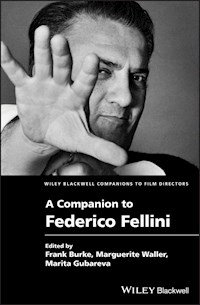
A Companion to Federico Fellini E-Book
86,99 €
Mehr erfahren.
- Herausgeber: John Wiley & Sons
- Kategorie: Geisteswissenschaft
- Serie: WBCF - Wiley-Blackwell Companions to Film Directors
- Sprache: Englisch
A groundbreaking academic treatment of Fellini, provides new, expansive, and diverse perspectives on his films and influence
The Wiley Blackwell Companion to Federico Fellini presents new methodologies and fresh insights for encountering, appreciating, and contextualizing the director’s films in the 21st century. A milestone in Fellini scholarship, this volume provides contributions by leading scholars, intellectuals, and filmmakers, as well as insights from collaborators and associates of the Italian director. Scholarly yet readable essays explore the fundamental aspects of Fellini’s works while addressing their contemporary relevance in contexts ranging from politics and the environment to gender, race, and sexual orientation.
As the centennial of Federico Fellini’s birth in approaches in 2020, this timely work provides new readings of Fellini’s films and illustrates Fellini’s importance as a filmmaker, artist,and major cultural figure. The text explores topics such as Fellini’s early cinematic experience, recurring themes and patterns in his films, his collaborations and influences, and his unique forms of cinematic expression. In a series of “Short Takes” sections, contributors look at specific films that have particular significance or personal relevance. Destined to become the standard research tool for Fellini studies, this volume:
- Offers new theoretical frameworks, encounters, critiques, and interpretations of Fellini’s work
- Discusses Fellini’s creativity outside of filmmaking, such as his graphic art and his Book of Dreams published after his death.
- Examines Fellini’s influence on artists not only in the English-speaking world but in places such as Turkey, Japan, South Asia, Russia, Cuba, North Africa.
- Demonstrates the interrelationship between Fellini’s work and visual art, literature, fashion, marketing, and many other dimensions of both popular and high culture.
- Features personal testimonies from family, friends and associates of Fellini such as Francesca Fabbri Fellini, Gianfranco Angelucci, Valeria Ciangottini, and Lina Wertmüller
- Includes an extensive appendix of freely accessible archival resources on Fellini’s work
The Wiley Blackwell Companion to Federico Fellini is an indispensable resource for students, instructors, and scholars of Fellini, Italian cinema, cinema and art history, and all areas of film and media studies.
Sie lesen das E-Book in den Legimi-Apps auf:
Seitenzahl: 1525
Veröffentlichungsjahr: 2020
Ähnliche




















Table of Contents
Cover
Notes on Contributors
Editors’ Notes
Foreword
References
Preface: Felliniesque. A Glimpse Behind the Curtain
Reference
Acknowledgments
Glossary
Part I: Fellini and Friends
1 Introduction
Fellinian Wonder
Reimagining the Political
Caricature, Cartooning, and Queering
Digital Fellini
Postscript
References
2 Fellini, the Artist and the Man: An Interview with Vincenzo Mollica
References
3 Fellini: Backstory and a Dream
Backstory
A Dream
4 A Certain Freedom in Filmmaking
5 A Bit of Everything Happened: My Experience of
La dolce vita
6 Fellini a Casa Nostra
Carlo Verdone
Luca Verdone
Part II: Beginnings, Inspirations, Intertexts
7 Neorealism Masked: Fellini’s Films of the 1950s
Fellini and Neorealism
Caricatural Realism
The World of the Spectacle and the “Spectacle of the World”
Vagabondaggio
and Itinerancy: A Path into the Heart and tothe Edges of Neorealism
References
8 Fellini’s Graphic Heritage: Drawings, Comics, Animation, and Beyond
Fellini the Cartoonist, 1937–1947
The Age of Dreams, 1948–1993
Fellini During and After Fellini
Conclusion: Never Ending Images
References
9 In Bed with Fellini: Jung, Ernst Bernhard, Night Work, and
Il libro dei sogni
Bed cinema
Night Work
The Book
Drawing
The
Coniunctio
Spirits
The Numinous
Fine
(Senza Fine)
References
10 Fellini and Esotericism: An Ambiguous Adherence
Fellini and Esotericism
A Transcendental Foundation: The Collaboration with Rota and Pinelli
Bernhard and Rol as Guides to the Unknown
Ambiguous Journeys: Mastorna and Tulum
“
Voluttuosamente Aperto a Tutto
”
References
11 Circo Fellini
References
12 Fellini’s Sense of Place
Introduction
Fellini’s Sense of Place
Fellini’s Sense of Place at Work
References
13 “Il viaggio di G. Mastorna”: Fellini
Entre Deux Morts
Ghosts of a Chance
A Vibration of the Light
Fellini between Two Deaths
References
14 An “Incapacity to Affirm”: Fellini’s Aesthetics and the Decadent Movement
What is “Decadent Aesthetics”?
The 1960s
Il Casanova di Federico Fellini
From the Late Nineteenth Century to the Twentieth Century
References
15 Fellini and Fashion, a Two‐way Street: An Interview with Gianluca Lo Vetro
References
Part III: Collaborations
16 Ennio, Tullio, and the Others: Fellini and His Screenwriters
Writing with Pinelli and Flaiano—and Why They Split
Poetry, Improvisation, and Dubbing
References
17 Fellini and His Producers: Strange Bedfellows
Contentious Cohabitation
Organization and Management of Human Capital in a Cinematographic Project
Fellini’s Thoughts on Producers
Producer or Patron?
Case Study 1:
La dolce vita
. The Producer Exists (Actually, There Are Two of Them)
Case Study 2:
E la nave va
. The Producer is Absent
Conclusions
References
18 Masina and Mastroianni: Reconfiguring C. G. Jung’s
Animus
and
Anima
The
Anima
in Cinema
Giulietta Masina, Fellini’s
Animus
Marcello Mastroianni, Fellini’s
Anima
References
Part IV: Aesthetics and Film Language
19 “Io non me ne intendo”: Fellini's Relationship to Film Language
References
20 Fellini’s Visual Style(s): A Phenomenological Account
Crammed Foregrounds, Black‐and‐white Contrast, and Noir Aesthetics
Introduction of Color, and Effetto Dipinto
Plastic Seas and Other Material excesses
References
21 The Liquid Hyperfilm: Fellini, Deleuze, and the Sea as Forza Generatrice
The Hyperfilm as Assemblage
Rhizomatic Cinema
The
Forza Generatrice
Fellini’s Creative Unconscious and the Sea as Screen
The Plastic Sea and Cinema as Hypergenre
References
22 Sounding Out Fellini: An Aural Continuum of Voices, Musics, Noises
Introduction
A Sonic Continuum
Egli Danza … Egli Danza
Music and the Musician as Partners in Dance
A Musical Baby Prodigy
Camera‐dance
La dolce vita
: Sounding the Depths, the Surfaces, and the Social
Casanova’s Obsessions in Sound Takes
The Felliniesque and Musicking
References
23 Fellini and the Aesthetics of Intensity
Intensity in Cinema
La dolce vita
Pathways of Intensity in
La dolce vita
Il Casanova di Federico Fellini
The Staging of a Staging
References
24 Egli Danza: Fellini’s Contexts and Influence from Before Rossellini to Sorrentino and Beyond
Fellini at the Intersection(s)
Artisanal Beginnings: Fellini and His Craft
Neorealism and Its Authors
Models and References
Sorrentino and Recent Italian Cinema
References
Part V: Contemporary Dialogues
25 Remote Control Politics: Federico Fellini and the Politics of Parody
Un Animale Extraterrestre
References
26 “
Il Maestro
” Dismantles the Master’s House: Fellini’s Undoing of Gender and Sexuality
Introduction
Of Men and Rodents
Rosalba and Her Sisters
From Anitona to Saraghina
Feminist Imperialism and the Politics of Difference
References
27 Racial Difference and the Postcolonial Imaginary in the Films of Federico Fellini
I
II
III
References
28 Environmental Fellini: Petroculture, the Anthropocene, and the Cinematic Road
Fellini's Roads:
Le notti di Cabiria
, Automobilization, Esso, and the “Boom”
Fellini’s Hybrids:
La dolce vita
, Cinecittà, and Rebuilding the Eternal City in Plastic
Fellini and a Geology of Media
Petromelancholia: Fellini offroads, or plastics within
References
Part VI: Receptions, Appropriations, Dispersions
29 Fellini’s Critical Reception in Italy
The Earliest Films: Critical Suspicion, Critical Promise
The Trilogy of Grace: The Tragic Adventures of the Humble
La dolce vita
and
8½
: The Spiritual Void of a Nation, the Crisis of Modern Conscience
Federico of the Spirits and the Magical Aspect of Life
The Mysterious Eternity of Infancy: From
I clowns
(1970) to
Prova d’orchestra
(
Orchestra Rehearsal
1979)
The 1980s: Ever Darkening Visions Amid an Industry in Decline
“Has Speaking Poorly of Fellini Become Impossible?” The Final Films
References
30 Fellini’s Reception in France
Critics and Polemics
Theory
Eulogy
References
31 The Fellini Brand: Marketing Appropriations of the Fellini Name
Advertising, Marketing, and Fellini
What’s in a (Brand) Name?
The Man as Brand: The Fellini Mystique
Case Studies: Global Applications of the Fellini Brand
Fellini and Hedonism
Dining da Federico
Conclusion
References
32 Fellini Remixed: Anglo‐American Film and Television Appropriations
Fellini and Film Citation and Adaptation
Fellini and the Anglo‐American Small Screen
8½
Become Public Service Announcement
Affectionate Payback
Northern Exposure
: The Limits of Difference
3rd Rock from the Sun’s
De‐alienation
Conclusion
References
33
Il ritorno in patria
: From Rimini to Winnipeg by Way of the Alps
References
34 Fellini and South Asian Cinemas
References
35 Interview with Tanvir Mokammel
36 Roma, Fellini, and Me
37 Fellini and Turkey: Influence and Image
Fellinian Influence
Fellini and Turks
References
38 Fellini in Japan
I. A Tale of Two Films
II. Masumura and Fellini
References
39 Fellini in Russia
40 Fellini in the Cuban Context
References
Part VII: Short Takes on Individual Films
41
Lo sceicco bianco
(
The White Sheik
1952)
References
42
La strada
(1954)
References
43
Le notti di Cabiria
(
Nights of Cabiria
)—Cabiria in the Classroom: Teaching Fellini in the Twenty‐first Century
References
44
La dolce vita
(1960)
References
45 Oh, My
8½
46
Giulietta degli spiriti
(
Juliet of the Spirits
): A Twenty‐First Century Users’ Guide
47
Fellini
‐
Satyricon
References
48
Roma
: Amor Through the Looking‐Glass
49
Il Casanova di Federico Fellini
(
Fellini’s Casanova
) in the Age of #MeToo
References
50
Prova d’orchestra
(
Orchestra Rehearsal
) and
E la nave va
(
And the Ship Sails On
)
References
51
Intervista
: There Are No Rules
Appendices: Foundations and Archives for Fellini Research
Appendix A: Rimini and Fellini: The Fondazione Fellini, the Cineteca di Rimini, the Museo Fellini, and CircAmarcord
Reference
Appendix B: Additional Archival Sources
Index, Terms and Issues
Index, Names and Titles
End User License Agreement
List of Illustrations
Foreword
Figure G.1 Federico Fellini and his mother, “nonna Ida.” 1963.
Figure G.2 From left to right: Maddalena Fellini, sister of Federico; France...
Chapter 2
Figure 2.1 One of Fellini’s sketches to entertain Vincenzo Mollica’s daughter ...
Figure 2.2 Milo Manara became a friend and collaborator of Fellini via their f...
Chapter 4
Figure 4.1 Lina Wertmüller talks of her relationship with Fellini on the groun...
Chapter 7
Figure 7.1 The white sheik appears “miraculously” airborne to his greatest fan...
Figure 7.2 Cabiria’s mascara, as she looks into the camera eye and at the spec...
Figure 7.3 The rocky countryside terrain where Augusto finds his final resting...
Chapter 8
Figure 8.1 A sketch of Donald Sutherland as Casanova, with annotated instructi...
Figure 8.2 First dream on page: a drawing of Anna Giovannini, “La Paciocca” fr...
Figure 8.3 Fellini’s sketch of Disney, “Gelsomina,” and himself.
Figure 8.4 Even in the most imaginative self‐caricatures, such as this one, Fe...
Chapter 9
Figure 9.1 Fellini dreams of Giulietta dying.
Il libro dei sogni
, 31. Cineteca...
Figure 9.2 First entry: Fellini’s dream of vibrations, air, and the sky.
Il li
...
Chapter 10
Figure 10.1 Fellini meets Ernst Bernhard dressed as a clown.
Il libro dei sogn
...
Figure 10.2 Second dream on page: Fellini expresses his anxiety in relation to...
Chapter 11
Figure 11.1
Figure 11.2
Figure 11.3
Figure 11.4
Figure 11.5
Chapter 12
Figure 12.1 Spatial dynamics in Steiner’s living room.
Figure 12.2 Local identities challenged from outside: the passing of the Rex o...
Chapter 13
Figure 13.1 G. Mastorna’s plane, emergency landed in a square in front of a Co...
Chapter 14
Figure 14.1 Casanova’s escape from the Piombi prison is not only less heroic...
Figure 14.2 Casanova looks up at the circus giantess (draped figure screen r...
Chapter 15
Figure 15.1 Sylvia wearing a pretino dress in her climb up the St. Peter’s dom...
Figure 15.2 Ava Gardner wearing an early version of the Sorelle Fontana’s pret...
Figure 15.3 Pierone wearing the “collo dolcevita” (turtleneck). Directed b...
Chapter 18
Figure 18.1 Fellini’s sketch of himself as Ginger‐Masina and Fred‐Mastroianni’...
Figure 18.2 Amelia‐Masina can play along with Pippo at the end of
Ginger and F
...
Figure 18.3 Snàporaz‐Mastroianni befuddled and frightened as he is surrounded ...
Chapter 19
Figure 19.1 Promenade in anticipation of the passage of the ocean liner Rex. F...
Figure 19.2 Paola’s gaze at the camera and at us at the end of
La dolce vita
Figure 19.3 Fellini’s fondness for “di quinta” shots that intrude into the f...
Figure 19.4 The lack of verisimilitude of Fellini’s “television” images “in ...
Chapter 20
Figure 20.1 Guido framed by Daumier’s back and arm.Directed by Federico Fe...
Figure 20.2 Giulietta’s hallucinatory claustrophobic room, reminiscent of Max ...
Figure 20.3 Fellini’s fondness for fog in the third phase of his career.D...
Chapter 21
Figure 21.1 Incomplete structures in
I vitelloni
(1953),
8½
(1963),
La do
...
Chapter 22
Figure 22.1 Fellini’s sketch of himself and Nino Rota. Diogenes Verlag AG Coll...
Chapter 23
Figure 23.1 Marcello confronts the death of Steiner (screen left slumped in ch...
Figure 23.2 Casanova and his automaton partner in the final scene of
Il Casano
...
Chapter 24
Figure 24.1 Fellini’s preference for a “mouse‐height” shot in the Florentine...
Figure 24.2 Zampanò, Gelsomina, and their “mini camper” in Fellini’s “road m...
Figure 24.3 Fergie plays the Saraghina figure as a much more conventionally se...
Figure 24.4 Baron Cefalù (Marcello Mastroianni) exits from the movie theater w...
Chapter 25
Figure 25.1 A mural with Silvio Berlusconi (center right) and members of the s...
Figure 25.2 As he leaves the kitchen, the server effectively kicks Berlusconi ...
Chapter 26
Figures 26.1–26.2 In
La dolce vita
, Sylvia (Figure 26.2) reproduces and exagge...
Figures 26.3–26.4 A ricochet of gazes among angry feminists, Snàporaz, a Felli...
Chapter 27
Figure 27.1 Fellini’s disquieting dream of a foreigner.
Il libro dei sogni
....
Figure 27.2 Hyperwhite Anita complains of Antonio’s ink‐throwing, an act tha...
Figure 27.3 Group of black and white women in an agrarian setting serve as cou...
Chapter 28
Figure 28.1 “Petroleum helps to build a better life”—a promise Fellini’s
Le no
...
Figure 28.2 Automobiles return the camera’s gaze as a serene forest setting co...
Chapter 31
Figure 31.1 The brochure, with company logo, for the Fellini Pelliteria, estab...
Figure 31.2 The Gradisca Ristorante in New York City.
Figure 31.3 The Café Amarcord in Beacon, New York.
Chapter 32
Figure 32.1 Four women on a rooftop in
La dolce vita
are replaced by French ...
Figure 32.2 Felliniesque figures in pursuit of Ed seem menacing: part of a F...
Chapter 33
Figure 33.1 Riccardo, one of the vitelloni, sleeping in the final scene of t...
Figure 33.2 Sleeping Companions.
My Winnipeg
(2007). Directed by Guy Maddin....
Chapter 35
Figure 35.1 Tanvir Mokammel, 2009.
Chapter 39
Figure 39.1 Gelsomina meets a kindred marginal figure, Osvaldo: psychologism a...
Chapter 40
Figure 40.1 The befuddled and dissociated bourgeois consciousness of Sergio in...
Chapter 42
Figure 42.1 Zampanò with dual sexual attributes. Archivio Federico Fellini—Com...
Chapter 43
Figure 43.1 Cabira’s boyfriend steals her purse and tosses her in the Tiber wh...
Chapter 44
Figure 44.1 Maddalena (along with Fellini) eschews judgment. Directed by F...
Chapter 45
Figure 45.1 At the end of
8½
, as Guido’s fantasy of light slips back into...
Chapter 46
Figure 46.1 BRI‐NYLON gets an opening credit, highlighting the importance of...
Chapter 47
Figure 47.1 The marriage of Lichas and Encolpio: open sexual discourses in
F
...
Chapter 48
Figure 48.1 Anna Magnani, Roman womanhood at its most iconic, expresses her di...
Chapter 50
Figure 50.1 The camera within the camera as
E la nave va
ends not on the story...
Chapter 51
Figure 51.1 Marcello Mastroianni, dressed as Mandrake, dances with Anita Ekber...
Guide
Cover
Table of Contents
Begin Reading
Pages
ii
iii
iv
v
vi
xi
xii
xiii
xiv
xv
xvi
xvii
xviii
xix
xx
xxi
xxiii
xxiv
xxv
xxvi
xxvii
xxviii
xxix
xxx
xxxi
xxxii
xxxiii
xxxiv
xxxv
xxxvi
xxxvii
xxxviii
1
2
3
4
5
6
7
8
9
10
11
12
13
14
15
16
17
18
19
20
21
22
23
24
25
27
28
29
30
31
32
33
34
35
36
37
38
39
41
42
43
44
45
46
47
48
49
50
51
52
53
54
55
56
57
58
59
60
61
62
63
64
65
66
67
68
69
70
71
72
73
74
75
76
77
78
79
80
81
82
83
84
85
86
87
88
89
90
91
92
93
95
96
97
98
99
100
101
102
103
104
105
106
107
108
109
110
111
112
113
114
115
116
117
118
119
120
121
122
123
124
125
126
127
129
130
131
132
133
134
135
136
137
138
139
141
142
143
144
145
146
147
148
149
150
151
152
153
154
155
156
157
158
159
160
161
163
164
165
166
167
168
169
170
171
172
173
174
175
176
177
178
179
180
181
182
183
184
185
186
187
188
189
191
192
193
194
195
196
197
198
199
200
201
202
203
204
205
206
207
208
209
210
211
212
213
214
215
216
217
218
219
220
221
222
223
224
225
226
227
228
229
230
231
232
233
234
235
236
237
238
239
240
241
242
243
244
245
246
247
248
249
251
252
253
254
255
256
257
258
259
260
261
262
263
264
265
267
268
269
270
271
272
273
274
275
276
277
278
279
280
281
282
283
284
285
286
287
288
289
290
291
292
293
294
295
296
297
298
299
300
301
302
303
304
305
306
307
308
309
311
312
313
314
315
316
317
318
319
320
321
322
323
324
325
326
327
328
329
331
332
333
334
335
336
337
338
339
340
341
342
343
344
345
346
347
348
349
350
351
352
353
354
355
356
357
358
359
360
361
362
363
364
365
366
367
368
369
370
371
372
373
374
375
376
377
378
379
380
381
382
383
384
385
386
387
388
389
391
392
393
394
395
396
397
398
399
400
401
402
403
404
405
406
407
408
409
410
411
412
413
414
415
416
417
418
419
420
421
422
423
424
425
426
427
428
429
430
431
433
434
435
436
437
438
439
440
441
442
443
444
445
446
447
448
449
450
451
452
453
454
455
456
457
458
459
461
462
463
465
466
467
468
469
471
472
473
474
475
476
477
478
479
480
481
482
483
484
485
487
488
489
491
492
493
494
495
496
497
498
499
500
501
503
505
506
507
508
509
511
512
513
514
515
516
517
518
519
520
521
522
523
524
525
526
527
528
529
530
531
532
533
534
535
536
537
538
Wiley Blackwell Companions to Film Directors
The Wiley Blackwell Companions to Film Directors survey key directors whose work constitutes what we refer to as the Hollywood and world cinema canons. Whether Haneke or Hitchcock, Bigelow or Bergman, Capra or the Coen brothers, each volume, comprises 25 or more newly commissioned essays written by leading experts, explores a canonical, contemporary, and/or controversial auteur in a sophisticated, authoritative, and multidimensional capacity. Individual volumes interrogate any number of subjects—the director’s oeuvre; dominant themes, well‐known, worthy, and under‐rated films; stars, collaborators, and key influences; reception, reputation, and above all, the director’s intellectual currency in the scholarly world.
Published
A Companion to Michael Haneke
, edited by Roy Grundmann
A Companion to Alfred Hitchcock
, edited by Thomas Leitch and Leland Poague
A Companion to Rainer Werner Fassbinder
, edited by Brigitte Peucker
A Companion to Werner Herzog
, edited by Brad Prager
A Companion to Pedro Almodóvar
, edited by Marvin D’Lugo and Kathleen Vernon
A Companion to Woody Allen
, edited by Peter J. Bailey and Sam B. Girgus
A Companion to Jean Renoir
, edited by Alastair Phillips and Ginette Vincendeau
A Companion to François Truffaut
, edited by Dudley Andrew and Anne Gillian
A Companion to Luis Buñuel
, edited by Robert Stone and Julián Daniel Gutiérrez‐Albilla
A Companion to Jean‐Luc Godard
, edited by Tom Conley and T. Jefferson Kline
A Companion to Martin Scorsese
, edited by Aaron Baker
A Companion to Fritz Lang
, edited by Joseph McElhaney
A Companion to Robert Altman
, edited by Adrian Danks
A Companion to Wong Kar‐wai
, edited by Martha P. Nochimson
A Companion to Steven Spielberg
, edited by Nigel Morris
A Companion to D. W. Griffith
, edited by Charles Keil
A Companion to Federico Fellini
, edited by Frank Burke, Marguerite Waller, Marita Gubareva
A Companion to Federico Fellini
Edited by
Frank Burke, Marguerite Waller, Marita Gubareva
This edition first published 2020© 2020 John Wiley & Sons Ltd
All rights reserved. No part of this publication may be reproduced, stored in a retrieval system, or transmitted, in any form or by any means, electronic, mechanical, photocopying, recording, or otherwise, except as permitted by law. Advice on how to obtain permission to reuse material from this title is available at http://www.wiley.com/go/permissions.
The right of Frank Burke, Marguerite Waller, Marita Gubareva to be identified as the authors of this editorial material in this work has been asserted in accordance with law.
Registered Office(s)John Wiley & Sons, Inc., 111 River Street, Hoboken, NJ 07030, USAJohn Wiley & Sons Ltd, The Atrium, Southern Gate, Chichester, West Sussex, PO19 8SQ, UK
Editorial OfficeThe Atrium, Southern Gate, Chichester, West Sussex, PO19 8SQ, UK
For details of our global editorial offices, customer services, and more information about Wiley products, visit us at www.wiley.com.
Wiley also publishes its books in a variety of electronic formats and by print‐on‐demand. Some content that appears in standard print versions of this book may not be available in other formats.
Limit of Liability/Disclaimer of Warranty
While the publisher and authors have used their best efforts in preparing this work, they make no representations or warranties with respect to the accuracy or completeness of the contents of this work and specifically disclaim all warranties, including without limitation any implied warranties of merchantability or fitness for a particular purpose. No warranty may be created or extended by sales representatives, written sales materials, or promotional statements for this work. The fact that an organization, website, or product is referred to in this work as a citation and/or potential source of further information does not mean that the publisher and authors endorse the information or services the organization, website, or product may provide or recommendations it may make. This work is sold with the understanding that the publisher is not engaged in rendering professional services. The advice and strategies contained herein may not be suitable for your situation. You should consult with a specialist where appropriate. Further, readers should be aware that websites listed in this work may have changed or disappeared between when this work was written and when it is read. Neither the publisher nor authors shall be liable for any loss of profit or any other commercial damages, including but not limited to special, incidental, consequential, or other damages.
Library of Congress Cataloging‐in‐Publication Data
Names: Burke, Frank, editor of compilation. | Waller, Marguerite R., 1948– editor of compilation. | Gubareva, Marita, editor of compilation.Title: A companion to Federico Fellini / Frank Burke, Marguerite Waller & Marita Gubareva.Other titles: Companion to Federico FelliniDescription: Hoboken : Wiley‐Blackwell [2020] | Series: Wiley Blackwell companions to film directors | Includes bibliographical references and index.Identifiers: LCCN 2019042675 (print) | LCCN 2019042676 (ebook) | ISBN 9781119431534 (hardback) | ISBN 9781119431510 (adobe pdf) | ISBN 9781119431541 (epub)Subjects: LCSH: Fellini, Federico–Criticism and interpretation.Classification: LCC PN1998.3.F45 W373 2020 (print) | LCC PN1998.3.F45 (ebook) | DDC 791.4302/33092–dc23LC record available at https://lccn.loc.gov/2019042675LC ebook record available at https://lccn.loc.gov/2019042676
Cover Design: WileyCover Image: © Photo Elisabetta Catalano
To Bianca, Gabe, Lea, Tyler, and Wylie
The Comune di Rimini and Mario Guaraldi contributed significantly to the preparation of this volume (see Acknowledgments).
In Memoriam: Peter Bondanella (1943–2017)
Notes on Contributors
John Agnew is distinguished professor of geography and Italian at UCLA. He is the author and coauthor of numerous essays, and author of, among other works, Globalization and Sovereignty; Hegemony; The New Shape of Global Power; Geopolitics: Re‐visioning World Politics; Place and Politics in Modern Italy; and Berlusconi’s Italy. He is also the coeditor of The Wiley Blackwell’s A Companion to Political Geography and The Wiley Blackwell’s A Companion to Human Geography.
Hava Aldouby is a senior lecturer and gallery director at the Open University of Israel, Department of Literature, Language and the Arts. Her main field of research is moving‐image art, focusing on experimental cinema, video, and new‐media art, with a particular interest in haptic visuality, skin, and migratory aesthetics. She is the author of Federico Fellini: Painting in Film, Painting on Film; has contributed to Ori Gersht: History Reflecting; and is editing Shifting Interfaces: Presence and Relationality in New Media Arts of the Early 21st Century.
Giaime Alonge teaches film history at the University of Turin, Italy. He has been a Fulbright visiting professor at the University of Chicago. He has published numerous articles and books on American and Italian cinema, film and history, animation, and film technique, including Scrivere per Hollywood. Ben Hecht e la sceneggiatura nel cinema americano classico. He also works as a screenwriter, mostly with director Daniele Gaglianone, with credits such as I nostri anni, Nemmeno il destino, and Ruggine. As a novelist, he has written L’arte di uccidere un uomo.
Marco Andreucci is a state employee of Rimini origins. He received degrees in political science at the Università di Bologna and in history at the Università Ca’ Foscari di Venezia, with a thesis on "Fellini a Rimini." He has authored essays on contemporary local history and on the Second World War, as well as a book of fiction for children, with the support of the European Commission.
Gianfranco Angelucci is a writer, director, journalist, and university teacher. He was Fellini’s collaborator and friend for more than 20 years, scripting (among other things) Intervista, which won the 40th Anniversary Prize at Cannes and the Golden Prize at the Festival of Moscow. From 1997 to 2000, he directed the Fondazione Federico Fellini in Rimini. He has published numerous books on Fellini, including Federico F., a “factual fiction” dedicated to the last difficult moments of Fellini’s life, and Segreti e bugie di Federico Fellini. He has written L’amore in corpo, Tra un anno al caffè della Plaka, and Ritorno a Medjugorje, and directed Miele di donna and (with Liliana Betti) E il Casanova di Fellini?
Adriano Aprà has been publishing since the early 1960s. In the mid‐1960s, he founded and edited Cinema & Film, contributing essays to the journal, and in the 1970s he codirected Filmstudio 70 (Rome). He has published, among many other things, Per non morire hollywoodiani; Stelle e strisce. Viaggi nel cinema Usa dal muto agli anni '60; In viaggio con Rossellini; and Breve ma veridica storia del documentario. Dal cinema del reale alla nonfiction. He directed the festival at Salsomaggiore (1977–1989) and at Pesaro (1990–1998). From 1998 to 2002, he was the director of the Cineteca Nazionale in Rome; and, from 2002 to 2009, he taught the history of cinema at the University of Rome, Tor Vergata. He has made a fiction film, Olimpia agli amici, and a documentary, Rossellini visto da Rossellini. He codirected Rosso cenere with Augusto Contento.
Nicola Bassano is a film historian who, since 2014, has been responsible for the Archivio Federico Fellini within the Cineteca of the Comune of Rimini. For several years, he has been involved in archival research, collaborating with museums, foundations, and institutions with the aim of disseminating awareness of Italian cinema and its major auteurs, with a particular eye to the work of Federico Fellini.
Rebecca Bauman is associate professor of Italian at the Fashion Institute of Technology, State University of New York, where she also teaches in the Department of Film, Media and Performing Arts. She has authored numerous articles and book reviews on Italian cinema, film melodrama, mafia studies, fashion, and masculinity. Her most recent publication is an article on quality television and the TV series La Piovra, published in the Journal of Italian Cinema and Media Studies.
Marco Bellano is adjunct professor in the history of animation at the University of Padova, Italy. His main research area is music in film and animation. He is an award‐winning scholar who has authored Metapartiture: Comporre musica per i film muti and Animazione in cento film (with Giovanni Ricci and Marco Vanelli). He is currently writing Václav Trojan: Music Composition in Czech Animated Films and Allegro non Troppo: Bruno Bozzetto’s Animated Music.
Paolo Bertetto is a professor of cinema at Università Sapienza di Roma. He has been a university professor at Paris 8, Nice, Madrid Complutense, and Leipzig. He has been director of the Museo Nazionale del Cinema and has published approximately 20 books dedicated to cinema of the 1920s, to the avant‐garde, and to the Nouvelle Vague, as well as to the theory of cinema and to methodologies of textual analysis. His monographs include: L’enigma del desiderio, Lo specchio e il simulacro, Microfilosofia del cinema, and Il cinema e l’estetica dell’intensità. He is also the author of two novels, Cuore scuro and Autunno a Berlino.
Frank Burke is professor emeritus at Queen’s University, Canada. He has published on American, Italian–American, and Italian cinema, and edited the A Companion to Italian Cinema. His work on Federico Fellini includes three books and numerous articles in English—Fellini’s Films: From Postwar to Postmodern (revised and updated, Intellect, 2020), and, with Marguerite Waller, Federico Fellini: Contemporary Perspectives—and contributions to books and journals in Italian. He provided the audio commentary with Peter Brunette for The Criterion Collection release of Amarcord and the sole audio commentary for Roma.
Alessandro Carrera is John and Rebecca Moores Professor of Italian Studies and World Cultures and Literatures at the University of Houston, Texas. He has published on Italian and comparative literature, continental philosophy, classical and popular music, and Italian cinema. He is the author of Fellini’s Eternal Rome: Paganism and Christianity in the Films of Federico Fellini. He has translated three novels of Graham Greene and all the songs and prose of Bob Dylan into Italian.
Luciano Castillo, a critic, researcher, and film historian, currently directs the Cinemateca de Cuba. He has published more than 20 books, many on Cuban cinema history, including the four‐volume Cronología del Cine Cubano and La Biblia del Cinéfilo. He is a member of the Union of Writers and Artists of Cuba and the Cuban Association of Film Critics (a subsidiary of FIPRESCI).
Rebeca Chávez is a director of documentary and fiction in Havana whose work explores contested areas in Cuban artistic and political culture.
Valeria Ciangottini was cast by Fellini, at the age of 14, as the young girl Paola in La dolce vita. She studied at Actors Studio in Rome and had numerous film roles. She also has had a lengthy career in television, starring in TV films and series and hosting programs for children. Over time, she has come to concentrate more on theater than on film or television, particularly comedies.
Barbara Corsi has worked at the Archivio del Cinema Italiano dell’Anica and has published essays, biographical entries on producers, and two monographs: Con qualche dollaro in meno and Produzione e produttori. She has taught the economics of film at the Università di Padova, Milan’s Università Cattolica del Sacro Cuore, and the Università di Lingue e Comunicazione (IULM), and is currently a research fellow on the British AHRC‐funded project, Producers and Production Practices in the History of Italian Cinema 1949–1975, coordinated by Stephen Gundle (University of Warwick).
Esha Niyogi De’s research interests lie in cross‐border studies of South Asia. She is the author of Empire, Media, and the Autonomous Woman: A Feminist Critique of Postcolonial Thought and the coeditor and coauthor of Trans‐Status Subjects: Gender in the Globalization of South and Southeast Asia. With funding by the Fulbright Foundation and the American Institute of Pakistan Studies, she is writing a monograph titled Women's Transborder Cinema: Female Authors and Familial Narratives across South Asia and coediting a collection of scholarly essays titled Transregional Filmscapes across South Asia: Histories, Borders, Encounters. She is cofounder of the South Asian Regional Media Scholars Network and teaches at UCLA.
Francesca Fabbri Fellini is a journalist who has worked at RAI since 1987 as a presenter for numerous important television shows. She has also worked as a writer and on‐air presenter for programs related to cinema on the radio station RTL 102.5. Her uncle Federico called her “Felliniette.” As the only daughter of Maria Maddalena, Fellini’s sister, and the only remaining Fellini heir, she commits herself to the care and diffusion of the image and work of “Il Maestro.” She owns several trademarks related to the Fellini name in Italy and abroad and serves as the global ambassador for the Famiglia Fellini.
Goffredo Fofi has been an elementary school teacher, a citizen of numerous cities, and an engaged intellectual, committed to supporting the marginalized and creating networks alternative to consumer culture and cultural homogenization. He schooled himself as a film critic between Turin and Paris, working as an editor at Positif. He has published numerous articles and books, including L’avventurosa storia del cinema italiano raccontata dai suoi protagonisti, 1935‐1959 (with Franca Faldini). He has founded and directed a variety of journals focused on the evolution (or devolution) of society and culture, most recently Lo Straniero and Gli asini.
Shelleen Greene is associate professor of Cinema and Media Studies at the University of California, Los Angeles. Her research interests include Italian cinema, black European studies, and postcolonial studies. Her book titled Equivocal Subjects: Between Italy and Africa—Constructions of Racial and National Identity in the Italian Cinema examines the representation of mixed‐race subjects of Italian and African descent in Italian cinema. Her work has also been published in Postcolonial Italy: Challenging National Homogeneity and California Italian Studies.
Marita Gubareva is a freelance journalist and researcher, based in Rome. She received her first doctorate from Moscow State University with a dissertation on Decadent aesthetics in French and English literature, and her second from the European University Institute (Florence) with a dissertation on the adaptations of Giacomo Casanova’s Histoire de Ma Vie for the cinema. Her research interests include seventeenth‐century and late‐nineteenth‐century aesthetics, Casanova studies, Italian film studies, and the history of collecting and connoisseurship.
Cihan Gündoğdu is a PhD candidate in international relations at Kadir Has University. He is currently working on relations between Turkey and Iran. He is interested in Fellini's cinema, contemporary Turkish film, and European art films. He has created an archive containing published books and articles written in many languages, as well as a wide range of electronic materials and documents related to Fellini and his works.
Dom Holdaway is a research fellow at the Università degli Studi di Milano. He has also worked at the Università di Bologna and the University of Warwick. His research focuses on the intersections between politics and cinema: from cultural policy to issues of representation and national identity. He has edited Rome, Postmodern Narratives of a Cityscape (with Filippo Trentin), and recently coauthored essays on the economy of Italian cinema in Comunicazioni Sociali and Il cinema di Stato. Finanziamento pubblico ed economia simbolica nel cinema italiano contemporaneo.
Jennifer Ruth Hosek is an associate professor of transnational German studies at Queen’s University, Canada. Her focus on Cuba–German cultural relations is reflected in her monograph Sun, Sex and Socialism: Cuba in the German Imaginary. Her current major project is centered on urban transport and film.
Amy Hough‐Dugdale is a lecturer in the Department of Italian at Scripps College, and recently received her PhD in Comparative Literature from the University of California, Riverside, with a dissertation titled “The Liquid Eye: A Deleuzian Poetics of Water in Film.” Amy’s areas of interest include Italian cinema, the cinema of poetry, ecopoetics, intermediality, Deleuzian theory, literary translation, and creative writing. Her lyric essay “Marathon Meditation” was published in the Los Angeles Review of Books Quarterly Journal and her essay on Fellini’s La voce della luna won the 2019 California Interdisciplinary Consortium of Italian Studies (CICIS) prize.
Earl Jackson is professor emeritus at the University of California, Santa Cruz, and is currently chair and professor of the Department of Foreign Languages and Literature at Asia University in Taichung. He is the author of Strategies of Deviance: Studies in Gay Male Representation; Fantastic Living: The Speculative Autobiographies of Samuel R. Delany; and numerous articles on Japanese and Korean cinema. He has recently completed a monograph on the relation of Japanese film theory and practice. He has worked in Korean independent film as screenwriter, editor, line producer, and actor. He is currently writing on the director Yuzo Kawashima and the novelist/essayist Yoko Tawada.
Russell J. A. Kilbourn is associate professor in the Department of English and Film Studies at Wilfrid Laurier University, specializing in film theory, memory studies, and adaptation. He is the author of Cinema, Memory, Modernity: The Representation of Memory from the Art Film to Transnational Cinema and W. G. Sebald’s Postsecular Redemption: Catastrophe with Spectator, and coeditor, with Eleanor Ty, of The Memory Effect: The Remediation of Memory in Literature and Film. His current book project is on Italian director Paolo Sorrentino.
Naum Kleiman, a member of the European Film Academy, studied at the All‐Union State Institute of Cinematography. At Gosfilmofond, he supervised the reconstruction of Eisenstein's Bronenosets Potemkin (Battleship Potemkin), Oktiabr (October), Generalnaia Linia/Staroe i novoe (The General Line/Old and New), as well as the creation of a photofilm Bezhin Lug Sergeia Eizensteina (Sergei Eisenstein’s Bezhin Meadow) based on frames from the censored and destroyed film. He took part in a six‐volume edition of Eisenstein’s works and has managed the “Eisenstein Memorial Apartment,” a personal and professional archive of Eisenstein materials. He has curated numerous Eisenstein exhibitions in Moscow and abroad, is the editor of Kinovedcheskie Zapiski (Filmscholar’s notes), and has had numerous international academic affiliations.
Amara Lakhous is a visiting professor in the Department of Italian Studies at New York University. He was born in Algeria in 1970 and moved to Italy in 1995. He is the author of five novels, which have been translated into numerous languages (three were written in both Arabic and Italian). His best‐known works are Clash of Civilizations Over an Elevator in Piazza Vittorio, Divorce Islamic Style, and A Dispute over a Very Italian Piglet. His most recent work, The Prank of the Good Little Virgin of Via Ormea, was published in Italian in 2014 and in English in 2016. Clash of Civilizations Over an Elevator in Piazza Vittorio was adapted as a movie by Isotta Toso in 2010.
Mario Naito López is the leading specialist in North American and European cinema at the Cinemateca de Cuba, with over 20 years of editorial experience for the Cinemateca, notably in Cuban film.
Gianluca Lo Vetro is a journalist, fashion critic, essayist, and curator. In 1987, he introduced fashion to the pages of L’Unità, addressing the subject in a sociological key. He has collaborated with the weekly L’Europeo and with lifestyle magazines such as GQ. He has curated retrospectives, such as Giubileo for the 50th anniversary of Roberta di Camerino and “Fiorucci Free Spirit” for the 30th anniversary of Fiorucci. He has also taught at the University of Bologna. In recent years, he has dedicated himself to the study of Fellini, which resulted in the publication of Fellini e la Moda, and has been writing for La Stampa.
Elan Mastai is an award‐winning screenwriter and novelist. He has written five feature films, including The F Word (distributed internationally as What If), which premiered at the Toronto International Film Festival prior to its theatrical release in more than 30 countries. His debut novel, All Our Wrong Todays, has been translated into two dozen languages. He is writing the movie adaptation for Paramount Pictures and Oscar‐nominated producer Amy Pascal. He is currently a writer and producer on the Emmy‐winning television series This Is Us.
Mario Masvidal was chief science editor for more than 25 years for a major Cuban publishing house. He has taught at Central University, Santa Clara (Cuba), and is currently a professor of semiotics and communications at Havana’s University of the Arts (ISA). As well, he hosts a radio show and works in television on matters cultural and artistic.
Tanvir Mokammel is a filmmaker and author from Bangladesh, as well as director of the Bangladesh Film Institute and the Bangladesh Film Centre. He has made feature films that have received national and international awards, and 14 documentaries. Among his features are: The River Named Modhumoti, Quiet Flows the River Chitra, A Tree Without Roots, Lalon, The Sister, and Jibondhuli. His documentaries, like many of his feature films, have dealt with significant historical, political, and social issues, and his books with the history and art of cinema, Charlie Chaplin, the noted Bangladesh writer Syed Waliullah, the Danish author N. F. S. Grundtvig, and folk education.
Vincenzo Mollica has for decades been one of the leading television journalists in Italy, impassioned by comics, cinema, and Italian popular music “d’autore.” He met Federico Fellini in the mid‐1970s. He was a cartoonist, as was Fellini in his early days, and their love for comics became the basis of a long and close friendship. Mollica has hosted numerous important television programs—both specials and series—in the history of the RAI. He has edited, authored, and coauthored approximately 60 books on numerous popular‐culture topics and figures, including Il fumetto e il cinema di Fellini; Viaggio a Tulum; Fellini sognatore. Omaggio all'arte di Federico Fellini; Il viaggio di G. Mastorna detto Fernet; Fellini: Parole e disegni; and Fellini sognato. His book of personal observations, Scritto a mano pensato a piedi. Aforismi per la vita di ogni giorno, was published in 2018. In 2018 as well, he was granted the honor of Commendatore Ordine al Merito della Repubblica Italiana. At the 2019 Venice International Film Festival, he was awarded the 2019 Premio Bianchi by the Italian union of film journalists.
Giuseppe Natale is a professor at the University of Nevada, Las Vegas, where he teaches Italian studies, classical studies, and translation studies. He has published on Italian literature, translation theory and pedagogy, and cinema. He has translated several major American novels into Italian, such as Herman Melville’s Moby Dick, Toni Morrison’s Beloved, and Thomas Pynchon’s Gravity's Rainbow. He has also edited the English translation of Gianfranco Angelucci’s Federico F.
Marina Nicoli has authored The Rise and Fall of the Italian Film Industry and published essays in national and international journals on the economic history of Italian cinema, international coproductions, and distribution practices. She teaches economic history at the Università Bocconi (Milan), and is currently a research fellow on the British AHRC‐funded project, Producers and Production Practices in the History of Italian Cinema 1949–1975, coordinated by Prof. Stephen Gundle (Warwick University).
Mark Nicholls is senior lecturer in cinema studies at the University of Melbourne. He is the author of Lost Objects of Desire: The Performances of Jeremy Irons and Scorsese’s Men: Melancholia and the Mob, and he has published articles on Italian cinema, art cinema, and creative practice histories of The Archers and The Ballets Russes. Mark is a radio and print film journalist and has an extensive list of stage credits as a playwright, performer, producer, and director.
Áine O’Healy is professor of modern languages and literatures at Loyola Marymount University in Los Angeles. Her research interests lie in transnational cinema; contemporary Italian film; and discourses of race, gender, and postcolonial studies. She has published over 70 articles on Italian cinema and is the author of Migrant Anxieties: Italian Cinema in a Transnational Frame. With Katarzyna Marciniak and Aniko Imre, she is one of the coeditors of Transnational Feminism in Film and Media. She has also coedited special issues of Feminist Media Studies and California Italian Studies.
Federico Pacchioni is Sebastian Paul and Marybelle Musco Chair in Italian Studies at Chapman University, California. His books include Inspiring Fellini: Literary Collaborations Behind the Scenes; Pier Paolo Pasolini. Prospettive Americane (with Fulvio Orsitto); and the second edition of A History of Italian Cinema (with Peter Bondanella). He has published numerous articles on Italian cultural history at the intersection of literature, film, and theater.
Stefania Parigi teaches at the Università Roma Tre. Her scholarship concentrates principally on Italian cinema, combining historical research with theoretical reflection, archival investigation with film interpretation. She has worked on silent cinema, 1930s cinema, and contemporary cinema, but has dedicated major attention to post–Second World War cinema. She has written and curated books on Roberto Rossellini, Cesare Zavattini, Pier Paolo Pasolini, Marco Ferreri, Francesco Maselli, and Roberto Benigni. Her most recent volumes include Cinema ‐ Italy, published in Great Britain, and Neorealismo. Il nuovo cinema del dopoguerra.
Elena M. Past is associate professor of Italian at Wayne State University. Her research includes work on the toxic waste crisis in Naples, Mediterranean cinema and ecocinema, animal studies, and Italian crime fiction and film. She has written Italian Ecocinema Beyond the Human and coedited Italy and the Environmental Humanities: Landscapes, Natures, Ecologies with Serenella Iovino and Enrico Cesaretti.
Kriss Ravetto‐Biagioli is professor of Film, Television and Digital Media at UCLA. She has worked on the question of nation building, ethnocentrism, and sexual violence in the Balkans and Eastern Europe; Nazism, Fascism, and the Holocaust; surveillance and social media; digital art and experimental cinema and the uncanny; and the emergence of new forms of politics through social media. She is the author of The Unmaking of Fascist Aesthetics; Mythopoetic Cinema: On the Ruins of European Identity; and Digital Uncanny.
John Paul Russo is professor of English and Classics and chair of the Department of Classics, University of Miami. His fields of study are critical theory, history of culture, and Italian and Italian–American cultures. He has received three Fulbright Awards to Italy. He is book review editor of Italian Americana and a former coeditor of RSA. His most recent books are The Future without a Past: The Humanities in a Technological Society; The Italian in Modernity, cowritten with Robert Casillo; and Luoghi di un’Italia ritrovata (forthcoming).
Albert Sbragia is associate professor of French and Italian Studies and Comparative Literature, Cinema and Media at the University of Washington. He is the author of Carlo Emilio Gadda and the Modern Macaronic, and his previous studies on Fellini discuss the oneiric element in his filmmaking and his place in the rise of French and American auteurism. His current research examines the reterritorialization of Italian spaces under globalization in recent Italian cinema.
Antonella Sisto teaches Italian at Providence College and Rhode Island College. She received her PhD in Italian studies from Brown University and has been the recipient of two postdoctoral fellowships. As a Mellon postdoctoral fellow at the Five Colleges, she taught and collaborated with the Italian and Interdepartmental Film Studies Program and the Massachusetts Multicultural Film Festival. As a fellow at Brown, she collaborated with the Italian Department and the Cineteca di Bologna’s Rediscovered Cinema Festival on Tour. She has published and presented her work internationally. Her first book is Film Sound in Italy: Listening to the Screen, and she is currently working on a transdisciplinary project on sound and modernity, using film, visual and sound art, and everyday sonic interaction to explore how sound, in its specific cross‐cultural significance, can work as an aesthetic, ethical, and ecocritical acoustic proposition to better understand and relate to the world around us.
Erika Suderburg is a filmmaker and writer. Her books include Resolutions: Contemporary Video Practices; Resolution 3: Global Networks of Video; and Space Site Intervention: Situating Installation Art. She is currently a faculty member at the University of California, Riverside, located in the Department of Media and Cultural Studies.
Victoria Surliuga is associate professor of Italian at Texas Tech University. She is a scholar of modern and contemporary Italian poetry and Italian cinema, a poet, and a translator. She has written on the relationship between poetry and painting in Giambattista Marino; Federico Fellini; the poetry of Franco Loi, Giancarlo Majorino, Giampiero Neri, and Andrea Zanzotto; and in the work of Italian artist Ezio Gribaudo. Recent book publications include Ezio Gribaudo: My Pinocchio and Ezio Gribaudo: The Man in the Middle of Modernism.
Caroline Thompson is a novelist, screenwriter, and film director. She adapted her first novel, First Born, with Penelope Spheeris, and though the movie was never made, it proved the start of a long screenwriting career that has included Edward Scissorhands; The Addams Family; Homeward Bound: The Incredible Journey; The Secret Garden; The Nightmare Before Christmas; Black Beauty; Corpse Bride; City of Ember; and Welcome to Marwen. She also directed Black Beauty and wrote and directed Buddy and Snow White: The Fairest of Them All. She is the 2011 recipient of the Austin Film Festival’s Distinguished Screenwriter Award, the first woman to be so honored.
Marco Vanelli teaches language and literature in public school, as well as cinema and theology in university, in Tuscany. He is the editor of and frequent contributor to Cabiria ‐ Studi di Cinema, a quarterly journal that specializes in historical research, especially amidst the forgotten pages of Italian cinema. He rediscovered and supervised the restoration of the short Chi è Dio? (1945) of Mario Soldati, one of the first instances of Italian neorealism. His interests include animated cinema and the spiritual aspects of the cinema d’autore. With Marco Bellano and Giovanni Ricci, he authored Animazione in cento film.
Carlo Verdone is a major contemporary Italian filmmaker whose films have enjoyed great commercial and critical success. He worked in cabaret and in television before making his first film, Un sacco bello, under the mentorship of Sergio Leone. He has gone on to make over 25 movies, linked to the tradition of commedia all’italiana in terms of both comedy and social commentary. Acting in many of his films, at times in multiple roles, he has been considered the heir of Alberto Sordi. He has also performed in the films of other directors, such as Paolo Sorrentino’s La grande bellezza, and won numerous nominations and awards for his acting. He is the brother of filmmaker Luca Verdone and the son of Mario Verdone, noted film scholar and critic.
Luca Verdone is an internationally renowned, award‐winning director of documentary and fiction films, focusing often on art–historical themes. Among his documentaries: Le memorie di Giorgio Vasari, Alberto il grande, La meravigliosa avventura di Antonio Franconi, Sergio Leone; among his fiction films: 7 chili in 7 giorni, La bocca, and Il piacere di piacere. He is the brother of filmmaker and actor Carlo Verdone, and the son of Mario Verdone, noted film scholar and critic.
Cristina Villa is a lecturer at the University of California—Accent Florence. She holds a PhD from UCLA. Her research and published articles focus on history, memory, trauma, genocide, and the Shoah in cinema and literature. Other research interests include food history and a human‐rights‐based approach to food. She recently coauthored a chapter about Italian food history in the book Alla tavola della longevità by renowned bio‐gerontologist Valter Longo.
Marguerite Waller is emerita professor of comparative literature and gender and sexuality studies at the University of California, Riverside. Her scholarly publications include essays on medieval and Renaissance literature, film and visual culture, transnational feminisms, feminist epistemologies, sustainability, and decolonial aesthetics. She is the author of Petrarch’s Poetics and Literary History, and has coedited five books—Federico Fellini: Contemporary Perspectives (with Frank Burke); Frontline Feminisms: Women, War, and Resistance (with Jennifer Rycenga); Dialogue and Difference: Feminisms Challenge Globalization (with Sylvia Marcos); The Wages of Empire: Neoliberal Policies, Repression, and Women’s Poverty (with Amalia Cabezas and Ellen Reese); and Postcolonial Cinema Studies (with Sandra Ponzanesi).
Lina Wertmüller was the first woman nominated for an Academy Award for Best Director (Pasqualino Settebellezze/Seven Beauties 1976). She has been named a recipient of a 2019 Academy of Motion Picture Arts and Sciences Governors Award—an honorary Oscar for lifetime achievement. She was assistant director on Fellini’s 8½ and has often acknowledged the importance of her relationship with the director. She became an internationally renowned auteur on the basis of her distinctive oeuvre, including films such as Mimì metallurgico ferito nell’onore (The Seduction of Mimi 1972), Film d'amore e d'anarchia, ovvero “Stamattina alle 10 in via dei Fiori nella nota casa di tolleranza…” (Love and Anarchy 1973), Travolti da un insolito destino nell'azzurro mare d'agosto (Swept Away 1974), and Pasqualino Settebellezze. She continued to make films into the new millennium, and her career has been particularly remarkable in the context of an Italian film industry that made little room for woman directors at the time she was most active.
Rebecca West is the William R. Kenan, Jr. Distinguished Service Professor Emerita at the University of Chicago. She has published over 100 articles in modern and contemporary Italian literature and culture, cinema studies, and feminist studies. Her authored or edited volumes are Eugenio Montale, Poet on the Edge; Gianni Celati: The Craft of Everyday Storytelling; Pagina, pellicola, pratica. Studi sul cinema italiano (ed.); The Cambridge Companion to Modern Italian Culture (coedited with Zygmunt Barański); Italian Feminist Theory and Practice: Equality and Sexual Difference (coedited with Graziella Parati); and Scrittori inconvenienti. Essays on and by Pier Paolo Pasolini and Gianni Celati (coedited with Armando Maggi).
Vito Zagarrio is a professor of cinema and television and director of the Audiovisual Production Center at the Università Roma Tre. He has taught in several American and British universities and is the founder and artistic director of the Roma Tre Film Festival and the Costaiblea Film Festival. He has published numerous books on American and Italian directors, and on issues related to film and television, film production, and Italian cinema. He has directed documentaries on film history, various Italian directors, the new Italian documentary, and the new Italian cinema. He has directed TV programs and three feature films: La donna della luna, Bonus malus, and Tre giorni di anarchia.
Alberto Zambenedetti is assistant professor in the Department of Italian Studies and the Cinema Studies Institute at the University of Toronto. He is the editor of World Film Locations: Florence and World Film Locations: Cleveland, and a coeditor of Federico Fellini. Riprese, riletture, (re)visioni. His scholarship has appeared in journals such as Annali D'Italianistica, Studies in European Cinema, Journal of Adaptation in Film & Performance, Short Film Studies, The Italianist, Quaderni d’Italianistica, and Space and Culture.
Editors’ Notes
To avoid cluttering the text with explanatory endnotes for terms such as the EUR, commedia all’italiana, and the anni di piombo (“the leaden years”), which recur with some frequency in the volume, we have gathered them in a glossary early in the book. We encourage readers who are not greatly familiar with Fellini or Italian history and cinema to consult this guide to terms and issues.
It is the practice in this volume to use Italian film titles as our default and provide English film titles, normally in parentheses and always in italics, when films have formally acquired such titles, for purposes of exhibition, distribution, and so on. In cases where there is no English title, but the Italian title requires translation, we provide the translation in parentheses and in quotation marks.
Several titles of Fellini films are the same in English as in Italian, except for initial capitalization (e.g., La strada in Italian vs. La Strada in English), the presence or absence of a hyphen (Fellini ‐ Satyricon in Italian, Fellini Satyricon in English), or a minimal change in articles (I clowns in Italian, The Clowns in English). Providing both forms for the initial appearance of the title in each essay seemed to be belaboring the trivial, and the Italian title can easily be employed via Google or IMDb to find the English equivalent—so, in these cases, we have provided just the Italian titles.
For English titles, we follow recent Criterion Collection releases when their film titles represent an improvement over previous versions. For example, Vittorio de Sica’s




