


A Companion to Global Gender History E-Book
148,99 €
Mehr erfahren.
- Herausgeber: John Wiley & Sons
- Kategorie: Geisteswissenschaft
- Serie: Blackwell Companions to World History
- Sprache: Englisch
Provides a completely updated survey of the major issues in gender history from geographical, chronological, and topical perspectives This new edition examines the history of women over thousands of years, studies their interaction with men in a gendered world, and looks at the role of gender in shaping human behavior. It includes thematic essays that offer a broad foundation for key issues such as family, labor, sexuality, race, and material culture, followed by chronological and regional essays stretching from the earliest human societies to the contemporary period. The book offers readers a diverse selection of viewpoints from an authoritative team of international authors and reflects questions that have been explored in different cultural and historiographic traditions. Filled with contributions from both scholars and teachers, A Companion to Global Gender History, Second Edition makes difficult concepts understandable to all levels of students. It presents evidence for complex assertions regarding gender identity, and grapples with evolving notions of gender construction. In addition, each chapter includes suggestions for further reading in order to provide readers with the necessary tools to explore the topic further. * Features newly updated and brand-new chapters filled with both thematic and chronological-geographic essays * Discusses recent trends in gender history, including material culture, sexuality, transnational developments, science, and intersectionality * Presents a diversity of viewpoints, with chapters by scholars from across the world A Companion to Global Gender History is an excellent book for upper-level undergraduate and graduate students involved in gender studies and history programs. It will also appeal to more advanced scholars seeking an introduction to the field.
Sie lesen das E-Book in den Legimi-Apps auf:
Seitenzahl: 1686
Veröffentlichungsjahr: 2020
Ähnliche




















Table of Contents
Cover
Title Page
Copyright Page
List of Figures
About the Editors
Contributors
Introduction
Part I: Thematic Essays on Gender Issues in World History
Chapter One: Sexuality
BIBLIOGRAPHY AND FURTHER READING
Chapter Two: Gender and Labor in World History
Early Human Societies and the Emergence of Gender Divisions
The Emergence of Complex Societies and Gender Divisions in the Ancient World
Militarization, Decentralization, and Gender Divisions in Feudal Societies
Merchant Capitalism, Gender Ideology, and Protoindustrialization
Industrial Capitalism, and Public and Private Labor
Resistance, War, and Revolution, and the State
Conclusion
BIBLIOGRAPHY AND FURTHER READING
Chapter Three: Structures and Meanings in a Gendered Family History
Sources for a Gendered Family History
Family Structures and Functions
Relations within the Family
State Intervention in Family Life
BIBLIOGRAPHY AND FURTHER READING
Chapter Four: The Construction of Gendered Identities in Myth and Ritual
Introduction
The Terrain and What is at Stake
Inscribing Gender in the Flesh: Making the “Female” and “Male” in the Ancient World
Circumcision, Identity, and Rites of Passage
Circumcision and the Sande and Poro of the Mende of Sierra Leone
Maintaining Gender in and through Mythology
Gender in Sande and Poro Masks
Concluding Comments
BIBLIOGRAPHY AND FURTHER READING
Chapter Five: Gender Rules: Law and Politics
Ancient Patriarchy
The Medieval and Early Modern Periods
The French Revolution
Western Models in a Colonial Setting
BIBLIOGRAPHY AND FURTHER READING
Chapter Six: Race, Gender, and Other Differences in Feminist Theory
Concepts of Race
Concepts of Women, Sex, and Gender
The Inseparable Nature of Race and Gender
More than Analogous: Sexuality, Border Identities, and Disability
Located Knowledges: Representation and Positionality
Conclusion
BIBLIOGRAPHY AND FURTHER READING
Chapter Seven: Gender and Material Culture History
Introduction: Genders of Things, Things of Genders
Women’s History and Material Culture Studies
Gender, Material Culture, and Consumption
Gender, Material Culture, and Production
Conclusion
BIBLIOGRAPHY AND FURTHER READING
Chapter Eight: How Images Got Their Gender: Masculinity and Femininity in the Visual Arts
Women Artists and Gender Analysis
Symbolism and Subversion
Women, Gender, and the Arts of East Asia
Artist, Patron, Image
Critical Race Theory and Art
Postcolonial and Globalized Art History
LGBTQ+ Studies in Art
BIBLIOGRAPHY AND FURTHER READING
Chapter Nine: Gender, Revolution, and Anti‐Imperialism
Revolution
Anti‐Imperialism
Transnationalism
Conclusion
BIBLIOGRAPHY AND FURTHER READING
Chapter Ten: Feminist Movements
Feminist Movements and Feminism
Women and Rebellion in Early Modern Europe
Nineteenth‐Century Liberal Feminism
Socialism and Feminism
Anti‐Colonialism, National Independence, and Feminism
Feminism in the 1960s and 1970s
International Feminism and Intersectionality in the Twenty‐First Century
BIBLIOGRAPHY AND FURTHER READING
Part II: Chronological and Geographical Essays
Early Societies (100,000 BCE–1400 CE)
Chapter Eleven: Gender in the Earliest Human Societies
Gender in Prehistory (c.40,000–4,000 years BP
)
Studying Ancient Gender
Conclusions
BIBLIOGRAPHY AND FURTHER READING
Chapter Twelve: Gendered Themes in Early African History
Kinship, Motherhood, and Healing in East Africa
Masculinity and Marriage in Southern Africa
Men’s Work, Women’s Work, and Social Organization in Central Africa
Clanship, Households, and Incorporation in Atlantic‐Era West Africa
Gendered Themes in Early African History
BIBLIOGRAPHY AND FURTHER READING
Chapter Thirteen: Women and Gender in Ancient Mediterranean Cultures
Religion and Rituals
Gender Identities and Sexual Norms
Social Restrictions
The Life Cycle
Women’s Work in the Household and Beyond
Governance
Warfare
Women’s Voices
Conclusion
BIBLIOGRAPHY AND FURTHER READING
Chapter Fourteen: Confucian Complexities: China, Korea, Vietnam, and Japan
China
Korea
Vietnam
Japan
Summary Reflections
BIBLIOGRAPHY AND FURTHER READING
Chapter Fifteen: Toward Engendering Early Histories of the Indian Subcontinent: Consolidating Insights and Continuing Challenges
Introduction
From the Second to the Mid‐First Millennium BCE
Early Historic Developments
Recognizing Regional Diversities
BIBLIOGRAPHY AND FURTHER READING
Chapter Sixteen: Gender in the Ancient Americas: From Earliest Villages to European Colonization
Village Life
Stratified Societies
From Stratified Societies to States
Future Directions
BIBLIOGRAPHY AND FURTHER READING
Chapter Seventeen: Medieval Europe
Governing
Labor
Legal Structures
Material Culture
Conclusions
BIBLIOGRAPHY AND FURTHER READING
Gender in Early Modern Society (1400–1750)
Chapter Eighteen: Gender, Science, and Medicine in the Early Modern World
Spaces and Strategies
Science
Health and Healing
Gendered Knowledge
Conclusion
BIBLIOGRAPHY AND FURTHER READING
Chapter Nineteen: Bringing the Gender History of Early Modern Southeast Asia into Global Conversations
Gender Roles and Indigenous Ritual
Incoming Religious Influence and Changing Gender Regimes
Gender and Rural Economics
Global Trade and Gendered Influences
Class Differences: Court and Village
Concluding Remarks
BIBLIOGRAPHY AND FURTHER READING
Chapter Twenty: Women, Gender, and Sexuality in the Middle East
High Culture: Palace Women and Dynastic Politics
Elite Households Beyond the Court
Middle and Lower Class Women in Provincial Towns and the Countryside
Gender, Sexuality, and Poetry
Eighteenth‐Century Changes
Conclusion
BIBLIOGRAPHY AND FURTHER READING
Chapter Twenty‐One: Did Gender Have a Renaissance? Reconsidering Categories in Early Modern Western Europe
Renaissance Italy
Work and Family
Protestant and Catholic Reformations
Gender, Power, and Politics
The Many Women of Early Modern Europe
BIBLIOGRAPHY AND FURTHER READING
Chapter Twenty‐Two: The Atlantic World
Gender and the Imposition of Imperial Control
Women, Gender, and the Adaptation and/or Acquiescence to Imperial Control
Women, Gender, and Resistance to Empire
Conclusion: Empire as a Gendered Category of Analysis
BIBLIOGRAPHY AND FURTHER READING
Gender in the Modern World (1750–1920)
Chapter Twenty‐Three: New Global Imperialism
Stages of Empire
The “Woman Question”
Race, Gender, and Empire
Mixed‐Race Families
Masculinity, Sexuality, and Empire
The “Other” Empire
Conclusion
BIBLIOGRAPHY AND FURTHER READING
Chapter Twenty‐Four: Women’s and Gender History in the Middle East and North Africa, 1750–World War I
Property and Power
Law and Gender
Sexuality
Family Life
The “New Woman”
Women’s Movements and Nationalism
Conclusion
BIBLIOGRAPHY AND FURTHER READING
Chapter Twenty‐Five: Gender, Women, and Power in Africa, 1750–1914
Kinship and Conjugality
Slavery and Women’s Work
Political Power Wielded by Women
Women and Trade: Issues of Autonomy and Agency
Gender, Colonial Capitalism, and Initial Colonial Conditions
Sexuality, Masculinity, and Control of Women
Conclusions Without Closure
BIBLIOGRAPHY AND FURTHER READING
Chapter Twenty‐Six: Clash of Cultures: Gender and Colonialism in South and Southeast Asia, Australia, and New Zealand
South Asia
Southeast Asia
Australia and New Zealand
Conclusion
BIBLIOGRAPHY AND FURTHER READING
Chapter Twenty‐Seven: From Private to Public Patriarchy: Women, Labor, and the State in East Asia, 1600–1919
Status Inequality and Sex Segregation
Crises and Reforms in the Nineteenth Century
ACKNOWLEDGMENT
BIBLIOGRAPHY AND FURTHER READING
Chapter Twenty‐Eight: Gender, Power, and Society in Western Europe, 1750–1914
Introduction
Enlightenment and Revolution
Domesticity and its Discontents
Industrialism and Urbanism
Power and Politics
Empire, Travel, and Leisure
BIBLIOGRAPHY AND FURTHER READING
Chapter Twenty‐Nine: Gender in Russia and Eastern Europe, 1750–1914
Elite Women
Serf Women
Jewish Women
Intellectual and Cultural Life
The Emancipation of the Serfs
Women’s Education
Women's Charitable Activities
Reform and Revolutions
Conclusion
BIBLIOGRAPHY AND FURTHER READING
Chapter Thirty: Turbulent Times: Turbulent Times: Gender in Latin America and the Caribbean, 1750–World War I
The Eighteenth Century
Rebellions
Independence Wars
Slavery and Emancipation
Gender and Nation
BIBLIOGRAPHY AND FURTHER READING
Chapter Thirty‐One: North America from North of the 49th Parallel
Overviews and Collections
New France and British North America
Indigenous Women
Working and Family Lives in the Nineteenth and Early Twentieth Centuries
Middle and Upper‐Class Women: Law, Religion and Social Reform
Bodies, Reproductive Health and Sexuality
Science and Healthcare
Women’s Suffrage
BIBLIOGRAPHY AND FURTHER READING
Gender in the Contemporary World (1920–2020)
Thirty‐Two Feminism and Gender Construction in Modern Asia
Nationalism, Feminism, and Gender in South Asia
Gender in Colonial and Postcolonial Southeast Asia
Gender in Modern Northeast Asia: Korea, China, and Japan
BIBLIOGRAPHY AND FURTHER READING
Chapter Thirty‐Three: African Women since 1918: Gender as a Determinant of Status
The Colonial Period post‐1918
The Late Colonial and Postcolonial Periods
Conclusion
BIBLIOGRAPHY AND FURTHER READING
Chapter Thirty‐Four: The Gender of Modernization and the Modernization of Gender: Latin America and the Caribbean since 1914
Gender at the Dawn of Latin America’s Age of Extremes
Personal Politics: Gender and the Rise of Populism
Gender in the Hot Spots of the Cold War
The “New Wave” of Latin American Feminism
BIBLIOGRAPHY AND FURTHER READING
Chapter Thirty‐Five: Gender in Russia and Eastern Europe since World War I
Transformations in “Old Regime” Eastern Europe
Reform and Authoritarianism in Interwar Eastern Europe
Gender and the Second World War
Socialism and Gender in Postwar Eastern Europe
Private Life Rebounds in the Soviet Union
Gender in Post‐Socialist Russia and Eastern Europe
BIBLIOGRAPHY AND ADDITIONAL READING
Thirty‐six Equality and Difference in the West since World War I: North America, Western Europe, Australia, and New Zealand
World War I and Women’s Suffrage
Social Consequences of World War I
The Depression, Backlash, and World War II
The Postwar Boom and the Cultural Revolution of the 1960s and 1970s
The Women’s and Gay Liberation Movements
Successes and Failures of Second‐Wave Feminism
Social and Demographic Change in the Late Twentieth and Early Twenty‐First Centuries
Equality and Difference in the Fractured Societies of the Twenty‐First Century
Conclusion
BIBLIOGRAPHY AND FURTHER READING
Index
End User License Agreement
List of Illustrations
Chapter 7
Figure 7.1 Sylvia Plath's yellow checked dress, with label “Made in U.S.A. f...
Figure 7.2 Court cupboard owned by Hannah Barnard, 1710–20, Hadley, Massachu...
Figure 7.3 Pair of bridal lotus shoes, Zhejiang and Jiangsu style, early twe...
Figure 7.4 Robert Feke,
Anne Shippen Willing
(Mrs. Charles Willing), 1746. O...
Figure 7.5 Gown made in the “Eastern” style with Chinese export silk, 1760–7...
Figure 7.6 Francis Hayman, 1707/8–1776, British,
Dr. Charles Chauncey, M.D
.,...
Figure 7.7 Advertisement for a safety bicycle in England, 1887.
Figure 7.8 A pair of lace‐bark slippers, Jamaica, c. 1827. EBC 67770, Econom...
Figure 7.9 Anthropomorphic ceramic pot, early twentieth century, Democratic ...
Chapter 8
Figure 8.1 Paula Modersohn‐Becker,
Selbstbildnis als Halbakt Baernsteinkette
...
Figure 8.2 Artemisia Gentileschi (1593–1653/3),
Self Portrait as La Pittura
....
Figure 8.3 Phaptawan Suwannakudt,
Walking in the Dusk
.
Figure 8.4 Jean‐Marc Nattier,
Madame de Caumartin as Hebe
, 1753.
Guide
Introduction
Cover Page
A Companion to Global Gender History
Title Page
Copyright
List of Figures
About the Editors
Contributors
Table of Contents
Begin Reading
Index
WILEY END USER LICENSE AGREEMENT
Pages
iii
iii
iv
ix
xi
xiv
xiii
xiv
xv
xvi
xvii
1
2
3
4
5
6
7
8
9
11
12
13
14
15
16
17
18
19
20
21
22
23
24
25
27
28
29
30
31
32
33
34
35
36
37
38
39
40
41
42
43
44
45
46
47
48
49
50
51
52
53
54
55
56
57
59
60
61
62
63
64
65
66
67
68
69
70
71
72
73
75
76
77
78
79
80
81
82
83
84
85
86
87
88
89
90
91
93
94
95
96
97
98
99
100
101
102
103
104
105
106
107
108
109
110
111
112
113
114
115
116
117
118
119
120
121
122
123
124
125
126
127
128
129
130
131
132
133
134
135
136
137
138
139
140
141
142
143
144
145
146
147
148
149
150
151
152
153
154
155
156
157
158
159
160
161
162
163
165
166
167
168
169
170
171
172
173
174
175
176
177
178
179
180
181
182
183
185
187
188
189
190
191
192
193
194
195
196
197
198
199
200
201
202
203
204
205
206
207
208
209
210
211
212
213
214
215
216
217
218
219
221
222
223
224
225
226
227
228
229
230
231
232
233
234
235
236
237
239
240
241
242
243
244
245
246
247
248
249
250
251
252
253
254
255
256
257
258
259
260
261
262
263
264
265
266
267
269
270
271
272
273
274
275
276
277
278
279
280
281
282
283
284
285
286
287
288
289
290
291
292
293
294
295
296
297
298
299
301
303
304
305
306
307
308
309
310
311
312
313
314
315
316
317
318
319
320
321
322
323
324
325
326
327
328
329
330
331
332
333
334
335
336
337
338
339
340
341
342
343
344
345
346
347
348
349
351
352
353
354
355
356
357
358
359
360
361
362
363
364
365
367
368
369
370
371
372
373
374
375
376
377
378
379
380
381
382
383
385
386
387
388
389
390
391
392
393
394
395
396
399
400
401
402
403
404
405
406
407
408
409
410
411
412
413
414
415
416
417
418
419
420
421
422
423
424
425
426
427
428
429
430
431
432
433
434
435
436
437
438
439
440
441
442
443
444
445
446
447
448
449
450
451
452
453
454
455
456
457
458
459
461
462
463
464
465
466
467
468
469
470
471
472
473
474
475
476
477
478
479
480
481
482
483
484
485
486
487
488
489
490
491
492
493
494
495
496
497
498
499
500
501
502
503
504
505
506
507
508
509
510
511
512
513
514
515
516
517
518
519
520
521
522
523
524
525
527
528
529
530
531
532
533
534
535
536
537
538
539
540
541
542
543
544
545
546
547
548
549
550
551
552
553
554
555
556
557
558
559
561
562
563
564
565
566
567
568
569
570
571
572
573
574
575
576
577
578
579
580
581
582
583
584
585
586
587
588
589
590
591
592
593
594
595
596
597
598
599
600
601
602
603
604
605
606
607
608
609
610
611
613
614
615
616
617
618
619
620
621
622
623
624
625
626
627
628
629
630
631
632
633
634
635
636
637
638
639
640
641
642
643
644
645
646
647
648
649
650
651
652
653
654
655
BLACKWELL COMPANIONS TO HISTORY
“Any library owning … Blackwell Companions will be a rich library indeed.”Reference Reviews
This series provides sophisticated and authoritative overviews of the scholarship that has shaped our current understanding of the past. Each volume comprises between twenty‐five and forty essays written by individual scholars within their area of specialization. The aim of each volume is to synthesize the current state of scholarship from a variety of historical perspectives and to provide a statement on where the field is heading. The essays are written in a clear, provocative, and lively manner, designed for an international audience of scholars, students, and general readers.
BLACKWELL COMPANIONS TO WORLD HISTORY
These Companions tackle the historiography of thematic and regional topics as well as events in world history. The series includes volumes on Historical Thought, the World Wars, Mediterranean History, Middle Eastern History, Gender History, and many more.
BLACKWELL COMPANIONS TO EUROPEAN HISTORY
This series of chronological volumes covers periods of European history, starting with medieval history and continuing up through the period since 1945. Periods include the Long Eighteenth Century, the Reformation, the Renaissance, and 1900 to 1945, among others.
BLACKWELL COMPANIONS TO BRITISH HISTORY
This branch of the Blackwell Companions to History series delves into the history of Britain, with chronological volumes covering British history from 500 CE to 2000 CE. Volume editors include Pauline Stafford, Norman Jones, Barry Coward, and more.
BLACKWELL COMPANIONS TO AMERICAN HISTORY
Including thematic and chronological volumes on American history as well as a subseries covering the historiography of the American presidents, this strand of the Blackwell Companions series seeks to engage with the questions and controversies of US history. Thematic volumes include American Science, Sport History, Legal History, Cultural History, and more. Additional volumes address key events, regions, and influential individuals that have shaped America’s past.
A COMPANION TO GLOBAL GENDER HISTORY
SECOND EDITION
Edited by
Teresa A. Meade and Merry E. Wiesner‐Hanks
This second edition first published 2021© 2021 John Wiley & Sons Ltd
Blackwell Publishers (1e, 2004)
All rights reserved. No part of this publication may be reproduced, stored in a retrieval system, or transmitted, in any form or by any means, electronic, mechanical, photocopying, recording or otherwise, except as permitted by law. Advice on how to obtain permission to reuse material from this title is available at http://www.wiley.com/go/permissions.
The right of Teresa A. Meade and Merry E. Wiesner‐Hanks to be identified as the authors of the editorial material in this work has been asserted in accordance with law.
Registered OfficesJohn Wiley & Sons, Inc., 111 River Street, Hoboken, NJ 07030, USAJohn Wiley & Sons Ltd, The Atrium, Southern Gate, Chichester, West Sussex, PO19 8SQ, UK
Editorial Office111 River Street, Hoboken, NJ 07030, USA
For details of our global editorial offices, customer services, and more information about Wiley products visit us at www.wiley.com.
Wiley also publishes its books in a variety of electronic formats and by print‐on‐demand. Some content that appears in standard print versions of this book may not be available in other formats.
Limit of Liability/Disclaimer of WarrantyWhile the publisher and authors have used their best efforts in preparing this work, they make no representations or warranties with respect to the accuracy or completeness of the contents of this work and specifically disclaim all warranties, including without limitation any implied warranties of merchantability or fitness for a particular purpose. No warranty may be created or extended by sales representatives, written sales materials or promotional statements for this work. The fact that an organization, website, or product is referred to in this work as a citation and/or potential source of further information does not mean that the publisher and authors endorse the information or services the organization, website, or product may provide or recommendations it may make. This work is sold with the understanding that the publisher is not engaged in rendering professional services. The advice and strategies contained herein may not be suitable for your situation. You should consult with a specialist where appropriate. Further, readers should be aware that websites listed in this work may have changed or disappeared between when this work was written and when it is read. Neither the publisher nor authors shall be liable for any loss of profit or any other commercial damages, including but not limited to special, incidental, consequential, or other damages.
Library of Congress Cataloging‐in‐Publication Data
Names: Meade, Teresa A., 1948– editor. | Wiesner‐Hanks, Merry E., 1952– editor.Title: A companion to global gender history / edited by Teresa A. Meade and Merry E. Wiesner‐Hanks.Description: Second Edition. | Hoboken : Wiley, 2021. | Series: Blackwell companions to world history | Revised edition of A companion to gender history, 2004. | Includes bibliographical references and index.Identifiers: LCCN 2020029247 (print) | LCCN 2020029248 (ebook) | ISBN 9781119535805 (hardback) | ISBN 9781119535782 (adobe pdf) | ISBN 9781119535829 (epub)Subjects: LCSH: Sex role–History. | Gender identity–History. | Sex role–Cross‐cultural studies. | Gender identity–Cross‐cultural studies. | Feminist theory.Classification: LCC HQ1075 .C655 2020 (print) | LCC HQ1075 (ebook) | DDC 305.3–dc23LC record available at https://lccn.loc.gov/2020029247LC ebook record available at https://lccn.loc.gov/2020029248
Cover Design: WileyCover Image: Photograph by Nancy Borowick
List of Figures
7.1
Sylvia Plath's yellow checked dress, with label “Made in U.S.A. for Harrods, London,” 1950s
7.2
Court cupboard owned by Hannah Barnard, 1710–20
7.3
Pair of bridal lotus shoes, Zhejiang and Jiangsu style, early twentieth century
7.4
Robert Feke,
Anne Shippen Willing
(Mrs. Charles Willing), 1746
7.5
Gown made in the “Eastern” style with Chinese export silk, 1760–70
7.6
Francis Hayman, 1707/8–1776, British,
Dr. Charles Chauncey, M.D
., 1747
7.7
Advertisement for a safety bicycle in England, 1887
7.8
A pair of lace‐bark slippers, Jamaica, c. 1827
7.9
Anthropomorphic ceramic pot, early twentieth century, Democratic Republic of Congo
8.1
Paula Modersohn‐Becker,
Selbstbildnis als Halbakt Baernsteinkette II,
1906
8.2
Artemisia Gentileschi (1593–1653/3),
Self Portrait as La Pittura
.135
8.3
Phaptawan Suwannakudt,
Walking in the Dusk
8.4
Jean‐Marc Nattier,
Madame de Caumartin as Hebe
, 1753
About the Editors
Teresa A. Meade is Florence B. Sherwood Professor of History and Culture, Union College, Schenectady, New York. She has focused on integrating issues of gender and ethnicity into the Latin American historical narrative as a teacher of undergraduate students and author of A History of Modern Latin America, 1800 to the Present (2009, 2016) and A Brief History of Brazil (2002, 2009). In addition to authoring and editing other books and journals, she is a member of the Editorial Collective of Radical History Review and former president of the Board of Trustees of The Journal of Women’s History.
Merry E. Wiesner‐Hanks is Distinguished Professor of History and Women’s and Gender Studies Emerita at the University of Wisconsin‐Milwaukee. She is the long‐time senior editor of the Sixteenth Century Journal, former editor of the Journal of Global History, and the editor‐in‐chief of the seven‐volume Cambridge World History. She is the author or editor of thirty books and many articles that have appeared in English, German, French, Italian, Spanish, Portuguese, Greek, Chinese, Turkish, and Korean, and are widely used in teaching around the world, including Gender in History: Global Perspectives and Women and Gender in Early Modern Europe. Her research has been supported by grants from the Fulbright and Guggenheim Foundations, among others.
Contributors
Patricia Acerbi teaches history at George Washington University and through the Clemente Course in the Humanities at Bard College. She is the author of Street Occupations: Urban Vending in Rio de Janeiro, 1850–1925 (2017) and a number of journal articles and book chapters.
Susan D. Amussen is Professor of History at the University of California, Merced. She is the author of An Ordered Society: Gender and Class in Early Modern England (1988); Caribbean Exchanges: Slavery and the Transformation of English Society (2007); and (with David Underdown) Gender, Culture and Politics in England, 1560–1640: Turning the World Upside Down (2017).
Barbara Watson Andaya is Professor in the Asian Studies Program at the University of Hawai’i. A historian by training, her most recent books are The Flaming Womb: Repositioning Women in Southeast Asian History, 1500–1800 (2006) and A History of Early Modern Southeast Asia (2016). She is General Editor of the new Cambridge History of Southeast Asia and is working on a book on gender in sexuality in Southeast Asia from early times to the present.
Nupur Chaudhuri is Professor of History at Texas Southern University. She is the author of many articles, and the co‐editor of a number of books, including: with Margaret Strobel, Western Women and Imperialism: Complicity and Resistance (1992), with Ruth Roach Pierson, Nation, Empire, Colony: Critical Categories of Gender and Race Analysis (1998), with Eileen Boris, Voices of Women Historians: Personal, Professional and Political (1999), and with Sherry Katz and Mary Elizabeth Perry, Contesting Archives: Finding Women in the Sources (2010).
Marcia‐Anne Dobres is Lecturer in Anthropology at the University of Southern Maine. She is the author of Technology and Social Agency (2000) and has co‐edited Agency in Archaeology (2000) and The Social Dynamics of Technology (1999). She is currently investigating the social technology of Ice Age cave art in the French Pyrénées (c. 14,000 years ago) to understand its role in facilitating the negotiation of gender and social agency.
Laura Levine Frader is Professor of History at Northeastern University, and was the holder of the first Gender Equality Chair at the Université de Sorbonne Paris Cité (USCP). Her publications include Gender and Class in Modern Europe, co‐edited with Sonya O. Rose, (1996), and Breadwinners and Citizens: Gender in the Making of the French Social Model (2008).
Patricia Grimshaw is Professor Emerita in the School of Historical and Philosophical Studies at the University of Melbourne where she taught women’s and gender history from the 1980s. Her publications include Women’s Suffrage in New Zealand (1972), Paths of Duty: American Mission Women in Nineteenth Century Hawai’i (1989), Equal Subjects, Unequal Citizens: Indigenous Peoples in Britain’s Settler Colonies (2003), and, most recently, White Women, Aboriginal Missions and Australian Settler Governments: Maternal Contradictions (2019).
Julie Hardwick is Professor of History at the University of Texas at Austin. She is the author of The Practice of Patriarchy: The Politics of Household Life in Early Modern France (1998), Family Business: Litigation and the Political Economy of Daily Life in Early Modern France (2009), and Sex in an Old Regime City: Young People, Intimacy and Work in France, 1660–1789 (2020).
Raevin Jimenez is LSA (Literature, Science, and Arts) Collegiate Fellow at the University of Michigan‐Ann Arbor. She specializes in precolonial African history, and is currently working on a book Guard against the Cannibals: Gender, Generation, and Political Identity in Southern Africa, 9th‐19th Century.
Rosemary A. Joyce is Professor of Anthropology at the University of California, Berkeley. Her experience as a field archaeologist conducting research in Honduras and Mexico, and as a museum anthropologist examining collections in museums through Europe and North America, informs her work on the way that sex and gender are shaped and anchored through materials ranging from clothing and jewelry to images depicting gendered stereotypes. She is the author of ten books including Gender and Power in Prehispanic Mesoamerica (2001), Embodied Lives (with Lynn Meskell; 2003), and Ancient Bodies, Ancient Lives (2008).
Darlene M. Juschka is Associate Professor in the Department of Gender, Religious and Critical Studies at the University of Regina. Her areas of interest are semiotics, critical theory, feminisms, and posthumanism. Some of her more recent work includes “Feminisms and the Study of Religion in the 21st Century,” Berlin Journal of Critical Theory (2018), “Feminist Approaches to the Study of Religion,” in Richard King, ed., Religion, Theory, Critique: Classic and Contemporary Approaches (2017), and “Indigenous Women and Reproductive Justice – A Narrative,” in Carrie Bourassa, Betty McKenna and Darlene Juschka, eds., Listening to the Beat of our Drum: Stories in Indigenous Parenting in Contemporary Society (2017).
Amy Kallander is Associate Professor of Middle East History and affiliated faculty with the Women’s and Gender Studies Department at Syracuse University. Her first book, Women, Gender, and the Palace Households in Ottoman Tunisia (2013) examines the political, economic, and social roles of elite women between 1700 and 1900. She is currently working on a book examining gender and modern womanhood in the Middle East and Tunisia in particular in the global 1960s.
Linda Kealey is Professor Emerita at the University of New Brunswick in Fredericton, NB, Canada specializing in Canadian women’s history with particular focus on labour, left‐wing politics and health. She is the editor or co‐editor of several volumes on Canadian women’s history, a former co‐editor of the Canadian Historical Review and former co‐editor (2003–2006) of Atlantis: A Women’s Studies Journal.
Deirdre Keenan is Professor Emerita in the Department of English, Carroll College, where she taught Postcolonial Literature, American Indian Studies, Milton, and Renaissance Literature.
Susan Kingsley Kent is an Arts and Sciences Professor of Distinction in the Department of History at the University of Colorado, Boulder. She is the author of numerous books, including Gender and Power in Britain, 1640–1990 (1999), Gender and History (2011), and, most recently, Gender: A World History, forthcoming from Oxford University Press.
Sonya Lipsett‐Rivera is Professor of History at Carleton University in Canada. She is the author of Gender and the Negotiation of Life in Mexico, 1750–1856 (2012) and The Origins of Macho: Men and Masculinity in Colonial Mexico (2019).
Barbara Molony is Professor of History at Santa Clara University. She is the author or editor of a number of works that examine Japan and East Asia in a transnational perspective, including (with Kathleen Uno) Gendering Modern Japanese History (2005), (with Janet Theiss and Hyaeweol Choi) Gender in Modern East Asia (2015), and (with Jennifer Nelson) Women’s Activism and “Second Wave” Feminism: Transnational Histories (2017).
Robert A. Nye is Horning Professor of the Humanities and Professor of History Emeritus at Oregon State University. He is the author of Masculinity and Male Codes of Honor in Modern France (1993, 1998) and an Oxford reader, Sexuality (1999).
Vivian‐Lee Nyitray is Associate Vice Provost and Executive Director, the University of California Education Abroad Programs. Prior to this she was a member of the Religious Studies faculty at UC Riverside. Her publications include The Life of Chinese Religion (2004), co‐edited with Ron Guey Chu, and the forthcoming Women and Chinese Religion: Persuasion and Power.
Jocelyn Olcott is the Margaret Taylor Smith Director of the Program in Gender, Sexuality, and Feminist Studies and a Professor of History and International Comparative Studies at Duke University. She is the author of Revolutionary Women in Postrevolutionary Mexico (2005) and International Women’s Year: The Greatest Consciousness‐Raising Event in History (2017), and co‐editor with Mary Kay Vaughan and Gabriela Cano of Sex in Revolution: Gender, Politics, and Power in Modern Mexico (2006; in translation 2009).
Karen Petrone is Professor of History at the University of Kentucky. She is the author of Life Has Become More Joyous, Comrades: Celebrations in the Time of Stalin (2000) and The Great War in Russian Memory (2011), and co‐editor of Gender Politics and Mass Dictatorship (2011). She is currently at work on a book on war memory in Putin's Russia.
Allyson M. Poska is Professor of History at the University of Mary Washington in Fredericksburg, Virginia and the author of four books, including Gendered Crossings: Women and Migration in the Spanish Empire (2016), winner of the 2017 best book prize from the Society for the Study of Early Modern Women, and Women and Authority in Early Modern Spain: The Peasants of Galicia (2005), winner of the 2006 Roland H. Bainton Prize for best book in early modern history or theology.
Meha Priyadarshini is a Lecturer in Early Modern History at University of Edinburgh. She studies the connections between colonial Latin America and Asia in the seventeenth and eighteenth centuries, with a particular focus on the material culture of the transoceanic exchanges.
Utsa Ray is an Assistant Professor at the Department of History, Jadavpur University, Kolkata. She is the author of Culinary Culture in Colonial India: A Cosmopolitan Platter and the Middle Class (2015) and has published widely in journals such as Modern Asian Studies and the Indian Economic and Social History Review. She is also a part of the Gastronomica Editorial Collective.
Sean Redding is Zephaniah Swift Moore Professor of History at Amherst College in Amherst, Massachusetts, where she researches and writes on South African rural history. She is the author of Sorcery and Sovereignty: Taxation, Power and Rebellion in South Africa, 1880–1963 (2006) and is working on a book‐length manuscript entitled “Violence, Gender and the Reconstruction of Tradition in Rural South Africa, 1880–1965.”
Meghan K. Roberts is Associate Professor of History at Bowdoin College, where she teaches early modern European history. She is the author of Sentimental Savants: Philosophical Families in Enlightenment France (2016) and is currently working on a study of eighteenth‐century medical practitioners.
Kumkum Roy teaches ancient Indian social history at the Centre for Historical Studies, Jawaharlal Nehru University, New Delhi. Her areas of interest include political processes and institutions, gender studies, studies of marginalized groups, and pedagogical issues. She is the author of The A–Z Guide of Ancient India (2010) and Questioning Paradigms, Constructing Histories (2019).
Mary D. Sheriff (1950–2016) was the W.R. Kenan, Jr. Distinguished Professor of Art and department chair at the University of North Carolina at Chapel Hill. Her work was in eighteenth‐century art history of France, specializing in gender, sexuality, and creativity. Her books include The Exceptional Women: Elisabeth Vigée‐Lebrun and the Cultural Politics of Art (1996), Moved by Love: Inspired Artists and Deviant Women in 18th Century Art (2003), and the posthumously published Enchanted Islands: Picturing the Allure of Conquest in Eighteenth‐Century France (2018).
Deborah Simonton (FRHistS) is Associate Professor of British History, Emerita, University of Southern Denmark, and Visiting Professor, University of Turku. She leads the research network Gender in the European Town and is General Editor of The Routledge History Handbook on Gender and the Urban Experience (2017), and The Cultural History of Work (6 vols., Bloomsbury, 2018) with Anne Montenach. She is currently completing a volume for Routledge on Gender in the European Town.
Charles Sowerwine is Professor of History, Emeritus, at the University of Melbourne. His Sisters or Citizens? Women and Socialism in France since 1870 (Cambridge, 1982, 2008) was the first work of an Anglophone author published by the Presses de la Fondation Nationale des Sciences Politiques (1978). Recent publications include, with Susan Foley, A Political Romance: Léon Gambetta, Léonie Léon and the Making of the French Republic, 1872–1882 (2012), and the third edition of France Since 1870: Culture, Politics and Society (2018).
Kate Kelsey Staples is Associate Professor of History at West Virginia University interested in the gender and social history of urban spaces in medieval Europe, as well as their material culture. She has published Daughters of London: Inheriting Opportunity in the Late Middle Ages (2011) and a number of articles on fripperers, upholders, and the trade in secondhand clothing and goods in late medieval Paris and London.
Judith E. Tucker is Professor of History at Georgetown University, former Editor of the International Journal of Middle East Studies (2004–2009), and former president of the Middle East Studies Association (2017–2019). She is the author of Women in 19th Century Egypt (1985), In the House of the Law: Gender and Islamic Law in Ottoman Syria and Palestine (1998), and Women, Family, and Gender in Islamic Law (2008), and is co‐author of Women in the Middle East and North Africa: Restoring Women to History (1999).
Bella Vivante is Professor of Classics, Emerita, at the University of Arizona. Her research has focused on women’s roles in ancient Greece and the eastern Mediterranean, and she has developed an innovative, gynocentric approach to studying the many non‐Western features of ancient cultures that incorporates Native American women’s research in “The Primal Mind,” in Feminism and Classics (1992). Many of her works reveal antiquity’s dynamic qualities to both scholarly and general audiences, including her translation of Euripides’s Helen in Women on the Edge (1999) and Daughters of Gaia: Women in the Ancient Mediterranean World (2006), and, as scriptwriter and lead actor, Women, Marriage and the Family in Ancient Greece (2012 dvd).
Anne Walthall is Professor of History Emerita at the University of California, Irvine. She has edited or co‐edited a number of volumes on women, including Women and Class in Japanese History (1999) and Servants of the Dynasty: Palace Women in World History (2008). She is also the author of The Weak Body of a Useless Woman: Matsuo Taseko and the Meiji Restoration (1998).
Barbara Winslow is Professor Emerita, Brooklyn College, where she was the Director of the Women's and Gender Studies Program as well as the Coordinator of the Secondary Social Studies Program. She is also the founder and Director Emerita of the “Shirley Chisholm Project of Brooklyn Women's Activism, 1945 to the Present” (chisholmproject.com). Her many publications include Sylvia Pankhurst: Sexual Politics and Political Activism, (1996, reprinted 2021), Shirley Chisholm: Catalyst for Change (2013), Clio in the Classroom: A Guide to Teaching US History (with Carol Berkin and Margaret Crocco; 2009), and with Julie Gallagher, Reshaping Women's History: Voices of Non Traditional Women Historians (2018).
Christine D. Worobec is Distinguished Research Professor Emerita at Northern Illinois University. She is the author of Peasant Russia: Family and Community in the Pre‐Emancipation Period (1991) and Possessed: Women, Witches, and Demons in Imperial Russia (2001). She also co‐authored Russia's Women: Accommodation, Resistance, Transformation (1991).
Marcia Wright is Professor of History Emerita at Columbia University. Her publications include African Women and the Law: Historical Perspectives, co‐edited with M.J. Hay (1982) and Strategies of Slaves and Women: Life Stories from East‐Central Africa (1993).
Introduction
Teresa A. Meade and Merry E. Wiesner‐Hanks
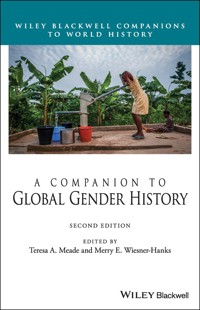
When a book project, no matter how long or short in the making, comes to an end, authors confront a final step of choosing an image for the cover, a task that is often pleasant, but also challenging. For this new edition, we wanted the cover to illustrate the long temporal sweep of gender history and the diversity of topics contained in the book, as well as highlight their global reach. The image we selected has just the geographic and chronological breadth we sought. In it a woman in the rural Ghanaian village of Mowire fills buckets of water that she and her daughter, who sits nearby, will carry a long distance. According to Nancy Borowick, who took the photograph, women like this along with “children as young as three or four head to the nearest well multiple times during the day to pump water for their homes for bathing, cooking and drinking.” This scene, repeated in poor countries throughout the world where water is scarce, expensive, and time‐consuming to obtain, conveys the reality that collecting, pumping, hauling, and standing in line for water is gendered work. Historically, women drawing or carrying water appear on early Chinese scrolls, ancient Etruscan jars, and classical Greek vases. Stories from the Bible feature women at wells, while traditional Indian songs and dances portray women getting water from the Ganges. Just enter “women carrying water” in a computer search engine and you can spend hours in front of a screen looking at “Indian Women Carrying Water,” “Bedouin Women Carrying Water,” “Maasai Tribal Women Carrying Water,” and so on. You could even buy enough tote bags and pillow covers with reproductions of classical and contemporary art portraying women toiling with water to fill an entire house.
According to the United Nations, women and girls worldwide spend 200 million hours a day collecting water, time that takes away from caring for their families, attending school, taking care of themselves, or doing anything else. For many women, this can mean as much as five hours daily traveling over rugged terrain transporting water, sometimes in dangerous conditions. Women balance huge jugs on their heads while pregnant and carrying children, or lead youngsters who are themselves loaded down with bottles and cans. Women and children also suffer the direst effects of contaminated water since toxins are absorbed by pregnant women, pass into breast milk and on to infants and young children. This is true throughout the world, from isolated villages in Ethiopia to metropolitan cities such as Flint, Michigan. But women are also fighting for clean water: women protested contaminated city water in Flint, and as Jocelyn Olcott explains in her chapter in this volume, Aymara women led the fight against the Bolivian government’s privatization of the water system and sale of water rights to the US‐based Bechtel Corporation in 1997. Mexican women organized campaigns to bring clean water to cities and villages, a basic human need which the outbreak of the COVID‐19 pandemic – in which handwashing is the most important precaution – made even more evident. On the cover of this book an African woman’s muscles strain as she fills multiple buckets at a communal well, a task representative of gendered labor for all time. But she also suggests an area in which women are working toward a different future, as they do in many chapters in this book.
We could have chosen any number of images that point to the past, present, and future of gender because, perhaps even more than when the first edition appeared a decade ago, gender is everywhere on the international stage. As chapters by Patricia Acerbi, Barbara Winslow, Charles Sowerwine, Patricia Grimshaw, and others in this book point out, feminism has grown in strength in many quarters of the world. It is challenging male authority on the playing field, in the courts, in entertainment and the media, and in the upper echelons of power, as women seek gender equality. The largest protest demonstration in the history of the world, the Women’s March of 2017, brought millions into the streets, while the spread of #MeToo has empowered women in many fields. On the other hand, as many of our authors note, growing nativist and nationalist movements across the globe have also unveiled the enduring strength of misogyny, especially as it intersects with racism. The wage gap persists, and only a small percentage of women reach top leadership positions in government and business. Even the impact of the 2020 worldwide pandemic has been shaped by gender: incidents of domestic violence against women and children rose precipitously in households where multiple family members were confined for weeks to prevent the spread of contagion; workers in hospitals, nursing homes, and other care facilities most at risk of exposure to the virus were – and are – disproportionately female; women also predominate in the low‐wage service jobs that are impossible to do from home or while maintaining the “social distancing” that the COVID‐19 pandemic requires. Female national leaders, including New Zealand’s Jacinda Ardern, Germany’s Angela Merkel, Finland’s Sanna Marin, and Taiwan’s Tsai Ing‐wen, also did better than their male counterparts at fighting the virus, with much lower death rates and better infection control. The countries with the highest death rates were all led by authoritarian men more concerned with projecting their masculinity than protecting public health.
The prominence of gender in historical scholarship matches its visibility on the world political stage. More than thirty years ago Joan Wallach Scott argued in the pages of the American Historical Review that history was enacted on the “field of gender.” Scott defined gender as “a social category imposed on a sexed body,” and stated, in a line that has since been quoted by scholars in many fields, that “gender is a primary way of signifying relations of power.”1 Scott later explained that she had originally wanted to pose the salience of gender to historical analysis as a question, but the editors of the American Historical Review would not allow questions in article titles.2 In the decades since her article appeared, that salience has become clear. Gender – understood as a culturally constructed, historically changing, and often unstable, system of differences – has become a standard category of historical analysis for many younger historians, and a fair share of older ones as well. The women’s history on which gender analysis was initially based has continued to flourish and expand.
What has also happened in the last thirty years is that historical gender analysis and women’s history have increasingly become international enterprises, in terms of both the focus of scholarship and the scholars involved. While the footnotes in Scott’s article – and most other theoretical discussions of gender from the 1980s – were numerous and wide‐ranging, almost all of them referred to studies of the United States or Europe. Since then, new research has begun to challenge understandings of gender derived primarily from the Western experience, and examine the role of women and of gender in global processes. Because of this, we decided to slightly retitle this second edition, adding Global and making it A Companion to Global Gender History.
For this second edition, every chapter has been updated since the first edition, along with the inclusion of seven new authors and seven completely new chapters reflecting topics that have becoming increasingly important in the last decade, including material culture, science, and global imperialism. Written by authors from across the English‐speaking world, the book includes a diversity of viewpoints and reflects questions that have been explored in different cultural and historiographic traditions, thus providing an overview of gender history worldwide. We have attempted to decenter the West, locating Western Europe and North America as simply one of many social formations within a gendered world history that expands from many hubs. As both scholars and teachers, the contributors understand the importance of making difficult concepts understandable, providing evidence for complex assertions regarding gender identity, and grappling with evolving notions of gender construction. We have sought to preserve the features readers praised in the first edition, including balanced coverage of the field of women’s and gender history. In this way the book contributes to the history of women, studying their interactions with men in a gendered world, and also explores the role of gender in shaping human interaction over thousands of years. Each chapter includes suggestions for further reading that give readers the necessary tools to pursue a subject further.
When thinking about how to organize such an enormous project, we decided that it would be useful for readers to have both thematic chapters that provide conceptual overviews of the ways in which gender has intersected with other historical topics and categories of analysis, and more traditional chronological–geographic chapters that explore gender in one area of the world during a specific period (though these are of necessity very broad). We could not cover every part of the world in every time period in a single volume, but we provide enough chapters in each period to allow comparisons between different regions of the world, and enough chapters about one area to allow the tracing of change over time within it. We gave the authors a relatively free hand to explore their particular topic in the way they saw fit, celebrating differences as useful examples through which to assess the ways in which insights in one area can challenge received wisdom and standard generalizations in another.
One of the key points emerging from this collection is that no generalization about gender has applied to all times or all places. Indeed, even Scott’s definition of gender as “a social category imposed on a sexed body,” while acceptable thirty years ago when scholars were asserting the difference between “cultural” gender and “biological” sex, is today highly contested. As the chapter by Deirdre Keenan examines in more depth, intersex and trans individuals have challenged the notion that gender is based on the body. They highlight the nebulous boundaries and permeable nature of the categories “women” and “men,” and challenge us to think carefully when using these words. Historical and anthropological research from around the world has similarly provided evidence of societies in which gender was not based on body parts or chromosomes, but on something else. Sometimes this was a person’s relationship to reproduction, so that adults were gendered male and female, while children and old people were regarded as different genders, and one’s gender thus changed over the span of a lifetime. In some societies gender may have been determined by one’s role in production or religious rituals, with individuals who were morphologically (that is, physically) male or female regarded as the other gender, or as members of a third or even fourth or fifth gender. Marcia‐Anne Dobres suggests that there is evidence for third genders as early as the Mesolithic period (10,000 BCE), Kumkum Roy discusses destabilization of binary gender categories in the Jain tradition, and Rosemary Joyce explores gender fluidity in the early Americas, as does Barbara Andaya in early modern Southeast Asia. Robert Nye notes the continuing power of the two‐gender system, however, and analyzes the ways notions of gender intertwined with those of sexuality.
Another key point of this collection is that gender must always be considered in connection with other categories of difference and social hierarchies, such as class, race, ethnicity, sexual orientation, ability, religion, and so on. Often these social hierarchies reinforced one another in systems of oppression that were multiplicative rather than additive, conceptually defined as “intersectionality.” Many of the chapters in this book examine such interlocking hierarchies. As Susan Kingsley Kent observes in her review of gender and the law, legislation governing the right to vote, own property or retain an inheritance, laws determining the ownership of slaves, statutes preventing foreigners from gaining citizenship, and so forth, have always rested on the intersection of gendered assumptions of race and class. Nupur Chaudhuri and Utsa Ray discuss the intertwining of gender and racial understandings in colonial India, where colonial authorities viewed Englishmen as vigorous and “manly” while Bengali men were dependent, soft, and “feminine.” Several chapters, including those by Barbara Winslow and Patricia Acerbi, examine movements that challenged these interlocking hierarchies, particularly those that connected feminism with the struggle for national liberation and anticolonialism, thereby challenging both imperialist and gender hierarchies. Those struggles continue, as witnessed by the March for Black Trans Lives in Brooklyn in June 2020, which brought more than 10,000 people together, one of many demonstrations for racial justice around the world that summer, sparked by police violence and systemic inequalities.
Others chapters look at situations in which social hierarchies counteracted one another or created contradictions. Many of the essays in this collection discuss high‐status women who ruled over or alongside men despite cultural norms that decreed female inferiority and subservience. Bella Vivante points to the ruling queens from pharaonic and Ptolemaic Egypt and Kate Kelsey Staples those of medieval Europe. Amy Kallander highlights the important political, social, and philanthropic roles of women in the Ottoman and Mughal ruling courts, and Christine Worobec examines the empresses of eighteenth‐century Russia and Eastern Europe.
Several of the chapters provide evidence of more fluid gender roles – whether positive or negative – while others point to ways in which many types of historical developments served to rigidify existing notions of masculinity and femininity. This included the social stratification that accompanied the rise of centralized states in Mesopotamia and Mesoamerica, as Bella Vivante and Rosemary Joyce point out. It continued with the spread of text‐based religions and philosophical systems, such as Christianity and Confucianism, which tended to relegate women to an inferior status, as Barbara Andaya and Vivian‐Lee Nyitray note.
Colonization was a potent force in creating more rigid gender roles. Allyson Poska and Susan Amussen discuss ways in which European empires imposed patriarchal norms on those they encountered in the Atlantic World, and also trace how women resisted European domination by asserting their traditional gendered power and authority. Sean Redding’s chapter demonstrates how Europeans colonizing Africa sided with the most retrograde aspects of the colonized, and imposed male domination in ways it had not previously existed, a process Utsa Ray finds in other imperial settings as well. Colonization also created new myths, particularly related to masculinity. The frontier narrative, from crossing the Great Plains of North America to forging into the jungles of Africa to subduing the Indian subcontinent, has been a mainstay of triumphalist historical narratives and the core of the western literary canon. Linda Kealey, Charles Sowerwine, and Patricia Grimshaw challenge American, Canadian, and Australian frontier mythology, and point to links between this and later racism and exclusivity.
As they provide evidence for both fluidity and rigidity in gender structures, the essays also provide evidence on both sides of the debate about women’s agency and oppression. Merry Wiesner‐Hanks, Raevin Jimenez, and Kumkum Roy document ways in which the family and kin group served as an institution protecting and supporting male privilege and patrilineal descent, but also as a location of real female power. Judith Tucker explores the ways in which the doctrines and institutions of Islam were both restrictive and liberating for women, while Meghan Roberts notes that early modern women worked actively in science and medicine, creating networks that enabled them to do so, despite enormous constraints and marginalization. Anne Walthall traces how Chinese women created a rich literary culture in the seventeenth and eighteenth centuries, despite Confucian ideas about women’s inferiority, and other authors also highlight women’s writing, music, and dance. Several authors discuss new scholarship on the actions of enslaved people in creating new cultural and social forms despite the humiliation, violence, disease, and dehumanization brought by enslavement.
Women’s history began in some ways as a branch of social history, and many of the chapters include extensive discussions of issues that matter to social historians: the family, work and leisure experiences, marriage patterns, and class differences. Laura Frader provides an overview of the historical influence of gender on labor and looks particularly at the ways that women’s and men’s work has been valued differently over time, a fact that the examinations of labor in the chronological‐geographic essays reinforce. Marcia Wright discusses how kinship systems in Africa adapted to dramatic social and economic change, revealing women’s important role as entrepreneurs. Julie Hardwick finds similar adaptation in early modern Western Europe, as does Amy Kallander in the early modern Middle East, although both authors remind us that the impact of economic development, and of other social and political changes, was very different for elite urban dwellers than for rural people. According to Deborah Simonton, complex and conflicting gender ideologies in the modern era intersected with industrialism and urban development in Europe, and Linda Kealey emphasizes the same processes in Canada.
The scholarship of the last forty years has made clear, however, that the centrality of gender is not limited to social issues, and many of the chapters examine themes that have traditionally been the province of political, diplomatic, and even military historians. Though some mainstream national history – the accounts that legitimate nations and their governments – remains cut off from the interpretative richness gender analysis provides, the process of building and ruling societies has always been carried out according to gendered principles. Judith Tucker examines the relationship between nationalist struggles and women’s movements in the nineteenth and early twentieth‐century Middle East; Anne Walthall and Barbara Molony do the same in East and Southeast Asia. Sonya Lipsett‐Rivera analyzes the roles women assumed in the rebellions and wars of independence in Latin America, and Sean Redding those in Africa. Barbara Molony and Karen Petrone suggest ways that the study of war – long viewed as a primarily masculine realm, though rarely studied as such – benefits from closer analysis of gender. According to Molony, the sex slavery that was part of World War II in Asia came into the headlines in 1991 when Korean and Chinese women forced into prostitution to serve the Japanese imperial army during World War II as so‐called “comfort women” came forward to demand reparations. Comfort women’s memoirs deepen our understanding of conflict worldwide, as have the accounts of Holocaust survivors, refugees, and other war victims. Because sex slavery, rape as a tool of combat, and similar practices are not, nor have ever been, unique to Japan, the history of war can be better understood when it incorporates these deeply troubling issues. Engendering war, as these chapters do, brings to mind the writer Viet Thanh Nguyen’s terse dismissal of the heroism of masculine combat: “Not all soldiers are rapists, but every army rapes.”3




