


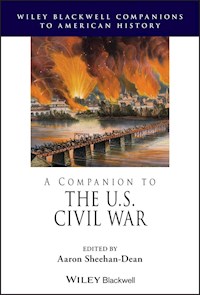
A Companion to the U.S. Civil War E-Book
62,99 €
Mehr erfahren.
- Herausgeber: John Wiley & Sons
- Kategorie: Geisteswissenschaft
- Serie: Blackwell Companions to American History
- Sprache: Englisch
A Companion to the U.S. Civil War presents a comprehensive historiographical collection of essays covering all major military, political, social, and economic aspects of the American Civil War (1861-1865). * Represents the most comprehensive coverage available relating to all aspects of the U.S. Civil War * Features contributions from dozens of experts in Civil War scholarship * Covers major campaigns and battles, and military and political figures, as well as non-military aspects of the conflict such as gender, emancipation, literature, ethnicity, slavery, and memory
Sie lesen das E-Book in den Legimi-Apps auf:
Seitenzahl: 2613
Veröffentlichungsjahr: 2014
Ähnliche




















Contents
Volume I
Notes on Contributors
Preface
Acknowledgments
Part I: CAMPAIGNS AND BATTLES
Chapter One: VIRGINIA 1861
REFERENCES
Chapter Two: MISSOURI
General Histories
Early Battles
Confederate Incursions into Missouri, 1862–1863
The Price Raid
Unit Histories and Soldier Diaries and Memoirs
Guerrilla Warfare
Biographies
Reference Works
REFERENCES
Chapter Three: MISSISSIPPI VALLEY CAMPAIGN
REFERENCES
Chapter Four: 1862 SHENANDOAH VALLEY CAMPAIGN
REFERENCES
Chapter Five: LOGISTICS
Procurement, Organization, and Supply
Distribution
Confederate Shortages
REFERENCES
Chapter Six: PENINSULA CAMPAIGN
REFERENCES
Chapter Seven: SOLDIERS
REFERENCES
Chapter Eight: KENTUCKY
Kentucky’s Civil War Significance and Historiography
Secession Crisis, Neutrality, and Politics
Kentucky Goes to War: Mobilization and Two Confederate Invasions
Emancipation and Black Soldiers
Guerrilla Warfare and Racial Violence
Concluding the War: Vanquished Become Victors
Conclusion and Suggestions for Further Research
REFERENCES
Chapter Nine: GUERRILLAS
Defining Civil War Irregulars: The Scholarly Debate
Guerrilla Memoirs/Histories Written by Veterans
Biographies and Unit Histories
U.S. Army Counter-Irregular Warfare
The Vietnam War’s Impact on U.S. Civil War Scholarship
Scholarship on Militant Dissent in the Civil War
“The Long War” and U.S. Civil War Guerrilla Studies
REFERENCES
Chapter Ten: MARYLAND CAMPAIGN OF 1862
REFERENCES
Chapter Eleven: BATTLE OF ANTIETAM
The Commanders
Battle Histories
Phases of the Battle
Specialized Studies and the Battle’s Aftermath
REFERENCES
Chapter Twelve: CIVIL WAR TACTICS
The Last Napoleonic War or the First Modern War?
Strategies, Doctrine, Operations, and Tactics
How Soldiers Fought
Tactics: How Battles Were Fought
Unit Histories
The State of Civil War Tactical Scholarship
REFERENCES
Chapter Thirteen: BATTLE OF FREDERICKSBURG
REFERENCES
Chapter Fourteen: BLOCKADING CAMPAIGNS
Contemporary Accounts of the Blockade
The Efficacy of U.S. Navy Enforcement
Economic Impact of the Blockade
The Blockade as Naval Strategy
The Blockade as Foreign Policy
REFERENCES
Chapter Fifteen: CHANCELLORSVILLE CAMPAIGN
A Campaign of Contingency
Hooker’s Campaign Plan and Opening Moves
The Battle of Chancellorsville, May 1 and 2, 1863
The Battle of Chancellorsville, May 3 and 4, 1863
The End of the Campaign and Strategic Results
REFERENCES
Chapter Sixteen: BATTLE OF GETTYSBURG
REFERENCES
Chapter Seventeen: AFRICAN-AMERICAN SOLDIERING
REFERENCES
Chapter Eighteen: VICKSBURG CAMPAIGN
REFERENCES
Chapter Nineteen: OCCUPATION
REFERENCES
Chapter Twenty: ARKANSAS
REFERENCES
Chapter Twenty-One: INDIAN AMERICA
We Are All Americans
Allies
Soldiers
Civilians and Refugees
“Insurgents”
The Vanishing Indian
REFERENCES
Chapter Twenty-Two: NAVAL DEVELOPMENT AND WARFARE
Organization and Leadership
Sailors’ Lives
Blockade
Technology and Naval Revolution
Syntheses
REFERENCES
Chapter Twenty-Three: BATTLES OF CHICKAMAUGA AND CHATTANOOGA
Opening Moves in the Tullahoma Campaign
McLemore’s Cove
The Battle of Chickamauga, September 18–20, 1863
Chattanooga Campaign
REFERENCES
Chapter Twenty-Four: ATLANTA CAMPAIGN
REFERENCES
Chapter Twenty-Five: GEORGIA AND CAROLINAS CAMPAIGNS
First Histories
Modern Overviews
State Studies: Georgia
The Carolinas
Social History
REFERENCES
Chapter Twenty-Six: PRISONS
REFERENCES
Chapter Twenty-Seven: 1864 SHENANDOAH VALLEY CAMPAIGN
REFERENCES
Chapter Twenty-Eight: OVERLAND CAMPAIGN, 1864
REFERENCES
Chapter Twenty-Nine: LOUISIANA AND TEXAS CAMPAIGNS
REFERENCES
Chapter Thirty: PETERSBURG CAMPAIGN
Background
Grant and Federal Strategy at Petersburg
Grant’s Summer Offensives
The Longest Winter
The Final Battles of the Petersburg Campaign
Campaign Historiography
African Americans and Civilians in the Petersburg Campaign
Siege Warfare and Life in the Trenches
Conclusion
REFERENCES
Chapter Thirty-One: TECHNOLOGY AND WAR
REFERENCES
Chapter Thirty-Two: WAR AND ENVIRONMENT
REFERENCES
Chapter Thirty-Three: APPOMATTOX CAMPAIGN
REFERENCES
Chapter Thirty-Four: MEDICINE AND HEALTH CARE
Overview: Organization and Challenges
Medical Issues
Historiographical Questions and Challenges
The Current State of the Field
REFERENCES
Chapter Thirty-Five: CIVIL WAR VETERANS
General Studies
Institutional and Political Histories
Veterans in Gilded Age America
Memory
Pensions and Economic Issues
Disability
Biographies
Masculinity
Conclusion
REFERENCES
Volume II
Part II: LEADERS
Chapter Thirty-Six: ULYSSES S. GRANT
Hardscrabble
Reunion and Reaction
A Baby Politician but Brilliant General
The Unredeemed Captive
Grant’s Ascension
Who’s Buried in Grant’s Tomb?
REFERENCES
Chapter Thirty-Seven: ROBERT E. LEE
REFERENCES
Chapter Thirty-Eight: UNITED STATES GENERALS
Grant
McClellan
Sherman
Second Ranking Generals
REFERENCES
Chapter Thirty-Nine: ABRAHAM LINCOLN
Early Life
Springfield and the Law
Antebellum Political Career and Slavery’s Critic
Road to the White House and the Secession Crisis
President and Commander in Chief
Lincoln and Emancipation
Conclusion: General Biographies
REFERENCES
Chapter Forty: JEFFERSON DAVIS
REFERENCES
Chapter Forty-One: FREDERICK DOUGLASS
REFERENCES
Part III: POLITICS, SOCIETY, AND CULTURE
Chapter Forty-Two: CIVIL WAR DIPLOMACY
Confederate Diplomacy
Union Diplomacy
Foreign Powers
Contexts and Legacies
REFERENCES
Chapter Forty-Three: ETHNICITY
REFERENCES
Chapter Forty-Four: WOMEN
REFERENCES
Chapter Forty-Five: MANHOOD
REFERENCES
Chapter Forty-Six: NORTHERN POLITICS
The Republican Party
The Democratic Party
The Party System
Politics, Political Culture, and National Identity
REFERENCES
Chapter Forty-Seven: SOUTHERN POLITICS
REFERENCES
Chapter Forty-Eight: NORTHERN DISSENT
REFERENCES
Chapter Forty-Nine: SOUTHERN DISSENT
Dissent and the Question of Confederate Defeat
Defining the Dissenter
Conclusions
REFERENCES
Chapter Fifty: NORTHERN HOME FRONT
Civil War Cities
The Rural North during the Civil War
Conclusion
REFERENCES
Chapter Fifty-One: SOUTHERN HOME FRONT
The Role of Southern Communities in the Civil War
The Effect of the Civil War on Southern Communities
REFERENCES
Chapter Fifty-Two: ABOLITIONISTS IN THE CIVIL WAR
Abolitionists before the Civil War
Abolitionists during the Civil War
Post–Struggle for Equality Treatments of Abolitionists during the Civil War
More Recent Extensions of Larger Studies of Abolitionism into the Civil War Years
Abolitionist Women during the Civil War
Abolitionists in Recent Studies of the Civil War Era
Conclusion
REFERENCES
Chapter Fifty-Three: SLAVERY IN THE CIVIL WAR
REFERENCES
Chapter Fifty-Four: EMANCIPATION
Early Scholarship
The Contours of Emancipation
Gender
Lincoln and Emancipation
Who Freed the Slaves?
The Transnational Turn in Emancipation Studies
REFERENCES
Chapter Fifty-Five: LITERATURE
REFERENCES
Chapter Fifty-Six: MUSIC
Foundations
The Patriotic Declension Thesis
Sectional Studies
Songs and Songwriters
African Americans
Women
Military Bands and Bandsmen
Recent Syntheses
REFERENCES
Chapter Fifty-Seven: RELIGION
REFERENCES
Chapter Fifty-Eight: CONSTITUTION AND LAW
The Nature of the Union
The Coercive Power of the State
The State and the Economy
African Americans and the Union
Citizenship
The Constitution
REFERENCES
Chapter Fifty-Nine:NATIONALISM
REFERENCES
Chapter Sixty: WARTIME POLITICAL ECONOMY
REFERENCES
Part IV: THE CIVIL WAR IN HISTORY
Chapter Sixty-One: THEORY AND METHOD
Agency
Aftermath
REFERENCES
Chapter Sixty-Two: THE GLOBAL CIVIL WAR
REFERENCES
Chapter Sixty-Three: WARTIME ORIGINS OF RECONSTRUCTION
The Politics of Wartime Reconstruction
The Wartime Origins of Free Labor
The Wartime Development of the Free Black Community
REFERENCES
Chapter Sixty-Four: MEMORY
REFERENCES
Name Index
Subject Index
WILEY BLACKWELL COMPANIONS TO AMERICAN HISTORY
This series provides essential and authoritative overviews of the scholarship that has shaped our present understanding of the American past. Edited by eminent historians, each volume tackles one of the major periods or themes of American history, with individual topics authored by key scholars who have spent considerable time in research on the questions and controversies that have sparked debate in their field of interest. The volumes are accessible for the non-specialist, while also engaging scholars seeking a reference to the historiography or future concerns.
Published:
A Companion to the American RevolutionEdited by Jack P. Greene and J. R. Pole
A Companion to 19th-Century AmericaEdited by William L. Barney
A Companion to the American SouthEdited by John B. Boles
A Companion to American Women’s HistoryEdited by Nancy Hewitt
A Companion to American Indian HistoryEdited by Philip J. Deloria and Neal Salisbury
A Companion to Post-1945 AmericaEdited by Jean-Christophe Agnew and Roy Rosenzweig
A Companion to the Vietnam WarEdited by Marilyn Young and Robert Buzzanco
A Companion to Colonial AmericaEdited by Daniel Vickers
A Companion to American Foreign RelationsEdited by Robert Schulzinger
A Companion to 20th-Century AmericaEdited by Stephen J. Whitfield
A Companion to the American WestEdited by William Deverell
A Companion to the Civil War and ReconstructionEdited by Lacy K. Ford
A Companion to American TechnologyEdited by Carroll Pursell
A Companion to African-American HistoryEdited by Alton Hornsby
A Companion to American ImmigrationEdited by Reed Ueda
A Companion to American Cultural HistoryEdited by Karen Halttunen
A Companion to California HistoryEdited by William Deverell and David Igler
A Companion to American Military HistoryEdited by James Bradford
A Companion to Los AngelesEdited by William Deverell and Greg Hise
A Companion to American Environmental HistoryEdited by Douglas Cazaux Sackman
A Companion to Benjamin FranklinEdited by David Waldstreicher
A Companion to World War Two (2 volumes)Edited by Thomas W. Zeiler with Daniel M. DuBois
A Companion to American Legal HistoryEdited by Sally E. Hadden and Alfred L. Brophy
A Companion to John Adams and John Quincy AdamsEdited by David Waldstreicher
A Companion to the U.S. Civil War (2 volumes)Edited by Aaron Sheehan-Dean
In preparation:
A Companion to American Sports HistoryEdited by Steven Riess
A Companion to Custer and the Little Big Horn CampaignEdited by Brad D. Lookingbill
A Companion to the Meuse-Argonne Campaign, 1918Edited by Edward G. Lengel
PRESIDENTIAL COMPANIONS
Published:
A Companion to Franklin D. RooseveltEdited by William Pederson
A Companion to Richard M. NixonEdited by Melvin Small
A Companion to Theodore RooseveltEdited by Serge Ricard
A Companion to Thomas JeffersonEdited by Francis D. Cogliano
A Companion to Lyndon B. JohnsonEdited by Mitchell Lerner
A Companion to George WashingtonEdited by Edward G. Lengel
A Companion to Andrew JacksonEdited by Sean Patrick Adams
A Companion to Woodrow WilsonEdited by Ross A. Kennedy
A Companion to James Madison and James MonroeEdited by Stuart Leibiger
A Companion to Harry S. TrumanEdited by Daniel S. Margolies
In preparation:
A Companion to Abraham LincolnEdited by Michael Green
A Companion to Dwight D. EisenhowerEdited by Chester J. Pach
A Companion to Ronald ReaganEdited by Andrew L. Johns
A Companion to the Antebellum Presidents, 1837–61Edited by Joel Silbey
A Companion to the Reconstruction Presidents, 1865–81Edited by Edward Frantz
A Companion to Gerald R. Ford & Jimmy CarterEdited by V. Scott Kaufman
A Companion to Warren G. Harding, Calvin Coolidge, and Herbert HooverEdited by Katherine A. S. Sibley
A Companion to John F. KennedyEdited by Marc Selverstone
This edition first published 2014© 2014 John Wiley & Sons, Inc.
Registered OfficeJohn Wiley & Sons, Ltd, The Atrium, Southern Gate, Chichester, West Sussex, PO19 8SQ, UK
Editorial Offices350 Main Street, Malden, MA 02148–5020, USA9600 Garsington Road, Oxford, OX4 2DQ, UKThe Atrium, Southern Gate, Chichester, West Sussex, PO19 8SQ, UK
For details of our global editorial offices, for customer services, and for information about how to apply for permission to reuse the copyright material in this book please see our website at www.wiley.com/wiley-blackwell.
The right of Aaron Sheehan-Dean to be identified as the author of the editorial material in this work has been asserted in accordance with the UK Copyright, Designs and Patents Act 1988.
All rights reserved. No part of this publication may be reproduced, stored in a retrieval system, or transmitted, in any form or by any means, electronic, mechanical, photocopying, recording or otherwise, except as permitted by the UK Copyright, Designs and Patents Act 1988, without the prior permission of the publisher.
Wiley also publishes its books in a variety of electronic formats. Some content that appears in print may not be available in electronic books.
Designations used by companies to distinguish their products are often claimed as trademarks. All brand names and product names used in this book are trade names, service marks, trademarks or registered trademarks of their respective owners. The publisher is not associated with any product or vendor mentioned in this book.
Limit of Liability/Disclaimer of Warranty: While the publisher and authors have used their best efforts in preparing this book, they make no representations or warranties with respect to the accuracy or completeness of the contents of this book and specifically disclaim any implied warranties of merchantability or fitness for a particular purpose. It is sold on the understanding that the publisher is not engaged in rendering professional services and neither the publisher nor the author shall be liable for damages arising herefrom. If professional advice or other expert assistance is required, the services of a competent professional should be sought.
Library of Congress Cataloging-in-Publication Data
A companion to the U.S. Civil War / edited by Aaron Sheehan-Dean. volumes cm. – (Wiley Blackwell companions to American history ; 77) Includes bibliographical references and index.
ISBN 978-1-4443-5131-6 (hardback)1. United States–History–Civil War, 1861–1865. I. Sheehan-Dean, Aaron Charles, editor of compilation. E468.C73 2014 973.7–dc23
2013046763
A catalogue record for this book is available from the British Library.
Cover image: Volume 1: The Fall of Richmond, 1865, lithograph by Currier & Ives. Library of Congress, Prints and Photographs Collection. Volume 2: Sergeant Alex Rogers with Battle Flag, Eighty-third Pennsylvania Volunteers, Third Brigade, First Division, Fifth Corps, Army of the Potomac, albumen silver print from glass, c. 1863. Metropolitan Museum of Art, Purchase, Alfred Stieglitz Society Gifts, 2013 (2013.50).© 2013. Image copyright The Metropolitan Museum of Art / Art Resource / Scala, FlorenceCover design by Richard Boxall Design Associates
Volume I
Notes on Contributors
Sean Patrick Adams is Associate Professor of History at the University of Florida. He is the author of Old Dominion, Industrial Commonwealth: Coal, Politics, and Economy in Antebellum America (2004) and is currently completing a book on energy transitions in home heating in the nineteenth-century United States.Paul Christopher Anderson teaches at Clemson University. He is the author of Blood Image: Turner Ashby and the Civil War in the Southern Mind, and is currently working on Sorrow the Living, Sorrow the Dead, which examines the collapse of the South Carolina chivalry, as well as After the Fire, a trilogy about cultural reconstruction in the Shenandoah Valley.Aaron Astor is Associate Professor of History at Maryville College in Maryville, Tennessee. He is the author of Rebels on the Border: Civil War, Emancipation and the Reconstruction of Kentucky and Missouri, 1860–1872 (2012) and earned his PhD in History at Northwestern University in 2006.L. Diane Barnes is Professor of History at Youngstown State University, where she pursues research interests in nineteenth-century social history, slavery and abolition, and documentary editing. She is associate editor of the Frederick Douglass Papers and editor of the journal Ohio History. Her writings include Frederick Douglass: Reformer and Statesman; The Old South’s Modern Worlds: Slavery, Region and Nation in the Age of Progress; and Artisan Workers in the Upper South: Petersburg, Virginia, 1820–1865.Michael T. Bernath is Charlton W. Tebeau Associate Professor in American History at the University of Miami. He is the author of Confederate Minds: The Struggle for Intellectual Independence in the Civil War South.Andrew S. Bledsoe is Assistant Professor of History at Lee University. His work on American Civil War soldiers and officers has appeared in a number of books and journals. He is author of the forthcoming Citizen-Officers: The Union and Confederate Volunteer Junior Officer Corps in the American Civil War, 1861–1865.Keith S. Bohannon is Associate Professor of History at the University of West Georgia. He is the author of numerous scholarly articles and essays and co-editor with Randall Allen of Campaigning with “Old Stonewall”: Confederate Captain Ujanirtus Allen’s Letters to His Wife (1998).James J. Broomall is an Assistant Professor in the Department of History at the University of North Florida. A scholar of the nineteenth century, he has both presented on and written about this topic in numerous forums and is currently writing a book-length study of masculinity and emotions in the Civil War era South. His work has appeared in the edited collection Creating Citizenship in the Nineteenth-Century South, and in the Journal of the Civil War Era, among other venues.Jacqueline Glass Campbell is an Associate Professor of History at Francis Marion University. She earned her PhD from Duke University in 2000 and is the author of When Sherman Marched North from the Sea: Resistance on the Confederate Home Front (2003). Her current project is titled “A Unique but Dangerous Entanglement”: Benjamin F. Butler in Occupied New Orleans.Bradley R. Clampitt is an Assistant Professor of History at East Central University. He is the author of The Confederate Heartland: Military and Civilian Morale in the Western Confederacy (2011).Benjamin Franklin Cooling is currently Professor of National Security Studies at the Eisenhower School for National Security and Resource Strategy at the National Defense University. He is the author of numerous histories of the Civil War, including Counter Thrust: From the Peninsula to the Antietam and Symbol, Sword and Shield: Defending Washington during the Civil War.Lynda Lasswell Crist has been the editor of The Papers of Jefferson Davis at Rice University since 1979.Brian Dirck is Professor of History at Anderson University. He has written numerous books and articles on Abraham Lincoln and the Civil War, including Lincoln and Davis: Imagining America, 1809–1865; Lincoln the Lawyer, a study of Lincoln’s legal career; Lincoln and the Constitution; and Abraham Lincoln and White America.Steven Nathaniel Dossman teaches at Texas Christian University in Fort Worth, Texas. He is the author of Campaign for Corinth: Blood in Mississippi and Vicksburg, 1863: The Deepest Wound.Don H. Doyle is McCausland Professor of History at University of South Carolina. He has published Nations Divided: The United States, Italy, and the Southern Question; Nationalism in the New World, edited with Marco Pamplona; and Secession as an International Phenomenon (edited). He is finishing a book on America’s International Civil War.Michael A. Flannery is Professor and Associate Director for Historical Collections, University of Alabama at Birmingham. Besides the works cited in his chapter, he is also the co-editor (with Katherine H. Oomens) of Well Satisfied with My Position: The Civil War Journal of Spencer Bonsall (2007).Andre M. Fleche is Associate Professor of History at Castleton State College. His work on African-American Civil War soldiers has appeared in the journal Civil War History and elsewhere. He is the author of The Revolution of 1861: The American Civil War in the Age of Nationalist Conflict.Lorien Foote is Professor of History at Texas A&M University. She is the author of two books, including The Gentlemen and the Roughs: Manhood, Honor and Violence in the Union Army (2010), which was Honorable Mention for the Lincoln Prize.Buck T. Foster (PhD Mississippi State University) is a native of Booneville, Arkansas and is presently a Visiting Assistant Professor at the University of Central Arkansas, where he teaches courses in American history, military history, and the Old South. He is the author of Sherman’s Mississippi Campaign.Barbara A. Gannon is currently an Assistant Professor of History at the University of Central Florida. She is the author of The Won Cause: Black and White Comradeship in the Grand Army of the Republic, which was awarded the Wiley-Silver Prize for the best first book on the Civil WarJudith Giesberg teaches at Villanova University and is the author of three books on the Civil War, Civil War Sisterhood: The United States Sanitary Commission and Women’s Politics in Transition (2000),“Army at Home”: Women and the Civil War on the Northern Home Front (2009), and Keystone State in Crisis: Pennsylvania in the Civil War (2013).James Gillispie is the Vice President for Academic Affairs and a Professor of History at Sampson Community College in Clinton, North Carolina. He is the author of Andersonvilles of the North: The Myths and Realities of Northern Treatment of Civil War Confederate Prisoners (2008) and Cape Fear Confederates: The 18th North Carolina Regiment in the Civil War (2011). He teaches courses on mid nineteenth-century Southern history, the Civil War era, and the Great War.Robert L. Glaze holds degrees in history from Kennesaw State University (BA) and the University of West Georgia (MA). He is currently a PhD candidate at the University of Tennessee in Knoxville.David T. Gleeson is Reader in American History at Northumbria University in Newcastle upon Tyne, England. He is the author of The Irish in the South, 1815–1877 (2001) and editor of The Irish in the Atlantic World (2010). His most recent work is The Green and the Gray: The Irish in the Confederate States of America (2013).Mark Grimsley is an Associate Professor of History at Ohio State University and the author of numerous books and articles on the Civil War, including And Keep Moving On: The Virginia Campaign, May–June 1864.Kurt Henry Hackemer is Professor of History and Associate Vice President for Academic Affairs at the University of South Dakota. His books include The U.S. Navy and the Origins of the Military-Industrial Complex, 1847–1883 (2001) and To Rescue My Native Land: The Civil War Letters of William T. Shepherd, First Illinois Light Artillery (2005).Stanley Harrold is Professor of History at South Carolina State University. Among his publications during the past decade are Subversives: Antislavery Community in Washington, D.C., 1828–1865 (2003), The Rise of Aggressive Abolitionism: Addresses to the Slaves (2004); and Border War: Fighting over Slavery before the Civil War (2010).D. Scott Hartwig is a veteran of thirty-two years of the National Park Service and works as a supervisory historian at Gettysburg National Military Park. He is the author of To Antietam Creek: The Maryland Campaign of 1862 (2012).Wayne Wei-siang Hsieh is the author of various articles and West Pointers and the Civil War: The Old Army in War and Peace (2009). He is an Assistant Professor of History at the United States Naval Academy in Annapolis, MD.Caroline E. Janney is Associate Professor of History at Purdue University. She is the author of Burying the Dead but Not the Past: Ladies’ Memorial Association and the Lost Cause and Remembering the Civil War: Reunion and the Limits of Reconciliation.Brian Matthew Jordan is a doctoral candidate at Yale University and adjunct instructor in the Civil War Era Studies Department at Gettysburg College. His dissertation, “When Billy Came Marching Home,” is exploring how Union veterans came to terms with the experience of the war in the decades after Appomattox.Christian B. Keller is Professor of History at the United States Army War College, Carlisle, PA. Along with many scholarly articles, he is author of Chancellorsville and the Germans: Nativism, Ethnicity, and Civil War Memory (2007) and co-author of Damn Dutch: Pennsylvania Germans at Gettysburg (2004).James Marten is Professor and Chair of the History Department at Marquette University, former President of the Society of Civil War Historians, and author or editor of more than a dozen books on the sectional conflict and children’s history. His most recent book is Sing Not War: The Lives of Union and Confederate Veterans in Gilded Age America (2011).Jaime Amanda Martinez is an Assistant Professor at the University of North Carolina at Pembroke, where she teaches the U.S. Civil War and African American History. She has published essays on wartime slave hiring and the Confederate economy, and is completing a book-length manuscript on slave impressment in Virginia and North Carolina.Christian McWhirter is an Assistant Editor for the Papers of Abraham Lincoln and the author of Battle Hymns: The Power and Popularity of Music in the Civil War.Kathryn Shively Meier is Assistant Professor of History at Virginia Commonwealth University. Her first book, Nature’s Civil War: Common Soldiers and the Environment in 1862 Virginia (2013), has been awarded the Edward M. Coffman Prize.Brian Craig Miller is Assistant Professor and Associate Chair of History at Emporia State University and serves as Book Review Editor for Civil War History. His publications include A Punishment on the Nation (2012) and John Bell Hood and the Fight for Civil War Memory (2010).Jennifer M. Murray is an Assistant Professor of History at the University of Virginia’s College at Wise. She is the author of The Civil War Begins and the forthcoming “On a Great Battlefield”: The Making, Management, and Memory of Gettysburg National Military Park, 1933–2012.Barton A. Myers is Assistant Professor of Civil War History at Washington and Lee University. He is the author of Executing Daniel Bright: Race, Loyalty and Guerrilla Violence in a Coastal Carolina Community, 1861–1865, which received the Jules and Frances Landry Award in Southern Studies.Samuel Negus is a final-year PhD candidate at Texas Christian University in Fort Worth. His primary research addresses politics and foreign policy in the Early American Republic. He has previously written journal articles on various naval and diplomatic aspects of the Civil War for Civil War History and the Northern Mariner.Megan Kate Nelson is a Lecturer in History and Literature at Harvard University. She is the author of Ruin Nation: Destruction and the American Civil War (2012) and Trembling Earth: A Cultural History of the Okefenokee Swamp (2005). She lives in Lincoln, Massachusetts.Clayton R. Newell retired from the Army in 1992. Since then, he has been an independent military historian, consultant, and writer. His published works include Lee vs. McClellan: The First Campaign and Of Duty Well and Faithfully Done: A History of the Regular Army in the Civil War, co-authored with Charles R. Shrader.Jonathan A. Noyalas is Assistant Professor of History and Director of the Center for Civil War History at Lord Fairfax Community College in Middletown, Virginia. He is the author or editor of eight books on Civil War Era history, including Stonewall Jackson’s 1862 Valley Campaign: War Comes to the Homefront.Timothy J. Orr is an Assistant Professor of History at Old Dominion University in Norfolk, Virginia. He is the editor of Last to Leave the Field: The Life and Letters of First Sergeant Ambrose Henry Hayward, and he has authored several essays analyzing partisanship in the Union Army.Scott C. Patchan is the author of The Forgotten Fury: The Battle of Piedmont (1996), Shenandoah Summer: The 1864 Valley Campaign (2007), The Battle of Piedmont and Hunter’s Raid on Staunton (2011), Second Manassas: Longstreet’s Attack and the Struggle for Chinn Ridge (2011), and The Last Battle of Winchester (2013). He also served as a contributing historian and author for TimeLife’s Voices of the Civil War: Shenandoah 1864 and has written dozens of articles on the Civil War.Jeffrey Patrick completed his MA in history at Purdue University, and is currently the librarian at Wilson’s Creek National Battlefield. He has published numerous books and articles on military history, including Campaign for Wilson’s Creek: The Fight for Missouri Begins, for which he received the Eastern National Author’s Award.Elizabeth Brown Pryor is the author of numerous books and articles on nineteenth-century history, including Clara Barton, Professional Angel and Reading the Man: A Portrait of Robert E. Lee through His Private Letters. The latter won multiple awards, including the Lincoln Prize and the Jefferson Davis Award.Paul Quigley is the James I. Robertson Jr. Associate Professor of Civil War Studies at Virginia Tech and director of the Virginia Center for Civil War Studies. He is the author of Shifting Grounds: Nationalism and the American South, 1848—65 (2011).Carol Reardon is the George Winfree Professor of American History and scholar-in-residence of the George and Ann Richards Civil War Era Center at Penn State University. She is a past president of the Society for Military History.Brian Holden Reid is Professor of American History and Military Institutions, King’s College London, and since 2010 Academic Member of College Council. His books include J.F.C. Fuller: Military Thinker (1987, 1990), The Origins of the American Civil War (1996), Robert E. Lee: Icon for a Nation (2005, 2007) and America’s Civil War: The Operational Battlefield, 1861–1863 (2008).John C. Rodrigue is the Lawrence and Theresa Salameno Professor in the Department of History at Stonehill College. He is the author of Reconstruction in the Cane Fields: From Slavery to Free Labor in Louisiana’s Sugar Parishes, 1862–1880 (2001); and Lincoln and Reconstruction (2013).Anne Sarah Rubin is an Associate Professor of History at the University of Maryland, Baltimore County. Her book A Shattered Nation: The Rise and Fall of the Confederacy received the 2006 Avery O. Craven Award. Her study of the memory of Sherman’s March, entitled Through the Heart of Dixie: Sherman’s March and America will be published in 2014.John M. Sacher is an Associate Professor at the University of Central Florida. His A Perfect War of Politics: Parties, Politicians, and Democracy in Louisiana, 1824–1861 won the Kemper and Leila Williams Prize for best book on Louisiana History. His research focuses on nineteenth-century politics, and he is currently investigating Confederate conscription.Christian G. Samito obtained his law degree from Harvard Law School and his PhD in American history from Boston College. He teaches at Boston University School of Law and his most recent book is Becoming American under Fire: Irish Americans, African Americans, and the Politics of Citizenship during the Civil War Era (2009).Robert M. Sandow is Professor of History at Lock Haven University of Pennsylvania and author of Deserter Country: Civil War Opposition in the Pennsylvania Appalachians (2009). His research focuses on the Northern home front with special interest in issues of politics, dissent, and the impact of war on society.Sean A. Scott is Visiting Assistant Professor at Christopher Newport University. He published A Visitation of God: Northern Civilians Interpret the Civil War in 2011 and is currently researching church–state relations during the Civil War.Jay Sexton is University Lecturer and Tutorial Fellow in American History at Corpus Christi College, University of Oxford. He has written on Civil War foreign relations, international finance in the nineteenth century, the Monroe Doctrine, and the global legacy of Abraham Lincoln.Aaron Sheehan-Dean is the Fred C. Frey Professor of Southern Studies at Louisiana State University. He is the author of Why Confederates Fought: Family and Nation in Civil War Virginia and the Concise Historical Atlas of the U.S. Civil War, and the editor of several works on the conflict. He teaches courses on nineteenth-century U.S. history, the Civil War and Reconstruction, and Southern History.Adam I. P. Smith is Senior Lecturer in U.S. History at University College London. He is the author of No Party Now: Politics in the Civil War North (2006) and The American Civil War (2007).Mark A. Snell has served as the director of the George Tyler Moore Center of the Study of the Civil War at Shepherd University since 1993, where he is also Professor of History. He is a retired U.S. Army officer and former Associate Professor of History at the United States Military Academy. During the fall semester of 2008 he was the Visiting Senior Lecturer of War Studies at the Royal Military Academy Sandhurst in the United Kingdom. He is the author of From First to Last: The Life of Major General William B. Franklin (2002). His most recent book is West Virginia and the Civil War: Mountaineers Are Always Free (2011).Yael A. Sternhell received her PhD from Princeton University and is currently Assistant Professor of History and American Studies at Tel Aviv University. Her first book, Routes of War: The World of Movement in the Confederate South, was published in 2012.Margaret M. Storey is Associate Professor of History at DePaul University. She is the author of Loyalty and Loss: Alabama’s Unionists in the Civil War and Reconstruction (2004) and editor of Tried Men and True: or Union Life in Dixie (2010), the memoir of a Tennessee Union cavalryman.Matthew Warshauer is a Professor of History at Central Connecticut State University and serves as the co-chair of the Connecticut Civil War Commemoration Commission. He is the author of Connecticut in the American Civil War; Andrew Jackson and the Politics of Martial Law; and Andrew Jackson in Context.Bradford A. Wineman is an Associate Professor of Military History at the United States Marine Corps Command and Staff College, Marine Corps University, Quantico, Virginia. He is the author of “Trains, Canals and Turnpikes: Transportation in Civil War Virginia, 1861–1865,” in the edited volume Virginia at War, 1864 (2009).
Preface
Why are there so many books on the U.S. Civil War? If anything in Civil War history approaches an existential question, that is it. Despite the groaning shelves, the endless graduate student reading lists, and the intimidation factor such a dense historiography presents to both novices and experts, we continue to research and write new works at a prodigious pace. We cannot seem to help ourselves. As the historiography grows larger and more intricate it inspires more debates, more questions, more research. Occasionally, new evidence appears which can encourage scholars to challenge seemingly secure interpretations. New analytical tools – from the use of literary theory and postmodern philosophy to data mining to the rise of geographic information systems – allow us to reevaluate existing paradigms. The readily availabile primary evidence on the conflict ensures that it will always draw scholars’ attention. The Civil War happened among a highly literate, mostly place-bound population in an industrializing nation. The mid-nineteenth century may turn out to be unique in terms of the volume of handwritten records produced that have been preserved (certainly it looks so from the vantage point of the early twenty-first with its daily cleansing of electronic inboxes). Families saved letters, local historical societies and libraries collected newspapers, and the creation of professional archives and historical societies at the time when veterans began producing their histories and memoirs created an almost unmatched collection of evidence for future scholars.
But even if the sources are available, what makes it important to write about the Civil War? Why bother? The conflict provides a graceful fulcrum point in national histories, combining great drama with an uplifting story about national integrity and success. It also provides the materials for a darker gloss on that collective story. The virulence with which white Southerners defended slavery, the reluctance with which most Northerners supported emancipation, the brutal fighting and astonishingly high casualty rates, and the uncertainty of the war nullify any tendency toward smug celebration. Easy moralizing aside, historians are drawn to the war because so many of the issues and problems of modern America seem to derive from it: our obsession with race as a way of ordering individual and group identity; debates over the proper balance of federal and state authority; the nature of American nationalism in a culturally diverse republic; the role of violence and conflict in our public lives; and the struggle over how democracy should work and where sovereignty resides.
Because of its robustness as a field, Civil War history functions as a useful mirror on both academic and popular attitudes toward the past. Scholars writing in the vibrant subfield of memory studies have elaborated the ways in which memories and discussions of the Civil War reflect Americans’ core beliefs and political struggles. Their analyses have focused mostly on popular celebrations, commemorations, and memories of the conflict. In contrast, this collection offers historiographical essays that chart how scholars have understood the conflict. A long-standing division of the field into Fundamentalists (or Traditionalists) and Revisionists structures much of the literature. As the essays demonstrate, many late nineteenth- and early twentieth-century historians regarded the conflict as inevitable and as driven largely by disputes over slavery. In the 1920s and 1930s a new generation of historians rejected this approach. They transferred the lessons of World War I – that military violence accomplished little beyond death and destruction – to the Civil War and interpreted the conflict as contingent and avoidable. Largely ignoring the problem of slavery, those scholars restored an important, if overstated, degree of human choice and action to the story. As Americans came to rethink the meaning and role of race in national life in the 1950s and 1960s, scholars turned back toward the Fundamentalist position, this time viewing slavery not as a political dispute among white Americans but as the root of an intractable problem. As the essays in this collection reveal, the distinction between Fundamentalists and Revisionists helps organize writing on the conflict, but the essays also reveal that such a clean division may have outlived its usefulness. In particular, the social and cultural histories of the last decade have drawn our attention to issues beyond causation, which undergirds the customary division in the literature outlined above.
Some scholars have written histories of the broad changes in the field (such as Thomas J. Pressly, and James M. McPherson and William J. Cooper). Others have compiled bibliographies or guides to selected subfields (such as Steven E. Woodworth, Lacy Ford, and David J. Eicher). But the diversity of subfields within Civil War history and the sheer volume of writing means that a full historiography can only succeed if it leverages the talents of a wide array of scholars. Further, because the essays written for this collection came from experts in their various subfields and because they followed the conventions of their peers, the essays themselves possess great variety in terms of tone, format, and approach. Some chapters tell the story of the historians who fashioned the literature and in that way illuminate the topic. Others focus on the topic itself – say, narrating the account of a battle – and in the process explain how the literature developed. Even where there are complementary essays on Northern and Southern aspects of the same issue – politics or home fronts, for instance – the style and tone may differ significantly. Any effort on my part to impose uniformity on the structure and perspective of the essays failed in the face of the individuality of the authors and the unique nature of the literature on the various subfields.
I opted for a rather traditional division of chapters by sections representing military affairs, leaders, political, social, economic, and cultural topics, and methodological concerns. This approach promised to offer readers the easiest way to dip into the book in search of answers to particular questions. But it has the considerable flaw of suggesting that these realms – war, politics, society, culture – were somehow distinct. Among the most important accomplishments in the field over the last twenty-five years (and this is a point made by many authors in their essays) has been collapsing these artificial distinctions and recapturing the holistic experience of war that defined the lives of participants. The histories of battles and campaigns in Volume I reflect this shift by considering how societies mobilized for war, how battlefront and home-front space often overlapped, how both nations’ armies treated civilians, and how popular conceptions of military fortunes shaped political attitudes and support for war. The political and social histories of Volume II reveal how the war reshaped American life. The industries in each region flourished or failed based on what they contributed to the war effort. People’s conceptions of manhood and femininity fluctuated as wartime issues and concerns pressed new challenges upon them. Religious faith reflected a person’s national loyalty and determined the conflict’s meaning. At a fundamental level, war experiences shaped how people understood what it meant to be American, foreign, male, female, white, black, loyal, or disloyal.
The artificial divisions between academic and public history – trotted out by many – are also transcended in this volume. Few of the authors distinguish between the two supposedly separate genres, and then only with regard to the first generation of scholarship, when many books were compiled by participants of the war with explicitly political aims. Civil War historians benefit from writing in a field that generates both popular interest and lay readers as well independent scholars who approach our common material from a broad range of perspectives. Rather than watering down the field, as some lament, this opportunity has encouraged historians to explain the significance of their research to people not well versed in the professional debates. Quite unintentionally, this process has enriched those very debates. As the essays here demonstrate, what matters to Civil War historians are methodologically rigorous and persuasive arguments, regardless of whether they come from a trade press or an academic press.
The complex relationships among different subfields and different analytical methods sketched above suggest that the present volumes could have been organized much differently. Historiographies of the Civil War can proceed chronologically, exploring how the literature changed over time, or they can divide geographically, comparing the ways in which historians have treated different regions. They can revolve around the major debates that have spurred investigation and argument. All these structures have strengths and weaknesses. The present volumes combine different approaches – sometimes essays focus on a particular place (for example, Missouri), other times on a discrete event (the Battle of Gettysburg), and still others focus on thematic issues (nationalism or religion, for example) – because this best captures the range and diversity of styles used by historians themselves. Even so, and despite its considerable size, this collection has gaps, some accidental and others the result of circumstances during its production.
Given all that historians have accomplished in terms of thinking about the U.S. Civil War, a reader may well wonder if we are not better off ending the search. Don’t we know enough now? Is there really more to learn that has not been covered in the 60,000 books already written on the conflict? One answer is that the quest to understand the Civil War, or indeed any history, will never be complete. As new experiences and new questions press themselves upon us we return to the past with new eyes. The answer that presents itself after a reading of the essays in these volumes is that great new opportunities have opened up thanks to the integration of military, political, social, and cultural history over the last three decades. We should continue the practice of bringing battlefront and home front together. We need many more cultural investigations that explore how the war challenged Americans’ intellectual, religious, and moral frameworks. We need more studies that broadly situate the war in the flow of history across the nineteenth century rather than marking it out as distinct. We need more global histories that connect foreign actors to the war and trace the influence of the conflict on the rest of the world.
And we should reaffirm the old tradition of Civil War history that is relevant to its readers. It is easy now to condemn the Revisionists who interpreted the war in the light of World War I’s needless killing and saw a similar waste in the Civil War. It is also easy to see how modern Fundamentalists drew inspiration from the Civil Rights Movement and the challenges it posed to the meaning of race in the United States. But the confidence with which we condemn or dismiss histories where present concerns weigh heavily conceals the impact of our own society and lives on the history we write. More importantly, it erodes our professional imperative to speak clearly to issues of major importance in the world today. Civil War history will always be fascinating and will always be relevant. Investigating its history helps us understand a host of issues that bear on the world today – the role and scope of political dissent in wartime, the appropriate balance between civil liberties and national security, how to enforce international laws of war in military conflicts, and how wars create unexpected opportunities for political and social change even as they forestall other reform possibilities, to mention only a few. The challenge for future historians of the conflict lies in finding ways to achieve these goals while staying engaged with the historiographical discussions so ably documented in this collection.
Acknowledgments
When Peter Coveney first raised the idea of publishing a historiographical collection on the Civil War, I encouraged him because I thought it seemed like a good idea and because I figured someone else would edit it. I still believe it is a good idea, despite having been the person who agreed to take on the task. But all I really did was coordinate. My deepest thanks go to the sixty-three authors who agreed to write the essays and then delivered thoughtful and clear explanations of what we do as Civil War historians. Reading through the essays one last time, I am astounded by how much they cover and by how many insights they offer not just on the Civil War but on history more broadly. Gary Gallagher and Peter Carmichael offered sage advice about topics and structuring as well as helping me to identify potential authors. I am grateful to them both, as I am to the anonymous readers of the original proposal who suggested additions and deletions that improved the collection considerably. Peter Coveney has offered patient and wise counsel all along, humoring me as the volumes expanded and encouraging me when obstacles appeared. The project editors and assistants at Wiley Blackwell – Galen Smith, Allison Medoff, Elizabeth Saucier, and Georgina Coleby – have been consistently efficient and friendly. My thanks to them for all their help. Last, my thanks and love to Megan, Liam, and Annie who tolerated my groaning about deadlines and editing and who always help me see the value in both the past and the present.
Part I
CAMPAIGNS AND BATTLES
Chapter One
VIRGINIA 1861
Clayton R. Newell
On April 12, 1861, Confederate artillery in Charleston Harbor fired on the Union garrison at Fort Sumter and opened hostilities in the Civil War. But the first significant land battles occurred further north in Virginia. The war in the Old Dominion in 1861 took place in three phases. In May, Union forces launched an invasion into western Virginia that eventually kept that section of the Old Dominion in the Union as the state of West Virginia; in July, a Confederate army scored a major success against the Union at Bull Run; and in August, Confederate President Jefferson Davis dispatched Robert E. Lee to western Virginia in what turned out to be a failed attempt to regain control of that part of the state. Of the three, Bull Run or Manassas is well remembered as a Confederate victory that sent Union forces hightailing it into Washington. However, unlike the events in western Virginia that led to the formation of a new state in the Union, the battle outside Washington had no long-lasting consequences. In 1965, Richard O. Curry in his book noted that “The strategic importance of Northwestern Virginia to the Northern cause, however, has not been appreciated by most students of the Civil War” (1964: 65).
Lesen Sie weiter in der vollständigen Ausgabe!
Lesen Sie weiter in der vollständigen Ausgabe!
Lesen Sie weiter in der vollständigen Ausgabe!
Lesen Sie weiter in der vollständigen Ausgabe!
Lesen Sie weiter in der vollständigen Ausgabe!
Lesen Sie weiter in der vollständigen Ausgabe!
Lesen Sie weiter in der vollständigen Ausgabe!
Lesen Sie weiter in der vollständigen Ausgabe!
Lesen Sie weiter in der vollständigen Ausgabe!
Lesen Sie weiter in der vollständigen Ausgabe!
Lesen Sie weiter in der vollständigen Ausgabe!
Lesen Sie weiter in der vollständigen Ausgabe!
Lesen Sie weiter in der vollständigen Ausgabe!
Lesen Sie weiter in der vollständigen Ausgabe!
Lesen Sie weiter in der vollständigen Ausgabe!
Lesen Sie weiter in der vollständigen Ausgabe!
Lesen Sie weiter in der vollständigen Ausgabe!
Lesen Sie weiter in der vollständigen Ausgabe!
Lesen Sie weiter in der vollständigen Ausgabe!
Lesen Sie weiter in der vollständigen Ausgabe!
Lesen Sie weiter in der vollständigen Ausgabe!
Lesen Sie weiter in der vollständigen Ausgabe!
Lesen Sie weiter in der vollständigen Ausgabe!
Lesen Sie weiter in der vollständigen Ausgabe!
Lesen Sie weiter in der vollständigen Ausgabe!
Lesen Sie weiter in der vollständigen Ausgabe!
Lesen Sie weiter in der vollständigen Ausgabe!
Lesen Sie weiter in der vollständigen Ausgabe!
Lesen Sie weiter in der vollständigen Ausgabe!
Lesen Sie weiter in der vollständigen Ausgabe!
Lesen Sie weiter in der vollständigen Ausgabe!
Lesen Sie weiter in der vollständigen Ausgabe!
Lesen Sie weiter in der vollständigen Ausgabe!
Lesen Sie weiter in der vollständigen Ausgabe!
Lesen Sie weiter in der vollständigen Ausgabe!
Lesen Sie weiter in der vollständigen Ausgabe!
Lesen Sie weiter in der vollständigen Ausgabe!
Lesen Sie weiter in der vollständigen Ausgabe!
Lesen Sie weiter in der vollständigen Ausgabe!
Lesen Sie weiter in der vollständigen Ausgabe!
Lesen Sie weiter in der vollständigen Ausgabe!
Lesen Sie weiter in der vollständigen Ausgabe!
Lesen Sie weiter in der vollständigen Ausgabe!
Lesen Sie weiter in der vollständigen Ausgabe!
Lesen Sie weiter in der vollständigen Ausgabe!
Lesen Sie weiter in der vollständigen Ausgabe!
Lesen Sie weiter in der vollständigen Ausgabe!
Lesen Sie weiter in der vollständigen Ausgabe!
Lesen Sie weiter in der vollständigen Ausgabe!
Lesen Sie weiter in der vollständigen Ausgabe!
Lesen Sie weiter in der vollständigen Ausgabe!
Lesen Sie weiter in der vollständigen Ausgabe!
Lesen Sie weiter in der vollständigen Ausgabe!
Lesen Sie weiter in der vollständigen Ausgabe!
Lesen Sie weiter in der vollständigen Ausgabe!
Lesen Sie weiter in der vollständigen Ausgabe!
Lesen Sie weiter in der vollständigen Ausgabe!
Lesen Sie weiter in der vollständigen Ausgabe!
Lesen Sie weiter in der vollständigen Ausgabe!
Lesen Sie weiter in der vollständigen Ausgabe!
Lesen Sie weiter in der vollständigen Ausgabe!
Lesen Sie weiter in der vollständigen Ausgabe!
Lesen Sie weiter in der vollständigen Ausgabe!
Lesen Sie weiter in der vollständigen Ausgabe!
Lesen Sie weiter in der vollständigen Ausgabe!
Lesen Sie weiter in der vollständigen Ausgabe!
Lesen Sie weiter in der vollständigen Ausgabe!
Lesen Sie weiter in der vollständigen Ausgabe!
Lesen Sie weiter in der vollständigen Ausgabe!




