


Erhalten Sie Zugang zu diesem und mehr als 300000 Büchern ab EUR 5,99 monatlich.
- Herausgeber: Birlinn
- Kategorie: Geisteswissenschaft
- Sprache: Englisch
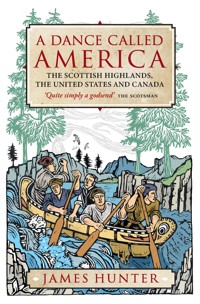
Journey from the Isle of Skye to the Deep South, to the Rockies and beyond. A dance was devised in eighteenth-century Skye. An exhilarating dance. A dance, a visitor reports, 'the emigration from Skye has occasioned'. The visitor asks for the dance's name. 'They call it America,' he's told. Over a period of three centuries, many thousands of people left the islands and wider north of Scotland to make new lives across the sea. In this new edition of his acclaimed book, historian James Hunter follows in their footsteps – from the Deep South to the Rockies and beyond – to tell the story of the Highland impact on the New World. In doing so, he reveals how soldiers, explorers, guerrilla fighters, fur traders, lumberjacks, railways builders and settlers from Scotland's glens and islands contributed much to the USA and Canada. It is the story of how a hard-pressed people found in North America a land of opportunity. In this edition features a new introduction from James Hunter, where he reflects on what led him to embark on travels and researches that took him across a continent.
Sie lesen das E-Book in den Legimi-Apps auf:
Seitenzahl: 683
Veröffentlichungsjahr: 2022
Das E-Book (TTS) können Sie hören im Abo „Legimi Premium” in Legimi-Apps auf:
Ähnliche


















James Hunter is Emeritus Professor of History at the University of the Highlands and Islands. He has written extensively about the north of Scotland and about the region’s worldwide diaspora. In the course of a varied career he has been, among other things, director of the Scottish Crofters Union, chairman of Highlands and Islands Enterprise and an award-winning journalist. His book Set Adrift upon the World was Saltire History Book of the Year in 2016.
‘This book is quite simply a godsend . . . A Dance Called America for me is the book of the year’
George Gunn, Scotsman
‘A book that should be read by everyone of Highland descent and by any Scot who has more than a passing interest in his or her sense of nationality’
David Ross, Herald
‘An excellent . . . account of a fascinating subject’
Alan Bold, Sunday Times
‘There have been several books on the Highland Clearances, which are one of history’s great tragedies, but nobody else has looked at what happened to the Highlanders once they got to other countries . . . I found this book quite simply fascinating and engrossing. I read it quite compulsively’
Joe Farrell, BBC Radio 3
This edition first published in 2022 by
Birlinn Limited
West Newington House 10 Newington Road
Edinburgh
EH9 1QS
www.birlinn.co.uk
First published by Mainstream Publishing Company in 1994
Copyright © James Hunter 1994, 2022
ISBN 978 1 78027 719 6
The right of James Hunter to be identified as the author of this work has been asserted by him in accordance with the Copyright, Designs and Patents Act, 1988
British Library Cataloguing-in-Publication Data
A catalogue record of this book is available on request from the British Library
Typeset by Hewer Text UK Ltd, Edinburgh
Papers used by Birlinn are from well-managed forests and other responsible sources
Printed and bound by Clays Ltd, Elcograf S.p.A.
For Iain and Anna
In the evening the company danced as usual. We performed, with much activity, a dance which, I suppose, the emigration from Skye has occasioned. They call it America. Each of the couples, after the common involutions and evolutions, successively whirls round in a circle, till all are in motion; and the dance seems intended to show how emigration catches, till a whole neighbourhood is set afloat.
James Boswell, Journal of a Tour to the Hebrides, 2 October 1773
Contents
Introduction
1 King George and Broadswords!
2 What, Then, is the American, This New Man?
3 A Hardy and Intrepid Race of Men
4 To Found in the New Land a New Glengarry
5 Such of Them as Did Not Die While Going Across the Ocean
6 Many Men Have Loved the Island of Cape Breton
7 Lords of the Lakes and the Forests
8 Even if the Emigrants Escape the Scalping Knife
9 Stand Fast, Craigellachie!
10 I Will Fight No More Forever
11 The Power of Your Dreams
Bibliography
Index
Introduction
The maps I used when making the road trips that underpin this book are maps that have survived. But excavated from the cupboard where they’ve languished for nigh on 30 years, they look to have acquired an antique aura. Today, I guess, I’d happily rely on one or other of the in-car aids that, with a modicum of effort on your part, tell you exactly how to get from one point to another. But back in the early 1990s there was no alternative to maps. Bought for a dollar or two at off-interstate gas stations, picked up from airport information desks, in motel lobbies or in travel centers, my maps were mostly turned out, I see, by Rand McNally, by MapArt, by the American Automobile Association or its Canadian equivalent. Among the 40 or so items I’ve dug out are some less standardised productions that deal in small localities. Firmly in this category are a North Glengarry Tour Map, a foldout guide to Flathead Lake and Mission Valley, a map of Industrial Cape Breton, another of Québec et Environs. But maps of this sort are, I find, in a minority. Most show bigger areas: New York State, Saskatchewan, Ontario; Washington State, British Columbia, Idaho, Montana; Nova Scotia, Manitoba, North Carolina and Alberta.
Bundled up in this same cupboard are leaflets and flyers that helped make sense of what I saw when in the places where I found them. Some have to do with battles that occurred at Moore’s Creek Bridge, at Big Hole and on the Plains of Abraham. Others are introductions to what, in North America, are called historic sites – Johnson Hall, Grosse Île, Lower Fort Garry, Fortress Louisbourg and Fort William, for example. A third set stems from visits to a variety of interpretative institutions – Glace Bay Miners Museum, Lachine Fur Trade Museum, Museum of the Cape Fear and Winnipeg’s Museum of Man and Nature.
To look again at glossy, illustrated brochures of this sort is at once to unleash memories. But not so many, I find, as resurface when I open one or other of my strictly unpictorial and starting-to-be-faded paper maps. Here, for instance, is a map of Georgia. It’s one of Rand McNally’s. There’s a price sticker for $1.95 on its cover. Inside, a couple of locations have been circled heavily in pencil. One of them is Savannah, where on a long-gone August evening I flew in from Inverness by way of London and Washington DC.
At a car rental desk, which I’d called from Scotland some weeks previously (this being prior to the email era), I got the standard – somewhat quizzical – US reaction to a driver’s licence consisting, as UK licences then did, of a sheet of paper folded into a cellophane wrapper. I confirmed that my rented car would be dropped off not back there in Savannah, but some 300 miles away at Fayetteville, North Carolina. I paid what was owing, got keys to a vehicle, directions to the rental parking lot and a further set of instructions as to how to reach the interstate, which, I gathered and my map confirmed, was fairly close at hand.
Outside, night was falling and it was raining slightly. But it was also, as compared with where my day-long journeyings had started, very warm. I stowed my luggage in the car’s trunk and, after a bit of re-familiarisation with American-style controls, set off for the supposedly easy-to-find interstate – this being the I-95, which traverses eastern Georgia on its way from Maine to Florida.
Within minutes I’d become entangled in a maze of streets intended to give access to truck depots, storage sheds and other buildings of the type that cluster around airports. I’d just stopped to see what I might glean from Rand McNally – Travellers Would Be Lost Without Us! – when from behind there came another vehicle. It pulled alongside. It was, I realised, a police car. It contained, I saw, two cops.
There’s a plotline you get often in movies and crime novels set in the US South. It’s late and wet and dark and muggy and oppressive. Then there’s a police cruiser. Next, guns come out and things end really badly.
Because I’d seen or read too much of this stuff, I lowered my window with some trepidation. Where was I headed? asked a voice. To the interstate, I said, while hoping that my accent would make clear just how I’d got myself to where I surely wasn’t meant to be. And after that? the voice asked. To Darien, I said. What’s with Darien? the voice asked – with more curiosity, I should make clear, than menace.
A chunk or two of history would have had to be included in a proper explanation as to why, the moment I was in the country, I’d turned my back on one of America’s more attractive cities and plumped instead for a little place of no great consequence a good ways down the coast. Darien, I could have said, was where in the 1730s there took shape this continent’s first substantial settlement of Scottish Highlanders. It was thus the obvious starting point for someone aiming, as I was, to write a book about the Highland impact on the United States and Canada. But this, I reckoned, would be greater detail than was wanted. And so I stuck with saying that Darien was where I’d got a reservation. The voice seemed satisfied. Just follow us, it said. We’ll take you to the interstate. And so those good guys did.
Not much more than an hour later I was checking into a Darien motel. Since my last meal of any consequence had been an airline lunch served over the Atlantic, I was hungry. But since it had by now gone 4 a.m. where I had started out from, I was also very tired. And so I went immediately to bed – promising myself that, first thing in the morning, I’d seek out, as proved a simple matter, one of those Southern eating places where they ply you with all the coffee you can handle before providing you with eggs and ham and grits and sausage, plus several rounds of toast and jelly, all on one enormous plate.
***
I began to take an interest in outflows of people from the Highlands to the Atlantic Ocean’s other side when, between 1971 and 1974, I researched and wrote a doctoral thesis dealing, first, with the forcible displacement of much of northern Scotland’s population and, second, with this population’s fightback. But my focus then, and in The Making of the Crofting Community, the published version of my thesis, was on what folk were leaving, not at all on where they went or on how they made out when they got there. That changed when, starting in 1980, I got a chance to make some visits to the US and Canada. These included a couple of four-week stints made possible by summer-school teaching deals: one in Cape Breton Island, the other in North Idaho. Evelyn, my wife, and our two children (to whom this book is dedicated) came with me on those jaunts. They made for great vacations. They also made me want to write about the way the Highlands, as I’d now learned at first hand, continue to have meaning and significance for Americans and Canadians of (as they themselves might put it) Scottish heritage.
Impressions dating from that time are to be found in what you are (I trust) about to read. So are insights deriving from the many books I took home from my forays. A key starting point was the output of creative writers – Hugh MacLennan and Margaret Laurence prominent among them – whose fiction and essays tell of what it is to be a North American with roots in the Highlands. Equally informative, and so frequently consulted that my copy’s pages have parted company with its bindings, is Sister Margaret MacDonell’s 1982 collection of Gaelic songs and poems from North Carolina, the Canadian Maritimes, Ontario and elsewhere. Next to Sister Margaret’s anthology on my shelves are more prosaic accounts of places shaped and things accomplished by Highlanders of whom, before I made my own Atlantic crossings, I had not so much as heard.
Some discoveries were (to me, at least) exciting. One stemmed from a purchase made towards the close of our family stay in Idaho, when we headed off on an excursion to Seattle and Vancouver – prior to driving through the Rockies, by way of Kamloops and the Kicking Horse Pass, to Banff in Alberta. There, at the close of a day spent gazing at the mountains surrounding Lake Louise, we paid a visit to the no longer extant but then regionally iconic Book and Art Den on Banff Avenue. In one of the several purchases I made in that timber-fronted store, I find on opening the paperback in question, there survives a line-drawn bookmark of a sort that was a Book and Art Den speciality. The book containing this bookmark was written by Peter C. Newman, one of late twentieth-century Canada’s leading journalists. It’s entitled Caesars of the Wilderness. It’s the second volume of a trilogy about the fur trade and much of it deals with an enormously successful corporation called the North West Company.
‘The North West Company,’ begins Newman’s opening chapter, ‘was the first North American business to operate on a continental scale. Its vast holdings were administered with greater efficiency and larger civil budgets than the provinces of Lower and Upper Canada [today’s Quebec and Ontario]. The NWC’s wilderness headquarters, first at Grand Portage and later at Fort Kaministikwia (renamed Fort William in honour of William McGillivray, the company’s second chief executive officer), could accommodate nearly two thousand people at the height of the trading season, its fifteen-foot palisade of pointed timbers enclosing Canada’s first inland metropolis.’
This concern’s personnel were known in their time as Nor’Westers, and Newman deploys strings of placenames to give some indication of their extraordinary reach: ‘The Nor’Westers’ outposts stretched from Nasquiscow Lake in central Labrador to Fort St James west of the Rockies, north to Fort Good Hope [on the Arctic Circle], south to Astoria at the mouth of the Columbia River on the Pacific, across the Prairies and the Great Lakes.’
These locations span the greater part of modern Canada, the world’s second-largest country. But they don’t by any means delimit the NWC’s sphere of influence. From their Montreal headquarters and from their warehouse complex at nearby Lachine, Newman writes, the Nor’Westers established series after series of trading forts in what today are Oregon, Washington State, Idaho, Montana, North Dakota, Minnesota and Wisconsin. Those areas are now in the US. But had it not been for the North West Company, Newman argues, America’s frontiers would be even more expansive and Canada as we know it would not exist: ‘The impact of [NWC] trading routes was pervasive enough to work the magic that helped save Western Canada from being absorbed into the United States. The land had already been claimed through right of exploration by the Nor’Westers . . . It was a puny scattering of tiny outposts that held the line, but it was enough.’
In advance of my acquiring Caesars of the Wilderness, the only firm I knew of in a fur trade context was the Hudson’s Bay Company. The HBC, like its Asia-facing counterpart, the East India Company, had featured regularly in what I’d read or been taught about the British Empire’s rise to global dominance. And I’m anyway old enough to have attended secondary school in the West Highlands in an era when Bay Company representatives, as their predecessors had done for generations, came recruiting in that part of Scotland – their visits followed by grown-in-the-telling tales of how two or three lads had been persuaded to sign up for service in Baffin Island or some equally romantic-sounding, if doubtless cold and inaccessible, location.
But dipping into Newman, when still in our Banff hotel, I was presented with perspectives I’d not previously come across. Being newly imbued (because of its having taken us two days to get clear through the Rockies) with some sense of Canada’s sheer scale, I’d have anyway been gripped by the scope of Nor’Wester ambitions. But what was truly revelatory was the discovery that the transcontinental trading entity Newman so powerfully describes – this concern that in the decades on each side of 1800 handled four or five times more furs than the Bay Company – was founded, run, controlled by men who’d come to North America from the Scottish Highlands. In ways of which I’d previously known nothing, it now became apparent to me, Highlanders – at periods when their homeland was being raked and scarred by clearance – were exerting a decisive influence on the fortunes of another continent. There was a story here, I felt, that ought to be better known in Scotland. It was a story too, I recognised, that didn’t quite accord with what I’d earlier had to say about how matters had unfolded in the Highlands during the later eighteenth and early nineteenth centuries.
The Scottish north of that time, or so I contended in The Making of the Crofting Community, was a place of social fragmentation and cultural collapse. Deprived by their lairds of homes and land and any hope of betterment, a broken people, I suggested, necessarily took a long time to regroup. Not until the 1880s and subsequently, I maintained, would Highlanders muster the collective self-belief it took to mount the protest movement that at last delivered victories like the winning of security of tenure and the handing back to crofters of some proportion of the area that had earlier been lost. But no broken people, it was clear from reading Peter Newman, could have produced the North West Company. Nor could a broken people have established so widely and so determinedly in North America the many Highlander-settled and (to begin with) Gaelic-speaking communities of whose existence I’d become increasingly aware. How, then, to square this circle?
That it somehow needed squaring was underlined by the appearance in 1991 of a book I think a classic. Written by Canadian historian Marianne McLean and the product of extensive research on both sides of the Atlantic, The People of Glengarry is an intricate account of how successive waves of migrants from the Scottish Glengarry, and from neighbouring localities in western Invernessshire, managed to set up home in what became Glengarry County in the south-eastern corner of what was then Upper Canada. There, McLean comments, those ‘people in transition’ – her shorthand term for them is ‘clansmen’ – succeeded in recreating something of the outlook, ethos, way of thinking they’d known in the communities their Scottish landlords had destroyed. That success, McLean observes, does not accord with my portrayal of the Highland past.
‘James Hunter,’ McLean writes, ‘has argued that the clearances psychologically devastated the clansmen. Their world was turned upside down when their erstwhile leaders suddenly jettisoned ancient social values and substituted individual self-interest for the common good. The Highlanders who experienced the transformation of their society and, in particular, the betrayal of the clearances were, according to Hunter, demoralised and unable to mount an effective resistance to their landlords . . . But if Hunter and others who take this line are correct, how are we to explain the quite different attitude of the Glengarry settlers? The community of Glengarry County was extraordinarily self-confident, a fact that argues that at least some of the clansmen had quite a different experience.’
Marianne McLean is right. While not resiling from my original account of how people who remained in the Highlands responded to what was done to them, I’ve long since come to a realisation – one stemming from exposure to North American perspectives – that I got wrong my understanding of those other Highlanders who headed overseas. Emigration from the Highlands of the clearance epoch – emigration I’d initially portrayed as flight and failure and defeat – can be seen, I now believe, as something else entirely. The decision to quit a homeland in which so much emotion had for so long been invested can properly be interpreted, in part at least, as a self-assured rejection of the path on which the north of Scotland’s landed class had set the region.
This path led from the emptied glens of the Highland interior to the congested and impoverished coastal townships that served as receptacles for families set adrift by mass eviction. There those families, or so clearing landlords intended, would find it impossible to derive a worthwhile livelihood from newly laid-out and always diminutive crofts. There they’d be dragooned into providing lairds with the workforce needed to exploit a seaweed resource which, by the nineteenth century’s opening years, was providing estate owners with profits every bit as big as those yielded by the sheep farms coming into existence in the many places those same owners had depopulated. It was this cheerless prospect, Marianne McLean insists, that Glengarry County’s settlers, her own forebears among them, refused to entertain. ‘The creation of a Highland settlement in Upper Canada,’ she concludes, ‘was an ambitious alternative to the crofting . . . settlements developed by the landlords of western Inverness-shire. The conception and realisation of this alternative was a remarkable achievement; it was this accomplishment which gave birth to the clansmen’s pride in their Glengarry.’
That thinking I embodied in this book – not just in connection with the new Glengarry but in connection also with other North American localities where Highland influence looms large. Space is also found for the Nor’Westers and for the railway-builders, also of Highland origin, who’d one day follow where fur traders led. My intention, I should stress, was by no means to be exhaustive. It was to do no more than offer an overview, a rough-drawn sketch, of themes and topics that could fill a library. And even the sketch proved challenging enough.
***
It was easy to develop an ambition to write about links between the transatlantic world and the Highlands, a term used here to mean the Hebrides as well as Scotland’s northern mainland. It was harder to find the necessary time. I’d begun the 1980s as a newspaper staff-writer turned freelance. Then in 1986 I’d taken a job with the Scottish Crofters Union – a job which meant a family move to Skye. Not until the later part of 1992, by which point I’d reverted to being self-employed, did starting on this book seem feasible. Courtesy of a publisher’s advance, some bits of research funding and an element of cross-subsidy from one or two other activities, I started to accumulate the necessary material.
Historians distinguish between what they call primary and secondary sources. The first consist mainly of documentation from the past – documentation stored usually in public archives. The second take the form of more recent accounts of what it is that’s being looked into. Other than where I draw on early nineteenth-century correspondence kindly copied to me by the late Sir Donald Cameron of Lochiel, what follows relies largely on sources of the secondary type – leavened with a generous sprinkling of quotations from older writings where available in print. Some such material I was able to consult at home in Skye – courtesy of Portree Public Library’s inter-library loan service. More was tracked down in the National Library of Scotland to which, over the winter of 1992–93, I made several week-long visits. A third tranche consisted of publications acquired in the course of travels of the kind that started that August night in Georgia.
Why did I think I had to go there? How was it that I needed all those roadmaps? A good answer can be found in Landscape and Memory by Simon Schama. ‘Historians,’ Schama notes, ‘are supposed to reach the past always through texts, occasionally through images; things that are safely caught in the bell jar of academic convention; look but don’t touch. But one of my best-loved teachers, an intellectual hell-raiser and a writer of eccentric courage, had always insisted on directly experiencing “a sense of place”, of using “the archive of the feet”.’ This Schama himself does to good effect. And though his mention of what he’d heard from his teacher didn’t appear in print until 1996, it’s seemed to me important, ever since I first attempted to write history, to do as he advocates – to spend at least a little time in locales central to such stories as I’m trying to tell.
That’s how it came about that when Evelyn and I married in 1972, one year into my explorations of the crofting past, Evelyn was for better or worse persuaded that our honeymoon should consist of a walking tour of the Hebrides – a tour that happily took in scenes of nineteenth-century confrontations between protesting crofters and the forces of repression. It was necessary, I felt, to get a glimpse of what is out there; to experience, in Schama’s phrase, a sense of place. For that same reason, I’ve since undertaken lots more research-related trips. I don’t do so, I should clarify, with any mystical or supernatural aim in mind. My purpose isn’t to commune with people now long dead. It’s just to be where they were; to see, perhaps describe.
And so, when writing this book, I went twice to North America. My initial journey, in the summer of 1993, took me from Darien to the Cape Fear River area of North Carolina; to the Mohawk Valley in upstate New York; to the St Lawrence estuary, Quebec, Montreal, Lachine, Glengarry County, Ottawa; to various locations in Cape Breton. A second journey, later that same year, was made in winter. It began at Thunder Bay in Northern Ontario. Brief stays there and in an icy Manitoba were followed by a three-day, 850-mile drive across the snowy prairies separating Winnipeg from Calgary. Then came Vancouver and the Fraser Canyon, Spokane, North Idaho and Western Montana.
Those expeditions – south to north in the first instance and then east to west – followed, in rough outline, the spread of Highland settlement across the continent. But to better fit with how I structured my eventual narrative, I here and there depart from how my travels truly were. Thus, as you’ll see, I give readers the impression that I headed south on the I-95 from the Carolinas into Georgia when in fact I took that freeway in the opposite direction. For this, I beg indulgence.
And there’s one very general omission. It would have been good, had time permitted, to have sought out and spoken with more people. That deficiency would later be made good in part when BBC Radio 4 commissioned a documentary series based on this book’s opening chapters. But even in the course of my original two trips there were encounters – some prearranged, some chance – that proved most helpful.
Marianne McLean, whom I’ve already mentioned, took time on a searingly hot day to introduce me to Glengarry County. At Moosomin, Saskatchewan, John Currie, on seeing me looking round a snow-blanketed graveyard and hearing that I was fresh out of Scotland, brought me in from the cold, fed me in his farmhouse kitchen and told me of his community’s links with emigrants – one of them his father – who’d come to that quarter from Benbecula and South Uist more than a century before. Members of Vancouver Gaelic Choir permitted me to wreck an evening practice session by grilling them about their Highland ancestry. And Jim McLeod, a college teacher in Coeur d’Alene, North Idaho, made it possible for me to make contact with the Native American family who feature in my closing chapters.
Back in the summer of 1986, when Jim was looking into his own Highland background and, because of this, consulting some of what I’d written, he and his wife Judy came knocking at our door in Skye. The friendship thus initiated was cemented when, as touched on earlier, I was asked by Jim to help teach a history class at a Coeur d’Alene summer school populated mainly by pipeband members who’d got together there from all across the American West and Western Canada. Hence its being automatic on my side to turn to Jim for help with a request arising from reading I’d been doing preparatory to heading once more for his corner of the States.
This reading’s starting point was the Battle of the Little Bighorn, one of the better-known events in US history and, in essence, an 1876 clash which ended in American forces suffering a crushing defeat at the hands of Lakota, Cheyenne and Arapaho fighters owing allegiance to chiefs like Sitting Bull and Crazy Horse.* Predictably, this US reversal was followed by the deployment of ever more powerful American formations – a development leading, in turn, to Sitting Bull and several thousand of his Lakota people moving from their Montana homeland into Canadian territory, where, around Wood Mountain in what is today Alberta, the Lakota found a sort of sanctuary.
At Wood Mountain in October 1877 Lakota numbers were boosted by refugees from new hostilities resulting from a further Native American grouping, the Nez Perce, having gone to war rather than move on to one of the reservations where, in accordance with US policy, all America’s Indigenous people were being more and more confined. Following a final bloody encounter with the American military in Montana, a Nez Perce contingent made it safely to Sitting Bull’s Wood Mountain encampment. This contingent was led by Chief White Bird. And at Wood Mountain he was shortly to be joined by a young man, one of the chief’s close relatives, whose aim it was to write and to publish an account of the Nez Perce War as that conflict had been experienced, not by the US army but by White Bird and his people. That account, I gathered, had indeed been compiled and printed. This was intriguing. But what, from my standpoint, made it more intriguing still was this writer’s identity. That he’d been close kin to White Bird wasn’t in dispute. But his name – one that could scarcely be more redolent of the Scottish Highlands – was Duncan McDonald.
Today I’d turn to the internet to find out more. But in 1993, when the world wide web was scarcely up and running, all I could readily establish was that Duncan’s father, Angus McDonald, was a Highland-born fur trader who’d left Scotland in 1838 and who’d afterwards married into the Nez Perce. This accounted for Duncan’s close connection with Chief White Bird. But for all that I was anxious to include him in the book I’d now embarked on, the only additional information I’d been able to discover about his wider family consisted mainly of pointers to the locations of trading posts where Duncan’s father had been stationed. The site of one such post, Fort Colville, can be reached from Coeur d’Alene. And so I now phoned Jim McLeod, with whom I anyway meant to visit when back in North America, and said that, when we were together, it would be good if we could jointly go and have a look at what, if anything, might be left of Angus’s Colville base.
There the matter would have rested, but for a call Jim got not long before my planned arrival. This call came from one of Jim’s acquaintances – a man employed by the US Forest Service. He was newly home from a forest service conference, this man said. There, he went on, he’d got into conversation with a forester who worked on Montana’s Flathead Indian Reservation, where this forester, Tom Branson, was one of the reservation’s tribal members. Tom, said Jim’s friend, had chanced to mention that he was part Scottish by descent. Knowing of Jim’s interest in Scotland, Jim’s friend concluded, he’d taken a note of Tom’s phone number and was now suggesting that Jim might take a moment to give Tom a call. This Jim did. What if anything, Jim enquired, had Tom heard of his Scottish forebear? Well, Tom said, he was my great-great-grandfather and his name was Angus McDonald.
Having first told Tom of my close interest in Angus, Jim (understandably astonished to have made this connection) asked if it might be possible, when I got to Coeur d’Alene, for he and I to travel to the Flathead Reservation and there meet with Tom. Sure, said Tom, no problem. But the person we really ought to get together with, Tom added, was his great-uncle, Charles or Charlie McDonald. Charlie, Tom explained, had been born in 1897. He was Angus McDonald’s grandson, Duncan McDonald’s nephew and, as Tom took care to stress, one of the Flathead Reservation’s tribal elders. Charlie, Tom felt, would readily speak with me. And so it was arranged that Jim McLeod and I should go to Mission Valley, Montana, where, as this book recounts, we were most warmly received and where Charles McDonald shared with us his first-hand recollections of his Uncle Duncan – this man who’d been with White Bird in the camp of Sitting Bull.
***
If I’d written A Dance Called America in the 2020s instead of in the early 1990s, it would not be as it is. It would certainly include additional content – this content telling, for example, of a spring day in 2003 when, driving out of Toronto, I took Highway 3 for Windsor, Ontario, to talk with Alistair MacLeod, whose 1999 novel No Great Mischief attracted, not just in Canada but internationally, both critical acclaim and a whole shoal of literary awards.
The Ontario landscape traversed by Highway 3, like landscapes featured elsewhere in this book, is spattered with placenames that are duplicates of Highland originals – Aberfoyle, Appin, Glencoe, West Lorne, Mull, Iona Station. But that wasn’t why I chose to take Highway 3 to Windsor. I selected this route because Alexander MacDonald, No Great Mischief’s narrator, is driving it as the novel opens: ‘As I begin to tell this, it is the golden month of September in southwestern Ontario. In the splendid autumn sunshine the bounty of the land is almost overwhelming . . . The roadside stands are burdened down by baskets of produce . . . Signs invite you to “pick your own” and whole families can be seen doing exactly that . . . standing on ladders that reach into the trees of apple and of pear.’
Alexander isn’t headed for an orchard. His destination is a rundown, seedy, slightly frightening city district where the sidewalks are obstructed by ‘chained-down garbage cans’ and where the streets are strewn with broken glass. Here, crookedly-hung, brown-painted doors give access to blocks of one-room apartments occupied largely by single, ageing men: ‘Behind the closed doors one can hear vague sounds. The most dominant one is, perhaps, that of men coughing and spitting. Almost all of the men smoke quite heavily, some of them rolling their own cigarettes, sitting in their underwear on the edge of their beds . . . Few of the people eat very much . . . Tomato soup is heated on top of hot plates and filled with crackers. The smell of burned toast is often present, and sometimes jars of instant coffee or boxes of teabags sit on windowsills or on archaic radiators beside packages of purchased cookies so laced with preservatives that they may sit there for months without any sign of change.’
Alexander is a successful orthodontist, but, drawn by ties of a sort central to the world of No Great Mischief, he has come to visit with his older brother Calum, an ex-miner who’s dying of drink. Entering Calum’s room, Alexander gives his brother a bottle of brandy – ‘brandy always works the fastest’ – and then the two men talk. They speak, as you sense they’ve done often, of their emigrant great-great-great-grandfather, Calum Ruadh, Red-Headed Calum or Malcolm. Calum Ruadh’s colouring, Calum says, has been inherited by Alexander; his name, Alexander responds, has come down to Calum. Those facts restated for perhaps the thousandth time, Calum Ruadh’s departure from Scotland, despite this departure having occurred in 1779, is discussed at length and in detail.
Elsewhere No Great Mischief’s author comments: ‘It has often been said that the Celtic people are given to living a certain portion of their lives in the past.’ This is certainly true of the Scottish-Canadian Celts who populate No Great Mischief’s pages. It’s true of Alexander and of Calum; it’s true too of Catriona, Alexander’s twin sister and a woman who seems closer to him than the wife we barely glimpse. These are people haunted – almost literally – by history.
The more recent segments of this history have unfolded in Cape Breton Island, where, following their founder’s emigration, Clann Chalum Ruaidh, Calum Ruadh’s clan, lived until twentieth-century circumstance dispersed its members across Canada. But if Cape Breton looms large in Clann Chalum Ruaidh’s past, so do the more distant outlines of Scotland and of that other, broken-apart clan to which Calum Ruadh’s own ancestors belonged. ‘I see them sometimes,’ his Cape Breton grandfather says in the little Alexander’s hearing at a point when an adult conversation has turned to the family’s remote forerunners. ‘I see them . . . coming home across the wildness of Rannoch Moor in the splendour of the autumn sun. I imagine them coming with their horses and their banners and their plaids tossed arrogantly over their shoulders. Coming with their broadswords and their claymores . . . Singing the choruses of their rousing songs, while the sun gleams off the shining of their weapons and the black and redness of their hair.’
After this golden age of Scottish clanship, No Great Mischief implies, came a protracted and tragic fall that’s ended in a direct descendant of those shouting, chanting warriors sitting blearily before a newly opened brandy bottle in a Canadian slum. But what if, instead of surrendering to booze’s consolations or getting on determinedly with orthodontics, Calum Ruadh’s present-day descendants were to return whence he came? No Great Mischief explores that possibility in passages that take Catriona MacDonald, its narrator’s sister, to the West Highland locality which, prior to his 1779 leavetaking, was home to Calum Ruadh.
Approaching this locality from the east, as she afterwards tells her brother, Catriona drives along ‘narrow winding tracks’. Reaching the coast, she leaves her car and walks on a rocky shore, ‘looking at the seaweed and a pair of splashing seals’. Next Catriona sees ‘the form of an older woman’ approach, carrying in her hand a bag of freshly gathered winkles: ‘And then . . . she met the woman face to face, and they looked into each other’s eyes. “You are from here,” said the woman. “No,” said my sister, “I’m from Canada.” “That may be,” said the woman. “But you are really from here. You have just been away for a while.” ’
Catriona is now taken to a nearby home: ‘ “This woman is from Canada,” said my sister’s guide to an old man who sat on a wooden chair inside the house. “Oh,” said the old man and my sister could not judge his degree of comprehension. He had on a soiled tartan shirt covered with a black sweater and wore a cloth cap. His eyes seemed rheumy and she thought he might be hard of hearing and that, perhaps, his mind wandered . . . “Did you come far?” he said. “From Canada,” she said, again uncertain of his degree of comprehension. “Ha,” he said, “the land of trees. A lot of the people went there on the ships . . . Almost all gone now,” he said.’
This is fiction, and it has fiction’s magic properties. But that’s not to say that the paragraphs I’ve quoted deal only in imaginative constructs. I put this point to their author when with him in Windsor, a town that would be thought a suburb of Detroit, Michigan, were it not for the fact that the river separating the two also separates Canada from the United States. ‘I didn’t want No Great Mischief to be seen as autobiographical,’ Alistair MacLeod replied. ‘That’s partly why I made its leading characters MacDonalds, not MacLeods.’ This is fair enough. But it’s difficult all the same to credit that there’s nothing of its maker in a novel featuring a narrator by the name of Alexander, equivalent to the Gaelic Alasdair or Alistair; a novel all about a family whose forefather left eighteenth-century Scotland, as Alistair MacLeod’s migrant ancestor also did, for Nova Scotia’s Cape Breton Island. When Catriona, visiting Scotland from Canada, is told it’s there she’s ‘really from’, might there be in this exchange something of her creator’s own experiences?
Alistair MacLeod was born in 1936 in Saskatchewan. But his parents were Cape Bretoners, and when their son was small they went back to Cape Breton – to the Gaelic-speaking locality where they’d grown up and where Alistair too would be raised. This community, also home to Alistair’s future wife Anita, had been settled long before by Highland emigrants who’d lived previously in Moidart or on the nearby Isle of Eigg – home to Alistair’s forebears. He was a sixth-generation Canadian, Alistair told me. But he was also, he went on, a product of a Cape Breton community where people of Highland origin had customarily found husbands and wives among neighbouring families of almost identical background. In a very real sense, then, or so Alistair suggested, to come from that part of Cape Breton was also to come from Eigg or Moidart. This accounted, Alistair went on, for something that occurred when he and Anita – perhaps somewhat in the manner of the fictional Catriona – first made a sort of pilgrimage to Moidart and to Eigg. By several folk they met there, Alistair said, they were told they looked like people who came from those places. And that was by no means all.
Scots Gaelic is dialectical. The Gaelic spoken in Eigg or in Moidart isn’t the same as the Gaelic of Skye – which differs, in turn, from the Gaelic of Sutherland and Lewis. But when Anita and Alistair MacLeod risked a little Gaelic with new-made friends in Moidart or in Eigg, this Canadian couple’s pronunciation and vocabularly were such as to identify them as belonging, in effect, to Eigg or Moidart families. ‘People in Scotland were amazed that our Gaelic accents turned out to be the same as theirs,’ Alistair said. ‘It’s a tremendous thing, a powerful thing, to have been away from a place for so long, to have been away for perhaps two hundred years, and still to fit right in when you go back.’
***
There’s much in what I learned from Alistair MacLeod that I’d weave into one or other of this book’s eleven chapters if they were being shaped from scratch. And by no means all those chapters, I should underline, would deal in quite the same way with their subject matter. That’s not surprising. To write history is to be engaged, by definition, in an unending process of revaluation. This stems in part from new things being found out about what’s gone before. But it results too, and more fundamentally, from fresh approaches having always to be taken, old assumptions having always to be ditched. The way we live, what seems to us important, what’s acceptable, what isn’t; these are continually in flux. And so our thinking about all kinds of topics, the past included, is forever altering. That’s why no verdict on any aspect of history can be the last word.
This book deals with the movement of people from one continent to another. At one point it touches on migrations – taking place when it was written – from Asia to the USA. Today that sort of reference would, for certain, be expanded. When telling how, in the 1820s, 1830s, 1840s and 1850s, many thousands of Highlanders – most of them poor, some of them hungry, many of them made deliberately homeless – embarked on long voyages in dangerously dilapidated ships, I’d be remiss not to have something to say about those other thouands who, in equally inadequate vessels, have been setting sail more recently for Europe from the Mediterranean’s African coast. Migrant shipwrecks and migrant drownings, which, along with migrant deaths from disease, were the common fate of Highlanders, are, however sadly, however reprehensibly, with us once again. But as compared with their present-day counterparts, the Highlanders of two centuries ago had one critical advantage. They were white. That rendered them acceptable to the generality of folk in charge of nineteenth-century North America. African migrants to twenty-first-century Europe are less fortunate – encountering all too often hostility, rejection, racism.
This racism, it’s thought increasingly, can neither be understood nor contested without some awareness of its being wrapped up historically in Europe’s trafficking of millions of enslaved men, women and children from Africa to the New World. That’s why so much effort has of late gone into analysis of the way that slavetrading and slaveholding – practices underpinned by insistence on the supposed racial inferiority of slavery’s victims – helped fuel British and wider European territorial and economic expansion. And that’s why, had it been compiled today, this book would give more attention than it does to the fact that Highland settlers in North Carolina’s Cape Fear River country were, in numerous instances, buyers, owners and sellers of black slaves.
***
Nowhere was more central to the life of the Highland communities that came into existence around the Cape Fear River in the years immediately preceding the American Revolution than what was then the little town of Cross Creek and is now the city of Fayetteville – a city that, back in 1993, I headed for on leaving Darien.
Fayetteville, as it happens, was the 1973 birthplace of George Floyd, an African-American whose death in May 2020, at the hands of police in Minneapolis, would result in protest all across the US and in lots of other countries. This protest was given purpose and direction by the Black Lives Matter movement, which looks to combat, and ultimately to eradicate, racism in all its forms.
In Fayetteville, where Black Lives Matter feeling drew on the city’s links with George Floyd, that feeling manifested itself in calls for one of the city’s older buildings – dating from the time of slavery – to be at once knocked down. This is the Market House, constructed in 1838 and, until slavery’s abolition in 1865 at the end of America’s Civil War, a place where African-American slaves were bought and sold. Days after George Floyd’s death an attempt was made to set the Market House on fire, while a petition calling for its demolition attracted more than 100,000 signatures. ‘The Market House building,’ that petition stated, ‘is a reminder of slavery and fuels white supremacy. It should be replaced with a beautiful landmark.’
Many of the slaves who passed through Fayetteville’s Market House belonged to families of Highland background – North Carolina’s Highland settlers having begun acquiring slaves from the moment of their arrival in what was, at that point, a British colony. Some of those slaveowning Highlanders are named in this book. There were many more – the ready availability of African-American slaves in the Cape Fear River country being held up as one of the locality’s attractions in a 1773 pamphlet, Informations Concerning the Province of North Carolina, from which I quote extensively on subsequent pages. That Glasgow-printed publication’s author, himself a Highlander, was looking to persuade other Highlanders – ideally those with a bit of cash at their disposal – to give up on Scotland and to set up home in the vicinity of Cross Creek. Should they make this move, the Informations’ readers were advised, they could do worse than purchase slaves: ‘Young healthy negroes are bought . . . for between £25 and £40. Five of these will clear and labour a plantation the first year, so as you shall have everything in abundance for your family with little trouble to yourself.’
Perhaps aware that, even in the eighteenth century, a comment of this sort might cause unease, the same writer adds: ‘I cannot help mentioning here the happiness in which blacks live in this [province] . . . compared to the wretchedness of their conditions in the sugar islands [by which was meant the West Indies]. Good usage is what alone can make the negroes well attached to their master’s interest. The inhabitants of Carolina, sensible of this, treat their valuable servants in an indulgent manner . . . They have small houses or huts . . . [by] which they have little gardens, and live in families separated from each other.’
Well, maybe; or, and this is much more likely, maybe not.
***
Pressure for the demolition of the Fayetteville Market House was just one manifestation of wider demands for the eradication of physical survivals from an era when huge numbers of people were reduced to the status of tradeable commodities. Often that impulse was directed against statues of a type found commonly in public spaces. To begin with, the statues thus targeted were mostly commemorative of individuals who’d had involvements in slavery or who’d spoken out or acted in its defence. Increasingly, however, attention – sometimes in the form of direct action – began to turn to statues of men (they were almost invariably men) known to have been implicated in, or to have profited from, other forms of racial exploitation and oppression. These included a statue featured at the start of this book’s Chapter Nine. It’s one I came across in 1993 when strolling round Ottawa’s Parliament Hill. Here’s my description of it: ‘This statue shows a man in the heavy overcoat and stout boots which were necessary to survive a nineteenth-century Ottawa winter. His hair is long, his face – even allowing for the flattery of sculptors – is impressive. His name, as stated on a plinth which carries no subsidiary wording, was John A. Macdonald.’
Would I be as fulsome today? No. That follows from my now knowing – thanks, not least, to protest of the Black Lives Matter sort – much more about Macdonald than I knew when researching this book. While aware that the Canadian Confederation’s first premier, a man of Scots birth and wholly Highland parentage, was (as subsequent pages acknowledge) a rogue, I had no inkling 30 years ago of John A. Macdonald’s role in formulating and directing policies explicitly intended to remove an Indigenous presence from the greater part of the prairies I was to drive across just months after my encounter with his Ottawa memorial.
While a student, I’d been one of millions who bought and read American writer Dee Brown’s 1970 book, Bury My Heart at Wounded Knee, a book whose author’s purpose is made explicit in his subtitle: An Indian History of the American West. It was there I first learned of the Nez Perce War and saw the name White Bird in print. And it was because I’d thus been made aware, albeit at a distance, of what was done to the Nez Perce and to other Native American peoples that I wanted my own book to include, by way of what I heard from the McDonald family on the Flathead Reservation, at least something of those grim happenings.
But there was, in the early 1990s, no Canadian equivalent of Dee Brown’s writings to be had – none that came my way at any rate. I’d read about the fur trade’s corrosive impact on Indigenous society – few if any of the North West Company’s Highland operatives (as made clear in my Chapter Ten) hesitating to ensnare and control their First Nations suppliers by addicting them to alcohol. I was aware, too, of the campaign (described in Chapter Eight) the Manitoba Métis waged against the largely Highland settlement established not long after 1800 in the locality where Winnipeg would develop. But when I turned to how the wider prairie region was afterwards opened up for homesteading settlement, I was content (as is evident in Chapter Nine) to stick with then standard accounts of John A. Macdonald’s part in those proceedings – accounts which, though a little sniffy about his frequent resort to financial expedients of dubious legality, majored on the premier’s undoubtedly decisive contribution to ensuring that his country stretched, as it still does, from the Atlantic to the Rockies and on to the Pacific.
Being no longer ignorant of the way this territorial consolidation impacted on the Indigenous population of the Canadian West, I’d now find it insufficient to write of John A. Macdonald as I wrote of him originally. That this is so is owed in no small part to the work of the Canadian Truth and Reconciliation Commission – on which, incidentally, Marianne McLean served as historian and archivist. Set up in 2008, the commission was charged with the task of enquiring into the record and legacy of what were called Indian Residential Schools. Established during Macdonald’s time in office, and backed strongly by him, those schools (the last of them not closed until the 1990s) were intended to assimilate Indigenous children into mainstream Canadian society by separating them from their parents and from their communities, with a view to eradicating, in effect, Indigenous language, culture, spirituality and much else.
The nature of the Truth and Reconciliation Commission’s findings (findings grounded in an immense amount of Indigenous and other testimony) is evident from the opening sentences of its 2015 report: ‘For over a century, the central goals of Canada’s Aboriginal* policy were to eliminate Aboriginal governments, ignore Aboriginal rights . . . and, through a process of assimilation, cause Aboriginal peoples to cease to exist as distinct legal, social, cultural, religious and racial entities in Canada. The establishment and operation of residential schools were a central element of this policy, which can best be described as “cultural genocide”. Physical genocide is the mass killing of the members of a targeted group, and biological genocide is the destruction of the group’s reproductive capacity. Cultural genocide is the destruction of those structures and practices that allow the group to continue as a group. States that engage in cultural genocide set out to destroy the political and social institutions of the targeted group. Land is seized, and populations are forcibly transferred and their movement is restricted. Languages are banned. Spiritual leaders are persecuted, spiritual practices are forbidden, and objects of spiritual value are confiscated and destroyed. And, most significantly to the issue at hand, families are disrupted to prevent the transmission of cultural values and identity from one generation to the next. In its dealing with Aboriginal people, Canada did all these things.’
This was to reinforce the message of Canadian academic James Daschuk’s 2013 book, Clearing the Plains: Disease, Politics of Starvation and the Loss of Indigenous Life, a book that went a long way to transforming Canada’s relationship with its past and which, a little ironically, was to attract, among other awards, the Canadian Historical Society’s Sir John A. Macdonald Prize.† ‘Clearing the Plains,’ American historian Elizabeth A. Fenn has commented of Daschuk’s work, ‘is a tour de force . . . The prose is gripping, the analysis is incisive, and the narrative is so chilling that it leaves the reader stunned and disturbed. For days after reading it, I was unable to shake a profound sense of sorrow. This is fearless, evidence-driven history at its finest.’
There may be scope for argument as to how far John A. Macdonald was personally to blame for the Canadian government’s failure to come effectively to the aid of the many Indigenous communities laid waste, during Macdonald’s time in office, by the hunger and sickness described so powerfully by James Daschuk. But it’s certain that, from Macdonald’s perspective, Canada’s first inhabitants were in every way inferior to the country’s more recently arrived whites. Here, for instance, is Macdonald’s explanation – delivered to the Canadian House of Commons in 1883 – of the need, as he saw it, to have Indigenous children schooled far from the reservations to which his administration was relocating their mothers and fathers: ‘When the school is on the reserve the child lives with its parents who are savages; he is surrounded by savages, and though he may learn to read and write his habits and training and mode of thought are Indian. He is simply a savage who can read and write.’
It’s easy in light of these comments to see why, in 2018, Scotland’s devolved government removed what had been glowing references to John A. Macdonald from its website. It’s equally easy to understand – all the more so in the aftermath of 2021 discoveries at the sites of former residential schools of unmarked graves containing the remains of hundreds of Indigenous children – why some of Canada’s numerous statues of the nation’s first prime minister have been daubed in red paint and, in one case in Montreal, pulled down and decapitated.
Responding to that Montreal episode, the Globe and Mail, perhaps Canada’s most influential newspaper, while acknowledging that ‘no good can come from whitewashing history or burying wrongs done’, commented of the man long seen as ‘Father of Confederation’: ‘Macdonald, flawed though he was, laid the foundation for something that is fundamental to our lives, namely this country itself.’
That (as recognised in Chapter Nine) is true. It’s equally true, as the Globe and Mail pointed out, that Macdonald, ‘in his attitudes and beliefs’, was ‘very much a man of his time’. But the same could be said of most people. It could certainly be said of someone else who features in this book. That someone is Patrick Sellar, who organised the clearance of a large part of Sutherland and who rationalised his actions, much as Macdonald did, by dismissing the dispossessed as ‘savages’ whose ‘barbarous’ language, Gaelic, had served only to divorce them from the supposedly superior civilisation of which Sellar thought himself a product. There’s no way I’d look to minimise or excuse the results of Patrick Sellar’s actions on the basis of his being a man of his time. And neither, in the light of what I’ve learned since 1993, would I advance a like defence of Sir John A. Macdonald.
***
Twentieth-century assessments of John A. Macdonald’s record and significance, assessments I drew on when researching this book, were the product of a then prevalent tendency to write Canadian history (and, Dee Brown notwithstanding, North American history more generally) in ways that paid little or no attention to Indigenous perspectives. Given my own conviction (one embodied in The Making of the Crofting Community) that Highland people’s understanding of what had gone on in the Highlands both before and during the clearances had similarly been left out of most treatments (academic treatments in particular) of the Highland past, I should arguably have made more in this book, and would certainly make more now, of Highland settlement in both Canada and the US having depended – just as the beginnings of large-scale sheep farming in the Highlands depended – on the availability of land from which long-established communities had, by one means or another, been removed.
Clearances of the type inflicted on Sutherland and much of the rest of the Highlands during the late eighteenth and early nineteenth centuries can be seen as the culmination of longstanding efforts to subvert and ultimately destroy the region’s clan-based society. These efforts were to be replicated in subsequent assaults on Indigenous populations in every part of North America. This book touches on these parallels. And they’re explored further in one of my subsequent publications, Glencoe and the Indians, a book* which recounts in greater detail than I do here the story of the Flathead Indian Reservation’s McDonald family. There, for example, I tell how it came about that when, in 1876, White Bird and other survivors of Nez Perce confrontations with the American military met with Duncan McDonald, they were meeting with a man who was kin to White Bird while also being the great-great-great-grandson of someone who, as a little boy, had fled from soldiers sent in 1692 to kill Glencoe’s MacDonald chief and that chief’s clansfolk. What was inflicted on the Nez Perce in the 1870s was by no means identical, it needs acknowledging, to what had been done in Glencoe two centuries before. It’s nevertheless possible, or so it seems to me, to see in the Glencoe MacDonalds and the Nez Perce – peoples linked by the family I first encountered in the person of a Flathead tribal elder – two of the many tribal groupings, right across the world, who have had to grapple with the consequences of their having got in the way of what history’s winners invariably call progress.
But if there are notable overlaps in the historical experiences of Scottish Highlanders on the one side, the Nez Perce and other North American peoples on the other, there are marked divergences also. These divergences stem in part from the migrations described in this book. The territorial expropriations that resulted in Highlanders being turned out of so many localities might have had something in common with still more widespread expropriations in North America. But by getting themselves across the Atlantic, Highlanders, while remaining victims of one set of dispossessions, became – in their new guise of landholding settlers – the beneficiaries of the hugely more extensive dispossessions that, whether in Canada or the US, have left the descendants of North America’s original inhabitants in charge of no more than tiny fractions of the areas their people once occupied.




