


28,99 €
Mehr erfahren.
- Herausgeber: John Wiley & Sons
- Kategorie: Geisteswissenschaft
- Sprache: Englisch
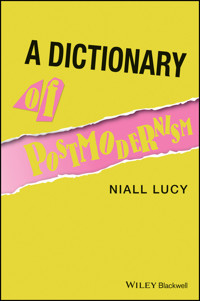
A Dictionary of Postmodernism presents an authoritative A-Z of the critical terms and central figures related to the origins and evolution of postmodernist theory and culture.
- Explores the names and ideas that have come to define the postmodern condition – from Baudrillard, Jameson, and Lyotard, to the concepts of deconstruction, meta-narrative, and simulation – alongside less canonical topics such as dialogue and punk
- Includes essays by the late Niall Lucy, a leading expert in postmodernism studies, and by other noted scholars who came together to complete and expand upon his last work
- Spans a kaleidoscope of postmodernism perspectives, addressing its lovers and haters; its movers and shakers such as Derrida; its origins in modernism and semiotics, and its outlook for the future
- Features a series of brief essays rather than fixed definitions of the key ideas and arguments
- Engaging and thought-provoking, this is at once a scholarly guide and enduring reference for the field
Sie lesen das E-Book in den Legimi-Apps auf:
Seitenzahl: 469
Veröffentlichungsjahr: 2015
Ähnliche




















Table of Contents
Cover
Title Page
Acknowledgments
Preface
Notes on contributors
Author
Contributors
Description
Introduction
Barthes, Roland:
Baudrillard, Jean:
Cultural studies:
Culture:
Deconstruction:
Deleuze, Gilles:
Derrida, Jacques:
Dialogue:
Differend:
Discourse:
Eco, Umberto:
Essence:
Foucault, Michel:
Globalization:
Habermas, Jürgen:
Hassan, Ihab:
Hyperreality:
Jameson, Fredric:
Jencks, Charles:
Lacan, Jacques:
Lyotard, Jean-François:
Metanarrative:
Minor(itarian):
Modernism:
Modernity:
New media:
Paraliterature:
Phrase:
Poststructuralism:
Punk:
Remix:
Representation:
Ronell, Avital:
Semiotics:
Simulation:
Situationism:
Sokal affair
Transcendental signified:
Truth:
Žižek, Slavoj:
References
Index
End User License Agreement
Guide
Cover
Table of Contents
Begin Reading
Pages
iii
iv
V
ix
x
xi
xii
xiii
xiv
xv
1
2
3
4
5
6
7
8
9
10
11
12
13
14
15
16
17
18
19
20
21
22
23
24
25
26
27
28
29
30
31
32
33
34
35
36
37
38
39
40
41
42
43
44
45
46
47
48
49
50
51
52
53
54
55
56
57
58
59
60
61
62
63
64
65
66
67
68
69
70
71
72
73
74
75
76
77
78
79
80
81
82
83
84
85
86
87
88
89
90
91
92
93
94
95
96
97
98
99
100
101
102
103
104
105
106
107
108
109
110
111
112
113
114
115
116
117
118
119
120
121
122
123
124
125
126
127
128
129
130
131
132
133
134
135
136
137
138
139
140
141
142
143
144
145
146
147
148
149
150
151
152
153
154
155
156
157
158
159
160
161
162
163
164
165
166
167
168
169
170
171
172
173
174
175
176
177
178
179
180
181
182
183
184
185
186
187
188
189
190
191
192
193
194
195
196
197
198
199
200
201
202
203
204
205
206
207
208
209
210
211
212
213
214
215
216
217
218
219
220
221
222
223
224
225
226
227
228
Preface
This book is something of a postmodern hybrid. It’s Niall Lucy’s book, imagined, planned and executed by him, but it’s also a collage, involving other writers. Niall wasn’t able to complete it, but he was keen to see it finished. At his request, the contributors – friends and colleagues of his – have undertaken that task on his behalf. We have sought to keep Niall’s project and his unique style in mind, but his mixture of erudition, wit, defiance and firm views on certain topics was all his own. An inevitable consequence of this is that our entries will sometimes reflect the contributor’s interests and opinions rather than Niall’s directly. Also, there are occasions when Niall has quoted work published by one of us. Thus, we have “signed” each entry, so that readers can avoid mistaking those passages for self-citation, or mistaking the parts he did not write for Niall’s own work. The book is laid out as an encyclopedia, with entries in alphabetical order. Each entry is a short essay. In most cases each one has been completed by a single hand (rather than by collective authorship), in order to preserve Niall’s characteristic mode of argument by example. The largest number of entries is by him, with the six contributors taking between four and six each.
The project has been a labour of love for all of us. This book is offered as Niall Lucy’s Dictionary of Postmodernism, but it’s also a Festschrift to him by a group of individuals whose lives and work have intersected with his, and in several cases with each other’s too. We’ve all enjoyed his company, benefited from knowing and arguing with him, and feel confident that you, dear reader, will do too. For this is a working book, designed for readers to use and enjoy, and to dispute where necessary. In order to do justice to what Niall was attempting, we have tried to do justice to the topic.
There are varying views on postmodernism. In his Postmodern Literary Theory (1997) Niall Lucy wrote that it could be seen as the outworking of a literary–philosophical tradition that goes back to the Romantic movement in Germany and elsewhere. Postmodernism was what happened when that tradition, including its critics, eventually abandoned the idea that there was something central and intrinsically valuable about literary texts, and began to apply its considerable analytical, emotional and political resources to the consideration of any text, in a universe of knowledge where, to the perceiving subject, everything presents as a text, including context (as Derrida famously remarked, il n'y a pas de hors-texte – roughly translatable as ‘con-text is everything’). Thus, postmodernism may be another way of discussing the historical experience, philosophy and practice of general textuality:
What was once the romantic space of the literary becomes, for postmodernism, a general plane of human existence, on which concepts of identity, origin and truth are seen as multiple and structureless assemblages rather than as grounds for understanding human “being” and culture … I think “postmodernism” refers to the generalization or flattening out of the romantic theory of literature, which marks it as a “radical” theory of the nonfoundational, structureless “structure” of truth. I do not think postmodernism is all that radical, in other words.
(Lucy, 1997: ix–x)
Postmodernism, therefore, poses historical, political, theoretical and even “romantic” problems. Here, we set out to explain some of them. But as Niall wrote in the Preface to his Derrida Dictionary, “this will not have been a dictionary.” Instead, as he put it: “My aim here has been to provide a series of outlines and interpretations of some … key ideas and arguments, rather than fixed definitions. I discuss these … within the widest context of Continental thought” (Lucy, 2004: xii).
Some of us may have strayed a little beyond the Continent in question. Niall had views about this. When he asked me to “see this through to publication,” he warned me that compromise was needed:
John, you’ll need to tighten up a little. This can’t be an opportunity to crack twee jokes, or to show that Lyotard and Barthes, say, know nothing about the world, which is best explained by a hard-nosed, street-smart approach. You have to pay at least some respect to theory and theorists, or this just won’t work. (email, 8 May 2014)
Having spent some instructive and informative time working on the book with all those concerned – Niall himself, co-contributors Robert Briggs, Claire Colebrook, Tony Thwaites, Darren Tofts and McKenzie Wark, as well as Sam Lucy-Stevenson, Niall’s wife and our colleague at Curtin University’s Centre for Culture and Technology – I can say that it has worked. We have paid every respect to theory and its all-too world-knowing theorists, perhaps with one or two hard-nosed street smarts thrown in. Watch out for the jokes though.
John Hartley, January 2015
Barthes, Roland:
French structuralist and poststructuralist thinker, critic, linguist and semiotician, 1915–80
Barthes’s career is an exemplary one for this book. In close to three decades, he moves through many of the main intellectual currents of his time and place, and does it in an often thoroughly idiosyncratic way. Though he does not often name his contemporaries, the debts and homages are obvious; his work is alive with theirs, echoing, taking up and playing with their ideas with the stylistic virtuosity that is Barthes’s signature.
Lesen Sie weiter in der vollständigen Ausgabe!
Lesen Sie weiter in der vollständigen Ausgabe!
Lesen Sie weiter in der vollständigen Ausgabe!
Lesen Sie weiter in der vollständigen Ausgabe!
Lesen Sie weiter in der vollständigen Ausgabe!
Lesen Sie weiter in der vollständigen Ausgabe!
Lesen Sie weiter in der vollständigen Ausgabe!
Lesen Sie weiter in der vollständigen Ausgabe!
Lesen Sie weiter in der vollständigen Ausgabe!
Lesen Sie weiter in der vollständigen Ausgabe!
Lesen Sie weiter in der vollständigen Ausgabe!
Lesen Sie weiter in der vollständigen Ausgabe!
Lesen Sie weiter in der vollständigen Ausgabe!
Lesen Sie weiter in der vollständigen Ausgabe!
Lesen Sie weiter in der vollständigen Ausgabe!
Lesen Sie weiter in der vollständigen Ausgabe!
Lesen Sie weiter in der vollständigen Ausgabe!
Lesen Sie weiter in der vollständigen Ausgabe!




